Cyclical payments began in June 1997. Previously, regular monthly payments were made only on the third of the month (or on the first prior business day when the third was not a business day). These payments continue to be made in certain circumstances and are called "cycle 1" payments.
Cycle 2, 3, and 4 payments are made on the second, third, and fourth Wednesdays, respectively, of each month. Such Wednesday payments generally are made to people who filed for benefits after May 1997, with the particular Wednesday dependent on a beneficiary's birthday. Beneficiaries whose birthdays are on or before the 10th of the month receive their benefits on the second Wednesday, those born on the 11th through the 20th receive theirs on the third Wednesday, and the rest receive theirs on the fourth Wednesday.
Cycle 1 payments apply in the case of beneficiaries who filed before June 1997, and continue to apply (regardless of filing date) to those who are current recipients of Supplemental Security Income (SSI) benefits or who reside in a foreign country.
The graph below shows the growth, by trust fund, of payment amounts made on the second through fourth Wednesdays of each month as a percentage of total cyclical benefits. Click on the graph for underlying data.
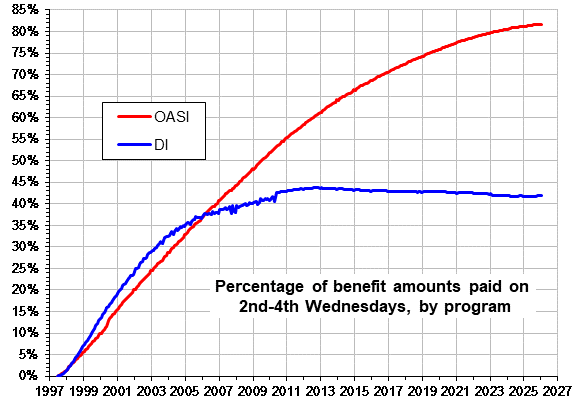
Compared to the OASI program, the DI program has faster turnover but a greater percentage of concurrent SSI beneficiaries. Thus one factor tends to cancel out the other one, and, as shown in the above graph, the growth in the percentage of beneficiaries receiving cycle 2, 3, and 4 payments by program (OASI versus DI) reflects these opposing forces.