Links
Visit the
Atlanta Region
Area Web sites
Search for your office's location
Region 4 Employment Opportunities
Benefits Information
Pension Plan
Newly appointed employees are covered by the Federal
Employees Retirement System (FERS) as Further Revised Annuity Employees
(FRAE), FERS-FRAE. This is a contributory three-tier plan
providing retirement income from a Federal pension, Social Security and a
Thrift Savings Plan (TSP). The first two components are defined benefit
plans. The FERS-FRAE retirement contributions, which equal 4.4% of your basic pay,
and the Social Security (FICA) tax contributions, is equal to 6.2% of your
basic pay, are automatically deducted from your bi-weekly pay.
The third
component, the TSP, is a voluntary defined contribution plan. This means an
employee's benefits depend upon the amount of their contributions.
Participation is voluntary, but TSP is a very important part of your
retirement under FERS. In order to have a comprehensive retirement plan TSP
must be considered as a major factor under FERS.
In addition to a
future retirement benefit, FERS provides disability coverage and survivor
benefits.
If you were employed by the Federal government in the past,
you may be covered by the Civil Service Retirement System (CSRS) or the CSRS
Offset system instead of FERS.
Thrift Savings Plan (TSP), Traditional and Roth contributions
The TSP is a retirement savings and investment plan
for Federal employees. The TSP is a defined contribution plan similar to the
401K plan offered in the private sector. Contributions are made by payroll
deduction.
The TSP is administered by the Federal Retirement Thrift
Investment Board and the Department of Interior Business Center (IBC).
For CSRS employees the TSP is a source of retirement income in addition to the regular CSRS annuity.
For FERS employees the TSP is one part of the three parts of the retirement package, along with the FERS Basic Annuity and Social Security. The money that is saved and earned through the TSP account will provide an important source of retirement income.
All newly hired employees (including reemployed
annuitants who are in a position covered under CSRS or FERS) will be
automatically enrolled into the Thrift Savings Plan (TSP) at a contribution
rate of 3% when they enter on duty, unless an employee makes their own TSP
contribution election. The contributions will be invested in the Government
Securities Investment (G) Fund until the employee makes a contribution
allocation with the TSP.
FERS employees will receive Agency
Contributions and Agency Automatic (1%) Contributions in the TSP account.
FERS employees are vested in an automatic 1-percent contribution made by the
agency after 3 years.
Employees are allowed to contribute up to the
IRS elective deferral limit each year.
Traditional contributions are
before-tax contributions to the TSP account that will be taxed when
withdrawn. This reduces the taxable pay and current overall tax bill.
Roth contributions are after-tax contributions to the TSP account that will be tax-free when withdrawn. The significance of Roth contributions is that the earnings are also tax-free when withdrawn (as long as IRS requirements are met).
Group Health Benefits Program
The Federal Employee’s Health Benefits (FEHB) insurance program is available to employees and their families for protection against the cost of illness and accident. Employees may select from a variety of plans, including fee-for-service, health maintenance organizations, and point-of-service plans based on the employee’s geographic location. The cost depends on the plan selected. The government pays a portion of the cost for health benefits premiums, usually about 70%. The premiums are deducted from the employee’s bi-weekly pay.
Annual Open Seasons are conducted each year which allow employees an opportunity to elect or make changes to their current coverage.
Group Life Insurance Program
The Federal Employees’ Group Life Insurance (FEGLI) Program provides group term life insurance for Federal employees and retirees, as well as many of their family members. As such, it does not build up any cash value or paid-up value. In most cases, a new Federal employee, is automatically covered by Basic life insurance with the convenience of payroll deductions unless the coverage is waived. The government pays one-third of the cost of the Basic Life Insurance. The employee pays the full cost of Optional Insurance, and the cost depends on age. FEGLI offers Basic coverage and several additional options:
Basic coverage: Equal to the employee’s salary rounded up to the next even thousand, plus two thousand dollars, and
Three types of Optional insurance:
- Option A – Standard, in the amount of $10,000;
- Option B – Additional, in an amount from one to five times the annual rate of basic pay after rounding the salary up to the next even $1,000;
- Option C – Family, one to five multiples of coverage for a spouse and all eligible children. Each multiple is equal to $5,000 in the death of a spouse and $2,500 in the death of an eligible child.
The Office of FEGLI, which is a private entity that has a contract with the Federal Government, processes and pays claims under the FEGLI Program.
Injury Compensation Plan
The Federal Employee’s Compensation Act (FECA) provides pay, medical care and assistance, including vocational rehabilitation and reemployment rights if an employee sustains a disabling injury while in the performance of official duties.
Pay
For most SSA jobs, employees are paid according to the General Schedule (GS) classification pay system.
- Salary Increases: Under the GS classification pay system, you are eligible to receive within-grade increases until you reach the highest step of your grade provided your performance is at the successful level and you have completed the required waiting period.
- Payroll Deductions: Deductions are made for Federal income tax, State and Local income taxes in some areas, Medicare and Social Security and/or retirement. You may also authorize deductions for life insurance, health benefits, and the Combined Federal Campaign.
- Direct Deposit of Salary Payments: The payroll office will send your salary directly to a bank or other financial institution for deposit in your checking and/or savings accounts. The Agency will no longer issue paper checks to employees.
- Payday: Every other Tuesday is designated as payday for SSA employees. Your salary payment will cover a 2-week pay period ending 10 days before payday. Employees can use Employee Express to view and print their Leave and Earnings Statements which show gross and net salary as well as the amount taken out for each payroll deduction. Although Tuesday is designated as the official payday, most employees will receive their net pay in their chosen direct deposit account on the Friday before payday Tuesday.
Work Schedule
Generally employees work a full-time schedule of 5 days a week, 8 hours a day. However, some employees work a part-time schedule from 16 to 32 hours a week.
- Alternative Work Schedule: Some SSA offices have alternatives to a fixed work schedule. These alternatives take two forms, with some variations - flextime with credit hours and compressed work schedules:
- Flextime refers to a variety of arrangements in which fixed times of arrival and departure are replaced by a working day composed of two different types of time - core time and flexible time. Core time is the designated period during which all employees must be present. Flexible time is designated as part of the schedule of working hours within which employees may choose their time of arrival and departure from the work site.
- Flextime with Credit Hours allows employees to work additional time after completing their normal workday provided they have advance approval from their supervisor. The additional time will be accrued for employees to use sometime in the future.
- Compressed Work Schedule allows employees to work eight 9-hour days, one 8-hour day and take one day off in a biweekly pay period or work four 10-hour days each week of the biweekly pay period.
Holidays
The Federal Government observes ten legal holidays.
Leave
Approved absence from work in the Federal government is called leave. All leave must be requested in 15-minute increments and approved by your supervisor. There are several types of leave:
- Annual leave is a paid absence from duty that you may use for vacations, rest and relaxation and periods of time off for personal business or emergencies. Leave is earned as follows:
Years of Federal Service Annual Leave Accumulated Less than 3 13 days a year 3 through 15 20 days a year 15 or more 26 days a year
For most full-time and part-time employees, the maximum annual leave that can be brought forward at the beginning of a new leave year is 30 days, or 240 hours.
- Sick Leave: Used for the following reasons:
- Illness;
- Receiving medical, dental, or optical examinations;
- Presenting a health threat due to exposure to communicable disease; or
- Involvement in adoption-related activities.
A limited amount of sick leave may be used to provide care for family members or for death of a family member. You earn 13 days of sick leave a year and it may accumulate without limit.
Training
On-the-job training is provided SSA-wide. It covers needed knowledge and skills; i.e., clerical, technical, professional, managerial, etc., in accordance with established management priorities and availability of funds.
Awards
You are eligible for honorary and monetary awards that are granted to recognize superior accomplishments.
Employee Assistance Program
SSA’s Employee Assistance Program (EAP) offers counseling services to help employees with career-related concerns, family, legal, and financial issues, and other aspects of employee wellness. SSA’s EAP also provides employees referrals for child care and elder care services and offers an array of work-life educational programs. Additionally, SSA’s EAP offers consultation services and supervisory training to members of management.
Child Care Centers
In SSA’s Atlanta Region, there are nine child care centers located on federal properties, giving numerous SSA employees either onsite- OR nearby-access to high-quality, affordable child care services. Each of the nine child care centers are designed with children in mind and are equipped with child-appropriate furnishings and facilities. Also, each center has either received or is in vigorous pursuit of completing national accreditation through the National Association for the Education of Young Children.
In addition, SSA’s Employee Assistance Program (EAP) can provide employees referrals to other quality child care centers and child care-related services in employees’ local communities.
Elder Care Resources
Recognizing that employees are (or may become) caregivers of aged loved ones, SSA acquaints employees with the various issues involved in elder care. SSA’s Employee Assistance Program (EAP) can also connect employees with community resources and services that can help them meet their loved ones’ care needs.
Access to Fitness Centers
SSA has a fitness referral program that allows
employees and their eligible family members the opportunity to join select,
commercial fitness centers at substantially-reduced rates.
Also, depending on your work location, you may have access to an affordable, onsite fitness center.
Related Information
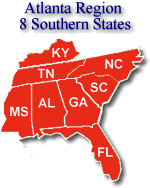
Alabama
Florida
Georgia
Kentucky
Mississippi
North Carolina
South Carolina
Tennessee