Oral Histories
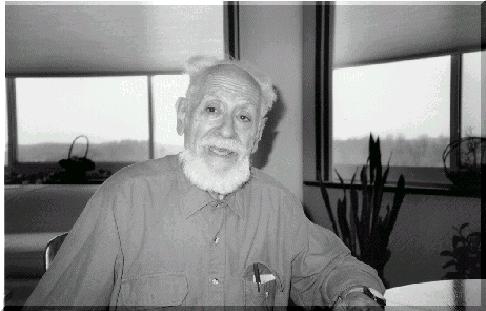
Isadore Herbert "Herb" Borgen
 |
Soundclip from Borgen interview. (Concerning the war-time Civilian War Benefits program--a little-known precursor to Social Security disability. [In RealAudio format] |
Photo Gallery
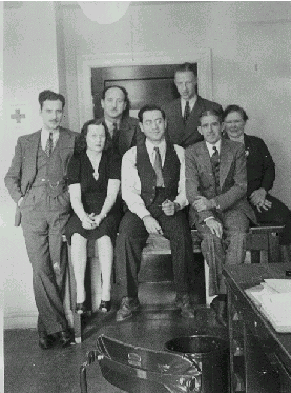
Herb Borgen, seated center, circa 1938, with a Claims Policy Unit, in Washington, D.C.SSA History Archives.
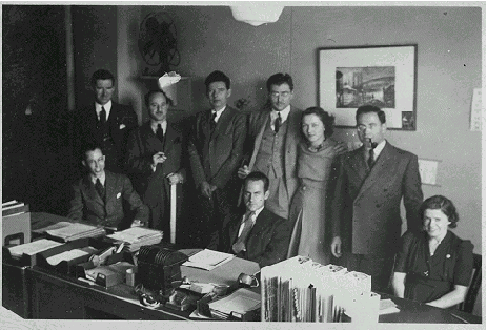
Herb Borgen (standing right), with the some of the Region II Review Staff, BOASI, circa 1941. SSA History Archives.
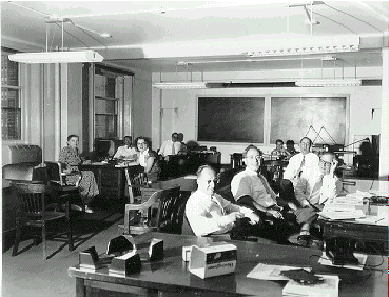
Herb Borgen with the Central Disability Planning Staff in the summer of 1952. The staff was located in room 826 of the Equitable Building in downtown Baltimore. Also shown, left to right): Lois Garvin; Lorraine Hejl; Ed Mueller; Art Hess; Gus Meyers; Herb Borgen; Shirley Winner; Jim Calhoon; Dr. Carl Rice. SSA History Archives.
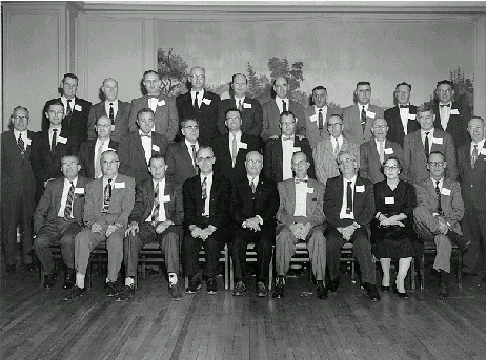
Herb Borgen is seen fifth from left in the middle row at this State Agencies Conference in Newport, Rhode Island, December, 1957. SSA History Archives.
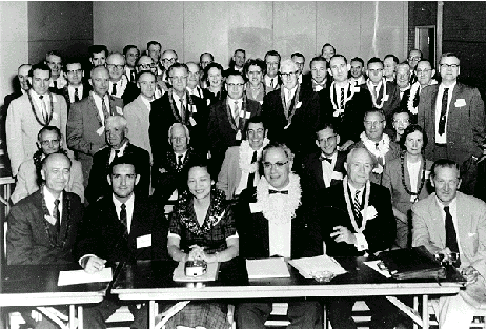
Herb Borgen, fourth from left, front row, at BOASI Conference in Salt Lake City, Utah, September 1959. SSA History Archives.
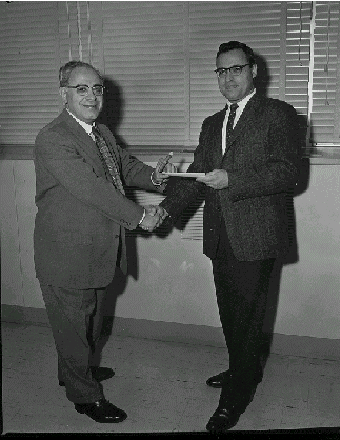
Herb Borgen with Mendel Kaufman, 3/27/61. SSA History Archives.
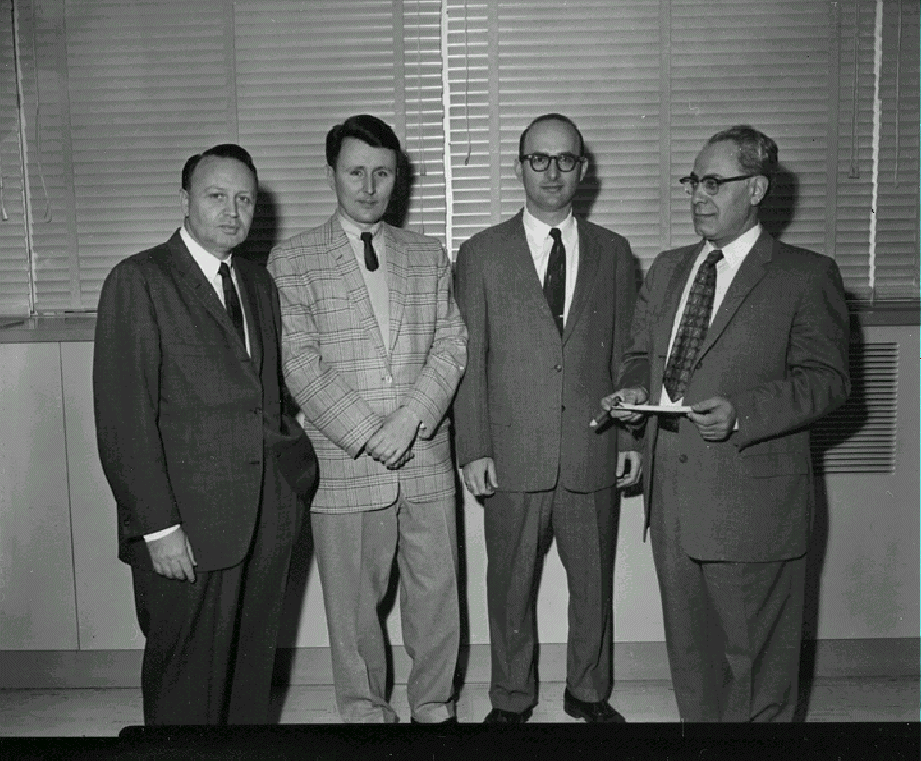
Herb Borgen with, left to right: Roy Carmel; Neal Purnis and Isidore Brauner. SSA History Archives.
Herb Borgen Oral History Interview
This is an interview in the SSA Oral History Series. The interviewee is Herb Borgen. The interviewer is Larry DeWitt, SSA Historian. The interviews took place on 4/3/96; 5/15/96; and 5/29/96, at Mr. Borgen's home in Baltimore, Maryland. The interviewer's questions and any editorial comments appear in italics. Mr. Borgen was given an opportunity to review and edit the raw transcript.
Q: Herb, what I'd like you to start with is just by telling us how it is you came to work for SSA. What was your first job and what were the circumstances of you coming here for the first time?
Borgen: That's a long story in itself.
Q: That's alright. I've got lots of tape.
Borgen: I was in law school--Columbia. I was sick; I lost a year. I got out in 1934, which was not a very good year, especially for rather poor guys who managed to get through school.
The Department of Justice had an arm known as the FBI, the Federal Bureau of Investigation, which was the only bureau which separated itself from the Department of which it was a constituent. They were the Federal Bureau of Investigation. J. Edgar Hoover was the guy who ran his little empire, and he advertised--I don't remember where-- "Lawyers and law school graduates to apply for a civil service exam. Fingerprint Classifier." I took it; I got the job. It was down in Washington. That was in 1934.
Right out of school I went down and I didn't take the bar exam or anything, just packed up and went. That meant three meals a day and a roof, and so forth, and more or less, independence. Salary was $1,440 a year, payable every 2 weeks. Washington was a very different city in those days. Roosevelt was in...do you want me to go through this stuff?
Q: Yes, please. Absolutely.
Borgen: It was a southern city. Congress had been a southern stronghold and the southern Representatives and Senators, and the municipal government, and everything, was southern.
Well, I found myself a room. All the houses down along Pennsylvania Avenue, E Street, F Street, D Street and about 20th and 21st Street NW--there were small homes. A lot of civil servants from way back lived with their families and they had extra rooms that they rented out. With Roosevelt a whole flock of new people were coming in. The city was teaming with young people and it was a great new world.
Of course Fingerprint Classifier wasn't going to be contributing very much to that, but the atmosphere was charged. Working with me were a whole flock of people--lawyers, brokers, Ph.Ds who had been in the field of education--all sorts of people from all over the country. In those days civil service was apportioned among the states depending on representation, and in each state a certain quota, you might say, were selected from the exams. It might still be working--I don't know. So there were people from all over the country and in the place where I lived, Lou Zawatzky and a number of other guys I can't think of, we had rooms. We lived there and we ate out. My budget was $1 a day for food, and that was ample. It was amazing. Dinner across the street from the old State, War and Navy building, which is now one of the executive offices right next to White House on 17th Street, there was this restaurant (the name escapes me)--dinner, white table cloth, full course, desert, tip and all--60 cents! So we survived. It was ok.
The working conditions at Fingerprint Classifying were--everybody was overeducated, over-experienced, under-classified...
Q: It sounds like a clerical job in some ways.
Borgen: Fingerprint Classifier? You may have seen those fingerprint cards at the post offices or something. Well, every civil service applicant filed one, and all the police departments in all the states sent in their files. A variety of reasons for filing.
First of all you, have to classify the print. You have to find some system for identifying groups, and then reducing them to a small group, and then you check it with your glass and make the necessary identification. What in the hell you needed a law student for, I don't know.
Q: Right. Ok.
Borgen: But that was the claim. You had to make an identification which could stand up in court. Actually anybody with eyes could do it.
It was a very interesting place. I ran into trouble there. I had been suffering from constipation all my life so I used to have to spend a lot of time in the men's room, comparatively, and when I was in the men's room I did my business, but in the men's room is where all the guys got together to discuss football scores and how they were going to bet and so forth, and who was your bookie. And there were public telephones and they would go to the public telephones and place their bets. That was rampant. That was not my type because I don't follow any of these sports and I'm not a gambler. I was in the bathroom and they would watch (Hoover had his men out) the amount of time you spent in the washrooms. There was a staff meeting and we got bawled out. I raised my hand. "I go to the bathroom because it's the call of nature--I have to go. I have nothing to do with this other stuff." "Borgen, the more you talk, the worse it will be."
When celebrities would come, Hollywood people and so forth, everybody had to dress up specially and Hoover would parade the people around.
Occasionally I'd be sick (rarely); I'd be in my little room there in summer, sweltering...
Q: No air conditioning.
Borgen: Come on. No fan even. You just opened the window. I called in sick and at one point there's a knock on the door--a nurse from the Department of Justice. I said, "Oh good. Somebody who can help me a little. I was feeling lousy." "We were just checking to make sure you were really sick." OK, that's a great help. And another time I had little blisters on my hand. I went to see the nurse. She said, "Oh, that could be very contagious. Go out. Don't touch anything. Go to the doctor." I went to the doctor. He says, "Do you want to take a vacation?" I said, "Well I could go to New York for a couple of days." He says, "Go out and come back to work in a couple of days." I did. At that time the doctor (most of the guys used him)--he was the physician for the Washington baseball team, a fat jovial guy.
And at one time the Attorney General, Homer Cummings, met with the Department of Justice people including the FBI. "I also work here," he said--because J. Edgar Hoover was practically his boss!
Later on some of the guys decided--there was this legislation and activity about forming unions, organizing civil servants. I come from a fairly liberal background and I figured, well, it's my duty. I should join. I joined. Some of my friends didn't. Some of them whose parents and relatives had been organizers of the AFL (the American Federation of Labor)--they were afraid. I and some others joined and then the boom began to be lowered. One of the guys who worked with us had a son who was a problem case. He would never amount to anything, his nerves were all shot, so his father, who worked for the FBI, would never have anything--only expenses. He was the first one who was invited to resign. And then, one by one, the members of the union were forced out.
Q: Now what did they say to you? What grounds did they use? I mean did they just tell you that they wanted you out because you were a member of the Union, or did they have to find some pretext.
Borgen: No. No. Oh no. I was told that I wasted too much time. I don't remember what else, if anything.
Q: Now this was a mass thing. A lot of people lost their jobs.
Borgen: Many, many of them...
Q: And they ended up at Social Security.
Borgen: Yes, at Social Security.
Q: Which is very interesting. . .
Borgen: Oh yeah. . .
Q: Because I've seen in the history files these job applications from people who used to have jobs as Fingerprint Classifiers--they all came at the same time.
Borgen: Approximately. Because we were kicked out one at a time. Norman Milburn, was a personnel man then, and of course I went to him and I wanted a transfer. He knew my story. He said, "Sure. Come on over. We'd love to have you."
Q: Now, he was at SSA?
Borgen: Social Security, yes--BOAI, this was before survivors insurance. They were recruiting for the Accounting Operations staff. I am now talking about September or August of '36, somewhere around there.
Prior to that--Oh here's another thing that didn't win me favor in the FBI. I took the exam for Special Agent. A Special Agent was a high salary guy--$5,000 a year.
Q: You were going to be an FBI agent?
Borgen: Yeah. You had to be a lawyer or an accountant. Some of the guys had got together who had just gotten out of school and we felt we ought to take the Bar. Some of them were members of the Bar in their home states but I hadn't taken it. I just graduated from school and I figured I didn't need the Bar. I'm never going to get anywhere in the law profession. You can't visualize the situation, in the 1930s during the Depression. The idea of my being able to make a living, when I had this sure salary with a retirement and all. I was persuaded. I took the Bar. I passed the Bar so I was a lawyer and I think the FBI required you to be a lawyer and a member of the Bar to be Special Agent.
Q: So you applied to be a Special Agent? What happened?
Borgen: They gave exams. I took the exam. I thought I did pretty well, but I didn't make it. I got a letter saying I didn't make it. Try again. I wrote Mr. Hoover a letter in effect saying, "Don't kid me. No use in my trying again. You're not going to appoint me anyway, for a number of reasons." I didn't think I mentioned them, but that was the tone of the letter. In fact I'm sure that didn't sit well with him. My implication was "Brother, you are a bum." That's what I was telling him. I didn't trust his invitation to take the exam again. I wasn't going to be a Special Agent if he could help it.
And then I ended up with coming to Social Security. I had all that added incentive, plus the FBI request to please depart and close the door behind you. And at OAI I met a lot of the guys from the FBI who were already working there. I was assigned to the Correspondence Unit.
Q: Now did this job at SSA pay more or was it just people who were being pressured?
Borgen: Some just wanted out of the FBI in any way. Some of the guys who didn't join the union--they left on their own. They were not forced out.
Q: I've seen files on dozens and dozens of people who came over from the FBI, from this job that you had.
Borgen: And thereafter, when Social Security appropriations were up before the committees in Congress, Hoover had his man there with some proviso. None of this money shall be spent for the salaries of any of these guys who were radicals, communists, or lord knows what. But the Bureau of Old-Age Insurance was fairly liberal, and they knew what they were doing. They hired us and I think we made Social Security pretty much what it was as intended by the legislation. We got it going.
Q: So late 1936 you came over and interviewed with SSA and they offered you a job in Accounting Operations.
Borgen: Yes. Well that was before the account numbers, they were recruiting to set up in the Candler Building all those large accounting operations--punch-card operators, and everything. I heard that it was supposed to be the largest single recruitment in the history of the federal civil service, to put Social Security in the Candler Building. Thousands were hired. I was assigned to the Correspondence Unit, to answer inquiries and all that sort of stuff. There was a whole staff in DAO for this.
Q: You were in the Candler Building?
Borgen: In the Candler Building. I knew an awful lot of young people in the Candler Building. My wife was recruited from her civil service exam. She took a statistics exam and she got in and what she did was classifying, with a lot of others, when they set up the records, the punch-cards and so forth, and identification, the SS5s and all that, the employer identification numbers and so forth.
Q: Had you lived in Baltimore before that?
Borgen: No.
Q: So this is all new. This is the first time you had come to Baltimore.
Borgen: Yes. I was living in Washington, and I had to move to Baltimore. They told me to report to Market Place. The night before I packed up my suitcase with all my belongings, came to Baltimore. It was pouring cats and dogs and at the station (B&O Station) I took a cab. I wanted to go to Market Place, wherever that was. Oh, no. I wanted to go to a hotel near, very close to Market Place. I didn't know Market Place from a hole in the ground. The cab took me there. It was the Hotel Louie in the Block. (Editor's note: The Block is a notorious section of downtown Baltimore famous for its "adult entertainment.") That night was a restless night. But I slept.
The next morning I went down to the Candler Building and signed in and got my place and I moved out of the Hotel Louie and moved to the Knights of Columbus. The Knights of Columbus also had rooms for rent. It was a decent place in mid-town, and I lived there for a long time, until I got to know the city, and then I moved up to North Avenue near Druid Hill Park. I think it was 800 West on North Avenue.
BOAI was bringing in so many kids, housing them got to be a real problem. And there my ties with the Union got kind of tenuous. Of course I was very much impressed by the Personnel Office, and the others, and I thought they were fine people and they were doing a swell job. Some of the other guys, I suspect, were really left wingers and those were the days when there was a lot of boring from within--Fellow Travelers, and all that.
Q: There was a lot of sentiment in favor of communism at that period. It was almost a mainstream sentiment.
Borgen: Right. All the college kids--this was the way to go. The people I mostly associated with were Norman Thomas followers--Eugene Debbs, Norman Thomas types. The communists had no use for us. We were fools or fakers because the real way to get heaven on Earth was through the communist principles, and we were socialist types fooling the people and so forth, or we were fakers. The conflict was great.
Q: Now while we're on this subject of the political climate, how would you characterize SSA as an organization? You alluded earlier that it was a fairly liberal sort of a place, that it had a political orientation that was liberal. Is that a fair description?
Borgen: I think so. I think Roosevelt really reflected the sentiment of most of the people, of most of my friends anyway, and the general attitude reflected that. It was sympathetic to labor and organizing and getting a fair wage, getting employment--all the things that Social Security was going to do. This was a great place. Morale was sky high. Everybody was doing his best.
But of course some thought it wasn't good enough, and I used to have long talks with those guys--the real left wingers and I would clash. We would take long walks and I would try to persuade them, and they would try to persuade me, and these were mostly within the union. One of the guys (a very bright young fellow, Bernie Schultz, fat boy, round face, very bright--also CCNY, I was CCNY too) came to me one day in my room and he said, "Herb, I've been invited to join the Communist Party. What should I do?" I said, "Bernie, they'll kick you out so fast you won't know what hit you." He was a very independent guy. He was a good man. Bright and intelligent and imaginative and he had his own ideas. I said, "Bernie, that's a party of discipline. You wouldn't be able to stand them." And I knew from experience because I was always arguing with them. They were nice guys, but they were misled or something. I couldn't understand their mentality. We were all working for a goal, with Social Security, for the betterment of people in general. But they went their way and the socialists went the other way. Roosevelt was closer, I would say, to the socialists and farther from the communists than even the socialists--and that was the prevailing spirit.
Q: So the people who worked at SSA in those early days had a sense of a mission and a sense of the importance of what you were doing?
Borgen: Strong. A strong sense.
Q: They were philosophically committed to it, is that right?
Borgen: Yes. But Bernie got into trouble. I think Bernie--I don't know what happened, whether he joined or not. But I do know that within the union, when there was trouble, for instance, in Spain and the Soviets were organizing, some of these guys with whom I was in constant argument, they'd hold a meeting on events in my apartment. We were like an executive committee, self appointed. Leaders, you might say. These guys wanted to pass a resolution--by the union group in the Candler Building--to support Russia or the Russian position. It was stupid. But generally they would prevail in the debates due to their force and their discipline and their energy. But most people liked the idea of Social Security--at least we thought so. But they didn't drive; they didn't have the push. I'm talking in general--not the employees. The employees were ok for Social Security.
Some of these guys met with their fate later on. I never heard any more from Bernie. Oh, Bernie got into trouble. He was one of the brightest guys I knew. His assignment was pulling paper clips and Bernie couldn't do that all day, and he managed to get into trouble. So he was brought up on charges. They were going to fire him. Actually he was breaking the rules. And he was defended and they had hearings in the Candler Building and so forth. I don't know. He transferred out. I think he went to work for the Civil Service Commission, where his brother was already there as an examiner. I heard no more about it.
Years later (I was married and had a child and so forth) an FBI guy turns up. Do I know Joe? Yes, I know Joe. How well did I know him? Did I ever visit him at his home? Does he visit in my home, etc., etc.? I told him what I knew about Joe.
Q: Now this was in the '40s or the '50s?
Borgen: In the '40s.
Q: Ok. Before the war, during the war?
Borgen: It must have been. . .well...I skipped a couple of steps in between.
Q: We'll come back. So they were investigating these guys because they were Communists or Communist sympathizers or something. That's the idea?
Borgen: Right.
Q: Alright. Let me ask you just about the Candler Building.
Borgen: Let me just finish this story. There's a quick conclusion. I called this guy Joe. "I was interviewed about you." I told him what I said. He thanked me. The next morning I went to work. He had resigned. He went to work in a carpet factory or something. He had come out of the FBI. I knew him from the FBI. I knew his position. I didn't think he was going to overturn the government and I kept arguing with him to try to get him to see the light, that he was so far off. We would discuss current events and differ on them and I felt an obligation to tell him. I told him. Some of the guys who came over to OAI were that way. Others were afraid, I think afraid, where they figured they'd get ahead faster if they didn't join the Union. They came over. Others came over at the invitation of Mr. Hoover and so on, and that was quite a group. Now, where am I?
Q: Tell me a little bit about the Candler Building, what it was like. Did we occupy the whole building or just some of the floors?
Borgen: No. Some of the floors. I believe it was some of the upper floors.
Q: It must have been a huge operation though.
Borgen: Yes. All the Social Security account number cards were filed there, etc. At first there were no monthly payments, just lump-sum payments. The original Social Security Act was a very short little piece of paper. If a guy died and he had made his contributions, you see contributions began in '37, and he died before the effective date for monthly benefits, his estate had a right to a return. Tricky. We followed the laws of the state in which the guy was domiciled, a resident. That's quite a few states. The estate, the widow or the administrator, would file a claim. So there had to be claims forms and a whole procedure and there had to be adjudicators. During that period when we were making benefit payments, you might say, lump sum payments of 10 cents, 65 cents, big payments, but in that period we were developing our concepts and our legal procedures of how to handle these things.
Q: How to take a claim, how to process a claim.
Borgen: And everything had to go through the General Accounting Office, every form and so forth. We had the award forms that were about this long. We must have had about 15 or 20 items on it--the earnings, the name, the address, the beneficiary, the computation. And often, for instance, if the name on the SS-5 was Joe A. Bloke and the death certificate said Joe Adam Bloke, you had to make a finding, a special finding. Joe Adam Bloke and Joe A. Bloke are identical, by hand, hand-printed in triplicate--time consuming, oh. (This applied also to denial decisions.)
Q: Everything was by hand, right?
Borgen: Oh, everything was by hand. This was after I got out of the Correspondence Unit...
Q: Now that's what you did in the Correspondence Unit?
Borgen: No. No. That was before. The Correspondence Unit was when cards were first being assigned, when account numbers were first being assigned and people were raising questions.
Q: Ok. What kind of questions would they be asking?
Borgen: Who remembers? But we were foolish. We were kids. Inexperienced, is the correct word. All of us with college degrees, writing letters and--we used sesquipedalian words. So we had to be turned around--it got to be a real problem. Years later...
Q: So you could write in a simple language?
Borgen: Yes. So we had to learn to write in a simple language, so you could understand it. Don't try to show how smart you are, and don't be too damn technical. Later on, in Washington at the 18th & H Street Building, John J. Corson (he was great at reviewing the correspondence), he reviewed almost everything. At that time I wasn't in Correspondence, but I knew what was going on. He said, "Stuff should be written so that the newsboy downstairs in the building at Social Security, a guy 12 years old, could understand it. Bring it down to his level." That was a continuing struggle.
Q: Ok. So you worked in the Correspondence Unit...
Borgen: Then I transferred to--I transferred and a whole flock of others--into Adjudication.
Q: Now were the records on those big ledger sheets and stuff? Tell me about that.
Borgen: I don't know. I wasn't involved with that, although we had to use them to adjudicate the cases. I was in Correspondence and then I was in Adjudication.
Q: Alright. Tell me what you did.
Borgen: We were broken down by regions. This group handled all the claims coming from Region II, and so forth. Essentially it was fairly routine, going over these papers, and filling out these forms. And then the volume increased and we were moved to Washington.
Q: The Adjudication Unit.
Borgen: The Adjudication Unit, including all the regional groups.
Q: Do you remember what year that was?
Borgen: No.
Q: Ok, so the Adjudication Unit was relocated to Washington.
Borgen: To Washington.
Q: Because they needed space in the Candler Building or...?
Borgen: No, I don't think so. It could have been that, I suppose--I really don't recall. They could have found places in other parts of Baltimore.
Q: The administrative headquarters had been in the Washington all the time. Accounting Operations was in the Candler Building. So did you move back into the building where the rest of the Headquarters was or into a different building?
Borgen: No, a different building. We moved into an altered old apartment house, pretty far south of Constitution Avenue. Right near a very big apartment house, a big, very fancy, apartment house that was used as an apartment house, which was later bombed down. And that site became the State Department building. Back then, it was the residence of a lot of the guys who were working in Adjudication, and where we were working was just a block or two south of that. But we were just a few blocks from other SSB divisions.
Lou Lang headed Claims Policy. Now I headed a little group of--I'm talking now about 1939, after the '39 amendments. We were paying substantial amounts now. George Keating headed the region, the Adjudicative region. We were broken up into units. I had one of the units. There were ten or so adjudicators and then I had--I gave you the picture of my reviewers--Tom Parrot was one of the guys, and I headed that group. Lou Lang, Mercia Leton, and a couple of others were working on Claims Policy.
Q: Ok.
Borgen: We had a lot "fun" interpreting the rules that we were following. I received a card, I don't know why or how, from some congressman, maybe a New York congressman--in those days I voted in New York on absentee ballot because I was still a New York resident. They were going to hold a hearing in the committee (I forget which committee) and I was invited to attend as a witness if I wanted to come. I discussed that with Lou Lang. Lou Lang headed the Policy group and I told him, "Lou, my feeling is that we're wasting a lot of time filling out these damn forms. If we've approved the application you can simply get a simple form to indicate you approved it, stamp it, sign it and out it goes. You don't need all this massaging."
Q: These forms were kind of like a record of all the decisions that had already been made on the claim? Is that correct?
Borgen: No. This was the allowance decision, with all the required findings on which it was based. This allowance decision went to some Payment Center for processing and it got entered into the Treasury Department on the rolls. It went from here to the rolls--benefit rolls. Lou Lang taught me something. I was learning, actually, all along. If I had the knowledge and experience that I have now back then I would have been able to do better. You know what he says to me (when I told him about this idea, the simple form, you know), "But you know what that would mean to the size of the staff?"
Q: So he didn't want to do it?
Borgen: No. No. He didn't...He put it a little more forcefully. "And you know what we would do to you if that's what you do to us?"
Q: So he didn't want you to go to the hearing and suggest that?
Borgen: I did not go.
Q: How did you get an invitation to the hearing?
Borgen: I don't know.
Q: And that's the kind of thing they wanted to find out?
Borgen: I don't know. They were going to discuss Social Security, what aspect I don't know. I don't know, but I thought I had a great idea to simplify things. Like the idea in these recent days, the post card IRS income tax form.
Q: So after the '39 amendments passed and we started paying monthly benefits in 1940 I assume the volume of these cases picked up quite a bit.
Borgen: Oh, let me tell you another experience. With the 1939 amendments we had already decentralized considerably. I think the Payment Centers had already moved out. At any rate, it was decided that the central office people who are writing the rules--I didn't do claims policy initially, eventually I did. From Adjudication I went to into Claims Policy and there we had to write the rules, various rules. At various points I was involved with the rules on parents' dependency, proof of age, a whole flock of burning issues and that's where I worked with Gus Myers and a whole flock of other guys, great guys. We developed the procedures. So along comes somebody from on top, from the clouds, and says the field people are unhappy. They think the nuts in central office don't know what is going on. They ought to get their feet wet.
So from time to time we were sent out to work a day or so at the field office. I landed in Harlem. It was just a wonderful experience. It really was meaningful. I would say that one of the many wise things Social Security did was to get the central office people in the ivory tower to get down to the grass roots and see how things work and what the problems are. And did I see problems.
For one thing there's a racial problem. I had no problem. At one point the Claims Policy Division, Ewell Bartlett, was thinking of recruiting a black man to work in Claims Policy and he asked me, he says, "I know you guys are liberal and so forth. How would you feel if I hired him." I said, "Fine. No problem."
There I was in Harlem and I was told the field rep would go out to make contacts for Social Security numbers, to answer questions and explain things. I was advised to be very careful. In Harlem if they think you're an investigator, a welfare investigator or something like that, you might get hurt, so I was cautioned. Nothing ever happened. Nothing to support those fears, but I think it's interesting. That was the perception among all the field people, the Social Security people in the field office--Social Security employees. I was white, and I think there may have been some other white guys there, but we were told to be careful even going in the streets there.
A crowd of women came in at one point. They're going to apply for Social Security numbers. They're giggling and laughing, and I asked them "where's your employer?" "Over there. In that building over there." More laughter. I asked one of the guys what was going on. He said, "That's a whorehouse."
Q: And they wanted account numbers for their employment?
Borgen: Right. We gave them account numbers. They were treated like anyone else. But I was just surprised. I mean it was a novel experience.
I had another similar experience. An old lady comes in. She wants to know about her earnings record. The field office had send out a request and received the information. She came in for an explanation. She said, "Why is it that in the first two halves (they used to report earnings semi-annually) I got so much and then after a while it stopped all together, but I've been working steadily, I've been doing the same thing." I said, "Well, that's a fine howdy do. I can't explain that. Let's go talk to your employer." This was around my school on 116 th Street. Columbia University. I went to law school at Columbia. Columbia had a very famous School of Journalism, among other things. In that area there were a number of real fancy homes that were no longer being used as single family homes. People were renting rooms. So students would have rooms there. She worked in one of those houses. So I went with one of the staff people, a black man. I knocked on the door and a lady comes and looks, sees my colleague, shuts the door and goes right back. Then she comes back with the mistress of the house, she opens the door and gives us a sour look. "Come on in. What do you want?" "We were wondering about the earnings reports." "I've taken care of that. You guys, Internal Revenue have all been here. The state revenue people have been here. I've explained it all." I said, "We'd like to discuss it with you." We go in. She says, "Sit here." We sit and I see where I'm sitting, it's a room about living room size. There's a bookcase and I think there was a piano there. From what I could see it was a piano and the lady explained. "My brother is a Wall street lawyer and he has incorporated us as a charitable institution, exempt from Social Security taxes. And that's why I stopped paying Social Security taxes."
Q: So this was her maid or her housekeeper or something?
Borden: Yes. This was her servant.
Q: And she stopped paying taxes?
Borden: Yes. So I asked, "So far as I know she's doing the same work, what's the nature of the change?" "Oh, we have quarters for impoverished southern ladies. This is just for women who want to stay here and they can't afford it; we have a room for them. We give them a room. We also provide theater tickets." I knew about the theater tickets because in the summertime I'd get a summer job at the theaters during the Depression (we were in pretty bad shape) and a lot of tickets were handed out to fill the seats. So she'd get a lot of these tickets and she'd hand them out with no charge. And those kids could have gotten them on their own. "And there's a piano provided for them in which they can practice, and I have a library and they can borrow the books, and we're a charitable organization and it's been approved." So we say, "Well, where does your brother work?" "Downtown." "Ok. Thank you."
And off we go. I excused myself from Harlem. I said, "I'm going down to the downtown office." I went to the downtown office. I get one of those guys (you dealt with one of the field reps). I go with one of the field reps. We go into this law office, a real swanky place. We ask for this guy and he comes around and says, "Yes. This is what it is and we've gotten the New York state approval," it is a charitable institution. That's it." "Ok," I said. "I have all the information I need."
Eventually when I got back--we had a Coverage Section in Policy. I said, "Can we get after these guys?" Our policy had gotten to be that if the employee could establish that she was paid a salary, and we were satisfied that the place was covered, they get the benefits even if it did not appear on the wage record --we treated it like a correction. But if this is a non-covered unit, how do we work this out? Well they have to work this out with IRS, and they were very unhappy in the Coverage Section. They got a few of these, quite a few of these. Internal Revenue was not very cooperative because what they would have to do is spend a lot of time and manpower to collect a few cents. They wanted to go after the big guys. I said, "But this is an injustice. This gal's retirement is threatened. She's an older woman and she's going to retire." Well they worked on it and they worked on it and I kept after them. Did they do it? Did they do it? A long time later, Internal Revenue got it straightened out. She was going to pay the tax. They were not exempt. So that was the sort of thing that you couldn't forget.
One other story. I went out with a Claims Rep into Harlem for a claimant. He was retired, an old man in Harlem. We go up to this poor apartment. Spotless. Clean. A very nice old guy, real old, handicapped and so forth. He applied for retirement benefits, and also for the wife's benefit. "Where's your wife?" "In bed." She was bed-ridden. We went to see them--black people. And the Claims Rep began taking the application from her. At one point he asked, "Were you previously married?" If she said she was previously married, of course after that you'd have to say, "What happened?" He asked the question, and there was silence and discomfort. The air got a little sticky. He wrote "No" on the application. Then we went along and I said to myself, well, that's life. I knew from experience that those who said "Yes," and then had to show that they were legally divorced had problems, a lot of the people down in the south, they didn't know from legal divorces. They thought if you jumped over a barrel or you went under the moon or something like that, you were legally divorced. They would never have been able to establish it. I thought that was fine.
We had similar problems all over--proof of age, proof of parents' dependency. I did a study on proof of parents' dependency. Often if the parent was on a farm and a large part of his income was from his horses and his cattle, his dairy, his milk and so forth, it was hard to say what was the wage earner's contribution. The guy supplied, among other things, he would supply some of the feed for the cattle. We had to figure out whether more then 50% of the man's support came from the child. How much feed did he supply for the cattle? That sort of stuff. It got to be...if you were going to play by the book, you're going to be ridiculous. If you're going to insist on dotting each "I" it would be impossible. But if you're going to relax it too much, it would be giving the government's money away. So it was hard. I learned a lot, and I suppose a lot of others did too. I'm mentioning these because I suspect my experience could not have been very different from that of many others.
So, I was in Claims Policy, and then I'm working on guardianship and so forth. We had the problem, when you're paying somebody and somebody's incompetent, whether it's a child or Alzheimer's or what have you, how do you do it. Well, we developed rules on guardianship. We insisted on guardianship. How enforced that ever was I don't know. But we would insist that the payment was made to the guardian on behalf of so and so. Supervision of those things was questionable.
Well a lot of things in between. The war came and the guys began to be drafted and some of them went off and never came back and some of them were very unhappy with military life. I remember one of the guys who came back after the war and was assigned to the Chicago Payment Center. One day he didn't show up and he was very unhappy. They went to his apartment to see what happened. He hung himself. He committed suicide. There's a lot of stuff in guys coming back. But there was also a lot of talk about disability. Well before that, before disability... Let me see, what do I have here. Civilian war benefits...
Q: Yes. Tell me about that. Tell me what that was about.
Borgen: Well, the President was given emergency funds. He allocated, I think it was about $5 million, to the Federal Security Agency to set up provisions for air raid wardens, auxiliary policemen, auxiliary firemen, civil air patrol and that sort of stuff--people injured in the performance of their duties. And for the widows and so forth if they were killed, and for the payment of their medical care, because the Public Health Service was also part of the Federal Security Agency. I did not set up the office. I don't think I was involved in that. I just don't remember how it happened. My involvement was just on the periphery, I suppose.
We established a joint office, familiarly known as "the joint," in the Equitable building on the top floor. And we wrote up procedures and policies together with physicians detailed to us from the Public Health Service--Thomas B. McKnealy and Dean Clark. Wonderful guys. We agreed that questions of eligibility would be OASI's job, Milt Mayer, Gus Myers, and me, and we had a staff. Mostly we were writing procedures and forms and stuff and working with these two doctors as to how we were going to actually operate.
Q: Now were these benefits that we paid under the regular title II program or this was...
Borgen: Out of the emergency fund allocated by the President. I don't know if Congress even knew about it.
Q: Ok. So this was a different benefit program, a temporary war benefit program.
Borgen: Temporary Civilian War Benefits.
Q: And the eligibility for these benefits was similar to Social Security or had no connection?
Borgen: No connection.
Q: Ok. But you all were in the Federal Security Agency you got...
Borgen: We were in the Federal Security Agency. We had the machinery for checking on identifying people. We were accustomed to doing that, taking these claims on a volume basis. We had machinery for referring to Internal Revenue, getting people onto benefit rolls, and we had the space. We had office space available in Baltimore.
Q: Ok. So now this paid benefits that would be similar to Workmen's Compensation or...?
Borgen: I'll give you a case. Yes. It was very similar to Workmen's Compensation.
As a matter of fact, in anticipation of all this, actually long before this, I got involved with disability planning, I figured this was likely to happen. Social Security was talking about disability benefits. It was in the papers. They were talking about how it would be nice to have disability benefits insurance. So I figured I'll read up on this. I'll study up on this and so I studied what I thought was relevant from Public Health Service reports on disease and disease identification, incidence rates, prevalence, types, etc. And there were books on Workmen's Compensation, text books--lots of them. And the International Labor Organization (the ILO) connected with the United Nations at the time, would issue material on government Workmen's Compensation programs throughout the world. And there were authorities in the universities who wrote law articles. I delved into that and I think in the process I got to feel that I had a more comprehensive view than a lot of the guys who were assigned to do the work--the guys who were doing disability planning.
Gus Myers (who's picture is there) had worked for Ms. Perkins in New York state when she was head of Workmen's Compensation there. So he was experienced in Workmen's Compensation and he had the workmens' compensation attitude--he didn't trust anything. We'd get into some terrific debates (Gus and I). One time Gus comes into me (I was working on some of these things we were doing on planning; I don't remember what aspect) and he tells me, "You're wasting time on this. Why don't you do this." So I asked him--I used the Socratic method on him--"How would you do this? But if you do this would you do that?" At the end he came out saying just the opposite of what he came in with and he went out crest-fallen. Later Milt came in and said, "Herb, you shouldn't have done that to Gus!"
I'll show you the type of case we had, one claim--I'll give you two claims. They're both interesting. I'll stop with two. A guy, a husband of a woman who was going to be a nurse's aid in the civil defense (you know they practice bandaging and they had meetings and all that). He was a volunteer. So the group there they bandaged him up and so on. It was outdoors. I think it was a actual air raid siren. They were testing the sirens. Were you around then?
Q: No. That was a little before my time. I was born in 1949. But that's alright.
Borgen: Yes, that's alright. I guess it's hard for me to appreciate that, you know? I assume you know these things, that you lived through them.
Q: No. I know some of them just by reading about them.
Borgen: Yes, well that's how the knowledge passes.
In any case, I'm sure it was a siren because all of the lights were out. The windows were shielded. Air raid wardens were going around to make sure all the lights were out. And so they ran for the shelters--the nurses ran and they left him lying there bandaged in the alley where he was. A truck was coming through. He couldn't move and he couldn't yell. He was hit by the truck and was badly hurt. Well, we had a problem. He was helping out and so forth. We allowed the claim. We found him eligible. The doctors signed the forms for their part. They took care of the medical expenses. If we said he was eligible they paid and we took care of the benefit rate. I don't remember how that was set up, frankly.
Q: So this program even paid medical care long before we had Medicare or any of that? We were paying medical care benefits...
Borgen: Yes. Yes, right in the Equitable building on the 8th floor in Social Security, staffed by almost entirely Social Security employees and a doctor.
Q: How interesting.
Borgen: The doctor's desk was here. My desk was here. Cases came to us first to make sure he was eligible and the doctor didn't have much to do. He just got the medical reports. Of course we had the medical reports. Field offices developed those claims. We told them what to do. There were so few of them there was no manual. We instructed them if they had to make contacts, Public Health Service might have used some of its contacts. I don't know. They made out their forms, where they worked, how much they were paid, the hospitals where they were treated, or whatever.
An interesting problem of eligibility came from the Aircraft Warning Service. A fellow was stationed out on the coast in the Carolinas, I think, and he had to watch airplanes to see if by configuration it was an enemy plane or something like that. And, of course, he didn't have toilet facilities in these isolated spots--the mountains and beaches. He had an outhouse. He went to the outhouse. He was bitten by a spider. It was a serious one. Some poison got into his system and he was really sick and there's no question about his being disabled and so forth. But was he eligible, because we required a war-related trauma.
Q: So the question was, is a spider bite a war-related trauma?
Borgen: Yes. We took that up with the Social Security Board. We allowed the claim.
Q: Good. That's very interesting.
Borgen: One sad one was in Alaska. Auxiliary fireman dragging a hose, practicing. He had a heart attack, attributed to carrying the hose. Well there's a lot of conflict on that but the doctors decided that it was work-connected, that we could find a trauma and eligibility--there was no question. Those were the kinds of problems that I remember.
Q: And did that go on all during the war? It lasted until the war was over?
Borgen: Before the war ended. The atomic bomb had not been dropped, but it was obvious Japan was licked. Germany had already surrendered, the European front was over. Our problem was just the Pacific. We were not going to be getting any more claims, so what do we do? I thought Social Security should give up this program. We shouldn't want to keep it because it would be a program in which there would be nothing new coming in and disappearing caseloads.
Q: But you were paying regular benefits, monthly benefits to some people?
Borgen: Well, the Treasury was. The roll was set up. What do we do with this? Well I knew the Employees Compensation Commission also administered the Long Shoremen and Harbor Workers' Act. They also administered the District of Columbia Workmens' Compensation. They also administered the Panama Canal Workers' and a number of other small programs. The program was dying out, was dwindling, evaporating. I figured that should be their home, especially since the Bureau of Employees' Compensation was also under the Federal Security Agency. So all we had to do was get the Social Security Board to agree, so we had to take it up with the Captain (Captain Watson--McNutt's right-hand man). We went down to his office and we gave him the story and he said "yes." So it was transferred. Congress had nothing to do with it.
But in the process, in our experience of operating this program, we did develop contacts with a variety of disability programs. We did work out a disability ratings schedule, because we were paying partial disabilities as well as total, and temporary total as well as permanent total, and all that sort of stuff. I turned over all those papers in that big box that I gave to Linda David. Some guy came down and took it and I don't know whatever happened to it. Some of the stuff I turned over to the Bureau Library there. I don't know. They may have thrown it out.
Q: I brought a couple of things to show you. I found some things finally. Here is a copy of the disability rating schedule for Civilian War Benefits program, from December 1943. I have the original but this is just a photocopy.
Borgen: I don't need the original. May I make some comment about this.
Q: Please. I want you to. That's why I brought it!
Borgen: Some of the differences between this rating schedule and what we had in disability insurance programs. For one thing, this provided for temporary total disability. In other words there's a trauma, an accident. The guy is laid up, but he's going to recover. He's not going to be disabled permanently, and he's going to recover. In the meantime he's out of work, he's getting medical care. That was covered both in the medical care provision and in the disability benefits, at the same rate of total disability. If when his condition stabilized he had a partial disability, if the partial disability appeared to be permanent, then we applied the rating schedule. We do not have that at all in Social Security. In other words the disability insurance is total, and the expectation is it's going to last way into the future--be permanent. So in the Civilian War Benefits program we were actually following very closely what the Veterans Administration did.
Q: The way they did ratings?
Borgen: The way they did their ratings, yes. There are a number of problems that you have with this, that we wouldn't have in our program, because a fellow may have more than one partial disability. You don't add the two numbers together, but you had the schedule of combinations.
Q: But you had a table...but we considered multiple impairments.
Borgen: Oh yes.
Q: And added them together.
Borgen: Added them together. Or they reached Temporary Total at 100%. And there had to be injuries, generally traumatic. No occupational disease like "black lung" and so forth. When they stabilized generally as Permanent Partial we could generally apply the schedule.
Q: Did you participate in putting together this schedule?
Borgen: Oh yes.
Q: And I saw a reference somewhere that ORS (Office of Research and Statistics) had helped with this schedule, that BOASI and ORS somehow together worked it out...
Borgen: I don't remember now what their role was.
Q: Tell me what you did to put this together. How did you do that?
Borgen: We had the advantage of cooperation from the Veterans Administration. We had access to their rating schedule. I believe in those days their rating schedule was confidential.
At this time the Railroad Retirement Board also had its disability insurance program. Well, they had the equivalent of Workmen's Compensation, and it's the same thing. We also had some reference to the experience of Long Shoremen and Harbor Workers. These were all federal programs so we felt we were on a pretty stable ground.
Now what Gus Myers and his bunch in Claims Policy (OASI Claims Policy) contributed, I don't remember. It probably was the participation of the field offices because we did not have any special field staff in the Civilian War Benefits program. The fact that we had the field organization covering the entire country made it particularly suitable for Social Security to handle this program, getting forms filled out, explaining the program and all that sort of stuff. They got the evidence together and forwarded it, got the Social Security number and I believe to some extent we used the earnings records.
Q: The way it looked to me from what I read was you had to establish earnings because the payment amount depended on earnings and we used the earnings record, if that was available, but we used other things like pay stubs or whatever.
Borgen: That's right, because a large number of civilian defense workers were women who had no earnings records at Social Security. I don't remember how we handled that. I just don't. I know at one point the Social Security feeling was that homemaker was an occupation and that some credit should be given on the wage records for that for a variety of reasons. But I don't know how we handled those individuals. Their medical bills were covered through PHS after we determined eligibility.
Q: Now in terms of some of the dates, it looks to me like the "Joint Office" that you talked about before opened in March of '43. That's what I think. Now the original letter that President Roosevelt sent to FSA with the $5 million from his Emergency Fund, he actually sent that letter in February of '42 and in that first letter it didn't cover civilian defense workers; it just covered people who were overseas...
Borgen: Sea Bees, Wake Island...
Q: Sea Bees, Wake Island. Exactly. And then in October of '42 he extended it to civilian defense workers and people in the country. Then in March of '43 you opened the Joint Office and paid your first disability claim and then it ended in June of '45.
Borgen: And you know how it ended. It didn't end. It was transferred.
Q: Right, but we stopped taking new claims.
Borgen: We stopped taking claims. The material, the old claims, those who were on the rolls, all that material, was sent over to the Bureau of Employees Compensation. It occurred to me you may want to call the Bureau of Employees Compensation and say, "How's it doing? What's happened to it? Are you still there?"
Q: That's a great idea. I should try that.
Borgen: I'd like to know how it's being funded.
Q: Yes. Me too. And do they still have beneficiaries?
Borgen: Well of course. I'm sure there are widows.
Q: Yes. I better check. That's a good idea. Now did you come into the program right there in '42 or did you come in when the joint office was set up in '43?
Borgen: Gus Myers and Milt Mayer both worked in whatever disability was being formulated, early on. Their experience had been with Workmen's Compensation in New York. Certainly Gus. Milt, I don't remember what his background on this was.
My background, I told you. I decided this was an interesting field. It was a vacuum before the war and I read Social Security was thinking about the extensions to the program--old age, survivors and disability. I thought it would be a good idea to learn something about the experience in Workmen's Compensation, the International Labor Office (the ILO) and their experience internationally, the German experience, French and so forth. And then there were academics who wrote about evaluating disability. And there were books on malingering and all that, related to Workmen's Compensation. In doing all this I picked up a lot of stuff which I'm afraid none of the other guys had. They knew their experience in New York.
At any rate I got in with them and we started (I don't remember the date) formulating an organization and a program. In the planning, I don't remember the participation of the Public Health Service. Their doctors, McKnealy and Dean Clark, were available and we knew they were going to pay the benefits but I don't remember how the inter-organizational setup was agreed upon. It was agreed upon to a large extent that Social Security (we) would make the decision as to whether the individual was a civil defense worker, establishing his eligibility as a properly covered person, establishing whether or not the injury was in the performance of his duty, whether it was traumatic, etc. We made the final decision and determined the amount of benefit, and whether he was entitled to the benefit. It wasn't clear to some of the doctors, who came to help us at various stages in the actual working after this was set up, as to who decided that it was total disability or partial disability. Who had the responsibility and the authority? That almost lead to blows between Chuck Hayden and me. His said "this is total disability." I said, "Well that's our decision." Is he able to work? How does this fit in? You notice this rating schedule is almost all partial disability--relates to partial disabilities.
Q: But there must be something about total disability. Here, for example, it shows presumptive cases where it's presumed to be 100%...
Borgen: Well, in the history of Workmen's Compensation this isn't even a question--there are some cases were the person is totally disabled, without the slightest doubt. Anybody who loses both feet, both hands, a combination of the feet and hands, becomes blind, any such disability which requires the individual to be permanently disabled--that really never got to be an issue. It was never an issue.
Q: But we did have these categories, these presumptive disability categories.
Borgen: Yes, we used the presumption.
Q: Ok.
Borgen: You see there is no work clause here as I recall it. There is not a retirement test.
Q: Right. Ok. Not substantial gainful activity or any of those concepts...
Borgen: This was not an air-tight arrangement.
Q: Now let me see if I understand the process. Somebody's out in Paducah and in Paducah they get...
Borgen: Let's take in Muleshoe, Texas.
Q: Muleshoe, Texas. Working in the civilian defense program and they become injured in line of their duties, the local DO...
Borgen: They go to the field office, the field office takes a claim. The Office of Civilian Defense (OCD) did all the public information work as did CAP & AWS--to care for their volunteers.
Q: They take a claim and fill out a form (and I have copies of the form I'm going to show you in a second and we'll talk about that).
Borgen: Very good.
Q: ...and a local DO would also collect medical evidence from the doctor there in Muleshoe.
Borgen: Help the guy, yes, ask the fellow to get it and so forth. They've got to release the evidence. Otherwise the doctor wouldn't give the information.
Q: Then they would ship that claim...
Borgen: To the "Joint."
Q: To the Joint, with the medical evidence. Now...
Borgen: It would come to us. We would get it, check his earnings record and all that sort of stuff...
Q: ...make sure he was a civilian defense worker...
Borgen: ...and the medical evidence...
Q: ...and the nature of the trauma...
Borgen: Yes, and some of these things didn't require anything. But some time there was a problem. We had a staff of adjudicators, they weren't fully trained, but they could recognize some things. If the doctor says this guy's two feet were amputated, we didn't have to consult the physician. Some of these other areas were more problematic. For example, elbow ankylosis. This is a condition which is caused by an injury where it's supposed to be flexible and it's no longer flexible, it becomes fused. So there were degrees of extension, flexion, supination, pronation. So in the listings we developed we showed different ratings with differing degrees of flexibility--180 degrees, 135 degrees. Sometimes there was a question as to whether or not this was valid, whether this was due to the injury.
Q: Or some preexisting condition. It might have been...
Borgen: They may have had it all along. He was working and he had this all along, so it had to be separated and the cause determined. We had to consult with the physician. That's why the physician was sent in. Also the medical bill. The district office would get all the papers, the documents where the guy would have had to pay the doctor and so forth. We turned those over the doctor.
Q: PHS paid that.
Borgen: PHS paid that.
Q: But in an ordinary case--in a fairly simple, straight-forward case--you would get the application and you would also get the medical evidence and you would make the disability determination.
Borgen: That was where we got into a fight. With this guy, Hayden. He didn't like the idea of a layman making that kind of a decision.
Q: Now was Hayden a part of your team or who was he?
Borgen: He was Public Health Service.
Q: He was the Head of the Public Health Service?
Borgen: No. No. He was assigned to us by the Public Health Service.
Q: Oh ok. In addition to McKnealy and Dean Clark?
Borgen: Well for the daily claims operations, McKnealy wasn't there. He and Dean Clark had moved out. They were in on the original planning and organizing. I don't remember the dates.
Q: That's alright. But the issue here...
Borgen: We had Hayden; we had Dr. Harolson. Harolson was a very interesting character. When he came into the office he would open the door and just stick his hat in. Stuff like that. Hayden was the one that gave us a problem. He and I went out to the hallway to talk pretty loud. I thought he would sock me. He was a big football hero type man. But I succeeded in explaining the different roles of professional and administrative functions. We became friends.
Q: Because he wanted to make that disability decision? He thought the doctor...
Borgen: Well you see he was also involved, either at that time or subsequently, with the health insurance program in Massachusetts. I think it was called HIP or whatever. It was in Massachusetts. And I suspect he was a little bit concerned about non-medical people (whom they like to call the lay person) making decisions which affect their handling of medical care, eligibility of medical care for payment, and so on and so forth. They were, like a lot of other doctors, a little suspicious and uneasy about Social Security being in this business.
Q: But the way it worked out is that you made the decisions..
Borgen: Oh yes. We made the decisions as to payments. We made the decisions as to whether or not the guy was eligible, was a member of the civil defense, and so on and so forth. The Public Health Service accepted that.
Q: But you made the disability decision too--disabled or not disabled.
Borgen: We made the decision. It had to be one, and there were no so-called "dissenting decisions."
Q: ...20%, 40%, multiple impairments. Unless it was a complicated problem, and you needed to consult with the PHS doctors...
Borgen: Well, what was complicated and what wasn't is a pretty amorphous concept. But they got to see all of these cases, because they were paying the medical bills. And we always got their opinions on all medical issues. By and large we had 100% agreement, sometimes after mutual exchanges of judgements on evidence and so forth.
Q: And if you made them eligible for cash benefits, that automatically made them eligible for the medical benefit too. I mean it was part of the same program...
Borgen: Yes. Because we made the basic decision that he was eligible. The Public Health Service really wasn't involved in that. Here's a saving clause. I didn't remember this. "Enemy action will" (I'm reading), "enemy action will ordinarily be a matter of common knowledge."
Q: Did we do in this program anything like consultative exams. If there wasn't enough evidence from the local doctor did we send for an exam?
Borgen: It was never a problem. I don't recall any problem about the acceptability of the medical findings. And I might also mention --I made a little note--we didn't have a reconsideration unit. We didn't have an appeals process. When we had a problem--I mentioned earlier the one with the black-widow spider bite...
Q: On the Carolina coast...yes.
Borgen: That went right up to the Social Security Board.
We also had one with a fireman in Alaska, pulling the hose with a heart attack. Well I knew from the Workmen's Compensation cases this is always a bone of contention, and we tended to be liberal. We felt we should be liberal and...
Q: ...nobody objected to that, basically.
Borgen: No. No. It's just that we wanted to have it settled and not just by us but as high up as we could go, which was the Board. We knew that in some programs causal connections between exertion and cardiac problems were bones of contention.
Q: Ok. Now I also saw a reference in here somewhere to an escape clause in these rating schedules and it said something to the effect that in case the use of the schedule would be--I can't remember the way they described it, but it would be an injustice or something--that it was possible to overrule the schedule and override the listing and make an allowance even without using the schedule. Do you remember any case where you actually used that escape clause, where you couldn't fit somebody on the schedule for some reason...
Borgen: I did not see all the cases. As a matter of fact, most of the cases went by without me. But here's what it meant. "An individual" (I'm reading) "shall be deemed," not presumed, deemed, "to be permanently disabled when the Board determines that he is afflicted with an impairment of mind or body which is permanent in character." The human body is awfully complicated and varied among individuals. Some degree of flexibility is essential. But the problem of keeping in bounds, as a practical matter, did not arise.
Q: The other interesting thing about this rating schedule is the first rating schedule was all on--what do you call it--muscular/skeletal. The first rating schedule was on the muscular/skeletal system, and there was some reference to the idea that later on you would develop rating schedules for mental impairments. Because that was more complicated and this was expected to be connected to some kind of war-related trauma, so you thought most of them would be muscular/skeletal.
Borgen: We never got to the mental listing, as I remember. We never got to that. Fortunately that is an area that--I don't know if I told you the story. At one point, when we were considering the guidelines or the standards for disability insurance benefits, when we had the problem of neuroses and hysteria and all that sort of stuff, we got some guys over from St. Elizabeth's and we wanted to know what they thought. Of course, we had medical advisors of all sorts but this was the hospital. These were guys that were in the business of treating mental illness. They didn't like the idea at all of our paying benefits for things of that sort and considering them practically permanent. It would interfere with the therapy.
Q: ...because they were trying to cure them?
Borgen: They were trying to cure them, and they would be put in the position of trying to cure a guy whose whole outlook and slant wants to be disabled. And they are put in the position of trying to defeat his entitlement. It presents a metaphysical, ethical, moral, dilemma. However, he did say, "By acknowledging the condition and its severity you are lending some credibility and gravity to the handling of these cases." It indicates...
Q: ...there is something seriously wrong.
Borgen: There is something wrong. This guy is hysterical and he can't move. Yes, he can't move. He simply can't until we cure the condition which brings it about, and it's not physiological or anatomical. It's not even neurological; it's just whatever. Well neurology gets into a little deep water here. So they thought that it should be included, preferably, if it could be done without paying them benefits. However, if we are going to pay benefits for physical conditions and diseases, they thought we also ought to do it for mental impairments, but they were very reluctant. We did include them and in CWB we avoided it. We didn't get involved.
Q: Here's the field office instruction handbook, a copy of the handbook. It even has the forms.
Borgen: What's the date on this?
Q: This is January '43.
Borgen: I see.
Q: So it even has the forms back here.
Borgen: Incidentally (I just noticed), the President's allocation was in terms of temporary aid.
Q: Right. I think that was...
Borgen: And when the funds ran out, that's when it ended.
Q: Here was the form that you used to...
Borgen: That's right.
Q: This was the CWB7 form.
Borgen: The title shows: Social Security Board, Bureau of Old Age and Survivors Insurance, Civilian War Benefits, US Public Health Service, Civilian Medical Care.
Q: And that was the Joint.
Borgen: That's the "Joint."
Q: And this is the physician's report.
Borgen: Civilian War Benefits. Yes, that's the way we operated. We worked very well together, considering there were a lot of borderline areas.
Q: I'm really interested in the disability program here, but this Civilian War Benefits program actually had two other parts to it besides the disability benefit. One was what was called Civilian War Assistance, which was help with relocation and repatriation of people who got stranded and stuff like that. I know you guys didn't do it...
Borgen: No. That could have been in the Bureau of Public Assistance.
Q: Then there was another part; it had to do with enemy aliens, we funded the relocation, the internment, of the Japanese in the West coast, and other things under this program. Do you know anything about that?
Borgen: No.
Q: Let me ask you a question that you probably won't know and I don't expect you to, but just by chance. One of things I've been trying to figure out is how many cases, how many claims we processed under this program. Do you remember at the end of this thing, a report or anything that said here's how many cases...
Borgen: I'm sure that we made reports and we received reports and maybe Research and Statistics compiled this data for us. I don't remember. I know at one point we reached the million dollar mark in payments and I don't remember whether that included medical care or not.
Q: I think they had a separate fund.
Borgen: I don't recall how we divided the funds. But we paid out a million bucks and it was small potatoes compared to Social Security. It simply indicated something about the value--the significance of the program.
Q: Here's the question that most interests me about this. In effect, Social Security was in the disability business briefly during the war. How much of what we did during this Civilian War Benefits program carried over to what we ended up doing in the planning for disability insurance?
Borgen: It's hard to say. For one thing you may have noticed from the schedule we had here it's essentially partial disability. In the insurance program (DIB) that had no significance.
Well what we learned was problems dealing with the attending physicians. We learned some of the problems in evaluating disabilities, recognizing a partial from a total, and that there is an appreciation of the big difference between finding of date of death and a "disability" as defined. The carry over--aside from those atmospheric and attitudinal things--was not much, except that public response turned out to be more crucial in DIB.
Q: How about working relations with other organizations involved in disability, like the VA. You talked to the VA to help do this rating schedule and you ended up talking to the VA again when we ended up doing the disability listings.
Borgen: Oh yes. There was no problem with the VA during the CWB period.
Q: So that seems to be some carryover...
Borgen: The Civilian War Benefits programs was in many ways comparable to the Veterans Administration's Division of Pensions and Compensation. But the Veterans Administration also had a disability insurance program which was operated like a life insurance with disability provisions in it. What they did there was more like what we were going to do eventually when DIB was enacted. The Veterans Administration's insurance definitions of total disability were very much like Workmen's Compensation total disability, where it wasn't a matter of a partial thing, more like DIB. For those cases, there is a lot of judicial precedent. Many of those cases-- Workmen's Compensation or disability insurance, private disability insurance policies and Veterans Administration disability insurance--those have been gone over quite a bit by federal courts, as well as the state courts, depending on what program was involved. That experience was more related to ours.
Q: After Civilian War Benefits ended in '45, it wasn't very long before we had to start planning for the freeze in '52 and so on. Did you kind of keep your hand in disability that whole time. I mean you had experience running the disability program for two years and then a few years down the road you're back in that business again.
Borgen: Well when they were planning disability we didn't know what we were going to get. The legislative period was a peculiar one. First we didn't get anything, and if I recall the steps, the next thing was Aid to the Permanently and Totally Disabled--public welfare. The next thing was as I recall--it's logical but it may not be accurate chronologically--the disability freeze and then...
Q: The program.
Borgen: The freeze was the camel's nose in the den, and I remember somebody later saying then the whole camel came in with Medicare.
While these steps were going on we were...I was doing some other things. I don't remember what. In the very early stages my experience here was called upon, but from other people, to develop memoranda and things of that sort. Social Security didn't get it, but Public Welfare got it on the basis of need. I know I went to Baton Rouge, Louisiana where we figured that would be a good place to study how they were working. And we saw how they were working and how they evaluated things and it was vague and general. We didn't come back with any great contribution, other than we knew the problem would be with the medical evidence. And in Public Assistance the fact that the people involved were in need of the money carried a great deal of weight.
Q: Made it easier. In fact I sometimes think that was the reason that we were able to do disability during the war, because the special emergency of the war allowed people who resisted the idea of a disability program to accept a temporary disability program. Would you agree with that?
Borgen: You mean Civilian War Benefits?
Q: Yes.
Borgen: You got to remember that during that war the morale in this country was not what it had became with Vietnam or Korea. There was no question about patriotism and whoever was involved was doing their best. So there was a lot of sympathy and recognition that these people had to be taken care of.
Q: Anything more about Civilian War Benefits?
Borgen: We had a lot of good help and other things and the way we worked the medical provisions in Civilian War Benefits was very smooth, except at one time. We had Chuck Hayden. Hayden was later Medical Director of the Massachusetts, health insurance plan. For a while he was detailed to us during the war. He was detailed to Civilian War Benefits. A big, strapping, good-looking guy, in a uniform, and in the elevator on the way up in the Equitable Building all the girls would get excited to see him. We had a staff and we were making the disability decisions. But Hayden would say "this guy is disabled; this guy isn't disabled." I had to tell him, "That's my job." I'd say, " you do that and I'll do this." He hit the ceiling. He was a big guy.
Q: So he was like a medical advisor or what was his job?
Borgen: We had a whole series of people that came and went that worked with us in the "Joint Office." They worked on the medical costs, the guys who were injured and they were also...
Q: So he was from Public Health Service? So like McKnealy and...?
Borgen: Haroldson...
Q: So he did that?
Borgen: He later testified. Chuck Hayden was called as a witness. He was okay, except that he thought the doctor should make the medical decision. Naturally, Bill Roemmich had a lot of trouble with the administrative people. To some extent he was justified. They just didn't talk the same language. The administrative people wanted production; they wanted the decisions to be more administrative. The physicians were thinking in medical terms and they wanted to do all sorts of studies which could have added to medical knowledge, I suppose. And they were at odds.
Q: You were in the middle?
Borgen: I was in the middle. Bill Roemmich had good ideas, medically. Administratively, he had some weird ideas of how the law's administered, how it's formulated, what Congress can do, should do. I pointed out to him, "Look, on the whole we're managing--we don't do everything--these guys, Bob Ball and the others, they're doing a good job, we are in business and we're doing a good job." But he couldn't understand it. On the administrative side, Bill Roemmich is a good scientist, a damn good scientist. A good scientist is often a lousy administrator. They just don't work together. You listen to him and so on and so forth, and we work it out.
Q: As you said before, in the early days of the program, in the late '30s, already people at the Social Security Board were talking about disability and wanting to add it into the program and trying to agitate for that eventually. . .
Borgen: Well it wasn't very active. It wasn't very public.
Q: But it would be almost 20 years before we really got that program and there was a lot of resistance to it from different places. You talked about some of it before--the AMA and so on.
Borgen: And the insurance companies.
Q: And the insurance companies.
Borgen: And the state workmen's compensation programs--represented in the Labor Department and by the I.A.I.A.B.E., And so forth.
Q: It almost seems to me that this little experience we had from two years of the Civilian War Benefits program was the camel's nose under the tent, or the first experience. It seems to me to be significant because it's our first experience with a disability program. Do you see it that way?
Borgen: CWB worked. It worked. We were able to work with the physicians. We had the cooperation of the attending physicians. Our problems were technical, not social or economic or anything like that in CWB.
Q: Because there were a lot of doomsayers who said disability could never work.
Borgen: Those who testified before Congress when the various bills were up would say (the insurance companies, for instance) we've stopped writing disability insurance. What you have is malingering. This was during the Depression, (I'm talking about in the '30s before the war.) People are going to stop work and they're going to claim disability. It is a fact that Veterans Administration data showed that when labor is in demand, they're getting good salaries, they're not filing for disability--even people who could qualify under any technical kind of rules, would be reluctant to apply. (I don't remember when I got it but I did have it and I knew.) You may have to fire them because they're disabled and they can't do it any more. But they wanted to work. They wanted the job. Then comes a Depression. Guys are out of work; they're thrown out. Well they aren't as fast. Their muscular, mental and other sensory coordination is impaired, and so forth--they're not as productive and they can get a young fellow who would be more effective instead of an old guy. When guys were out of work your claims for disability benefits will increase. And that was true with the Veterans. They had the experience with World War I veterans. You could almost predict it. The volume would go up. There was also some conflict among program concepts and goals. Also some overlapping.
I should have mentioned somewhere's along here, what we got in disability insurance benefits, and we did not have in Civilian War Benefits, was the conflict with unemployment insurance. To be eligible for unemployment insurance you had to be able and available for work and you had to apply for a job. A lot of the guys who were applying for DIB also sought unemployment insurance and in some states they were getting it. We had a problem. How could we find under Social Security that the man is unable to engage in substantial gainful activity when he is at the same time alleging and claiming he is able and available. We managed to get through with that. We were wondering which is the basic benefit, for one thing. For another, it's not our problem--it's the unemployment compensation peoples' problem. But we did not have that sort of thing in Civilian War Benefits. By and large I really don't recall any instance where we would get a report that this guy who's collecting total disability under Social Security's Civilian War Benefits is also going to work every day, or "I saw him mowing the lawn" and that sort of thing.
Q: It just wasn't an issue?
Borgen: It never came up in CWB. I don't recall it ever coming up. So there was no relationship to that, and as far as unemployment compensation is concerned, I think we were justified in feeling, well that's an unemployment compensation problem. Unemployment compensation should say, "How come you're saying you're able and available when you applied for aid saying you're disabled?" We felt we were basic and we would make the decision and then if they wanted to duplicate the payment, it's their business.
We also had problems with the Office of Vocational Rehabilitation. For example, unemployed mine workers preferred the disability benefit over the grimy mining--in many instances. Ken Pohlmann the United Mine Workers of America rehab man talked a lot with me about this.
Q: You said before that in June of '45, at the end of this program, we turned the Civilian War Benefits program over to the Employee Compensation Commission, and you said to me the other day that there were some people in the Social Security Board that regretted that idea and that you were pushing it and some people were resisting it.
Borgen: I don't recall that it was voiced, but I think Alvin David and some others in the Program Analysis Division would resist it. I don't recall any vocal reference to it but that doesn't mean it didn't happen.
Q: But why would there be some resistance? Why would there be people who regretted it?
Borgen: Because the experience gave us a precedent. We had a job; we did it
Q: We were in the disability business.
Borgen: We did it. And we worked with the appropriate agency for paying the medical care and it worked smoothly. It worked effectively. I don't recall any complaint, it just worked well. It worked beautifully.
Q: Tell the story of you and your wife in the Candler building and then we'll stop at that point.
Borgen: Going back to the days in the Candler building, before the 1939 amendments, a lot of young fellows came down. They were unmarried. A lot of girls and women came down and they were unmarried and they would get together some times behind the file cabinets. I understand some of them were caught in flagrante delicto. I don't know. That's gossip.
I met my wife there. We were formally introduced by a mutual old friend. Jack Futterman met his wife there. George Leibowitz, who transferred to the Treasury, met his wife there. Oh, it was rampant. What we used to do (the New Yorkers) we would take the train, the Sunday excursion train at Union Station in Washington, to New York, on Saturday night. We would pick up the tickets; it was $3.50 for a round trip to New York. It was all night. We would arrive in New York in the wee hours of the morning and then we would take the train back to Washington late at night and we would arrive in Washington in the wee hours of the next morning. So it was a one-day excursion. And there would be car-loads full of friendly Candler building employees on those cars. We would take the backs of the seats out and put them in between the seats so you had a bed if you could sleep. The trains were slow and had frequent stops and all that. You couldn't sleep. We were bleary-eyed the next morning.
Q: But you were young too.
Borgen: But we were young. On one of the trips, but this was not an excursion trip, I was coming back from New York on business or something and my girl friend was on the train. She almost missed the train. Her mother took her to the train at Penn Station from New York and I proposed to her on the train. That was March 31. Three or four days ago was our 58th anniversary. I was a lucky man.
Q: Let's stop for today.
Borgen: In the material that I turned over, that they couldn't find, was stuff I had obtained from the Veterans Administration. Bill Driver, who later became Commissioner of Social Security, headed Pension and Compensation at the time and we discussed some of the problems he had and we were likely to encounter and this had been, I think, in the very early stages of disability planning. And he made the veteran's rating schedule available through Doc (they called him Doc--I suppose he was a Ph.D.) Teachout, who was the man in charge of what I guess we would have called the disability policy outfit at the V.A. They formulated the veterans rating schedule. The veterans rating schedule was a highly confidential booklet, hard cover. They let me have copies with subsequent revisions, later copies, earlier copies, middle copies, current copies. Those were confidential. I had to promise the utmost of secrecy, etc. They were in that box and I don't know what happened to them. Plus later on the Administrative Procedures Act went into the requirement for publication.
What's interesting to me is some of the things I learned from the contacts in the Veterans Administration. For one thing the organization of the schedule was based on a variety of concepts which we did not have. They paid for partial disabilities. Nobody seemed to have much of a problem on temporary total. They had problems we were never to encounter and certainly didn't want to get involved with, the acute conditions and what they had for purposes of compensation was a combined rating schedule, a rating that was 10% in the partial and in the other rating the guy had two different distinct disabilities--the problem was how do you evaluate them? Well they had some sort of a mathematical rule. All the possible combinations in terms of percentages were arranged so that two disabilities, three disabilities, four disabilities, different ranges and the like could be evaluated. If you have a 10, a 20 and a 15 it isn't a simple arithmetic sum--some formula was applied to it which was a little bit less than simple addition, but significantly more than the highest individual ratings.
One of the things we wanted to avoid in our program--I don't know, I say we. Sometimes I say I and sometimes I say we. I was not alone. There were a lot of people working on that. Some how or another I felt responsible. Also something like the contacts we made with the Railroad Retirement Board. They had been in the disability business for some time before we were so the Bureau sent Dr. McKnealy, me, Dorothy Steiglitz, and Lucille Covey who later went into the Appeals Council and she retired from the Appeals Council. We spent about 3 months with the Railroad Retirement Board in Chicago seeing how they set up their ratings and how they administered it. And what we came back with at the end of 3 months was the first draft of the Disability Standards and Evaluation Guide. We used different titles. We had to get into different spins to satisfy different groups.
Q: Now this is before the title II legislation right? This is the early years when people were talking about it and planning for it?
Borgen: Yes. We had a disability "freeze" before payments were included. And this is also the time the Congress didn't trust us, and also they weren't particularly enthusiastic about disability. But in terms of welfare, they enacted Aid to the Permanently and Totally Disabled, administered by the Bureau of Public Assistance. So that was in operation before we were.
So we went to Baton Rouge, APTD. I went with Barkev Sanders, who was a medical statistician. We were in New Orleans and we went up to Baton Rouge and we spent some time with the welfare people, seeing how they operated and how they conducted themselves and evaluated cases. And, of course, we spent some time later with Bill Driver in the Veterans Administration on pension and compensation and they were very cooperative. And I learned a few administrative things that later turned out to be important. For one thing in the Veterans Administration while we were having some meetings (they were very small meetings--I and maybe one or two other people together with Bill Driver and some of his people). We'd be in a meeting and there would be a knock on the door and who comes in? I forget the guys name, but he was the Administrator of Veterans Affairs and he was bringing someone in with him and these guys who had been working there for some time had to introduce themselves to Bill Driver, and I said to myself, this is no way an organization should run. The welfare people in Baton Rouge--they had a device. Every day, almost every day anyway, all the Branch Chiefs or whatever would get together for coffee in the middle of the day and that was where they had a real conference. That is where you got the dirt, people explained things, discussed problems, exchanged views, and there was a mingling of various branches of the government. And I think that's the way it should be run. And to some extent, there's no question that Social Security--all the different parts--would get together and talk freely.
We knew we were entering a field where we were not alone. The country had a number of programs overlapping. There's the Bureau of Employees Compensation, which administered the Longshoremen and Harbor Workers Act, the program for the District of Columbia, and certain other groups. They also had all the rag-tag, bobtail, old government programs like the Panama Canal Workers and so on. And they ultimately became the repository of the Civilian War Benefits cases, because while we had it there was no Congressional appropriation. It was out of the President's emergency fund. When the war was ended I felt we ought to get rid of it, although as you appreciate, we had what we called "the joint" which was the way we termed our little office on the 8th floor in the Equitable building. "The joint" was a place where we had a joint administration of the Public Health Service and Social Security. We were both under the Federal Security Agency, McNutt and his assistant, the Captain, Watson. They ran the whole show. So, realizing this wasn't going to amount to anything more, we'd have to go to Congress, we'd have to get appropriations, and all we would have is something disconnected from Social Security, except maybe the wage record which we might want to resort to, but very little to do with the rest of Social Security. It was an appendage. I thought we ought to get rid of it so we submitted that suggestion to the Social Security Board. We transferred it to the Bureau of Employees Compensation because that was the attic--the Smithsonian attic for old programs which were not going to increase but they were going to gradually vanish. So the Social Security Board said ok. We had a meeting with Captain Watson. He said ok and the next thing you know, bingo, the whole thing was turned over. I think some people in Social Security regretted it, and I think they felt I didn't do well by them by advocating it.
Now this indicates, either there or in some of these other things (old memos), in the 1930s the Social Security Board was interested in social insurance. Social insurance in those days meant Bismarck. More or less Bismarck. It could have also meant Karl Marx, depending on how you felt about it. And that created quite a dilemma in the thinking and in advocating things. What they wanted was disability insurance. They felt there ought to be vocational rehabilitation. There ought to be welfare for those who fell on the interstices of the law. There should be unemployment compensation insurance, disability and medical insurance. But these were recognized as being far off in the future. Those things were all mixed up--different administrations, and if I may say so, different empires, different people interested in aggrandizement. Bureaucrats, unbureaucrats, philosophical thinkers, small thinkers, stuff like that. This was a very mixed up area. The Veterans Administration, the Railroad Retirement Board, all these programs. The biggest thing, the biggest pressure, the biggest fear, was medical care. Rehabilitation--everybody was for vocational rehabilitation. Marie Switzer really had Congress enthused. Because it brought people back to work. It wasn't just paying benefits and so forth. In Marie Switzer's office in big black letters across her desk was a sign that said: "First thing we do" (this was Shakespeare), "we kill all the lawyers."
There was also the President's Committee on Employment of the Handicapped, which was headed by a blind former General named Maas. And there were industry leaders. I represented Social Security. Industry leaders and government people got together to discuss how do you make the infrastructure available to people in wheelchairs, to the blind, and to a large extent there was the cooperation of Social Security. Vic Christgau was then Director of the Bureau (very helpful). We managed to get through building toilets for the handicapped, smoothing and eliminating steps and building ramps. All that was done as a result of this President's Committee. It was a big field. Where was our nitch? Good question.
One of the main objections to disability in Social Security was the concept (now bandied about considerably) of entitlement. The American Medical Association, the Chamber of Commerce, they didn't like entitlements. The United Mine Workers, the AFL-CIO, they liked entitlements. Ok. Social Security was already in the business of direct (almost direct) dealings with the employers, on wage reporting, and with the self-employed eventually--their reporting. And with the individuals who qualified for Old-Age and Survivors benefits. And we had the earnings records, and the Social Security numbers. The way some people looked at it, we had your number. And the connection with the Prussian outlook, the concept of Bismarck, so very distasteful, many people were very suspicious about it.
Q: Can I ask you about the AMA. You said the AMA didn't like the idea of entitlements. Later on, when we started talking about health insurance, they didn't like that because they said that was socialized medicine, but did they say a similar thing about disability benefits? Were they worried?
Borgen: The entering wedge! The camel's nose is in the tent and if you're not careful the whole camel will be in the tent and you'll be on the outside!
Q: So they thought it was socialized medicine too?
Borgen: That's what they were afraid of.
Q: Because the government was getting involved in the medical business somehow?
Borgen: Also, there were casualty insurance companies. There was the Association of Mutual Insurance. There was an Association of Stock Insurance Companies, you know shareholders owned it. You know the difference between a mutual company and a stock. I had contacts in both of those places, some of the guys who went to law school with me and I told them about my contact in the AMA.
Q: I want you to talk about that in more detail. You can do it now if you want, or you can go on and we'll come back to it.
Borgen: Well, I don't have a speech. If you were to ask me questions it would be easier.
The history of Social Security reflects the growing accommodation by all these various parties. The insurance companies were very suspicious of Social Security getting into disability. They wanted to know what would their role be. Now old age-benefits, they made an accommodation. Their salesmen were offered by Social Security statements that showed how much you would get from Social Security and the salesman would say, "Now do you think you could live on that?" "Of course not." "Supplement it. Buy our policy." So it became a workable arrangement.
On disability the story was different. During the Depression an awful lot of people began to think of themselves as disabled, especially professional people, who depended on clients whose business was on a cash basis--there was no credit, this was a universe without credit cards. A lot of the doctors, they were doing an awful lot of charity work. They couldn't support themselves. They'd have a little heart attack. They'd have disability insurance. They went on the insurance company rolls. A lot of doctors had disability insurance and a lot of others too. A lot of the insurance companies stopped underwriting disability insurance. They couldn't afford it. It was a losing venture.
The casualty and the mutual insurance companies, their big business was in Workmen's Compensation. Workmen's Compensation worked very well with the cooperation of the Labor Department. All these lines, all these entitlements. For many years the Labor Department supported the conventions of the Workmen's Compensation people--the insurance companies and the compensation commissioners. They would get together and they would have seminars and all that sort of stuff. Their proceedings were published at government expense through the Labor Department.
When Social Security disability insurance got into the picture they got worried for a number of reasons. They were making their determinations of disability under their state laws. They covered occupational diseases and things of that sort. They were concerned about the work connection. We weren't concerned about work connection. We weren't even concerned about the morality. ( I think I told you this story of my visit in the Harlem office and these women came in and their occupation was prostitution. We gave them account numbers.) They began to worry. For one thing, to some extent their concern, and our concern, was the potential duplication of benefits. We were certain there would be some problems with that. The way the problem was met with was the Social Security benefit was adjusted, a percentage of the Workmen's Compensation was deducted from the payment. So from the point of view of rehabilitation and stuff, the incentives to go back to work, we worked it out. That worked out alright.
But they had concerns. Just as we were preempting, you might say, total disability in other areas we might get into their area. What reason would they have for coexisting when two programs are doing the same thing? And they got to be very suspicious of the Labor Department. The Labor Department was federal and they were afraid of the Feds. I forget the guy's name--the Commissioner there in one of the sections of the Labor Department, not the secretary--asked me one day, "Herb, could the federal government take over?" I said, "Well..." Maybe I shouldn't have said this, but he asked me a question and I'm a fairly honest guy and I said, "There was the experience with unemployment compensation." The federal government isn't paying unemployment compensation but the money comes from state employer taxes. There were deductions in those states that had acceptable plans--met the standards of the Unemployment Compensation Commission. The standards for unemployment were pretty much settled in Washington. And he says, "Well that could happen to Workmen's Comp?" I said, "I don't know." I couldn't say that it was impossible, but there was a simple way to do it. I think he was worried because this fear was growing among the state agencies with whom he was cooperating. The Labor Department felt it was important to have good workmen's compensation programs, but these guys didn't want to have anything more to do with the Labor Department. They wouldn't invite them to their meetings any more. They wouldn't let them publish their proceedings. They went off on their own. "Federal government keep your hands off." And that was communicated to some extent in the relationships with Social Security. They didn't like the idea and I suppose they let their Congress people know about it.
Who else was involved? The Veterans Administration, Railroad Retirement Board--we had no problem with them. We worked out combinations. By law we were supposed to make contracts with the states for our disability determinations, but it would be either the Welfare Department or the rehabilitation agencies in the states. I don't think anybody else was seriously considered as a contractor to make the initial determinations. Why did Congress do that? They didn't trust Social Security. They wanted Social Security out of the business--the entering wedge. But the Agency had to write the regulations, after all, there was a Disability Trust Fund for which we were responsible. We had to have some responsibility.
Now, an interesting fact is that if the state denied the disability, we couldn't overrule that. If, on the other hand, the state allowed it, we could turn them down and deny the benefit. We were not allowed to make allowance decisions, they didn't trust us. They were afraid we'd be too liberal. And the states, Congress figured they'd be careful. Little did they know. It showed, I think, a lack of comprehension. We paid the administrative costs to the state agencies for making these determinations and the benefits did not come from State funds. They (the state) hired it's own people under their laws, civil service or other- wise, and that was a problem. We had a group in Social Security, in disability, that worked with the states to keep them clean. In some of the states the hiring policies were not very clean (racial discrimination and all that sort of stuff, aside from political patronage). So we had to watch that. But rehabilitation was the big thing, and in most instances it was the rehabilitation agencies we had to work with.
We made those contracts because Marie Switzer, and some of the others, they cooperated with us. We would meet with these state agency people. They organized and they sent their representatives to meet with us and they wanted to know what was in it for them. What assurances did they have that they could make their decisions their way, and so forth. And besides they were afraid--they were very happy with Marie Switzer's jurisdiction over there. Marie was very liberal with them. We might not be so.
I remember at one point Art Hess--and some of the others that were over there --we took a little break and retired to the men's room, and in the men's room we were pretty free with our conversation. Art was very depressed. He said, "We can't get these guys to agree to sign up with us. How are we going to have a program when we're required by law to get an agreement." I told him a story and I said, "Try it out on them." "I read someplace about this debate about cohabitation, sexual intercourse--who's on top, who's on bottom. And you point out to them it doesn't matter who's on top, who's on bottom, as long as it's mutually satisfying!"
Q: So that's the basis that you got them to sign up?
Borgen: Well, I think it was helpful.
Q: This is the hidden history that nobody knew!
Borgen: I'm not so sure Art would remember. He might. If they didn't want to sign up with us, then the alternative would have been with the Welfare people, but if we signed up with the Welfare people we'd be in constant conflict with rehab, and rehab was actually part of the disability qualification, referral of claimants to Rehab was a condition of eligibility. There's no question about it. But they turned around. They were always suspicious of us. They wanted to make sure that their administrative reimbursement money was coming through and we weren't interfering. I think we were a little bit smarter than they were though. I hate to put it this way, but we had to do it. We wanted to do a real fair and good job. We wanted to do what we thought Congress intended for us to do and we also felt that if we made progress here and did a good job we probably could move ahead in the other goals that Social Security had in mind--medical care or whatever.
Q: In the years before the legislation passed you became a kind of unofficial liaison to the AMA folks and were talking to them about their position and whether they would support disability or not. Tell me a little bit about that.
Borgen: It came about very easily. I knew somebody there and I could talk with him and he felt comfortable with me and I felt comfortable with him.
Q: And who was that? Was that McKnealy.
Borgen: No. McKnealy and Dean Clark were Public Health Service. I don't think they were too well liked or interested in AMA politics. Their interest was basically the technical medical stuff. Dean, when he was New York HIP program director, told me he thought the provision for State disability decisions was stupid, but it was the only way Congress would approve the program.
We had to have--you know we had a freeze period. Before they even trusted us with all these ifs, ands and buts, first it was Aid to the Permanently and Totally Disabled. Then they loosened up a little. "Ok, you can protect the earnings record with a disability freeze."
In that period is where we began to deal with the lawyers. At that time the plaintiff's attorneys association--the American Association of Plaintiff Attorneys. It later became the Trial Lawyers Association. They made their money in Workmen's Compensation cases and in negligence cases and in malpractice cases. That was quite a business. Remind me to tell you about my meetings with them at one time, the American Bar Association.
Joe at the AMA felt (he was the General Counsel)--he felt there should be a program. The AMA could have a program to show doctors when they're put on the witness stand in a court case how to handle themselves and Joe worked through a guy who apparently was very capable in setting up a series of 1-hour or so programs, movies, TV, that sort of stuff. And they showed the doctor on the stand and they put him through the grilling on cross-examination and showed him how to avoid admitting himself to things that were not asked, to stay within the boundaries, to be cooperative, to tell the truth and all that sort of stuff. A very good job and it was very well accepted and appreciated. And I figured that's what we were going to have to do because the doctors didn't like us one bit. Social Security to them meant nationalized medicine, socialized medicine.
So, working with Wally Kendal in Public Affairs or Public Information, something like that, Charlotte Crenson was there, Roy Swift, a couple of other guys from different periods--we figured we're going to do that. We're going to have a movie to show the role of the physician in the disability program. The attending physician has to protect his patient. He might lose the patient if the patient (he might fear he would lose the patient) if he made a report which showed that the patient was not disabled. The patient didn't want him to. So you had to point out to them that our procedures took that into account and we under certain circumstances could require that the individual undergo an independent consultative medical examination. That would not be at his expense. The state would arrange it and the doctor would know, whatever he says, another doctor is going to review, not only what he said, but he's going to examine the patient. So it was a protection for him, for us, for the program. The problem was to get the doctors to cooperate. They were not going to lose patients because they told the truth, but they should know what was behind this. And we needed to explain it, so we arranged a film.
I learned a little bit about politics. I was naive. I got the film-maker who had produced Joe's film. He was in New York. I went up to New York a couple of times. He would meet me in a restaurant to discuss the project, and he'd buy my meal. I didn't realize that was a conflict of interest. At any rate he didn't get the contract. We found some others--another company.
Wally Kendal thought it should be presented one way, I thought it should be presented another way. We worked it out with the AMA people--reviewing the script, what would go well, what would be most informative, etc. without irritating anybody. And we checked on several different movie picture production people and we got the film made. The film opened with credits showing "produced by the American Medical Association and the Social Security Administration." That combination by itself was a tremendous hurdle that we overcame. AMA in cooperation with Social Security--these two cooperating groups produced this.
Q: Yes, and also from some of the memos that I looked at I got the impression that there was like a series of meetings that went on where you tried to persuade them that this was ok and they shouldn't be worried about it and they should not oppose it.
Borgen: That was on both sides. We had to persuade the AMA and Social Security. At one point...well I thought the cooperation should go just a little bit further. I thought we ought to have a Medical Advisory Committee and in setting up the Medical Advisory Committee it was in cooperation with the American Medical Association. I think there was a constituency of the medical advisors, the members of that committee. There were a bunch of real good men. There's no question in my mind I had no hand in their selection. Art Hess and the Commissioner and the AMA people--I don't know what their standards were, but they picked these guys and they were honest, smart.
All of our standards or guidelines were cleared through them. When this became effective we had to set up our rules, procedures for the district offices, for the state agencies, for the adjudicators. We had, I don't know, 500 field offices or something like that. We had to set up the policies and we had to clear it with General Counsel and we had to clear it with SSA. We worked day and night. We'd start early in the morning and it was late at night, 10 or 11 o'clock at night, when our wives would pick us up downtown.
My job was to present these things to the Medical Advisory Committee--Dr. Roemmich and the other chief medical people at Social Security. Art Hess and I, we presented these to this committee to get their approval and they did. They were very helpful. For instance we had this New York state Commissioner of Health (Hilleboe, I remember him) and then there's the guy from Minnesota, Twin Cities (Mac something) and the guy from Texas, the psychiatrist. These were very down-to-earth people. Any emotional disorders that we brought up Dr. Wade would say something like: "Now down in Muleshoe, Texas--Hey you fellows don't realize we don't have the facilities like Johns Hopkins down in Muleshoe, Texas." It turns out there was a place called Muleshoe, Texas. I thought he made it up. Well we got that cleared through--in a sense that was AMA's blessing.
Q: You made it sound like it was fairly easy. Weren't the negotiations sort of difficult and did it take awhile to persuade them to come around?
Borgen: Not too much. For one thing, what we had done--I told you we worked with the Veterans Administration, the Railroad Retirement Board and others. The standards we adopted were very compatible, I might say, although we had other problems with the Veterans Administration, like when the VA said a veteran was 100% disabled and we said he was not disabled for Social Security--Oh boy. From time to time we made changes in the procedures and the policies to meet situations that we hadn't encountered. My job was to present it as not a change. We called it a clarification. At one point Dr. Hilleboe (I remember I was always smoking a pipe) and Hilleboe said, "Herb, what are you smoking in that pipe?" (He thought my policy rationale was a little strange.)
Well it was a good time in a sense. Where it was going, it was very satisfying to me. But with the Veterans Administration we ran into complications, as I mentioned. And not only with the Veterans Administration, but the Unemployment Compensation people too. To qualify for unemployment compensation you had to be...
Q: ...able to work.
Borgen: ...able and available. Well, some of those guys were collecting unemployment compensation and...
Q: ...filing for disability. So you were in conflict there.
Borgen: Well, of course, the beneficiary didn't complain. But there were guys who were sniping at Social Security. Some of them went to the trouble of making a listing of the potential accumulation of benefits--a veteran who worked for the Railroad Retirement Board, who was covered by Social Security, and who had a work-connected disability, I don't know--a couple of other things. He added them all up. Such an imaginary guy would appear a fool for working. He could indulge himself in stamp-collecting or fishing. Well that was one of the problems. The tougher problem, I thought, was how do you explain when one agency makes a decision and another agency makes a different decision and it appears that...
Q: You're in conflict?
Borgen: Yes. The idea was--the picture was--"Uncle Sam said I am total disabled. Where do you come off saying I'm not. Well why don't you guys talk to each other?"
I had a number of sessions with Bill Driver in Chicago. " Why can't we do something to combine our evaluations so we do not have these conflicts." Because in those days there were an awful lot of veterans and they were clearly disabled. We had a lot of overlapping business--more so than with anybody else because at that time the labor market was such that unemployment compensation was not the big problem. The big problem was veterans. He asked me some questions. He said, "Look, how much time do you fellows spend on the Hill explaining your decisions?" Most of our complaints in those pre-disability days were straightforward questions, "is she a widow or isn't she?" We had a very good record. They didn't bother us and Congress didn't bother us. Bob Ball or somebody would go over to the Congress maybe a couple hours a week or month. Driver said, "I spend most of my time up on the Hill rationalizing the decisions." He said, "We have the American Legion; they have their office right next to mine. They have their desk and telephone and so forth. They are right there. Whom do you have bothering you? The American Legion isn't going to give up any of its clout." He said, "And anybody, I don't care if it's the President of the United States, who thinks he can just willy nilly go over the heads of the American Legion is a dumb bell." Well, he was telling me, in other words, it's impossible because we weren't going to give in and they weren't going to give in.
So we had to develop a rationale. It wasn't a very satisfactory one. I wasn't too happy with it, but we worked it out. Our rationale was that it's a different law. Your rights stand for different reasons. This is based on a different concept of what we're supposed to do, and the Veterans Administration has a different concept for their purposes. They make their decision and we administer our law and so forth. And we applied that also to Workmen's Comp although that wasn't a big headache. Most of it was Veterans.
Q: Yes. Now there was another thing I saw in one of the files, in one of the memos related to the VA, that suggested that in the early days, as part of developing our disability listings, you went and got a bunch of old VA cases, field cases from the VA and reworked them according to our procedures...
Borgen: Yes. We were located downtown and the Veterans Administration had an office in the building right next to the Equitable building. It was down in Baltimore. We arranged with Bill Driver and the others, that little group that had gone over to Chicago (they were very cooperative) they would make some of their cases available to us. And we had developed a draft of the listings that we were going to use. That draft, incidentally, those first copies of--as well as a letter from the Railroad Retirement Board saying, "This is fine. You guys are done and so forth." That was in the box.
Q: I have got to find this box.
Borgen: I don't think you're going to.
Q: I'm going to try.
Borgen: Well...I lost my train of thought.
Q: The VA and the cases.
Borgen: They would make these files available to us, on the assurance of strict confidentiality--they believed us and we stuck by it. We'd pay no attention to the names or anything like that. We wanted the medical picture. We wanted to apply that medical picture because we were confident Veterans Administration would have good medical reports, so we didn't have to worry about whether this was adequate or whether they had good medical reports. And we would be applying our standards and the case would go around to six or eight guys and each of them independently would make a decision. We got better than 85% as I recall it, consistency, unanimity.
Q: Between you and the VA, or within your six people?
Borgen: Within our six people. We were applying our standards to their medical record. Where else were we going to get medical records like that? We wouldn't have trusted the Welfare people, they did not have the facilities that the Veterans Administration had.
Q: With the hospitals and...
Borgen: Hospitals. So we got good medical reports and we got unanimity. When I say unanimity, I mean all of us applied the standards the same way in, I think, 85% percent of the cases. And I used the concept of the bell curve because that was included in all the listings. A certain percentage down at both ends of the bell curve--now you know what I'm talking about?
Q: Sure.
Borgen: Some cases were pretty close to denial. It's borderline. They're very close to the smoothing out--at the other end of the curve, the reverse. There is the area where the adjudicator would have to exercise judgement. Hopefully, the number of those instances would be small, like in the sample, because I did not believe we could produce a divine set of laws which everybody would interpret the same way and things would go perfectly smoothly. Our goal was to reduce to the minimum the number of instances where different conclusions could be reached from the same evidence.
Of course, the same thing was true in some ways with the old-age and survivors program. We usually say that retirement and survivors benefits are less judgmental because it is easy to determine if a person is age 65 or has died, and so on. But it is not always so easy, and a similar Bell Curve applies to the decisions we make under the retirement and survivors programs.
For example, there are lots of issues around what is acceptable proof of age, especially in the early days when original birth certificates were not as readily available, especially in some parts of the country. We used to have big debates in Claims Policy over what was acceptable evidence of proof of age, and the fact is that there was some area for judgment in these determinations.
Another example is dependent parents. I'll give you one real case we had in Claims Policy. An elderly man lived on a farm and grew his own food and raised livestock. His son was a deceased wage earner and the man filed for survivors benefits alleging that he was dependent on the son because the son had been providing feed for the livestock, and so forth. So we had to determine what percentage of the feed the son had been providing (it had to be over 50%) to qualify the man as dependent on his late son.
Another whole area of considerable controversy and judgment involved coverage issues. I already talked about a case where an employer had declared herself a charitable institution and thus exempt from payroll taxes. Lots of small mom and pop type operations were trying that ploy in those days and we had lots of determinations to make, on a case by case basis, as to whether the concern was a real charitable institution.
And then there was the problem of what we came to call "constructive payments." This happened at the end of the year when a worker needed that last paycheck in December to have enough earnings to get their full quarters of coverage. But sometimes the check wasn't actually paid until sometime after the new year. These persons could potentially lose out on some coverage. So in Claims Policy we devised this idea of "constructive payment" which said that if the money was earned for December and it wasn't paid until January, just because of holiday processing delays, that the money could be considered to have been paid in December under accepted common law, and the coverage would be granted.
So the point is, there are lots of judgement calls in the retirement and survivors programs as well; they aren't all that different from the disability program in this respect.
One of the things we insisted on was--in a sense we foiled the rigor of the intent of Congress in eliminating our authority to reverse a state agency towards an allowance. But what we could do, and we did do, was if we felt the state was allowing or denying (it worked both ways, but denying was the hard one) and we felt it wasn't justified under our established rules, we would ask, for instance, for additional medical evidence, because it didn't meet our standards. We need more on this case and that case. That's where our medical staff came in, to help us work out what it is that we really needed to clinch it one way or the other. What we were dealing with was, in effect, presumptions. If he met the listing we could safely allow him. If he didn't meet the listing it was either he clearly didn't meet it (clearly he was able to do work) or the evidence was not complete so we would go back for more evidence. And we would go back and, in effect, in many instances, a state denial became a state allowance, or vice versa. States were very unhappy, just like anybody else whose memo was returned. We said "we've got incomplete development." "Why are guys doing telling us what's complete and what isn't," they would say. "Well, we wrote the regulations and you agreed to abide by our regulations and this doesn't quite fit in." In some states they were very defensive, and others didn't care too much, and some of them cooperated in the sense they knew what we were trying to do. We were trying to do a real good job and they cooperated. I got one guy from the Maryland Vocational Rehabilitation Agency. He was transferred into our outfit. He was well-respected among the Rehab people and he was a good guy (Foy Lunsford). His wife complained later to me that he had to work harder, he had more worries...
Q: What about the appeals process? I mean you talked about how we could reopen a case, but what about the appeals process? I mean the claimant could appeal if they didn't get the answer they wanted and we'd have to go through the appeals process.
Borgen: That's right. That's the way the American Bar Association came into the picture. The guy could be represented by a lawyer. Of course, he could be. Ordinarily that's not a problem. The fee was fixed by law. I think it was $10 or $15 a case while the case was in the administrative appeals process. You'll see some talk of that in the Harris subcommittee report. The American Bar Association was saying, "Oh you can't get a good lawyer at that rate. What are you guys trying to do?"
Well what we were trying to do was to avoid the experience of the insurance companies. They stopped writing disability insurance because they kept losing in the courts. I had prepared myself a little bit by checking some of the veterans insurance, disability insurance which some of the guys had. Those went into the courts. Their pension and compensation was to some degree, at least in the beginning, merely considered a gratuity not appealable to the courts. That came later. But the insurance was a contract with the government and that went into the courts, it could go to the Supreme Court.
And the Supreme Court and other courts had decisions on how they interpreted the concept of permanently and totally disabled. That's how we got into the concept of substantial gainful activity. Oh, the problems we had there. Should it be "substantial" or "substantially," "substantial, comma, substantially," or whatever. If it was sufficiently vague we could work around it. Our attitude was you better keep your options open. Our experience was if you get into the courts you have a problem and we had no problem during the freeze period because there wasn't enough at stake. When we got to the appeals process and the benefit payments got to be significant that's where their backs got up.
Q: What about our own internal appeals process with hearings, with what is now the Office of Hearings and Appeals?
Borgen: The Administrative Procedures Act required appointments of Referees, later they became Administrative Law Judges. They were angling for a higher civil service classification, but they got the title anyway. They required that they be people with experience in adjudicating adversarial claims, which meant Justices of the Peace and guys like that who didn't know...
Q: ...anything about disability.
Borgen: They didn't know a damn thing about disability. I squawked. I went to our General Counsel. My argument was on the basis of patent law. Patents--a lot of money is involved in patents--they had an appeals process and I knew some guys who were patent attorneys and I knew some guys who worked in the patent office. They wouldn't appoint a guy to their hearings process except one who had years of experience in handling patent law cases, who knew the patent law, who knew the engineering and knew the substance, the content, the material. I figured, oh this is going to be bad, and to some extent it was. Well you see the ads now "Your claim has been denied?" "Call so and so." Now they'll take a case on a contingency fee where they know they'll win.
Q: In recent years we've had a problem in a sense that the hearings and appeals process reverses a lot of cases that the DDS denies, and there's been a lot of complaint about dual standards and we're trying to come up now with a more unified process. Was that true from the very beginning? Did we have a similar problem like that in the beginning?
Borgen: That was always a problem, but we were able to manage it. I felt, after I retired and I saw what was going on in the press about disability, that this was my life's work and it was falling apart.
Q: In the '80s? In the early '80s?
Borgen: Yes. That's when I started writing to Art Hess and saying, "My God, what's going on?" And I felt I didn't do my job. I should have covered this and that. And he started consoling me, "No, you did alright." That helped a little, but I think what has happened is terrible.
I attended a Bar Association meeting and most of the guys were learning techniques on how to persuade the juries. They liberalized the Workmen's Compensation laws. You couldn't get state legislators to liberalize Workmen's Compensation. Workmen's Compensation is a good program today because they took it to court. That was exactly the reason why insurance companies went out of the business. Either that, or in Workmen's Compensation they had no problem; they raised the rates. That was there but...
Q: So we did not have a high reversal rate at our hearings office in the early part of the program the way we do now? Like now over 70% of the cases are reversed.
Borgen: No. That's another thing that bothers me. There was the Administrative Conference of the United States which was--at one point we met down in Virginia some place. Before the meeting that organization, or some Congressional Committee, had canvassed all government agencies where the federal government contributed subsidies or otherwise. For instance there was a growing of hogs. If they did it a certain way, if they met the standards, they would get a little money from the Department of Agriculture. And if they didn't do it according to the standards, they wouldn't get the money and they had an appeal to the courts. It's amazing how many agencies in the government and how many industries and occupations were involved with subsidies and grants and so forth. A large number of them were appealable to the federal District Courts, and up the line. At one point, after I retired--and one of the reasons I retired is I felt I wasn't doing what I should be doing, I didn't have the influence--I got myself admitted to the Federal District Court here in Baltimore. I was going to practice. I was going to take these cases.
Q: You were going to be one of these guys advertising in the paper, "If your claim is denied call Herb."
Borgen: I was going to take these cases and I met the restrictions of the Administrative Procedures Act. In other words, I had not participated in any individual cases so it wasn't a conflict and I could go right into business. And in taking these cases I would show Social Security how they could have avoided this. I would have pointed out the flaws in their policies. They wouldn't listen to me before, so now they'll get it through the court. But I was discouraged somewhat by friends and relatives. They said, for one thing, I'm not the kind of a guy who could put his whole heart in the case when I disagreed with my client's position. In other words, I would be advocating something I didn't agree with and I was doing it to show...
Q: And as a lawyer, you have to be able to do that and not let it bother you.
Borgen: I don't have a poker face. I couldn't do it. I wouldn't have been able to do it. But I got admitted to the Bar anyway. I thought I might and I investigated it.
We had this listing, and this was my concern. As the benefits got to be more significant, as the labor market changed, as people looking for work would use whatever recourse they had to get some money, the lawyers would come in and would certainly screen out the cases. They were not going to waste any time on cases they didn't think they could win. They gave you a free interview and the reward they got was now open. They could really collect on these things, and they would make their money like on workmen's compensation, although I suppose awards in workmen's compensation and negligence cases were amounting to millions. You know that. Class actions. And over a period of time I watched Social Security's contribution to the caseload in the District Courts. And I said, "Look, if one way or another something isn't done about this--for instance, sound guys making the right decisions in the first place, in the Appeals Council, in the hearings and so forth--the District Courts are going to be so clogged with disability cases they're not going to have time to do anything else."
Q: And that's exactly what happened in the early 1980s, Herb. You were a prophet!
Borgen: It was as obvious as the nose on my face. And of course lawyers fees...and incidentally, at this Bar Association they brought in Roscoe Pound...
Q: I've heard the name. I can't remember who...
Borgen: He was like Oliver Wendell Holmes. He was from Massachusetts. He was the Dean of Harvard and his textbooks were like the Bible. But the time they brought him to the Bar Association meeting, I think it was the Plaintiffs Association, he was a doddering guy--senile. And he was sitting there, a fixture, like an American flag you know. It made everything holy.
And what they were talking about, for instance, this one guy would say, "Look, if you're talking about a hip, a hip replacement, or it's a negligence action, show the jury these heavy braces that the guy puts on, and drop them "accidentally" so the jury hears them clanking and is impressed by it. That helps in the verdict, the amount you're going to collect in damages." You know really down to earth, bread and butter suggestions.
Well they were going to do to Social Security what they did to Workmen's Compensation. They were going to liberalize it. There was a little seminar that I conducted and I said, "Look, you guys are wonderful and so on and so forth, but a case in court does not have the facilities of hearing by one of the Congressional committees. The Congressional committee calls in witnesses and they hear from all sides and there's pros and cons and they can weigh things and they have big staffs so they get statistics. They have the whole government there and they modify the laws appropriately." And that was published in the Proceedings of the ABA, and my cousin up in New York, who was a practicing lawyer, saw it and said, "Herb, I saw your name in the ABA Proceedings." Well, that's about all that accomplished.
After some of the meetings with the American Medical Association, I attended meetings with the National Medical Association, which, in those days, was the organization of African American physicians. These were wealthy guys and I told them how important it is for them to cooperate and get the medical reports for their patients. They weren't interested. Their feeling seemed to be: we made it; he can make it on his own. Why can't he do it the way we did it? They were not sympathetic at all, we cut no ice with them, we got no help from them, to my surprise and dismay. But in a sense it was fortunate because they really didn't have much clout anyway.
We had problems on whose evidence we would accept--chiropractors, the Blind Association, Christian Scientists--we had lots of fun working these things out.
Q: What about consultative exams. You talked about them earlier but let me just make sure I got it all. You said we did the CEs in part to protect ourselves, to make sure we were getting good evidence and also to protect the physician to make sure there was some objective basis here so the patient wouldn't come back and make a complaint to him. Was there anything else about the role of CEs? I'm not quite sure what I want to ask here... Was that a controversial idea, the fact that we would go and do our own medical exams. Did the physicians welcome that because it protected them or did they see it as second-guessing them?
Borgen: There was some of that. But it was not--at least when I was there, to my knowledge and experience--it was not a serious obstacle. (I used to have a lot of fun with the Greek terminology and medical terms behind which a doctor could hide from his patient. For example, a diagnosis of "cephalagia" really meant nothing more than a headache in Greek.) There was some fear--the guy's going to the family physician, a general practitioner, and his problem is his liver so we would refer him to a specialist. Well the family doctor thinks the that patient would say, "Why do I bother with my family doctor? I'm going to be treated by this other doctor who is the specialist and knows how to do it." There was some of that, yes. But by and large it was not a problem.
What we did have trouble with was some of the doctors on pulmonary function tests who were using machines calibrated a little cock-eyed so that the results came out too severe. This mostly appeared in the coal mining areas in Pennsylvania. I don't think the United Mine Workers, with whom I had very fine dealings encouraged or participated in any way with doctoring the findings. (I worked with a fellow by the name of Kenneth Pohlmann, Dr. Lauren Kerr I think was the Medical Director, and Ken was in charge of their Rehabilitation Services, and we worked together beautifully.) But some of our adjudicators noticed one guy's findings--oxygen consumption and things of that sort, the availability of the oxygen to pass through into the lungs and into the blood--the findings were a little bit screwy. I don't remember in what respect. And so they put some of our doctors and staff on to watch medical reports from this guy or from this area. Sure enough, it was a problem. So I made a trip to Chicago, to see the AMA about this guy. The AMA had previously investigated that problem doctor in other connections. There I learned what a lot of people didn't appreciate. The AMA's authority over individual physicians was very limited. It's a federation of state societies. State societies--some of them were one way and some of them were another. On the national level, in Chicago, they did have an investigative panel. While I was there my friend Joe called up his guy in that department and said, "What have you got on Dr. so and so?" "We've got our eye on him. We have a lot of problems with him. We wanted to restrict his license, remove his license." The state examiners wouldn't cooperate but they were working on this guy. So there was some of that. But that was AMA cooperation to some extent. Their hands were tied.
Q: Alright. Let me go back and pick up a couple of things that I missed the first time we talked, and then I'll see what else you have on your list. I went back and looked at some of the papers in your folder and I saw a couple of things I wanted to ask you about. Going back now to 1941, there was some stuff in there about--there was a committee called the Performance Analysis Committee to set up procedures for rating employees.
Borgen: I don't know anything about it. I don't remember.
Q: It was a small thing, but I just saw a memo about it and I thought...
Borgen: Well I was a frivolous guy. In one of these sessions I was in a meeting and we were discussing--I don't know if that was the thing that we're talking about-- but there was this business on ratings. Maybe that was the one. I don't know. And all the Assistant Directors were there and I remarked that I thought it was peculiar that of all the Assistant Directors, in all the things that I had watched and heard, I didn't see any unfavorable report on anybody that was an Assistant Director!
Q: How did that go over?
Borgen: I was never called back.
Q: Alright. Let me ask you about something else. I'm very interested in things that SSA did during the war. This thing with Civilian War Benefits program was very interesting, but we did lots of other changes, organizational changes, program changes, a lot of things went on during the war and I wonder if--I have this picture of...
Borgen: This was the Auxiliary Coast Guard, Port Security Force. I still have my jacket and my sweater and my underwear and my peacoat hangs here.
Q: Tell me what that was. What were you guys doing and what was that all about?
Borgen: The young fellows here were all 4Fs, like me, and some of the other ones. Here's Eddie Watman...
Q: Wait a minute now. I have some of these identified. Let me see just in case you've got some that I don't know. ok, that's Eddie Watman. Now you have given--this is stuff that Sid Leibowitz wrote down and it may be that you give it to him. It had to be Sid Leibowitz. Sid wrote this; it's in Sid's handwriting. I just thought in case there was some that you recognized that he hadn't written down, I would write them in. It's not a very good picture. It's a photocopy. I should have brought you the original picture.
Borgen: Well the original picture wasn't very... Look there's me.
Q: Well tell me about this. What did you guys do?
Borgen: On weekends--every weekend--we would meet in the Johns Hopkins Athletic Field, or others, to drill. In the evenings we would hold a meeting, I think it was in the USF&G building downtown, to get our orders and stuff. We would be carted, trucked, to the different piers where we would stand guard on the ships. I think we carried loaded guns, although I never fired one, and I know some of the guys would use it target shooting at rats.
Q: So you were a volunteer guard service so to speak?
Borgen: Yes, right. I've got some of the material about this some place but it didn't deal with Social Security.
Q: No, I know. But these were all folks who worked at SSA and were a volunteer group right? Excuse me, BOASI employees. This particular group. This photo.
Borgen: This Force was much larger. This was quite a large force. Many of them were World War I veterans. They were carted to and from by trucks, vans, whatever, and once we were being brought back and these old guys were jumping off. I thought I was a big shot. I jumped. I fractured my metatarsal. I went to an orthopedic physician and he examined me and suggested I get a metatarsal arch, and it would go away. I had to pay for that. There was no medical care for such "work-connected, service-connected, disabilities." I did not apply to CWB.
Q: Anything else? Were there any special events during the war that SSA was involved in like this? Anything else you can think of?
Borgen: Well we also gave blood. I volunteered to give blood and I went in and they pricked my finger and so forth and they said ok now you go in there and take your cookies and coffee and I said, "But I haven't given any blood." And they said, "You're not going to give any blood. We don't want you to give any blood or you'll go into a sort of a shock." So I never gave any blood during the War.
Now one interesting footnote, after the war, SSA formed a team to be part of the occupation forces in Japan. Our job was to help Japan rebuild its Social Security system. I was given a part of this assignment, but I ended up not going because I had two small children at home, and my wife didn't want me to leave the family, since they couldn't go to Japan with me since transport accommodations were so limited then. (As an aside, our son would go on, years later, to become an academic expert on Japanese history and would spend time in Japan.)
Q: Ok. What else do you have on your list there. Do you have some other things that you wanted to tell me about that we haven't covered yet?
Borgen: I think you'll see there--you had asked me when did they start thinking about medical care. I think you'll see in these reports, Congressional reports. In the 1930s, the Social Security Board, the concept of insurance was full-blown, but they knew it wouldn't--they couldn't do anything.
Q: So, well while we're on that. You retired in 1968. So you were still at SSA during Medicare, the passage of Medicare.
Borgen: I didn't want to have much to do with that at all.
Q: So you didn't?
Borgen: I didn't.
One or two things Art Hess asked me to check on. The likelihood that we would have a large number of alcoholic, mental cases for total disability and who would require medical care. What would be the Medicare load relating to alcoholics? Of course one of the things we did in preparing the listing was to check with the insurance companies for their experience, and the oil companies, especially Standard Oil of New York/New Jersey. We went down and asked if they have much of a problem with alcoholism. It was a real problem, they said, among their employees.
So I had an interview with the President of the American Psychiatric Association about the incidence and prevalence of alcoholism in the Medicare age group, and apparently the feeling was that they weren't going to live that long. It wouldn't be a big problem. I washed my hands of it.
Q: So, organizationally, did you stay in Claims Policy during this whole period until the end of your career?
Borgen: Disability Policy.
Q: I mean Disability Policy. I'm sorry. Once you got into Disability Policy...after you left Claims Policy you went to Disability Policy right?
Borgen: No. It was Program Analysis where we were planning for disability.
I don't know if I told this story. One of the earliest things in which I participated was a request from Oveta Culp Hobby. She wanted a statement of pros and cons. Should we do it now? Should we do it this way and so forth. Basically, should the program be delayed for more experience, perhaps by public welfare. And we gave the pros and cons. We tried to be as neutral and objective as we could. We handed it in and she reached the conclusion that she thought we ought to wait in pushing for Social Security disability, and she praised the quality of the report. Which made a few people at Social Security unhappy. Bob Ball, I remember him complaining that we did "too good" a job.
And other guys were estimating the volume of claims--how large a program would be involved. We had to get data on reasons why people were out of work because of illness. I looked high and low. There wasn't a damn thing that was really useful, but there were some public health surveys from home to home about guys who weren't working because of illness. That was information taken right from the Census--a guy talking to the guy's wife (the surveyor talking to the guy's wife)--what was his illness, and was that what kept him from working? "Yes, otherwise he would be working."
And then there were all sorts of figures. Well, I threw my hat into the ring and I gave a figure. At a later date--I don't remember what connection that was--in one of the reports, a statistical report, I think it was a Public Health Service report, they quoted the Social Security Administration figure on the anticipated workloads. But I had pulled it out of a hat! I saw all the other estimates and I figured it's more or less a ballpark figure.
Q: Ok. So what about toward the end of your career then in the mid-60s, any particular things that you were working on, any particular issues, anything...
Borgen: I was unhappy with the reversals. I thought the Policy Division, the Policy Branch, ought to do a little oversight over the adjudication and the reconsideration review, and then there was a separate group on cases going to the Appeals Council. I thought the Policy people ought to do something about, that, but that wasn't accepted.
There was pressure to bring in psychological testing and social-educational factors and things of that sort, and I was opposed to that. I didn't want to have anything to do with that; it was too ambiguous. I like things that you could put your finger on and say this is it, with some rare exceptions.
And then there was the Black Lung situation. And you know what brought it on in the first place. It was the threat of the mine workers striking. Of course a lot of their reasons were good, in which we had no say, safety features in the mines. But Black Lung as a factor for entitlement--it made no sense. There's no diminution--functional capacity was not diminished. It's just the color has changed. Silicosis in the hard rock mining areas, that produced reduction in pulmonary function. Workmen's Compensation covered that--no problem. But they always turned down this coal miners' business because they couldn't find any reduction in function.
Oh, I have a story. Pohlmann, the rehab guy at the United Mine Workers, would have local union leaders, mine leaders, in Washington and I attended one of the meetings. I encouraged them to accept the rehabilitation clients that state agencies were able to refer them to. We had referred them, and the state agencies referred them, for rehabilitation services. The guy looked at me like what kind of hashish am I smoking. He says "these guys don't want to be rehabilitated. If I were to start encouraging them to get back into the coal mines, I'd be out of work. They'd kick me out of the union. I can't do that." Actually that was a fact that we had to take into account-- across the board.
I have here some notes I took at a meeting during those early days of disability planning. Let me see what we were discussing. "The important thing is to assure uniformity--uniformity is a bad word, but they have to be coherent and consistent. It's important to have all the adjudicating personnel, small in number, concentrated in one place, to have easy communications among them. Concentration of claims development is important. Then the size of the case load and the size of the covered population. We had to have that. Standards. Discussion of judgement factor, in general. Railroad Retirement Board emphasis on physiological evidence. Communication of standards and uniformity of interpretation. Other procedures: training new personnel."
In the beginning we were wondering: How the hell are we going to get into this program? We don't have any trained people. Did I mention this before?
Q: No, you didn't, I don't think.
Borgen: Fortunately for us the Veterans Administration was conducting a RIF, a reduction in force, in Philadelphia, and there was a whole flock of well trained, capable guys who knew as much about disability as many of the doctors. En mass, including their Medical Director, Archibald Simpson, they came to Baltimore.
But of course with the Appeals Council and some of the others that were already in Baltimore, they had to be trained about Social Security wage records, insured status, and so on. The examining physicians could have the doctor-patient relationship problems we already discussed. The beginning date of disability, how to fix that, the appeals and policing. Those are some of the factors in getting started. And I put a great deal of emphasis that we should have separate branches for state agencies and all that sort of stuff.
There were some Japanese visitors to study our system, and this must have been the late '50s I think. They stayed with us at our apartment and they were very happy. I learned something from them and they learned something from us but I had difficulty understanding them. We also had visitors from France come and we spent time with them. The guys from Russia were most interesting. I think you'll see some things there, some of the memos, one memo or report. When they learned about our working with rehabilitation and trying to get them into a trial work period and all that sort of stuff they said, "We don't have the kind of a problem. If we say he's not disabled we offer him a job. If he doesn't take it, he's out. If he takes it, he's out but he's got a job. We don't have your problem." Well that's nice work if you can get it.
One of the pictures I think you have some place was a meeting of the International Social Security Association. One of the attendees was a German physician. He found our way of living peculiar. For one thing, I was supposed to impress him with our medical library, the National Medical Library. I took him down to Washington. One of the things in Germany he couldn't get, and would like to get his hands on, was a copy of that German periodical in which the article appeared by Koch (the guy who discovered the TB bug). In Germany he couldn't get it. Well, we go to the desk and in a few minutes they bring it to him. Boy, oh boy, that guy was very impressed with what the Americans have. It didn't help us in our Administration but...
The clipping I just gave you is from the Wall Street Journal as of May 22, 1996. It deals with a subject that has bothered me for many years--hearings and appeals.
After the Administrative Procedures Act was passed the fellows who knew about disability evaluations, and knew the problems and the technical terms and so forth, and could deal with doctors, could not on that basis alone qualify to decide appeals. Under that Act, the only ones eligible for the appeals procedure past reconsideration were people who had experience in adversarial cases--trial attorneys. Which meant that most of us, including myself, who had some idea we might like to do that work, were ineligible.
Q: Even though you had a law degree?
Borgen: Oh the law degree didn't do you any good. You had to have experience in managing a trial...
Q: Litigation...
Borgen: A trial. I fussed. My fussing of course was very small whining. The General Counsel noted the problem, but they wouldn't do anything about it. In this May 22 article a federal judge in a class action case about silicone jell implants decided that he was going to appoint, may appoint, a national panel of experts to handle the evidence and to evaluate it and things of that sort. And that is exactly the sort of thing I thought that they were doing in the patent office and to some extent in the Veterans Administration, both of them being fairly immune to most of this stuff...
Q: And this is the kind of thing you were suggesting we should've done.
Borgen: We should've gotten an exemption. As a matter of fact, wherever scientific data is involved you don't leave the issue to opposing lawyers, for obvious reasons. Our experience with Workmen's Compensation cases--the insurance companies and the employers had their doctors. Well most of the doctors generally took the position that the defendants took. To the question of cause and effect--evidence, symptoms and complaints and diagnoses--that got to be kind of scientific. It wasn't a question of credibility. In other words it wasn't whether the guy was telling the truth, the question was did the guy know what he was talking about. So the plaintiff's attorneys--they're now called the Trial Lawyers Bar Association--they had their line up, especially in cardiac cases. They had a few doctors who they paid a nice fee and they were available always. They were on call. Those doctors were known to the profession. These were the guys who will say that lifting a hot cup of coffee or something caused cancer of the lip, or something.
At any rate, this is doing what I thought should be done. It was something that I believed. And we had the Administrative Conference of the U.S., which is administrative people in the judicial branch, who are experts on their procedures. We met with them down in Virginia. I forget the year. This is one of the things I brought up, and of course I got nowhere.
Q: Ok. Good.
Borgen: This is an invitation to one of the White House conferences, and I don't remember which one it was. Now this...the President's Committee on the Employment of the Handicapped. I discussed it previously. Now here we have the date. It was May 9 and 10, 1963, in the Departmental Auditorium. I think they were largely responsible for the activity throughout this country of cutting down curbs so people in wheelchairs could get off a bus and the wash rooms were made available to people in wheelchairs.
And this is when I was in Chicago. We were studying the Railroad Retirement Board's disability program. They had the kind of disability program we were given. As a matter of fact, the fellow who headed their policy outfit actually wanted to come to Social Security--to transfer. Some of them had a feeling for some time that Congress was going to abolish them. Railroads were getting to be less and less significant from this aspect and the place to be would be to get to Social Security, and he said he could set up the disability insurance program.
And this is a letter I wrote on November 17, 1952. I'm writing to my wife and I said, "I am now waiting for Dr. McKnealy and we will go to breakfast downstairs." "Stiglitz"-- that was one of the others with me, and Lucille Covey, she was there as I recall. Stiglitz, Covey, me and McKnealy. "Stiglitz acts a little like a stuffed shirt. When we were in the car, which is a two-door, she wouldn't budge when we stopped until I walked around and opened the door from her side. She has lost her return trip ticket and I don't know what to do. She complained to the hotel about service. Pray for me."
But out of this session we spent a couple of months in Chicago and we worked out a proposal of evaluation guides and standards in which I participated.
This is a photograph of a dinner-dance in the Officers' Club at Fort Meade, May 1963. We had a party--I don't recall why. At any rate they put on a little act, "A Slice of Life--Disability Program Style" Dramatis Persona: Art Hess was played by Ray Bonin; Wayne Tucker was played by Ken Takahashi; Herb Borgen was played by Paul Nichols; Chet Fintley by Jerry Steinback.
Q: Oh but the way, since the last time I talked to you I did call Art Hess and I talked to him on the phone and I think I am going to go down to interview him. I told him that you had shown me some of the letters that you and he had exchanged and that I had talked to you, so he was very excited about that.
Borgen: Here's a copy of something that Joe Lerner and I wrote and had published in the Journal of Neurological Psychiatry--"Evaluating Emotional Disorders."
Q: I think that's all I have. Do you have anything else that you remember about this that you want to say?
Borgen: Very early in the game we received applications and offers by investigating companies who worked for the private insurance companies. They had these trucks with a hidden camera to catch guys working.
Q: No kidding.
Borgen: And would we agree to hire them? On contract. From my experience I felt it could be useful, because I did feel there was some potential for fraud and malingering. That sort of stuff is an age-old problem with these kinds of benefits. So I thought, properly handled and controlled, it would work. But I didn't argue very strongly for that certainly. I thought it would be good, but the decision was we're not going to do anything like that. We're not going to spy on them.
However, I have encountered a number of situations where I too wondered how come we're paying someone. I was on a bus once traveling with a guy (I was no longer working). He was going up to New York for a medical exam or something and he was on disability insurance benefits and he was also working (he didn't know I had worked for Social Security). It was sad. It could just be an odd-ball case. You'll have the lady with the mink coat and the Cadillac going to the grocery store and using food stamps. But that doesn't disprove the importance of the program. It's not iron clad. It's not heaven on Earth. You got to take some of that.
I felt in all these situations wherever evidence is involved--whether in old-age benefits or survivors benefits or disability benefits--you've got to use the milk of human kindness. And there are a few things that are not clear-cut ethically or otherwise. The fact that it does happen does not justify going overboard.
On the medical care provisions we never really had an issue in Civilian War Benefits as to the quality and the necessity for the amount of medical care. The cost element issue did not arise. Presumably doctors charged their usual fees. They didn't have gateways to decide whether he should go to a specialist. None of those things came up then because it was limited in scope of the covered population. It was a small program and limited in coverage.
John Neelly was the guy who handled Bureau fraud cases, and I think he's still alive. He used to communicate with me around Christmas time. He handled fraud for OASI, and there were some cases right from the very beginning, even before we started paying benefits. Two guys in DAO were setting up multiple account numbers and posting, getting things posted, and they figured they were going to collect eventually. They were caught. John Neelly would know about this.
Q: Any other thoughts, to conclude?
Borgen: In today's Wall Street Journal there is a letter to the editor regarding the disability program. The issues raised in this letter are the same issues we struggled with in the 1940s and 1950s as we were designing the disability program. We were fully cognizant of these problems and we simply concluded they could not be resolved, that we would have to live with them. And those same problems are present today, and nobody should be surprised by this.
Two of these issues are: 1) There is always a concern about the role of the physician in the disability determination. If the doctor provides evidence to SSA, and we deny the claim, the applicant is likely to blame the doctor. This was recognized from the beginning. To prevent misunderstanding on this point we prepared a video explaining the role of the physician in the disability program. Our policy was that the doctor reports his findings to SSA, but it is the government that makes the disability decision--it is an administrative decision--not the doctor's decision. We showed the film at medical association meetings and encouraged the doctors to explain this to their patients. But still today, some doctors are uncomfortable about this, as you can see from the letter in the Wall Street Journal.
2) There is always going to be an unresolvable conflict between the goal of a disability benefit program--to judge someone disabled so they can qualify for payments--and the goal of the physician--to heal the patient so they are no longer impaired. This is especially sensitive in mental impairment cases, because the physicians feel that the self-image the claimant had as a "disabled person" could itself become an obstacle to improvement. None of this is new. We fully understood this problem from the beginning, but we concluded that there was no resolution. You cannot resolve this conflict any more than you can reconcile hot and cold or oil and water. We just have to live with this.
Q: Okay. Thank you.