1994-96 Advisory Council Report
Restoring Security to Our Social Security Retirement Program Joan T. Bok, Ann L. Combs, Sylvester J. Schieber, Fidel A. Vargas, and Carolyn L. Weaver 1 I. Introduction Relatively early in the Advisory Council’s deliberations it became clear that there was strong opposition to, and perhaps no support at all for, a general increase in payroll taxes to deliver the Social Security benefits promised by current law. For most members this meant we needed to consider changes to the benefit side of the program. The problem that we faced as we examined benefit reductions was that such reductions run counter to two of the traditional goals of Social Security. The first of these goals relates to the adequacy of benefits and retirees’ ability to achieve a reasonable standard of living. The problem with many of the benefit reduction packages that we considered was that several Advisory Council members were not confident that Social Security, together with other likely sources of income, would continue to meet broadly accepted measures of income adequacy for future retirees. The second of these goals relates to the fairness of Social Security in its treatment of participants in the program. Traditionally, this goal has meant that, other things being equal, a worker who contributes more to Social Security over his or her lifetime should receive absolutely higher benefits than one who contributes less, although the one who contributes less should receive relatively higher benefits in comparison to pre-retirement earnings. We looked somewhat more broadly at this goal than past Advisory Councils, in that we considered how Social Security treats workers across time. Most Council members expressed concerns that under current law Social Security was not a "good buy" for current and future generations of workers. Potential benefit reductions would make a "deal" that was already questionable even worse. In sum, the Advisory Council faced a Social Security system projected to be underfunded by 25 to 30 percent after the turn of the century, a strong reluctance to increase payroll taxes to deliver current-law benefits, and real concerns about cutting benefits sufficiently to rebalance the system. These constraints required that we begin to "think outside" the normal boundaries of public policy that have constrained the development of Social Security policy for more than 60 years. The members of the Advisory Council ultimately split into three groups, each taking a different approach to addressing the issues we faced in trying to restore Social Security’s financing. We believe that the option that we recommend is superior to either of the other two. We come to that conclusion partly because we believe it will ultimately garner more public support. More fundamentally, however, we believe that it will provide greater retirement security for current and future workers than a shored up pay-as-you-go system or either of the other proposals, and that it will be better for our national economy over the long term. Very likely, this Advisory Council has taken longer to conclude its deliberations than any prior Council. The very length of our deliberations is an indicator of the complex problems we face in restoring solvency and confidence in Social Security, a vital system of retirement income support for our citizens. When the rhetoric is set aside, there was more agreement on this Advisory Council than it might appear. Faced with a serious and pressing financing problem, declining public confidence, and poor rates of return for younger generations, all of us saw the need to improve Social Security’s funding base and reap the gains from the higher returns to equity investment. This was a major point of agreement, implying a fundamental change in the way Social Security is financed and the way surplus funds are invested. Consensus broke down on the questions of whether or not workers should be allowed to reap the benefits and accept the risks of their investment decisions and whether or not an increase in saving and investment, not just a better return for the trust funds or for individual workers, should be a goal of reform. Even with these disagreements, a majority of Council members recognized: (1) the desirability of moving toward a fully funded component of Social Security with investment in private capital markets, believing that both individuals and the economy as a whole stand to gain from a system built on saving and real capital investment; (2) the potential hazards of centralizing and possibly politicizing investment decisions; and (3) the powerful effect that private ownership could have in building confidence about the future of Social Security. These areas of agreement on important substantive issues led a majority of Council members to support fully-funded personal savings accounts and to include them as a key component of their reform proposals (the Individual Accounts and Personal Security Accounts plans). There are many ways that personal accounts might be incorporated into Social Security, and the two options contained in this report reflect the breadth of at least some critical aspects of the choices that are available. Most importantly, personal accounts may be a small add-on to Social Security, as in the case of the IA plan, or a larger replacement for a portion of Social Security, as in our PSA plan. In addition, personal accounts may be structured so that workers have limited discretion in their investment decisions and in the way they may withdraw funds from their accounts at retirement, as in the IA plan, or they may be structured so that workers have considerable flexibility, as in the PSA plan. Personal accounts also may be introduced on a mandatory or voluntary basis, although both of our plans would be mandatory for workers. 	As we approached our task of reviewing the status of Social Security and trying to develop a proposal that would create a secure, sustainable system into the next century, we quickly realized that there was more to be dealt with than an "actuarial imbalance." While the long-range deficit is, in our view, large and pressing, other problems also raised serious concerns. They include: the growing lack of confidence about the future of Social Security; the growing concerns about the value of Social Security to younger workers; the increasing interest in private alternatives to Social Security, including reforms being undertaken in many countries throughout the world, plus our own sense of the growing interest in these approaches here at home; and, more generally, the growing concerns about the impact of Social Security on the federal budget, national saving, and economic growth. We developed the PSA plan not only to respond to the actuarial deficit, but also to address these broader concerns. A central problem with Social Security, in our view, is the way the system is financed, largely on a pay-as-you-go basis. Pay-as-you-go financing amounts to an income transfer system from workers to retirees rather than a retirement saving mechanism for workers. Under this arrangement, workers—and society more generally—forgo the opportunity to invest in real private capital and to earn the higher rate of return it would afford. According to estimates contained in a Social Security Administration study, the average rate of return on Social Security taxes for the cohort of workers now turning 65 is about 4 percent, net of inflation. 2 In other words, if the taxes of this cohort of workers had been collected in an account yielding a real compound rate of interest of 4 percent annually, the accumulated balance would be just equal to the present value of the Social Security benefits they are projected to receive. For comparison purposes, cohorts of workers retiring before 1970 enjoyed double-digit rates of return. The cohort retiring in 1960, for example, had a real rate of return of 15 percent annually and the cohort of workers retiring in 1980 had a real rate of return of 7 percent. With pay-as-you-go financing, the maximum rate of return payable to future cohorts is determined by the real rate of growth of taxable wages in the economy, which is generally assumed to be 1 to 2 percent in the long term. This is substantially below the real return to private capital investment, which is estimated to be on the order of 9.3 percent for society as a whole on a pre-tax basis, or 5.4 percent net of corporate income taxes. 3 Under present law, the average real rate of return on Social Security taxes is projected to fall to about 2 percent on average for workers reaching age 65 in 2020, and to level out at 1 to 2 percent on average for younger workers and future generations. Benefit cuts or tax increases designed to close the long-range deficit would depress rates of return to even lower levels—below 1 percent on average—until such changes were fully phased in. 4Individual workers fare better or worse than average depending on their marital status and earnings, among other factors—with single workers and high-wage workers faring worse than average, and low-wage workers and one-earner couples faring better than average. For some workers, the rates of return are projected to be negative. Importantly, these figures ignore any financial or political risks that might alter the financing base of Social Security or the level of Social Security benefits or taxes in the decades ahead. There are those who are critical of rate of return calculations on the grounds that they are used to evaluate Social Security along the single dimension of "money’s worth," ignoring other important functions of social insurance. Money’s worth is only one of the standards against which a Social Security system should be evaluated, but it is an important one. It is hard to dismiss the money’s worth issue when discussing a program whose primary function is to deliver retirement benefits to workers in direct relation to their past earnings and thus to their tax contributions. Rates of return are a useful measure of performance and they confirm the simple fact that, as Social Security has matured, it has become relatively less effective at delivering retirement benefits in excess of taxes paid. With the population—and Social Security—aging, Social Security’s ability to generate windfall gains to retirees, or benefits well in excess of taxes paid, is evaporating and wealth losses are now in the offing. To maintain political support in the decades ahead, Social Security will have to offer better value to younger generations for their very substantial tax contributions. From an economic perspective, the fact that Social Security offers younger workers and future generations a rate of return on their taxes that is much lower than the real return to private capital has two important implications: First, there is less saving and investment than there otherwise would be and workers’ return on their "investments" in Social Security is lower. This translates into significant losses of real income and wealth, not just for individual workers, but for society as a whole. In addition, Social Security amounts to a net tax on wages for the typical worker, causing distortions in labor market outcomes and in workers’ desired form of compensation. This translates into additional significant losses of income and wealth. Studies by economists across the ideological spectrum suggest that the economic gains attributable to moving away from Social Security’s pay-as-you-go method of finance—a low-yielding system of income transfers—toward a system that is significantly more advance-funded would be very large. Virtually everyone on the Advisory Council has recognized the benefit of more advance funding, witnessed by the nature of the proposals they helped design and now support. The PSA plan has two clear advantages over the other proposals: First, it calls for greater advance funding than either of the other proposals; and second, it is designed in a way that we believe is vital to actually accomplish such prefunding. Our plan would fully advance fund about one-half of the Social Security retirement program leaving a base program financed on a pay-as-you-go basis; the fully-funded portion would be a system of privately managed, individually-owned retirement accounts. We refer to these accounts as Personal Security Account (PSAs), similar to individual retirement accounts or 401(k) plans in the private sector, except that they would be mandatory. In general terms, the benefits of the PSA plan exceed those offered by the current system for a number of reasons. The portion of Social Security that becomes fully funded through individual accounts would:
For the portion of the system that remains a tax-transfer mechanism, the PSA plan would:
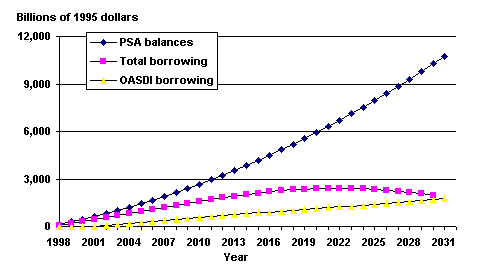
The floor of protection in the PSA proposal would continue to be supplemented by the nation’s elderly public assistance program, Supplemental Security Income (SSI). Our proposal would very gradually transform Social Security into a system that offers workers two kinds of benefits: first, a basic flat benefit for full-career workers, which is scaled to years of work and financed on a pay-as-you-go basis, and second, the proceeds of Personal Security Accounts, which are fully advanced funded with workers’ tax contributions and investment earnings. PSAs would be funded with 5 percent of the current payroll tax (which is 12.4 percent, excluding Medicare), or about half the tax devoted to the retirement portion of Social Security. The first tier benefit and benefits to disabled workers and survivors would be financed with the remaining 7.4 percent. Five percentage points of the tax would be rebated for investment directly to workers or to the financial institutions of their choice. Workers would own their PSAs and the interest thereon; they would be free to invest them in a wide range of investments and financial institutions; accounts would be held and managed by private financial institutions; individuals could begin making tax-free withdrawals at 62—regardless of their income or work status; annuitization of PSA balances would be an option but would not be forced on individuals who wished to control the timing and amount of their own distributions; and any balances remaining in an account upon death would be included in an individual’s estate. The PSA proposal would retain a spouse benefit. Unless a woman has earned a higher tier-one benefit on her own work record, she would still be eligible for 50 percent of her husband’s benefit. Widow’s and widower’s benefits would continue as well, only at a higher percentage amount than under current law. Young survivors would receive benefits as under current law but with actuarial reductions equivalent to benefits payable at age 65. ;It is important to note that this proposal does not, as suggested by one group of Council members, "abolish the present Social Security system"-- words apparently designed to arouse grave concern among people of all ages, but especially among senior citizens and older workers. The new two-tiered system affects no one older than age 55. It is phased in very slowly, becoming fully effective only for workers under age 25, and the projected benefits these workers would receive under the PSA plan are superior to those projected under current law. People from ages 25 through 54 would receive a portion of their first tier benefits based on what they had accrued under the current system, wage indexed until retirement, plus a portion of the new flat benefit based on the number of years worked under the new system; in addition, they would own their PSA accumulations. Also, while the flat benefit for full career workers would be set initially at the equivalent of $410 monthly in 1996, the amount future retirees actually would receive would be considerably higher than this. The reason is that it takes many years for the new system to be phased in and, during the intervening years, the benefit would be increased annually to keep pace with average wage growth in the economy. The flat benefit for a full career worker retiring in 2041, the first year someone could retire at normal retirement age who has spent a lifetime under the new two-tiered system, is projected to be $664 monthly in constant 1996 dollars, 62 percent higher in real terms than the initial benefit amount. Once an individual is on the benefit rolls, the benefit would be indexed to the cost of living, as under present law. This reform would turn the vast majority of Social Security taxpayers into investors and, in the next decade alone, would release literally hundreds of billions of dollars of payroll taxes for investment in the private sector. As an indication of the magnitudes involved, taxable payroll in the U.S. is now about $3 trillion, 5 percent of which equals $150 billion annually, with the amount of additional revenues available for investment each year growing at the rate of growth of total wages in the economy. With workers assumed to allocate half of their contributions to equities and half to U.S. government securities, the SSA actuaries project that the total accumulation of assets in personal accounts will be close to $6 trillion in 2020 and $16 trillion in 2040 in constant 1996 dollars. The tier-one benefit would serve as a back stop to the PSA accumulations. Set initially at a level equal to about two-thirds of the poverty level, this benefit would, as indicated, gradually rise over time, providing a minimum level of protection for all workers, but especially low-wage workers and others who, for whatever reason, accumulate relatively small PSA balances.5Of course, Social Security would continue to be backed up by SSI, which provides a guaranteed floor of protection to the elderly and disabled poor. Workers of various ages and at various earnings levels are projected to fare well under the PSA plan in comparison to the two alternative proposals considered by the Advisory Council. The PSA plan clearly dominates the others for younger workers and future generations. In trying to evaluate how people fare, it is important to be aware of the assumptions underlying the actuaries' projections. Apart from the host of economic and demographic assumptions which follow the 1995 Trustees' intermediate assumptions with a modified CPI assumption, the actuaries assume that workers invest in stocks and bonds in a particular way, that they earn a particular interest rate on their investments, and that they pay a particular amount in fees to the financial institutions that manage their personal accounts. For the estimates shown in the "Comparison of Plans," the real yield on stocks is assumed to be 7 percent, which is consistent with historical returns.6The real yield on bonds is assumed to be 2.3 percent, which is the actuaries' long-range assumption for the real yield on long-term U.S. government bonds.7In addition, the actuaries assume that administrative fees on personal accounts would be 100 basis points, or 1 percentage point. Together, these assumptions imply that workers who hold a 50-50 mix of stocks and bonds would have an average real yield of 4.65 percent, or 3.65 net of administrative fees. In addition, workers are assumed to hold the same mix of stocks and bonds that is observed to be held in 401(k) plans. Workers under 40 are thus assumed to hold 55 percent of their PSA balances in equities yielding a net return on their PSA accounts of 3.9 percent, whereas workers aged 60 to 69 are assumed to hold 43 percent of their balances in equities yielding a net return of 3.3 percent on their PSA accounts. Of course, workers who invest more heavily in equities or buy funds with lower investment management fees, such as index funds, would have higher expected returns. Workers who invest more heavily in bonds or spend even more on administrative fees would have lower expected returns. The actuarial memo in Appendix II of this report shows estimates for higher and lower yield portfolios. The other two plans, it should be noted, are assumed to have much lower administrative fees—10.5 basis points in the case of the IA plan and 0.5 basis points in the case of the MB plan. This, together with the assumption that under the MB plan the government will invest up to 40 percent of trust fund reserves in private equity, at a real return of 7 percent annually, helps account for the inflated estimates for the MB plan. We raise these details for two reasons. First, since we cannot know what the future holds, assumptions must be made and the resulting estimates are no better or worse than the underlying assumptions. In this regard, we believe the interest rate and asset mix assumptions are generally reasonable. However, we believe that the gap between the administrative fees on the PSA plan and the MB plan is too large. We would expect money managers to compete aggressively to reduce fees and we would expect workers to search out low cost investment options such as no load mutual funds and index funds. Some mutual fund companies currently offer index funds for retail management fees under 30 basis points per year. In addition, we do not believe it is appropriate to evaluate the MB plan as if its proponents actually endorsed centralized investment, which, in the end, 8 Removing this from the evaluation of their plan creates a large funding gap and forces the need for additional tax increases or benefit cuts, either of which would worsen the estimated performance of the plan. Second, when evaluating the effect of a change in Social Security, it is crucial to know what the baseline point of comparison is. Since Social Security is substantially under financed after the turn of the century, present law does not provide a point of comparison. The MB plan does not provide one either, in our view, now that its proponents have withdrawn their endorsement for centralized investment. In either case, benefits will have to be lower or taxes will have to be higher than now projected. In our discussion, we consider a baseline in which the payroll tax is maintained at its current level of 12.4 percent (excluding Medicare), and benefits are gradually scaled back to restore actuarial balance.9We compare the PSA plan to this and to the IA plan. In addition, we refer to internal rates of return rather than to money's worth ratios. We do this simply because rate of return calculations are somewhat easier to interpret since they are not affected by historical movements in interest rates and make no implicit assumptions about the appropriate interest rate for determining who does and does not get their "money's worth." Data on replacement rates and benefit levels, which ignore taxes, are contained in the actuarial memo in Appendix II and are discussed in the "Comparison of Plans" section of the report. As revealed in the Appendix tables prepared by the Social Security actuaries, workers at all earnings levels, ranging from low to maximum, are projected to earn higher rates of return under the PSA plan than under the IA plan or the baseline. 10The younger the worker, the greater the benefits to the PSA plan, the reason being the relatively longer period of time over which the younger workers can accumulate personal accounts at the higher rate of return. For single male workers with low earnings, rates of return under the PSA plan vary from 2.46 percent for the 1943 birth cohort—i.e., those now aged 53—to 2.99 percent for the 2004 birth cohort; this compares to 2.34 percent to 1.93 percent under the baseline. For the 1964 birth cohort, now age 33, the rate of return under the PSA plan is nearly double the baseline—1.40 percent compared to 0.73 percent—for the average wage worker and even higher for workers at higher wage levels. For single females, rates of return under the baseline are somewhat higher than for males, making the gains for females under the PSA plan somewhat smaller but nevertheless significant. For two-earner couples, which will be the dominant type of couple in future decades, the PSA plan also dominates the alternatives shown. Here again, since couples tend to fare better than singles under the baseline and under present law, the gains are not as large as for singles but are nevertheless significant. Considering the couple with average earnings who was born in 1964, the PSA plan is projected to offer a real rate of return of 2.08 percent as compared to 1.64 percent under the baseline. To appreciate the significance of a half or full point difference in real rates of return, when compounded over many years, consider the following example. If a couple invests a lump sum of, say, $20,000 today at age 30, by the time they reach age 65, this amount would have grown to $41,111 with a 2.08 percent return as compared to $35,342 with a 1.64 percent return. With a full percentage point increase in rate of return, the accumulation would have grown to $49,787. As compared to the IA plan, the PSA plan outperforms the IA plan for workers at all ages and earnings levels, whether single or in two-earner couples. The differences are significantly smaller, however, than when the PSA plan is compared to the baseline. These findings are especially significant in light of the fact that the PSA plan includes a transition payroll tax supplement and the cost of servicing the debt, both of which are included in these estimates. In other words, these estimates are net real rates of return. Unfortunately, the estimates do not extend far enough into the future to show how workers would fare who enter the work force once the supplemental transition tax is repealed, who naturally would earn even higher rates of return. 11These workers also stand to gain the most from any savings-induced increase in national income. Judgments must be made about the level of various risks under the different options. The relatively greater share of benefits coming about through wealth accumulation in individually-owned accounts under the PSA plan, for example, exposes workers to more financial risk but shields relatively more of their retirement incomes from political risk. As noted elsewhere, we believe that the political risks attached to government benefit promises 20, 30, or 40 years down the road far outweigh the financial risks of a well-diversified portfolio. As with any proposal to move toward fully-funded personal accounts or simply to increase the funding basis of the current Social Security system, there is a transition cost of getting from where we are to where we would like to be. The reason is Social Security's pay-as-you-go method of finance, which implicitly is a form of deficit finance. In contrast to a fully-funded system, in which each generation of workers makes contributions that are saved and invested to fund their own future benefits, such as in a 401(k) plan in the private sector, a pay-as-you-go system shifts the cost of benefits for current elderly generations to current and future generations of workers. Whereas a fully funded system always has assets equal to outstanding liabilities, and thus operates with no unfunded liabilities, a mature pay-as-you-go system operates with very large unfunded liabilities. These liabilities are ignored in federal budget accounts. According to the SSA actuaries, in present value terms, Social Security is scheduled to pay about $18.6 trillion in benefits to current workers and retirees over the next 75 years. This compares to OASDI's reserve fund plus projected tax income from these workers, which totals $9.8 trillion. Social security's unfunded liability is thus about $9 trillion in present value terms. It is the existence of this unfunded liability—an implicit or "off the books" debt of the federal government—that creates transition costs. Moving toward a fully funded component of Social Security, without reneging on expected benefits, requires that this implicit debt to retirees and workers be officially recognized, and gradually met, at the same time workers' taxes are being deposited in personal accounts to help fund a portion of their retirement benefits. The SSA actuaries estimate that the long-range transition cost of our proposal is the equivalent of 1.52 percent of taxable payroll in the economy. We recommend spreading this cost over a 70 to 75 year period so as not to concentrate the burden too heavily on today's workers. Further, we recommend that this cost be met through a payroll tax supplement and, because of the concentration of these costs in the early decades of the transition, an increase in federal borrowing. In particular, we propose a payroll tax supplement of 1.52 percent—employee and employer shares combined—coupled with new, explicit government borrowing during the early years of the transition. This borrowing would be fully repaid with the proceeds of the tax during the later years of the transition, at which point the tax supplement would be repealed. We would like to stress that none of us favor a tax increase to fund the current system. We favor a tax increase only to fund the transition to personal accounts. In addition, among taxes, none of us favor a payroll tax supplement. We would prefer a broad-based consumption tax, which would be paid by a broader segment of the population, including the elderly who have fared so well under the current pay-as-you-go system. Such a tax would also create fewer labor market distortions and be consistent with our more general goal of boosting national saving. However, since the U.S. does not presently have such a tax, we concluded that the costs of setting up the administrative apparatus and layering this tax on top of the existing income tax structure would outweigh the gains. Should the U.S. tax system move in the direction of a consumption base, we would regard this as a highly preferable means of meeting part of the cost of transition. We also would favor general spending reductions coupled with any tax increase. However, there was concern expressed that targeting specific federal programs for reductions would be outside the charge of this Advisory Council. In light of this, we proposed a tax supplement in order to deal forthrightly with the issue of transition costs. We do believe that debt-financing part of the transition is desirable. Issuing new government debt just as we are about to rebalance our federal books may seem like an unsavory prospect. This debt, however, helps spread the burden to future generations, who stand to gain so much from these reforms, rather than concentrating it purely on current workers. Two questions that have been raised about our proposal are why the transition costs are so large and why we chose to meet these costs the way we did, rather than the way Senator Bob Kerrey (D-NE) and former Senator Alan Simpson (R-WY) proposed in the legislation they introduced. The Kerrey-Simpson bill (S.825) would involve smaller transition costs and, in addition, would not require a tax increase to fund the transition. The Kerrey-Simpson bill would create a system of personal accounts that is fully funded with 2 percent of the payroll tax, about one-fifth of the overall tax devoted to the retirement program. The PSA proposal, on the other hand, would create such a system with 5 percent of the payroll tax, about one-half of the tax devoted to the retirement program. The larger cost of our proposal reflects the greater extent to which we move toward fully-funded personal accounts and make explicit and begin to pay off Social Security's unfunded liability. ;In our view, it is highly desirable to move toward larger personal accounts than in the Kerrey-Simpson bill. Larger accounts offer workers the potential for higher retirement incomes by allowing them the opportunity to invest more of their taxes in higher-yielding stocks and bonds, and on net should result in significantly larger economic benefits. In addition, larger accounts would give workers keener incentives to make informed investment decisions and to monitor the performance of their investments. Larger accounts also would be relatively less costly for financial institutions to administer. As for the means of financing the transition, the Kerrey-Simpson bill provides for what might be called "internal financing." Social Security benefits are scaled back sufficiently to close the long-range deficit and, in addition, cover the cost of the 2 percent personal accounts. This cost, moreover, is met by a combination of reductions in future benefits for current recipients and for future recipients. As analyzed by SSA, our proposal finances the transition "externally"—i.e., through explicit government borrowing and a general tax increase or equivalent spending reductions. Actually, the PSA proposal includes internal financing as well since, in recognition of the fact that individuals would be accumulating sizable personal savings accounts, Social Security benefits are scaled back more than necessary to close the long-range deficit. These benefit reductions would apply almost exclusively to future retirees. As a result, under the Kerrey-Simpson bill, relatively more of the cost of transition is borne by current older generations. While there are advantages to this, in particular, reversing some of the enormous wealth transfers that have taken place from younger to older generations, there also are advantages to spreading the burden to future generations who stand to gain the most from reform. The approach taken in the Kerrey-Simpson bill also effectively limits the extent to which personal accounts can substitute for a portion of Social Security. From a practical political standpoint, there was little support on the Advisory Council for modifying the cost-of-living adjustment beyond the adjustments that will flow from measurement changes made by the Bureau of Labor Statistics. 12 Also, there was no support in our group for increasing the share of benefits subject to taxation—in fact, we propose reducing the share of benefits subject to taxation to 50 percent to be consistent with the tax treatment of most benefits provided through employer-sponsored retirement plans. As a result, there were few practical means of spreading the burden to current older generations except by way of a consumption-based tax. The one change affecting the elderly that our group did support, as did the other members of the Advisory Council, was a phase-out of the thresholds used for determining how much of an individual's benefits are taxable. Because of other features of the tax code that limit income tax liabilities for the low-income elderly, this change is expected to affect only a small share of beneficiaries. It also should be noted that, with the exception of a few program changes that apply generally, such as the increase in the retirement age, our proposal would pay all benefits "earned" to date, with that amount indexed to wage growth until the time of retirement. Among the various options for transitioning to a new system, this is quite generous. Other less costly options include price indexing or freezing accrued benefits, or meeting less than full accrued benefits for younger workers or even canceling those benefits for workers under a certain age, such as 35. These options have been suggested by some in recognition of the greater risk younger people attach to receiving scheduled benefits and the larger gains they can expect under the reformed system of personal accounts. As a group, we felt that the benefits that would flow from the PSA plan made the cost of our transition worthwhile. Finally, the fact that our present system is significantly underfunded on a pay-as-you-go basis makes the transition appear more costly than it actually is. In present value terms, fully $3.1 trillion is required over the next 75 years simply to close the deficit. 13To make ends meet and also allow for personal accounts, our proposal includes a number of changes to reduce the ongoing cost of the program, such as raising the retirement age to 67 and then indexing it to longevity, and creating the new tier one benefit. The burden of the transition, of course, depends on the size of the economy in future years, which is discussed below. Another question voiced about our proposal is whether we really are advocating a payroll tax increase comparable to the increase in the IA plan. While the 1.52 percent payroll tax supplement in our proposal is similar in magnitude to the 1.6 percent payroll tax increase contained in the IA plan, the similarities stop there. Under our proposal, the payroll tax supplement is a means to pay off accrued liabilities and to make possible the transition to fully-funded personal accounts that ultimately comprise half the retirement program. When the transition is completed, in about 70 years, there is no continuing tax liability. In the case of the IA plan, by contrast, 1.6 percent would be established in the law as the increase in the payroll tax used to fund the individual accounts. These accounts and the related tax are permanent add-ons to Social Security, in contrast to our plan in which the accounts are a substitute for a portion of the program and the tax is transitional. We refer to the tax supplement as a "Liberty Tax" since it frees workers of a significant portion of the debt they have been passed from older generations. We also want to stress that the size of the tax supplement is only an estimate, and it is based on the actuaries’ assumptions that the long-term rate of economic growth will be 1.4 percent to 1.5 percent annually and that our proposal will result in no savings-induced increase in the capital stock or per capita income. In fact, under the actuaries' methodology, each of the three reform plans offered in this report and, indeed, any reform is assumed to have the same effect on national saving and economic growth—precisely none. We feel strongly, however, that the reforms we propose will be very beneficial to the economy. If this is the case, or if the rate of economic growth is simply higher than now projected, the actual rate of taxation would be lower. This does not follow with the IA plan. As to the concern about proposing to issue so much new debt, particularly in the current budget climate, the first point we would make is that the "new debt" being issued would basically amount to making explicit a portion of a debt that already exists—in the form of outstanding, unfunded benefit promises—but is not officially recognized in national debt figures. The second point is that the amount of new borrowing is not large by recent historical standards and, more importantly perhaps, is ultimately dwarfed by the accumulation of assets in personal accounts. With earnings and labor force growth, net new capital investment, made possible through growing contributions to personal savings accounts, could be undertaken even during the early years of the transition when the government is issuing bonds. Consider first the increase in annual federal borrowing from the public under the PSA plan. As evaluated by the Social Security actuaries, this borrowing is projected to rise from 1.23 percent of GDP in 1999 to a peak of 1.93 percent of GDP in 2007, and then to fall gradually to 1.0 percent of GDP in 2020 and to zero by 2030. Beyond 2030, Social Security improves the overall federal budget relative to present law. This borrowing has two components: first, direct borrowing specified in the PSA plan to help fund the transition and, second, what might be called indirect borrowing which results from the loss of projected Social Security surplus funds and the more rapid draw-down of trust fund reserves than under present law. While the former debt and its draw on private resources are clearly attributable to and specified in the PSA plan, the latter is assumed to result, meaning the federal government is assumed to take no offsetting actions in the rest of the budget. Certainly, the government could respond to the loss of surplus funds and the need to redeem trust fund reserves in the early years of the reform by cutting other federal spending or raising other taxes, in which case the indirect debt would be reduced or eliminated. The indirect borrowing assumed to result from the PSA plan is heaviest in the first few years of implementation, at 1.2 to 1.3 percent of GDP, but drops quickly, falling by half by 2005 and to zero by 2016. The direct borrowing from the PSA plan is never as large, ranging from 0.6 to 0.8 percent of GDP in the period 2002 to 2009, and falling gradually to 0.29 percent in 2015 and to zero in 2034. Some sense can be made of these figures by noting that the PSA plan envisions moving back toward pay-as-you-go financing of the government program. As a result, trust fund assets are redeemed for cash only until 2015, the point at which pay-as-you-go financing has been restored and reserves are maintained at 100 to 150 percent of annual outgo thereafter. By contrast, under the assumptions used in this report, the current system begins running cash flow deficits in 2015 and trust fund reserves are drawn down steadily thereafter, until completely exhausted. Thus, beginning in 2016, the financial condition of the trust funds begins improving under the PSA plan. Direct borrowing to help finance the transition ceases in 2034, and repayment of this borrowing begins in 2035. The overall impact of the PSA plan, including direct and indirect borrowing, on the unified federal budget is projected to be positive relative to present law by 2030, with the improvement in the federal budget balance growing thereafter. In relation to annual contributions to the PSA accumulations, the amount of new borrowing is at its peak in the first five years, amounting to 69 percent of PSA contributions in 1999. The increment to federal borrowing relative to PSA contributions falls to 44 percent in 2010 and to zero in 2017. Recognizing that the government may offset some or all of the indirect borrowing through spending reductions or revenue increases in the rest of the budget, the lower figures for direct borrowing are also relevant. In this case, new borrowing peaks at 43 percent of PSA contributions in 2003, then falls to 21 percent in 2010, to 13 percent in 2020, and to 4 percent in 2030. Figure 1 shows, in constant 1995 dollars, the total amount of federal borrowing relative to total PSA accumulations under the proposal. Again, we distinguish between direct borrowing and that stemming from the loss of projected trust fund monies that, in the first analysis, is assumed to increase federal borrowing. As shown, total PSA accumulations rise quickly from about $1.0 trillion in 2003 to $4.2 trillion in 2015 and to $8.0 trillion in 2025 in constant 1995 dollars. Total borrowing peaks at around $2.4 trillion in the period 2019 to 2024. In 2020, total borrowing equals 40.0 percent of PSA accumulations, but is declining at a rate of about 2 percent per year relative to aggregate PSA balances—i.e., by 2025 it will be down to 29.3 percent of PSA balances. Total direct borrowing reaches $1.9 trillion in 2034, and, with interest continuing to accumulate, peaks at $2.1 trillion in 2039, or about 15 percent of total PSA accumulations in that year. PSA Balances, Total Federal Transition Borrowing, and Direct OASDI Borrowing from the Treasury in 1995 Dollars
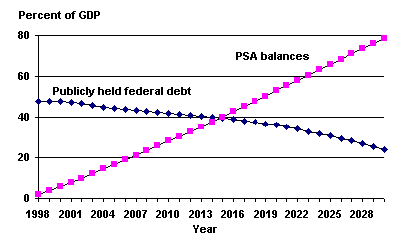
Considering recent historical experience, between the end of fiscal year 1980 and the end of fiscal year 1994, the amount of federal debt held by the public rose from $1.3 trillion to $3.5 trillion in constant 1995 dollars, for an increase of $2.2 trillion in constant 1995 dollars. The increase in debt under our proposal, accumulated over 35 to 40 years, is about equal to the amount of federal debt absorbed by financial markets in a period less than half as long. By the standards of recent historical experience, that is, the incremental growth of the federal debt would not be large. Could financial markets absorb this increase in explicit government debt? Presumably there would be some upward pressure on the interest rates on government securities relative to private securities, which could affect the cost of servicing the debt and the net returns to personal accounts. Given recent historical experience, however, together with our general understanding of the relationship between interest rates and the size of the national debt (which, empirically, is not strongly positive), we conclude that these effects would not be large. We also presume that the Federal government would recognize the desirability of tightening its belt in the rest of the budget, ideally moving toward a surplus position in the next century, in anticipation of major structural reform of Social Security. Furthermore, if the non-Social Security portion of the federal budget were brought into balance over the period during which the total value of new federal debt generated by the PSA plan, relative to present law, was growing in real terms (the period from 1998 to 2022), the total federal debt as a percent of GDP would decline throughout the transition period. It would decline in absolute terms beyond 2028. In developing this estimate, shown in Figure 2, we assumed that our national leaders accomplish their stated goal of balancing the budget after 2002. We assumed that deficits in fiscal 1996 and 1997 would equal $120 billion and then decline at a rate of $20 billion per year until achieving balance thereafter. Figure 2 shows estimated federal debt that would be held by the public if the federal budget were balanced after 2002 except for the debt associated with a transition to the PSA plan. Over the full transition period, the federal debt claim on the economy would shrink under the PSA transition plan, unless the efforts to otherwise balance the budget fail. Although we believe the financing mechanism we offer has real merit, we recognize that there is no single "right way" to fund the transition to a system of personal accounts. Transition costs can be met in any number of ways—through reductions in federal spending, through increases in the payroll tax or other federal taxes, through the sale of federal assets, through new explicit borrowing from the public, or through some combination of the above. Figure 2 PSA Balances and Estimated Federal Debt Held by the Public under the PSA Proposal with Transition Borrowing as a Percent of GDP from 1998 to 2030
Source: Office of the Actuary, Social Security Administration, 1996 and calculations by the authors as described in the text. As noted, under the Kerrey-Simpson bill, transition costs are met by scaling back the growth of future Social Security benefits. This imposes relatively more of the cost of transition on current older generations. Our proposal, by contrast, finances the transition outside of the Social Security system, accommodating much larger personal accounts and spreading the burden to future generations. Chile provides an example of yet another approach. In moving toward full-scale personal accounts funded with 10 percent of workers' wages, effective in 1981, it took a multi-pronged approach: through spending reductions and tax increases in the 1970s and early 1980s, the central government ran budget surpluses in anticipation of the social security reforms; benefit commitments under the old system were trimmed somewhat as indexing was modified and the retirement age was increased and part of the payroll tax continued to be used to meet outstanding liabilities; and formal government bonds, known as "recognition bonds," are to be deposited in workers’ accounts at retirement, reflecting part of the system's implicit debt—that part equal roughly to the unfunded past service liabilities for workers who chose to switch to the new system. These bonds, which carry a real interest rate of 4 percent annually, are redeemed with revenues from the general fund of the Treasury at the time workers retire. How a nation decides to finance the transition is important. It determines how the burden is distributed across generations and income classes and what the net economic benefits of reform are likely to be during the transition. Which method is chosen, however, is less important than the fact that, on a going forward basis, the economic gains to a fully-funded, privately managed system of personal accounts are likely to be very large. The PSA proposal has evoked a number of criticisms by members of the Advisory Council advocating other proposals and by other public policy analysts. We believe that few of these criticisms have merit, and that those that do can be dealt with through plan design or regulation. Concerns have also been raised which we hope to allay by further clarification. One concern that has been raised about the PSA plan is that many Americans are "unsophisticated" about making investment decisions and that a plan based on personal choice is either impractical or must be accompanied by some type of guarantees that would ensure workers a minimum rate of return or a minimum fund accumulation. When evaluating our proposal for personal accounts, we believe it is crucial to appreciate the enormous strides that have been made in the last couple of decades in financial markets and in individuals' participation in them. With the introduction of IRAs, 401(k) plans, and other self-directed investment vehicles, millions of workers and retirees have gained an enormous amount of experience with making investment decisions. In addition, with the explosion of mutual funds and, in particular, equity index funds, ordinary working men and women do not need to "play the market" -- incurring large transactions costs and exposing themselves to excessive risk -- in order to reap the benefits of stock market participation. And, no doubt owing to the tremendous competition for new customers and new funds, there is a wealth of financial information available about alternative investment strategies and institutions, and performance ratings are widely available. In our view, workers have never been better positioned to make sound financial decisions. Admittedly, there are people in our society with little knowledge or understanding about how to invest money. While no one has attempted to determine who these people are or why they are ill-informed, we believe that among workers, the problem is concentrated among those who have never had any money to invest. Why would people take the time to learn about something that has no practical value for them, knowledge that would likely only frustrate them? Under the PSA plan, with a portion of their Social Security taxes rebated for investment in accounts they own, workers at all income levels would have keen incentives to make sound financial decisions, either by acquiring the needed expertise or seeking out those who have it. This is not to say that with personal accounts everyone will make the best financial decisions, reaping the best possible rates of return. Some workers will take on too much risk; some workers will not take enough. We were in general agreement, however, that workers would fare better, ex ante, under this option than under the present inadequately-financed system, a shored up pay-as-you-go system, or either of the other two options developed by the Advisory Council. 14 In our deliberations about how to structure personal accounts, we were presented with no hard evidence that workers did not—or could not, with experience—make sound financial decisions. Good decisions appear to come with education and information, and with experience and learning—all of which would be gained rapidly under a system in which workers were making regular contributions to personal accounts offered by competing financial institutions. The investment decisions required of people would not be like other major investment decisions that are made very infrequently. For example, for most people purchasing a new home is a relatively rare event so little experience is gained that might improve future decision making about home purchases. Another kind of decision might be deciding whether or not to undergo some major surgery that involves an element of urgency that precludes the acquisition of appropriate information. For workers investing PSA balances, market returns on their accounts would provide steady information on investment performance. The relative success of competing financial institutions would provide valuable information on alternative investment options. Our proposal contains only one proviso: that personal accounts be invested in regulated financial instruments widely available in financial markets. Some supporters of the PSA proposal would prefer to see limited restrictions placed on certain categories of investments that would not be permitted in the early years of the PSA program while the general public becomes more educated about financial risk and return. However, none of us want to restrict workers ability to invest in a highly diversified set of financial instruments widely available in the marketplace. 15While we recognize the government's—i.e., the taxpayers'—potential interest in limiting excessive risk taking, there was no consensus about the kinds of restrictions that might be needed or be found cost-effective. And indeed, the concern expressed most frequently, in financial news and other coverage of retirement income planning issues, is that workers do not take enough risk. We also recognize the possibility that with some investment options offered by some institutions, administrative fees could be high in relation to investment returns. Proposals to cap the fees that could be charged and to require special licensing of financial institutions handling personal accounts, however, were without general support. The problem here, as in so many areas of government regulation, is making sure that there is a problem worthy of federal intervention, that there is a regulatory solution well-tailored to the problem, and that the regulations are likely to result in net economic gains. For example, we were well aware of the concern that workers err on the side of taking too little risk in their investments for retirement and thus may not generate adequate retirement incomes. However, we were presented with evidence, based on experience with a sample of 401(k) plans, suggesting that this concern may be overstated because of the failure to disaggregate the data on the basis of workers' ages. The data suggested that asset allocation decisions are appropriately related to age: the older the worker, the smaller the share of assets allocated to equity and the larger the share allocated to fixed-income investments. The relatively high overall share of assets in fixed-income investments in these plans where workers manage the investment of their own retirement money derives, at least in part, from the fact that older workers tend to have accumulated larger balances than younger ones. More generally, in considering the population as a whole and the kinds of regulations that might be appropriate, it is unclear what benchmark one would use to determine whether workers were taking too much or too little risk. Certainly, the "right" way to allocate investments depends not only on one's age but also on the size and risk-return profile of non-pension assets, among other factors. In general, we envision a regulatory environment consistent with a wide range of choices for workers—for example, a range of options comparable to that now available to workers through 401(k) plans—offered by a wide array of financial institutions competing for workers' PSA balances. We felt that it was beyond the scope of our charter to develop a full-blown regulatory framework. We do feel, however, that the experience with 401(k) and other self-directed retirement savings plans indicates that a regulatory environment can be structured to give workers a wide range of options with which to meet their own needs and desires. We also believe that concerns about "unsophisticated investors" can be rectified most effectively by an educational effort, not by significantly restricting investment choices or by substituting government decisions for individual decisions. We believe that new financial institutions and arrangements will continue to emerge, as they have in the past. One logical development would be group purchasing arrangements through employers, trade associations, and other such places where people cluster together during their working lives. In cases where employers are already offering 401(k) investment options, it would be quite simple for the same investment vendors to simply offer their funds for PSA investments. As to the question of whether there would be any guarantees of a "reasonable" return on workers' investments, the short answer is no—and neither are there any such guarantees under the present system. Many middle-aged and younger workers are projected to earn negative rates of return on their Social Security taxes—and this is before factoring in the political risk that future benefits for middle- and high-wage workers might be scaled back 25 percent or more; that the cost-of-living adjustment might be capped, reduced, or eliminated altogether, even if only temporarily; that benefit taxation may be increased appreciably; or that benefits may one day be means-tested. One of the features we find most appealing about personal accounts is that workers would own their accounts, and the retirement savings they embody, and are thereby exposed to much less political risk than under the present system—political risks that, over the next 20, 30, or 40 years could easily dwarf the financial risks of a well-diversified portfolio. Having said this, when discussing the adequacy of benefits, the first tier of our proposal cannot be ignored. Fully half of the Social Security retirement program financing would continue to be accomplished through the central defined benefit system. The first tier embodies a high degree of redistribution from high to low wage workers—indeed, two workers with identical years of work, one of whom earns the minimum wage and the other of whom earns four times that, and pays four times the taxes, would get the same benefit. This redistribution is not hidden in complex benefit formulae and eligibility criteria, but is a straightforward result of moving toward a flat benefit for full-career workers, prorated only for years of work. As under present law, this benefit is fully cost-of-living adjusted. The first tier benefit is designed to ensure that, together with second tier accumulations, all full-career workers, regardless of income level, can expect to receive a minimally adequate retirement income from Social Security. By minimally adequate we mean enough so that even low-wage workers—and even workers who invest in relatively low-yielding assets—should not have to resort to means-tested poverty assistance. Our expectation is that workers will do considerably better than this. Of course, tier-one benefits are no more "guaranteed" than are Social Security benefits today. They may be more secure, however, by virtue of the fact that they can be financed at a significantly lower projected payroll tax on workers—7.4 percent versus 12.4 percent. Another concern we have heard expressed is that workers would not be required to annuitize their account balances at retirement. The fear is that workers would have so much freedom to decide how to use their PSA accumulations at retirement that they may withdraw their entire balance, spend it, and end up penniless—or worse, a burden on public assistance programs. A less extreme version of this concern is that workers will simply spend their accumulated savings too quickly and then be unable to maintain their consumption throughout their retirement years. The answer, some say, is to force workers to purchase an annuity at retirement, spreading their payments out evenly over their retirement years. Under our plan, workers would be free to purchase an annuity with some or all of their accumulated savings, if they so wished, but they would not be required to do so. While we question the premise that large numbers of workers would make decisions that would leave them worse off in a lifetime sense, we are aware of the risk of over-consumption by low-wage workers due to the array of federal safety net programs that tie eligibility to low assets. We considered several options for mitigating this potential problem. For example, if annuitization is seen as the only way to assure that retirees do not exhaust their resources prematurely, it might make sense to require retirees to show that they have annuity incomes from Social Security and private savings that would be equal to the poverty level income or some multiple such as 1.5 times the poverty line—over their life expectancy. For those who did not have such annuity incomes, it would be possible to require that they purchase an annuity with a portion of their PSA accumulation up to the target level. In addition, or alternatively, full redemption of PSA balances in a single withdrawal could be restricted. One of the issues we grappled with in our own deliberations on whether to require annuitization was how to determine the appropriate target level of such annuitization. Under current law, Social Security benefits are only about 85 percent of the federal poverty line for the hypothetical "low-wage" worker retiring at age 65 in 1996. The flat benefit alone under the PSA plan for such a worker would grow to that level by 2020. Low-wage workers retiring in 2020, however, will still be getting three-fourths of their benefit determined under the current formula under the transition that we propose. By the time the full transition is completed, the flat benefit for normal retirement will exceed the poverty line. While we understand the desire to restrict people from spending down their assets in order to qualify for means-tested transfer programs, we believe that forcing people to convert their PSA balances into annuity incomes beyond levels that protect against such behavior goes beyond the reasonable province of the public interest. Mandatory annuitization forces individual to purchase annuities upon retirement, regardless of the current market price for annuities. Annuities are highly sensitive to interest rates and, depending on one’s retirement date, the interest rate at the time of purchase will determine the size of the annuity payments. Optional annuitization, on the other hand, would allow individuals to determine when, if ever, they wish to annuitize all or part of their benefits. Retirees who want to want to live a more thrifty lifestyle than the general public might deem appropriate, in order to preserve some of their PSA accumulations to pass on to their heirs, should be able to do so without the interference of the government. In addition, forced annuitization discriminates against populations with low life expectancies, such as certain minority groups, depriving them of the right to pass along a portion of their Social Security wealth to their heirs. There is also some concern that between Social Security and Medicare, the nation's elderly have too much of their wealth annuitized, leading to higher levels of consumption and smaller bequests than they would deem desirable. In the end, we concluded that the tier-one benefit provided a significant degree of forced annuitization, and that any further requirement was unnecessary. Proponents of the MB plan have asserted in their supplementary statement that our proposed tax treatment of benefits is without parallel in the federal tax treatment of retirement benefits. While this is technically correct, it is substantively wrong. In order to explain the rationale behind our proposal, it is necessary to explain how the income tax treats various forms of retirement savings. Throughout this discussion, we assume that workers save some portion of their earnings during their working career to help provide for their retirement needs. To keep the example as simple as possible, we are only going to track the effects of alternative tax treatments on a single year’s savings. If we tracked the effects on multiple year’s savings, it would complicate the analysis, but have no real bearing on any of the conclusions. If a worker saves through a regular savings account, the contributions to the account are made with earnings that have already been taxed. For example, assume that a worker has a marginal federal income tax rate of 28 percent and that, in preparing for her retirement, she wants to save the after-tax income from $2,000 of earnings, or $1,440 — i.e., $2,000 x (1 - 0.28). For simplicity, assume that the savings are deposited Table 1 Relative Value of Money in a Regular Savings Account Paying an Interest Rate Equivalent to a 5 Percent Inflation Rate and Subject to a 28 Percent Tax Rate
at the beginning of the year in which the saving is done in an account that earns 5 percent interest annually, and further assume that the rate of inflation in the economy is 5 percent per year—i.e., the real rate of interest is zero under these assumptions. In the first year, the 5 percent interest rate would generate $72.00 in interest on the savings. Since this is interest income in a regular savings account, however, it would be taxed at the worker’s 28 percent marginal tax rate, leaving $51.84 cents in net interest after taxes. Assume that the original deposit and the net interest income are left to accumulate in the account until the worker retires. Table 1 shows the practical effects of the income tax treatment of regular retirement savings under the set of assumptions used here. Column 2 in the table shows how the original $2,000 in earnings would have to increase in nominal terms to maintain constant purchasing power over time. Column 3 shows the worker’s accumulated savings balance in nominal terms. The accumulated value of these savings as a percent of the real purchasing power of the original earnings is shown in Column 6, which is Column 3 divided by Column 2. The net effects of the tax system on regular savings is shown in Column 7, which is 100 percent minus the value in Column 6. Referring to the last column in the table, the picture is clear: the federal income tax system places an ever higher claim on the earnings of workers who defer consumption from their working years to their retirement years if that consumption is deferred through a regular savings account. Recognizing that it is desirable for workers to save for their retirement so they might have a reasonable standard of living in their old age, the federal tax code has made provision for taxing retirement savings less punitively than it taxes regular savings. It does so by allowing tax-preferred saving through tax-qualified retirement programs sponsored by employers and through IRAs. Table 2 shows how benefits accumulate in a tax-preferred savings account, such as a 401(k) plan or an IRA, relative to how they accrue in a regular savings account, using the same assumptions as in Table 1. Under the tax-preferred account the earnings are not taxed at the point they are earned so the full $2,000 of earnings goes into the account and accumulates interest until withdrawn. Assuming the total accumulation is withdrawn at once, the original savings plus accumulated interest is taxed at the assumed 28 percent tax rate. Column 2 in Table 2 corresponds with Column 3 in Table 1, and shows the nominal value of accumulated savings in a regular savings account net of federal income taxes. Column 3 in Table 2 shows the annual tax liability on the original earnings and the tax liability on interest income each year it is earned. The tax liability in the year the wages are earned is the difference in original earnings ($2,000) in Table 1 and the net amount actually invested ($1,440). The tax liability on interest income shown in Table 2 is the difference in the gross interest and net interest in Table 1. Column 4 in Table 2 shows the nominal tax paid in each year stated in dollar terms at the end of the 10 years, and is the product of the nominal tax liability from Column 3 multiplied by the equivalent dollar multiplier in Column 7. For example, the $560 in taxes paid on the original earnings would have a nominal value of $912.18 stated in current dollars 10 years later. This is equal to $560 times 1.62889 (1.63 rounded) or $912.18. The table shows that under the tax-preferred account the disposable income from the original savings plus the net interest it has earned is 14.4 percent higher than for the regular savings account—i.e., $2,345.61 versus $2,050.97. The effective tax rate on the original earnings adjusted to account for inflation is 28 percent—i.e., the $2,345.61 is 72 percent of the original $2,000 adjusted by inflation to the date the benefit is distributed. In this case, there is no tax penalty on the worker for deferring consumption from the period when wages are earned to the retirement period. Taxes and Benefit Accumulations under Regular Savings and Tax-Deferred Accounts at 28 Percent Tax Rat with Interest and Inflation Rates at 5 Percent Per Year
The federal tax code treats workers’ voluntary contributions to IRAs, 401(k)s, 403(b)s, and section 457 plans on a tax-preferred basis, like the tax-preferred contributions in Table 2. It also treats employer contributions to tax-qualified plans in the same fashion, in that the employer makes contributions on a pretax basis and interest on the contributions are not taxed until benefits are distributed. The tax code, however, does not allow workers’ mandatory contributions to these plans to be made on a pretax basis. Thus, to the extent that an employer might require that workers make contributions to a defined benefit plan, the tax code requires that these contributions be made on a post-tax basis. When benefits are distributed from the plan, any benefits over and above the original worker contributions are taxable. In this regard, these kinds of plans treat workers’ contributions much more like a regular savings account than a tax-qualified account. Most employers have realized the punitive nature of this tax treatment of employee contributions to tax-qualified plans. As a result, with a small number of notable exceptions, virtually all private sector employers sponsoring tax-qualified defined-benefit plans today fund them solely with employer contributions. In the case of tax-qualified plans, most contributions are made on a pretax basis. In the case of Social Security, employer contributions are made on a pretax basis and worker contributions are made on a post-tax basis. We were mindful in designing the PSA proposal that if employee contributions to the PSAs were made on a pretax basis it would result in reduced federal tax collections in the early years of the program. As a result, we have recommended a tax treatment of benefits that minimizes the short-term effects on federal tax revenues. Specifically, we have proposed that employee contributions be made on a post-tax basis as is presently the case with Social Security payroll taxes, but that benefits not be taxed when distributed. Table 3 compares the tax payments and benefit distributions for the hypothetical worker considered in the development of the prior two tables under two tax regimes. The first regime is one where pretax contributions finance the benefit which is taxed at distribution. The second regime assumes that post-tax contributions finance the benefit which is not taxed at distribution. The table shows that when the amounts are stated in equivalent dollars, the results of the two cases are identical from both the government’s and the worker’s perspective. When we considered the tax treatment of benefits under the PSA proposal in the context of this analysis, we felt that benefits that were financed with pre-tax employer contributions should be taxable at distribution. We felt that the benefits that were financed with workers’ post-tax dollars should not be taxable. One issue that might be raised by this analysis is our underlying assumption that the rate of return on the savings in our examples is assumed to be equivalent to the general rate of inflation. If this assumption is relaxed so the rate of return on assets is higher than the general inflation rate, the tax treatment of employee contributions to the PSAs would be somewhat more favorable than the tax treatment accorded tax-qualified plans. Referring back to the analysis of internal rates of return in the "Comparison of Plans" section of this report, however, expected real rates of return under Social Security for middle- and higher-wage earners are extremely low. Only if policymakers are concerned that potential rates of return would become to high, which we find unlikely, would it make sense to allow workers to contribute to their PSAs on a pretax basis and to tax benefits. Table 3 Tax Collections and Retirement Accumulations under Alternative Tax Regimes for Tax-Deferred Accounts Assuming 28 Percent Tax Rates and 5 Percent Rates of Return
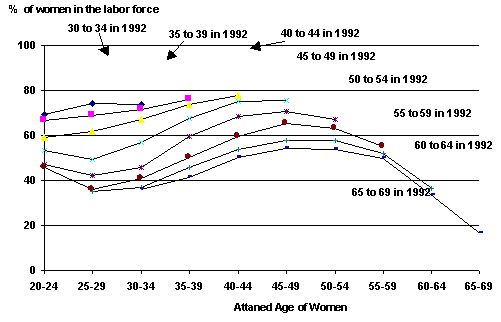
We believe the treatment of tax-qualified plans is a reasonable basis for our recommendations on the tax treatment of PSA accumulations, and the analysis we used to draw this conclusion calls into question the proposed tax treatment of Social Security benefits under both the MB and IA proposals. In both cases Social Security benefits would be taxed in the same way as the regular savings account shown in Table 1, rather than as a tax-preferred retirement account. We believe that policies that effectively impose a tax penalty on workers for deferring consumption from the working portion of their lives to the retirement portion is not justifiable under any circumstances. We believe it is particularly insidious when workers are required by law to defer that consumption and are then effectively punished for complying with the law. Given the low rates of return that current workers face under Social Security, there is absolutely no justification for taxing more than 50 percent of benefits, the portion financed with employer pretax contributions. Another concern expressed about the PSA proposal—or any proposal that links benefits more directly to taxes paid—is that women will be disadvantaged and, therefore, that personal accounts must not be part of reform. We reject this claim. Before explaining why, two points need to be clarified: First, elderly women now on the benefit rolls would be unaffected by personal accounts or by any other benefit changes in the PSA proposal. In fact, older workers and retirees would actually benefit from the increase in widow(er) benefits we propose. Second, because of women’s greater longevity, they presently fare better than comparably situated men—and would continue to do so in future decades under the new tier-one benefit. Simply put, men and women with the same earnings pay the same tax rates and collect the same monthly benefit (assuming that neither is receiving a spouse benefit that would be added onto their own earned benefit), but on average, women collect benefits about four years longer than men, and this gap is widening. Among younger people who are potentially affected by personal accounts, everyone—male and female alike—who works and pays Social Security taxes would build protection under a personal account from the first dollar earned in covered employment. Under the present system, people must work or be married a certain number of years to qualify for benefits, and secondary earners in two-earner couples must earn a significant share of the couple’s combined earnings in order to receive any return on the taxes they pay. Unlike the current system, personal accounts offer everyone, both married and single, the security of knowing that 5 percent of their covered earnings annually will go into a personal account that they own and invest, and which earns interest. This will be the case no matter when the wages are earned on which contributions are made, and no matter whether these wages are earned through continuous or very sporadic work or whether they comprise a large or small share of a couple’s combined earnings. Each worker’s account would be independent of any accounts their spouse may be accumulating. The income that is generated by these accounts will be additive to any other benefits the individuals will be entitled to receive. The proceeds of the personal accounts will not reduce any other Social Security benefits. Implicit in the concern voiced about this proposal and its treatment of women is an increasingly outdated view of women in the American workforce—one in which women are dependent on their husbands for their means of support in old age. In this view, women generally do not work for pay, and if they do, generally do so for relatively brief periods before or after child rearing or the death of a spouse. However, the percentage of women awarded benefits on the basis of their own work history has risen substantially over the years. In 1994, fully 62 percent of women were awarded benefits as retired workers, rather than through their role as spouse. In comparison to women who are retired today, many more women in the future are expected to receive Social Security based on their own earnings. This is because of the systematic increase in labor force participation among women. Figure 3 shows labor force participation rates over the years of women of various ages in 1992. The bottom line in the figure, for example, shows the labor force participation rates of women aged 65 to 69 in 1992, at various ages during their lives. When these women were ages 30 to 34, in the mid-1950s, 35.8 percent of them were in the labor force; five years later, when they were between the ages of 35 and 39, 41.3 percent were in the labor force. Their labor force participation peaked in 1972 when, aged 45 to 49, 54.4 percent were in the labor force. The line just above the bottom line in the figure shows the labor force participation rates at various ages for the cohort of women who were 60 to 64 in 1992; the third line from the bottom shows the labor force participation rates at various ages for women who were ages 55 to 59 in 1992; and so forth. Figure 3 Labor Force Participation Rates Over the Lives of Women, by Age in 1992
Source: U.S. Department of Labor, Bureau of Labor Statistics.
At the end of 1992, there were 4.98 million women between the ages of 65 and 69 receiving Social Security benefits. Of these, 62.2 percent were receiving retired worker benefits. 16 As pointed out earlier, the labor force participation rate of this group of women peaked at 54.4 percent when they were in their late 40s. This means that the percentage of women receiving worker benefits in this age group was about 10 percentage points higher than their peak labor force participation rate. This situation arose because some of these women earned their benefit rights either before or after their late 40s, but were not in the labor force at the time the overall labor force participation rate for their group was at its zenith. Over the last half of this century, labor force participation has been higher for every successive cohort of women. The daughters of currently retired women have had labor force participation rates that are consistently 25 to 30 percentage points higher than their mothers had at corresponding ages.
As women’s education levels and work histories have more closely reflected those of their male counterparts, the so-called "gender gap" in earnings also has been closing. People with similar earnings and contribution rates would accumulate PSA balances that vary only due to investment choices and performance. We know of no evidence that women systematically make inferior investment choices. Ultimately, the impact of the personal accounts cannot be evaluated independently of the tier-one benefit, which as noted earlier is highly redistributive to low-wage workers. For women who only work a brief portion of their career outside the home, or only hold marginal part-time jobs for extended periods, the combination of their tier-one benefit, which retains the spousal benefit, and their PSA accumulation is likely to be more generous than current-law benefits. Furthermore, such a worker, if married, would receive an increased tier-one benefit if her spouse predeceases her, plus she can inherit any balance that is left in his PSA. The more typical situation for women in the future will be that of being a partner in a two-earner couple, where both spouses have had relatively full working careers. Two-earner couples will be most appropriately analyzed as two workers rather than as a worker and a non-working spouse. The comparative analysis suggests that women would generally fare relatively well under the PSA proposal. Another concern that has been raised by critics of the PSA proposal is that it would create a financial windfall for companies and individuals in the financial sector of the economy. We assume that the underlying premise of this concern is that those engaged in the business of managing other people’s money will have larger incomes if a proposal of this sort is adopted. In general terms, we note that all three of the plans included in this report would increase investment in private equities markets. That increased investment will involve added work and fees for companies and individuals in the financial sector. More specifically, relative to our own plan the response to this concern involves two separate considerations. First, this proposal was motivated by our desire to fully fund a portion of the accruing obligations under our basic national retirement program. For years actuaries and economists have understood that there are tremendous benefits to funding retirement programs rather than financing them on a pay-as-you-go basis. The process of funding involves accumulation of assets that someone has to manage. The motivation for funding retirement programs has nothing to do with expanding asset managers’ workloads, it has to do with achieving the gains that accrue from funding. These gains include increased interest earnings on workers’ PSA contributions, in addition to higher real wages and national income resulting from added savings and investment. The larger workload that asset managers would realize is purely a byproduct of the decision to improve the funding base of Social Security. Our support for the PSA proposal is based on the much greater potential benefits it holds for workers, retirees, and the economy than the other plans before the Advisory Council. Second, while the PSA proposal will result in substantial accumulations of assets that will be managed by professional asset managers, it does not follow that people or businesses in the financial management sector of the economy will make exorbitant profits. The financial services business is extremely competitive. There are retail mutual funds that will provide investment management services for 20 or 30 basis points per year. Over the long-term the kinds of portfolios that they offer have generated rates of return that are 400 or 500 basis points above the rates of return that might be expected from investing only in government bonds, and 600 to 700 basis points above the rates of return workers in a pay-as-you-go retirement plan could expect in a demographically stable environment. In the short term, some individuals and businesses may profit from the implementation of a PSA-type proposal—those that properly anticipate the demands of workers and have the capital in place to meet those demands. However, with substantially more money to be managed, new people and businesses would surely enter the market, eliminating the potential for any continuing "windfall" profits. If there is a concern that some potential asset managers might cheat workers, such behavior is already outlawed and made punishable by fines and imprisonment. Under our proposal, the Disability Insurance and Survivors Insurance portions of Social Security remain government-administered programs with benefits largely, but not entirely, calculated as under present law. In the case of DI, it was generally believed that the complexities of the program precluded a serious examination of reform options by this Advisory Council. For example, there was no consideration given to the question of requiring individuals to purchase private disability insurance policies. However, given the linkages between the Social Security retirement and disability programs--and the rapid growth of DI in recent years--it was impossible to ignore DI altogether. The problem we confronted in developing the PSA plan involved the retirement age. 17As the Social Security normal retirement age rises, as it does under our plan and the IA plan, the penalty for drawing benefits early also rises. This heightens a financial incentive older workers already have to file for disability benefits: under present law, a worker who can qualify for disability benefits at age 62 can draw a full, unreduced benefit whereas the worker who chooses to retire at 62 suffers a 20 percent benefit reduction. Following legislation first introduced by the former Chairman of the House Social Security Subcommittee, Congressman Jake Pickle (D-Tex.), our proposal applies a limit to DI benefits such that a worker can not draw larger benefits under the disability program than he or she could draw under the retirement program. DI benefits would continue to be calculated as under present law, based on average indexed monthly earnings, but would be capped at the amount payable to an age 65 retiree. This means that workers becoming disabled in future decades will receive lower benefits than they would under present law. The first group of workers affected by this change, those eligible for benefits in 2000, would experience only a relatively small change, only about 0.5 percent relative to present law. The size of the reduction would rise over time for future workers, reaching 20 percent for workers eligible for benefits in 2035 and reaching a limit of 30 percent decades later in 2085. Unfortunately, to avoid arbitrary notches in benefit levels, this change in the formula affecting older workers had to affect workers of all ages. Certainly, we would have preferred to eliminate subsidies for older people choosing disability benefits over retirement benefits without reducing protection for younger people with disabilities, many of whom are seriously disabled and have little choice about working. There was no simple answer to this problem, however. 18Disabilities do not tend to be all-or-none, and disability decisions typically are not black-and-white. There is considerable room for discretion in decision making, particularly for workers at older ages. The DI program has been growing very rapidly in recent years and failing to deal with this problem, in our view, would have been fiscally irresponsible. 	 Having said this, as shown in the "Comparison of Plans" section of this report, the impact of the PSA proposal on workers who become disabled is mitigated when these workers reach age 62 and are able to gain access to their PSA accumulations. A number of critics of the PSA proposal have argued that creating a two-tiered system of the sort that we propose would lead many workers to abandon their support for the redistributive aspects of Social Security. We have two responses to this concern. First, the redistributive nature of the benefits under the PSA plans is not all that different than the structure of benefits that the American public has supported for more than half a century. We do not believe that they support this benefit structure because of the extremely complicated way in which the redistribution is now achieved. With the two-tiered approach we have proposed, the redistributive component of the program will be more visible and easier to explain to the American people and, therefore, it should garner their ongoing support even more readily. We are aware that some people want to retain the current benefit structure because they believe more redistribution is accomplished than would be possible if the public generally understood it, and they believe that this is desirable. We do not share this view. We believe American workers should have a clear understanding of who gets what from Social Security and at what price. We also believe that Americans have demonstrated over the years their strong support for helping lower-income people, especially lower-income elderly people. Second, a number of other countries have two-tiered programs with flat benefits in the first tier and these programs have retained the support of their citizens. Both the Canadian and United Kingdom’s systems are examples of this sort of structure that have operated for years in English-speaking countries. Others have suggested that in a system which includes personal accounts, everyone must fend for himself or herself. Clearly, the PSA proposal is not subject to this criticism. Our proposal requires all workers to save for their retirement and provides a base benefit for retirees financed by all workers. The net result, we believe, will be a stronger and sounder Social Security program and a higher standard of living for future generations. As we said earlier, we support our proposal because we believe it would be the most effective in providing retirement security for current and future workers, and the most equitable in delivering benefits across generations in relation to the contributions those generations will make. We also believe our proposal is the most promising for helping to spur economic growth in the future. There are several specific reasons we oppose the other two plans. There are five fundamental reasons why we oppose the Maintenance of Benefits (MB) proposal that has been put forward by six members of the Advisory Council. The first has to do with the presentation of the proposal. The other four have to do with the substance of the proposal. Our first reason for opposing this plan relates to its presentation. For the last 18 to 20 months, we have been raising what we believe to be substantive questions about the desirability of having the federal government become the largest holder of private capital in our economy. Throughout the deliberations of the Council, our concerns were dismissed. Through the penultimate draft of the Council’s report, dated in late October 1996, the advocates of the Maintenance of Benefits option had described their proposal as envisioning "large scale investment of OASDI Trust Fund monies in the equity market in order to help bring the program into balance…" The final version presented to the Council in late November 1996, "envisions, after a period of study and evaluation, the possibility of a large-scale investment of OASDI Trust Fund monies…" [emphasis added]. Even though the proponents of this proposal seem to be having second thoughts about its desirability as we approach the end of our lengthy deliberations, all of the comparative analyses of the plans contained in this report—including all of the actuarial analyses—assume that this change is still part of the basic proposal. This element of their proposal has been the largest single "fix" that they had to offer. The remainder of their proposal is wholly inadequate to rebalance the system: over one-third of the long-range deficit is left unsolved. Moreover, the remainder of their proposal is wholly inadequate to achieve the benefit levels contained in the various actuarial analyses. Additional tax increases would be required, and they would hit younger generations the hardest. The remainder of our comments relate to our opposition to central government investment of trust fund monies in the private sector. First, we do not believe that it is desirable for the federal government to become a large investor in the private capital markets of this country. The proponents of the MB plan would have us believe that Congress would (and could) follow a passive investment strategy that would generate favorable rates of return for the trust funds, expose workers and retirees to minimal risks, and be neutral in its effects on U.S. capital markets. We do not share this view. We believe that with the accumulation of such vast equity holdings--$1 trillion or more in constant 1996 dollars by the year 2015—the pressures to use the funds for socially or politically "desirable goals" would be tremendous, putting at risk not only workers’ taxes and retirees’ benefits, but also the allocation of capital in the economy. We know as a practical matter that even if Congress were able to overcome all political temptations, and devise a truly passive (and neutral) investment strategy, there would be no way for it to bind future Congresses to comply with this strategy. It is worth noting that the current administration has suggested that some share of employer-sponsored retirement plan assets should perhaps be used for "economically targeted investments." This term is generally considered to mean making investment decisions to achieve socially desirable purposes rather than basing the decisions solely on their economic risk and return. The current administration also used federal pension funds to avoid debt ceiling limits when it could not resolve its budget differences with Congress in early 1996. More generally, while we are all aware that rules can be devised that would require investments to be made passively through index funds, our concern is that there is no assurance that such rules would be devised and enacted by Congress and no means at all by which to bind future Congresses. One can easily imagine the political pressures that would come to bear on Congress to drop shares of certain companies from the index, perhaps tobacco companies or companies deemed to have unfavorable labor practices; the pressures to add shares of other companies, perhaps those with favorable work conditions and employee-benefit packages; or the pressures to dump shares when the market experiences a drop in value. Any such activity would immediately render a passive investment strategy active and politicized, and, to the best of our knowledge, active management of a massive reserve fund has virtually no support on the Advisory Council. Second, we believe that if the government were to become a large investor in the private capital base of our economy it would create tremendous conflicts of interest for the government in its roles as fiduciary for Social Security participants, on the one hand, and regulator of business in the interest of the public welfare on the other. Consider, for example, the situation that we would be facing today if the government were the largest investor in tobacco companies. How could it resolve its responsibility to protect the worth of the assets that were the basis of workers’ retirement income security while considering the need to regulate the sale of tobacco products in the interest of protecting the public’s health? Third, we believe that the issues of corporate governance raised by this proposal are extremely important. The suggestion that Social Security could be a passive investor not exercising its shareholder rights, including voting proxies, in the large number of companies in which it would own stocks completely ignores the redistribution of ownership rights and management control that would result. The recommendation indicates that investments would not be made in all stocks in the economy, only in those represented by major indexes. This suggests that Social Security could become the largest shareholder, owning 5 to 10 percent of the stocks of virtually all of the largest companies in the United States. With that kind of ownership share being passive, other minority investors would be cast into positions of having majority control in some of the companies involved. Would this prove to be a universal problem? Probably not. In cases where corporate policy issues were extremely contentious and the power balance between those on one side or the other of the issues was slim, however, this policy could be a decisive factor in determining corporate control. Furthermore, the government has consistently taken the position that the voting of proxies for stock held by pension plans is a fiduciary act. Ignoring proxies is not an option for fiduciaries of private-sector pension plans. Why should this responsibility be waived for the trustees of Social Security? Fourth, the MB proposal holds out a false promise to the American worker. It suggests that the underfunding in the current system can largely be overcome without any added costs being borne. As the proponents’ summary of this proposal suggests: "The sole purpose of Social Security’s investment in equities is to secure a higher return than can be obtained from the present practice of investing all funds in government bonds." There are at least three false premises underlying this false promise to American workers—first, that the government can just swap debt for equity and make trillions of dollars in the process; second, that there are no serious political consequences to consider when government-run trust funds take on the financial risks of equity investment; and third, that there is not some significant risk that the Congress would reject the proposal that it be entrusted as portfolio manager to the nation’s 140 million worker-taxpayers, leaving a very substantial funding shortfall in the MB proposal. As to the first premise, the comparative analysis of the proposals shows that this proposal generates little in the way of added savings in the national economy over its early years. The accumulation of $1 trillion in equities is to be accomplished largely by swapping the government bonds the trust funds otherwise would have held for equities. As Gramlich and Twinney argue in their separate statement, if it is such a good idea for the government to trade $1 trillion worth of bonds for equities, why doesn’t it just issue the bonds today and buy the equities straight out. Of course, almost all economists and financial analysts would tell us that such policies would change relative interest rates, increasing rates on government bonds relative to private securities and resulting in a potentially large redistribution of wealth from existing bond holders toward new bond holders and from new equity investors toward existing equity holders. Federal Reserve Chairman Alan Greenspan made this point recently, stating that merely investing the current trust funds in stocks would boost interest rates on government bonds. He concluded "[A]t best, the results of this restricted form of privatization are ambiguous." 19The great swap experiment may improve returns to the trust funds, but not without imposing large uncompensated losses on many Americans. Anyone who holds out to the American people the hope that there is a no cost option for solving the problems we face with our entitlement programs is grossly distorting the facts. We are aware that there may be salutary effects to forcing the government to compete in the open market to sell the bonds it issues to the trust funds, but these could be achieved with fewer economic and political risks under the PSA plan. As to the second premise, we do not believe that the supporters of the MB plan have adequately considered the political and financial consequences of major movements in equity values. With the federal government holding trillions of dollars in private equities in the Social Security trust funds, what would happen if there were a major drop in equity values? Could Congress stand by idly as the value of Social Security’s portfolio dropped? How long could it stand by idly? Would it alter its investment strategy mid-stream, turning a passive into an active strategy? Would it resort to general revenue bailouts to "hold the trust funds harmless?" What kind of pressures might Congress bring on the exchanges and on financial regulators to slow market adjustments? Alternatively, if fund managers adjusted equity holdings to maintain either a fixed share of equities or a target rate of return on the overall portfolio, how would this be done without adversely affecting share values? The run-up in the stock market in 1995 and again in 1996, for example, presumably would have required a major selling off of equity shares. How often and how quickly would such adjustments be made? Proponents of the MB plan did not evaluate these possibilities. We believe that these political and financial risks are far larger with a centralized investment mechanism than with the highly decentralized mechanism in our PSA plan. As to the third premise, it is our view that Congress and the American people would recognize the political and economic pitfalls of putting the federal government in the position of portfolio manager and would reject this proposal. If it did, a payroll tax increase of at least 0.82 percentage points would be required to offset the revenue loss. Fifth, there was a broad consensus among the members of the Advisory Council that proposals to increase the payroll tax to deliver benefits in the context of the current benefit structure were not desirable. Yet this proposal does precisely that. Delaying the tax increase until the next century, or failing to acknowledge the need for an earlier tax increase, does not change this reality. As a related matter, we believe the proposal to increase the payroll tax rate by 1.60 percent—employee and employer rates combined—in 2045 is grossly unfair to a whole generation of citizens who cannot possibly defend their own political interests. This proposal amounts to nothing more than imposing a tax that we are not willing to pay ourselves on our grandchildren who have not yet been born. While we do not agree with many of the characterizations of Social Security as nothing more than a Ponzi scheme, we can understand why some citizens might resort to such characterizations when they see proposals of this sort. We would also note our concern with the way the asset allocation decision in the MB option appears to have been developed. The amount of Social Security reserves to be invested in private equity was not determined by an analysis of the excess returns relative to risk for different asset classes—in this case, private equities and government bonds—or, in more general terms, by an analysis of the degree of risk that would or should be borne by Social Security taxpayers and beneficiaries. Nor was any analysis conducted of the way the risks of equity investment would or should be allocated between taxpayers and beneficiaries. Without these kinds of analyses, we presume that the asset allocation decision was simply derived, given the assumed excess return to equities, as that which was required to generate sufficient additional earnings to the trust funds to make necessary only the most modest reductions in future benefits. This is troubling on its face—even more so now that the proponents of the MB plan appear to have withdrawn their support for this proposal.
Why We Oppose the Individual Accounts Proposal We oppose the Individual Accounts (IA) proposal for some, but not all, of the same reasons that we oppose the MB plan. We have some additional reasons for opposing this plan as well. Our first concern is that this option simply contains far more restrictions on workers' choices than we deem necessary or desirable. The option sharply limits workers’ investment choices—how much is unspecified, but probably involves no more than three or four stock and bond index funds, if modeled after the Thrift Saving Plan for federal employees. Presumably in order to prevent some workers from making costly mistakes, the government would prevent all workers from making truly profitable investments—such as investment in a high-growth fund that, while on the high end of administrative fees, may net a return better than the market average. The plan also forces workers to annuitize their full accumulations at retirement—no matter what their other sources of income, their life expectancy, or their medical or other family needs. Presumably in order to prevent any worker from depleting his or her accumulation and potentially falling into poverty before the end of life, the government would prevent all workers from having the opportunity to bequeath a portion of this wealth to their heirs. Second, by requiring individual accounts to be held by the government, the IA plan puts the government in a line of business the private sector is better equipped to handle. While the purported purpose is to take advantage of "economies of scale" in administration, which many large money managers, no doubt, have already achieved, it leaves the government in a unique position to change the law governing these accounts, raising concerns about political risks. Under this option, workers must make mandatory contributions to one or more of a limited set of investment funds, funds that are selected and held by the federal government. Assuming a mix of bonds and equities consistent with workers’ distribution of assets in 401(k) plans, the actuaries project that, in 1996 dollars, the government would be holding $1.6 trillion in 2020 and $4.0 trillion in 2040 in private equities on behalf of covered workers. As before, this raises a question about the ability of the government to remain a passive actor while holding so much private equity. Finally, with respect to the regular Social security program, the IA plan results in very large reserve funds—the equivalent of more than four years of benefit payments by 2020—and yet offers nothing in the way of a constructive investment policy. Despite the many concerns raised over the years about whether the Social Security reserves are saved and contribute to national saving--or simply fund expansions in the rest of the budget—the IA plan retains the government's present "investment policy," meaning that all surplus funds would be channeled into special-issue U.S. government bonds, which are little more than IOU's from one part of the government to another. The PSA option, by contrast, substantially scales back the size of the basic first tier Social Security program and attempts to keep reserve funds at a level no higher than deemed necessary for an adequate contingency fund; this substantially reduces the fiscal distortions that may result under present-law investment policy. We do applaud the proponents of the IA plan in their straightforward acknowledgment of the added cost of the plan to workers. We believe that it is vitally important that policymakers be straightforward with the American people about the costs of these proposals and we would note that this in not a characteristic of all of the reform proposals that have been put forward. The individual account add-on to Social Security, created under the IA plan, has been likened to the Thrift Savings Plan for federal employees, which is held up as a model by some. In one sense the analogy is apt: the government would offer participants a narrow range of investment options, presumably including equity and bond index funds, and the individual accounts would be managed by the federal government. But under the TSP, workers may invest in one or more of three passively managed index funds—a federal government bond fund, a corporate bond fund, and a commercial large capitalization stock fund. Under the IA plan, workers must invest in one or more of the funds offered. Under the TSP, contributions, which may be as high as 10 percent of earnings, are entirely voluntary. If displeased with restrictions imposed on, or the performance of, a particular fund, workers can shift their contributions and interest earnings to another fund, reduce the size of their contributions or stop making contributions altogether, and, in certain circumstances, withdraw their contributions and earnings. In a very real sense, the funds compete head-to-head with private funds and other private investments, not just with one another. The competition fostered by individual choice and the mobility of resources places real limits on the inefficiencies that can be imposed by Congress or by its designated governing board. There is no similar competitive check under the individual-accounts proposal. The IA plan mandates that workers invest a fixed amount of their earnings in one or more pre-selected funds; there is no freedom to reduce contributions, stop making contributions, or to reallocate them to privately managed investments. Because the MB plan has no individual involvement at all, the Thrift Savings Plan analogy is even less appropriate. It is interesting to note in this regard that the Kerrey-Simpson legislation would allow workers to invest either in one or more of a set of Thrift Saving-style funds held by the federal system or in IRAs. This gives workers a critically important escape hatch in the event the funds offered by the government fail to perform as expected, the information and management services are inadequate, or the range of investment options is too narrow to provide the desired mix of portfolio risk and return. A recent GAO report noted that the three index funds offered by the TSP did not reflect the range of investment options offered by private-sector 401(k) plans and supported the addition of expanded fund offerings. In addition, in trying to draw a comparison between the TSP and the MB or IA plans, supporters cite the experience with the TSP as evidence that their investment board would not be politically influenced. There is no comparison, however, between the scale of operations of the TSP and that of Social Security—even now, let alone as projected under the MB or IA plans. As of January 1995, about one million workers were making voluntary contributions to the TSP and total investments were $27 billion. This compares to Social Security’s current reserve fund of about one-half trillion dollars, which already exceeds by a factor of nearly 20-fold that of the TSP and dwarfs the largest corporate pension funds held by U.S. corporations, including such giants as IBM, AT&T, and General Motors. The problems of political management and control of investment funds and fund managers can be expected to increase exponentially with assets as large as those contemplated under the various proposals for centrally-managed investments. These problems must be weighed carefully against the supposed gains attributable to sharply curtailing individual choice and reducing the availability of competing investment options so as to prevent some workers from taking undue or inadequate risks (as defined by whom?). An effective—and effectively controlled—investment policy requires that competition be fostered wherever possible. Competition fosters the dissemination of information on alternative investments, investment strategies, and investment managers that is needed by citizens and policymakers if resources are to flow to their highest valued uses. We are concerned that some opponents of reform seek to minimize the challenges we face in retooling Social Security to meet the needs of future generations and restore the public’s confidence in the program. Modest changes that only delay the day of reckoning, without addressing the root causes of the problem, are an abdication of our responsibility to today’s workers and their children. The time has come to discuss new approaches that can improve Social Security, expand our economy, and improve standards of living. Throughout our deliberations, one group of Council members asserted repeatedly that Social Security is not in "crisis" and that only moderate changes to the system are needed. Several of the rest of us on the Council believe that the constant refrain that there is no "crisis" is a contrived straw man, one that proponents of the status quo use to shut down debate on substantive issues and delay action by policymakers. The word "crisis" suggests a pending imminent catastrophe unless immediate evasive action is taken. The fact that Social Security is not projected to run cash-flow deficits for another 15 to 20 years and is not projected to exhaust its assets until 2029 hardly fits into the category of imminent on most people’s time horizon. But a few words of caution are in order. First, it would be foolhardy at best to say that we know the date of insolvency is 2029. This just happens to be the most recent official projection. As Council members know all too well, the government’s official projections of Social Security’s long-range financial status, issued annually by the Social Security Board of Trustees, have deteriorated in almost every year since the last major legislation in 1983. Since 1983, the projected date of insolvency has slipped from 2063 to 2029 and the peak amount of Social Security reserves has fallen from $20.7 trillion to $2.8 trillion. As Council members also know well, the Trustees’ long-range projections are surrounded by a high degree of uncertainty. Second, it is simply wrong to say that the system is not projected to "run out of money." This is precisely what happens when a trillion dollar plus reserve fund hits zero. Social Security has no open tap on the federal Treasury that keeps the money flowing and full benefits going out on time. The fact that workers must continue paying taxes does not change the reality that when the reserves are depleted, if checks are to continue to go out on time, they will have to be cut in amount. There was a time, as recently as 1983, that the prospect of being unable to pay full benefits on time was widely regarded as a crisis. Having said this, suppose we take the 1996 Trustees’ Report as the best available projection of what the future is likely to hold—it projects annual cash flow deficits beginning in 2012 and insolvency in 2029. The substantive issue then becomes whether it matters when Congress acts to restore long-range solvency. There was broad agreement on the Council that early action should be a high priority. Delaying action until the problem is more imminent will result in much more disruption in the plans and expectations of American workers and retirees, and, quite possibly, doom reforms that could bring significant benefits to younger workers and future generations. In addition, it will fuel public skepticism about the willingness and the ability of the government to make good on its long-term benefit promises under Social Security. All of us on the Advisory Council agree that there is no imminent pending catastrophe in Social Security’s financing. But a number of us believe that delaying the changes needed to right the system would be a tremendous disservice to the American people. To illustrate the consequences of delayed action, consider an example in which we wished to immediately rebalance the program and were willing to accumulate substantial assets in the trust funds. Under this scenario, an across-the-board benefit reduction of 15 percent today would solve the projected deficit in the system. If we wait another decade to rebalance the system, the benefit cuts would need to be somewhere around 25 percent. If we wait until after 2010, they would be around 35 percent. Now consider the fact that across-the-board benefit reductions, which affect current as well as future beneficiaries, cannot be implemented on short notice. If policymakers imposed a 15 percent reduction in benefits effective January 1, 1998, many current retirees would be thrown into an immediate situation of having inadequate resources to meet current consumption needs. Rent payments, grocery bills, and so forth, cannot easily be adjusted for people who often have the smallest margins of extra monthly income. In light of this, it is important to realize that the costs of balancing the system will be larger on a prospective basis than the current underfunding levels suggest. The reason that we believe action is needed now is because of the potential harm that could come from delaying change. In our deliberations, the Advisory Council saw tremendous resistance to proposals to rebalance Social Security by increasing payroll tax burdens. In contrast, we saw a number of proposals that had been put forward in recent years that would depend largely on benefit reductions. Such proposals have been proffered by several sitting and former members of Congress. These proposals have come from both parties and from individuals across the political spectrum. The former Democratic Chairman of the Social Security Subcommittee of the House of Representatives’ Committee on Ways and Means put forward a proposal in 1994 that relied almost solely on benefit reductions. It is the likelihood of benefit reductions, albeit on a prospective basis, that makes the need for change particularly urgent. Benefit reductions are not just a problem for retirees. If policymakers decide to shore up Social Security mainly by reducing benefits, many workers would naturally want to make up for some of the resulting loss in their retirement income by increasing their savings. Delay in adopting the needed policy changes simply magnifies the burden for workers trying to make appropriate adjustments. For example, suppose that at some future time Congress adopts a policy that involves benefit cuts of 25 percent relative to current law. Suppose further that many workers would still want to retire at age 65 and maintain the standard of living in retirement that they are planning for under current law. A worker only 10 years from retirement would have to save an additional 10 percent of wages over the last decade of his or her career to make up for such a benefit reduction. For a worker 20 years from retirement, the marginal increase in needed savings drops to 4.5 percent of wages. If we can give the worker 30 years of lead time, it drops to 3 percent. Are we facing an imminent catastrophe in the delivery of benefits through Social Security? No. Have we reached the point that some viable policy options could cause extreme disruption to the retirement hopes of many workers? Yes. If we wait another decade to address this issue, the Social Security system may still not be in "crisis" in the sense of there being an imminent potential catastrophe for the program, but some workers, and possibly some retirees, will face a crisis in dealing with the changes that are required. Certain options that are now available no longer will be available. We are unanimous in the view that policymakers should deal with this problem immediately and in a serious fashion. While we know there is no imminent danger that Social Security benefit checks will not be mailed on schedule, we are concerned about the growing public doubts about the long-term viability of the program. We believe that the underfunding of Social Security is partly to blame for the lack of confidence in the system. While much of the public might not fully understand the nuances of Social Security financing, people do understand—and feel threatened by—news reports that the Social Security Trustees are predicting the trust funds will be depleted sooner than previously expected and during their expected lifetimes. In addition, we believe that the decline in the value of Social Security benefits relative to taxes paid contributes to declining public confidence among younger people and to increased interest in private alternatives to Social Security. Figure 4 shows the percentage of the public indicating that they were not confident in the program from a number of national surveys done over the last 20 years. The initial survey was done in 1975 before there was a widespread appreciation of the financing problems created by the changes to Social Security adopted in 1972. Those changes led to unanticipated increases in benefit levels for new beneficiaries during the 1970s. The level of non-confidence in the system grew steadily from the 1972 survey until 1983 when Social Security’s short-term funding crisis was addressed. By 1983, nearly two out of three people indicated a lack of confidence in Social Security. That lack of confidence declined somewhat as the trust funds began to accumulate substantial balances after the 1983 Amendments. Since 1983, as successive Trustee’s Reports have indicated that the trust funds will be depleted toward the beginning of the baby boomers’ retirement, the lack of confidence has been rising again. Figure 4 Percentage of Respondents in Public Surveys Reporting They Are "Not Too Confident" or "Not At All Confident" about the Future of Social Security
Source: American Council of Life Insurance, "Monitoring Attitudes of the Public" surveys by Yankelovich, Skelly and White (1975-1982) and the Roper Organization/Roper Starch Worldwide (1983-1994) as reported in Jennifer Baggette, Robert Y. Shapiro, and Lawrence Jacobs, "The Polls—Poll Trends, Social Security—an Update," Public Opinion Quarterly (Fall 1995), vol. 59, no. 3, p. 426. Numerous recent public opinion polls reveal the same basic finding: most people lack faith that Social Security will be there throughout their retirement. Polls also reveal that people are more confident in their own private savings and their employer-provided pensions than in Social Security. We believe that it is vital that the public have full faith and confidence in Social Security if we are to expect younger workers and future generations to contribute to and continue to support the system. We believe that it is impossible to generate such faith and confidence in the system when annual Trustee’s Reports project deteriorating long-range finances and the depletion of trust fund balances within the life expectancy of current workers. Finally we believe that a system that provides workers with an opportunity to accumulate real, owned wealth, along with a backstop of protection against a lack of success during their working lives, is one that will generate much more confidence than the current system which is based largely on unfunded promises. Besides the additional personal confidence that workers will achieve with the accumulation of wealth as the foundation for their retirement security, the potential increase in real savings and investment that can be achieved by funding a portion of Social Security will provide further benefits to workers and to the economy as a whole. Virtually all economists today believe that savings rates in the United States are too low. They believe that higher savings rates will lead to more investment and to an expansion of the economy that, in turn, will lead to higher levels of real income in future decades. And virtually all economists and financial analysts believe that the rate of return to private capital investment is substantially higher than the implicit rate of return Social Security can offer in the decades ahead. We believe it is imperative that policymakers seek solutions to the Social Security financing problem that translate into significant increases in national savings and investment. Another word heard frequently during our deliberations from one group of Council members was "radical," which appeared to be used about any proposal this group deemed sufficiently different from its own. In our view, this too was designed to shut off rather than to encourage debate. There was a time, in the early 1930s, that Social Security was considered "radical." There was a time, as recently as the early 1980s, when benefit taxation was considered radical and a fundamental breach of the government’s promises to the nation’s elderly; today, taxation of benefits is accepted and proposals for increasing the amount of benefits subject to taxation are commonplace. There was a time when proposals to accumulate very large reserves in the Social Security trust funds--especially if those funds were to be invested in private markets--were considered radical. Perhaps they still are. This, of course, is the heart of the reform proposal offered by the group of Council members so quick to decry other proposals as radical. And there was a time when discussing personal accounts as a component of Social Security was radical; today, systems based on personal accounts are in place in many countries around the world and there is intense interest in the United States in these and similar reforms. People unfamiliar with social security systems around the world may not realize that there are models for the kinds of changes proposed by all three groups. To mention only a few, the Singapore social security system is a model, although on a far larger scale, for the individual accounts in the IA plan. Sweden has also been considering such a plan. The two-tiered social security system in the United Kingdom is similar to the PSA plan in many regards, including the provision of a floor benefit based on years of work and a second tier which permits individuals to invest in personal accounts rather than in their social security system. In our view, what is "radical" and what is "tinkering" reform is in the eye of the beholder, differing across people and countries and over time. If the nation’s policymakers are to make any substantive headway in understanding the problems confronting Social Security and the range of options for dealing with them, we must get beyond such politically charged words. There are legitimate and important issues to debate about the IA plan and our PSA plan, just as there are about the MB plan, and we do not believe that decrying the plans as "radical" or as "fundamentally changing the nature of social security" promotes an open or informative exchange of ideas. FOOTNOTES 1 Joan T. Bok, Ann L. Combs, and Fidel A. Vargas would like to acknowledge the contributions of Sylvester J. Schieber and Carolyn L. Weaver to the preparation of this statement. 2OASI taxes (employee and employer shares combined) and benefits only. Dean R. Leimer, "Cohort-Specific Measures of Lifetime Net Social Security Transfers," Office of Research and Statistics Working Paper no. 59, Social Security Administration (February 1994), p. 52. 3Estimates of returns on non-financial corporate capital in the period 1960 to 1994. See Richard Rippe, "Further Gains in Corporate Profitability," Economic Outlook Monthly, Prudential Securities, Inc., August 1995, and Martin Feldstein, "The Missing Piece in Policy Analysis: Social Security Reform," National Bureau of Economic Research Working Paper no. 5413 (January 1996). 4For example, under the assumption that benefits are scaled back to restore pay-as-you-go financing, Leimer projects that average rates of return fall to 0.8 percent for future birth cohorts. See ibid., p. 52. 5 Because the flat benefit is wage indexed for each successive cohort of workers until they are eligible to receive benefits, the flat benefit would increase relative to the poverty line over time because the latter is price indexed. 6 Over the period 1900-1995, which includes the Great Depression, World War II, and the market drop of October 1987. See Appendix II. According to data compiled by Ibbotson Associates, during the period 1926-1995, in which the average real rate of return on stocks was 7.2 percent, there was no 30-year period in which the average return fell below 4.4 percent. 7 The rates used imply a 4.7 percent spread between stocks and bonds. Over the last 100 years, the real return to stocks has exceeded the real return on Treasury bills by about 6 percent annually. See Narayana R. Kocherlakota, "The Equity Premium: It's Still a Puzzle," Journal of Economic Literature, vol. 34 (March 1996), p. 42. 8 For amplification on this point, see the discussion of our opposition to the MB plan later in this statement. 9 This is basically the IA plan without the individual accounts add-on. For interested readers, the actuarial memo in Appendix II also provides estimates based on the assumption that taxes are raised to restore actuarial balance. Since there was virtually no support on the Advisory Council for tax increases to finance benefits under the existing system, we did not regard this as a reasonable baseline. 10 Refer to Tables IRR1-IRR4 in Appendix II. In these tables, our baseline is referred to as "MTR," for maintain tax rate. Our plan is referred to as 5%PSA-401K, representing the intermediate investment option following 401(k) allocations. (The lower and higher yield options are designed as 5%PSA-US Bond and 5%PSA-Hi-Yield, and are explained more fully in the Appendix memo.) The IA plan is referred to as 1.6%IA—401K (with higher and lower yield options also shown). 11In evaluating rates of return under the PSA plan, recall that only half of the retirement program is replaced by private accounts, leaving the balance earning the very low average rates of return of a pay-as-you-go system. Studies which report much higher rates of return to personal accounts, and/or much lower returns to present law, typically make at least one of three assumptions: (1) that personal accounts replace the full Social Security program, including the disability and survivor portions; (2) that workers invest in all-stock portfolios and possible earn the full pre-tax return to private capital investment; or (3) that workers pay the full Social Security tax, including the portion that pays for disability and survivors benefits, but receive only retirement benefits—i.e., they are assumed to work and pay taxes until retirement, without a period of severe disability, and then to live the average life expectancy, gaining no disability benefits and possible no survivor benefits. The calculations in this report relative to assumptions (1) and (2) have already been addressed in this statement. Regarding assumption (3), the calculations contained in this report are based on the assumption that workers experience the average probabilities of disability and death, meaning that there is some expected value to disability and survivor benefits. 12Our deliberations on this issue took place long before the panel convened by the Senate Finance Committee issued its final report on December 4, 1996. 13 While the data in Appendix II evaluating the three plans is based on 1995 Trustee's Report assumptions as modified to incorporate the CPI adjustment used in projections for the Advisory Council's deliberations, the $3.1 trillion is based on the assumptions in the most recent Trustee's Report, issued in 1996. 14 The SSA actuaries project that workers at all earnings levels would earn higher retirement benefits, and higher rates of return, under our proposal than under the other two options offered by the Advisory Council. In certain cases the MB plan, which basically maintains present-law benefits, is projected to perform better for workers with non-working spouses, but for reasons explained elsewhere (one-earner couples are expected to comprise a relatively small part of the beneficiary population in the next century, and proponents of the MB plan have withdrawn their support for centralized investment), we do not place great weight on these estimates. 15Some analysts who have been supportive of our overall approach to Social Security reform believe that we should stipulate that, during the early years of the new program, workers be limited to investing in insured accounts or mutual funds which include a diversified portfolio of stocks and/or bonds. Generally we believe that any restrictions on individuals' right to direct the investment of their PSAs should be limited to those necessary to protect investors from exposure to highly speculative financial instruments. In other words, rather than impose a rule which states that only certain investments are permitted, we believe that Congress should delineate the exceptions to a general rule permitting investment in any regulated financial instrument. This is the principle that governs investments in private sector retirement plans. Examples of the types of investments that legislators may deem too speculative are gold futures or highly leveraged structured notes. By structuring any restrictions as exceptions to a general availability rule, individuals would be able to take advantage of a large number of diverse investment vehicles. Moreover, PSA holders would be able to invest in new products introduced in the market. If we try instead to identify appropriate investment vehicles, it will require affirmative intervention by Congress to update the list of acceptable alternatives. This would deprive investors of market opportunities and run the risk of politicizing the choice of investments. 16 Social Security Administration, Annual Statistical Supplement, 1993, to the Social Security Bulletin, p. 193,p. 17 The age at which full retirement benefits can be draw, referred to as the normal retirement age, is presently 65. Benefits can be drawn as early as 62, but at an actuarially reduced rate—80 percent of the full retirement benefit at age 62. Under present law, when the normal retirement age rises from 65 to 67, as it is scheduled to do beginning in the year 2000, early retirement benefits will continue to be payable at 62, only at a lower rate—70 percent of the full retirement benefit. Since disabled workers draw full benefits that are comparable to what they would receive if they retired at the normal retirement age, there is a financial incentive for workers who wish to retire early to file for disability benefits if there is any chance of being approved. In this way, they can avoid the actuarial penalties for early retirement. 18 One way to mitigate the effects of this proposal on younger workers was contained in the Pickle legislation, namely, in calculating average lifetime earnings, the same number of drop-out years for younger and older disabled workers could be applied. 19 Greenspan went on to say, " I should stress that this does not mean that at least a partial privatization of our Social Security system does not provide a potentially viable solution to current financing problems. There are a number of thoughtful initiatives that, through the process of privatization, could increase domestic savings rates. These are clearly worthy of intensive evaluation. Perhaps the strongest argument for privatization is that replacing the current unfunded system, which apparently discourages savings, with a fully funded system, is that such a change could boost domestic savings. But, in any event, we must remember it is because privatization plans might increase savings that makes them potentially viable, not their particular form of financing." From remarks by Alan Greenspan at the Union League of Philadelphia, Philadelphia, Pennsylvania, December 6, 1996. |
||||||||||||||||||||||||||||||||||||||||||||||||||||||||||||||||||||||||||||||||||||||||||||||||||||||||||||||||||||||||||||||||||||||||||||||||||||||||||||||||||||||||||||||||||||||||||||||||||||||||||||||||||||||||||||||||||||||||||||||||||||||||||||||||||||||||||||||||||||||||||||||||||||||||||||||||||||||||||||||||||||||||||||||||||||||||||||||||||||||||||||||||||||||||||||||||||||||||||||||||||||||||||||||||||||||||||||||||||||||||||||||||||||||||||||||||||||||||||||||||||||||||||||||||||||||||||||||||||||||