

Arthur F. Simermeyer
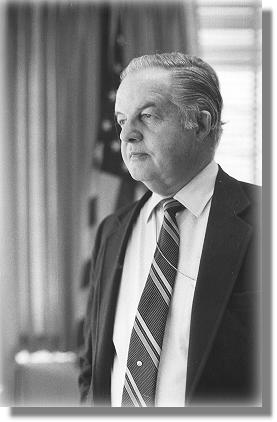
Career Highlights
9/50: Claims Representative--New Rochelle, New York
1953-1958: Claims Supervisor/Field Rep.--Yonkers, New York
1955-1958: Senior Claims Supervisor--New York Downtown Office
1958- 1960: Staff Assistant Management, New York Regional Office
1960-1961: Assistant District Manager, Midtown New York Office
1961-1962: Assistant Regional Rep. Intern Program
1962-1965: Assistant Regional Rep., Cleveland Regional Office
1965-1968: Regional Rep., Cleveland
1968-1970: Assistant Director for Administration, Bureau of Retirement
& Survivors Insurance
1970-1972: Program Advisor, Assistant Commissioner, Field
1973-1976: Assistant Director for Operations, Bureau of Supplemental
Security Income
1976-1979: Assistant Director for Operations, Bureau of Disability
Insurance
1979-1980: Director, Office of Disability Operations
1980-1986: Associate Commissioner for Central Operations
11/84-10/86: Acting Deputy Commissioner for Systems
10/86-12/88: Senior Advisor to the Deputy Commissioner for Operations
Photo Gallery
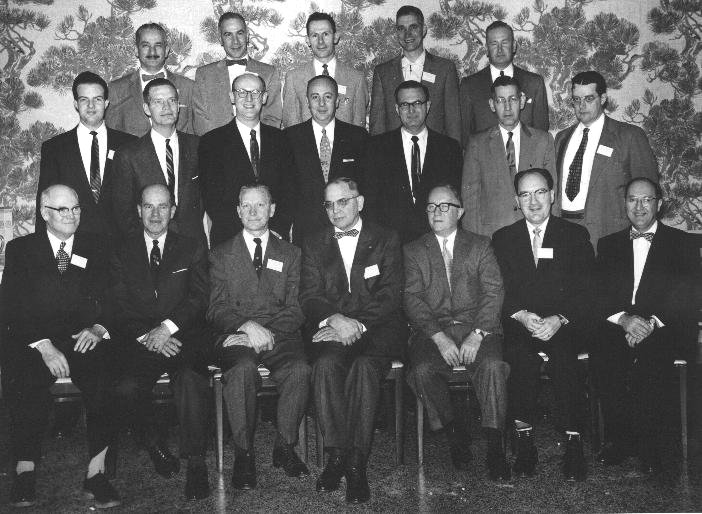
Art Simermeyer is at the left end of the second row, circa 1957. SSA History Archives.
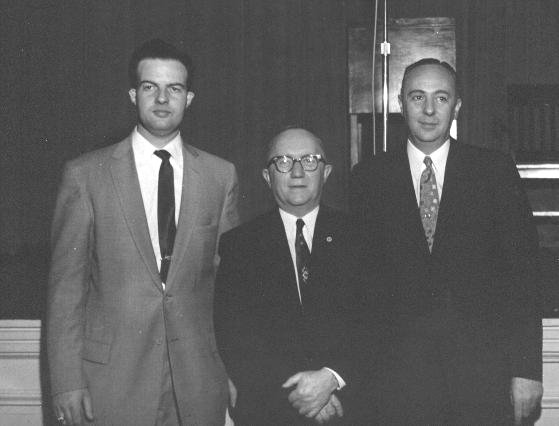
Art Simermeyer in 1957 with Harold Schaefer (center) and Sid Wekser
(right).
SSA History Archives.
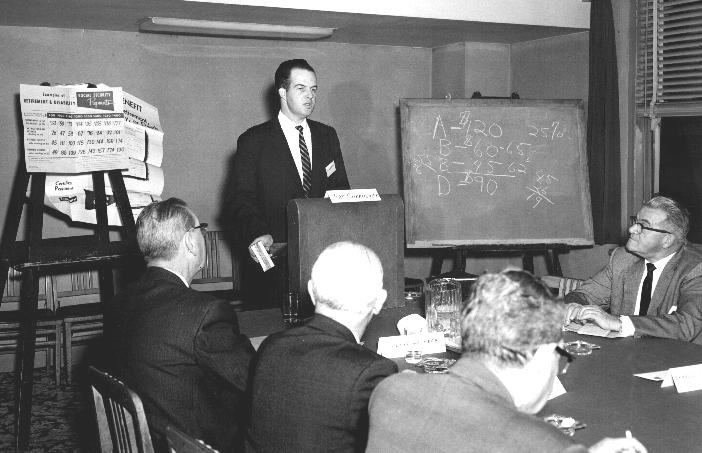
Art Simermeyer teaches a training session in December 1960. SSA History Archives.
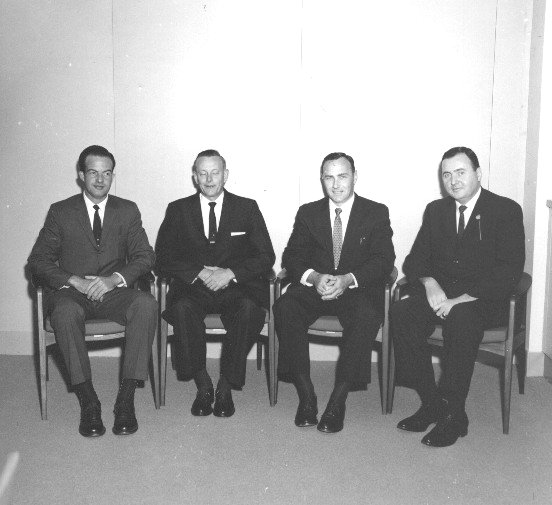
Art Simermeyer with other Assistant Regional Rep. Trainees, 9/28/61.
Left to right:
Simermeyer; Gene Riegler; Pete McCoy and Jack Mullane. SSA History
Archives.
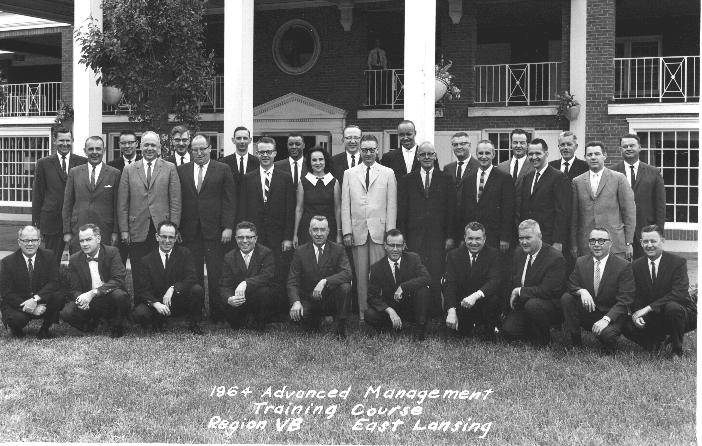
Art Simermeyer is third from right in the back row. Hugh McKenna in white suit in center. SSA History Archives.
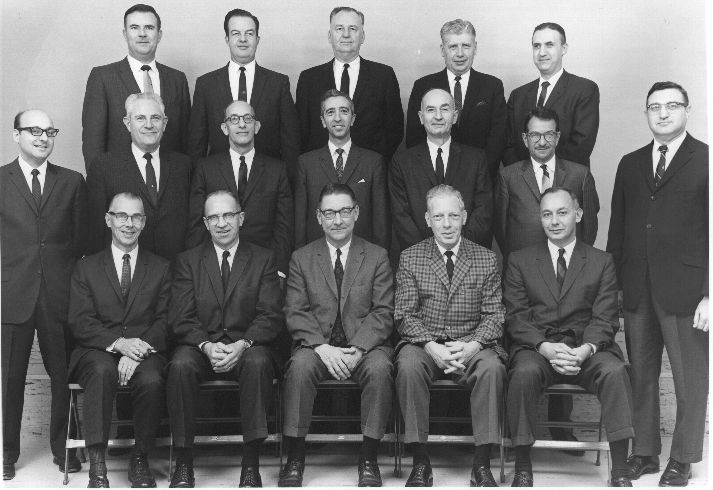
Art Simermeyer with top staff of the Bureau of Retirement & Survivors Insurance, 1967. Left to right, seated: Elsworth Listerman; Gene Brees; Hugh McKenna; Sam Smith; Walter Baun; 2nd Row: Sam Prestianni; Milton Freedman; Ed Watman; Charlie Delle Bovi; Jim Matarazzo; Julius Berman; Harold Turkel; 3rd Row: Bob Flynn; Art Simermeyer; Joe White; John McConnachie; Ed Sabatini. SSA History Archives.
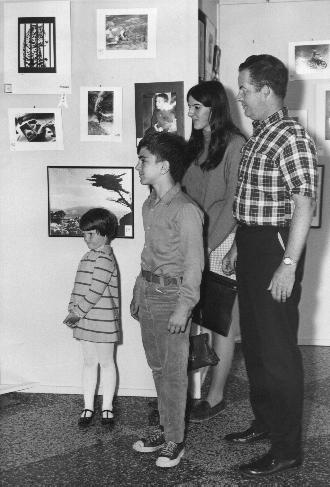
Art with his children, Maureen, John and Carol, circa 1968. SSA History Archives.
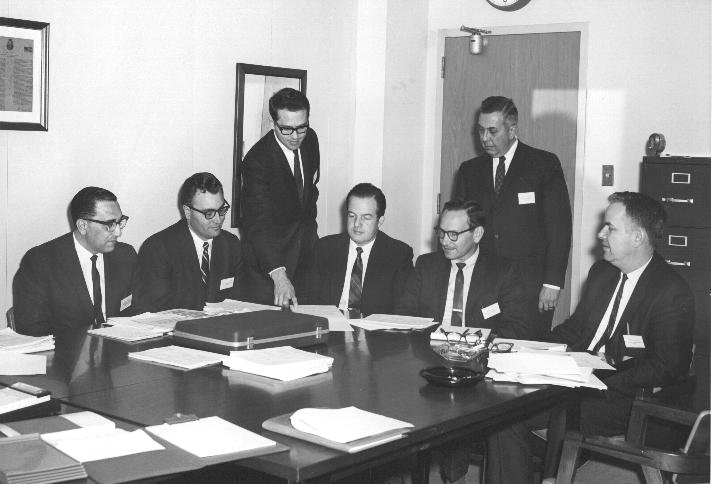
Art Simermeyer in conference with the Directors of Management for the Regions, April, 1968. Left to right: Lou DeLucas; Pat Caliguiri; Jim Forbus; Art Simermeyer; Roger Duba; Bob Willwerth; Lee Forrest. SSA History Archives.
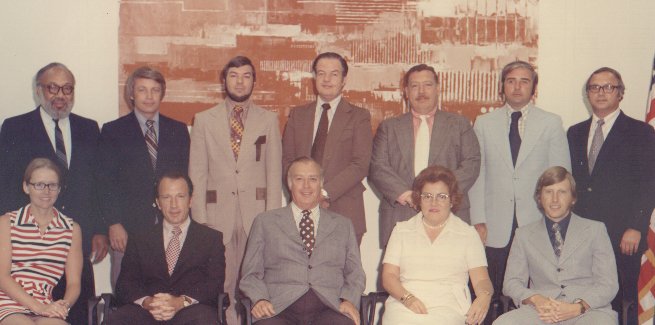
Staff of the Bureau of Supplemental Security Income, 1974. Left to right, standing: William Bailey; Alfred Williamson; Dave Tomlinson; Art Simermeyer; Bob Trazzi; Pete Wheeler; Don Helm; Seated: Marty Garner; Paul Cotton; Sumner Whittier; Eleanor Bader; Pete Spencer. SSA History Archives.
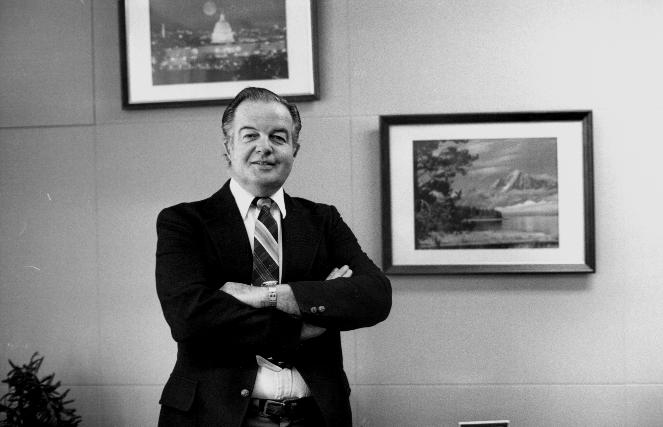
Art Simermeyer in 1981. SSA History Archives.
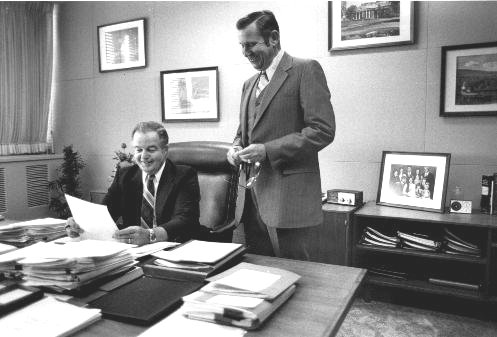
Art Simermeyer with Harry Overs in 1981. SSA History Archives.
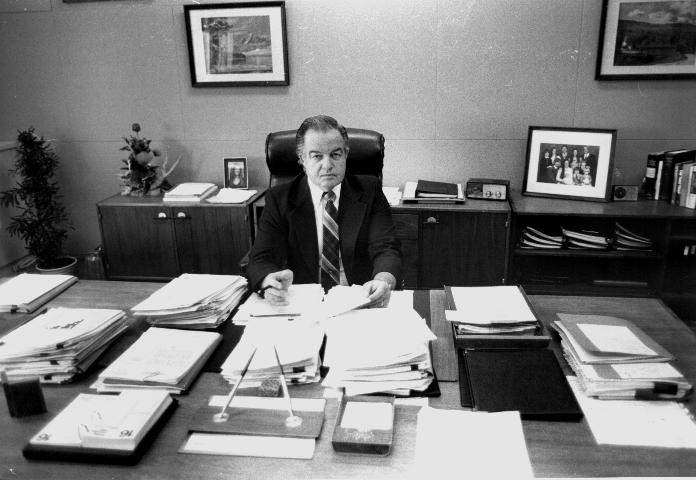
Art Simermeyer at his desk in 1981. In this image one can see both Art's organized approach to his work and that sometimes gruff demeanor which hid a gentle inner spirit. SSA History Archives.
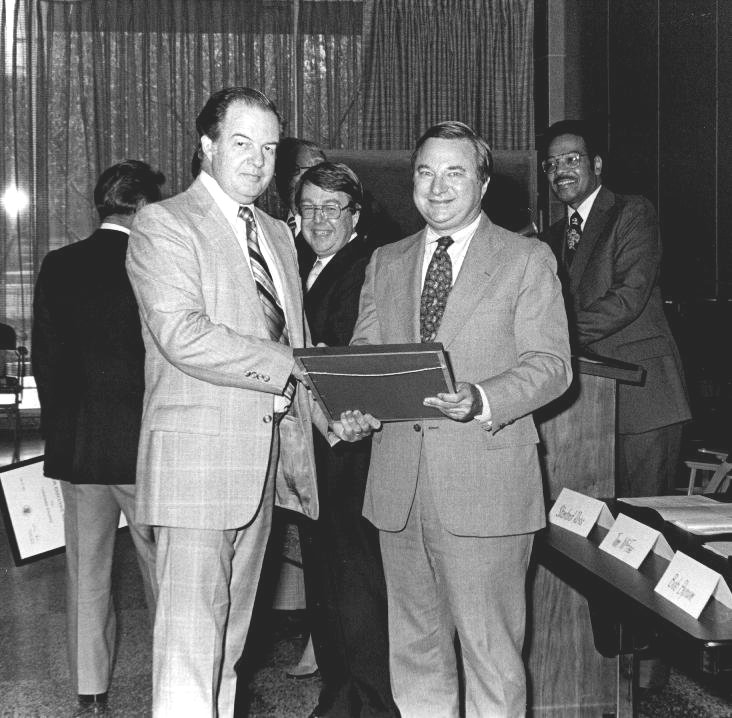
Art Simermeyer receives his SES certification from Commissioner Stan Ross. SSA History Archives.
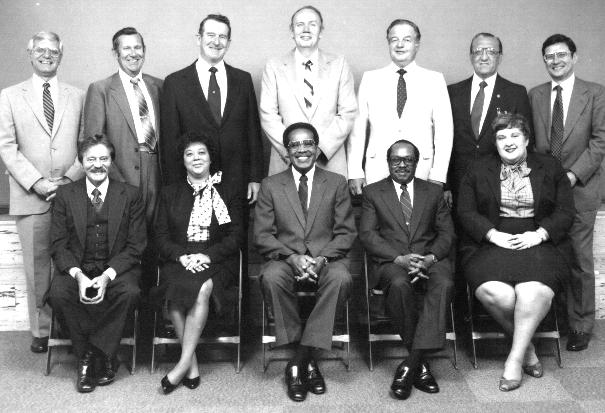
Top staff of the Office of Central Operations, 1984. Left to right, Seated: Claire Poad; Ruth Pierce; Herb Doggette, Jr.; Al Brown; Huldah Lieberman; Standing: Ed Arthur; Harry Overs; Gerry Boyd; Don Mings; Art Simermeyer; Lou De Lucas; Marty Taffet. SSA History Archives.
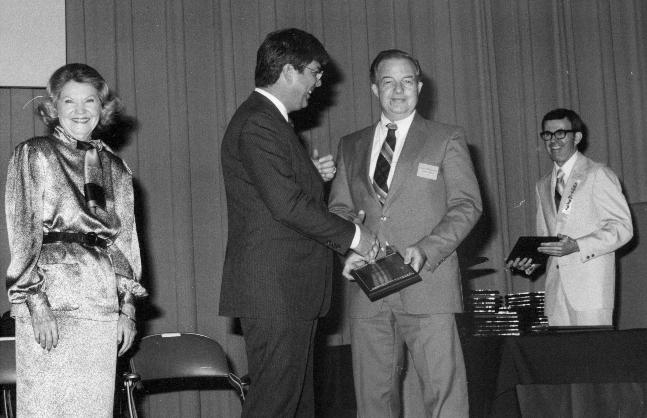
Art Simermeyer receives a Commissioner's Citation from Commissioner Jack Svahn as Martha McSteen looks on. October 2, 1979. SSA History Archives.
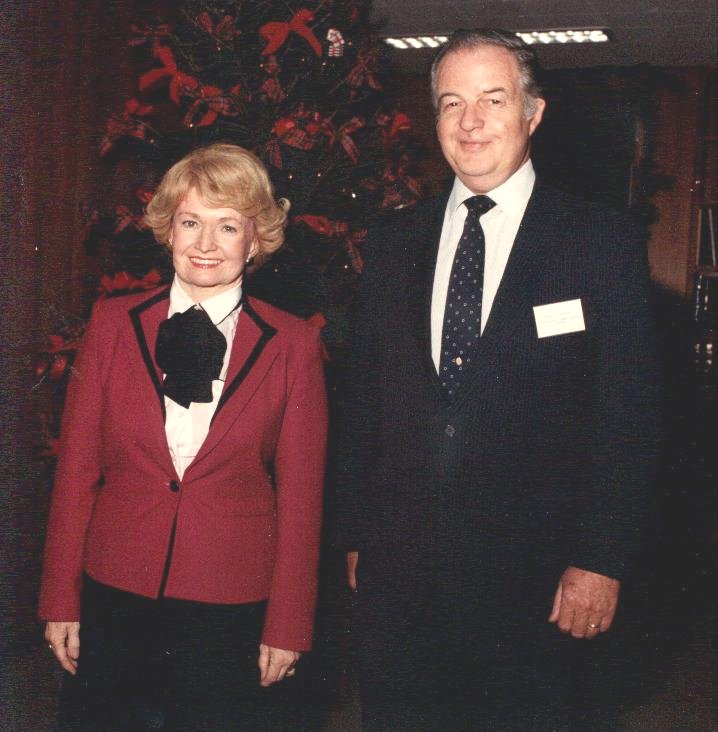
Art Simermeyer with Secretary of Health & Human Services Margaret Heckler. Circa 1985. SSA History Archives.
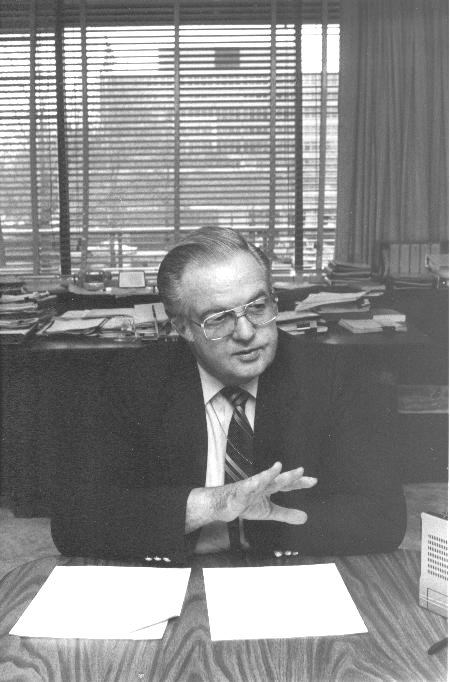
Art Simermeyer in his office in Baltimore's West High Rise Building during his tenure as Acting Deputy Commissioner for Systems. 1985. SSA History Archives.
Commissioner's Message to SSA Employees
Some Reflections
on Art Simermeyer
Art Simermeyer had a long and distinguished career of more than
38 years with SSA. Starting as a Claims Representative in New
Rochelle, New York in 1950, Art came to Baltimore in 1968 where
he rose steadily in the organization due to his management skills
and his reputation for prodigious hard work. He was a demanding
boss whose external demeanor could appear gruff, but whose real
nature was as gentle and sweet as anyone I ever met.
Those who worked for Mr. Simermeyer, as I was fortunate enough
to do, never minded how hard he expected us to work, because
we knew he worked himself even harder. He was notorious for
taking home stacks of paperwork every night, which would then
appear on the desks of his subordinates early the next morning,
with terse, imperative notations outlining exactly what he expected
of them in regard to the paperwork he had reviewed the night
before.
During the early 1970s Art had a key role in running the SSI
program. By the late-1970s he was running SSA's disability operations,
and eventually, all of SSA's Central Operations. In 1984, despite
the fact that he had no technical background in computer systems,
Art Simermeyer was put in charge of all systems operations at
SSA. He was Acting Deputy Commissioner for Systems during the
most critical period of SSA's Systems Modernization Plan, which
Art helped manage to a successful conclusion. Art was called
to take on this challenging role because the Acting Commissioner,
Martha McSteen, felt that the Office of Systems needed strong
and stable management--from someone with an unquestioned reputation
for probity. She knew of no one who better fit that bill than
Art Simermeyer.
During the last phase of his career, Art was put in charge of
the launch of SSA's new 800# telephone service. This was a service
innovation introduced in SSA in October 1988. When Commissioner
Dorcas Hardy tasked SSA with creating a nationwide 800-number
telephone network, there was widespread skepticism within the
organization that such a network could be put in place as quickly
as the Commissioner demanded. Hardy announced her intention
to create the system in January, 1988 and set its launch date
as October 1988. Art Simermeyer was put in charge, and put on
the spot to deliver on the Commissioner's promise. At SSA's
Operations Conference in Baltimore in April 1988, Commissioner
Hardy gave a determined speech in which she restated her insistence
that the system would go live in October 1988. To emphasize
her point, she said she had been making Art Simermeyer practice
saying "OC-TO-BER, OC-TO-BER." Art got up to speak
following the Commissioner, and with his best dead-pan humor,
he opened his speech with, "The Commissioner said to practice
saying OC-TO-BER. OC-TO-BER. OC-TO-BER. I think I've got it.
Now if she will just tell me which year." It brought the
house down, because hardly anyone in SSA believed it would be
that October. But Art Simermeyer was responsible, and so the
national 800-number went live nationwide on Monday, 10/3/88.
On October 31, 1999 Art Simermeyer and his wife Marie boarded
EgyptAir Flight 990 at Kennedy Airport in New York City for
a flight to Egypt, where there were planning a vacation. When
Flight 990 crashed into the Atlantic Ocean near Nantucket, Art
and Marie, and 215 others, lost their lives. Art and Marie had
been scheduled to travel a week earlier, but rescheduled their
flight so they could stay in Baltimore to attend the wedding
of a daughter of long-time friends. Art was 72 years old, and
Marie was 61.
This interview, conducted in 1996, is being published here on
the Internet for the first time now so that those who did not
know Art personally may be able to gain a more vivid sense of
his career and the many contributions he made to the operation
of the Social Security program.
Larry DeWitt
SSA Historian
November 1, 1999
Audio Clip From the Interview--Simermeyer's Closing Comments |
||
| Note: This 8 minute and 18 second audio clip is available in two formats, RealAudio and Windows Media Player. | ||
| RealAudio Format | (1.0 mb file) | |
| Windows Media Player Format | (1.9 mb file) | |
| Art Simermeyer Oral History Interview |
| This is an interview in the
SSA Oral History series. This interview took place in four sessions
on 10/22/96; 10/30/96; 11/14/96; and 11/27/96. All interviews took
place in Mr. Simermeyer's home in Randallstown, Maryland. The interviewer
is Larry DeWitt, SSA Historian. The tapes of these sessions were transcribed by Robert Adams, Barbara McIntyre, Gail Hooley and Mary Haskins of SSA's Braille Services Unit. The transcripts were edited by Bob Krebs and Gloria Tong of the Historian's Office. |
| (Note: Approximately 100 printed pages.) |
| |
| Q: Okay, Art, I would like
to start at start of your career. And the question that always interests
me is the first question: how in the heck did you come to SSA? What
were the circumstances? Were you planning to come here? Did it happen
by accident? Tell me where you started, and what job and what the
circumstances were; how you started at SSA. Simermeyer: Okay, I started in September of 1950. I had been in the service and then in the first real college class following the service, that is, I went in 1946 and I got out in 1950. And the job market was flooded with applicants--people who had gotten a degree under the GI bill and who needed a job, wanted a job. So it came up to about June of 1950, when I graduated, and I had become engaged and needed a job, looked around, things were tight, as I said. I had an opportunity with the A&P, which was the forerunner of what's now Super Fresh. And my uncle was a supervisor in that business in New York. And he said that he thought he could find something for me down the road, but first thought I first ought to get some experience working in supermarkets to get a feel for the whole operation. Which I did. I was working there, and, actually, my mother found out about this Federal Service Entrance Examination, I think, and encouraged me to apply for it. So I did, with no real expectation of anything happening. It wasn't called that. At that time, it was called the Junior Professional Assistant Exam (JPA, I think). Anyway, I took the exam, and did pretty well, and got nothing out of it--I mean no contacts. I had a few leads that didn't materialize. And then suddenly, I got a contact asking if I was interested in a job in Social Security. Because by coincidence, the 1950 Amendments were being passed. And that was really a tremendous expansion for Social Security. I mean at that time, my recollection is that there were 12,000 employees in Social Security throughout the entire organization, as compared to, I believe 65,000 today. So it was really a very small organization relatively speaking. But it was going through tremendous growth, because of what they call "New Start." The insurance requirements for people to collect benefits had been reduced from whatever it was going up towards 40 quarters. It was reduced to 6 quarters to collect benefits. (Prior to 1950 a quarter of coverage was credited according to the amount of wages earned in a calendar quarter. The 1950 amendments credited quarters of coverage based on the amount of income reported annually.) And millions of people were being included for the first time under Social Security: self-employed people, totally, and other groups of workers who had been excluded in the original program. And the liberalized retirement test did a whole lot of things to create a tremendous workload suddenly. So there was a tremendous expansion suddenly. So I was called down to New York for an interview, to New York City, and passed the interview. And within a matter of weeks, I was told that I could have a position as a claims representative trainee. And at that point, I was living in Mamaronack, New York, which is in Westchester County. And there was an opening in an office in New Rochelle, New York, which was 5 miles down the road. So that was a tremendous advantage for me to be that close--to have a job to be able to commute 5 miles to work. In any event, I started in 1950. And after a week or two of orientation in the office, they sent me to Baltimore for 3 weeks of training, which was the basic claims rep training activity at that time. The manual--the claims manual--was 1 volume. As I recall, we had 8 applications. I mean, they were relatively simple in compared to today's world. And the 3-week training program was to teach you how to take an application, how to get an earnings record, how to adjudicate the claim, to handle the public, and to answer questions afterwards in terms of the subsequent activity, when they worked and so forth. So it was a good program. It was downtown in Baltimore, because we didn't have any headquarters building out in Woodlawn. And we met all the top people. The trainees in that class were basically from the New York area. And it sort of fits the stereotype of the New Yorker, I think. I think that at least one thing I remember when we were coming to the end of the 3-week training program, Francis McDonald, who was the pioneer in training in Social Security back then, had a habit of coming to the classes to give a little pep talk and do his thing. So he came one day, and we were all sitting there. And suddenly, he started asking questions. He said, "Well, what do you want to be in Social Security?"--"What's your goal in Social Security?" And I sat there and listened to these other guys. And I was amazed. I mean, they wanted to be Commissioner or in charge of the region. Or they had all these lofty goals, and they were holding forth. And I thought to myself, "Here we are; we haven't gotten our feet wet yet and these guys are ready to take over the reins." My answer was, "You know, I'd like to learn my job and get my feet on the ground and move ahead," and something a lot more down to earth in my view in terms of what to expect. But I thought, you know, I'm probably going to get marked at the bottom of the list because I have no high ambitions. But I thought that was a lot of baloney anyway. And I look back 10 and 15 years later, and all of those people that I can recall had all disappeared. I mean, they were not in the organization, there were none of them in high positions, there were none of them that had really achieved their goals as they stated them in September 1950. So I came back from Baltimore. Q: Can I ask you a couple of things about the training? One of the things I think we used to do in that training class is sort of program philosophy and principles, that we used to sort of give our employees a grounding in the philosophy of social insurance. Did that happen in your training class? Did they do that? Was that significant for you, was it important? Was it not? Simermeyer: Yes. They did it. I don't know how much time we spent on it, or how much it meant to me at that time. It did give me a foundation. In those days, my recollection is the conversation went (or the presentation) went along the lines that the country was moving from an economy where people had been agricultural and living on farms or in the same city in the same place. And the parents, as they aged, tended to stay in the home. And the young people and they grew up together, either farming the farm or they went out to work, and the grandparents watched the children. And there was always an accommodation--the young people took care of the older people. And that was the mores or whatever at the time. But since the war, and since the development of industry, and women going into the labor market and farms in decline and a whole lot of things changing, the old people did not have that kind of role to play. And the young people, conversely, didn't have the homes to accommodate them or a lifestyle they could be compatible with. And so the old people tended to become more on their own, had to look out for themselves. And Social Security really was coming on as a way to provide them with the income and resources so they could maintain some decent standard of living. And that kind of thing was the one foundation for what was taking place now with the expansion. Q: What about the experience of coming to Baltimore and seeing the organization? This is an interesting topic to me because we don't do this anymore. Simermeyer: It's regrettable. Q: We don't send trainees to Baltimore, either to see Baltimore and the operations and see the leaders of the organization or to get this background and the philosophy of social insurance. And I'm wondering--it looks to me like that's a loss. And I'm wondering what you think about that? Simermeyer: I thought it was a loss. I thought it was a loss for years later, when we did it for years and years. And then they stopped it because there were too many trainees coming in and budgetary reasons and other things curtailed it. But I agree with you. I always thought there was a tremendous loss in terms of getting to see and hear the leaders of the organization and people like Francis McDonald and getting a perspective of the whole organization from the central office point of view. And then the environment of coming to Baltimore was interesting. When we came down here, the first day, they gave us a list of names and addresses. And we went around the area on our own. The addresses were gathered from previous trainees and from people in training who had made some contacts and whatever. (I don't know exactly where it came from.) But it was a list of places where you could go and rent a room. And we teamed up - I forget why I teamed up with this particular fellow, he was very nice. We went out. And they gave us directions. You had to take streetcars and buses and go out to the community, find our way, knock on the door, talk to the lady in charge who lived there. And in our case anyway, we got a very nice double room with a private bath adjoining. And I think it cost something like $10.00 a week, which is phenomenal in terms of cost. And it was very comfortable. And I think for $3.00 or $4.00 a week more, she did our laundry. So it was really a good setup. And they kind of took care of us that way. And the people in central office made us feel a part of the organization. And that was a loss when that stopped. Later, I think it became much more sophisticated. They stopped the rooming houses and those kinds of facilities for others who came along. And also because it was downtown, it was very convenient. I don't know if they had training classes out in Woodlawn after they built the headquarters, because it wouldn't be very difficult to get back and forth, the way we did. Q: Okay. So you finished training and went back to New Rochelle to start, to be a Claims Rep? Simermeyer: To New Rochelle. I turned out to be the first claims representative in that office. The office was that new. They had a person who was a field representative who had been handling the claims part of it until I arrived. And then he was able to go out and do contact stations and field visits and so forth, and I stayed in the office and handled the claims, plus doing the other work on the account number desk and other things that had to be done in the office. In those days, it was all really paperbound. I mean we had file cabinets, and everything was on paper. And each paper was in a folder, and every folder was in a file cabinet. And we had piles on our desks. The pending was kept on a tally sheet, and every week, when you cleared a claim, you put a red line through it, and so forth. And you did your end of the week report for the old. Q: We were still doing that in 1983 and 1984, when I left the field, Art. In 1985, we were still doing that. Exactly the same way. Simermeyer: That's right. It was very easy to keep up with things in those days, too. because things were much simpler. You know, the 6-quarter rule and other things made life relatively easy in terms of technical complexity. The other side of it was the volume. I mean, there were a lot of people who were coming in and starting new, getting Social Security cards, and having their accounts established and claiming benefits. And then all the growth problems that Social Security had, trying to handle that workload. Not everything worked perfectly either. Because it was paperbound, it was very difficult if there was a problem, you know, to have it corrected. You did not have the kind of access to information that you have today. But in any event, I worked in New Rochelle for 4 years; a little less than 4 years, seemed to be getting no place--I mean, in terms of progress or promotions. So my ARR (Assistant Regional Representative) Dave Culperman--I got him one day when he came around and said to him, "You know, I don't see any progress. And if I don't see how I can make progress, I don't think I can continue with the organization," or words to that effect. It wasn't a threat. It was just to let him know that I was getting a little frustrated, and he didn't make any commitment or anything at that point. But it was a relatively short time later that he let me know that I could be a--they were establishing a-- claims supervisor job in Yonkers, New York. (Yonkers was about 15 miles from new Rochelle.) I don't think I had to go before a panel to do that; they just promoted me to supervisor in Yonkers. So I went over there. It was a larger office, had a bigger territory, a larger territory. There was a technicality there, because I had not been a field representative, which is the normal line of progression. They kind of labeled me a field representative and put me out in the field. They let me continue as supervisor; I had that job, but, in addition, they gave me field things that sort of met the qualifications of I guess of field experience, which was on my record. So I went through that as well. And that was all kind of informal and ad hoc. But, I did work in contact stations and made all the contacts and do what good field reps are supposed to do. It was while I guess I was in Yonkers that I had my most memorable interview, when the manager had a call from Henry Wallace, who had been the Vice President under Franklin Roosevelt. And after he finished as Vice President, he retired to Salem in Westchester County, to his estate. But he started to raise or develop hybrid corn and either strawberries or chickens, or maybe both--I forget which. But anyway, he had heard that farmers were covered by Social Security, and he wondered if he was covered. And so the manager felt that I should go out there and visit him and discuss it with him, and let him know what the situation was. Which I did; I went up to his estate, met him, and we talked. And I had gotten some advice from the Regional office beforehand because of the sensitivity of it. Anyway, sensitivity in not wanting to make a mistake. He was very nice and very personable. And we talked. And as it turned out he was not covered, because it was not actually a business and it was not producing any income. It was just strictly research. Although later, it did develop that his hybrid corn, as I understand it, it did develop into some very productive strains. I don't know what finally happened to them,whether they became patented or how they got into the marketplace. But at that point, he had no income, and really wasn't concerned; he just wanted to do what was right. Anyway, it was a memorable event for me. Q: Did you tell him no? Simermeyer: Yes. Q: Did he take that with good grace? Simermeyer: Yes. He said he really wasn't concerned whether he could get coverage like he wanted to be insured so he'd get benefits. I mean, he didn't need it. He just wanted to do the right thing, and he was satisfied with that. And I often wondered later if you know if and when anything changed. I met him again, and so that was the end of that. At any rate, in 1954, it's also when the disability freeze started, and that created a lot of work in the Yonkers office in terms of people coming into file. It was a whole new world for us in terms of getting into medical evidence and the questions that we had to develop--very laborious and detailed. And it was only to establish a freeze. People didn't understand that. I mean, all it did was to protect their earnings records so that they would not suffer a loss of benefits later on. And they were totally dissatisfied, because they came in expecting to get something, and all they got was a lot of questions. And if we made a determination of "Okay, you're allowed a freeze," I mean so what? They were disabled. They were out of work. They needed help. It wasn't any answer for them at all. But that was a problem we dealt with. Plus I think what--farm coverage started after 1950, right? And we were detailing people out to (not from my office--I didn't go) but to the Midwest to handle the farm claims that were coming in. And they got into all people, particularly from the New York Region--if you can imagine going to Kansas and Missouri and all those places and having to deal with questions like grout sows and all the things that they get into out there. These people--it was a totally different world for them. We used to hear about those stories in amazement, you know, and all of the things that went on at that time. But it didn't affect me directly; it was sort of a tone of the times. Q: Now these two offices that you worked in--in New Rochelle and Yonkers, how big were they? How many staff? They don't sound very large from what you've told me so far. Simermeyer: Well, the first one, as I said New Rochelle, I was the first claims representative they had. And then they got another one--Jack Scarengella who, ironically and interestingly, is still the manager of New Rochelle, New York. He went on from that job down to the city, worked in the Regional Office, and came back to New Rochelle as a manager some years later. And he remained there from 1958 up till the present. If he's retired, it's not more than a year or so. And he loves that. So he was there. And Jack Wallman, who later migrated to Baltimore, to a job--some staff job. But at any rate, I think the most we ever had were 3 claims representatives, 1 manager, we each had 1 clerical assistant, I think; an account number clerk--an office of about 10 people in New Rochelle, after it got fully staffed, in 1952 and 1953, after the first impact. And then when I went to Yonkers, that was considerably larger. It had field representatives and a manager, an assistant manager. I was a supervisor. You had to have I think 6 claims representatives to have a supervisor, in those days, plus clericals. So there was a staff of maybe 20 or 25 people; probably 20; not large by any standards today. But I got into large later. I mean, from Yonkers, after about 2 years, I was invited downtown to meet Harold Schaefer, who was in that picture you saw before who was the manager of the Downtown district office which was located at 42 Broadway. And I went down to visit him, ostensibly to be interviewed for a job as a claims supervisor in Downtown which, I think, was a higher grade, because it was a larger office. At any rate, I arrived with pad and pencil and sat down for the interview prepared to take notes and so forth. Things like that impressed him; I mean, that was one of the big things, you know, that I was that much into it. Instead of walking in, cocky and just telling him how I was going to run the world or something, I was there to take notes and get direction and on and on. He liked that. So I ended up being promoted to Downtown, which was in the same building as the Regional Office. Which is kind of another amusing anecdote. At any rate, when I got in there, it was a big office. We had a couple of supervisors, a couple of training classes. We were spread out in a U-shape. The building was built in a U-shape. But we had so many people, we occupied the whole floor. And there were claims representatives in each arm of the U, and across the front was a reception area, and in the back, were the manager, assistant manager, and so forth. And they decided to establish a job ,which they never had a formal title for. They called it "the third man." And we used to say, it came with a zither--the third-man theme. But what it was a supervisor who was above all of the people in the office: the other claims supervisors, the claims representatives, and also the field representatives. It was an experimental thing. And there was one in downtown New York; that was me. And there was one in midtown New York, that was Des Burns. I don't know if you know the name Des Burns, but he was a brilliant guy. And he eventually migrated to Baltimore too. He died some 20 years ago, I guess. But he and I were both in this experiment to see if this would be a new way to operate,a new advantage to trying to keep all of the activity coordinated, and so forth. So that put me basically under the Manager and Assistant Manager: Harold Schaefer, Sid Wexler, and then there was me. And they liked that arrangement. Because I was running and jumping. I mean, I had a lot, I had my hands full, I had all I could handle. Q: So you were like the operations manager in the office, in effect? Simermeyer: Right. And Sid Wexler was the public-relations guy. I mean, Sid sat in that office at his desk on the telephone all day long, talking to people. It wasn't social business. He was calling the welfare people, he was calling people at different places in the city and State level. It was a relatively key office in New York, in downtown Broadway. And he was maintaining all these contacts, getting all this information, which tied into things that the field reps needed help on, or they wanted assistance with, or he would kind of grease the wheels for them by his contacts. So he was really filling a vital role. But he did not like walking the floor. He did not like worrying about technical things and claims, and so forth. He also reminds me of Bob Dole; he had polio, and he had one arm withered. His body was very much like Bob Dole--he could only use one arm. And he used to have a telephone in that hand. But he was a great guy. I had great respect for him. He had over 50 years of service when I think he died in the Fordham District Office or else the one out in Westchester Square, or something. At any rate, we went through that. And one anecdote there was well, our office faced on Broadway and upstairs was the regional office. Joe Tie was the regional representative. And he and his ARRs, who were in town, loved to go to lunch across the street; Child's Restaurant, in those days, was very popular. Had a light lunch, and it was on the second floor, and it overlooked Broadway. And they'd go up and sit there and have lunch, usually overlooking Broadway at a table right by the window. They were there every day so they probably had a standing situation, you know. But one day, these guys played a prank on me. There was something--I don't think anything really happened in the reception area. But there were windows in the reception area that you could see out onto Broadway and, conversely, they could see in. So they came back, and there was some kind of a little rumble or rumpus--I forget what it was. Nothing to speak of, sometimes a claimant gets unruly or something. But anyway, they came back from lunch. And the next thing I heard, they were calling Harold Schaefer to ask what had been happening in the reception area at 12:30 when this claimant had been, you know, waving his hands and so forth. So Harold Schaefer got me and wanted to know because he was all upset because the regional representatives saw this, you know? So I explained to him that really nothing of any significance. It wasn't even worth reporting it to him, you know? Anyway, I couldn't figure out how they what was happening in my office. You know, none of them were there. Then it dawned on me that they were peering over across the street and somehow caught enough of it and decided to make a joke out of it and pull my chain, you know? Q: So you were already a manager, an operational manager at a pretty early point in your career that this point? I mean you were-- Simermeyer: That was after what--6 years. You call that an operational manager? A claims supervisor is not really; he was down here in the status ladder, and the manager was up here. Q: Right. But this job that you had--this experimental job--is a lot like being the office manager; a lot like being the operations manager of an office. So you've gone from being a claims rep to being a supervisor to being, what I would call generically, an operational manager. And did you like it, I mean already at this early stage in your career? Because a lot of your jobs that you've had you were operational manager, in many ways, and in many places in your career. And I sort of see you that way, as an operational manager. And I was wondering if the seed had already been sown here or did you realize that this was your area, that you liked it? Simermeyer: I never planned from one job to another to another. As I said, I didn't sit with those guys and say, "I want to be in Baltimore in charge of the operation, or whatever in 1970." I just said, "I want to do the next job as good as I can and think about the job after that baby, and point towards it." But I didn't have any lofty goals. I just was busy doing what I was doing. In a way, I was a product of my environment, okay? The organization was dynamic. It was growing, it was expanding, there was opportunity. There was a lot of flexibility in that respect. I mean, we still had to live up to the personnel rules and regulations and fill out all the forms and all of that. But there was opportunity. I mean there were promotion lists all the time because of all this expansion and more people coming in underneath and trainees, and so forth. Which I got into more later on too, when I got into my--two stages down the road, I landed up in a district office in midtown New York, which was tremendous. I had no pre-direction that I was going to be operations per se; I liked it. And I consider myself a pragmatist, okay? And I consider myself hardworking and driving, but respecting those that perform and not respecting those that don't. And so I got along pretty well with the people. I was never the most popular person in the office, maybe one of the most respected, you know? So I enjoyed that. And I worked hard. I mean I tried to set a standard. From the days that I became supervisor on, I always brought work home--to the detriment, maybe, of my family and my wife and my own well-being in some respects. But on the other hand, I felt like I wanted to be on top of it, I wanted to be ahead of it, I wanted to be comfortable, not feeling like I wasn't sure what was happening or what I was doing. And I'd rather spend the time and make the effort and be ahead of it. And I think that's really why you know Harold Schaefer and I got along so well. He was a good little Dutchman. I mean, he had his own lifestyle; he worked hard, came up at the beginning of the organization. And he was fatherly, very nice, very pleasant. But he had a very keen sense, I think, of evaluating people, very quiet, laid back, smoked his pipe. He liked what I was doing because it gave him what he wanted, you know, without having to worry about it, that kind of thing. So anyway, all of that was bubbling along. And I was anxious to get ahead to something and also to get away from the commute. I was commuting from Mamaronack, New York; taking the New York-New Haven Railroad to Grand Central in New York, and then I had to get off and get on a subway and take the subway down to Wall Street, get off, and then walk 3 or 4 blocks to the office. And that was to me, in those days, a long commute. And I had to do it the same way going back. I lived about a mile and a half from the office; that's why those pictures you see show me fairly thin, you know? I had to keep my legs moving. But anyway, after a couple of years, I was on vacation in Fairfield, Connecticut. And a call came through--we didn't even have a telephone in this little cottage we went to--the neighbor got the call. I don't know how they found me, but they did, and they wanted to tell me that there was an opening in new Rochelle, New York, the office where I had started as a manager. It was only a small office; it was only 1 grade higher than the job I had. But it was great, you know? Because as I said, on the status ladder, a manager was somebody. He was in charge, even though it was only 1 grade up. I said, "Great, I'll take it." And I was in heaven for about 2 days, and I got another call. In the meantime, this Jack Scarengella who was the other claims rep in New Rochelle with me, had gone on into New York to the Regional office as a Staff Assistant, a junior Staff Assistant. But he got a promotion or two down there. I found out later that first, they had offered him the job and he turned it down, and then they offered it to me, and I took it. And then he decided he'd like to have it. So then they decided, well, they'd give it to him, and I wouldn't have it, you know? So they called me up and said, "Well, sorry, but it was a good idea at the time." So I was very disappointed. But that was it. So Jack became the manager. And as I said, he's been there ever since. And I often think, "What if I had taken that job instead of him? Would I have been there ever since, you know?" I'll never know the answer. I came out of that and went back to the office downtown. And Harold Schaefer was very sympathetic, but said, "Don't worry, something will happen; something good will happen. I'm sure it will come." He didn't have anything specific in mind. But he just was trying to build me up. And I was happy enough to be there, but after you've been offered something, and it's taken away, then it's different involvement. So within a matter of a month or so, I get called to the Regional Office which is upstairs then about 6 flights up. So I went up, not knowing at all what was happening, and I got in to a meeting with Joe Tie, who was the Regional Representative. And he probed around with some general questions. And he said, "Fine, how would you like doing staff work here?" Well, I had never really thought about it. I didn't know if I'd like it. Joe Tie had a reputation. They used to call him Tiger Joe. And he was a rough customer in his day. He was toning down even at that point. He was becoming more gentle and easy to get along with. He was an interesting guy. He commuted from Philadelphia every week, came up on Monday morning and stayed in a hotel room in New York until Friday night. Then he went home to Philadelphia, which was where his family home was and that's where his sister lived. And he just maintained that arrangement, except when he was traveling out some place in the Region. But he was there in New York sort of on a commute basis. Anyway, we got into conversation. And he said, he'd like to have me come to work for him in the management area which was what they called them SAM and SAP. SAM was Staff Assistant Management; SAP was Staff Assistant Program. And there was big SAM and little SAM and big SAP and little SAP. Now I don't think the managers called us that; we called each other that, you know? But it got to be a permanent moniker. Anyway, I agreed to do it. And I came to work. And I don't think I was little SAM very long. For whatever reason, I can't recall whether it was an expansion or what, but I got to be big SAM. And that became a very interesting part of my career, because I was big SAM to the Regional Representative, but also had to provide to all those ARRs. They didn't have any staff of their own. Each had a secretary. But if they wanted something, they came to me. Then the different personalities of ARR's started to emerge. Like Vic Broom--I showed you the picture before)--he was a graduate of West Point, retired from the military, very meticulous, very neat, very perfunctory, you know, still thought he was a general when he walked around the office. His desk was clean. He arrived at quarter to 8 in the morning. He wanted his mail by 8 o'clock in the morning. His desk was clean by 8:30. Because what he couldn't or wouldn't handle, he delegated to everybody else, through me. He would give me all this stuff, and I would get the responsibility for assigning it out and reporting back and all this. And he was free and clear to do what he wanted to do, you know? He was more that way than the other ARR's. If I had four of them, I would have gone crazy, you know? Because he was...that's the way he operated. Each one of the others had a totally different personality. Some didn't care about the paperwork, others did their own paperwork--not just signing forms, but going through memoranda, and identifying things that had to be done, action items and things like that. So anyway, it was interesting. But as I built up a relationship with Joe Tie, placing more and more confidence or faith in me, it became more comfortable in terms of dealing with people like Vic Broom, you know. Because in the beginning, if I didn't have things back when Vic wanted them like tomorrow afternoon, you know, he'd begin talking to Joe Tie. Well, after Joe Tie could see that Vic Broom was not being totally reasonable and so forth, it got a little more balance into it. I could then negotiate a little more with Vic Broom, you know. Because I was not just a staff flunky running around but, you know, Joe Tie was backing me up. It was a whole different kind of experience for me, working in this environment. Because where I had been an operations manager with claims reps and field reps and supervisors to deal with and delegate to, now I was ,you know, on the other side of it. And I had a few staff people but nothing like I had had before, you know. But again, we got along, and it worked out fairly well. So we worked in that environment. And that was interesting because we were Region 2A--which was New York, the eastern half of New York and New Jersey. And Region 2B was the western half of New York State and Pennsylvania. And Joe Fraker was the Regional representative of 2B. But we were co-located on the same floor; we had regional reps and staff on one side, regional reps and staff on the other side. And those two guys didn't like each other: Joe Tie and Joe Fraker. And they're both deceased now, so it doesn't matter, right? And Joe O'Connor, who was the Regional Director, sat a couple of floors above and wanted to see peace and harmony and everybody getting along. But he didn't do anything to make it happen. He was just a nice guy. And he was too nice, probably. But that was not his forte either. It was political. And that all went back to earlier days with Anna Rosenberg--do you know that name? Q: Yes. Simermeyer: She was a famous person in her day. Q: Hugh McKenna told me about her. Simermeyer: Yes. Well, he would know more about that cycle. Anyway, Joe O'Connor, I think, was sort of the tail end of that group. And he came in as Regional Director. But anyway those two regional reps, they had a whole staff, just as we did. They had a big SAM, who was Ed Sabatini. Ed Sabatini, who later became the PSC Director in Philadelphia. So we got to know each other. We went to conferences together when they had big SAM come down to Baltimore, you know, and things like that. But back there in New York, when we'd write regional letters all the time to get the message out. Every week, you had a regional letter--all the things that were happening and things that had to happen, and so forth. And Joe O'Connor's great dream was to have us write a joint regional letter, you know? But we never did, never would. Because whenever we tried to do it, Sabatini and I tried to do it. Those two guys--Fraker and/or Tie--would get a hold of it and object to something, you know, making it impossible for us to do it. And I don't know if they had any real political motive like they figured if we started to do things like that, somebody would decide they could put the region together? So we went through life like that. It was not a major obstacle. I mean, we basically got the same information out to our managers. And we basically got along. But we didn't get into things like joint conferences or joint anything. It was always we had ours and they had theirs. It was almost a rivalry, except that there was no prize for the winner. It wasn't like the World Series. It was just a matter of running the best region, I guess, or running a good region. And our region was a good region. So we did several things there that were very enjoyable. Some of these conferences--like Ed Sabatini coming to Baltimore--I mean that was where we got more of the feeling for headquarters and the people in headquarters. And that was really something that I got more out of than I guess than I did as a claims rep. Because now you were dealing with the people who were not the policymakers, but they were implementing the policy. And they were making decisions, and you could have more of an impact on them and they on you. And you just had a better working thing. They did have a lot of conferences and meetings. I think back now to that and think of today, when we talk about doing things by conference calls and other types of devices which are effective. But you don't have the rapport, you don't have the relationships, and you don't have the follow through that you had then. Q: Now let me just make sure I've got the years right that this is happening. What years are we talking about here that you are doing this job? Simermeyer: In New York, in the Regional office? I went in there in 1958, and I got out in 1960. Q: Okay. Simermeyer: So in the meantime, I had been married before. And my wife developed leukemia, and died in 1960. No career decisions resulted from that, except that after her death in August of 1960, I went back, for a short time, to the Regional Office. It was very shortly after that Joe Tie said, "You've got to go out and get more experience in the field." Because I'd not been a manager; never been a manager. So he said, "You need that to get ahead." And I really wasn't--at that point in my life--wasn't that interested in starting on something new, but he prevailed. Anyway, I went up to midtown New York as the Assistant Manager, to another pioneer, Charlie Ferber, who is now dead. But he was one of the great old guys in that region. Charlie Ferber was a wiry little guy, read the-- what were the original Social Security laws? What did they call them? Regulations, Social Security regulations or whatever? Q: Yes, there was Regulation No. 1. Simermeyer: It was something else though. There was some kind of a book of fundamental Social Security rules, maybe rules and regulations. Anyway, that was his manual. He had them in the office. And when he had a problem, he'd go to them instead of going to the claims manual. I had to go to the claims manual and tell him what they were telling us to do, and it didn't agree with what he thought from the original regs. And I had a hard time getting him to come on with it. Anyway, it was an interesting office. It went from 51st Street to 52nd Street on Broadway. It was a city block long. And we had two training centers; I mean, like 18 trainees in each one, running almost continuously. We had 10 field representatives. And we had well, 30 claims representatives and a tremendous workload. And the Third Man theme had disappeared somewhere along the way. I don't know whatever happened, but there was no more, you know? So I was Assistant Manager there. And a really interesting kind of job because of all the variety, you know? And trying to keep track of these field representatives who were--some of them had been there 10 and 15 years. And they knew their way around the city. And they knew their way around everything, you know, including me. I had to try to keep up with them and make sure they're out working. These guys could find their way across Manhattan without ever surfacing, you know? They knew where all the tunnels were. They could literally get any place around that whole area. On a rainy day, they didn't need a raincoat, you know; they'd never get wet if they were out there working; at least, they seemed to be working. Anyway, it was a great experience for me. And then, at some conference--I forget where--maybe that picture you saw there, we started talking about this ARR Intern Program. And I'd heard about it before that. But at this conference, I was in and around after hours and we hung out in the local pub, and whatever, having a beer. And Hugh McKenna was there. And Hugh McKenna warmed up after a couple. So he got into a conversation with me about the ARR Intern Program. And he said, "Because of your home situation, meaning that I was a widower, I'm not going to consider you for that program, because I don't think you have the mobility that I need." And he said, "You would have been a candidate." And I said, "Well, I really thought that point could be a turning point," because I did, after working in the Regional Office, wanted to be an ARR. That was one goal. And I said, "Well, ARRs, as I'd seen them before, were always class I District Managers who had had 30 years of service. And they kind of went into this job in their dotage, you know?" And I figured, "That's the only other way you're going to get in, unless you get in through the Intern Program." And so I said, "Well, let me think about it, and I'll get back to you; maybe I can work something out." Some of the conditions of the ARR Intern Program were that you had to be mobile to go to wherever they sent you,and, I mean, out of the region. That's one thing he was trying to do, these Class I managers, they were so long in the area that they didn't want to go any place. And they were so entrenched and had so many relationships that you know, they really were not able to be impartial and objective and effective and bring in new ideas. So he wanted to start this kind of new breed. And that's the way he was going to do it: by having you go to a region where he assigned you. And also, if you hadn't been to Central Office, you had to come into Central office for an assignment, so you could get that exposure, experience. Those were the things he said I wasn't going to be able to handle in my situation, you know? So I came home and I said, "Well, I've got my mother and father, who are in their 60's, at that point." And said, "this would be a great opportunity for me." I had 3 children at that time. But I said, "I can't do it, under those conditions, unless you could help me with the children, while I'm in this program." And they agreed. They said, "Okay, if it means that much to you, it's an opportunity, we'll do it." So they did. They took the children and they put them to school every day and all the things that go with that--feeding and caring and loving and all that. So I then told Hugh McKenna I was available for this. So then, I had to come to Baltimore. And there were interviews and discussions. And that led to that other picture you saw with Jack Malane, and there was George Demott, Jim Hoss. Jean Reagler didn't get into it; (he got into it later), Tom Hart, me. There were five of us anyway. We were the ARR interns to start the program. Then we got assignments to different regions. And I was assigned from New York to go to Boston; the Boston Region. Which was good, it was adjacent. I think McKenna was trying to be a little understanding, instead of sending me to San Francisco, you know, or Atlanta. I went up there anyway. And I got into a relationship with--I don't know if you've ever heard the name--John Campbell. He was another one of those pioneers, like Joe Tie, a real pioneer. He was in the program from the beginning--a real crusty old guy. I went to the Regional office there and worked for him for a period of about 4 months, which was again an interesting experience because he was kind of-- took it upon himself to show me that any smart, uppity new Yorker coming up here doesn't just walk in and take over, you know? He gave me an assignment to write a regional letter explaining thus and such. And I'd write it in my New York style, laying it all out. And I'd take it in, and he'd take it like some of these things you see where you shred it down to where the only thing left is the word "the?" Well, he would do that to me. "Why do we need to say this? Don't you think they know that?" And you know, on and on. And he was giving me a lesson in you know, how other people live. So anyway, I had to absorb it, but I did. And I got along with the staff there pretty well. So I stayed in the Regional Office, doing that kind of thing for about oh, a month or 6 weeks. His staff meetings every morning were like nothing I'd ever seen. We had an office on the Boston Common. You know the Boston Common? Q: Sure. Simermeyer: And Welson Street, I think it was. And the third floor, I think was the Regional Office. The second floor was a coffee shop. And every morning, we'd go in the coffee shop, sit down, have a cup of coffee, sit around a table--his staff was that small. And John would hold forth on the activities of the day. And the other guys would chime in because they had been in the Regional office. They didn't have any turnover at all. They were there for years and years, most of them. And if the ARR were in town, they would join in. We'd sit there and talk. And out of it would come the plan for the day, you know? That was it. There were no staff meetings as such. We didn't sit around the table and have an agenda or anything like that. We had to learn to live in that style, you know? And of course, I had no voice, no vote. I was just there as a learner. So I finally learned enough, and after about 6 weeks, he decided I could go out with other ARRs and visit other offices. So they each--most of them--took me out--about 3 of them--on trips, you know? And they would orient me as to what they were doing in the office. And I would sit and listen and you know, chime in. That was great. I mean, I really enjoyed that. Because these guys were really nice and had their own personalities. But it was a learning and seeing a different modus operandi, a different style of management. Most of them were laid back, very casual. And after several of these kinds of things, he then decided I could go out on my own. That's really a big step forward. I mean, I'm going out in his region to visit his offices without anybody looking over my shoulder? So I got a string of offices to go out and visit. I remember one where I went. And sure enough, in the afternoon, who comes walking in but John Campbell, you know? I mean, this wasn't like I just happened to be in the neighborhood thing? It was like you know, a fair distance from the Regional Office. But he still wasn't totally sure of me, I guess. But anyway, I got along pretty well. Q: Now during those visits, what kind of stuff were you doing, you and the ARRs? What was this like? Simermeyer: We had staff meetings, and talked to the staff about what was happening and what was going on. I'd get my 5 minutes at the end, to explain why I was there and what I was doing, you know. And they'd talk about current developments and what ARRs were supposed to do in those days. Our modus operandi, all the time I was an ARR, was to always be there when the office opened. I'd always open with a staff meeting. I'd always give them an update on anything that was happening in the region or centrally, or whatever, then turn it around and ask them how things were going and what the feedback or recommendations or what complaints, whatever, you know? It was an interactive kind of thing. And when I went out of my own, I pretty much did the same thing. I had an agenda. We all did. When I went out on my own too--to cover these items, look at these things, they were told. John Campbell was the pioneer of what they called, in those days "self-help" and that became "claimant participation." And when I was in the Boston Region, he let me go to Hyannisport,which was the birthplace of not only John F. Kennedy, but self-help, as they called it then. The field rep, who had been out there regularly--I guess 20 years--had gotten an increase in workload,and had finally worked out this technique. They met in the basement of the City Hall which was this big, open room; that was his contact station. But the conditions were good for that kind of situation, okay? So he'd sit up there in the front where they had the town meeting, and the people sat where the taxpayers usually sit, you know. And they could see but they couldn't hear. But he, as he saw the size of the crowd, started saying, "Well, how many of you want a Social Security number," you know. And they raised their hands. And he said, "Well, take this application form and fill it out while I'm doing this interview," you know. And they would. So he was kind of running a dialogue with the people waiting for the contact station. I don't know if you've ever worked in a contact station. Q: Briefly. Simermeyer: But for most of them, and I did, it's like being in a post office where you sit in a room and they sit outside on a bench. And you call, "Next," and they come in. And there's no interaction, no dialogue, until you see your next customer. But here he had this environment where he could do this kind of thing, you know? And it became, all of a sudden, a big thing, that this was a new technique--this self-help--where people can help themselves, and it's going to save manpower, and it speeds up the process, and everybody participating and they're feeling better, you know? And all this psychology started coming out, what was basically, for him, a pretty simple thing, you know, when he started. So I went to Hyannisport and looked at it, talked about it. And I heard John Campbell later coming to Baltimore, bragging about this self-help, you know, which later became out of vogue. I mean, self-help was not a good term. So they coined "claimant participation." I think if you walked up to somebody and said, "What's claimant participation?" they wouldn't begin to know what you're talking about. But self-help you could understand. But anyway, this was one of the things that John liked. He didn't like bureaucracy. He didn't like a lot of writing, he just liked to have it that kind of easygoing way, you know? And his managers knew that. And the ones that went along with it were his favorites. But I remember one: we went to Portland, Maine, for example, to visit the District Office. I was sitting there in the managers office, and all of a sudden, he gets up and takes this school bell and rings the school bell. You know, big bell. "What's happening?" Work sampling. It was work sampling. Do you remember work sampling? Q: Sure, sure, of course. Simermeyer: When they heard the bell ring, they all wrote down what activity they were doing, you know. I never heard of such a thing, you know. But that's the way the Region ran. And then, there was another one when, there was a guy who worked at the account number desk, and I was watching him work. He was walking up to the desk saying, "Now, what do you want, you know? And I went back and I talked to the manager. And I said, "You know, look at the way he's talking to these people, ‘you know'? Couldn't he address them, ‘May I help you', could he use ‘may' or anything?" I said, "You know, if he used those kinds of words here, they'd be totally turned off." He said, "That's what they expect. What do you want? That's the way they talk in Maine or New Hampshire or whatever, you know?" And I was out of step because I was the guy who didn't understand. Q: Didn't understand the locals. Simermeyer: Forcing this stuff in on him. "You read this in a book someplace? That is the way we're going to go?" And he even let me go out on a comprehensive review. You know what a comprehensive review is? Q: Yes. That's why I asked the earlier question. Because I was wondering if you were doing comprehensive reviews. Simermeyer: That was the cap of my career, to be able to do a comprehensive review in that region. Philip Bryan was the guy who let me do it. He was one of the ARRs who later became Regional Commissioner. He was a great guy, intellectual. When I used to go on a trip with him, we'd drive through the countryside, and he'd say, "Take a look" at a scene, you know, a barnyard scene alongside the country. And we'd pass on, And then he'd say, "Tell me what you saw." You know, these mental exercises as you're driving along. "Did you see the tree? Did you see the side of the barn? What did it say on the side of the barn?" And he was doing these mental gymnastics with me all the time. Which was good. He was sharp. But at any rate, he sent me on a comprehensive review to an office in Maine, I forget which one-- Bangor Maine, there was an Air Force base up there. So I went in. And the manager was Snowshoe McManus. Snowshoe McManus was a good old guy. And he got his reputation from way back when. I mean, he was just a little old guy. He was no big husky guy. But he had been a pioneer up there and grew up at the office and went through his whole life there. I remember we used to go to lunch. And we ate I think it was like at a luncheonette at a supermarket, and that was it, when I was on the comprehensive. We were coming out of there one day and a little child --a little girl--is crying outside the store so we come out and Snow Shoe takes her by the hand. He says, "I'll go this way around the block and you go that way, and if you see a mother that looks distraught tell her that I've got her child." And he took the child went the one way and I went the other way. Sure enough we found the mother and got the child back to her. But I thought later we could have been picked up for kidnaping. That was the kind of guy he was. He couldn't let something like that go by or, just take her into the store and get the manager and say here this child's lost you know. He'd take it upon himself. He was wonderful. |
| However I went through at that
point, N.Y. style, on a comprehensive review. I had done many of them
in New York, and I was a pretty rough rider. If I didn't see something
I like, came 5 action items. So anyway I did a report on this office,
and I took it in to or I sent it in to Phil O'Brien, my report. Well, he called me in. He looked at me he says "You wrote this report on this office and Snow Shoe McManus." I said "Yes." "You don't realize, he said, "that man stood out there on the highway in 1937 and thumbed his way up and down the highway to get Social Security applications into the hands of people so that they would get numbers and they would start working this program. He started from nothing, zero, and built himself up, and the organization up, and you have the nerve to come along and give me all these action items that need to be done in order to put this operation on an even basis. I don't understand it. I'm not going to do turn this report in." That was the end of it, the comprehensive review. His whole philosophy was a shock for me and a lesson. Snow Shoe McManus had earned his stripes. He wasn't going to see him be subjected to any kind of, anything. He earned his place. And, respect him, and the operation--it would survive. It was not what it could be, but it wasn't like it was a derelict office. O'Brian had enough eyes on it and kept touch with it that it was not the best performing office, but it wasn't the worst. What he was saying is that the values of these thing are not just aiming for the best, just appreciate what has been done--which was a lesson. That's what the old organization was: there was a lot of feelings for the old timers, the pioneers. They really had done a tremendous amount of work and under adverse conditions compared to what happened later on, starting from nothing and building up an organization like that. Well anyway that was probably pretty much the most interesting part of that to report to you. A short time later Pinkie Lupton, who was Hugh McKenna's Deputy, arrived in Boston on a visit and said to me "well you'd been here now 5 months and it's time, we think, for you to come into Baltimore to get that kind of experience. So report in like in two weeks or what ever." From there, from Boston, I moved on down to Baltimore. Q: Should we stop there? Simermeyer: Yes. Q: O.K. I think where we left off is you were telling me the story of you comprehensive review, and then we just left your assignment in Boston and Pinkie Lupton came to get you to come into Central Office. And that's where we left off. Simermeyer: Pinkie didn't come to just see me he was there on a visit and during the occasion of the visit he told me that it was time for me to move on. So I went to Baltimore. There I teamed up with Tom Hart. Tom Hart had come from the field, he was in policy in Baltimore but that didn't qualify for central office experience in Hugh McKenna's mind. So he had to come over and work in Operations. So he and I were there together and they put us together in a room down adjoining the Post Office in the Operations Building, which is very barren. He received a project which was sort of a base for us to work on something. Mine was to restructure the Regional Office. I don't think they had any idea of restructuring the Regional Office. It was just kind of a exercise. I had to call for materials from Bob Minick there, who was in charge of employee development and training, as I recall. I don't know what Tom Hart's project was. We were each on a separate project. We worked a regular day, from 8:30 a.m. to 5:00 p.m. Bob Minick's section or branch--what ever they called it in those days--kind of adopted us for meetings and things so we didn't feel isolated totally. We went to their staff meetings, and we kind of engineered a few things. Like the regional reps used to come in for meetings every quarter, and we persuaded Mr. McKenna and the powers in the front office to let us sit in on those meetings. So we'd sit in, for example, three or four days while they met which was a very interesting experience to see these, what were then the most outstanding, (I mean outstanding like great, but like notable), people in the whole field organization to watch them interact and perform, because they were all old timers. They each had a role to play. In fact they all sat in that ninth floor conference room. Each had their own seat. If someone sat in the wrong seat that was a major event. Then they would dialogue with Hugh McKenna and Pinkie Lupton and those people on what was happening, what was going to happen. So it was very interesting. It was a very good experience. Couldn't duplicate it in any other kind of a situation. Well, anyway there... Q: Tell me before you go on, do you remember anything about those meetings? Can you give me a little bit of a sense of McKenna's management style, or how those meetings went, or anything that stands out any anecdotes, or any impressions that stand out besides what you just said. Simermeyer: Not specifically about. First of all I didn't attend that many of them, because I went in around October and I was moved out in January. So I only had a chance to go to one of them. Q: Okay. Simermeyer: So I was there about 4 months. Hugh McKenna is a very authoritative person. He had an agenda, he had everything lined up the way he wanted to present it. He did get feedback, he did let them talk, but he wasn't about to have some kind of a democratic process where he took a vote to decide to do this or that. It was pretty much getting clarification on what his goals and objectives were. I think I could give more on Hugh McKenna later since I interacted with him in a closer relationship over the years. We went through that and other kinds of activities that we could generate for ourselves. If there was a meeting of some public affairs officers or something we managed to finagle our way in so we could sit in the back and listen and learn, ostensibly learn and get a feel for Baltimore which is probably more meaningful than the projects we were working on. We had meetings then, regular meetings, my meeting was with Al Wells. I don't know if you remember him. He was a old pioneer he was the Assistant Director for Management I think, in the old DFO structure,(Note: Bureau of District Office Operations, Division of Field Operations and Management Assistant Bureau Director). He would ask me what I was doing, and he would pontificate. He had a tremendous library of old documents to date, he never saved them I don't think. You, as historian, would have a field day. So he pulled some things out and showed me what was happening. He gave me ideas and things. While I was there,that's when I met Marie who was a secretary to Bob Hughes who was the Executive Officer to Hugh McKenna. We just kind of accidentally met each other when I was up in the suite up there. And Rosina Cascio comically called it "Our Lady of Room 200." Later "Our Lady of Room 500." Kind of presided over the girls up there you know. Any way she was very cordial and friendly. Incidentally I had met her when I was in New York on 51st Street, in a job as Assistant Manager. Hugh McKenna sent her to the Region to get some first hand look at the field offices and so forth. Charlie Ferber and I--I remember--took her to lunch at this famous place, Lindy's. The specialty was cheese cake. So we had a little rapport, not a lot. She knew me, and she knew about me and so forth. Anyway, when I came into the front office I saw Marie and you could say our eyes met or something like that. But it wasn't that way exactly. But we did strike up a conversation and than one or the other of us suggested going out to dinner. So we did. From there the whole thing kind of grew. I remember our first date was in this steak house, around Mount Vernon. I don't know if it's still there or not. But afterwards for want of something better to do we went to see the deceased Archbishop who had died and was being laid out in the Cathedral. Q: Exciting date? Simermeyer: It was unusual. It's not something you would say you wanted to do to impress somebody. But, we had nothing better to do. I lived in a boarding house, and she lived with her mother and father. Later I switched off from the boarding house and roomed with a guy called Harry Stoddard, who since passed away but he was a very nice guy. Q: When exactly was this that you were there? What year was this. It was October to February of ...? Simermeyer: Well, my wife died in 1960. I went into the intern program in 1961 and moved to Baltimore in October 1961 and left Baltimore in January 1962. So we got along, Marie and I got along very well--had to in fact because we became engaged in a matter of two and one half months so that was amusing to me. I almost felt compelled to go and ask Hugh McKenna for permission to get married. That's the kind of guy he was. I'm coming into his office, here I am a intern and so forth. So I did. I didn't really ask him permission. I just told him I thought we were getting along very well and we would probably want to get married and so forth, and he hurumphed a little bit, and said well ok. He didn't ask any questions really. But it was only a matter of a week or two after that I found out he was transferred to Cleveland, Ohio. That was my next assignment. I don't know if there was any connection between cause and effect. But, I didn't stay there long after that. So any way those were the highlights of my Baltimore career. I moved to Cleveland, Ohio, in January, totally naive. I went into Cleveland and it was cold, but not too bad. I went into the Regional Office; Byron Goetz was the Regional Representative. As soon as I walked in he said to me, "Do you know how to conduct an FSEE interview, Clams Rep interview? (A panel, chair a panel.) I said, "Yes, I did that in New York when I was SAM in New York." He said, "Okay, we need someone in Detroit right away." Don Messmer who was the ARR for that area had taken ill, got the flu or something, couldn't make it. They wanted an ARR up there to get together with the managers and do the panel. So I just turned around and got a travel order, turned around, went back to the airport, and got a flight to Detroit where it was really bitter cold. I had a light black rain coat, no boots or any thing like that. I didn't expect snow. But it was snow and ice everything. They didn't do this out of malice. They just wanted somebody there and they thought I was smart enough to take of myself, I mean in terms of clothing myself. But I got there and it was cold. I remember that so well. I went downtown and met with Ben Wachter, who was the manager of Detroit downtown. I walked in and explained who I was and why I was there and so forth which was kind of a shock to these guys that here comes this smart aleck from New York. You never get rid of that tattoo where ever you go. So I walked in and I was about 35 years old, and he was about 60 something. I told him I was going to chair the panel instead of Don Messmer. Don was a lovable old guy, but they used to buffalo him. In fact there was a story that Chicago was region 5A in those days, Cleveland was region 5B, and these guys from Detroit had set themselves up as region 5C. They thought of Messmer as their leader. So this kind of upset their apple cart to have me walk in. They had no reason to other than I wasn't the standard person. So any way we went through the panels. They worked out alright. I didn't have any great problem and came back to Cleveland and told Byron that I was going to get married in April, and I would need some time off for that. We decided before I left that we would do it in April because of Lent. We had to wait until after Lent. So that meant 3 months of a commute. He said okay. He set me up with what he called the bride's groom network. He had had an ARR, Ray Jordan, who had passed away. He had another intern there--George Dermott, and then he sent me out. Why they sent two I don't know but they did. I came in after George. So, Byron decided to divide up his territory. His territory was pretty Northern and Eastern Ohio. They gave me a couple Cleveland offices which were great, and Akron which was close by, and then I went East to Youngstown and Ashtabulla and South to what later turned out to be a new office, New Philadelphia, which they opened up while I was there and Stubenville and Zanesville, and heading south came to Marretta, Chilacopy, and Portsmith. So there was like a arc around eastern side of Ohio. The big offices that got most of the attention were in Cleveland. The smaller ones I had to visit regularly but I knew Philadelphia too. That's where I met I met Harry Overs. Smaller ones didn't take as much time or attention. So it was a mix, and it was good. And I remember the one office we were at, West 25th Street. The District Office was upstairs in the Regional Office, and the manager was Maggie Bolton, which means nothing to you. But Maggie was an old female dowager manager, very set in her ways who again didn't see me coming in as a smart New Yorker, you know, telling her what to do or how to do it. And loved to pull my chain. For example at that time Tony Celebrezze was the Secretary. He came from Cleveland. Of course she knew Tony Celebrezze. So at Christmas time I'd go up to see her and she'd pull out Christmas card greetings from Tony and Ann celebrating whatever. She'd say "Did you get your Christmas card yet?" Well she knew that no way I was going to get a Christmas card. Little wrinkles like that made my life interesting. So I had to deal with her but everybody in the Region knew her, and what to expect and so forth. So I went through that routine working up. We had to go visit every quarter, and so many comprehensive reports you had to do and so forth. We had to have an agenda, have visit reports--a whole lot of routine. Probably a lot of it's still in existence today. But anyway to take care of my engagement I worked out a deal where I would fly out from Cleveland to Baltimore on Friday evening and meet Marie at the airport, and we'd drive to New York, where my children were. My mother and father were looking after them. We'd spend the weekend with the children and then Sunday night we'd drive back to Baltimore. I'd stay overnight with my buddy and then the next morning I'd fly from Baltimore to Cleveland and get there in time for the staff meeting. And the next week instead of coming to Baltimore I just went from Cleveland to New York and back. It got a little bit harried as it went on from one week to another to another, particularly with bad weather and other kinds of things. But we got through that anyway to April and got married. Took Marie out there and we got a little apartment in Palma, Ohio and we planned to stay there through the summertime. And get a place and bring the kids out and reestablish the family. Q: Now was this a permanent assignment in Cleveland or was it part of your interning? Simermeyer: No not a permanent assignment. Yes, it was a intern experience. It had no permanence to it. Q: But you were planning to stay there permanently at that time? Simermeyer: No. I was just planning to stay there as long as, I figured it was going to be a longer term than the ones I'd had before in Boston or Baltimore. But I mean they didn't give me any indication that I was going to stay a year or what. I got this place in Parma and then in the summertime Byron gets that transfer to Chicago and Paul Webb took his place. When Byron moved out, he had a house in Bay Village that he vacated on rather short notice. We had been there because he was very socialable and friendly. We liked the house and it suited our needs so we made a deal with the landlord to take over the house on a rent basis and with no renovations. I repainted some of the rooms and things but again no lease, no permanence, no nothing. So, in the fall the kids came out, they got established in the school out there and so forth. In the mean time, of course, Marie had gotten pregnant. She was due to have a baby in January and she did, who was Maureen. She was born January 26th or 27th. I get confused with the dates because it was 28 below zero, and snow and ice on the ground, and my car was frozen. I had two cars one in the garage and one behind outside, and the gas line froze, it was so cold. Couldn't get the car started. She got a ride to the hospital from a nurse who lives down the street who had seen her that day in the doctor's office. So, she went off to have her baby. I came home and stayed with the family. Found out about the new arrival by telephone call from the nurse who then came out and got me and took me out to the hospital to see Marie and the baby and so forth. Of course, I've heard about that ever since about how I couldn't even be there when the baby was born. The fact that was one of the coldest days I've ever seen. Q: Well now your on record with your version of the story. Simermeyer: She knows my version of the story. Doesn't matter. Anyway, it's all in fun. So, we went on like that. She had the baby now we had three other children so that was 4. She was doing well. Adjusting to life in Cleveland because when she was home she was a only child and her mother doted on her. I thought maybe that was the best thing that could happen was to get her out of town so she would be on her own. It was a little hard in terms of being thrown into the water and having to learn how to swim. But she did very well. So, we went on like that through 1961. I was working my network--1962, I'm talking about. So we got on up through 1962. They made a cut around the middle of 1962 on the ARR intern bit. They decided that they didn't want to keep two there, and so they were going to transfer one. It turned out to be George Demott who got transferred so he was gone and then I took over his network. In fact George had part of that network I described before; what I told you about was a full fledged network after I had taken George's part over. My part had been more, what I said was the bridegroom network. It was more confined to the northern part of Ohio. They added the southern part on after I got married and I was no longer a bridegroom. But George wasn't too happy about that. There was no pass or fail, it was just a matter of making a cut. So I stayed and he left. He went down to Charlottesville. He transferred to Charlottesville with Maury Duberry at that time. So continued on in Cleveland on a permanent basis now into 1963 doing what an ARR was supposed to do. Simermeyer: There are no particular highlights but in early 1963 Hugh McKenna asked me if I wanted to participate in this NIPA (National Institute of Public Affairs) program which was a year of graduate study. The Ford Foundation was funding this program to give a year of graduate work to people who had gotten into government but hadn't had a college background, a training for government. Mine had been economics and statistics and so forth it was not really government per se. So I said yes, I'd be interested. It was kind of a long drawn out process. You had to submit papers and get recommendations and go through interviews by somebody who happened to be in Cleveland who was on a board and got through that. And then they decided that I would be eligible or selected, however you want to say it. It was supposed to be quite an honor to participate. There were 5 schools: Princeton, University of Virginia, and one or two out West, I...USC. I remembered Princeton and University of Virginia because I put my bid in for one of those two schools because I felt they were more in the neighborhood, on the East coast anyway. I'd never get back to see the family or anything else if we all transferred out, moved out. So as it turned out it was not a great reason for making a selection. But I had no other criteria to go on anyway. They're all good schools. So they selected me for University of Virginia. So I went down there in June and sent the kids back to my mother and father for the summer. And they took them to Fairfield to a place where they had a little beach place on the water. Marie and I packed our belongings and went down to Virginia to find a place to live. And it was very hard with the baby and three children in a college town and only on a one year basis. We knew we were only going to stay there one year. We could have left everything in Cleveland but we had no real permanence in coming back to Cleveland. I thought maybe this program would generate another new one some place else. So we went down and found a place by luck and happenstance. A nice rancher, close to the University. We joined up, I mean we took a lease of 1 year. Put our things down there. I guess it was later than June but it was more like early, late August. So in the meantime the kids had to come back and get set up and go to school. And they started school earlier down there then they did in Cleveland. So I got a detail which was very thoughtful of them. They detailed me to the Charlottesville Regional Office for about 4 or 5 weeks while the kids were in school and before the program started. So, I got to know Maury Duberry and the ARRs down there and staff people, and I went out on some visits and did a comprehensive I remember in Richmond, Virginia, having learned my lessons from Boston about how to handle those things when you have a strange territory. But I enjoyed the regional office there although Maury Duberry was something else again. Maury wanted his ARRs to be traveling all time. So he had his staff meetings on Saturday. He started 8:00 a.m. in the morning and it was still going on at 4 or 5 o'clock in the afternoon. These guys were, they didn't appreciate that at all. That didn't seem right but he didn't want them to interrupt their office schedules and business and things. He was a stickler for all that. A very nice guy really, a little stodgy. But his ARRs were something else again. I don't think some of them are alive today. But, Jessie Lynn was from Beltbuckle, Tennessee. He used to put on a accent about being a country boy. Irv Allen, I remember particularly. He was a nice guy. He later retired or got out rather than move when they later moved the Regional office to Philadelphia. But anyway, I did my time there and then I went into the program in September. There were 4 other interns or NIPA fellows; they were from Bureau of Mines, Defense, Bureau of Prisons, some Defense outfit in Hawaii, and one other--6 of us all together. And we got into this program at the University of Virginia, and he gave us some flexibility. This fellow named Herb Emerich was the facilitator. He was very well known. I didn't appreciate him at that time, I mean his tremendous background. But he was one of the principal staff people of Franklin Roosevelt and had a history going way back to that time. And he was doing this as sort of a semi-retirement thing. So he helped us along, guided us, and counseled us, suggested programs for us. We had some flexibility in some of the courses we took. One was pretty much mandatory. It was called "The Processes of Change." The professor was Paul David, who had an excellent reputation in terms of elections--that is studying elections, nominations, all the way through the election. He had written books and delivered lectures and was an authority on the subject. But that's not what his program was about. It was kind of a dynamic thing. We had about 6 of us and then we had about 5 or 6 graduate students who were going through, taking that course. And we had Professor David, and he had another professor who was there on some kind of a not full time basis but he was attending classes giving counsel and so forth. And anyway we went through a whole tremendous range of subjects from Twinbe's books to everything from the beginning of time all the way up to the present and then try to predict the future. Tremendous amount of reading, and tests weren't tests, they were essays or how do you relate this, or how do you relate that? What do you think of this and that? But we did very well. The other guys and we all did very well. Maybe because we were all more mature then the graduate students or maybe we were not as enmeshed in a lot of other background and information and history. We just hit it cold. But of course everybody came up to a tremendous problem after they tried to predict the future. Everything is fine when you talking history until you get up to the current and then you realize all the factors that play into what makes the world go around in terms of everything--politics and environment, etc. Anyway that was a wonderful year because I was home everyday. We had a corral at the University, where we had books where we would go, and we would try to work an eight hour day, 8 a.m. to 4 or 8 a.m. 4:30 p.m. with time out for lunch. And we'd do research in the library work in the corral, and try to not fudge it. We figured we were being tested as a forerunner of a continuing program. So we did work along and we would talk to each other and share things with each other. But, that was the year too, that John Kennedy got shot. Everyone remembers where and when. I was at the University; in fact got a call from Marie, that she had heard it on television. We went out, of course now everybody was tuning in on it, everything ground to a halt. But that was a traumatic time. School shut down of course. We went through the whole experience. We came up to New York for Thanksgiving, a week or two later, and we drove through Washington. So we stopped at Arlington, went up to the grave. There was snow on the ground at that point, really an early snow fall. And at that point they had the servicemen's hats on the grave. They had each had--Navy, Marine Corps, Army--each put their, the guys in the honor guard put their, hats on the grave. I don't think they had the eternal flame developed at that point. Anyway, that was another moving experience. We came back, finished the year at Charlottsville, really enjoyable for a whole lot of reasons. And then in June came the "What's next?" routine. They said "we don't have any plans for you, other than go back to Cleveland and continue doing what you were doing". So we packed up all the furniture again and sent the kids up to New York for the summer, and then went out and bought a house in Bay Village, a bigger house, 4 bedroom. We moved in and got established, and this time they switched my network to Michigan from Ohio. I got downtown Michigan: that was Detroit, Highland Park, Dearborne, and going west to Kalamazoo and some other town out there. North to Muskegon, Travis City, Grand Rapids, Lansing, on up to the Upper Peninsula which was Eskanolva, and Markette, those were the district offices, which was a good network but it wasn't a bridegroom's network anymore. I had to travel from Cleveland to, if I wanted to take my car I'd visit Detroit office in the southern tier of Michigan using my car. But then after that came really elongated to get up to the other parts so I'd usually fly up there which meant flying from Cleveland to Detroit, and then maybe Detroit to Grand Rapids, and then Grand Rapids to Eskanolva, and what they called at that time the Blue Goose, which was a Northwestern Airline, or something. That was not like the Northwestern we have now. It was Northern Michigan Airline--little twin engine planes, you know bumpy rides. So I took that on and we went up through that area. I had a lot good times there. I mean friendly people, and we did our job and I don't remember any outstanding events there either. Paul Webb in the meantime was the regional rep. I was pretty well getting along and came up--that would have been 1964. Let's see. John Kennedy died in 1963 and I was in that job through early 1965. Medicare was about to, I'll say, erupt. Bob Ball had decided that he wanted to restructure the whole field. And he set up Regional Commissioners for the first time in 1965. But he didn't set it up in Cleveland, he set it up in Chicago because that was the home region really. And we had 11 Regions and 10 Regional Commissioners. Cleveland had no Regional Commissioner. Paul Webb was really unhappy about that because he thought everybody else got it, and he didn't. Got it meant the grade, prestige, and the whole thing, and now he was subservient to the guy in Chicago that he had been a peer with. Anyway, Paul negotiated with Baltimore. He came in and made some visits and did some negotiating. He got himself a job within BDI in charge of the Field Liaison Staff, I think they called it, with a promise of a super grade. He said it was a promise of a super grade. We never knew whether that really was, you know, when or how that would happen. The bottom line is that Paul left Cleveland. And now there was no regional rep there. The turned around and offered it to me, in early 1965. First they had offered me a job in Kansas City about 6 months before. I had gotten a phone call, I was out in the field. Hugh McKenna doesn't call and say I would like you to do this. He says somebody call and say Hugh McKenna would like you to do this you know. And, so I said let me think about it, and I thought about it. Meantime Marie was pregnant again. Now we had a baby, three children, one on the way, and move to Kansas City which is another 500 miles west of Cleveland. This was really tough. At that point, I would have really liked to have the job, but I realized it was going to be a family stress thing. So I called back and said "I'm sorry my wife is pregnant and going to have a baby, and I can't see moving her in the middle of all that going through a whole relocation project because I had been relocating every year for the last couple years--to Charlottesville and back to Cleveland. So he said okay. But I figured in those days if you didn't go when they said go, you didn't go period, and that was it. So I figured well that's the way it is. But then sure enough three or four months later this other thing opened up and they offered it. I took it. And then, Medicare was about to explode. It was. It started in 1965 and I forget when the legistration went through but... Q: July 1965. Simermeyer: Okay. So we started with a tremendous campaign to enroll everybody in Medicare. I mean all senior citizens who were eligible. That was a major effort, public relations wise, and workload wise, and getting our staff up to handle it, and the consequent problems of having enough space for the offices, and having enough offices, anticipating the workload coming in. When did it? You said the legistration started. Q: Yes and implementation was a year later. Simermeyer: 1966? Q: We had a one year period for it to take effect. Simermeyer: So we had one year to kind of tool up. But also to enroll people and that got to be a real challenge. You know having meetings with managers and meetings with groups in areas. The managers basically did most of it but I was involved in some of that. Then... Q: Did we open a lot of new offices? Or some new offices? Simermeyer: Not a lot of new offices, but we had some expansion. It really didn't come until some time later. And it came more as an evolution from large district offices to branch offices. That's when they really proliferated. This is kind of before that. But we had negotiations with Blue Cross and Blue Shield in Michigan who appeared to be the primary carriers and then Nationwide Insurance got Ohio. So we had to meet with them and tried to have joint meetings and talk about how we were going to handle things and so forth. In the meantime we were facing a lot of opposition from the AMA and other organizations. So we were trying to put that down. And trying to persuade people to sign up for Medicare because there was a deadline, I think it was the implication date to do it without a penalty. Also to get enough people in to make it viable. If people hung back and didn't sign up then you have all other kinds of consequences. So that was probably the major challenge for us to do that. I remember one time I wrote this letter, regional letter, to all the managers and I titled it "Selling Medicare". I went through a whole discussion of why we should get people signed up for Medicare--what it meant, what the consequences would mean be if we didn't, etc., etc. And I sent it, of course a copy went to Central Office and they thought it was great. They sent it over to Wilbur Cohen who was then the honcho of Medicare as an example of what the field was trying to do to put this program across. Back it came with a stinging rebuke about "We are not selling Medicare. Medicare is not a program that we sell like Sears and Roebuck sells bicycles or what ever." He was totally throwing it back in our face. Q: From Wilbur Cohen? Simermeyer: Yes. Wilbur or somebody on Wilbur's staff, had Wilbur's name. Q: Probably him. Simermeyer: Probably. I'd say you know you can't win. Some people think it's great, and some people don't. Q: He wanted you to just...? He wanted you to have to not sell it because it's already the law? or what? What was his attitude? Simermeyer: It was along that line, and you don't sell the law. It's a matter of law. I don't know why he did it, maybe a bad day the day before or something. Anyway it kind of deflated me. But the message was out and it did, along with other things, take its effect. We came up to 1966 with this crash program. We were doing all kinds of things like staying open the last week or two till midnight so people could come in if they were working and sign up for Medicare, and open on weekends and Sunday--things we had never done before. We had been open on weekends but never on Sundays. And so anyway we pulled it off, and Medicare got off the ground in 1966. Of course it was a very rocky ground. I mean, the carriers were not up to taking on that workload. We had then tremendous problems--people complaining we sent their bills in and they weren't paid, what happened? Then communication with the carriers was not the best because they had their own problems. They didn't want to spend all their time explaining these things because that diverted resources from what they were trying to do--set up a system. Well it was just a typical hairy start-up problem that I think you had to expect but we didn't. And we certainly didn't advertise it that way. You know tell people that it was going to take 180 days to pay a claim and so forth. We got a lot of flack for it because all the adversaries, the AMA, and everybody else was saying see we told you, it wasn't going to fly. Anyway we got that program up and it was the major singular thing. Another problem happened in SSA which was what was then called the area offices got into a lot of trouble. They were, they didn't get into it; it finally exploded on them. I forget exactly how the Medicare impact hit them ,but I do remember one thing. For example, during that time when Medicare was going in, they decided in Baltimore to transfer the workload--the Ohio claims workload from Philadelphia to Chicago, from Philadelphia area office to the Chicago area office. You wouldn't relate to those days, but it was hard to get responses from the area office. When you sent them a form you had to do it by mail. You had no telephone lines, and sometimes it was weeks before you heard from them. In the meantime the claimant is hung up--can't get his check, doesn't know why, can't get this, can't get that. Q: You mean you couldn't call them? I understand you didn't have a phone line computer system but? Simermeyer: They had a phone. You could call but unless it was a Congressional or something they were just overwhelmed. So they were backed up and the same thing as the carriers they were saying we have to work on getting these cases out. They were so paper oriented and so buried in paper that that was a problem. Folders all over the place and all kinds of antiquated management practices which is sort of a prelude to what happened next. But in the meantime they tell me I'm the regional rep. They're going to transfer my cases from Philadelphia to Chicago. I said, "Oh, no!" I mean the physical task of pulling all our folders, loading them in trucks, transporting across the Ohio turnpike to Chicago, unloading them in Chicago, setting them up in file cabinets. In the meantime I'm out of business. That's the only record, the only power we have. I protested. They told me to basically to shut up. This had to be done because Philadelphia was in such bad shape that they had to get the workload out of there. That's's the way it was going to be. So they did which compounded my Medicare woes too, only to the point of extreme aggravation. It was not total chaos, but it was another problem. So in the meantime other problems were showing up in the area offices. It was quite apparent that they were not able to function properly. They were outdated antiquated, and Dick Bradden had been in charge of that operation. Dick Bradden was a bright guy and he was a guy who kind of outlived his time. He was very good in his day but his day passed by. He was a Director, and he wasn't addressing these problems at all. So Bob Ball decided that he need to change that and he decided he wanted to put Hugh McKenna in that job. Well, Hugh McKenna... Q: Didn't want to do it. He told me he didn't want to do it. Simermeyer: Didn't want to do it. Did he tell you about his visit to Cleveland? Q: He did tell me that Ball came to the airport when he was on his way to fly to Cleveland and offered him the job. He had to fly to Cleveland and think it over while he was there. Simermeyer: Well, it has so harried what he told me, when Bob Ball came to the airport to see Hugh because he found out Hugh was leaving town. He came without his wallet. He didn't even have enough money to get out of the parking lot. He had to borrow five dollars from Hugh McKenna to get himself out of the parking lot to get home. So Hugh's flight came and Hugh left, and he came to Cleveland. So here he lands at the airport and he's totally engrossed in this problem. I had Dan Rucamp who was my staff assistant and his wife, Marie and me had a nice diner for him--a couple drinks, and stuff. First we came out to my house, and he said "I have to talk to Bob Ball." We no sooner get to the house than he's on the phone with Bob Ball. They're going on and on and on. So we knew that this was not your normal every day social event. So I had company there, and I had Maria cook the dinner and everything. So we went through it anyway, kind of in a perfunctorily form. Dan and his wife left, and Hugh was there now. So he told me what the situation was and what should he do and why should he do it, and on and on. Well I was kind of idealistic and dedicated and I said this really has got to be done. You've got the background, the experience, the ability--this is something only you could do and if you don't do it who will do it? And on and on. We went on with this conversation until about 3 o'clock in the morning. Marie went to bed in the meantime. At 3:00 a.m. we decided to back it in and went upstairs and went to bed. He was in one bedroom, and Marie and I were in the other. I woke up and I looked at my watch, it was about 9:30. The sun was out. We were supposed to be downtown at a staff meeting at 8:30. I completely overslept and so did he. So I went and knocked on his door and he was very grumpy. He said, "You--we'd better get going. We have a staff meeting." We were a little late. Well, anyway we did. I called down there and had them reschedule the staff meeting for 1 o'clock in the afternoon which we made. So we went to the staff meeting. None of this came up, but we took off and he was on a "visit the region" kind of thing-- get the feel of the region to see how well I was doing. So we were going out to west to, I forget the name of the office but it doesn't really matter, and eventually down to Lima, Ohio, where the manager was retiring and they were having a party. At the festivities, Hugh was going to make a little speech and so forth, and that was one focal point. Then we were going to go on down into Columbus, and fly him out of Columbus at the end of the week. So I had him the whole week. This was Sunday--we were off to a great start. We started out going on our visit from one place to another. Every evening it was the same thing, not until 3:00 in the morning, but you know? Q: Sit up agonizing over this decision? Simermeyer: Yes. What should I do? And, why should I do it? What am I giving up and how can I make this thing work? He didn't want to do it for sure. I kept leaning on him and leaning on him as best I could. The good of the organization and dedication and all that--all the good words. But, we finally got to Columbus and I got him on a plane back to Baltimore. I was never so happy to see him go. Q: He was still undecided when you put him on the plane? Or had he reconciliated by the end of the .. Simermeyer: He hadn't made a decision. He hadn't said "I'm going to go back and do it". He was still in his mode. And that's the way, you talk about how Hugh McKenna--he mulls over something until he's worn it out, until he's satisfied with it. This was really a traumatic thing for him. So he went back to Baltimore. I went back to Cleveland and we're chugging along and the next thing I heard he agreed. So he went over that new organization. Jim Murray came in as his successor as the head of the field organization. So now I worked for Jim Murray. He was a nice guy but completely different from Hugh McKenna. Laid back, low key, smooth, polished but not--he wasn't a driver like Hugh McKenna. One other thing that had happened before that too, it's another digression, but Hugh McKenna had introduced this MUM plan--that was another big effort we had back in about 1964 I guess it was-- Maximum Utilization of Manpower. This was the first introduction of the service representatives. As compared to what had always been before, every claims rep had a clerk; and they handled everything, claims and post-adjudication and so forth. Now came this division of work with claims going to claims reps and the other service workload going to service reps. But it became our challenge to go out and sell this to the whole field organization--us, the ARR's, regional reps. We had meetings, and Hugh McKenna got on us to do that and we did it. It wasn't easy because it created a lot insecurity in the field. Claims reps saying "if you bring service reps in what happens to my job. You won't need as many clams reps," and on and on. Well we worked out something. I think it was in the advent of Medicare so that there was some growth potential so the growth would be focused towards that. So there was some hope that it wouldn't just be wouldn't have to have some RIF in the process. Q: Who were these service reps? Did we promote the clericals or did we bring new people in? Simermeyer: Both. We promoted some clericals. We recognized that a lot of clericals couldn't handle that. They had not had that kind of background or training, so we recruited service reps. My recollection is that we recruited them off registers, but we also went out to places like business colleges and things and held that out as a job with a future. You could move from service rep to claims rep and so forth, and that was all part of it too. So we're back to Hugh McKenna going to that other organization. I keep calling it that because it was then called Division of Claims Control. Maybe it was before that it had changed its title. When Bob Bynum and Bob Ball realigned the Regional Commissioners and so forth, changed the field organization from DFO to something--to a bureau of district office operations and the DCC got changed to BRSI, Bureau of Retirement and Survivors Insurance. Hugh McKenna was now the director. So Hugh McKenna is down in Baltimore, and I'm in Cleveland and I'm tooling along my merry way, and now I start getting calls from Rosina to Marie. Remember our Lady of Room 200. And Marie was not too happy in Cleveland because it wasn't Baltimore, and she wished she was back here and so forth. She wasn't rebellious about or anything, just was not happy with the idea of having Cleveland as a home for an indefinite period of time. In the meantime I got calls, of course, directly from McKenna about coming in because he was now restructuring the organization. He was going to set up these changes from area offices to program centers. He was going to have a Regional Representative for BRSI in the Program Center, under that he was going to have a new Director of Management which they had never had before, a Director of Operations which they had never had before, and some other peripherals. Quality assurance, I think, was one of them. Hugh wanted someone to head up the management area. I said I don't want to work in Central Office. Thanks a lot, but no thanks. And then we'd go by for a week or so and I'd get another call. It was going on like that, and I kept thinking in a way you're kind of a turncoat. You talk to McKenna for a whole week, tell him go and do your duty. But when it comes to you, you don't want to do it. But I was happy in the field, and I thought I was a field man and that was where I wanted to be. Central office was loaded with all kinds of personality conflicts and bureaucratic stuff and things I had seen enough of when I was in there for my short tour. I really didn't see myself as having a great future there. But anyway I finally succumbed to the request to come in. So, in October of 1967 I came into Baltimore on a kind of a detail. It was more than a detail. It was just that I was not permanently assigned because I had to then go to a housing relocation kind of thing. So I came in and I started with Hugh as a Director of Management and in the meantime started trying to kind a place to live. Marie stayed in Cleveland with the 5 children then. We had to sell our house out there. So it all worked out finally; that's how you got to this house. It was a model. It was just being built, and when we came across it, I liked it. I liked the area and the size and so forth. When Marie came down during a holiday, she looked at it, and she liked it. So we decided to take this house. Of course, they had to finish it. In the meantime, good old Hugh is pressing me about getting past this point of being on a detail because when I was on a detail, all I was getting was per diem. But, I'm maintaining a home in Cleveland. I fortunately was able to live with my mother-in-law and father-in-law in Baltimore. But I had travel expenses traveling getting back and forth and on and on. And I was aggravating him cause I wasn't getting it done quickly enough. That's the kind of guy he is. Even though it was a rather major undertaking familywise. Anyway it all came about in January of ‘68, the house was ready and we moved here. Then I was telling you the other day about they had plywood walks up to the house because it was all mud in here. The streets were all mud. They cut all the trees down, everything. But we got through that. Of course, one of the first assignments after Marie and the kids came here, his assignment to me was to go out in the field with Gene Brees who was then the Deputy Director to Hugh McKenna. And Gene was a great guy. He had been a great deputy to Dick Brennan. He was from the old school. He knew the people, the places, he knew the history but he was not dynamic and forward thinking the way Hugh wanted to go. So, he said he decided to set up a team of Gene and me because Gene is the senior man right. I am the new ABD for management, still wet behind the ears. And we were going out, we were going out. We went from one city to another on a continuous circuit, interviewing people. And the BRSI Regional rep at that point was the third member of the team. So we had Ed Sabatini in Philadelphia. We had Al Wisterman in Birmingham. We'd arrive in the city. In the meantime, we had solicited these jobs for director of management and assistant director of management, director of operations and assistant director of operations. Q: Did the management staff, were they payment centers at this time? Simermeyer: No. By that time they were called PCS. Q: So the management staff reported to you, and the operational staff reported to someone else? Simermeyer: Charlie Delle Bovi. Q: O.K. Simermeyer: But Charlie was another one of the died in the wool area office DCC type guys. He knew that operation cold but he was not what Hugh McKenna was looking for in terms of the future. So Charlie was not even included in these panels because the panels were not that detailed in terms of operations. Hugh McKenna recognized he needed some continuity, stability. Couldn't have, if he brought in new faces for the management side, you don't want to bring in all new faces. Bring new faces on the operations side and toss out some new guys who had done nothing wrong. They did what they were supposed to do, and they carried the organization under tremendous workloads and things. They were struggling to get along. So, it was really kind of, I won't say pro forma; but, it was part of this over all restructuring that he wanted the interviewed. But we went as I said from place to place and had these people report into these places for interviews. We interviewed them in each of these cities--whoever had expressed an interest in that location, in that job. So they came in and anyway we spent about 3 weeks on that, full time going hither and yon all the time. I'm away from home here and she's just moving in. So we came back anyway and reported to Hugh. We had a whole new cast of characters for directors of management who were identified in one of those pictures there. And mostly the same people for Directors of Operations and the Regional Reps had had a hand in it, which was his wish so that they would be involved. Gene Brees had a hand in it so he would be committed to carrying it out. And I had a hand in it because I was going to get all these new types, and we were going to engage in this whole new activity. Meantime when Hugh McKenna took the job from Bob Ball, he said he had three requests. I think he said they were requests but they were basically like demands, I don't know if he told you about that. But, he wanted three studies one in Operations, which was headed up by Byron Goetze who was the Regional Commissioner from Chicago. One in Policy which was headed up by Roy Wynkoop who was had been in the Department and who had retired but had a lot of savvy in Labor relations, which was headed up by Willoughby Abner who was in the Federal Mediation Service. So they each conducted their own studies. They got their own teams together and did a whole lot of stuff, and came up with a whole raft of recommendations. Of course the Operations recommendations were focused towards that side of the house. They didn't involve me too directly except for management support, like budget and resources and other kinds of things to make things happen. But the management side of it--well it wasn't management per se. It was sort of a new frontier. He wanted that created. The labor relations side fell into my lap. The whole labor relations exercise. And he wanted to have a whole new frontier because the unions had been a good part of the problem before, in his view and in mine, too. When the payment centers were in such deep trouble, he had gone out and I had gone out and heard stories, too, about how Claims Authorizers would spend a part of the day making up bundles of cases. They had to do a certain quota of cases like 15 cases a day. Now you can get 15 tough cases, you can get 15 easy cases. How do you make that equitable? Well they had people who are screening files to make up "bundles" they called them. Q: For other people to work? Simermeyer: Yes. Of hard cases and easy cases to get the right mix. Totally unproductive. Q: Instead of just working them. Simermeyer: Yes. And that's judgmental anyway. How do you know the tough case is a tough case until you get into it enough? How do you know an easy case is a easy case because something can come up at the last minute? Anyway, all that kind of stuff, and the files were driving him crazy because they were stacked in file cabinets all over the buildings. They were moving from one division to another in gurneys. Do you know what gurneys are--like in the post office--these big tubs. So you had gurneys of files moving from one location to another. While they're in transit, people couldn't get to them. So they got to a point where they had to have the freeze. Have you ever heard about the freeze? If you had a problem in the Region about a case and you couldn't find, you couldn't get an answer from anyone, you'd call some telephone number--I think that's the way it worked--and you put the name on a freeze list. Somebody in our Regional office--the BDOO regional office--would make up the list and get it over to them. And on Friday morning everything would stop, and people would go looking for these cases in the gurneys, in the file cabinets, on the desks. In order to find them to find them to find out... Q: So everything had to stop moving so people could try to find it? Simermeyer: Yes. That's why they called it a freeze. Everything froze. Totally unproductive. So he recognized these problems, and the problems were magnifying. Workloads were increasing, the backlogs were increasing, and it was out of hand. So anyway that's what he was complaining about when he said why should I take this job. I didn't realize all of that then, but I thought later how big a piece I had bitten off. Anyway, we got the directors of management and it was my job to bring them in and get them oriented and set up a program that would give them training--experience in budget, in management--in all the things they needed because a lot of them were people from the field organization quite obviously. That's were we were looking to for the new blood for the new look: people to understand the problems of the field and bring it in. We recruited some outstanding people. We recruited some that weren't that outstanding. We did our best. We had people like Lou DeLucas who later became the Director in South Eastern. Pat Kalagearie who later became Associate Commissioner. So, they all saw this as a opportunity because they all got a grade out of it. They all had to go through somewhat the same transition too, moving from where they were in the field organization. They were fairly successful with their work, but there was not any great hope of a grade 15. They were all grade 14s. It was a career opportunity and so forth. They came in and we had been a whole program of training and management and organization. Labor relations and Willoughby Abner's recommendations came in. They called for a whole new focus on labor relations to try to bring it into a cooperative mode. Hugh McKenna was really dedicated to that. We put so much time in. We did set up a labor relations staff and, on that staff, one of the people who passed through was Herb Doggette who came in. We recruited him as assistant director of management in Chicago, out of Watts. He had been in Watts, and he may have been an ARR at that time. He came in, but was on his way to a Congressional fellowship. So we got him basically to get him into the organization for the future. Then he was in Chicago and then I don't know who suggested it, probably Hugh, that he come to Baltimore and take a crack at the labor relations job for a while before he went off in his fellowship which he did do. He wasn't there that long to make a substantive input just because of lack of time. Anyway the whole scenario was very demanding in the labor relations area, because it called for meetings with the Payment Center people, management people, the directors in principal, and with the presidents of the locals, and Art Johnson who was the head of the OPEC or whatever--he was the national head in Kansas City. They met locally and negotiated locally and they sent a lot of stuff into Baltimore. It had to be reviewed and we had to go back and forth a lot of staff work. Then Hugh wanted to have meetings, dialogue. So we had meetings in Hartford, Connecticut. I remember one in Houston, Texas; one in Indianapolis, Indiana. They were in neutral locations offsite--not PSCs, not program center sites, not Baltimore. We'd travel out there, and we'd have an agenda, and they'd have an agenda, and we'd go through this. It was such an extensive effort to try to bring them into a cooperative mode. In truth, I feel like they acted like spoiled brats. I mean they thought this was something that they were entitled to and something that they were going to have a hand in and they wanted it. They didn't want to be just partners. They wanted to be at least spokesmen for the employees and they were doing to tell management how to do it. Got into all kinds of questions about standards and quality and union time, grievances, the appraisal system--it just went on and on. That was sort of a major part of the effort with the Directors of Management in the PCS, too, because they were the principal point talking to the directors. Of course the union didn't like that because before they had been dealing with the Director of the PC, now they have to deal with this new guy who just had come from the field. He doesn't understand their problems. Well we went on through that whole thing, and it was there when I left. But in the meantime, two other major efforts that started to come into play. One was to break away from the concepts that had these gurneys moving around and these paper bound organizations. Hugh decided, or somebody Jim Matarazzo--you didn't know that name. He was a specialist, staff person for Hugh McKenna. Very gentle, as a lamb, great mind, not a good presenter, but he did research and some others on a payment center within a payment center which is the beginning of the module. Instead of have work moving from division to division, to floor to floor to floor--in some cases building to building, you had these modules set up. And you know what a module is? Everything was integrated. It was under much tighter control, and the paper didn't move as far as it used to. You could develop a sense of teamwork and so forth, responsibility with the work in your module, which was related to Social Security numbers so it was not strictly on a geographic assignment. Like module one didn't have Maine. But there was some tendency towards that because how the numbers had been distributed initially, and it still had a heavy impact on the workload--the origin of the workload. So that started up. Then he had Jim Matarazzo and others who were the principals develop this and present it. We went to meetings there with all the PC directors. I remember so well Julius Berman who was then the director of Great Lakes. He had been a manager in Chicago and really wasn't cut out of the old school, the way the other guys had been. When they presented this story, this picture of the module to Hugh, he rose up in great protest. "Hugh that is a blueprint for disaster!" McKenna was completely taken back. Julius wanted no part of this. He didn't want to go through the transition, the reformation if you want to call it that, of getting into this mode. He tore it up and down. Well Hugh got a hold of Julius later and tore him up and down, I'm told; I wasn't there to see it happen. But Julius learned to keep his mouth quiet in those kinds of meetings, but he had never kept it quiet completely. He was a another great character. They used to write highlight reports--the PC Directors--to Hugh every week about what they thought was happening and what wasn't happening and why it should happen. Julius had been a journalism major. He was the greatest writer. He had a great sense of humor, sarcastic, but he also used it almost like a machete. If he had a requisition into us for another 500 gurneys, and we had called out and told the Director of Management GSA had to get a new contract or something like that, and we had to wait for it, it didn't suit at all. It came in in the form of a highlight about how could he be expected to run a program center when he couldn't get something like a gurney to move the folders, and they would have to sit on the floor someplace. So McKenna would get a hold of that, and he would write a note on it and send it down the line to me, to the Director of Management. What are you doing about this? We explained to the guy what we were doing but he didn't like that answer. So we liked to get Julius's reports because they were so humorous but we dreaded getting them because he was zinging us all the time. He knew that when he'd do that Hugh would get on our tail. Q: Now I imagine that he was not only one who was apposed to the ideal of going to this modular stuff. Was there a lot resistance to this? Simermeyer: They were all opposed. This was radical. And these directors of the payment centers--we now had John McConnie in New York, who was an old timer there. He had been there before under Dick Brannan. Ed Sabatini in Philadelphia who replaced Joe Tie, who had retired. And Al Listermen in Birmingham who was an old timer but gentle. He was probably the most willing. Joe White in Kansas City, who was an old timer; he was a country boy. You never got an argument from him. You just got a lot of country philosophy to let you know he didn't think much of the idea. Walter Bond in San Francisco who was very intelligent. He really didn't buy into this thing, but he wasn't openly defiant. He was willing to give it a try. Julius Berman of course in Chicago. So those guys would get together and go through this presentation. We were kind of on the sidelines except that we weren't. The management aspects of this modularization were tremendous. Q: This should be an operational issue. Simermeyer: It was--but the budget, the equipment, the logistics, the moves? Q: Labor management relations. Simermeyer: Keep the operation going while you do this and the whole thing. Directors and management were very heavily involved to support it, not as the principals but as the main support. We had the modularization coming along and it looked, it was a monumental thing. So we tried, as I recall in mid-America which was Kansas City, which was Joe White, which was probably as good an audience as we're going to get. They set it up on a mini basis. They didn't do the whole Program Center, but they configured some modules, and they watched and evaluated them. We got through that. We were there then, I'm talking 1969, I guess, and of course what we focused on, too, was the need for new space, new buildings because the old buildings were so antiquated and outdated and not even in--the operation wasn't necessarily in one building. They had gone into multiple buildings like New York had the Lepbrack Center, where they were first downtown, they moved up to the Lepbrack center. They had a spin off at Hunt's Point, and Chicago they had a building across town which made life even more difficult when those guys used to drop folders off the back of trucks as they were delivering from one building to another. Then we get feedback from people in the Region. Hugh was a very unhappy guy. It turned out that we needed--we had to go for--new space: a new building that would suit this modular operation and be up to date. They were letting in worn out warehouses and everything else. So that became a Director of Management focus. We circled around that one and decided that the best place, because I think our lease was running out or something, and it was not good space anyway, was Birmingham, Alabama. Lou DeLucas was the Director of Management. Lou became a disciple of getting a new building, a Taj Mahal. We went through all this work to structure what it would look like, and expansion possibilities, and where the different components would be. We took field trips. I remember going to Hartford, Connecticut with Jim Matarazzo, who was the guy I told you about, working on the modular structure and Lou DeLucas and me. We met with Al Ragazino who was the manager of Hartford. He took us around to visit all these insurance companies. Hartford and all others up there. I can't recall the names. But they were very cooperative in giving us information as to how they thought they should be done and what they had done, and all the other amenities, too--the cafeteria, the nurses' facilities, and EAA, and the whole 9 yards. And so Lou came out of that thoroughly enmeshed in this operation. We had some, or he had some, expert advice--architects and others who were in the Birmingham area who fit it in with him. He had the basic idea from what he'd learned from Al Listermen and being in Birmingham plus what he saw in Connecticut. Developed what turned out to be Prototype for the new program service center. Q: On that terminology question, did you change the name then to Program Service Center as a result of this change to modularization or, tell me about why we made that change. Simermeyer: I don't know. Q: And when we made it. Simermeyer: I don't know. Except that it had been called the Payment Center, and Hugh put a great deal of stock in words and the meaning and message of words. To him Payment Center was a misnomer because they were not making payments, they were handling the paper. Payments were made by the Treasury Department, they were made by tapes at that point. So it really wasn't a Payment Center, from my recollection, just like he conjured up the words Service Representative, he conjured up the term Program Service Center to illustrate that it was not just an initial payment, it was the servicing of the beneficiary all the way through the AERO; with the falloff from AERO, the manual workload, the annual earnings test that they had to do, with all the things that had to be involved with when somebody died--they had to adjust all the benefits, they had collect overpayments. It was a whole range of activities that really did not suit the word Payment Center. I don't know if anything more dramatic came with that, I can't recall. I don't think anybody got a grade out of it, or anybody got anything out of it other than it was a more descriptive term. Q: Now just to jump ahead on this same subject for a second. Then later on, we named them Processing Centers and I think you had something to do with that. Tell me about that while were on that subject of terminology. You renamed them again, later on. You changed them to Processing Centers, right? Simermeyer: Well, yes, partly because my recollection is that I wanted to get a universal title. That was down in the office of Central Operations, OCO--I had 6 PSCs, 1 DIO, 1 ODO, 1 OCRO. Each one was doing a different kind of work. But I wanted to get a common terminology so that when I wrote to anybody I didn't have to explain why I have 6 of these, and one of these and one of these and one of these. I just created a universal term "Processing Center" because they're all processing workloads. Maybe not the best word, but it was a universal word that suited all of them, and nobody could argue with it. I think that's why I did it. That had not been the structure before OCO came along. You had just the PCS. Space became paramount. We were working on this building and this maturing. We got contracts and we started building. Then Hugh decided he wanted to go on and do other things too. In the meantime Jack Futterman had engineered this activity at the Dickinson Building because of expanding workloads. In the Dickinson Building he created that thing or had Dickinson build a structure that went from the original 2 story low rise to that central tower to handle all their workloads. Then they pulled some other disability units from other places and put them in there. He, Futterman, thought he had an inside track with Dickinson because they did this so fast and with the minimum of red tape, and it was all going to be a model for the future for any kind of large building we wanted to do. So Hugh became entranced with this and decided he wanted to but up a new one in San Francisco because again we had poor space and I forget what the lease terms were. He decided that it would be a good place to start and kind of a new twist. Bob Ball had moved Social Security headquarters from downtown Baltimore to Woodlawn, into farmland and then over the years you've seen what's happened to that plant. Well that's not what he was looking at directly but indirectly that by moving into an area outside the downtown area, you'd get a much better environment--work environment that is--and labor supply that would also enhance equal opportunity, because he was interested and active in that area too. So his decision then was to try to go to Walnut Creek outside San Francisco. Because at that point the BART was expanding out to Walnut Creek and he thought that would be a great opportunity. They'd run that line out to Walnut Creek from the downtown area. You could have your minorities coming out on the subway to work or whatever, for work in that area. You'd have new space, new area--everything brand new. Unfortunately when he and Jack went out to survey and discuss, negotiate, whatever they did, I wasn't party to that, I just heard about it. It went down the tubes because the Congressmen at that point were making decisions that were, what they wanted were, Federal Buildings in downtown ghetto areas to revitalize the downtown area. They didn't see moving to Walnut Creek as serving their problems. And these would be the Congressmen whose district were not in Walnut Creek. They wanted Federal money to be poured into downtown areas and thus enhance that vesco, which wasn't totally without merit but it put the kibosh on all the dreams that Hugh had had for these kinds of expansions. If you look today, you will find that with the exception with South Eastern which is where Lou DeLucas is, I think he got into a fairly good area. By good, I mean the economy and the environment in the surrounding area was good. But you look at Chicago, New York, Philadelphia, San Francisco. Kansas City didn't get into that because Kansas City was in a Federal Building, so they moved out in the Federal Building. In fact that's the one place where we never did get new space and had to make space modifications. That was the newest of all the buildings. As I think back maybe that's one reason why we went for the modularization there because the space there was more acceptable. While all this is going on, we're dynamically trying to relocate, dynamically trying to build up mods, dynamically trying to improve labor relations, dynamically trying to get our directors and managers up to speed. They're really getting a full test after coming from an ARR job in the field. This was a whole new adventure. We got to the end of that period. By 1970 I had been in there for 1968, ‘69, ‘70--all this time, I was getting a lot of flack from Hugh McKenna about why this wasn't getting done on time and that wasn't getting done on time. You asked me what kind of a man he was. He was dynamic and forceful, but he was non-forgiving. He was just a driver. I'm saying to myself he gave me no real promise of any opportunity after 3 years of this, I'm saying to myself this could be a long siege. Gene Brees was still the Deputy Director, and I'm chugging along, beating on all these things he wanted done right away. So I said to myself, it's time to look for something else and see if I can take another turn on my career. I never had a job that lasted more than 2 years except for the claims rep job; it was four years there. So, this is after my time anyway. I saw this posting on the board for this program evaluation job, under the Assistant Commissioner for Field, Tom Parrott. I read it. It was a brand new job. It had pretty broad job description: to set up an organization, under the Assistant Commissioner Field, tied into the Regional Commissioner's, to have a field staff at each Region to conduct....to carry out what sort of turned up later to me, I can't recall who told me, or why, or how, but it seemed like the Department was anxious to have a program evaluation capability at their level, which would be under the Regional Directors. |
| Now if there was anything that
SSA never wanted to do was to become folded under the Regional Directors,
anyway they could avoid. When this came to light that the Regional
Director would have this staff and this capability, Bob Ball kind
of seized the opportunity and suggested setting it up in SSA. If we
had our own, then we don't need their's, right? It sounded so simple
and so that really was the basis for it. There wasn't just suddenly a need for this program evaluation function that arose out of amendments or legislation or anything. I didn't know that at the time, but it didn't matter. It was a job where I would have a whole different frontier so to speak. I had a small staff of my own of about 6 people, augmented by people coming in on staff development programs and things like that. Then each Region had a Program Evaluation Officer with some support staff--senior and junior members and a couple of clericals. So it was not large. It was like the whole organization was maybe not more than 40 or 50 in number you know. Q: And what kind of work was this? I am not sure what you mean by Program Evaluation? What do you mean by that? Simermeyer: Well it was a little nebulous because there really wasn't a, just like the distinction between Payment Center and Program Service Center and Processing Center. Words had a life of their own. So Program Evaluation could almost be anything you wanted it to be, and it landed up being that. I decided in order to make this thing function we'd have Central Office for directed projects, augmented by regional projects, which the Regional Commissioner would dream up that he wanted, because of some local condition in the Region that he thought needed some evaluation by his staff. At this point the Regional Commissioner had housed an umbrella organization, right, with the BDOO and the BRSI and BDI and BHI, and I don't think, I don't know if BHI was in there or not; maybe they had already broken away. So he needed capability to be able to look over the whole organization, not just focus in on one component or another, although he wasn't precluded from that. So that was sort of the concepts that were being developed and some of them like Murray DuBarry, and my recollection is, took very strong interest in equal opportunity across the component lines, you know, were they all carrying it out the way that they should? The one project that I decided on, which turned out to be a monster, was evaluating the appraisal system across organizational lines. Where BDOO's appraisals inflated verus BRSI's, and was one region's verus another region's? That turned out to be like I said a big kettle of fish. Q: Now the field organization that reported to Tom Parrott, did it have BDOO and BRSI and all of that, or did you go across? Simermeyer: Yes, Tom Parrott was sort of a figurehead, I mean he sat up on the 9th floor; and he reported directly to Bob Ball, and under him he directed the Regional Commissioners. They in turn directed their regional components. Tom Parrot, that's another part of the story, Tom Parrott was not Hugh McKenna. He was not aggressive. He was not forceful. He was brilliant. He was a good friend, but if I went in there and talked to Tom and said, "Well listen," you really had to get his attention first. He really wasn't that eager to have me to come in and say give me a plan of action for the next six months or so. He would say "What would you like to talk about?" And so I would say," It looks to me like we're having a real problem in this area and we really ought to set up a program of evaluation study to take a look at it and see what we might do about it." "Well have you talked to the Regional Commissioner?" "Yes." "Has he talked to the Regional Representative?" "Well, yes." "Did they agree with it?" "Some do, and some don't." "Well maybe you ought to go talk to Hugh McKenna whoever and get their reading on it." He was not saying it's good, let's do it; or it's no good, let's not do it. It was sort of like, if you want to do it, go sell it. So I did. I remember in one case of going down to Hugh McKenna to explain why I wanted to do this thing which impacted on his Program Service Centers. First I went to Gene Brees who saw no problems with this at all. I'm really on the status ladder. I'm below all of these guys. They're Directors and Deputy Bureau Directors, and I'm a Staff Director. Q: Except organizationally you're a higher level. Simermeyer: But they knew that Tom Parrott wasn't going to raise a sword and say... Q: Okay. Simermeyer: But Gene Brees was very cooperative and he'd agree, but then would come another stonewall, and I couldn't get through. I'd go and talk to Tom Parrott, and he'd say go talk to Hugh McKenna about it. Well, I went down to talk to Hugh McKenna, and he read me the riot act. He said, "You know the problems I have. You know the problems I had. You worked on the problems," and he said, "you left." That was it. I got my Auschwitz number tattooed on my arm. So that was another thing I wasn't going to make any great progress working through that kind of a structure. So we worked around it. By that time Jim Murray by that time had gone back to be Regional Commissioner in Atlanta, and Lou Gossett was one of our best people down in Atlanta, Program Evaluation Officer. So I get Lou and talk to him and say, "What do you think about this?" He would say, "Well let me take a look at it." He would get on the horn to the people in Birmingham and people in the field organization and whatever, and he'd say, "Well we'll set up a study and do this and this and this." He would go over and interview people and do whatever he had to do. I don't even know if Hugh McKenna even knew what was happening or if it mattered, because now it was being handled at this level. So we were getting feedback on the problem, but only from one place, not the whole country. So it was like that. It was not a clear cut mandate. It was not a clear cut program and like I said it covered everything--program evaluation, appraisal systems, equal opportunity, some substantive issues, difficulties between BDI and BDOO in terms of communications, because BDI at this point was now the stepchild. The PSC's were now being modularized and coming into a closer alliance with the field. Where before they had been pretty antagonistic to each other, they started to come closer together. So the bottom line is that I was working that job and had again a kind of a new experience bringing these guys together for the first time, having meetings. We met in various places. Boston was one location to talk about that Region. We met in Atlanta I think. We met in different regional cities where we would see how that Region operated and tried to transmit some of the dynamism, like from Lou Gossett to some of the other people who were less energetic. Because these Regional Commissioners had a heavy hand in selecting the Program Evaluation Officers. And some of them had picked live wires, like Lou Gossett and others had picked unlive wires, you know, who were a little hard to motivate, particularly since they were sitting in a Region reporting to the Regional Commissioner. He started giving them other kinds of diverse assignments because they had staff and capability. I really couldn't fight that because I wasn't getting a lot of support from the top. Karl Bredenberg was a Deputy at the time to Tom Parrott, but he really wasn't that interested in this whole function and then I think he went off to Florida as a District Manager and Sarah Juni took his place. Sarah had been a policy person. Sarah had no real interest in this area either so that was probably the least satisfying of all the experiences I had. I got myself into it and then after I figure how do we get out of it. So I was sitting here and along comes the SSI Program which was now 1972, which was not SSI at that point it was ABDA--Aged Blind Disabled Assistance. I got signals you know that they were looking for people and this was a Super Grade, I think. I was not yet a Super Grade. I was a Grade 15 all of those years. That was another thing that bugged me about Hugh McKenna. He could have made some effort to try to reward because I took a financial beating to come here. There were no state taxes in Ohio. I came in here in at 5 percent off the top, plus all of the closing costs to move in, and they didn't reimburse you for that stuff. I'd taken a financial beating and Hugh McKenna's just saying, "Why don't you just get the job done." "Yes, well why don't you sweeten it up a little?" Well anyway to get on past that point to the Super Grade, that looked attractive to me. The place where I was wasn't that great so I went down to an interview with Sumner Whittier, you know that name? Q: I know him very well. He comes to see me occasionally. Simermeyer: That's right you told me. Sumner Whittier, I want to describe his personality. You know him better than I know him. But he had a dream, and it didn't seem to be going any place. Nixon was pushing, I guess it was then Welfare Reform, but he wasn't pushing it like he wanted. He was pushing it like it was a thing to do, almost like Clinton pushing Welfare Reform now. You know--with regrets. Q: I think that there is a lot of similarity there. Simermeyer: So any way Sumner says that he had a job opening in Administration and Systems and with my background in SSA I would be qualified etc., etc. I said okay, and it was a Super Grade. I would be reporting to Paul Cotton. I met with Paul. He was very charming, persuasive, dynamic. I thought that he was great after coming from the organization I had just been in. We were going to conquer the world in a peaceful way. So I got down there on that job. It went on for 3 or 4 or 5 months and Martha McSteen was there then, she was the Assistant Director for the Field. She had the field organization. Martha was looking at all of the pros and cons of what was happening, where she was, and what was the best thing for her. After about 5 months, she decided that the best thing for her was to be back in Dallas where I think she had been pushed back because the Regional Commissioner was waiting to register or something. She didn't get that job. But she went back there. She was the Director of Health Insurance in Dallas when she went back there. She had been in Denver too. She vacated the job. In the meantime the organization was moving forward with possibility of legislation and so forth. Sumner decided that I would be better off in the field organization, with my background, in setting up a field organization, because I had done things like that before. Q: All right explain to me a little bit about what the structure was there. Sumner was the Director. Was Paul Cotton his Deputy? And then there were sort of Assistant, I don't know what you would call them, Assistant Directors? Simermeyer: Yes, we were Assistant Directors, because we didn't have a Bureau. Q: So you were Assistant Directors? You had one for? Simermeyer: Well I was Administration Assistant. This was kind of the early days okay, not the full fledged organizational structure. Q: You had Administration Assistant and then Martha had the Field, and was there another one, or was that it? Simermeyer: I think that there was Quality Appraisal and then there was maybe State Relations. There were components that didn't relate to other components in SSA because we were now in an environment where we were interfacing with all of the States. Q: Now I want to sort of plant the question here and you can talk about it now or talk about it later as it evolves. One of the things that happens with the SSI Program as we begin to implement it is that we have lots of problems. You talked earlier about problems in committing Medicare, but we have even worse problems implementing SSI. A lot of folks depict that period in that whole transition as one in which SSA stumbled to some degree. So my question is at this early point in 1972, were there already having signs of that? Were we already having problems? Did that happen later in 1974? Just be aware of that question and tell me how you saw all of that happening as it unfolded? Simermeyer: It happened more in 1973. 1972 was still early. There was no legislation, a lot of conversation in Congress. The organizational structure that Paul Cotton had set up, incidentally we go back one other step too, Sumner Whittier came into the organization, he told me later, fully expecting to be named Commissioner when Bob Ball left. Bob Ball, he had been tied into Elliott Richardson. You know that name? Elliott Richardson was his campaign manager. And he thought, and I guess Elliott thought, he owed him something. So when this thing came along, this a possibility of legislation, it was a home. Sumner Whittier had been involved in some dynamic things. He had been the head of the VA. He was the head of Easter Seals. Q: He was Lieutenanat Governor in Massachusetts. Simermeyer: Yes. He was Lieutenant Governor, ran for Governor and lost. Built up a big campaign debt which he worked to pay off as I understand it. But anyway he was slated to become the Commissioner he thought and Paul Cotton, who had been recruited as a Deputy to Sumner, fully expected to take Sumner's job. When that didn't happen, they brought in Bruce Cardwell whose background was budget and finance to extensively--from what I can see--Nixon wanted somebody to put reigns on Weinberger and put the reigns on SSA, try to cut back. This was the beginning of cutting entitlement, not with legislation, but with other things. So Cap the Knife got his title there as I recall. Sumner didn't get the job. Bruce Cardwell did. Sumner started showing some frustration, and Paul Cotton started showing some frustration. But that sort of came along as time went by. It wasn't apparent right in the beginning. But because we had no real staff or organization or whatever... Q: No program. I wonder what you were doing in that area? Simermeyer: No program? Well we had a cadre of people who were people from throughout SSA who saw an opportunity maybe to get in on the ground floor, maybe a grade down the road, or maybe for good reasons and bad reasons and other reasons, they all came in. So Paul Cotton sets up this arrangement of Functional Staff Officers and Activity Task Officers. Functional Task Officers (FTOs) and ATOs (Activity Task Officers). Functional Task Officers were people--sort of disregarded grades and former jobs and so forth. They were set up in different areas, like one was enumeration. You had to enumerate all these people under this program if you are going to pay them under Social Security. A lot of them had been enumerated and a lot of them hadn't been enumerated. Then you had to convert the State rolls over to a uniform Federal payment file so you could start paying benefits and that was the conversion FTO and ATO. The FTO, I think, was the top and the ATO was the support. There were different groups. I landed up with this hodge podge of people and these functions and trying to put together a strategy. Like you said we had no program, we had no law. We were totally ignored by the field organization. Like, "What are you getting in our hair for? We've got real work to do, and you guys come along, and you guys want to talk about these possibilities..." and so forth. So it was not a pleasant time even though one of these guys in the Field Organization was Harry Overs, who was in charge of Operations. We had worked together in Cleveland. We worked together in other places and he later became a great friend. But, in those days he was so dedicated to that Field Organization. I am trying to get along and be able to function the way we were supposed to do it, the way Paul Cotton wanted it. Sumner of course had the big overview picture. He didn't get into all of this detail all day, he is worried about Congress and the States. Q: He is a politician after all. Simermeyer: Yes! If it smelled of politics that was his baby. But the rest of it, he just wanted somebody he could rely on. He was relying on Paul Cotton until they started to have their split. But any way, we went along like that and that was when I was an Administration Assistant. When I got into the Field Organization, things had jelled a little bit. My memory is a little fuzzy now, I'm going back to 1974, that's over 20 years, right? I can't remember what I had for breakfast. But they had started to get a feel, to recognize the need for a Field Organization. They didn't want to give them a title like Regional Rep, which I wanted, of course, was stature, grade, get good people, had to call them RPO's Regional Planning Officers. What does that mean? To begin with, in the semantics of the government, you couldn't call them Regional Reps because there was no program, no bureau and so you had RPO's. I had go out then and recruit the RPO's which I did. I mean I didn't recruit them unilaterally, but I had to work with the Regional Commissioners to identify these people, get them processed through, get them set up, and then set up a small staff with each one of them. They were starting to work out into their areas in their States and make contact like Pete DiSturco with Albany and Trenton and the people in Albany and Trenton talking about what if and how do we do it and so forth. So it was all kind of formative but not really going any place because the law was hanging there. It looked like it might not pass and then all of a sudden one day Sumner had gone over to a hearing or something and came back and had a bottle of champagne. Did he ever tell you that? Q: No. Simermeyer: Got us together in the office, and he breaks open champagne which is strictly against Government regulations. But he had gotten the word that the House or whatever had passed the bill. Q: H.R.1. Simermeyer: Yes. Now we have a life. So we all had a little paper cup of champagne and celebrated the occasion. Now we got some resources which mainly went to the field. Of course, they were claiming that they didn't nearly have enough to do and it had to be done on a short time frame because the law was passed in what, late 1972? Q: That is correct late 1972. Simermeyer: It was to be implemented January 1, 1974. Q: Earlier than that I think? Before 1974 and then it got pushed back. I think the law was that you were going to do it in 1973 and then you guys pushed it back a few months, not many. Simermeyer: Okay. Pushing it back, they also added on some more complications so it was not just like giving us just 3 months of grace or whatever. So now we are in a sudden deal where we had to go through this transformation, get all of these people enumerated, which was the workload for the district offices, go through the conversion which was a tremendous workload for the regional people because they weren't going to do it. But they had to go out and negotiate it. They started negotiating, well had been negotiating, but now it got serious and States were--some were in favor and some were not. Some were really negative and some of them were devilish. I mean like New York City went through a conversion where I believe and we believe that they deliberately goofed up the records of a lot of drug addicts. They also had poor information in their files anyway so maybe they didn't really deliberately goof them up. They just got goofed up. So it really hit the fan in January 1974. But other States were cooperative, but in many cases it was counter productive. What we are doing is hiring state workers who see their jobs going down the tubes right because they are going to convert all of these records, and then that's their workload--kiss it goodbye. So what motivation did they have? They're spread all around the country in all of these different jurisdictions, and some of them had state wide systems, and some of them had county wide systems. and some had--like New York City had--it's own jurisdiction. You are trying to deal with all of them, and you are bringing all of that data into Baltimore through--I think it was large tapes they were sending in--and they were getting goofed up. They didn't get delivered, or they weren't done right, or they were not done in the right format. They had to be sent back and done over. Meantime the clock is running, and we are paying for all of this. It was really getting scary in terms converting this workload over so we could make a payment in January of 1974. Then all of the nay sayers are saying, you know, "We never thought that it was a good idea for the Federal Government to take it over and now they are going to make a mess of it." By then the State Supplementation come along. It threw in all of these other clinkers about modifications and how do you determine the housing, the size of the family, or whether they had a working relative, or what the level was going to be--whatever. It was just a monumental problem that the regional people and the people I had known in Central Office who were in the structure were really grappling with to try to bring some order out of chaos. There was no place that you could go to get prior experience to see how it was done before. You have questions? Am I getting too fast for you? Q: No. No, you do, and let me put them to you. One thing that happened that just occurred to me, when we implemented SSI we didn't follow the familiar pattern that we had with RSI, which was with the Program Service Centers--with the field offices taking claims and adjudicating them in the PSCs. Instead we made a decision somewhere along this way that the Field Office would adjudicate these cases and that there wouldn't be PSC involvement. How did that come about? Simermeyer: We had an earlier decision too that I forgot. When I was back in maybe Administration Assistance that, like you said, instead of using the PC's which were by now starting to come out of their own trauma and you know, starting to stabilize but not to add on to this workload and put them down again. They decided to have Assistant Payment Centers. There were going to be 50 of them, one in each State. They were going to handle the variations within the State, I mean State Supplementation and/or whatever else. Then, they would be the hub and the District Offices would feed into them for information. Q: Okay. Simermeyer: Well that was sort of before the legislation. And when the legislation broke I didn't go to those meetings either, but I remember hearing that Art Hess and the other guys that run the table at that point, Hess was sort of driving SSI or the forerunner, decided that it was not economically feasible to setup 50 of these locations and staff them, put in the system, and equip it to go in the timeframe that they had so they abandoned the whole thing. Then they decided to go with the District Offices as the focal point and to have the data fed from the DOs into the Central Office and to bypass the Program Service Centers. Q: But that created other problems, because you had to also implement new systems capabilities to do that? You put in place your process that was in one sense was more streamlined than anything that you had had before, but it meant that you had to have a new system, a new telecommunications system which drove the creation of SSADARS right? Simermeyer: Right. Q: Tell me about that. Simermeyer: I can't. You get fuzzy because it was so long ago. But SSADARS was supposed to be the forerunner. Everybody was heralding it as the great answer. Then when they put in SSADARS and it didn't deliver, then that was compounding the problems. That happened because of all the other problems. The poor data that was transmitted, and the fact that the payment tapes weren't processed properly whenever they didn't use the right tape and on and on. SSADARS was kind of one more problem that had started out as being the magic answer and turned out not to be the magic answer. I can't really give you a lot of depth in that area because it was not my forte. Q: Two other things happened organizationally. One of them was at some point you became a Bureau. You became BSSI at one point. Simermeyer: BSSI. Yes. Q: Did that happen before the legislation or after the legislation? Simermeyer: After the legislation to my recollection. Q: And what did that do to your operations, anything particular? Simermeyer: No. We still had, I don't know if we ever got to calling the Regional Planning Officers Regional Reps in BSSI--I'm vague on that. But I know that as far as our organization centrally we now had an ABD for Management with Don Helms, his picture is in there some place. One for Systems who started out with a couple of old DAO types. They didn't work out so they eventually wounded up being Renny DiPentima and Quality Appraisal and that ended up with Earl Young who then transformed into Pete Wheeler and me in Operations and Lou somebody in State Relations or I forget if that was her direct title and this other guy, I can't think of his name, Williamson, I think? But anyway he was one of these guys that Sumner had brought in out of the blue, and he was supposed to have all of the answers, but he was more showcase than anything else. So that became our organization centrally. Q: You also alluded earlier to the idea that Paul Cotton and Sumner at some point had a sort of falling out. Could you tell me what that was about or what you alluded to there. What was going on in terms of the internal management of this organization? Simermeyer: Well Sumner, as you know, was focused on the Congressional relations, the State relations and his ability to make presentations which led to his creation of the Chart Room which led to all of these charts that went on almost to infinity. We had a whole staff that did nothing but develop and work and maintain these charts. Then we had briefings in the Chart Room, and we were expected to know everything about every chart that was in our area of responsibility. He would put us through this interminably, and then he would have staff meetings. As we got down to the deadline, it got to be daily staff meetings. They would start at 9 o'clock and they would go until maybe until 10:30. In addition to that he had briefings by ABD on a one on one basis in which you would explain your situation and he would throw questions at you. That was like once a week. So we were landing out spending half of our time in meetings, staff meetings, other meetings, conversation which seemed to be totally fruitless. Meantime, all of these problems are compounding and Paul Cotton, who is trying to drive the organization, is totally frustrated by Sumner's approach, what he thought his priorities were. They didn't have any open arguments or whatever. In the meetings they were very civil to each other, but it was not the kind of relationship that I have found with other Bureau Directors and Deputies, where one would trust the other. In private conversations, Paul would get very sarcastic about Sumner. Sumner would not treat Paul the same way, but he would kind of indicate that he couldn't count on Paul to do what he wanted in these areas. So it was sort of like an open division, but not an open conflict. Q: To go back to the point about the idea that SSA stumbled in implementing SSI, to some degree, it sounds like this was an insoluble problem, that some of these problems with the conversion and the data that we got from the States, that there was simply no way to avoid that and nobody could have fixed that? Simermeyer: I believe that. Q: Okay. Some of other things that you described could be called management issues, and there might have been a better way to manage them. Some of the others might be Systems issues, might have been out of our control again. Give me your assessment of why we stumbled, and whether it was inevitable given the task that they gave us and the time we had to do it, or whether we could have avoided it, or give me your overall assessment of how that all happened? Simermeyer: Well I think that it was almost inevitable maybe that given more time and more support from the whole SSA structure and more access to resources early on and if SSADARS had delivered more according to what it should have done, we might have come out of that with much fewer scars, but not clean. To me that's an inevitable problem of trying to make such a massive conversion for the reasons that I mentioned before. You're dealing with States that are antagonistic, and people in the States who were antagonistic, and in quite a few cases even our own local District Office people were antagonistic. They didn't want any part of this. California managers were almost in revolt about taking on SSI, down to the point where down to almost the last minute there was an attempt to try to put in legislation to exempt California from the SSI Program, not submitted by our managers, but fostered by our managers. I can get to that later on too. In January 1974 when this whole thing erupted, we went live with the payments system and problems started to occur. They occurred in two major places, one was in New York City. I shouldn't say in two, in at least two. New York City was one where these drug addicts, who were not getting their checks, arrived in the District Offices with knifes. The people who were unable to get their checks, other people--the poor citizens arrived in the District Office, couldn't get any assistance because the system was down, and records were incomplete or incorrect, and they had no way to take care of their problems. People were backed up in the District Offices in New York. They were out to the streets. I don't know if Sumner told you that but to the point that he hired buses to put on the street where they could sit in a heated bus anyway and wait until they could take them into the reception area. When they took them into that reception area they couldn't do anything for them anyway. Sumner went up and climbed on those buses to try to reassure those people. He felt so strongly about it, but there was nothing that he could do about it either. Meanwhile back at the ranch, Ray Lynan was a Deputy to Bob Bynum, and problems were happening in California all over the west coast. Ray Lynan decided that he wanted to go out there and Bruce Cardwell kind of pushed him out I think for the political background I just mentioned. He called me and asked me if I wanted to go as the SSI person in Operations to see what was happening. I talked to Sumner and he said sure, go. I was glad that I was going to California and not to New York in January. But we went out and we toured. We went from offices all the way from San Francisco, all the way down to Los Angeles and visited. Early in the morning saw the lines outside and talked to the people and Lynan was talking to the Managers. He was on the telephone back to Baltimore talking to Bob Bynum. He was trying to wrestle down what was happening and why. At the end of our tour, Bruce Cardwell came out and had a meeting with all of the managers in California and Bruce Cardwell and Ray Lynan. I was excluded because I was a part of that organization. Bruce Cardwell told them in no uncertain terms that the program was here to stay, we are going to live with it, you are going work it, and you are going to do what you have to do, etc. But I mean it was that kind of a negative attitude, and I don't think that it was restricted to California. It was just more of apparent in California, which was another negative. If you got people on this side of the fence who don't want the thing to work, and people on the other side that don't want it to work, how is it going to work? I don't really know why the managers were so ticked off. I think, you know, the truth going back to my good old friend Tom Hart, that he was not really driving them to acceptance. He was, I won't say that he was encouraging them, but he was not doing what he should do, and the Regional Commissioner I don't think, did what he should do. So it's a many sided coin. I don't know of any comparable programs really, even Medicare you see was not that bad, because we enrolled people in, they came in, and they filled out the applications and we entered the data. We didn't take a State file that may not have been updated in 6 months or updated incorrectly, and try to work up data elements on a sheet, put it on a tape, send the tape to Baltimore. So there was no comparison. Time when I was working for Tom Parrott in this Program Evaluation area, and after we talked I started thinking about how much did I accomplish in that job, what did I do, and I wasn't there that long. But I thought back then, I don't think that I mentioned this before, but one of the things that came up when I was in the job, and I recognized that it was partly political in being set up in order to have to give SSA a facility to head off the Department coming in with its own program evaluation staff capability and the unknown. After we got it up and rolling and operating, and the Regions were functioning with their Regional Projects and so forth, two opportunities came along that I seized. One was they had an 8-week program at the Federal Executive Institute for Senior Executives, and I put in for it. I heard about it and, I put in for it, and Tom Parrott readily agreed for me that I could go to that. I could not have done that working for Hugh McKenna or anybody else--to walk out for 8 weeks would be too much. That really turned out to be a great opportunity for me, and I appreciated it. It was a wonderful program. I don't think that they do them any more, but they did then. It brought together a group of, I guess we were Grade 15, people then from all over the country at the Federal Executive Institute in Charlottesville for an 8-week program on lots of things that were interesting to government employees. A lot of people--executives, they brought them down from Washington, speakers, and then we had individual programs. One of them was at that time--I guess we were really just getting into becoming aware of the hippies and the new breed that was coming in--and it was interesting because they took us in that program into some places downtown where the hippies were living--communal type things. We had rap sessions with them and it was pretty interesting. Another one was where we had projects to go out really studying black culture was the theme. As one of the offshoots, we went to a day care center down in Petersburg, Virginia, on a trip just to see how things were. It was so shocking to go down there and see these little black children in the day care center, and they were so deprived. The day care center was teaching them how to use the bathroom, how to use the toilet. They had never even seen a toilet you know. We got a lot of information and experience out of that. In fact when we came back the class usually presented a gift at the end to the Institute in the form of money. One class built a volleyball court and so forth, but I used whatever powers of persuasion I had to donate our class gift to this day care center in Petersburg to buy some more equipment. The head of the facility came up and talked to us, and we had a banquet at the end and talked about how much he appreciated that. But as I said that was a wonderful experience I wouldn't have been able to have if I hadn't taken a Program Evaluation job and out of that sort of spun off another one. There was a Regional Director there from Denver whose name I think was Bob Van Ormam. Maybe it wasn't Bob or Dick, but Dick maybe. As I mentioned before Regional Directors are political animals. He found himself out of a job when he came into the Institute. Things sort of closed in behind him and filled his position. There had been some other political wrestling going on, and he might have come into the FEI partly to get off the scene himself. In the meantime they made this move, and I didn't know all of the ins and outs. But anyway he landed up being assigned to a Task Force to study Welfare Reform under Dick Nathan, who was the Under Secretary at that time. So we had become acquainted in Charlottesville and he propositioned me to go with him on this Task Force to develop this Welfare Reform proposal. So I went back and talked to Tom Parrott and again he agreed, that it was, I guess, that SSA was happy to have some. I was not the only representative that was there too. Jerry Boyd was there heading up another group that was kind of competitive. And Renny DiPentima had come over from SSA, and he and I were mainly the Team Leaders under Van Orman to develop this strategy for this Welfare Reform. So we were at Fort McNair, I think, in Virginia during that time we spent several weeks there. We went over a day, we drove over, we commuted over and back in the evening. Anyway we finished that project and got merit certificates of appreciation or whatever for our efforts. It never went any place. It's kind of one of those efforts maybe like your folder process. It was political, I think, in terms of the activity to demonstrate to Congress that we were, that Nixon was actively interested in this area. Q: This was early in the 1970's? We are talking about before SSI? Simermeyer: Prelude to SSI, because it... Q: And before the Family Assistance Plan? Was it? Simermeyer: In around maybe, I can't place it chronologically that well. Q: Okay. Simermeyer: But anyway again it was an interesting exercise and I got some good out of it, and I think we made some contributions. But it was another interesting aside in that I never could have done that if I had stayed with BRSI. I would have been chained to the desk and told that these are my goals and objectives and told to get them done. So that accounted for part of the time when I couldn't think of how that time went by, and I didn't just sit on the 9th floor and go to Tom Parrott's deputies and so forth. So anyway we jumped from there through, you said that we went through SSI right? Q: I think that we finished unless there was more to say there. We talked about all the implementation problems and conversion. Simermeyer: Sounded religious you know. And then I talked about the visit to California and Sumner went up to New York and we got through the early stages there with tremendous trauma and bad publicity and systems problems, and it was just terrible. But we did survive. After the clean up, it started to function better. The Regional staffs were more established and in place but I don't recall if they ever got the title of Regional Representative or whatever for SSI in my time you know. They just went on and on. So we came up to a period where after the initial shock and after we got moving--1974--I guess was the first payment was around 1975. I guess it was that some decisions were made, and I think it was because there was some residual from all of this activity in 1974--I mean in terms of bad feelings and Bob Bynum. I can't recall why, became maybe the Deputy Commissioner over some kind of reorganization or something, but he decided to, I don't want to say break up SSI, but reconfigure it and move the people around. Sumner Whittier was being moved out, I think Pat Libers took his place. Paul Cotton went back to NASA where he came from. The other Assistant Directors were sort of shuffled and in that arrangement I was shuffled. Bob approached me about going to BDI to do an operational job. I had never had an operational job in headquarters before, and it is more management and administration and so forth. So this was a new experience. But I mean he put it in a positive light and also didn't give me any other choices. He said this is what I wanted you to do. I guess we weren't SES at that point I don't think, but anyway I went over to the Dickinson Building. Bill Rivers was the Bureau Director and the, what happened to the guy before me? Oh somebody I guess left, and Bill went from his position in charge of Operations, the ABD for Operations, up to become the Bureau Director, and I backed filled behind Bill Rivers in Operations. And so I went in there, spent a little time getting acquainted and oriented and so forth, because that was a whole new world to me. You are talking about the disability folders, I mean they were that thick, and they were going through the mail room and it was a whole different world. I mean not just the mailroom but then from the mailroom on through the whole process. There were tubs and gurneys and like they had in the Program Service Centers. It was stacked all over the place. It was horrible. Backlogs and problems in terms of staffing, but not utter despair, but it needed a lot of support. With no reflection on Bill, I mean Bill Rivers was doing his job with just an overwhelmed and overwhelming work load at that point, I think, because of a combination of SSI, disability, plus the regular disability workload and the nature of the disability workload. I remember Bruce Cardwell one time said, "If I had a choice of to which program [this was when SSI was first starting] I'd rather remove or eliminate in order to help SSA get balanced, it would not be SSI. It would be Disability." Just the nature of it created all of the difficulties we were having. So we set about doing a number of different things. One was to modularize disability which was a major task because we had to keep it operating while we did it. The Payment Centers had all ready gone through modularization so it was not like we discovered it. But it was major effort. First we had to set up a pilot and maybe the pilot had already been set up, I think that it had been. They were operating with a couple of modules--functioning--and then we cut some experience from the pilot and then had to set up a plan to reconfigure. This was complicated by the fact that it all had to be done in the existing space. We didn't have an overload of space. In addition we didn't have, that building was never built for the kind of workforce that was in there. When I talked later to other people about it, it was described as motel type construction. It was meant to be on a concrete floor, supporting no heavy loads like file cabinets and other kinds of things. So in that building in fact the whole files area was all down on the ground floor, so it wouldn't sink through the floor. Then as we modularized, of course, we had to move the file cabinets up into the building and into the modules. It became a matter of physical stress. We were putting file cabinets in. We could see the file cabinets tilting as the floor bent, because it was too much overload. So after some engineers looked at it and decided that we really couldn't do that, we had to mask the folders along the girders running North, South, East, and West and then kind of construct the modules around that. Little problems like that kept surfacing to make life interesting. So I remember Dick Robinson, I got him as my Deputy. Harold Waumsa had been my Deputy. He retired, he was a good guy, but he was kind of from the old school. Dick Robinson was too, but he had a very good reputation with the people there and he was a good, hard worker. He had a lot of credibility with the troops. I kind of put him in charge of modularization totally. I mean he didn't have anything to do as my Deputy per se but to go out and see that modularization got done. And, he did. We pulled that off after extended amount of time and wrinkles like the one that I described. We also had to recruit a massive number of Benefit Authorizers because of the workloads. The question came up about where and how we could train them. There weren't enough training facilities in the Dickinson Building, and the people in SSA were not going out of their way to make training space available to us. It was sort of like you had to do everything by your own boot straps--pull your own boot straps up. Lou Enoff was there. He was the ABD for Administration. He was helpful. But, anyway the bottom line is we had to go out and look for space to train all these several hundred Benefit Authorizers and that was an extensive training program. I think it went 26 weeks as I recall. Q: Do you recall? Simermeyer: No I never did that. It was one of the hardest jobs that I think in the organization. But, whatever it was lengthy. So we went out and looked for space. We went out and looked at that place on Route 40 which is now the Health Center for University of Maryland extended health care thing. The Hoschild Kohn Building in that Mall out there where we didn't take that space for several reasons. But we did finally land up at St. Charles Seminary down off Maiden Choice Lane, which is now Charlestown. At that point the Seminary had closed, but the space was there. So we went in and got a contract to set up training classes in that area. And we had as I said, several hundred of these Benefit Authorizers trainees going there. So we shuttled down back and forth to visit them, talk to them, and see how they were getting on. It turned out to be really a great opportunity for them. They liked being together in an off site location, and they had a good facility there. It was comfortable. The Colts were in town then, and they were practicing there. So during their break or after class, they would go out and they could see the Colts playing. They had their own intramural space where they could have games, and they had food brought in. I don't mean we sent a caterer or anything, but they would send out. They had a standing arrangement to send out for food, or bring it in, or they brown bagged it so they got along very well. They really had a wonderful rapport, and it was a good class. They stuck together I know long after they graduated. They had reunions and activities and kept track of each because I think of that environment. I thought later that it was totally accidental that we set it up that way, but how good it would have been if we could have done that for other people like Benefit Authorizers or whoever in Baltimore instead of what usually happens. You get absorbed into a training room here or there or whatever and they are not given that kind of opportunity. We would meet with them, have sessions with them, wrap sessions and talk with them in general in a group session and then it was a very interesting time as far as I was concerned. So those two, I guess, were the major activities in Disability during the time I was there. During that time they had a reorganization. We went from BDI to ODO. It's when they set up the Office of Central Operations with Pat Caligiuri as the Associate Commissioner and Bill Rivers retired. I don't know whether he had been striking for that job and didn't get it or what, but anyway he left and other parts of Disability were realigned with other organizations. The Office of Disability Operations arose out of the ashes and so I was then, the whatever position? Q: The Director. Simermeyer: Director as you say. Director of the Office of ODO and remained in my office on the second floor, if you know the Dickinson Building, overlooking that fountain which I was always kind of happy to have except that it spouted water for about three months in the summertime. Then they turned it off and somebody came by and looked out the window and described it as a sewage refining plant. That is what it looked like with all of these pipes. It was more accurate than I had ever thought about, but anyway that was my world there. Other parts of the organization remained in the building because even though they were realigned I don't think that they were relocated for a while. Well time went by and Pat (Pasquale) Caligiuri decided to leave as Associate Commissioner and when he did I guess this was? Q: It was 1980. Simermeyer: Yes. Let me see January 1979; that's the Dickinson Building. Q: I think you were the Director of ODO of 1979 and 1980 and in sometime in 1980 you went to OCO. Simermeyer: March 6th. Q: But before we go to OCO, let me ask you a couple of things about the ODO period. You talked about modularization and you talked about training. Was there anything during that time that you were there from well, I guess, from 1976 to 1980? Was there anything going on with systems changes? Were you doing any systems modernization? Was there anything about folder lists or was this long before folder lists? Any of that sort of stuff going on? Case controls, systems, anything that was important doing that period? Simermeyer: Case Control System--that was a big item, yes, because we had all of this problem with the folders and trying to control the folders on individual disks. Even with the modules, there were still thousands of folders out and in the process. So somebody had started the Case Control System to use bar code scanners to read the folders in and out of each location using the bar codes so we had a constant inventory telling us where each folder was so that we didn't have this constant searching. I think we had the freeze in Disability as we had it in the Payment Centers as I had mentioned earlier. So we went through a lot of trauma there because the case control state of the art was not that good. We couldn't get good equipment to make the bar codes, to read the bar codes with accuracy and quickly, and so forth. Renny at that point had moved into another systems area, I think, because he was the principal person I was dealing with, that we were dealing with, in terms of the Case Control System. He was putting a lot of time and effort into it. That was one big area that we were working on. You get confused because some of these activities that involve Disability I picked up on later when I was in OCO. But as far as systems changes, I can't recall. Q: Okay. So then you became the Associate Commissioner for Central Operations? So what was that at that time? That was ODO and...? Simermeyer: OPSC. They called it Office Of Program Service Centers which was Harry Overs with 6 Programs Service Centers and DIO and then OCRO, Office Of Central Office Operations, which was the Metro West Building downtown plus the 3 Data Operating Centers, plus Boyers Pennsylvania, which is where they had the so called Cave, where they stored a lot of SS-5s, material, and other archivical stuff. And that pretty much was the world of, what they called Central Operations. So when Pat, left I was put into that position under Herb Doggette, I think, who was the Deputy Commissioner for all of Operations, which included the field and Central Operations. So then I operated on the 2nd floor in the Altmeyer Building which had been where Hugh McKenna had been when I first came into Baltimore. In fact that is where I met my wife when I told you about way back when about first running into her. So in a way it was kind of nostalgic to come back to that location. Q: But a big step up in responsibility. I mean that was a major move it seems to me in your career? Simermeyer: Right. So I will go back one more minute to Disability. As we were going through modularization, one of the big problems we had, the biggest problem, was the field constantly complaining about us (that is Disability) not being responsive, not giving them service. When they called in about a critical case or they had a problem they called, or I guess they mostly wrote and/or called the Regional Office, or they called in sometimes to somebody in Baltimore, but it never really was very effective. They said they couldn't get answers. It took too long, we weren't responsive. As the modules were set up they were aligned by Social Security number and they were not strictly in geographic order. But the ways the numbers had been given out,there was some relationship between the numbers and the location like zero, zero, one to zero one hundred or something would be located in the New England States. Like my Social Security number is 120, it came out of New York. It went down the East coast and across to mid-America and up the West coast. Anyway there was a pattern between the modules and the Regions. So I started trying to figure out way to improve the communications back and forth between ODO and the field. The PSC's, Program Service Centers, had a step up on us because they were co-located in many regions. Like Chicago, the Great Lakes Service Program, related to Cleveland and also to Chicago and then they merged the Regions into one which was Chicago. But in other cases it was Kansas City was aligned. Dallas was not aligned. Boston was not aligned. But they related to there, like Boston related to New York and Dallas related to Kansas City. When they had meetings of their managers (the module managers and others), they would bring District Managers in and they would talk to each other and talk about problems each one had and/or solutions and communications and everything was getting better in the PFC's, but it wasn't in ODO. Partly because there was no facility for that kind of exchange. So I said to start a program having the Module Managers call District Offices periodically and ask them if there anything that they could do to help them establish some, to take care of their problem cases. Establish some have a telephone number that they can call. The managers could call in and in order to revolve in to this and in order to make it work we let the District Managers know that we were going to be contacting them so that they could look for their problem cases or difficult cases and be prepared to have a discussion. Not just to have somebody call out of the blue and say, "Hey you know, I'm from Baltimore Disability are you having any problems?" The managers in many cases would not have had any kind of direct exchange recently so they wouldn't be able to talk about them. So anyway it took some doing, because that was a sensitive area you know. Some District Managers were just waiting to get a shot at the people from Baltimore, and some people from Baltimore were just leery about calling the District managers and so forth. So anyway with some careful tuning, I mean, picking the right module managers to call and trying to work through Pat Kelajuri then as Associate Commissioner, talking to, having meeting with the Regional Commissioners and others and I would describe what we were doing and why we were doing it and how we were doing it. Over a period of time it started to catch on so that then as it did they found that problems that they had been so concerned about and carried on about really weren't that severe, there weren't that many there were some attention being given. The modules were starting to have an effect, because it was an improved process and the whole thing started to homogenize you know in terms of the field feeling better about ODO, and ODO feeling better about the field, that they weren't out to zap them all of the time. They got into some real situations were they helped out in some real troublesome cases. It wasn't like it was all sweetness and light, but it did go a long way towards improving the relationship between the two components which had always been very bad. So in Disability also started the idea of having of having a conference of managers. They had never been brought together as managers before. And I think it started probably more as modularization started to take effect. We did put together like a 3-day conference. We didn't have enough space in the Dickinson Building so we would come across to the Altmeyer Building and have it in the Multi-Purpose room. In a sense was getting them off site and I forget whether we involved a cocktail party. I don't think that we did. I mean at some neutral location to try to get them into some kind of social setting, but I don't recall if we were able to pull that off. Anyway in doing that too we bring the Commissioner and others to talk to them and that kind of helped morale and to make them feel people were looking out for them and caring about them, and I think that helped to improve morale. Then we had meetings on site with the managers with me, I mean, periodic, that was in the cafeteria. The only way we could do it was to divide off half of the cafeteria right after lunch, get them together and have the dialogue and try to build up some communication that way. So we were doing things like that to try to foster this idea of management being a team and management having a real role to play. And I guess that pretty well summarizes my Disability initiatives. I think I started the WEP Program there. There were 2 other things there. One was the Work Exchange Program because all of these people had been sort of locked in the same jobs. There were not that many career opportunities in Disability at that point--I mean to work up the ladder to other kinds of positions or to get out of BDI into other places. So I decided to have this program for people I think were basically Benefit Authorizers and below to voluntarily make themselves available for assignment in other organizations. I made the proposition to other components, I mean outside of Disability. Some of them got assignments within Disability and other parts that they hadn't been in before and others got assignments in other components outside in Central Office complex to get some exposure and some experience and you know, break out of the mold and on the premise that it would be like career development with no specific reward at the end, just to have that kind of satisfaction. But it did turn out to be beneficial to many of them because they did get exposure to other people and they exposed in terms of their own abilities they were, they surfaced. Where people used to think that, you know, beady eyed people were kind of drones or something they saw them, dealt with them and worked with them. They came to appreciate them more. A number of them did get promoted. I think that the program is still in existence, but I think, I heard over the years, after that, you know, people would come up to me and say, I was a WEP. I often thought that I should have tried to create a better name because I never thought of them calling themselves WEP's you know, but we weren't that smart in terms of that particular feature. So that was one of the career development things that I was boosting, and I don't know if there was another one or not that I wanted to mention, but maybe it will come back to me. In any event I went over to OCO and then Jack Svahn was the Commissioner, and I was elevated to the staff meetings. I went to them as part of the, I can't recall if I went in place of Herb Doggette, maybe I did, but I think I did sometime. I was there with Herb and sometimes not, but Herb had a pretty rough time with Jack Svahn and his people. I mean Jack was more of a political animal and Herb was a traditional bureaucrat. Like you said before the CEO type who should be left to manage and somebody else could do the politicking. But it was always a lot of, I don't want to use the word friction, but a lot of dialogue back and forth about you know the way things were going in SSA, because Herb had the bulk of the responsibility for all the Operations and if anything went wrong it was, why did you let it happen kind of thing. And if I can recall those times, they were hectic times; and we had a lot of problems. The Systems problems were starting to magnify and Jack Svahn, being the politician, was going around the country talking about how bad things were in SSA. I mean how we might not be able to get the checks out next month and other kinds of statements that were truly alarming and so that was part of the problems we were having in the staff meetings and these conversations and discussions. If I can put it in perspective, Jack Svahn's point was that he was trying to get the attention of Congress to focus on Systems, to focus on a solution to Systems problems. He needed money. He needed support. He was trying to do it by running around the country saying the house is burning get me a fire engine or whatever. But the managers around the country were horrified, because they were reading about all of this bad press and he got on some talk shows, The Today Show and other things. Wherever he went he had these drastic tales to tell and it was a very stressful time. He explained his logic, you know, to us saying that was what he was trying to do, and we should understand that and try to keep the troops quiet. But he would go out to the field and have these Regional meetings, and I went to some of them too, and he would deliver that message to those managers, but then you know, next week he would be out with another kind of a horror story. So that was kind of a back drop that made things a little uneasy. But in the meantime, I think, that was while I was in OCO, the Systems problems had grown so bad that like the Program Service Centers had these 360-365 computers that were totally obsolete and had no capacity, no capability and other problems were compounding and Jan? Jan who? Q: Prokop? Simermeyer: Prokop was brought into Systems to solve all of these problems. Jan Prokop had no background in SSA and I don't think intended to stay long in SSA, but was one of these brilliant scholarly types that professed to have all of the answers to the problems. Anyway I went to meetings that were representing OCO as I recall and we sat around the table while Jan Prokop developed his partitioning strategy I think he called it, which was to, Systems problems were so monumental he broke them up into groupings and he was going to focus on one after another after another. It turned out the last on his list were the Program Service Centers, and he was going to take care of all of these other problems first. Well I was horrified because that seemed to me like that was the gut of the operation and if Operations failed in hearing about these problems from PSC's and also from Harry Overs, who was a very strong advocate, I tried to make a strong pitch to him that, you know, that couldn't be and we needed a lot more systems a lot sooner than that. Well I came back from the meeting and I wrote a memo to Jan Prokop and expressed my unhappiness in the way he was dividing up these partisans and that we should be moving in a different direction. I sent it off to Jan Prokop, I think I sent a copy to Herb Doggette, but anyway, it hit the fan after that. Prokop had the mistaken impression that I had sent this memo out to all the Regional Commissioners as well as Herb Doggette and that I had deliberately sandbagged Phil Croppin tried to make him look bad and in front of all of the whole SSA world, so he erupted, and he sent me a stinging rebuke. I got it, and I was aghast you know so I went to Herb Doggette and showed him what Jan had said. I can't recall details only that Herb went to see Prokop and had it out with him. Then he came down to see me, and he had it out with me like don't you ever send a memo like that again and you know whatever, whatever, whatever. I think in my own mind I thought that he was doing it partly to demonstrate that he wasn't just my advocate, that he was trying to take the broader look at this thing you know. Well I think that it did do some good in terms of getting more recognition of our problems in Systems, but that is the kind of environment that I faced in OCO. It was a very difficult one because of all the dispersed authority and priorities and trying to take care of your own needs seeing that you own needs, of course, are the most important you know. So we went through that kind of an exercise and in the meantime we were having to do other things. We had a regular series of Program Service Centers meetings, which I would have started to bring Disability people into those meetings and we had field representation as I said, we tried to you know, open up communications that way and we did a number of things along that line. ODO? I don't know if ODO had started before while I was there or if it started after I got into OCO. But they couldn't handle the workload that they had, I think while I was still in ODO. We worked on a project to peel off all of the age 62 to age 65 disability beneficiaries and move that workload out to the PFC's to relieve the pressure on ODO and because at 62 do they convert to...? Q: I think that it is 65 that they convert? Simermeyer: To get the full benefit yes, but there was some kind of a thing at 62? Q: I'm not sure what happened? Simermeyer: Anyway that was one phase and then the second phase was it still wasn't doing enough so we moved it down to age 55, I think. We had another survey and study and work group which at that point was under Ruth Pierce as my Deputy to engineer that, to work out the transfer of those folders to the PSC's to further reduce the workload on ODO. At that point it was very saturated in terms of a lot of overtime and a lot of backlogs and so forth. |
| When I went to OCO, my Deputy
was Walt Statham. He was a black fellow, very highly regarded, had
been in the old DAO-type operation in OCO when it was reconstructed
as OCRO. So he came along as Pat Caligiuri's Deputy. Then when I took
over that position, he was there as my Deputy. He had been just assigned
down to Metro West full time, because they were just moving the people
from Woodlawn down to Metro West to fill up the hodgepodge of space
down there with OCRO components. So he was down there for several months as a gadfly--I mean that in a positive sense. He was looking in on where problems were occurring and people problems and working with the Union and trying to make it a peaceful transition. Not everybody going down there was happy relocating and other things were being shuffled about to accommodate that. Q: Where was the OCRO staff physically before that move? Simermeyer: They were in the Operations Building. That's what it was. The Operations Building was built for them. Walt Statham was down there anyway. He came back out to Woodlawn and continued to kind of be the ombudsman of that operation. Did you get enough answered to your question about where DAO was before? Q: Yes. Just while I'm thinking about it, who took your job in ODO before you moved up to the OCO job? Who took over as director of ODO? Simermeyer: Ed Arthur. I'll come back to that too, I guess. But Walt Statham came back out to Woodlawn. We worked together. We made some trips to Wilkes-Barre, and other places, where he really needed to get some exposure, to understand their operation. But Walt started to develop problems and pain in the stomach. It turned out he had cancer of the pancreas. That's a painful way to go, and he did. So he went through that trauma. And after he was gone, I tried to get some recognition for him in terms of, well, I wanted to name the Metro West Building in his honor. But that was not feasible in those days. So we did get to name the multipurpose room for him in his honor. We called it the Walt Statham Room, and had a ceremony where we had a picture--a painting made up actually from a photograph. The guy did a wonderful job and mounted it. There was a ceremony with his wife down there to honor him. So I had no Deputy then for a while. Then one day, I got a call from Ruth Pierce, who, at that point, was on some kind of a fellowship program or something studying at Harvard. She called out of the blue. I knew her, but not that well. We talked a few minutes. "So what brings you to call?" She said, "I understand you have a Deputy job open, and I'd like to fill it." So I was kind of taken aback at first. Q: That's Ruth. Simermeyer: I was impressed with that. No difficulty in figuring out where she was coming from. So I said, "Okay." She went through the machinations, whatever they were. Anyway, she came in and became my Deputy from then until I left OCO. But I used her, again, for these projects, like moving the disability folders out to the PSC's. I mean, you could give her a job. It was difficult in terms of a whole lot of the ramifications, as you can imagine. She just took it and did it and no bones about it. I think she got the Secretary's Citation for that. So anyway, she carried that off very well. Then Tina Sung had come out from someplace--she was in HEW I guess, at that point, and in some kind of a fellowship program or something. She came over. I forget how I got to know her. But anyway, I was impressed with her--maybe through Ruth because she was in that group. They had meetings and so forth. Anyway, she came over. She expressed an interest in the job. I don't think it was permanent at that point, one of those career-opportunity things. She became the Executive Officer. So I had Ruth and Tina as the top team there, which was very good. Then, as I said, I backfilled behind me with Ed Arthur, who had been--I think he had been my Deputy before. Dick Robinson, after we modularized disability; he retired. Then Ed Arthur came in. He had my position after I left. I think it was on a permanent basis. Within about a year, Herb Doggette had--I think it was Herb--had recruited Huldah Lieberman to come into Baltimore from Chicago, where she was a Regional Representative for Disability to head up some kind of a disability task force to do something because the whole disability process was still getting a lot of bad press and had a lot of problems. But she came in, and she wasn't there too long in that job. My recollection is that she was making as many enemies as friends with her attitude and strategy and approach. But after some months in that position, I got the message from Herb Doggette that I should place her in disability operations. She said, "I'm happy with what I've got." Well, that wasn't the point. So the point was that she would take over disability operations. Then, I looked around and worked around. I forget what had happened in OCRO; who was occupying OCRO. I don't know if it was somebody there who retired or not. But anyway, they offered OCRO to Ed Arthur. He took it. So he went down there as the director of OCRO. There's a gap there; isn't that strange? Q: What was happening with the PSCs during all this stuff? You haven't mentioned any change or anything with the PSCs. Was it still Harry Overs at the PSCs? Simermeyer: Harry Overs remained at the PSCs until he retired. I think that was before I left OCO. Well, they got better. My recollection is their performance improved. We started to get some replacements for the 360-365. It wasn't fast enough, and it wasn't good enough, but it was better. We got the case control system developed, and that was installed. That helped a lot to eliminate the folder backlogs. Of course, the modularization in the PSCs had started to take effect. They had mostly been moving, or moved into new buildings. They got a new building in--maybe before that--in San Francisco. The first one was Southeastern, as I told you, and then Philadelphia and San Francisco. Kansas City was in the Federal Building and remained in the Federal Building-- the best place up to that point of any of them. They never did move out of there. Then finally, New York came along. That was the last and the slowest. For a lot of political and other reasons, they finally built space in--what was it, Queens, or something? Jamaica and that was being occupied at about the time I was leaving OCRO, I guess. They'd had a lot of other things going in management--training kinds of things, upgrading their managers' skills through broader selection processes. It wasn't just seniority. Harry had a lot of things going. He'd come in early in the morning, like 6:30 in the morning, and start talking to his directors, particularly starting with the East Coast, Marty Tapitt, who was always in early. He'd pick up information. By the time I got in (I'd get in about quarter after 8), he usually had been in touch with about two or three of the PSC's. I'd go in and there'd be notes on my chair from him--little stick-on notes--so I couldn't miss them, before I saw anything on my desk, telling me what was happening and I needed to know or whatever. So he was just Johnny on the spot, out visiting all the time, and bringing them in. So they were pretty dynamic in terms of that stage of the operation for what they had come through. They would absorb these disability workloads, I mentioned, and everything was sort of working for them. I can't recall much more than that about it. Any other questions about that? Q: How about the DOCs? You haven't talked about the DOCs at all during this time. Later on, the DOCs had a lot of changes in recent years. But during this period? Simermeyer: DOCs. When we first went out to Wilkes-Barre, that was the big one, the old one. That came up out of the Dan Flood era. He used politics to engineer that. I guess it was following the flood up in Wilkes-Barre. The flood, not Dan Flood. Q: Dan Flood, who was a Congressman from Pennsylvania. Simermeyer: Dan Flood engineered this activity so there would be a workload up there. It was always held out as the ultimate in terms of workforce: dedicated people, very loyal, and no turnover. Because of the environment, it was a better-paying job up there, and it was looked upon as a real good work factor for SSA. Well, that DOC got expanded out before I got there under the then Director--what was his name? He was later chased out of SSA. It was later than DAO. I'll think of it some time, I guess. But he construed a DOC in Albuquerque, and a DOC in Salinas, California. By saying "construed," I mean that he, from what I could gather (and I don't have any firsthand knowledge) he went out and kind of structured them for several reasons, one being equal opportunity because there was a high Hispanic population in Albuquerque, and also in Salinas. But the rationale, it probably tied into politics. Probably Domenici had something to do with Albuquerque, and I don't know if anybody in California--any Congressman had anything to do with Salinas. But they did open up. Q: Leon Panetta later on; it was Leon Panetta's district, at some point. Simermeyer: Well, he could have been in there. But if those things were happening, they were beyond my circle of knowledge. They weren't highly publicized. But they did open those facilities. They were comparable, in terms of workforce stability--low turnover, hard working people. A good workforce. Wilkes-Barre was handling SS-5's primarily, as I recall, right? And then also wage reporting. That was a big item for the DOCs, handling the high volume of 941's that were coming in--the employer's report of earnings that they had to post and get into the central records--the wage records. But as the systems transformations took place, and the employers moved more and more to magnetic tape and to more sophisticated systems, these workloads started to drop substantially. The big item had been these data-entry operators in these facilities and their equipment. The drop in workloads started to have some adverse impact on them. Well, one thing that had emerged too over time was the paperbound SSI folders had become a problem. In order to house them and manage them, they moved that workload to the Great Lakes Program Service Center back in the 1970's. Over time, it grew and grew and grew. Great Lakes didn't have the space for them; it housed them in a separate building. They had a separate workforce over there. It was not being handled that efficiently. It seemed to me in the balance of things, to have that work in Chicago, where you didn't have these factors of good work force, low turnover, high productivity, etc. Having it at an offsite location, there were a lot of complaints about it, that it was not really the best place to have that. So I had a group look into that. We came up with an alternative to move that workforce, that workload to Wilkes-Barre partly to offset the reduction in annual paper wage reporting. So we did engineer that. We had a transition to move all that work into Wilkes-Barre. That's where it is today, I think, and that's the way they operated. Q: So you had to take millions of folders, that were in Chicago, and physically move them to Wilkes-Barre? Was that a problem? Simermeyer: Well, like the other problems, I'm moving the disability folders from the Dickinson Building out to the PSCs, that was a problem. But this was a problem in terms of getting adequate space and getting the space adapted to accommodate this operation. Again, time wipes out a lot of the details. But it was difficult to bring the workload into the whole, different environment like that. I guess the things I remember about it was that I went up to Wilkes-Barre one time, thinking I had done something good to help retain the workforce and keep them occupied. The first thing I got hit with was somebody from the Union, telling me "What right did I have to bring in a basic grade 4 workload into a situation where there were a lot of grade 5 data-entry operators or something, who are going to suffer as a result?" Rather than see it as a benefit, in terms of retaining jobs, it was a negative in terms of they were losing something. That was the price you paid for doing things like that. I don't recall what we did with Albuquerque and Salinas. At one point, I thought we were going to eliminate them. As the workload shrank, we would either find other workloads for them, or move out. One of the things we did do, I think, was to set up some telephone lines into Salinas anyway to handle some kind of information about earnings records or something. I forget what it was. I remember going out to talk about it and look at it. I don't know whether those things materialized into a permanent workload or not. So I don't have much more on DOCs. Q: Now did each of the DOCs have a Director? Simermeyer: Yes. Q: You didn't have a person who was like the head of all 3 DOCs? Simermeyer: Well, the person in charge of OCRO was in charge of all 3 DOCs. So Ed Arthur was in charge of the 3 DOCs. Q: Okay, that's right. Simermeyer: So Ed Arthur was in charge of the 3 DOCs. He would bring them in for meetings periodically. They'd come in with the Director and the Deputy Director and 1 or 2 other top people. There would be maybe 5 from each DOC, and we'd have an agenda. They would communicate with the people in OCRO. I would go down and talk to them down in Metro West. They usually met down in Metro West. In OCRO meantime, after Ed Arthur got down there after we'd gone through the modularization in ODO, we thought about doing the same thing in OCRO. Again, the concept of setting up teams in a smaller environment and having an interaction with the field because they related more by area, like the mods in ODO, all started to come about. So that was put into effect while I was in OCO. Again, you had the transitional cost of doing that, but it paid off in terms of better communication, rapport. They were dealing with the--I guess the earnings records primarily--that was the main thing they were looking for from OCRO downtown. We set up some other units down there. I'm trying to recall what they did. But I remember putting in these telephone units. I think that was part of the attempt to provide faster information on earnings records where they didn't come in in rapid order. So, again, I lose track of that too. Q: So your office, OCO--your executives were Ed Arthur in OCRO, Huldah Lieberman in ODO, Harry Overs in the PSCs, yourself, Ruth Pierce, and Tina Sung--that was essentially your front office? Simermeyer: Yes. Q: Did you have any kind of other staff components? Simermeyer: There was one other staff. That was Jerry Boyd who was the Director of the OOAS, Office of Organizational and Administrative Support, which was a kind of a staff component that supported all of the OCO-wide activity. But each of the directors had his own staff who did their own internal. ODO had its own staff, and OPSC had a small staff because each director of the PSCs had his own staff, and the Director of Management in Operations. They were all working on their local projects and on some of the offload that we gave them from the OCO. But, then the OOAS was the coordinator among the OCO components, and then also, I think, the primary interface with the other components in SSA headquarters. The OCO budget, for example, was a big deal. They managed that, and then it filtered down into all the other units. I set up a system of briefings for all of them. I met with Harry and his staff on one occasion. Like I did maybe one a week. The next week would be ODO, Huldah and her staff. The next week would be OCRO, Ed Arthur and his staff, and then Jerry Boyd and his staff. They'd have an agenda. We'd meet and we discussed workloads and so forth. They had graphs. We'd have to struggle hard to get some uniformity in graphs and presenting data so that it was meaningful and trying to track whatever the local focus was: earnings records for OCRO; disability folders or whatever; complaints, whatever from ODO; and on and on and on. So I rotated around like that, and brought usually Ruth and some others with me to these briefings to kind of quiz these people and keep them on their toes, and then gather enough information to provide me so I could feed it back to other people and try to keep that going. So, I don't recall we ever had a managers' meeting in OCRO. If we did or not, I don't think so. I don't know if I ever got to that point. But we had them in ODO, and in the PSCs. We had a variety of communication kinds of things going to try to manage that way. Q: When you took over the OCO job, was it Herb Doggette who basically selected you for that job? Simermeyer: I think so. I was acting for quite a while. And then we went through some kind of a process, and it became permanent. Q: When you took over OCO, did Herb communicate to you what his expectations were, what your goals were, what he wanted you to accomplish or anything like that? Did he say to you, "You know, you've got to fix what's going on in ODO or whatever?" My general question is going to be, did you achieve the goals he set out to achieve at the start of your tenure in OCO? Did you have a clear set of objectives? Or did you just make up as you go along, discover your goals as you worked it out? Simermeyer: Probably more the latter than the former. I didn't walk in there with a set of objectives to accomplish. I carried with me the ODO background, and I had had the exposure from meetings with these other people. Pat Caligiuri used to have them. It's not like created all these things. Caligiuri had meetings where we went offsite, all of us: Harry Overs and whoever was the predecessor for OCRO, and me, and our deputies, and so forth. He'd have an agenda, and we'd go through it and talk about workloads and things. So I was walking into something I was fairly comfortable with, not all new territory. I knew the problems too. I knew what difficulties we had with the staffing, for example. At that point, my recollection is it was after Jack Svahn left and Martha came in, that Nelson Sabatini came in with the big pronouncement that we were going to have a 20 percent cut in staff, and so forth. Things like that kind of determined your priorities. You know, "how are you going to live with that, you are you going to do that," and on and on. So between the systems problems and the workload backlogs and modularization activities and other things going on, I didn't really have a clearcut set of objectives to take me down the road. It was sort of going through a minefield and trying to get to the end of the minefield, but, in the process, trying to bring in certain kinds of principles like I've been talking about like communicating and organizing and having an agenda, and having briefings--a lot of activity, oversight activity, to try to bring it along. If things were not going well, then there were remedies. You had overtime, you had sometimes moving people around, or moving workloads around. All these things that we did were consequences of seeing what the problems were and what to do. But it wasn't a foregone set of conclusions. My feeling is that Herb's strategy was that he and I had a long relationship, all the way back to the time when I recruited him into a job. I didn't recruit him. I was one of the people who was recruited into the job in Great Lakes and then into Baltimore. He had confidence in me. We didn't have a lot of need for direction. If he gave me an order, that was pretty much it. Something like placing Huldah, or something. We talked about it and then I placed her. But he wanted results. If the results were there, in terms of workload--pending or whatever--he looked at the broad numbers. But he didn't look at them in the detail I looked at them. Because he was focused more up and out than I was; I was focused more down to my people. Also, my relationships with the field. That was his other big activity, was the Regional Commissioners and the Regions and Larry Hendricks and all that good stuff. Q: You talked a little bit about your working relationship with Herb. Tell me a little bit about your working relationship with your three top executives: Huldah, Ed, and Harry. You talked about Harry a little bit but you haven't said much about Huldah, after she took over, and Ed as he ran OCRO. Anything particular that stands out-- how the four of you functioned as an office? Simermeyer: Well, there really were five; if you count Jerry Boyd as one of the principals. I don't know how to deal with that. I guess I had a closer relationship with Harry, again, because we went all the way back to Cleveland back to the early 1960's we had first met. We had been back and forth over the years in different jobs and relationships and so forth. Harry was more aggressive in terms of--he was also right down the hall--he was about 4 doors from me. The other people were sometimes relatively remote: the Dickinson Building, Metro West Building, or way down the hall was where Jerry Boyd was quartered. Jerry Boyd was a very low key kind of guy. You could go by his office for a week, and you'd see him in there on the phone or talking or something, but you had no communication. Whereas you rarely got by Harry's office or like even as I said into my office without having a message on the chair. So it was partly that. But also, the Program Service Centers were really the major part of OCO, both in terms of size. I think there were 13,000 of them in 6 different locations, plus DAO. ODO was second in size and importance. OCRO was third in size and importance and didn't go by size equating to importance. But it was the focus of the world on those workloads. The main RSI workload was the PSCs and that was the bulk of our activity, and the secondary thing was the disability. But I had known disability operations, again because I had been there. I knew it, I thought, as well as Huldah or better because Huldah came from a position of being in the Region, in the field into ODO. She walked into an operation that had already been modularized and knew all the managers who had been in Operations. Ed Arthur had been my Deputy in disability, and he moved down to OCRO so I had a fairly close relationship with him. But I tried to let them operate with some sense of independence, although, as I said, I was on them all the time with briefings and things and feedback. I had staff meetings of my own where they came to my staff meetings. We kicked around a lot of things, issues and so forth--staffing, overtime--all the things that managers talk about. I'd say it was a pretty good relationship. The relationship with Jerry was okay. Jerry, as I said, was laid back. He more or less was reactive, I guess I'll say. But maybe that was my doing as much as anything else, because I gave him a lot of stuff to react to. Jerry had come off a long career in SSA, coming from the field in Kansas or Iowa into central office. He had been a major player in systems under Jack Futterman. He was one of the guys that really put in the early systems before SSADARS, and had a good systems background and knowledge. He was working his way up to, at one point, to be the head of welfare--whatever they wanted to call it in those days--FAP, or something. At a time when Jack Futterman was endorsing Jerry Boyd for that job, Tom Bell came along. Is it Tom Bell, who was his competitor? I forget. But somebody else came along and kind of squeezed out Jerry. There was some kind of like--Jerry kind of went on a shelf at that point. His star stopped rising. He still had a little background information and knowledge. But again, he was not actively, aggressively, trying to enhance his career. He was satisfied to do the job he was doing. It was a team. I don't know if it was the best team we could have had, but it was a working team. In looking at their backgrounds and so forth, you know, it was pretty functional. Our performance was pretty good, again recognizing the handicaps of systems drags and things like that. Q: You mentioned DIO a couple of times. Was there anything of particular interest happening in DIO during this period? Simermeyer: Well, DIO was operating okay in Central Office. They had these foreign service posts. We had a major problem with one in Italy, where one of the field representatives in Rome was taking fraudulent claims and taking the initial benefit payment as pay back for that activity. That was creating a problem when I got into the OCO job and had been surfaced. I forget how and why. But it was known. GAO, I think, had done a study or got into it, and made some criticisms that nobody had ever gone from headquarters out to look at these foreign-service posts or exercise any kind of direction or showed any concern, and this came back as criticism. Well, that wasn't strictly true because Pat Caligiuri had gone out a couple of years before to visit the post in Italy, and maybe one other. But that was not really focused on anything, I don't think, other than Pat's desire to see his homeland or something. It was work-related and oriented but I don't know the details of how he went, why he went, and what he did when he went. But then Harry Overs had gone out too. In his job as OPSC, he had gone to a couple of posts: one in Mexico, and one in Rome. So it was not totally correct that we had never shown any interest. But after that happened, I decided that I ought to go for whatever good I could do. So I went with Jack McHale. Jack McHale was in charge of DIO. We had a program of visits where teams from DIO would go to these foreign-service posts and evaluate the whole operation, and see if they could offer them any kind of assistance. These foreign-service posts were run by basically foreign nationals under the control of one guy who was the representative--really working for the State Department--but had been named the Social Security whatever, and brought into Social Security for some training and for meetings and discussions and so forth. But, basically, he reported to the State Department, as you probably know from talking to Lou D'Angelo. So there was a team set up. I went out with Jack and the team. We actually visited Frankfurt, Germany and then Stuttgart, which was a post working out of Frankfurt. That team was staying in Germany, looking at that operation. Jack and I went on down to (left them in Stuttgart), flew down to Rome, and visited with Lou and his staff and the people in the embassy, and met with the ambassador and others to kind of show the flag and talk about the problems and show an interest. So that was one activity that I remembered in DIO that took place while I was there. It never got much attention. The fraud situation was corrected. It was corrected before we got there. There were no more instances of it during the time I was in OCO, that I know of. In fact we went over to Rome and talked to Lou and talked to the staff and looked around. We really were not in a position to evaluate or catch that kind of a problem, or do anything about it anyway. That's true even today, like Frederico Pena giving an evaluation of Value Jet. I mean, what did he really know? Like you have some authority, and you get some information the best you can get. But you're not in a position to ferret those things out. It has to be done onsite. Or with this team that DIO sent out: those guys were more attuned to you know, finding things like that. But it's a very hairy proposition in terms of the foreign-service activity. Even today, in my book, if it's operated today the way it was then. These people and everyone I met seemed to be honest, loyal, sincere, dedicated and so forth. But if you got one of them in there, and they're dealing with these people out in the boondocks, and they're clever enough, I don't see any good way you could have a good enforcement program, a good integrity program to back that up in all these foreign countries. I remember going to Hong Kong. I went on behalf of Martha McSteen because the State Department invited her to go, and she turned it down at the last minute. So I went. It turned out to be a meeting of all the Southeastern Asia State Department people. As part of that, the guy from the Philippines was invited to go. So I went to the Philippines, met with him, talked to his staff and looked around and talked to people in the embassy, and so forth. We flew over to Hong Kong, and went to that meeting and talked it out, fraud and things of that type, but again in generalities. Those people at the meeting really weren't that interested in what we had to say. They had their own problems. In the course of that, though, we did go up to the facility we had in Hong Kong to look at it and talk to the people. There they had file cabinets, full of folders of all the beneficiaries. But in each folder was a photograph of the beneficiary. My recollection is, those people had to come in to collect their checks, and in doing that, they compared them with the folder--the picture in the folder. They got down to that level of trying to have integrity. In an operation like that, in a place like Hong Kong, you can see, it's fraught with possibilities for abuse. Q: When I look at the foreign operation, I would say that in some sense, it's kind of an orphan operation, in my limited perspective of it. In that many aspects of it, even today, are very primitive. For example, the systems that we use, if I'm correct, we use this very convoluted way of moving data back and forth by borrowing the State Department's and the VA's electronic network to send messages. Like even getting a query, it would take weeks to get a reply to a query. Simermeyer: That's right. Q: That in a local office, in a local DO, would be online--you could get instantly. Simermeyer: That's right. Q: If you needed a query from a database, and you were in a foreign-service post, you could wait several weeks to get it in the mail. So in some ways, that operation is still very primitive and very paperbound and sort of hasn't benefited, even today, from some of the modernization that we've done in the last couple of decades. Is that a fair assessment of the operation? And was it any kind of a management issue for you during that time? Or did you pretty much see it that it was going to run itself in the traditional way that it had always run? Simermeyer: Well, no means nothing. It's a multisided question. I don't know what the operation looks like today. What you described is the way the operation looked like when I was there. We were concerned about it, and we did talk to State Department people about getting a better kind of information-transmission facility. My recollection was that there was some optimism, and some people talking about some breakthroughs, and so forth, that I guess never materialized. Because what you're saying now strikes memory chords that did happen; that's the way it was. I think it was. Your house is burning, you're not really worried about taking care of the barn 40 acres over. We had our own focus. We had people in systems both then and later I don't think really concentrated much on it, understood much about it, or felt that was a problem they really had to give a lot of attention to. That is true. I think it's also because it was so diverse. I mean, you're talking about so many foreign-service posts. But beyond that, so many countries where there are such a strung-out network with all the different complexities. I don't know how you could really provide a very effective system that wasn't paperbound or, you know, tied down with all of that handicap. It's not viable unless the State Department decided it was a top priority and gave it a lot more attention. But I think they would probably argue that they had their own priorities and backlogs with illegals coming in and people trying to get visas and so on. Even there, the foreign-service officers, to my recollection, were hard pressed to concentrate on their jobs, depending on where they were because they were compelled to take their turn as desk officers then--which was worrying about getting American deceased bodies back home, visiting prisoners, and doing other things that take up the life of one of those guys. Trying to get some focus on the job that they had was difficult. Plus the fact that the State Department had its rules for rotating these guys (I guess the basis that they would remain more honest if they were not localized to the degree) so that they knew all the ins and outs of all the different operations. The converse was that when they got to a point where they could do it relatively effectively, they were moved to another place. But they weren't allowed to come back. I think Lou D'Angelo was probably one of the exceptions in terms of staying in. He went from Rome to England and then back to Rome again. Q: And stayed there for a long time. Simermeyer: Right. So there were a whole lot of factors. Plus the individuals themselves. They were out of sight. We saw them once a year when they came in for home leave or something. We'd have a meeting. Their concerns were so different in terms of what they had to live without in the State Department compared to what we had back home was a concern. It was just a strange world. Q: Okay. What else about OCO? I have one more question about the OCO period. You mentioned that at some point, Jack Svahn left and Martha McSteen came in as Acting Commissioner, and you also mentioned the downsizing. Can you talk a little bit about how those two things impacted on OCO? And that's about the end for today. Or do you want to take that up next time? Simermeyer: Probably, because I can't. Q: We can start with that at the next session, especially the downsizing. I wonder if that's an issue for you or had you already gone on to systems by the time the downsizing hit? Simermeyer: Well, I was in OCO I think, when it hit. But I only know there was Nelson and Herb and Lou Enoff and me and Martha et al. in this setting where Nelson was running back and forth to Washington and coming back with this news. I'm fuzzy. I think I was in OCO at the time when he was talking about these cuts. Q: Well, that's a major topic. Maybe we should hold off and start with next time so we can talk about that a little more. That's a major topic. Simermeyer: Yes. I can't just get my bearings in terms of where I was and what we did in OCO. Q: All right. Simermeyer: Let's do it that way. . . I thought a lot about it since then and tried to figure out why it isn't more of a standout in my mind. It must have been a relatively short time from the time we started it, or I got the message until I went into Systems. There was a different focus. When I was in OCO, Martha approached me about going to Systems. Systems had quite a few problems at that time, generated in good part I think by Marshall Mandell and the crew that he had assembled, plus some leftovers from Jack Svahn's era. Jack, as I said before, had made a big thing politically out of it about talking about the tragedy in Systems and the whole program; how the checks might not get out on time, and so forth, and used that as a driving force to get political support for the Systems Modernization Plan, which was then developed basically by Carl Couchoud. It had a price tag on it, as I recall, of $479 million dollars for the whole thing. I think it was a 5-year plan. So Marshall Mandell was the first Deputy on board when the plan was to put into effect. He started it. But it was rife with problems. Some of them I can't recall too well either. One fellow had been involved in some kind of a swindle. He took off, at one time from his home. Do you recall that? Q: Yes. Simermeyer: He disappeared. Q: Right. Later, he later was arrested by the FBI and went to prison for some shady business on one of the contracts that he was the manager for. Simermeyer: Yes. That was one element. I don't know if that tied in directly to Paradyne or not, because the Paradyne thing erupted. It turned out that they had built a phony model to show to the people who were looking at the contract. They didn't have a product that they really could put up. So I think he was tied in to that, but I'm not sure. But anyway, that was another problem. Then there were problems within the front office where Marshall was involving contractors. There were some people there from the Department who were on assignment to that office, which was in the West High Rise. In the meantime too, GAO had suddenly become very interested in all of these activities and whether the plan was a good plan, money was being spent properly, and so forth. GSA, which is the usual monitoring authority, or was over in systems at that time, started to show anxiety. In the midst of all of that, Marshall Mandell decided to leave. So that's when Martha asked me to take over Systems which I really didn't want to do. I remember the meeting with Herb and Martha and me because Herb was my supervisor then and talking about it. I tried to say, "Well, Herb would have been better in Systems than I would," trying to do what he was doing on an acting basis. But that wouldn't fly. Herb didn't want any part of that. The bottom line is, I did agree to take it. I did go in there, but it was in the midst of all of this controversy. The fellow, who had been from the Department, returned to the Department. I never saw him again. He sort of like disappeared which suited me fine because all I had heard were bad things about him. The other people that had been involved in these contracting things were no longer around. It was a cluster of them. EDS was there to assist, sort of bring in the private industry element, and keep the whole thing on track. Well, they remained on. Delloite, Haskins, and Sells was one of the outfits too; maybe they preceeded EDS, I forget. Q: Yes, they did. Before we go into all of that, I want to go back to that first meeting with Martha McSteen, where she offered you the job. Tell me about that in a little more detail. Describe to me what she said to you and how she made the offer to you and what her argument was to you. Why did she want you for the job? What did she say to you? Simermeyer: I don't know if I have that much memory. We were at some kind of an affair in Martin's West. I got a notice that she wanted to see me right away. So we broke away and went back over there. I think Herb had been over there with her anyway before that. So I entered the room, and we sat down. She said that she had all these problems with Systems, and needed somebody who had a good knowledge about Social Security and some management experience to take over Systems. Q: Did she outline the problems that you just described to me? Was she concerned about this lack of integrity and sort of whiff of scandals that was there? Is that what motivated her? Simermeyer: She didn't express that. She just had a--I don't know if you would use the word desperate, but it was sort of like she was desperate to find somebody who could step in quickly. So that she couldn't really go and recruit on the outside. She wanted somebody, as I said, with some management background and experience. We'd had a long history of working together from the time, way back, when she was an SSA Fellow in 1969 or 1970. She came into the front office and worked for Hugh Mckenna. That's when I was the Assistant Bureau Director for Management, and I remembered her spending about 4 months, I think, in that office. Her activity was more or less to generate some thoughts, suggestions, whatever, for improving Hugh's world of operation, which she did, which sort of gave me gas pains because they all ended up as action items falling in my area when she left. I thought that was really a neat trick in some ways. She didn't do it just to give me a fit, but that was the beginning of it anyway. But she was very charming and gracious and so forth. Our next encounter exchange was in SSI, when she came in to head up the field organization, as I told you. I was brought in to head up a whole cluster of activity, including in Systems, in what was going to be the Assistant Program Centers, and other things we talked about. Then Martha decided to leave that environment. Then I stepped in behind and did what she had been brought in for. From then on, it was just sort of like a friendly exchange. When she in different positions, we'd meet in different affairs. She was always very friendly. Anyhow, my feeling is that was part of the strategy: that she knew me, she trusted me, she had some--I don't know whether to use the word "respect" for my ability, or thought I had some ability. She needed somebody in a hurry. Q: So basically, it seems to me like her concern was managing the Systems Modernization Plan and all the activities that were going with it. She was looking for a strong manager. That's why she picked you? Simermeyer: I'd say so. Q: Okay. So you said no? You demurred at least? Simermeyer: I demurred as much as I could. It was not like "thanks, but no thanks" was the deal. There was nothing in it for me. I liked what I was doing. I liked where I was. I knew that if I left there that I wasn't going to go back. You couldn't turn around and go back. It wasn't like 6 months or whatever, it's just "go and do this." Again, for the sake of the organization however you want to describe it. I knew that as soon as I left, that Ruth Pierce would--and could--take over in my place, acting. She did and quickly established herself as somebody who could operate and run that thing. So that sort of closed the door behind me. So anyway, I went on to Systems. Q: Now, was there any discussion either at that time or was there any thought on your part about whether or not you had the appropriate background for this job? Usually, we put someone with some technical systems background in this job. That was the history of it, in recent times anyway. She didn't do that. She didn't look for someone with a systems background. She looked for someone with a management background. It sounds like her attitude was, "what I need is a manager; I don't need a technical expert." Simermeyer: Right. Q: Did you discuss that issue at all? Was that a concern to you when you went into that job? Were you concerned about not having that technical background? Was that an issue for you at the start? Simermeyer: Yes, I think it was an issue. But it was not controlling. If it had been, she wouldn't have made the offer, and I wouldn't have accepted. I felt that it would be a handicap. But given all the problems she had and the experience she had with someone like Marshall Mandell who was also preceeded by that other guy we talked about before, Jan Prokop. Q: Who were technical people. Simermeyer: We had a short history of these techies coming in, who had good technical background, but didn't know anything about Social Security in terms of its overall operation, its tradition, or its modus operandi and really felt that they didn't need to know that. So it's sort of like counterforce there. They had the technical and didn't think they needed anything else, nor did they have, in my mind, a good management background. They were more teacher types. They could expound on these things, but they didn't have--I don't think--the ability to put them into effect and pick people to lead them and monitor those people, and so forth and so forth. So anyway, now we come up to the situation where it's sort of going the other way. We're in deep trouble. The oversight agencies are pushing in on us. Martha is temporary. Martha's looking to get some permanent status, and this isn't helping her cause. She needs to do something. So I was the plug she decided to use to plug into the dike, and hope that it would work. Not like it was the end of a 6-month search or something like that. So I really didn't look forward to it. But when I did agree to take it, I went down there. When I say down there, it was on the West High Rise on the ground floor--Sumner Whittier's old office-- which was kind of ironic, me landing up there again. Well, the front office staff to me was critical because it was kind of related to Marshall Mandell. I wanted to remove that whole group. So I did. Tina Sung had been my executive officer up in OCO, so I brought her down as my deputy. Q: So Tina was your deputy? Simermeyer: Yes. Tina was my deputy. She had no great systems expertise either. But she had a lot of smarts. She was very intelligent and had a lot of people skills. I had a lot of regard for her. I knew she was very loyal, and we could work together as a team. So I got Roger McDonald, who had been one of my staff in OCO. I forget his exact position. I think he was the Executive Officer. But anyway, he came down to work with me. He had not great outside technical expertise; but he had an excellent knowledge of what was happening in SSA systems, in the Program Service Centers, and in other ways. He really was the guy that I wanted to use as the gadfly. He could look at things, evaluate things, report back, and give me information as to whether things were working or not working. I mean aboveboard. He didn't go around as the spy in the dark. Like they had daily briefings in the NCC at that time--they'd talk about the status of the activity in the NCC, whether they'd been successful in their overnight runs, whether there were delays or problems or backlogs, or what the consequences would be. So it came out in very hieroglyphic fashion to me. I couldn't relate to that or understand it. What they were reporting to each other would be summarized. By the time it got to me, I would only know basically if a disaster was about to occur with no lead time. So I started to send Roger to those meetings. He went every day, sat in, asked questions, picked up information, came back, gave me an intelligent report on how things were going--whether we had problems, whether there was a solution in sight, what the consequences would be, and so forth. So we set up a good team there. I did keep one guy, Fred Wirth, who had been in that office. I think he was outside that office. He was sort of a contracting officer, in terms of evaluating contracts and procurements and working with contractors or vendors or others who approached that office, either looking for business or reporting on contracts, or whatever. So I kept him. He had an SSA background, and he related to the people in procurement very well. I had a lot of faith in him. I thought he was totally honest and dependable. I set up a system whereby any contractors, vendors, or anybody else approaching that office had to go through Fred. It was sort of a way of trying to keep some purity in the operation for one thing. The other was that I couldn't technically relate to them that well anyway. So it was not a matter of me being able to deal that effectively with them. Q: But it gave you sort of an arm's length distance from the vendors. You weren't the one evaluating the contract proposals and so on? Simermeyer: Right. I never talked to a vendor directly after that--I shouldn't say after that, I never did, period. I think Marshall had a couple of situations, as well as some of the others in there, for having gotten involved with the vendors in terms of some perks. My recollection is Nelson Sabatini got nailed on some of that too; taking meals, entertaining. Not major financial things, but just enough to throw a cloud over whether they were really using integrity in their process. So I didn't want any part of that and never got into that. And that was good. Q: Can I ask you one thing about your selection of front office staff? Because again, it's this theme that I asked you about before, and I'll probably ask you about at least a couple more times. It's conspicuous again that you didn't pick anyone on your front office staff who was a technical systems expert. Was that deliberate? Was it there just wasn't a slot there because you had filled it with these two other people who you had other reasons you wanted on your staff? Was it an issue for you at all at that point? You didn't see a need to do that? Simermeyer: No. I thought my priorities were to have people whom I could depend on to follow through that you have, some kind of management perspective, as I did, that didn't have any shadows on them from prior experiences. I thought that the technical systems in itself was not the major factor. I didn't think that was that essential at that point. Q: So the issues from your perspective were not technical. They were managerial. Is that a summation? Simermeyer: Managerial, ethical, what do I want to say? The image. The relationship to the rest of the organization. Systems was regarded as a great problem, because the rest of the organization felt that they were being pulled down by it. It could destroy them. These contracting things were erupting, questions about whether systems was really moving ahead, all that kind of stuff was really kind of something that I felt were the major problems that I faced. Q: All right. So you started to say, you arrived on the scene in systems. Simermeyer: In the first week, about I think it was, we ended up going to a briefing on this thing. I think it's now called the Systems Modernization Center (the SMC) up on the second floor in the West High Rise. I was told that there was a meeting of these people, what do you call it? These HMA's (Hiring Monitoring Authorities). That's what I learned after I got used to it. But anyway, they were having a briefing. We walked in on the meeting unannounced. It was to me a scene of chaos. There were people there from Systems who had been making some presentations. These guys from GSA and GAO were literally tearing them up and wanting to know when they could have some specific information about this contract, or that project, or a whole lot of things that to me looked like they were really giving Systems a very bad time. My recollection too is that there were some representatives from Congress there. But I can't recall names, and I can't recall how many--not many. Q: Was this your Associate Commissionersgiving this presentation or do you know who it was? Simermeyer: No, below that. I don't know what they called them anymore. It used to be like project officers or something. Q: Well, when I came into systems, you had 6 program managers. Simermeyer: Yes. Q: Now I don't know if that was something you introduced or if it was in place when you got there. There were 6 parts of the SMP, 6 major areas. Each one of those had a program manager, they were called. Are those the guys you're talking about? Simermeyer: Well, my recollection now is that was the idea. But, they may not have been the same people, and there may not have been 6. It might have evolved into something from that beginning. But it was like that. There were these people who were the focal points, and they were giving this briefing. But it was totally, to me disjointed, both in terms of what I could see happening with these other people. So I took that upon myself as a major project to try to form that into an overall part of the Systems Modernization Plan, to have these things arranged so that they would be reported regularly. There was also I think a report that was due every 6 months or something on the SMP. It was supposed to go to all these people. It hadn't been put out for either 6 months or a year. So it was that kind of slippage that was ringing the alarm bells as well. So I figured you know, my focus is on getting the SMP report out on time. I think I went in there in November, and the report would have been due like in December. It wasn't being done, and these other guys were not really that organized or coordinated. I attributed that to a lack of direction, leadership, whatever from the top, including the Associate Commissioners, who were in some disarray. They were feuding amongst themselves as well. So that was not helping either, particularly Elliott Kirschbaum and Carl Couchoud. One was Systems Requirements and Validation. Q: Elliott. Simermeyer: And the other one was what? Office of what? Q: Whatever we called that. It was Systems Development. But I can't remember, was it OSD? What did we call that? Simermeyer: It could have been. But anyway, those two should have been in harmony; they should have been working together in sync, and they were not. They were accusing each other: "Well, you didn't do this, or I can't do this." "Well, you didn't give me that information, so I can't follow through." It was going on like that. So that was a major impediment to these other things happening, too. So we started having a lot of briefings in the SMC, interminable briefings. I spent hours there. I wondered many times whether that was the best approach. But it was the only approach that I knew was to have these guys come and put up on those charts their milestones, and explain delays and what they did to catch up, and whether these milestones were realistic, and so forth, and so forth, and so forth. So we went through that time after time after time after time. I made the top staff come and sit in with me--the Carl Couchoud's and the Elliott Kirschbaum's and others--to see what was happening and to relate to that. If they couldn't relate, they were supposed to do something about it. That information then was used as a base for the Systems Modernization Plan Report, I guess I'd call it. Well not simultaneously but almost simultaneously, Martha was giving me a lot of support for things that I don't think Marshall even tried to get. For example, outside recruiting of top staff. Tina Sung, who came in (not with systems expertise but had personnel expertise) was really great at that, in terms of advertising in publications throughout the country and other places--not other places but to other devices--soliciting applications for these topflight jobs. So that became part of it, bringing these people in for interviews and then working them through the process in what I think was a fairly streamlined process in relation to the way the Government works normally. But it was as a result of people like Dean Mesterharm came in and Cary Green and there were some others who are still there. I could dig up their names if I thought hard enough. Some turned out to be not high fliers. There was one guy we got from Hughes Aircraft on the West Coast who came in, ended up in the NCC, and turned out to be--I won't say a loser. But he didn't turn out to have all the credentials and ability and so forth that he was touted to have and that he touted that he had. But others did, and they were very good. So they came in. Of course, they were new. They had to fit into the organization. I set up a process (again, because I didn't have that kind of background where I interviewed them). The others interviewed them as well--Carl, Elliott, Renny, and other people--and gave me feedback on what they thought about their abilities. So we kind of picked good, solid performers. But breaking through all the history of SSA, which is always coming up the line, through the line, and working your way up the grades. That was a little bit rough as I recall now in terms of the impact probably on the people in Systems to see these outsiders coming in, taking some of the top slots. But Martha was game for it. I also got her approval to go out and recruit programmers--a large number of programmers--which, I think, totally irritated Nelson Sabatini who was trying to mastermind this downsizing, and Herb Doggette who, while he could see the merit of this, was hurting because they were putting the freeze on his field organization. Here I am advertising for programmers--I can think both externally and internally--and probably raising all kinds of questions throughout the organization. But to me, that was a desperate situation: they didn't have enough trained programmers. Again, we had to bring them in and set up training classes over on Security Boulevard in that building across next to Meadows East I guess it was. It was along that strip there. So we put them through training there. I'd go over and talk to them regularly to try to get a feel for how they were moving, going, and what they were doing. So we had a multifaceted approach. We're trying to deal with the monitoring authorities, trying to bring the SMP up to the speed it should be in terms of the reports that were due, getting the program managers in sync--doing what they were supposed to be doing. All of this basically was kind of a management focus. I didn't profess to be the systems guru, and I relied on them for support from people like Roger to keep it on track. So we went, and I think we started to make some progress in terms of pulling it all together. Well, we did other things, like I did get the top staff of systems, many of whom had never been in a district office and didn't know anything about the district operations, out in the field. I got approval from--I guess it was Tom Shortley--to take them down to Glen Burnie. They visited Glen Burnie, groups at a time. My recollection is that they spent a week there--not to overload the office and not to have a picnic--but to go down and to observe claims being taken, talk to people in the office, and get a feel for what their problems were, what their frustrations were. So that was one element: to try to open up that communication. Then generally just going to all the meetings where the Regional Commissioners would come in and we'd talk and try to give them meaningful status reports and other kinds of things. I'm trying to recall whether we put out any kind of informational sheet to the field. I don't recall. Q: Well, yes. Simermeyer: Yes? Q: I helped you with it. But we'll come to that in a second. I wanted to ask you about one of those meetings. I actually came to headquarters to work for you in July of 1985, when Tom Margenau and I came in as field reps. I'm going to ask you what you had in mind when you brought us in. But first I want to ask you about those meetings. Because one of the things that struck me when I came were those program manager meetings. By the time I got there in July, the way you had it arranged is each of those 6 program managers would come in and give you a briefing. You'd have one of those meetings every week in the SMC, as you said, and that program manager would come in and brief you on all the projects in their program area. The next week, the next one would come in, and the next week, the next one. So over 6 weeks, you had all of them in. And so each one came in every 6 weeks and briefed you; and you had a meeting every week. You had one of these briefings every week. You used to let Tom and I sit in to sort of educate us about Systems in the beginning. It used to boggle my mind about how many projects you had there that you were trying to manage and trying to keep track of and trying to manage this process. At the time, I know there were over 200 projects in the SMP that you were trying to manage. How did all that work? Did that whole system of having all those briefings and trying to manage all those 200 projects, how successful were you at doing that? Simermeyer: I don't know. It's tough dealing with you. Because you were there. You have a better memory than I of some of these things. As you say them, you refresh my mind. And you're right. I don't really, honestly think that I was managing 200 projects. I was sort of sitting on the top of the wagon, cracking the whip, and making those horses pull that wagon up that hill, even though I thought it was a pretty steep hill, and it was a hard load to pull. But, I, on the other hand, was driven by the HMA's, and the forces that be behind me. I felt if I had a clean start from day one, didn't have any of this baggage, I would not have operated the way I did. But when I walked in there, because of all these things, the controversy and so forth that was swirling around, I didn't think it made any sense to try to change course. Because even if I wanted to, I wouldn't know how to. To disrupt the operation at that point would be to admit it was going down the tubes and would be to invite these people to just tear us apart. They were not there to help us. Well, they said they were. Unless you put up a front and made it push forward, to me a plan is a plan is a plan. It doesn't have to be the perfect plan. You can make a lot of plans work just by force of support and direction and whatever without saying that this was the best way to go. But I never thought that the 200 projects were all what I should be so engrossed in. I didn't know anybody--either before and after--who went through that kind of torture. But again, it was because of these outside factors and the history. Q: You guys did try to at least track those projects. Because it used to boggle my mind about how I would see a briefing, and they would put up a project and show a time line; and either you or Tina or Roger would invariably say, "Now wait a minute. Six weeks ago, wasn't that milestone March instead of April?" You guys would get down to that level of watching all these projects. Simermeyer: Which is not really the best way to manage. There should have been more done at the level of the Associate Commissioners or others to do that. But I was kind of bringing them in, as I said, to make them participate by asking questions, hoping that they would say, "Well, the next time, that would be taken care of. I'm not going to have him sitting there saying, Why didn't this happen or whatever?" The program managers, I think, were pretty frustrated, because this was so out of keeping with the way SSA operated before. Nobody had ever run SSA that way before, with functional managers and program managers, except that guy, Paul Cotton, back in the SSI days, who had set up the ATO's and the FTOs--Activity Task Officers and Functional Task Officers. That was an attempt at this kind of organization. That management style was not unique to SSA. SSA was not a pioneer, but it was atypical. It was something that I found difficult to deal with because I never had to deal that way before in operational areas. There was somebody in charge, somebody accountable, somebody you could deal with. You didn't have this crossover where things were being integrated if you want to call it that. I also tried to strengthen (speaking of integrated) the Office of Systems Integration. Q: That's what it was, OSI. Simermeyer: That was Cary Green, right? Q: No. OSI was Carl, and OSPI was Cary Green. Simermeyer: Oh. I put my eggs in OSPI's basket. That was another guy. There was another fellow who had been there before Cary. Q: Dick Shepherd? Simermeyer: No, before Dick Shepherd. This guy was--I'm going to use the word even though it's going on the tape--a raving maniac. We had gone over when I was in Central Operations for a briefing in the NCC, I think it was. He put on this display. It was very persuasive, very effective. It looked like he was some kind of a borderline genius. What do they call it? Something folly, or something like that--not Haley's folly or--maybe his name will come back to me. But anyway, this guy was very impressive at first glance and first flush. But then as time went by, and it turned out that he and his operating in this area was not getting the job done. He was coming up with this radical approach, and the other people weren't buying it. He was kind of blocking me because he was in this strategic spot. I wanted to use that job in addition to Roger being on my own staff and monitoring and giving me feedback. This OSPI was going to be the one to monitor the overall plan and the program managers and write the Systems Modernization Report and do all of that staff work. That was a staff of considerably more than I had in my immediate office. I needed somebody I had a lot of confidence in, and that was Cary Green, another guy we recruited from the outside. Although Cary came in without having the SSA tradition and all that good stuff, he had to me a very good level of understanding. He was very cooperative. He was a very low-key guy, but he generated a lot of respect. I had to maneuver a little to get this other guy out of the position he was in. I forget exactly how I did it. But I got him to take early-out or something and get out of the job, and then moved Cary into it, and then restructured it. It started to function. The people in the SMC, I think, were on his staff. The girls that worked there--Sandy Failla and the others. Q: Right. Simermeyer: You know, he had that function. Q: That's right. Simermeyer: So we were trying to pull that in through OSPI as well. |
| Q: I wanted to ask you. I
mentioned this before. This may not be as significant in your memory
as it is to me, but I actually came to headquarters in 1985 to work
for you. Simermeyer: Yes. Q: You recruited--you and Tina--actually Tina is the one who approached me and asked me to do this. Two field reps to come in from the field. Simermeyer: Right. Q: To work on public information material to go back out to the field about Systems Modernization. Simermeyer: Right. Q: Do you remember that? Simermeyer: Yes. Q: Can you tell me what your thinking was and why you did that and what you were trying to accomplish? Simermeyer: Well, it was that same thing that I talked about before--trying to get a message to the field that they would relate to and understand. In the face of all of the earlier downplay by Svahn and all of the bad press that was being generated by these in-house scandals or whatever you want to call them, try to put out a positive image to the field in language they could understand. Tom Morganeau, as I recall, had written an article that was in OASIS when he was a field rep in Boise, Idaho, and that impressed me very much, that he had that kind of writing ability and skill. I forget how it became known that he wanted to come to Baltimore, but it did. We talked--Tina and I--about the idea of bringing in people with a field base who could come in and get enough of a grasp of what the Systems environment was and what the Systems activities were, and put out a report that would go back out, could be understood by somebody below the level of a Systems technician in the regional office--the field reps, the claims reps, the service reps and others. And, you came in as a second one of them, and my recollection is that Tom was there first and had started. Then the Commissioner or somebody up there decided that they could use somebody like that so he went upstairs either on detail or whatever, but it ended up as a permanent assignment up there. You were the other one of the two remaining behind to do this kind of a job. In my recollection, it gets a little stronger than that, and we did put out some kind of message to the field. Q: Right. I'll tell you, we actually did two main things. We did a monthly Systems newsletter that went to everybody in the field, and we did at least once what we called the field version of the SMP which was like an Executive Summary version. Those were the two big products that we produced for you on a regular basis so that we could sort of translate the SMP into common language. Simermeyer: That's right. Your memory is better than mine in that area, and I do now remember the field version of the SMP because it was so focused towards the higher monitoring authorities. I had gotten a lot of feedback from the field when I myself had tried to read it. I could not understand it when I was in OCO. I figured we needed to bridge that gap so that's what that was; so we went into that kind of a mode. Q: All right, let me ask you about a couple of other things, too. you talked before about tensions between OSR and OSI, between Carl and Elliott. It also seemed to me that there was another problem like that between the people in OSO in the NCC and people in OSI, between the software developers and the people running the system. For example, it would manifest in complaints that someone had thrown their software over the wall to the people in the NCC without any regard to whether or not they could put it up without bringing down the system and so on. I would describe it as bickering between those components about finger pointing whenever problems arose. I perceived when I got there that that was going on as well. Was that accurate? Did you also have that problem in the beginning at least? Simermeyer: Yes. Jack Wicklein had been the Deputy to Jan Prokop. When Prokop left (I don't know if that is when Mandell came in and Jack stayed in Prokop's place or what) but as Svahn came in and took over, then the NCC was opened up. I guess Jack was the first one to go over there. Jack was another kind of individual as well. He had a good Systems background and training and expertise I think, but he was not a techie type. He was more of (as he is today) a salesman and not a manager either in terms of managing a whole big operation like that. He did it more by a slap on the back, and let's go to Hertsch's and have lunch kind of thing, and didn't really bite the bullet in terms of some of the hard things to do. So I kind of think that that was part of it--that he tended to blame somebody else for problems in his operation. That was the way it was done. Those people had no loyalty to the Systems organization--no esprit de corps the way SSA had had it--working way up from the ground up and developing over the years. These people came in from diverse places. Carl had come in with Jack Svahn as an outsider, and Jack Wicklein had come in from some place else as an outsider. Elliott was there for a long, long time. I guess he had been working with Art Hess way back when, but he had maybe more of an SSA perspective; he was not a manager per SE. Elliott, in my view, had never really managed anything. He was a very bright guy, very precise and I suppose articulate. These guys all were individuals. They were not managers, they were not team players, so that was part of the problem of Systems and its lack of progress and all of that. Q: There was also another component if I remember. I may be getting confused on the timeline here, but you also had, I think, Pete Herrera at some point who was the Associate Commissioner for the part of the operation that was Office Automation. I don't remember what we used to call it. Was that during this time, or was that later? Maybe it wasn't. Maybe it was later. Maybe it was before. Well, I don't know. Simermeyer: Pete was there when I was there. Pete was a protege of Martha McSteen. Pete came in, not as my selection. He was... Q: from the Regional Office in Dallas, I think. Simermeyer: Yes, you're right, probably on a detail or something to start out. Then it gradually emerged into this kind of a situation where office automation became recognized as a big area and he was brought in to kind of pull it together. That was another diverse element in the amalgamation of Systems people because he had some Systems background, but again, not a techie type, and he didn't relate to the others. You're right, he was there. Q: Okay. At some point I want to talk about some of the successes because I think you had some, but I want to ask you about one more problem. This is terribly unfair because I happened to have been part of seeing this one unfold. I'm going to ask you and see what you say about it. It seemed to me that one of the problems you faced in trying to manage that organization was the very traditional problem of information coming up the line--whether it would get filtered out before it ever made it to you. I'm going to remind you of an incident that you and I participated in and have you comment on it. When we did that field edition of the SMP, the way Tom and I prepared it is that we went around and talked to all of the six program managers and we said: "What are your important projects? Describe them to me and when are they going to be operational? Give us the dates." Tom and I prepared the first draft of that SMP, and we sent it up to your front office for review. I was sitting at my desk two days later, the phone rings, I pick it up and it is Art Simermeyer on the phone. He says to me: "You've got an error here in this project where you're discussing the National Debt Management Project. You show it going up six months later than it's going up." I said to you: "Well, I don't think so, Art. That's the date they gave me when I talked to them about it last week." You said: "What!" You hit the ceiling. Then you hung up the phone and presumably went and had a conversation with your managers. It wasn't the only problem that we had trouble with, but I particularly remember the Debt Management Project was late. It was six or nine months late beyond its due date. Apparently your managers had not told you about that. You found out about it from me with the draft of this field edition of the Systems Modernization Plan. That little incident stuck in my mind. It made me wonder whether that was a problem that you faced during your tenure as the head of Systems--people filtering out information and not bringing it up to your office. Was that true, or was that an isolated incident? Do you remember that at all? Simermeyer: No, I don't remember that particular incident. I think that there was some of that in there. There were commitments made in the reports that we were supposed to update the next time around. If they didn't show progress, then it brought down the heavens from GAO wanting to know why we were slipping and then also from others in the organization. National Debt Management was a biggie and had been a biggie when I was in OCO. We were trying to get on top of that and it was a major priority for the organization by its very nature. You know, we were going to save all this money by this magnificent new system. Q: It was a troubled project. Simermeyer: Yes. Q: It had been delayed many times before you ever got here. Simermeyer: Yes, right. It was probably totally unrealistic to put it up the way we did with the dates that were there, although again, the dates that were there were the ones that were there when I went into it. I did not choose to (right or wrong) go in and say: "Look, all this information has got to be reevaluated and the dates have to be changed. We may have to drop back a year or two or three." To me that was just unacceptable. That was not what Martha wanted in her position again as temporary Commissioner with all of the other pressures on her and on the organization and the funding for this SMP. If we showed that we had spent part of that $479,000,000 (this was in the second or third year of the plan that I moved into it) that would have been just anathema you know, not acceptable. How could I say that it could not be done in the time frame that they said it could be done? There was no base of experience. We were not copying somebody else's ideas. We were in this thing, and so I decided that the best thing to do was to try to make it happen. I didn't like slippage because I knew that it was going to just turn out to be more of this criticism and questions, so that was probably why I reacted the way I did. I probably reacted, you're right, because somehow I had gotten some misinformation. The misinformation was what I wanted. I did not want misinformation, but I wanted... Q: to know there was a problem. Simermeyer: No, to know the dates, and I wanted to know that it was moving. This thing comes along and says: "No it's not." They were very stressful times. That's about all I can say about all that activity. I remember when Martha McSteen as Commissioner was invited to speak in Switzerland at a conference called ECOMA (it's a European Community of Management Analysis which was basically a code name for a computer organization of European companies), and Jack Wicklein had managed a membership of SSA in this organization overseas. How he did and why he did, I'll never know. There was really no rationale for SSA to be a member of this organization. Be that as it may, the organization invited Martha to be a keynote speaker in Zurich, Switzerland in 1980...when did I go in? In 1985? Q: You went in November 1984. Simermeyer: All right. In 1985 or 1986, Martha was invited while she was still there before Dorcas came, and she decided not to go. My feeling was that she didn't want to be out of the country at the time. Like I told you about this guy who was the Regional Director in Denver, went to the FBI and found out his job was filled after he left. For whatever reason, she did not want to go. She asked me to go to this conference. Well, you know, here's me going to Zurich to talk to this group of Systems people from all over Europe about what? So I got somebody to drum up the speech. It was this guy Jerry Kiefer, no Jerry Rieger. He was good at that. I got him in there as a staff person. I forget where he came from, but he turned out to be excellent in terms of giving me good information, support and feedback and so forth. He developed a speech for me to present. What I talked about was the progress of Systems Modernization in SSA and so forth, and it was good enough to carry the day. Anyway, I went to Zurich. Jack Wicklein was there. Jack went along. I don't know what his rationale was for going, but he was there as a representative. Jimmy Dean was there. Do you know Jimmy Dean? Q: Yes, he's from Systems. Simermeyer: He was there on his own. He went as a private citizen, as far as I know, and a friend of his-- Ricky somebody who was from BHI or HCFA--they just happened to be there, and they were there for the whole conference. I went from here to Madrid to a meeting of ISSA (International Social Security Administration). I went in to sit in on that meeting. I was not on the agenda, but I was invited to go, so I chose to go. I went to that meeting and then I went from there to Zurich. After the meeting and after the speech, I got my platinum plate, you know. That's when I showed you the picture when Jack was there. Well, we took off some time and drove up around through Lichtenstein, Switzerland and had a great old time. Jack was a great guy to be with. He was a great companion. The other two guys were nice, too. Then on the way back, this guy in charge of ECOMA had these gifts for Martha which we brought back. There was a Waterford Crystal owl and other things. We went up to see Martha when we got back, and Jack made a presentation. Jack brought them back. Jack presented them. I was there, but it was pretty clear that Jack was the engineer of this whole thing. We subsequently dropped out of ECOMA. After that, I couldn't see any rationale for us to belong to this organization and paying the fees that they wanted, but it was Jack who engineered it. Jack was that kind of a guy. I forget how I got into that, but anyway that was part of the history at that point. Well, one other interesting thing when I was in Madrid, this guy who was in ISSA (I think they worked out of Brussels) said he was interested in having a project to evaluate all of the social insurance program systems activities throughout the world in terms of their Systems modernization. Wouldn't it be a good idea if SSA would head it up, do a survey, gather this information, then assemble it and present it in a paper, and then he gave some location--I think it was Rome--in 2 years? I said: "Yes, it sounded okay." Politically, SSA was always favorable to ISSA initiatives. It was like the United Nations. It was something good to belong to and it did some good, but it was rather nebulous in terms of that. I came back anyway and I described it to Martha and told her what I planned to do. She said: "Okay," and I set it up anyway. Basically, Jerry Rieger? Keifer? Q: Rieger. Simermeyer: I keep mixing him up with Jerry Keifer. He was a Deputy Commissioner. Q: Yes, he was head of policy at one time. Simermeyer: Jerry Keifer? Q: Yes. Simermeyer: There was a Jerry Kiefer who was a Deputy Commissioner... Q: Yes, he was a Deputy Commissioner. Simermeyer: Back when I was in BDI. Q: He was the Deputy. Simermeyer: He spent weeks in my mailroom just going from one place to another. He drove me crazy. But, Jerry Rieger got the project of designing this survey and then sending it out to all these countries and trying to get them to respond. Of course, about half of them responded and half of them didn't. He had to gather the information into some intelligent form and then putting it together to draw some conclusions--the basis for putting together a paper. Well, in the meantime, the evolution of my career and everything else went along, and I never did deliver the paper. The paper was developed and presented by Herb Doggette. That's how it started. Q: I actually worked on it with Herb. Simermeyer: Did you? Okay. Well then, you know more about these things. Q: No, just a couple of little things I had. It's the point of your career that I brushed up against. Alright. At some point I want to talk about Martha leaving and Dorcas coming in and what change that produced. During that period when you were the head of Systems and Martha was still there, we've discussed some of the frustrations and the problems that you faced and the challenges, but we did some things, too. We made some accomplishments during this period. Systems began to be successful, I would say, during the early part of your tenure. Simermeyer: Well, the NCC started to perform at a much better level than it had earlier. There were fewer delays, breakdowns, and I'll call them traumas. I remember when we would have these things and something would break, and then we would have to have a conference call with all of the Regions. I guess Hal Fine was one of the people in Systems who was in SSA long enough and knew enough people in the field and so forth that he could communicate. So we would get him, and he was also able to relate to the Systems side of it. We used him a great deal to have these meetings or conference calls. He would come and talk about what had happened and what we were doing to fix it and when we would be back on track or whatever. So those kinds of things were happening. But they started to drop off. I don't know if I created that kind of communication, but I know I encouraged it as a way again to keep the field posted because I felt the worst thing they could have would be these things happening and information coming in and no feedback. What other things? Q: In 1985 did we put up the TAP terminals? We must have. Did we put up the dumb terminals? Did we really expand? I should have looked at my own notes here. Simermeyer: Yes we did. Q: The Modernized Claims System began to really go into place around then in a serious way. Simermeyer: Well, yes. Renny DiPentima, who was Carl's Deputy, had really taken the lead in that Claims Modernization activity. He had the model DO (they called it) down in the Operations Building, and he brought in all these detailees to work on the terminals and develop these programs. He really was able to put a lot of focus in it and that was very popular with the field because he had all of these promised improvements coming along. When he started to generate some, he had a lot of credibility and gave people a lot of hope because really at that point I think was when the impact of the downsizing was being felt. The rationale is supposed to be that Systems Modernization would compensate for that, and it hadn't been in the beginning, and it started to show some effect. That was a much more positive image for the field. The TAP terminals were, in my recollection, really outmoded before we even installed them. Well, I think we kind of suspected it. We didn't say it, but we just looked foolish. We were really looking for the TAP terminals. They were the dumb ones, weren't they? The Paradyne ones. Q: That's right. They were after Paradyne, but they were dumb terminals. Simermeyer: Well, the Paradynes were out there, I guess. Then what, the IBM got the contract? Q: Right, IBM 3270's, they were called--dumb terminals. We put 50,000 or whatever out there. Simermeyer: That's right. Q: Let me say a good word for you on behalf of the field. Even though they were dumb terminals, they were a big improvement over what we had before which was two terminals in the office, one in the back. If you wanted a query, you had to go get in line to get that query. When we put all those dumb terminals out there and you had one on your desk, that made a world of difference to the folks out there. It was a big breakthrough, I would say. Simermeyer: I think you're right and I recall some of that now, but the great hurrah was for the fact it was IBM, too, instead of Paradyne because they had not been able to get IBM into that environment. To my recollection, they would not be competitive. They were too high priced. For whatever reason, they changed their strategy and they became competitive. This became the magic answer to the Paradynes which had been discredited for all the reasons we talked about before plus the limited number of them. Even then there was a lot of talk by the HMA's: "Why are you putting in dumb terminals? The way that procurement process went, there was just no way to try to derail that. Again, you would have been behind the eight ball. If you had derailed it, you would have nothing, and it would be a long time before you would get something, plus all the questions about: "Why did you do that in the first place?" Q: So you had to live with that decision to buy dumb terminals? Simermeyer: Yes. It was made. Q: It was made before and you decided you had to carry that out. You couldn't restart that. Simermeyer: Right. It was either made before or we were so far into it that there was really no other strategy that I could have seen coming into play. You're right, the problems in the field of queuing to get queries and so forth was ridiculous. Q: The other thing that happened was that you got a bunch of new mainframes put in the NCC which made a big difference on the systems performance and how often the system was up. We got a lot of capacity during that period. We bought a lot of capacity and that helped a lot. Simermeyer: Yes. Q: We shouldn't diminish that achievement, I don't think. Simermeyer: No. But again, I think those were things that were in the flow. I didn't say this is what we need and do it, and that was the answer. They took a long time to accomplish, to justify, to get on board and when they did, there was some payoff. I can't talk too much more about that. Q: Okay. I don't remember the dates here exactly, but at some point Martha had to leave, and Dorcas came in as Commissioner. Martha didn't get the job permanently. Simermeyer: Right. Q: That ended up producing a change for you, too. Tell me about that transition, how that happened, and your first encounters with Dorcas and anything else about that. Simermeyer: Martha left, and I guess Dorcas was the anointed and decided to have a series of briefings in Washington. Briefings and meetings. It was a two-way flow. It was not just one way. We all had to troop over there (all the deputies, that is) to these meetings. She and Jim Kissko and this other guy who was on loan from another organization, a Philippine... Q: Chick Manzano. Simermeyer: Chick Manzano was there and maybe one or two others. They had been associated with her in her job in the Department. Well, they were sort of like "gad flies, too" (I'll call them). She had this group come and sit, and she would talk about what was happening in SSA and what she wanted to happen and so forth. I don't recall any specifics, and they would chime in--to me not offering anything of substance. They played a role as her staff advisors, and I suppose what they were doing was evaluating us. Then later they probably had a session to go over who they thought was doing well and who was not doing well or doing right or doing wrong or whatever. It was not a happy time. She was not rude or anything like that. It was just a little stressful to go through that kind of a process. Also, rather than her come to Baltimore where everybody was, five of us had to run over to see her every time she wanted to have one of these sessions. We started out that way, and then she started coming over to SSA. My recollection there is that she was absent a lot there, too. She spent a lot of time in Washington, certainly more than Martha had. Jim Kissko came over with her and became more of the focal point in the Commissioner's office. She would come over for Commissioner staff meetings and things. But on a day-to-day basis we dealt with Kissko more than with Dorcas and this little, almost like a girl with long hair, very eccentric). What was her name? Q: Enid Borden. Simermeyer: She brought into the Commissioner's staff meeting a radio so she could listen to the World Series while the staff meeting was going on. If I hadn't seen or heard of anything like that in my life, I wouldn't have believed it. It was true. Q: She was an eccentric character, wasn't she? Simermeyer: One of a kind. She was just eccentric. She didn't bother anybody or anything. She and Dorcas had their own little agenda, whatever it was. Dorcas was interested in establishing that she was working with the people in the Department, GSA, and GAO; and things were going to be better. She knew enough about the earlier controversies and criticisms and so forth. My calculation is her strategy was to show that she was going down her own track and that she was going to get the job done, and she was relying on these people for advice and counsel as to how to get it done. By these people, I mean in GAO and GSA. The guy in GSA, Frank McDonogh, was another one of those individuals that I came in contact with, a politician from the word go in my book. Is he still in the job? Do you know? Q: I don't think so. Simermeyer: He was a survivor, and he was putting up with all of these Federal agencies and their activities at a time when this guy from Texas, Congressman... Q: Jack Brooks. Simermeyer: Jack Brooks was really running around with a sword trying to cut off the head of every Systems person you could see as I recall and ruthless and driving GAO to investigate. There were problems, and he just continued to repeat them, confound them, and mount them. Anyway, McDonogh I thought could have been a buffer zone in there, but either he didn't have any rapport with Jack, or Jack Brooks didn't want to have anything to do with him. Nevertheless, he played a role. He was there and he put all kinds of constraints on us in terms of procurement, made life more difficult on the basis that he was monitoring more carefully. We had to go over and meet with him and play the game--have his people come over and meet with us and play the game. To me, it was not really substantive monitoring. It was more of this political kind of thing and I didn't like it at all, but I had no choice in the matter. Frank being Frank, we'd go over and have sessions and meetings and so forth. He finally decided that I ought to be on this interagency committee to evaluate this Navy procurement which was also underway at the time. Consequently, I had to go to these briefings which were given over in Washington or in Crystal City or wherever to participate in this activity as sort of a price of buying Frank's support in my own job. Like you said, he knew I had no real systems background and he really didn't care. He just wanted a representative from SSA. Well, I went, I sat, I listened, and I did not get much out of those briefings. They were done by EDS, I think, or Delloitte Hoskins himself, one or the other. They were very sophisticated, and they looked impressive. They were no better than ours and no more impressive. In fact, they were less detailed than ours. They would sit around and the Admiral, (I forget his name now) who was a very nice guy, would give Frank all kinds of words of reassurance and comfort, and they would serve coffee. The Assistant Secretary for the Navy sat in on those briefings, too, on occasion. They were not trivial. Eddie Heronimous from IRS was there. He was my counterpart in IRS. Some others were there. I can't recall. We finally got to a point where I persuaded Frank to let me bring Cary Green to the briefings mainly so that he could interpret what was being presented and give me feedback in language that I could understand--whether things were going or not going and in order to foster some relationship. I thought that some of the things they did looked good. I even arranged for a trip to Camp Phil in Pennsylvania which is a Navy base where they were doing a lot of this systems development. I got all the top staff at SSA, packed them on a bus, and took them up there. We went through briefings and had a lot of exchange about how we were going to work together and there were plenty of things we could cooperate on and all that good stuff. We came back from there and I think we had a counterpart briefing at SSA. We invited their top staff over and we took them through the NCC, built up our role, and tried to show them that we were making progress and all that good stuff. I think the whole thing kind of dried up after that. I recollect after that also that the Navy procurement kind of fell into disfavor. It did not deliver what it was budgeted and supposed to do. The contractor did not perform the way he should have. But anyway, that was another kind of sidelight that was going on. So here I am maintaining a relationship with McDonogh under these kinds of conditions which is a further distraction. If you figure I've got to get up at 5:00 o'clock in the morning to go to SSA, get a car to drive to Crystal City to be at a briefing at 8:00 o'clock, (we usually had them at 8:00 o'clock in the morning) sit through a briefing for 4 hours, and then get the driver to bring me all the way back to SSA. In the meantime, I had both hands pretty full with stuff to do, but they didn't care. That's the way it had to be. Q: What about your relationship with some of the other HMA's, like the Department and GAO? Did that improve at all? That was one of your objectives--was to improve those relationships. Simermeyer: Well, did it improve? I don't think so. One of the other peripherals, too, incidentally that came up was the Office of Technology Assessment which was not managed by, but who was the guy who had been the former Deputy Commissioner for Management in SSA who was kind of chased out before or at the time of Cardwell? I'll think of his name sometime, too, but he went over to Washington. He landed up with a job with the Inspector General. He was bidding for the Systems job because all this time I was Acting, and he was making it known that he was interested in that Systems job. Somehow he was also connected to the Office of Technology Assessment. OTA was an outfit, to my recollection, that was supposedly set up to evaluate and assess technology in a broad sense. One of its first assignments was to look at SSA's Systems Modernization with a critical eye. They had a team that came over and interviewed our people, and did evaluations and so forth, and then proceeded to start to write a report. They would show us the drafts of the report as they were writing it and invite comment. We went over to Washington to briefings. I took Renny DiPentima with me for that because Renny had good credentials from his academic background. He had the ability to talk their language. He was very expressive in so many ways that I felt he was the best person to dialog with them. They brought these people in who, in my view, were really technocrats. They were inexperienced and they were sharp shooting, and I don't really know what their purpose was. They were an arm of Congress to report to the Congress, but they were not related to GAO per se. Anyway, that was another element. I remember people like Jack Futterman going along on that briefing. I forget whether he was invited to comment from his perspective about SSA's history and what its focus was. And this other guy who was the former Deputy Commissioner, he was there as well. He did not have much to say. I felt he was there more as sort of a spy than anything else to see if he could find anything that he could use to enhance his idea of taking over the Deputy job. Well, he didn't come forth with anything, but this was another element of these monitoring authorities that I was putting up with that were bugging me. GAO had a guy who used to work for Social Security back when the DAO organization existed as I recall. (DAO was the Division of Accounting Operations which is a forerunner of Systems.) He was not a resounding success in SSA. He went to Washington, and he landed up at GSA and he landed up heading up this team ostensively because he had some SSA background. The people in Systems thought that he was coming back with a vendetta. I forget his name, too, but he did act like that. We had meetings and briefings and sessions with him, and he would present his findings. We would rebut them, and it was not a healthy environment. It was not a constructive environment. That led into the feedback to the GAO Report which came out sometime after that. In the meantime, another element had come along which was the SMP. It was a 5-year plan for $479,000,000. I got it in the second year, and along about the fourth year the question came up: "What happens after 5 years? Is it over and done?" No, it's not over and done. It's a living plan that is going to go on. We change the goals. You add new elements. Now you bring in new enhancements. You need more money to maintain those enhancements, right? If you add all those TAP terminals, they don't run on ozone. You need power, you need programming, and you need a whole lot of other things to make this thing work. So you have additional costs on top of the SMP costs to keep the system functioning. That got to be a hard sell even with Nelson Sabatini who was focusing totally on downsizing and on budget cutbacks and everything else. Here comes me wanting additional billions now. I forget what we projected, but it was billions more to do the SMP and run it out another 5 years. From whatever year we wrote the report, we were looking out 5 years as our span, but it got to be misinterpretation in terms of "What is this? They can't get it done in 5 years? Now it's a 7-year plan? It's going to be an 8-year plan?" There was no real recognition of that kind of a strategy. It was driving me crazy because of all of the monitoring people, and that includes the Department as well. What's under the Deputy Secretary to the little Irish lady? Q: Heckler? Simermeyer: Heckler. She had this guy who was a nice guy--an older man. I can't recall his name. He had some political base, but that was not overpowering. He decided to take on the role of monitoring the SMP and me. He had me running over to Washington all the time to brief him on what was happening in SMP. He had a gad fly on his staff--Wally somebody who spent all his time (as far as I could see) monitoring the SMP and me and giving this guy ammunition to ask questions. So I had to get on my horse and go over there once a month to meet with him and go through an agenda. He would be asking all these questions about: "Is this on target? Why isn't it on target? Why did it slip, and when are you going to make it up?" That went on and on and on. It was like an attack from every side, and there wasn't one ally--GSA, GAO, the Department, OTA, you name it--all coming in. And in SSA questions about: "Why aren't we achieving the savings that we projected?" because that was one of the budget things. The downsizing would be accomplished by Systems doing thus and such and by the year 1987 or whatever, we will have done thus and such. By 1987 we didn't do thus and such. We weren't making that kind of progress that they had predicted initially, and that became another negative. So here we got to be even our own for the new SMP, and I was getting no real staff support from those people. I had my own budget staff, and they were pulling this information together which we printed in our SMP Update without permitter of Nelson Sabatini and others. So later when that got around the circle of all these HMA's and questions were raised, they didn't always come and ask me. They'd ask him. Well, he either didn't know or didn't agree or for whatever reason. I felt I didn't have a good base of support there. The whole thing was kind of on quicksand. Dorcas, sitting where she is sitting and listening to people like Nelson who's giving her the gospel according to whoever he's talking to over in the Department and OMB or whatever, is coming up with a story that SMP isn't delivering and it's costing more money, and so forth and so forth. The bottom line there is all of those factors played into the idea that she thought she had to demonstrate some changes in order to either establish or maintain some credibility on her part. The GAO Report came out in the meantime, and it was very critical. I remember the guy in charge of GAO calling me up one day and telling me the report was coming. I think I had seen a draft or something. He said: "I just wanted to give you a heads up." I had never heard the term "heads up" before. He said: "What do you think?" I said: "I think you sandbagged me." "What do you mean?" I said: "You've sent people over here on a vendetta. They dug in. We had meetings. We gave them information that doesn't show up in that report. You got it slanted to show that we didn't do it right, and that you could have done it right. It's just downhill." "Well, I'm sorry you feel that way," he said. But that's the way I felt, and I think that's what came out of it. So Dorcas had her rendezvous and decided that she was going to have to shuffle some people, including me. I guess the major one was me. Others weren't included at the same time; I forget who. I think maybe that's the time when Rose Lepore got shuffled to Seattle, or a few other things she wanted to take care of. She did offer me the job as Regional Commissioner in Philadelphia. Did I want to go to be Regional Commissioner in Philadelphia? We had SES interviews. In the SES scheme of things, there is a time to rearrange and you move at their discretion. It's not a matter of you picking out a place you'd like to be, it's a matter of their discretion, so I was called up as part of this routine. There were others who had been called up as well. I had no real suspicion or conviction that anything radical was going to happen. She said in our conversation: "What did you want to do? I said: "Well, I'd like to stay and finish the SMP. I'd like to continue working on the SMP and bring it to some kind of a conclusion." She said: "Well, what else would you like to do?" I said: "Really nothing. I don't think that I want to go back to Central Operations. Ruth is doing well there, and there's nothing else that I want. I've done most of the things that I want to do in my career. I'd just like to finish up with this." "Well, how would you like to be Regional Commissioner in Philadelphia?" (These are not the exact words, but anyway that's the gist of it.) I said: "No, I don't really think so. At one time it would have been very attractive, but after 37 years in Social Security and a move for my family, that's not the way I see it." She said: "Well, I'm sorry about that because we're going to have to make some changes and some of them will be in Systems." I said: "Okay, well, what do I do now?" She said: "Well, why don't you go talk to Herb Doggette?" I left there, I went out, and I tried to get Herb Doggette who I think had already been forewarned. He was not party to this, but he had been forewarned I think that it might come that I would be contacting him. So after a while I did make contact with him by phone, and he said: "Well, what would you like to do? He said, "You can come and work with me. What would you like to be called? Would you like to be a Deputy to the Deputy Commissioner?" I said: "That doesn't sound very meaningful to me." "Well, would you like to be a Senior Advisor to the Deputy Commissioner?" I said: "Well, that sounds a little better than the Deputy to the Deputy Commissioner." Well, why don't you do that?" It was that simple. In the meantime, she had also made arrangements to replace Tina, Roger, and Liz McCardle who had been my mainstay all the way back from BDI as my secretary way back in 1976. She stayed with me all that time. She would go with me. That's about the way it came about. About a week later I was upstairs on the ninth floor again working for Herb Doggette in an office where I had been way back when working with Tom Parrott because he was at that end of the hall at that point--Herb Doggette and Tom's suite. That's when I went in as Senior Advisor to Herb Doggette. Q: All right. Then how did you end up honchoing the 800 number project? Tell me what you did. Did you do something before that? Did you work on something before that for Herb before you took over what you were doing with the 800 number? Simermeyer: Yes, but nothing major. I participated in Herb's management meetings--staff meetings, if you want to call them that, but very informal. He had a small staff, and we got along very well. I knew the people on the staff from earlier experiences. There was Ann Hart and Marilyn...Johnson? Q: Holland. Simermeyer: Holland. It used to be Johnson before she got married, and the tall guy. Q: Alan Lane. Simermeyer: Alan Lane. He was a nice guy. And, Liz came up with me and we sat there, and they kind of didn't know what to do about it either. We started figuring out what kind of activity could I do. I think one of the rules that had come down was that I was to be totally removed from the Systems environment because I never sat in on any Systems meetings or conferences or whatever even after that. First, Chick Manzano became the Acting. That was as big a blow to me as anything because it would prove that Dorcas had no concept of what to do about the job. She put him in there and he was totally miscast. As soon as she found that out, then she put it under Herb so he could try to bring some sense to it. Anyway, we got in to working with Herb and things came up, like I did a lot of review of material and whatever--to highlight items for him. That was not of great consequence, but we got into an area of handling special projects and Congressionals. Herb was getting a lot of heat from Congressmen about problems in downsizing and consolidating offices and so forth. They had a field component. It was Larry Hendricks, Art Solomon, and I guess Janice Warden was Larry's Deputy. They were the primary focal point of things like that, but it usually evolved up to Herb Doggette. I would work with the people in what they called it then, OFO (Office of Field Operations) to develop these replies to these Congressionals in terms of trying to satisfy the Congressional interest and try to bring about a peaceful settlement, if you want to call it that. They would work out with the Regional Commissioners, and I would work with them. Together we would kind of handle these things. Then there were special projects like Tins for Tots. Do you remember that? Q: Oh, sure. Of course. How can I forget, Tins for Tots. Simermeyer: Tins for Tots got elevated to the Deputy Commissioner's level, and I would be his honcho for Tins for Tots. There were all kinds of reports that had to go to Washington, I think, and other places, and feedback on numbers each week to show the progress. I would be honchoing for Herb, getting information from OFO, kind of pushing them to make their commitments things, and then providing feedback in memorandum form to the Commissioner's office--things like briefings and things like that. Tins for Tots was one. There was one project that involved Phil Graham from Texas who had a project to look at alien immigration relating to Social Security numbers. Q: Verification, yes. Simermeyer: Yes, and I got involved in that. That was near and dear to the heart of Dorcas for whatever reason, although it made no sense to any of us because the sample was invalid and it was structured so that the results were meaningless. Graham wanted something to have a report on and this is the way it went. We worked through the Dallas Regional Office on that pretty directly under the lady in charge of Operations. I forget her name, but I worked with her on that particular one. And then the Commissioner's priorities. What did they call them at that point--the objectives she had that we had? Tins for Tots was one of them. She had some kind of name for it--CAROTS. Q: CAROTS, yes, that's right. Simermeyer: Commissioner's something . . . Q: Activity... Simermeyer: It doesn't matter, but the concept was there, so I was the head honcho on CAROTS for Herb. Herb didn't do CAROTS. Somebody else did them down the line, but I had to help develop them, monitor the progress, get the feedback, put together reports, brief the Commissioner, things like that. Those kinds of things became, I guess, my major focus until the Commissioner decided she wanted the 800 telephone number project. Ann Jacobowski came from New York to head up that workgroup to determine how to go. After she gave her briefing and Dorcas decided she wanted to do it, Ann wanted to go back to New York to do her own thing. I had volunteered for that. I felt like these things I was doing were really not that meaningful to me, and I did not feel like I was doing the kind of work I could do. Herb approached Dorcas, Dorcas was agreeable, and so that's how I headed into that project which was basically to set up a workgroup made up of the different components, and then develop a plan, have meetings, briefings, strategies, and so forth. They were never as complicated, complex or difficult as the Systems kind of activity. The briefings were once a week on a Friday morning for an hour, with all of the components reporting so others could hear each other's reports. Then from there, monitoring--principally the guys from Telephone Technology and the field and working with them, and then from there out to the vendor, MCI. We had a very close relationship with them after they got the contract and with the procurement up to the time that MCI got the contract, and then working with the field in terms of trying to set up a field organization that included the existing teleservice centers plus some new ones to try to minimize the adverse affect on the field organization. We did not want to consolidate and pull all the service reps out and put them into one big mess. We tried to have an amalgamation of what was already there which wasn't adequate, but then supplement it with some additional new teleservice centers and expanded teleservice centers to make the thing start effectively. So we got that off the ground. We went out and visited Delta Airlines, Davis, American Express--a number of companies and organizations--to study their teleservice operations and get feedback and ideas about the backup for teleservice centers, when their peak loads were so as to have other workers adjacent who would be doing other work, who would be pulled in on a temporary basis--the whole range of activity. That was interesting and that was challenging, and that was very good. In the course of that, then we developed this briefing with these slides to show how the teleservice center areas, zones or whatever would overlap so in the morning the East Coast would open up. As the day went on, the West Coast would come on line. Gradually there would be a shutdown in the East Coast, but there would still be some ability to transmit traffic back and forth across these zones depending on weather and time of day and so forth (all that good stuff) to try to demonstrate to the field that what was happening was good for them and wasn't going to hurt service to the public. Those sacred words, you know. Then we went around the country, or I did, usually to the Regional Commissioners' meetings which they had periodically to present this and have conversations, discussions, workgroups and so forth. Basically, that came up pretty well as planned. Although as it went on, I saw this really as phase 1 and what we needed was phase 2 which would be to expand out to build more service centers, bring on more teleservice reps because we were not handling 100 percent of the traffic to my recollection. We handled 60 percent and the other 40 percent was still going local. They wanted to expand that out to make it 100 percent, but that would take additional resources and that would have to be new people. I didn't see pulling people out of district offices to make that 40 percent because I found that a lot of the telephone service to the public before the teleservice centers had deteriorated very badly. For example, we went to visit one place (Tulsa, Oklahoma, in fact) where Avis had a teleservice center. We went down to see the district office in the morning to pay a courtesy call on the way up. We walked in the office and in the whole office there were people sitting there interviewing, and telephones are sitting all over on the desks off the hook. The receivers are sitting on the desks. I asked: "So what's happening?" "Well, it's very simple: either we answer the telephones and the people don't get served in the reception area, or we take care of the people in the reception area and we don't answer the telephones." They were just sitting there. Q: They were off the hook. Simermeyer: Yes, they took them off the hook and turned off the telephone service which is self-destructive, right, because people who can't get through then have to come into the office and take a number and wait. It was just terrible. That was the accepted practice because they said they did not have the staff to handle both. That's the kind of environment we were trying to overcome with this 800 number. I tried to explain that days later. Hugh McKenna never did accept the idea that the 800 number was anything like an enhancement to service to the public. It was contrary to his philosophy, and we would talk about it and I would give him the Tulsa example. "This is not the district office environment that you knew, Hugh. This is what it was when we put that thing in. It was never intended to be done at that point, stopped and then just to keep pouring more traffic. It should have been expanded out as we were able to grow." Q: When this was being discussed and planned and when Dorcas committed the Agency to do this, I think it's fair to say there was a lot of skepticism in the Agency about whether we could do this or whether we could do this as fast as she wanted or whether it was a good idea. Is that true? Did you encounter some of that? Simermeyer: Yes, in the field. Well, they didn't like it. They thought they were giving up something, particularly when we started the appointment system--the idea that these teleservice centers were going to be given a block of time when people called in wanting to file a claim in X office, and the teleservice center would say: "Well, you can go in next Tuesday at 10:30 and have an appointment and somebody will take care of you." That was totally incomprehensible to the field because their total direction had been taking care of people as they came in, no priority. I don't think they had appointments in the field before that. Then we had to try to engineer it to say well, the manager will have to determine what blocks of time in a week are normally not heavy, what days of the week, what times of the day, and carve out a number of hours. We did not give them targets. Let's say, you had to make 25 hours available or anything like that. It depended upon a whole lot of factors, so some offices came up with a fair amount of time and some came up with very little time. We were talking the other day about some people (in fact yesterday) who go into a district office because they have an appointment for 10:30 on a Tuesday morning and they are there at 10 o'clock. They say: "We can't take care of you." There's nobody in the reception area. "We can't take care of you because you have an appointment at 10:30. You have to wait a half an hour." Those kinds of incongruities were never meant to be, but they have crept into the system. To get back to your point, yes, there was some apprehension,there was some skepticism, there was some doubt because they felt like: "Even though you say you're not going to take our people to do this, how do we know it's going to happen after the thing is up and running. Also, we won't have that workload, so our workload drops 5 percent. You take away 5 percent of our people; they're gone regardless of what you say." There were all kinds of feelings about it. There really was nothing in it for the district office per SE except for the sense (that I said before) that they couldn't handle the traffic anyway, but they didn't see that as a solution to that problem. We put it up, and, as I said, that was fairly successful (I think) with some initial impacts, of course, in terms of the breakdown in the system. It didn't mesh the way it was supposed to with the traffic being exchanged, the interchange of traffic, and there had to be a shakedown period. But again, with adverse criticism from the press and the media and the district offices. Q: But you did put it up, and you put it up on time according to Dorcas's schedule. Simermeyer: Right. Q: In fact, I'm going to remind you of another incident which is one of my favorite Art Simermeyer anecdotes. I think it was 1988. We put this up in October 1988? Is that when we put phase one up? Did you retire shortly after it went up? Simermeyer: I retired at the end of 1988. Q: I think we put it up in...Well, I don't remember. Anyway, we had a Systems conference which I think you started. Did you start the Systems conference? Simermeyer: That's right. Q: We forgot to talk about that. Simermeyer: Yes, we did. Q: Let's talk about that now. Well, I'll tell you the story first, and then we'll come back and do Systems conferences. After Herb Doggette took over as Deputy for Systems, he continued the tradition that you had started of annual Systems conferences. I remember one Systems conference where Dorcas Hardy got up and made a speech about how the 800 number was going to go up and how it was going to go up on time, and how she was telling you that you should practice saying: "October, October, October" because it was going to go up in October and she was making you practice. Then she sat down and you got up and in your dry wit you said: "Well, I've been practicing October, October, October, and now she'll just tell me which year." It brought the house down, but it was an expression of one of the issues that was there behind the scene which was this skepticism that we could never make this happen on time. It was never going to go up in October like she said it was, and she insisted that it was. You did it, and she was right. Part of that, I think, we have to give some credit to Dorcas for her determination to make this happen. Simermeyer: Yes. Well, I give more credit even for the longer term picture because Dorcas as I said, I put up this paper that said that in order to go to phase two which was to expand out the service, we need to add umpteen teleservice reps and so forth. I could never get the paper past Jim Kissko. He never gave it to Dorcas, and I felt that she really never understood that she had to make this extra commitment. I may be wrong in this, but that's the way I sized it up, and I never did talk to Dorcas. We had some meetings where we talked about it in vague terms. She would say: "Well, now this is going to be fully operational." I'd say something about: "Well, that's for phase one," and Kissko would butt in and say something to kind of derail it like not talk about phase two--we're just in phase one. I felt that she really never had the full information that we weren't going to just somehow magically make this thing more and more productive. I don't put that on her. I'd frankly put it on Jim Kissko, and he, I think, was reacting to the idea that the downsizing was a major goal and we weren't going to try to upset that apple cart and worry about trying to get additional staff when we made a commitment to meet our downsizing. That part of this organizational difficulty is that you're competing with other objectives for other reasons. To get back, you're right, for the Systems conference thing, I thought as I started the conferences in ODO, OCRO and in other places, that these people (after I got into the organization) these people had never had anybody come and give them anything positive. They were never brought together. They were never given an opportunity to act like a team or talk like a team and relate to each other at the managerial level. The top level was talking, but to do that, we would have to set up a conference and hopefully offsite. I maneuvered, and again with Tina's help, we managed to get the Convention Center with great difficulty because even there our good friends in the administration and management were saying: "Well, you can use the Multipurpose Room." I didn't want the Multipurpose Room. I wanted an offsite location where we'd have a different kind of environment and we'd have an opportunity to have a social hour afterwards and stand around and have a drink and talk. These people would feel in a different mode being brought into that environment. We did it with difficulty. By that I mean we couldn't provide reimbursements for travel. We provided some buses for those people who were not willing to drive. But others who drove, they drove and paid their own way, and we did not provide any kind of per diem or anything like that. They had to buy their own lunch. They had to pay for their own cocktail party. They had to do things that if they had gone out of town on a true-blown conference, they would have gotten the per diem rate and the whole thing would have been a little bit more palatable, maybe to some of them. They were very willing, and they turned out for that. We set up this program of outside speakers, especially Martha McSteen, to come and talk to them, and then the outside speakers to come and give them some good words on technology. We had these workshops where different components would talk about something in their particular area. It was pretty technical stuff, but we would give the managers a choice of workshops to go to so they could pick and choose because they could not go to all of them. We set up a little system where they had exhibits, and each component was encouraged to develop an exhibit to kind of highlight its accomplishments or what it was headed towards. They did that and to try to highlight that, we set up a system in which I created a little award which Roger McDonald eventually named "The Arthur" in lieu of "The Oscar". It was a little computer clock sitting on a marble base with a little thing on the bottom. We got it down here at Larry Kay's, and I bought it myself because I did not see anyway to get management to buy it. It was not that expensive. Anyway, we gave them out with a little hoopla and tried to fill up a little feeling of identity, rapport, respect, and make Systems people feel like they were as good as everybody else and they were getting done what they had to get done and they should be proud of it. Anyway, I took a lot of satisfaction from that. In fact, I was delighted when Herb took it over, I think he continued "The Arthur". Q: He did. Simermeyer: Later that dropped out, which was appropriate, but Renny continued to invite me to those conferences, not to participate but just to sit in. I enjoyed that because I got to meet a lot of the people there who had been there when I was there and who were friendly and responsive. I thought: "Dare I go back there after all I've put some of them through?" Many of them were very friendly and I think had acquired a lot of esprit de corps and basically had done what I hoped would come out of the conference. Q: I think it was a great idea. In fact, that it endures to the present day indicates that it was a good idea. Simermeyer: Did it endure this year? Q: I don't know. Simermeyer: I know, it did endure. What happened was, I came back from a trip to someplace. When I got here on a Friday, I got a call from Meg O'Hare that the conference was on for the next Monday and Tuesday or Tuesday and Wednesday. I forget which. I just couldn't make it. Then I thought later, "Well, maybe it's time to say good-bye anyway because years have gone by now. It's not like it was yesterday. So it did go by. They did have one this year, yes? Q: Yes. Simermeyer: Renny was gone, right? So I guess Dean did it. Q: Yes, Dean. One other odds and ends I forgot that I was going to ask you at the beginning, and I forgot to ask you, and I'm sorry to have to change the subject on you here. This is about the downsizing and about that meeting you were in with Martha McSteen and I don't know who else when Nelson Sabatini was in Washington getting worried about the downsizing. It sounded to me like you were sort of an eyewitness to that drama as it unfolded. I wondered if you could describe that meeting a little bit and what happened. I wanted to ask you that before. Simermeyer: In vague terms, the Deputy Commissioners and Martha were together, and Nelson came back from Washington. He called on the car phone and said he was coming back. He had the information and he wanted to discuss it, and we all got together. He arrived and he came in and he said something like: "Well, you are going to have to cut 20,000 positions in the next 2 years," or something like that. We were aghast. We said: "No way! We were just coming out of the SSI workload backlog, and with those Systems problems, you don't want to do that to the organization." He said: "You don't understand. I negotiated 20,000. They wanted 28,000." Those aren't quite the right numbers. But, what he was saying is: "That as bad as it is, it was worse until I got in there and negotiated." Then everybody said: "Well, 20,000 is better than 28,000," or words to that effect. We started thinking about how could we do this and what would we have to do to do it. I personally speculated later whether that really was the way the negotiation went. Q: So Martha wasn't then involved in the negotiation. That was Nelson? Simermeyer: Not directly. She was aghast, too. She had relied on Nelson to negotiate, and Nelson came back with this message. Nelson had some contacts in the Department. I don't recall the names now, but they were there. He had dealt with them for quite a while and a couple of people on the Congressional Committee, too. I can't recall those names. Again, I believe that Martha, being in a temporary position, was cowed, if you want to use that word. It's probably not the best word. She was being submissive and they were laying it on her. If she had been a full-fledged Commissioner with the President's support, she could have held her ground better, and she felt insecure because of that. Therefore, she did not choose to fight on these issues, but either tried to accommodate or figured if she was going to start, she might or might not be there when it ended. If she was there, she might do something if they had turned around. At that point she had followed Jack Svahn, right? Q: Yes. Simermeyer: She was under the Republican Administration? Q: Yes. Simermeyer: My feeling, with no verification, is that one of her strong supporters was Senator Tower, and he demised. It could have been the Speaker down there, too--Jim Wright. I may be off in terms of my timing whether he went down the tubes before or after that. Q: It was after that. Simermeyer: Okay, but I think Tower was an ally and had been before. Historically, I can't put it in the right perspective. But those factors might have played into it. She just lost her political support and that's the way it ended. Q: In terms of your own career then, we put up the 800 number, phase one. Then what did you do? Simermeyer: Retired. Q: You retired right after that, right? Simermeyer: Yes, I announced when that was going up--not at that meeting when they said "October," but I said to Herb, "When this is done, I'm leaving. I don't see a senior advisor role on any long-term basis." The position was not there before I got there, and I don't know if it was filled after that, although I understand that senior advisors pop up around now like mushrooms here and there. I felt that it was not the way I wanted to end my career in a long-term basis. Herb just said: "Okay fine, you're welcome to stay. If you want to go, okay." The Commissioner, in deference to her, said: "This was a great job." She gave me a Commissioner's Citation for it. We had the awards ceremony. She got up and made a little speech about how she respected that accomplishment and so forth, and the good things I had done. I got a standing ovation from everybody, and it made me feel good. It made me feel like this is a good time to walk out--when you can walk out and not be carried out or just fade away to nothing. Q: That's all I've got. Is there anything else that you wanted to talk about that I haven't asked you? Simermeyer: No. The 800 telephone number is my bottom line here. I don't know. There are little vignettes and things that I think have slipped by, but you've got enough vignettes there to make a pot of stew. Q: All right, let me just give you sort of a chance to sum up now. I usually ask people to sort of tell me their overall view of their career with SSA. Are you glad you did it? Simermeyer: Yes, sure. Q: Was it a good career? Simermeyer: Yes. Q: Was it fulfilling for you? Simermeyer: Yes, all of the above. Q: All of the above? Okay. Simermeyer: I felt like I had a whole range of jobs. I don't think I ever occupied one job more than 2 years except maybe a claims rep job. Not because I couldn't, but because new opportunities came along. There really were opportunities, and I was given opportunities. I was one of the first ARR interns when they set that program up and I had a year as a Fellow at the NIPA in Charlottesville at the University of Virginia. I got to go to the Federal Executive Institute for the 8-week program and other programs and other training experiences that were of great value and satisfaction to me to have that. I think it enhanced my career in terms of getting more of a management background, and I really enjoyed the program. I had a great deal of respect for it because of what it meant to the American public, and I thought it was a good, sound, social program that did a lot of good. It was fair and equitable in the way it was administered. The organization (as I told you) from the beginning--it had a tremendous esprit de corps. We compared then with the Marine Corps. It was relatively small, compact; and we knew each other. I knew a lot of people and held them in high regard. We stood together. We had a great reputation with the public for a long, long time. We were not politically poisoned or politically singed. The people that I knew and grew up with and got promoted with were career people. They were not politicians. They earned their promotions, and they put in a lot of extra time and effort to make the programs work. It just goes on and on and on in terms of my satisfactions. As time went by, a lot of those things kind of got worn out. The organization grew beyond the size when it could have that kind of esprit de corps. They had to discontinue the 3 weeks of Central Office training for claims reps the way they did in the beginning. Growth and the program exploding changed a whole lot of that. Medicare was an explosive growth, but it was still under control. Then when we got into SSI, those things started to tarnish some of the images. Then the disability workloads started to get out of control. By out of control, I mean they were just becoming more and more cantankerous I guess (is the word I'll use), and nobody could control them. Then political impacts and influences started to come into play, and other factors started to take away those early years of pride and satisfaction. The growth slowed in terms of the population. The workforce as well as the program growth sort of reached a plateau, so a lot of those things started to lose some of their meaning and value to me. On balance, I think that could probably be true of a lot of organizations. It wasn't unique to Social Security. People say that the whole American ethic is changing and other things are happening that you'd find a similar situation in a lot of other places. I think I was fortunate in terms of being in a good place at a good time in 1950 when all of this was occurring; and all of these good things were coming into play and getting a very fair break in terms of my personal treatment in all of that. I don't think that could be duplicated today because of all these other changes that have happened. There is no longer that kind of an environment where people could come in and do what I did, follow the path that I followed, and I didn't chart it. I didn't plan it, and I couldn't have. I was just glad that it came about, you know. It involved some effort. It involved some movement of my family, some disruption of my family and other minor sacrifices. But on balance, it was a good career and I'm satisfied that it turned out the way it did. Enough said? Q: Okay. |