Follow-up of Former Drug Addict and Alcoholic Beneficiaries
Research and Statistics Note No. 2001-02 (released October 2001)
The authors, Mikki D. Waid and Sherry L. Barber, are with the Division of Policy Evaluation and Division of Statistics and Analysis, respectively, within the Office of Research, Evaluation, and Statistics, Office of Policy, Social Security Administration.
The findings and conclusions presented in this paper are those of the authors and do not necessarily represent the views of the Social Security Administration.
Introduction
In 1996, Congress passed the Contract with America Advancement Act—Public Law (P.L.) 104-121—which terminated benefits for Supplemental Security Income (SSI) and Disability Insurance (DI) beneficiaries whose primary impairment was drug addiction, alcoholism, or both. Individuals whose drug addiction and/or alcoholism played a significant role in their disability are discussed in this note. As a result of the 1996 legislation, those individuals became ineligible for benefits, effective January 1, 1997—an effect reflected in the Social Security Administration's (SSA's) SSI and DI rolls.
The 1996 legislation was not the first law to restrict SSI eligibility for persons with drug or alcohol dependencies. The Social Security Act Amendments of 1972 (P.L. 92-603) were the first provisions to specifically address drug addicts and alcoholics (DA&As) in the DI or SSI programs. The 1972 amendments required that DA&A individuals receive payments only through a representative payee and participate in treatment (if appropriate and available).
Because of the rising number of persons with DA&A status receiving disability benefits, Congress included several provisions for them in the Social Security Independence and Program Improvements Act of 1994 (P.L. 103-296). Section 201 of P.L. 103-296 placed a 3-year time limit on both SSI and DI benefits to individuals whose primary impairment was drug addiction or alcoholism.
Then, on March 29, 1996, Congress enacted P.L. 104-121, the Contract with America Advancement Act of 1996, which contained new, more restrictive provisions affecting DA&A cases. Beginning on the day of enactment (under section 105), SSA ceased to award SSI payments and DI benefits to new applicants.
As of January 1, 1997, the law also terminated eligibility of DA&A beneficiaries receiving SSI and DI on March 29, 1996, unless they successfully appealed the termination. SSA granted DA&A beneficiaries 60 days to file an appeal after they received the termination notice, if the appeal could be based on the fact that:
- Their SSA record was incorrectly coded DA&A and that their benefits were not based on such;
- They had a disability in addition to DA&A and desired a new medical evaluation;
- They were age 62 before January 2, 1997, and were therefore eligible for Social Security retirement benefits; or
- They were aged 65 or older before January 2, 1997, and were therefore eligible for SSI payments based on age.
DA&A beneficiaries who appealed their benefit terminations on or before July 29, 1996, and who received no medical determination before December 31, 1996, continued to receive benefits while they waited for the initial decision. SSA terminated benefits immediately if the medical determination found no disability.
If, however, the individual received only SSI payments or was eligible for both SSI and DI benefits and was covered under the Goldberg-Kelly provisions, he or she would continue to receive SSI payments through the reconsideration level.1 Thus, under the 1996 legislation, DA&A beneficiaries continued to receive cash benefits (continued paid status) during the reconsideration level (appeal phase), whereas eligibility was terminated until the end of a successful medical determination (appeal). If the appeal was not successful, both paid status and eligibility status were terminated. Public Law 104-121 continues to allow individuals addicted to drugs or alcohol to continue to qualify for benefits based on another disabling condition(s) (such as acquired immune deficiency syndrome (AIDS), heart disease, schizophrenia, and so forth).
At the time SSA sent notification of eligibility termination to the former DA&A beneficiaries, the majority were receiving SSI payments. Although some of the results in this note include individuals who were not receiving SSI payments, the primary focus here is the 1996 legislation and how it affected SSI beneficiaries.
Findings
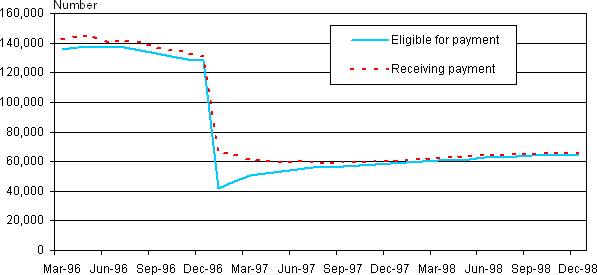
- Nearly 160,000 DA&A SSI beneficiaries received notices in 1996. Of those individuals, over 120,000 became ineligible to receive their SSI payments between March 1996 and December 1998. Between December 1996 and January 1997 alone, over 86,000 individuals lost payment eligibility.
- The majority of the former DA&A beneficiaries who were sent notices in 1996 and were receiving SSI payments were male and had been eligible for benefits for 5 years or less.
- Most of the former DA&A beneficiaries who continued to receive payments in December 1998 had been on the SSI rolls for 5 years or less, had no income other than SSI, were male, and were classified as being in the "other mental disorders" category.
- The majority of the former DA&A beneficiaries who received payments in March 1996 but had them discontinued by December 1998 had been on the SSI rolls for 5 years or less, had no income other than SSI, and were male.
Characteristics of DA&A Beneficiaries
Public Law 104-121 immediately ended the award of new DI and SSI benefits to individuals whose DA&A status was material to their disability, and it required SSA to terminate benefits to existing DA&A beneficiaries by January 1, 1997. From June through July 1996, SSA sent notices to over 209,000 DA&A beneficiaries, informing them of pending termination of their benefits and their right to appeal. The targeted DA&A beneficiaries accounted for approximately 2.6 percent of DI worker beneficiaries and SSI disabled adult beneficiaries at the time. Of the DA&A beneficiaries, 57 percent were SSI-eligible only, 22 percent were concurrently eligible for SSI and DI, and 21 percent were DI-eligible only.
Characteristics of the 1996 DA&A beneficiaries are detailed below.2
- The majority (79 percent) received SSI payments.
- Most were male (approximately 73 percent).
- The average age was 43 (almost 39 percent were aged 40–49).
- A disproportionately large share were black (about 40 percent). Blacks made up 28 percent of the entire blind/disabled SSI population in June 1996.
- Most (84 percent) had been eligible for benefits for 5 years or less.
- Many beneficiaries (41 percent) received between $250 and $499 per month in total combined SSI payments and DI benefits.
- Of those who received SSI payments, 98 percent received no earned income and 66 percent received no unearned income.
- For beneficiaries who received earned income, the average amount was $261 per month.
- Of those who received SSI payments, 75 percent had a psychiatric impairment.
- Many beneficiaries paid minimal contributions into Social Security (28 percent had earnings in covered employment in less than 40 percent of their adult years).
To illustrate how DA&A beneficiaries compare with other disabled beneficiaries, we compared SSI beneficiaries who were DA&A with all SSI beneficiaries who were blind/disabled (Table 1). The two populations differed substantially in certain categories. For example, the majority of the DA&A cohort were aged 30–59, whereas the ages of the blind/disabled cohort were more spread out. The DA&A cohort also had a larger proportion of both black and male beneficiaries. More of the blind/disabled cohort appeared to have earned some kind of countable income, which may account for the lower monthly benefits that the cohort received on average. Finally, a larger percentage of DA&A beneficiaries had been on the SSI rolls for 5 years or less.
| Characteristic | SSI populations | |
|---|---|---|
| DA&A | Blind/ disabled |
|
| Number | ||
| Total | 134,250 | 5,103,160 |
| As a percentage of total | ||
| Age | ||
| 1–29 | 8.2 | 31.6 |
| 30–59 | 87.6 | 46.5 |
| 60 or older | 4.2 | 21.9 |
| Race | ||
| Black | 40.1 | 27.8 |
| White | 41.0 | 47.4 |
| Other | 9.1 | 10.7 |
| Unreported | 9.8 | 14.1 |
| Sex | ||
| Male | 67.1 | 46.1 |
| Female | 32.9 | 53.9 |
| No countable income | 69.5 | 51.0 |
| On SSI rolls for 5 years or less | 82.9 | 50.9 |
| Average monthly payment (dollars) | 420.93 | 364.33 |
| SOURCE: SSI 10 Percent Sample File for June 1996 and DA&A Universe Sample File for June 1996. | ||
| NOTE: The results in this table may differ from those given elsewhere in this research and statistics note because the sample used here was taken from June 1996 (not March 1996). | ||
Addictions and Impairments of the March 1996 DA&A Beneficiary Cohort
SSA records indicate that over half of the total DA&A population were addicted to alcohol only, 16 percent were addicted to drugs only, and 27 percent were addicted to both.
The impairment data analyzed for March 1996 are for SSI cases only and indicate the impairment on which the eligibility was based at that time.3 Almost 75 percent of the SSI cases were classified in a psychiatric category, including 64 percent in the substance abuse category.4 A small percentage of individuals were classified in the affective disorder category (4.4 percent) and in the mental retardation category (3.0 percent).5 Very few people were listed in the cirrhosis of the liver or liver disease category (0.3 percent)—impairments often associated with severe alcohol abuse.
Maximus Inc., a referral and monitoring agency (RMA), provided additional information on DA&A beneficiaries.6 A sample of 82,806 cases from 43 states suggests that:
- Many beneficiaries had low levels of education (48.4 percent had 11 years or less, and only 32.5 percent reached 12 years);
- Few had technical training (64 percent had none, and 19 percent had 12 months or less);
- Most had no children (84.7 percent—76 percent of whom were women); and
- The vast majority had a criminal history (only 8.8 percent had none).
Loss of SSI Eligibility and Payment Status
The criteria for SSI eligibility should be considered before describing the individuals who lost eligibility and paid status. To be eligible for an SSI payment in any given month (that is, have eligibility status), an individual must meet certain criteria. Some of the criteria require that the individual be aged, blind, or disabled and have income and resources below a certain level. A person becomes ineligible for payment for any month in which the criteria are not met.
Of the 165,690 DA&A SSI beneficiaries who received notices in 1996, 100,010 of them lost paid status between March 1996 and December 1998. Only 65,680 individuals (or 40 percent of those who received notices in 1996) continued to receive payments by December 1998.
The number of people who lost eligibility status is slightly larger than that of those who lost paid status. Between March 1996 and December 1998, 101,120 DA&A beneficiaries lost eligibility status. Therefore, out of the 165,690 DA&A beneficiaries who received a notice in 1996, only 39 percent (64,570) had retained eligibility by December 1998. The decrease in the number of beneficiaries (beginning in January 1997) who were eligible to receive payments and the number who actually received payments is shown in Chart 1.
SSI DA&A beneficiaries receiving notices in March 1996 who continued eligibility and the receipt of payments through December 1998
| Month | Eligible for payment | Receiving payment |
|---|---|---|
| March 1996 | 135,510 | 142,440 |
| April 1996 | 136,800 | 144,540 |
| May 1996 | 137,190 | 144,150 |
| June 1996 | 137,400 | 140,580 |
| July 1996 | 136,890 | 142,040 |
| August 1996 | 135,240 | 140,230 |
| September 1996 | 133,280 | 137,340 |
| October 1996 | 130,690 | 135,170 |
| November 1996 | 128,940 | 133,360 |
| December 1996 | 128,230 | 130,800 |
| January 1997 | 41,920 | 66,990 |
| February 1997 | 46,260 | 64,530 |
| March 1997 | 50,330 | 61,600 |
| April 1997 | 52,210 | 60,430 |
| May 1997 | 53,460 | 59,700 |
| June 1997 | 54,580 | 59,760 |
| July 1997 | 55,730 | 59,130 |
| August 1997 | 56,330 | 58,980 |
| September 1997 | 56,810 | 59,370 |
| October 1997 | 57,690 | 59,660 |
| November 1997 | 58,160 | 60,300 |
| December 1997 | 58,810 | 60,320 |
| January 1998 | 59,300 | 60,820 |
| February 1998 | 59,770 | 61,770 |
| March 1998 | 60,490 | 62,180 |
| April 1998 | 60,790 | 62,680 |
| May 1998 | 61,480 | 63,250 |
| June 1998 | 62,490 | 64,170 |
| July 1998 | 63,100 | 64,160 |
| August 1998 | 63,410 | 64,520 |
| September 1998 | 63,810 | 65,100 |
| October 1998 | 64,090 | 65,250 |
| November 1998 | 64,470 | 65,750 |
| December 1998 | 64,570 | 65,680 |
How the Type of Reported Disability Changed Over Time
Because drug addiction or alcoholism was no longer a valid reason to retain program eligibility, persons continuing on the rolls had to establish eligibility based on another type of disability. In March 1996, when individuals first began to receive notices, over 60 percent of DA&A SSI beneficiaries cited "substance abuse" as their primary impairment. The second most cited impairment was "other mental disorders" (approximately 11 percent). That category does not include individuals suffering from mental retardation but does include those suffering from personality disorders, anxiety and other neuroses, schizophrenia, paranoia, functional psychoses, and other psychoses.
The primary impairment for DA&A SSI beneficiaries who were still eligible in December 1998 changed slightly, however, from March 1996. Of the 36,510 DA&A beneficiaries with a December 1996 diagnosis of substance abuse, over half (52 percent) were classified in the "other mental disorders" category by December 1998 (Table 2). The second and third most cited categories were "mental retardation" (8.4 percent) and "musculoskeletal and connective tissue disorders" (7.7 percent), respectively. Only 4.3 percent of DA&A beneficiaries continued to be listed in the "substance abuse" category.
| Primary diagnosis in December 1996 | Number of beneficiaries eligible in December 1996 | Primary diagnosis in December 1998 | |||||||||||||
|---|---|---|---|---|---|---|---|---|---|---|---|---|---|---|---|
| Infectious & parasitic | Neoplasm | Endocrine & metabolic | Mental disorders | Substance abuse | Diseases of the— | Musculo-skeletal system & connective tissues | Injuries & poisonings | Other | Missing | ||||||
| Retardation | Other | Nervous & sensory organs | Circulatory system | Respiratory system | Digestive system | ||||||||||
| Total number | 65,680 | 1,640 | 460 | 1,940 | 5,990 | 33,530 | 1,810 | 1,700 | 2,710 | 1,840 | 1,280 | 5,200 | 1,350 | 2,130 | 4,100 |
| Infectious & parasitic | 590 | 270 | 0 | 10 | 0 | 210 | 0 | 10 | 40 | 10 | 10 | 10 | 0 | 0 | 20 |
| Neoplasm | 40 | 10 | 0 | 10 | 0 | 0 | 0 | 0 | 0 | 10 | 0 | 0 | 10 | 0 | 0 |
| Endocrine & metabolic | 330 | 10 | 0 | 110 | 10 | 120 | 0 | 10 | 10 | 10 | 0 | 30 | 10 | 10 | 0 |
| Mental disorders | |||||||||||||||
| Retardation | 2,360 | 0 | 10 | 20 | 1,420 | 550 | 10 | 20 | 10 | 30 | 20 | 50 | 30 | 110 | 80 |
| Other | 8,510 | 80 | 30 | 130 | 250 | 6,590 | 10 | 120 | 210 | 140 | 60 | 300 | 80 | 200 | 310 |
| Substance abuse | 36,510 | 840 | 230 | 1,110 | 3,060 | 19,000 | 1,570 | 980 | 1,570 | 1,020 | 700 | 2,820 | 720 | 970 | 1,920 |
| Diseases of the— | |||||||||||||||
| Nervous & sensory organs | 240 | 0 | 0 | 0 | 10 | 40 | 0 | 110 | 0 | 0 | 20 | 30 | 0 | 10 | 20 |
| Circulatory system | 270 | 10 | 0 | 0 | 0 | 20 | 0 | 0 | 200 | 10 | 10 | 10 | 0 | 0 | 10 |
| Respiratory system | 260 | 0 | 0 | 10 | 10 | 20 | 0 | 10 | 0 | 150 | 0 | 30 | 10 | 20 | 0 |
| Digestive system | 310 | 0 | 0 | 40 | 0 | 40 | 0 | 0 | 0 | 0 | 170 | 10 | 0 | 30 | 20 |
| Musculoskeletal system & connective tissues | 770 | 0 | 20 | 50 | 20 | 90 | 0 | 10 | 10 | 50 | 10 | 360 | 10 | 30 | 110 |
| Injuries & poisonings | 230 | 0 | 0 | 0 | 20 | 20 | 0 | 0 | 0 | 0 | 0 | 50 | 140 | 0 | 0 |
| Other | 3,940 | 30 | 50 | 110 | 430 | 1,960 | 70 | 120 | 160 | 100 | 50 | 380 | 60 | 280 | 140 |
| Missing | 11,320 | 390 | 120 | 340 | 760 | 4,870 | 150 | 310 | 500 | 310 | 230 | 1,120 | 280 | 470 | 1,470 |
| SOURCE: DA&A Universe Sample File created from SSI 10 Percent Sample Files. | |||||||||||||||
Characteristics of DA&A Beneficiaries Who Continued to Receive Payments in December 1998
Almost 40 percent of the DA&A beneficiaries who were still eligible for payments in December 1998 had been on the rolls from 3 to 5 years (Table 3). Similarly, 34 percent had been on the rolls between 6 and 8 years. By comparison, in June 1996, 48 percent of DA&A beneficiaries had been on the rolls for 3 to 5 years, and only 12 percent had been on the rolls for 6 to 8 years.7
| Characteristic | All blind/disabled beneficiaries | DA&A beneficiaries continuing to receive payments | ||
|---|---|---|---|---|
| Number | Percent | Number | Percent | |
| Total | 4,324,700 | 100.0 | 65,680 | 100.0 |
| Years on the SSI rolls | ||||
| 2 or less | 683,020 | 15.8 | 9,590 | 14.6 |
| 3–5 | 906,490 | 21.0 | 24,730 | 37.7 |
| 6–8 | 854,280 | 19.8 | 22,360 | 34.0 |
| 9–11 | 482,240 | 11.2 | 5,690 | 8.7 |
| 12–14 | 483,580 | 11.2 | 2,430 | 3.7 |
| 15 or more | 915,090 | 21.2 | 880 | 1.3 |
| Living arrangement | ||||
| Own household | 4,046,720 | 93.6 | 63,930 | 97.3 |
| Another's household | 154,230 | 3.6 | 850 | 1.3 |
| Parent's household | 10,530 | 0.2 | 80 | 0.1 |
| Institution | 106,230 | 2.5 | 520 | 0.8 |
| Not reported | 6,990 | 0.2 | 300 | 0.5 |
| Other income | ||||
| Earned | 272,500 | 6.3 | 1,010 | 1.5 |
| Unearned | ||||
| Social Security | 1,419,170 | 32.8 | 15,990 | 24.3 |
| Other | 411,460 | 9.5 | 3,200 | 4.9 |
| No other | 2,221,570 | 51.4 | 45,810 | 69.7 |
| Sex | ||||
| Male | 1,784,810 | 41.3 | 42,050 | 64.0 |
| Female | 2,539,680 | 58.7 | 23,630 | 36.0 |
| Unknown | 210 | a | 0 | 0 |
| SOURCE: December 1998, 10 Percent Sample File and DA&A Universe Sample File. | ||||
| a. Less than 0.05 percent. | ||||
Other characteristics did not change a great deal between DA&A beneficiaries receiving benefits in June 1996 and those who were still receiving benefits in December 1998. For example, the vast majority of them lived in their own household (97.3 percent in December 1998 compared with 97.2 percent in June 1996). Also, the majority continued to receive no income other than SSI. Approximately 69.7 percent of beneficiaries received no other income in December 1998 compared with 69.5 percent in June 1996.
Finally, the gender composition changed slightly during the follow-up study period. In June 1996, 67.1 percent of DA&A beneficiaries receiving SSI payments were male and 32.9 percent were female. Of the beneficiaries who were still eligible in December 1998, 64 percent were male and 36 percent were female.
How DA&A Beneficiaries Were Affected, by State
In December 1996, the top five states with the largest number of DA&A beneficiaries receiving SSI payments were California (31,030), Illinois (16,100), Michigan (9,880), Ohio (6,550), and Tennessee (4,960) as shown in Table 4. In December 1998, the top four states did not change: California (14,690), Illinois (6,250), Michigan (5,290), and Ohio (2,820). However, Massachusetts (2,640) replaced Tennessee (1,570) as the state with the fifth highest number of DA&A beneficiaries receiving SSI payments.
| State | Number | Percentage decrease | |
|---|---|---|---|
| Receiving payments in December 1996 |
No longer receiving payments in December 1998 | ||
| Total | 130,800 | 58,080 | 55.6 |
| Alabama | 1,610 | 820 | 49.1 |
| Alaska | 290 | 110 | 62.1 |
| Arizona | 1,480 | 640 | 56.8 |
| Arkansas | 540 | 290 | 46.3 |
| California | 31,030 | 14,690 | 52.7 |
| Colorado | 910 | 520 | 42.9 |
| Connecticut | 730 | 390 | 46.6 |
| Delaware | 80 | 50 | 37.5 |
| District of Columbia | 180 | 90 | 50.0 |
| Florida | 2,530 | 1,140 | 54.9 |
| Georgia | 1,910 | 970 | 49.2 |
| Hawaii | 390 | 180 | 53.8 |
| Idaho | 240 | 110 | 54.2 |
| Illinois | 16,100 | 6,250 | 61.2 |
| Indiana | 1,510 | 560 | 62.9 |
| Iowa | 550 | 330 | 40.0 |
| Kansas | 780 | 300 | 61.5 |
| Kentucky | 4,500 | 2,320 | 48.4 |
| Louisiana | 1,090 | 510 | 53.2 |
| Maine | 830 | 450 | 45.8 |
| Maryland | 1,490 | 940 | 36.9 |
| Massachusetts | 4,620 | 2,640 | 42.9 |
| Michigan | 9,880 | 5,290 | 46.5 |
| Minnesota | 2,850 | 1,310 | 54.0 |
| Mississippi | 940 | 360 | 61.7 |
| Missouri | 1,460 | 660 | 54.8 |
| Montana | 290 | 110 | 62.1 |
| Nebraska | 330 | 180 | 45.5 |
| Nevada | 670 | 340 | 49.3 |
| New Hampshire | 190 | 100 | 47.4 |
| New Jersey | 1,110 | 580 | 47.7 |
| New Mexico | 700 | 350 | 50.0 |
| New York | 7,020 | 440 | 93.7 |
| North Carolina | 1,740 | 980 | 43.7 |
| North Dakota | 140 | 60 | 57.1 |
| Ohio | 6,550 | 2,820 | 56.9 |
| Oklahoma | 640 | 360 | 43.8 |
| Oregon | 1,500 | 560 | 62.7 |
| Pennsylvania | 4,320 | 2,080 | 51.9 |
| Rhode Island | 350 | 250 | 28.6 |
| South Carolina | 770 | 290 | 62.3 |
| South Dakota | 220 | 80 | 63.6 |
| Tennessee | 4,960 | 1,570 | 68.3 |
| Texas | 1,590 | 520 | 67.3 |
| Utah | 230 | 70 | 69.6 |
| Vermont | 160 | 80 | 50.0 |
| Virginia | 1,330 | 800 | 39.8 |
| Washington | 3,000 | 1,530 | 49.0 |
| West Virginia | 1,850 | 970 | 47.6 |
| Wisconsin | 2,480 | 1,020 | 58.9 |
| Wyoming | 90 | 20 | 77.8 |
| Other | 50 | 0 | 100.0 |
| SOURCE: DA&A Universe Sample File created from SSI 10 Percent Sample Files. | |||
New York had the largest percentage decrease (93.7 percent) in paid DA&A beneficiaries from December 1996 through December 1998. All but 440 of the 7,020 beneficiaries in that state lost their payments. During the same period, Wyoming had the second largest decrease (77.8 percent) in paid DA&A beneficiaries (from 90 to 20 individuals), followed by Utah (69.6 percent), Tennessee (68.3 percent), and Texas (67.3 percent).
Characteristics of DA&A Beneficiaries Who Received Payments in March 1996 but Had Them Discontinued by December 1998
Beneficiaries who spent the most time on the SSI rolls (9 years or more) were not as likely as those who spent 5 years or less on the rolls to lose payment status after the DA&A legislation (Table 5). A negligible number (0.5 percent) of individuals who lost payment status were on the SSI rolls for 15 years or more, compared with approximately 43 percent who were on the rolls for 2 years or less and 41 percent between 3 and 5 years. Thus, over 80 percent of DA&A beneficiaries who were no longer receiving payments by December 1998 had been on the SSI rolls for 5 years or less.
| Characteristic | All blind/disabled beneficiaries | Former DA&A beneficiaries receiving payments in 3/96 but discontinued by 12/98 | ||
|---|---|---|---|---|
| Number | Percent | Number | Percent | |
| Total | 4,324,700 | 100.0 | 81,470 | 100.0 |
| Years on the SSI rolls | ||||
| 2 or less | 683,020 | 15.8 | 34,620 | 42.5 |
| 3–5 | 906,490 | 21.0 | 33,390 | 41.0 |
| 6–8 | 854,280 | 19.8 | 9,610 | 11.8 |
| 9–11 | 482,240 | 11.2 | 2,600 | 3.2 |
| 12–14 | 483,580 | 11.2 | 830 | 1.0 |
| 15 or more | 915,090 | 21.2 | 420 | 0.5 |
| Living arrangement | ||||
| Own household | 4,046,720 | 93.6 | 77,350 | 94.9 |
| Another's household | 154,230 | 3.6 | 2,710 | 3.3 |
| Parent's household | 10,530 | 0.2 | 230 | 0.3 |
| Institution | 106,230 | 2.5 | 250 | 0.3 |
| Not reported | 6,990 | 0.2 | 930 | 1.1 |
| Other income | ||||
| Earned | 272,500 | 6.3 | 1,340 | 1.6 |
| Unearned | ||||
| Social Security | 1,419,170 | 32.8 | 20,910 | 25.7 |
| Other | 411,460 | 9.5 | 6,590 | 8.1 |
| No other | 2,221,570 | 51.4 | 52,790 | 64.8 |
| Sex | ||||
| Male | 1,784,810 | 41.3 | 57,870 | 71.0 |
| Female | 2,539,680 | 58.7 | 23,600 | 29.0 |
| Unknown | 210 | a | 0 | 0 |
| SOURCE: December 1998, SSI 10 Percent Sample File and DA&A Universe Sample File. | ||||
| a. Less than 0.05 percent. | ||||
The vast majority (94.9 percent) of DA&A beneficiaries who stopped receiving payments lived in their own household. That is not surprising, however, because individuals living in their own household made up a similar share (93.6 percent) of the SSI population that was blind/disabled. Similarly, individuals who had no other income made up the majority (51.4 percent) of SSI beneficiaries who were blind/disabled and 64.8 percent of the DA&A beneficiaries who were no longer receiving payments by December 1998. Approximately 26 percent of DA&A beneficiaries who lost payment status by December 1998 had Title II (Social Security) income, 8 percent had other unearned income, and only about 2 percent had earned income.
Finally, one of the most interesting facts is the difference in discontinued payments by sex. Of the DA&A beneficiaries who were no longer being paid by December 1998, over two-thirds (71 percent) were male. Females accounted for the majority (58.7 percent) of SSI beneficiaries who were blind/disabled but for only 29 percent of the DA&A beneficiaries whose payments were discontinued.
Data Sources
The major results of this note were derived from the following four data sources-one of which is an analytical source:
- DA&A Universe Sample File containing persons who were sent notices from SSA's Office of Disability.
- SSI 10 Percent Sample File from SSA's Office of Research, Evaluation, and Statistics.
- "Supplemental Security Income Recipients for Whom the Alcoholism and Drug Addiction Provisions Apply."8
- Analytical source—the Lewin Group and its subcontractor Westat Inc.—"Policy Evaluation of the Effect of Legislation Prohibiting the Payment of Disability Benefits to Individuals Whose Disability is Based on Drug Addiction and Alcoholism." Lewin submitted this report to the Social Security Administration on July 21, 1998.9
Notes
1. The Goldberg-Kelly provisions require that a beneficiary file a timely appeal and receive a payment in the month before termination—in this case, December 1996. The Goldberg-Kelly provisions also allow for the continuation of SSI payments if good cause is found for a late filing of an appeal.
2. The data were obtained from the DA&A Universe Sample File that was created by SSA's Office of Disability in May and June 1996.
3. Information was missing for almost 19 percent of SSI cases (mostly those at the appellate level). Data for DI beneficiaries were not available. The impairment on which eligibility is based at that time may differ from the impairment that was the basis for the original allowance.
4. The information in this paragraph should not be confused with the information found in Table 2. The information in this paragraph refers to impairments cited as of March 1996, whereas the data presented in Table 2 refer to impairments cited as of December 1998.
5. The "other mental disorders" category in Table 2 includes affective disorders, psychiatric disorders, personality disorders, anxiety and other neuroses, schizophrenia, paranoia, functional psychoses, and the other psychoses categories found in Exhibit App. 1.13 from the Lewin report (see Data Sources).
6. RMAs operated under contract to SSA and were responsible for conducting initial evaluations of DA&A beneficiaries and referring them to appropriate treatment services.
7. These and the following June 1996 statistics were obtained from Sherry L. Barber, "Supplemental Security Income Recipients for Whom the Alcoholism and Drug Addiction Provisions Apply," Social Security Administration, Office of Research, Evaluation, and Statistics (unpublished, June 1996), Table 3.
8. For more information, refer to note 7.
9. The data from this report were also used by Paul Davies, Howard Iams, and Kalman Rupp (2000) in "The Effect of Welfare Reform on SSA's Disability Program: Design of Policy Evaluation and Early Evidence," Social Security Bulletin 63(1): 3–11.