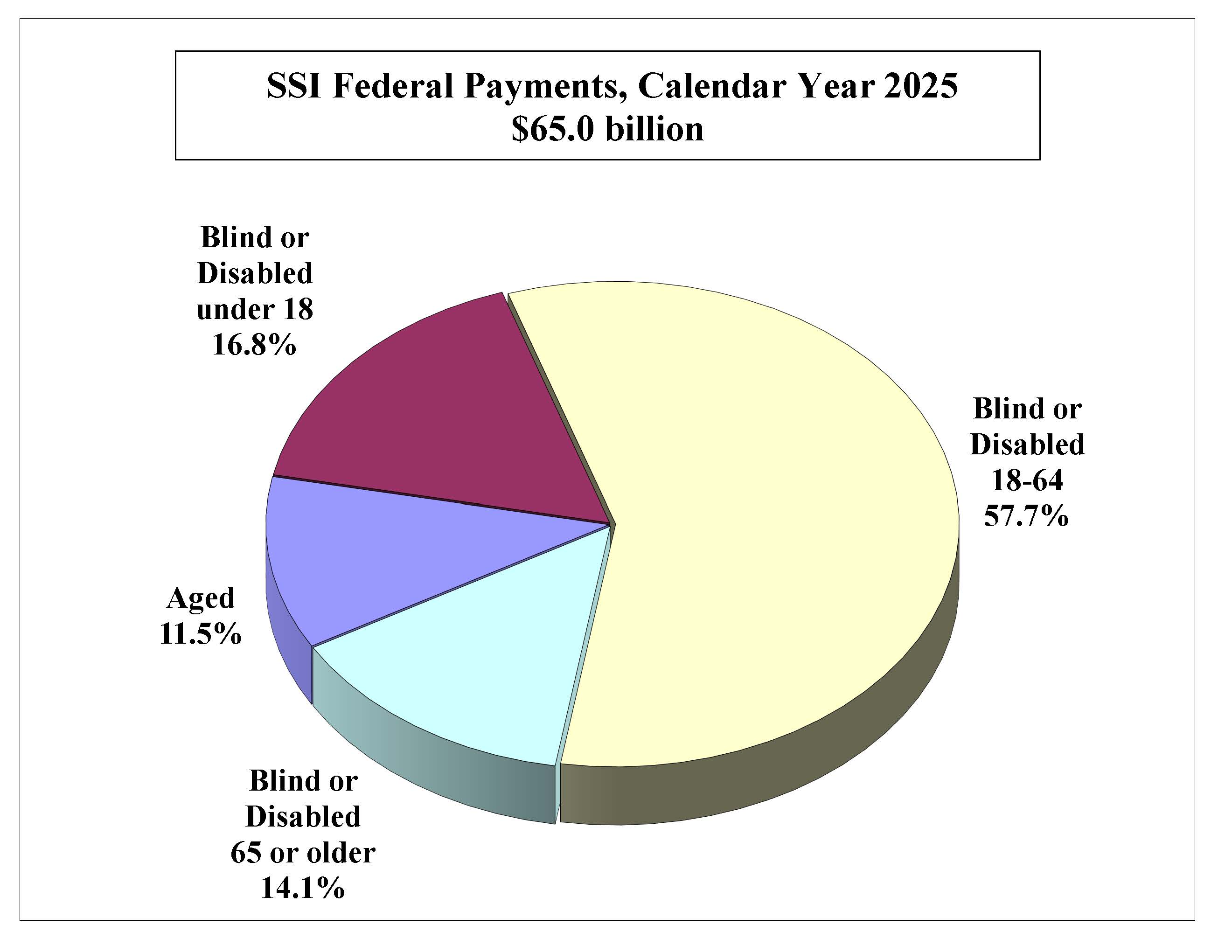
EXECUTIVE SUMMARY The Personal Responsibility and Work Opportunity Reconciliation Act of 1996 (Public Law 104-193) directs the Social Security Administration (SSA) to report annually to the President and to the Congress on the status of the Supplemental Security Income (SSI) program. Projections of program recipients and costs through at least 25 years are required elements of these reports. This report is the 30th such report. Highlights of the SSI Program • The SSI program is a nationwide Federal assistance program administered by SSA that guarantees a minimum level of income for aged, blind, or disabled individuals. It acts as a safety net for individuals who have limited resources and little or no Social Security or other income. Individual States have the option to supplement Federal payments. • In January 2026, 7.24 million individuals received monthly Federal SSI payments averaging $711, a decrease of about 17,000 recipients from the 7.26 million recipients with an average payment of $688 in January 2025. [D] • Federal expenditures for cash payments under the SSI program during calendar year 2025 increased 3.0 percent to $65.0 billion, while the funds made available to administer the SSI program in fiscal year 2025 increased 8.8 percent to $5.1 billion. In 2024, the corresponding program and administrative expenditures were $63.1 billion and $4.7 billion, respectively. Major Findings of the Report • By 2050, the end of the 25-year projection period, we estimate that the Federal SSI recipient population will reach 7.6 million. The projected growth in the SSI program over the 25-year period is largely due to the overall growth in the Social Security area population, though the growth in the SSI recipient population is projected to be somewhat slower than the growth in the Social Security area population. • As a percentage of the total Social Security area population, the number of Federal SSI recipients decreased from 2.10 percent in 2024 to 2.09 percent in 2025. We project this percentage to trend downward during the 25-year projection period, reaching 2.05 percent of the population in 2050. This decline occurs for several reasons, including that the percent of the population potentially eligible for SSI based on their citizenship and residency status is projected to decline slightly in the future. • We project that Federal expenditures for SSI payments in calendar year 2026 will increase by $1.3 billion to $66.3 billion, an increase of 2.0 percent from 2025 levels. • In dollars adjusted by the Consumer Price Index to 2026 levels, we project that Federal expenditures for SSI payments will increase to $69.1 billion in 2050, a real increase of 0.1 percent per year. • Federal SSI expenditures expressed as a percentage of the Gross Domestic Product (GDP) were 0.21 percent in 2025. We project that expenditures as a percentage of GDP will stay roughly level in 2026, and will decline thereafter to 0.15 percent of GDP by 2050. Federal SSI expenditures are projected to grow more slowly than GDP, both because the share of the population that will be potentially eligible for SSI will decline and because the maximum Federal SSI benefit is projected to grow more slowly on average than the growth in average income in the future.