2002 OASDI Trustees Report


2002 OASDI Trustees Report |
|
|
|
|
This section presents long-range projections in dollars of the operations of the combined OASI and DI Trust Funds and in some cases the HI Trust Fund. It provides the means to track the progress of the funds during the projection period. Meaningful comparison of current dollar values over long periods of time can be difficult because of the tendency toward inflation. Some means of removing inflation is thus generally desirable. Several economic series, or indices, are provided to allow current dollars to be adjusted for changes in prices, wages, and certain other aspects of economic growth during the projection period.
The selection of a particular index for adjustment of current dollars depends upon the analyst's decision as to which index provides the most useful standard for adjusting dollar amounts, over time, to create values that are appropriately comparable. Table VI.E7 presents five such indices for adjustment. Adjustment of any series of values is accomplished by dividing the value for each year by the corresponding index values for the year. This adjustment removes the inflation in the index from the series of values.
One of the most common forms of standardization is based on some measure of change in the prices of consumer goods. One such price index is the Consumer Price Index for Urban Wage Earners and Clerical Workers (CPI-W, hereafter referred to as CPI) which is published by the Bureau of Labor Statistics, Department of Labor. This is the index used to determine annual increases in OASDI monthly benefits payable after the year of initial eligibility. The CPI is assumed to increase ultimately at annual rates of 2.0, 3.0, and 4.0 percent for the low cost, intermediate, and high cost sets of assumptions, respectively. Constant-dollar values (those adjusted by dividing by the CPI) indicate the relative purchasing power of the values over time. Constant-dollar values are provided in table VI.E8.
Another type of standardization combines the effects of price inflation and real-wage growth. The wage index presented here is the SSA average wage index, as defined in section 215(i)(1)(G) of the Social Security Act. This index is used to make annual adjustments to many earnings-related quantities embodied in the Social Security Act, such as the contribution and benefit base. The average annual wage is assumed to increase ultimately by 3.6, 4.1, and 4.6 percent under the low cost, intermediate, and high cost assumptions, respectively. Wage-indexed values indicate the level of a series relative to the standard-of-living of workers over time.
The taxable payroll index adjusts for the effects of changes in the number of workers and changes in the proportion of earnings that are taxable, as well as for the effects of price inflation and real-wage growth. The OASDI taxable payroll consists of all earnings subject to OASDI taxation, adjusted for the lower effective tax rate on multiple-employer excess wages, and including deemed wage credits for military service through calendar year 2001. Values adjusted by dividing by the taxable payroll indicate the percentage of payroll that each value represents, and thus the extent to which the series of values increases or decreases as a percent of payroll over time.
The GDP index adjusts for the growth in the aggregate amount of goods and services produced in the United States. Values adjusted by GDP (see appendix VI.E.2) indicate their relative share of the total output of the economy. No explicit assumptions are made about growth in taxable payroll or GDP. These series are computed reflecting the other more basic demographic and economic assumptions, as discussed in sections V.A and V.B, respectively.
Discounting at the rate of interest is another way of adjusting current dollars. The series of interest-rate factors included here is based on the average of the assumed annual interest rates for special public-debt obligations issuable to the trust funds for each year. This series is slightly different from the interest rates used to create summarized values elsewhere in this report, where the actual yield on currently-held trust fund assets is used for each year. Ultimate nominal interest rates, which, in practice, are compounded semiannually, are assumed to be approximately 5.7, 6.0, and 6.2 percent for the low cost, intermediate, and high cost assumptions, respectively.
1 The CPI used to adjust OASDI benefits is the Consumer Price Index for Urban Wage Earners and Clerical Workers (CPI), as defined by the Bureau of Labor Statistics, Department of Labor. The values shown are adjusted by dividing the calendar-year annual average CPI by the analogous value for 2002, and multiplying the result by 100, thereby initializing the CPI at 100 for 2002. 2 The "SSA average wage index" is defined in section 215(i)(1)(G) of the Social Security Act; it is used in the calculations of initial benefits and the automatic adjustment of the contribution and benefit base and other wage-indexed program amounts. 3 Taxable payroll consists of total earnings subject to OASDI contribution rates, adjusted to include deemed wages based on military service through calendar year 2001 and to reflect the lower effective contribution rates (compared to the combined employee-employer rate) which apply to multiple-employer "excess wages." 4 The compound interest-rate factor is based on the average of the assumed annual interest rates for special public-debt obligations issuable to the trust funds in the 12 months of the year, under each alternative. |
Table VI.E8 shows estimated operations of the combined OASI and DI Trust Funds in constant 2002 dollars (i.e., adjusted by the CPI indexing series as discussed above). Items included in the table are: income excluding interest, interest income, total income, total outgo, and assets at the end of the year. Income excluding interest consists of payroll-tax contributions, income from taxation of benefits, and miscellaneous reimbursements from the General Fund of the Treasury. Outgo consists of benefit payments, administrative expenses, net transfers from the OASI and DI Trust Funds to the Railroad Retirement program under the financial-interchange provisions, and payments for vocational rehabilitation services for disabled beneficiaries. These estimates are based on the low cost, intermediate, and high cost sets of assumptions.
| Calendar year |
||||||
|---|---|---|---|---|---|---|
| $544.8 |
$79.6 |
$624.4 |
$465.2 |
$1,371.8 |
||
| 561.2 |
86.6 |
647.8 |
464.9 |
1,520.9 |
||
| 574.4 |
96.0 |
670.4 |
473.7 |
1,677.0 |
||
| 588.1 |
105.8 |
693.9 |
484.5 |
1,838.5 |
||
| 600.2 |
116.0 |
716.1 |
496.8 |
2,004.3 |
||
| 614.0 |
126.3 |
740.3 |
510.7 |
2,175.6 |
||
| 626.5 |
136.4 |
762.9 |
526.2 |
2,348.8 |
||
| 638.7 |
146.1 |
784.8 |
544.2 |
2,521.2 |
||
| 650.8 |
155.6 |
806.4 |
563.5 |
2,690.5 |
||
| 664.6 |
165.1 |
829.7 |
584.0 |
2,857.9 |
||
| |
|
|
|
|
||
| 711.4 |
198.4 |
909.8 |
683.1 |
3,445.5 |
||
| 770.6 |
223.4 |
993.9 |
844.7 |
3,838.2 |
||
| 831.9 |
218.0 |
1,049.9 |
1,017.6 |
3,686.3 |
||
| 897.8 |
178.8 |
1,076.7 |
1,174.6 |
2,956.2 |
||
| 969.0 |
109.7 |
1,078.6 |
1,301.8 |
1,721.6 |
||
2040 2
|
1,043.4 |
17.2 |
1,060.5 |
1,400.5 |
96.3 |
|
| 549.8 |
80.2 |
630.1 |
464.0 |
1,378.6 |
||
| 571.1 |
88.6 |
659.7 |
464.2 |
1,547.2 |
||
| 590.8 |
99.1 |
689.9 |
472.0 |
1,734.8 |
||
| 608.3 |
109.5 |
717.8 |
482.2 |
1,936.4 |
||
| 622.7 |
119.9 |
742.6 |
493.4 |
2,147.7 |
||
| 638.9 |
130.9 |
769.8 |
506.2 |
2,369.1 |
||
| 655.4 |
142.6 |
798.0 |
520.7 |
2,599.9 |
||
| 672.7 |
154.8 |
827.5 |
537.7 |
2,838.9 |
||
| 689.9 |
167.5 |
857.4 |
556.1 |
3,084.5 |
||
| 708.6 |
180.6 |
889.2 |
575.8 |
3,337.4 |
||
| |
|
|
|
|
||
| 776.7 |
236.8 |
1,013.5 |
677.7 |
4,365.0 |
||
| 865.9 |
302.6 |
1,168.4 |
851.2 |
5,531.9 |
||
| 962.0 |
353.3 |
1,315.3 |
1,041.6 |
6,410.1 |
||
| 1,070.2 |
387.8 |
1,458.0 |
1,221.2 |
7,004.3 |
||
| 1,194.0 |
413.6 |
1,607.6 |
1,372.7 |
7,458.7 |
||
| 1,332.8 |
442.8 |
1,775.6 |
1,497.3 |
7,997.7 |
||
| 1,487.0 |
483.7 |
1,970.6 |
1,634.4 |
8,751.3 |
||
| 1,657.8 |
536.0 |
2,193.8 |
1,800.8 |
9,709.1 |
||
| 1,848.9 |
597.6 |
2,446.5 |
2,006.2 |
10,825.3 |
||
| 2,063.6 |
666.0 |
2,729.6 |
2,238.8 |
12,063.6 |
||
| 2,304.4 |
743.2 |
3,047.5 |
2,495.4 |
13,463.8 |
||
| 2,572.3 |
830.0 |
3,402.4 |
2,785.5 |
15,037.7 |
||
| 2,869.5 |
926.0 |
3,795.6 |
3,115.4 |
16,773.0 |
||
| 3,198.9 |
1,029.0 |
4,227.9 |
3,492.3 |
18,627.2 |
||
| 539.0 |
79.5 |
618.6 |
467.7 |
1,363.4 |
||
| 554.0 |
87.3 |
641.3 |
466.6 |
1,495.8 |
||
| 561.5 |
98.2 |
659.8 |
472.5 |
1,617.6 |
||
| 557.2 |
108.6 |
665.8 |
480.8 |
1,713.3 |
||
| 554.8 |
117.2 |
672.0 |
495.2 |
1,796.8 |
||
| 569.6 |
128.6 |
698.2 |
513.5 |
1,897.9 |
||
| 579.2 |
135.7 |
714.9 |
532.4 |
2,004.9 |
||
| 587.6 |
140.2 |
727.8 |
550.6 |
2,105.1 |
||
| 595.1 |
144.2 |
739.3 |
569.4 |
2,194.0 |
||
| 604.4 |
147.8 |
752.1 |
589.1 |
2,272.6 |
||
| |
|
|
|
|
||
| 632.5 |
148.5 |
781.1 |
677.3 |
2,429.2 |
||
| 667.0 |
131.9 |
798.9 |
819.0 |
2,140.7 |
||
2025 2
|
701.2 |
79.8 |
781.0 |
969.5 |
1,198.9 |
|
1 The adjustment from current to constant dollars is by the CPI indexing series shown in table VI.E7. 2 Estimates for later years are not shown because the combined OASI and DI Trust Funds are estimated to become exhausted in 2041 under the intermediate assumptions and in 2029 under the high cost assumptions. |
Note: Totals do not necessarily equal the sums of rounded components.
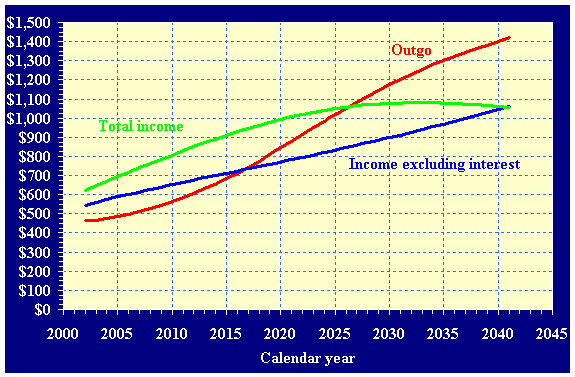
Figure VI.E1 provides a comparison of annual outgo with total annual income (including interest) and annual income excluding interest, for the OASDI program under intermediate assumptions. All values are expressed in constant dollars, as shown in table VI.E8. The difference between the income values for each year is equal to the trust fund interest earnings. Thus the figure illustrates the fact that, under intermediate assumptions, combined OASDI expenditures will be payable from (1) current tax income alone through 2016, (2) current tax income plus amounts from the trust funds that are less than annual interest income for years 2017 through 2026, and (3) current tax income plus amounts from the trust funds that are greater than annual interest income for years 2027 through 2040, i.e., through the year preceding the year of trust fund exhaustion.
|
Table VI.E9 shows estimated operations of the combined OASI and DI Trust Funds in current dollars-that is in dollars unadjusted for price inflation. Items included in the table are: income excluding interest, interest income, total income, total outgo, and assets at the end of the year. These estimates, based on the low cost, intermediate, and high cost sets of demographic and economic assumptions, are presented to facilitate independent analysis.
| Calendar year |
||||||
|---|---|---|---|---|---|---|
| $544.8 |
$79.6 |
$624.4 |
$465.2 |
$1,371.8 |
||
| 575.4 |
88.8 |
664.2 |
476.6 |
1,559.4 |
||
| 605.1 |
101.1 |
706.3 |
499.0 |
1,766.6 |
||
| 637.7 |
114.7 |
752.5 |
525.4 |
1,993.7 |
||
| 670.3 |
129.6 |
799.9 |
554.9 |
2,238.7 |
||
| 706.3 |
145.3 |
851.7 |
587.5 |
2,502.9 |
||
| 742.4 |
161.7 |
904.1 |
623.6 |
2,783.4 |
||
| 779.5 |
178.3 |
957.8 |
664.2 |
3,077.0 |
||
| 818.2 |
195.6 |
1,013.7 |
708.4 |
3,382.3 |
||
| 860.6 |
213.8 |
1,074.3 |
756.2 |
3,700.4 |
||
| |
|
|
|
|
||
| 1,036.7 |
289.1 |
1,325.9 |
995.5 |
5,021.1 |
||
| 1,301.8 |
377.4 |
1,679.2 |
1,427.1 |
6,484.2 |
||
| 1,629.3 |
426.9 |
2,056.3 |
1,992.9 |
7,219.6 |
||
| 2,038.4 |
406.0 |
2,444.5 |
2,666.8 |
6,711.7 |
||
| 2,550.4 |
288.7 |
2,839.0 |
3,426.4 |
4,531.4 |
||
2040 1
|
3,183.6 |
52.4 |
3,236.0 |
4,273.4 |
294.0 |
|
| 549.8 |
80.2 |
630.1 |
464.0 |
1,378.6 |
||
| 582.5 |
90.4 |
672.9 |
473.4 |
1,578.1 |
||
| 614.7 |
103.1 |
717.8 |
491.1 |
1,804.7 |
||
| 645.6 |
116.2 |
761.7 |
511.6 |
2,054.8 |
||
| 673.9 |
129.8 |
803.7 |
534.0 |
2,324.5 |
||
| 705.4 |
144.5 |
849.9 |
558.8 |
2,615.6 |
||
| 738.0 |
160.6 |
898.7 |
586.4 |
2,927.9 |
||
| 772.6 |
177.8 |
950.5 |
617.6 |
3,260.8 |
||
| 808.3 |
196.2 |
1,004.5 |
651.5 |
3,613.8 |
||
| 846.8 |
215.9 |
1,062.7 |
688.1 |
3,988.3 |
||
| |
|
|
|
|
||
| 1,004.7 |
306.3 |
1,311.0 |
876.7 |
5,646.4 |
||
| 1,236.6 |
432.1 |
1,668.7 |
1,215.7 |
7,900.6 |
||
| 1,516.9 |
557.0 |
2,074.0 |
1,642.5 |
10,107.6 |
||
| 1,863.2 |
675.2 |
2,538.4 |
2,126.0 |
12,194.0 |
||
| 2,295.0 |
794.9 |
3,089.9 |
2,638.5 |
14,336.7 |
||
| 2,828.4 |
939.7 |
3,768.1 |
3,177.5 |
16,972.7 |
||
| 3,484.1 |
1,133.2 |
4,617.4 |
3,829.6 |
20,505.0 |
||
| 4,288.6 |
1,386.7 |
5,675.3 |
4,658.7 |
25,116.9 |
||
| 5,280.8 |
1,706.9 |
6,987.7 |
5,730.2 |
30,919.3 |
||
| 6,507.5 |
2,100.1 |
8,607.6 |
7,060.0 |
38,042.2 |
||
| 8,023.2 |
2,587.4 |
10,610.6 |
8,688.2 |
46,876.8 |
||
| 9,888.3 |
3,190.7 |
13,078.9 |
10,707.6 |
57,806.1 |
||
| 12,178.7 |
3,930.2 |
16,109.0 |
13,222.3 |
71,187.5 |
||
| 14,989.9 |
4,821.6 |
19,811.5 |
16,364.7 |
87,285.2 |
||
| 539.0 |
79.5 |
618.6 |
467.7 |
1,363.4 |
||
| 571.8 |
90.1 |
661.8 |
481.5 |
1,543.7 |
||
| 606.1 |
106.0 |
712.1 |
509.9 |
1,745.9 |
||
| 636.5 |
124.1 |
760.6 |
549.2 |
1,957.3 |
||
| 670.3 |
141.6 |
811.9 |
598.3 |
2,170.9 |
||
| 721.8 |
163.0 |
884.7 |
650.7 |
2,405.0 |
||
| 764.4 |
179.1 |
943.5 |
702.6 |
2,645.8 |
||
| 806.4 |
192.4 |
998.8 |
755.7 |
2,888.9 |
||
| 849.3 |
205.9 |
1,055.2 |
812.7 |
3,131.4 |
||
| 897.2 |
219.3 |
1,116.5 |
874.4 |
3,373.4 |
||
| |
|
|
|
|
||
| 1,098.4 |
257.9 |
1,356.3 |
1,176.1 |
4,218.4 |
||
| 1,409.1 |
278.8 |
1,687.9 |
1,730.2 |
4,522.7 |
||
2025 1
|
1,802.4 |
205.0 |
2,007.4 |
2,492.1 |
3,081.9 |
|
1 Estimates for later years are not shown because the combined OASI and DI Trust Funds are estimated to become exhausted in 2041 under the intermediate assumptions and in 2029 under the high cost assumptions. |
Note: Totals do not necessarily equal the sums of rounded components.
Table VI.E10 shows, in current dollars, estimated income (excluding interest) and estimated total outgo (excluding the cost of accumulating target trust fund balances) of the combined OASI and DI Trust Funds, of the HI Trust Fund, and of the combined OASI, DI, and HI Trust Funds, based on the low cost, intermediate, and high cost sets of assumptions described earlier in this report. For OASDI, income excluding interest consists of payroll-tax contributions, proceeds from taxation of OASDI benefits, and miscellaneous transfers from the General Fund of the Treasury. Outgo consists of benefit payments, administrative expenses, net transfers from the trust funds to the Railroad Retirement program, and payments for vocational rehabilitation services for disabled beneficiaries. For HI, income excluding interest consists of payroll-tax contributions (including contributions from railroad employment) and proceeds from the taxation of OASDI benefits. Total outgo consists of outlays (benefits and administrative expenses) for insured beneficiaries. Income and outgo estimates are shown on a cash basis for the OASDI program and on an incurred basis for the HI program.
Table VI.E10 also shows the difference between income excluding interest and outgo, which is called the balance. The balance indicates the size of the net cash flow from tax income and expenditures to the funds.
Note: Totals do not necessarily equal the sums of rounded components.
Table VI.E11 shows projected future benefit amounts payable upon retirement at either the normal retirement age (NRA) or age 65, for workers attaining age 65 in 2002 and subsequent years. Illustrative benefit levels are shown for workers with four separate pre-retirement earnings patterns. All estimates are based on the intermediate assumptions in this report. The benefit amounts are shown in constant 2002 dollars (adjusted to 2002 levels by the CPI indexing series shown in table VI.E7). Benefit amounts are also shown as percentages of the general, career-average relative earnings level for each case, wage indexed up to the year prior to retirement. These percentages thus represent the benefit "replacement rate" of the career-average level of earnings.
The normal retirement age is 65 for individuals who reached age 62 before 2000 and is scheduled to increase to age 66 during the period 2000-05 (at a rate of 2 months per year as workers attain age 62) and to age 67 during the period 2017-22 (also by 2 months per year as workers attain age 62). Thus, for illustrative cases attaining age 65 after 2002, benefit levels shown for retirement at 65 are lower than the levels shown for retirement at NRA, primarily because of the actuarial reduction for "early" (pre-NRA) retirement.
Four different pre-retirement earnings patterns are represented in table VI.E11. Three of these patterns are for workers with scaled-earnings patterns,1 reflecting low, medium, and high career-average levels of pre-retirement earnings starting at age 21. The fourth case is the steady maximum earner. The three scaled-earnings cases have earnings patterns that reflect differences by age in the probability of work and in average earnings levels experienced by insured workers during the period 1989-98. The general, career-average level of earnings for the scaled cases is set relative to the SSA average wage indexing series (AWI) so that benefit levels are consistent with levels for "steady-earnings" cases that were shown in the 2000 and earlier Trustees' Reports. For the scaled medium earner, the general, career-average earnings level is about equal to the AWI. For the scaled low and high earners, the general, career-average earnings level is set at about 45 percent and 160 percent of the AWI, respectively. The steady maximum earner is assumed to have earnings at (or above) the OASDI contribution and benefit base for each year prior to retirement starting at age 22.
As noted above, the scaled-earnings cases were constructed so that their career-average earnings levels are consistent with the corresponding steady low, average, and high earners that were illustrated in the 2000 Trustees Report. As a result, values in this table for benefits under the present-law Social Security benefit formula are essentially comparable to those in earlier reports. Scaled-earnings cases are now generally being used instead of steady-earnings cases because they more accurately illustrate the differences in benefit levels under the wide variety of reform proposals considered in recent years.
| Year attain age 65 2 |
|
Retirement at normal retirement age |
|
Retirement at age 65 |
|||||
|---|---|---|---|---|---|---|---|---|---|
| |
|||||||||
Scaled low earnings:4
|
|||||||||
| |
65:0 |
$8,181 |
53.6 |
|
65:0 |
$8,181 |
53.6 |
||
| |
65:6 |
8,695 |
54.7 |
|
65:0 |
8,398 |
53.1 |
||
| |
66:0 |
9,458 |
56.3 |
|
65:0 |
8,823 |
53.1 |
||
| |
66:0 |
9,938 |
56.2 |
|
65:0 |
9,271 |
53.0 |
||
| |
66:2 |
10,462 |
56.2 |
|
65:0 |
9,648 |
52.4 |
||
| |
67:0 |
11,012 |
55.6 |
|
65:0 |
9,545 |
49.2 |
||
| |
67:0 |
11,602 |
55.5 |
|
65:0 |
10,057 |
49.1 |
||
| |
67:0 |
12,244 |
55.4 |
|
65:0 |
10,613 |
49.1 |
||
| |
67:0 |
12,940 |
55.5 |
|
65:0 |
11,213 |
49.1 |
||
| |
67:0 |
13,672 |
55.5 |
|
65:0 |
11,849 |
49.1 |
||
| |
67:0 |
14,438 |
55.6 |
|
65:0 |
12,512 |
49.2 |
||
| |
67:0 |
15,228 |
55.6 |
|
65:0 |
13,197 |
49.2 |
||
| |
67:0 |
16,050 |
55.6 |
|
65:0 |
13,910 |
49.2 |
||
| |
67:0 |
16,919 |
55.6 |
|
65:0 |
14,663 |
49.2 |
||
| |
67:0 |
17,837 |
55.6 |
|
65:0 |
15,459 |
49.2 |
||
| |
67:0 |
18,810 |
55.6 |
|
65:0 |
16,301 |
49.2 |
||
| |
67:0 |
19,833 |
55.6 |
|
65:0 |
17,188 |
49.2 |
||
Scaled medium earnings:5
|
|||||||||
| |
65:0 |
13,526 |
39.9 |
|
65:0 |
13,526 |
39.9 |
||
| |
65:6 |
14,357 |
40.6 |
|
65:0 |
13,878 |
39.5 |
||
| |
66:0 |
15,618 |
41.9 |
|
65:0 |
14,575 |
39.4 |
||
| |
66:0 |
16,406 |
41.8 |
|
65:0 |
15,313 |
39.4 |
||
| |
66:2 |
17,278 |
41.7 |
|
65:0 |
15,929 |
38.9 |
||
| |
67:0 |
18,180 |
41.3 |
|
65:0 |
15,756 |
36.5 |
||
| |
67:0 |
19,159 |
41.2 |
|
65:0 |
16,606 |
36.5 |
||
| |
67:0 |
20,218 |
41.2 |
|
65:0 |
17,524 |
36.5 |
||
| |
67:0 |
21,361 |
41.2 |
|
65:0 |
18,511 |
36.5 |
||
| |
67:0 |
22,571 |
41.2 |
|
65:0 |
19,562 |
36.5 |
||
| |
67:0 |
23,834 |
41.3 |
|
65:0 |
20,656 |
36.5 |
||
| |
67:0 |
25,135 |
41.3 |
|
65:0 |
21,784 |
36.6 |
||
| |
67:0 |
26,494 |
41.3 |
|
65:0 |
22,960 |
36.6 |
||
| |
67:0 |
27,927 |
41.3 |
|
65:0 |
24,204 |
36.6 |
||
| |
67:0 |
29,444 |
41.3 |
|
65:0 |
25,518 |
36.5 |
||
| |
67:0 |
31,049 |
41.3 |
|
65:0 |
26,909 |
36.5 |
||
| |
67:0 |
32,739 |
41.3 |
|
65:0 |
28,374 |
36.5 |
||
Scaled high earnings:6
|
|||||||||
| |
65:0 |
17,635 |
32.5 |
|
65:0 |
17,635 |
32.5 |
||
| |
65:6 |
18,871 |
33.4 |
|
65:0 |
18,238 |
32.4 |
||
| |
66:0 |
20,644 |
34.6 |
|
65:0 |
19,264 |
32.6 |
||
| |
66:0 |
21,687 |
34.5 |
|
65:0 |
20,241 |
32.5 |
||
| |
66:2 |
22,836 |
34.5 |
|
65:0 |
21,057 |
32.2 |
||
| |
67:0 |
24,028 |
34.1 |
|
65:0 |
20,823 |
30.2 |
||
| |
67:0 |
25,322 |
34.1 |
|
65:0 |
21,942 |
30.2 |
||
| |
67:0 |
26,720 |
34.0 |
|
65:0 |
23,155 |
30.1 |
||
| |
67:0 |
28,229 |
34.0 |
|
65:0 |
24,464 |
30.1 |
||
| |
67:0 |
29,829 |
34.1 |
|
65:0 |
25,851 |
30.1 |
||
| |
67:0 |
31,499 |
34.1 |
|
65:0 |
27,298 |
30.2 |
||
| |
67:0 |
33,216 |
34.1 |
|
65:0 |
28,788 |
30.2 |
||
| |
67:0 |
35,011 |
34.1 |
|
65:0 |
30,343 |
30.2 |
||
| |
67:0 |
36,906 |
34.1 |
|
65:0 |
31,985 |
30.2 |
||
| |
67:0 |
38,912 |
34.1 |
|
65:0 |
33,724 |
30.2 |
||
| |
67:0 |
41,032 |
34.1 |
|
65:0 |
35,561 |
30.2 |
||
| |
67:0 |
43,265 |
34.1 |
|
65:0 |
37,496 |
30.2 |
||
Steady maximum earnings: 7
|
|||||||||
| |
65:0 |
$19,942 |
24.8 |
|
65:0 |
$19,942 |
24.8 |
||
| |
65:6 |
21,642 |
25.2 |
|
65:0 |
20,922 |
24.6 |
||
| |
66:0 |
24,491 |
26.9 |
|
65:0 |
22,670 |
25.1 |
||
| |
66:0 |
26,216 |
27.3 |
|
65:0 |
24,335 |
25.6 |
||
| |
66:2 |
27,731 |
27.4 |
|
65:0 |
25,478 |
25.5 |
||
| |
67:0 |
29,366 |
27.3 |
|
65:0 |
25,252 |
24.0 |
||
| |
67:0 |
30,975 |
27.4 |
|
65:0 |
26,651 |
24.0 |
||
| |
67:0 |
32,691 |
27.3 |
|
65:0 |
28,127 |
24.0 |
||
| |
67:0 |
34,495 |
27.3 |
|
65:0 |
29,680 |
24.0 |
||
| |
67:0 |
36,452 |
27.3 |
|
65:0 |
31,364 |
24.0 |
||
| |
67:0 |
38,485 |
27.3 |
|
65:0 |
33,116 |
24.0 |
||
| |
67:0 |
40,582 |
27.3 |
|
65:0 |
34,920 |
24.0 |
||
| |
67:0 |
42,772 |
27.3 |
|
65:0 |
36,806 |
24.0 |
||
| |
67:0 |
45,087 |
27.3 |
|
65:0 |
38,798 |
24.0 |
||
| |
67:0 |
47,537 |
27.3 |
|
65:0 |
40,905 |
24.0 |
||
| |
67:0 |
50,128 |
27.3 |
|
65:0 |
43,136 |
24.0 |
||
| |
67:0 |
52,857 |
27.3 |
|
65:0 |
45,485 |
24.0 |
||
1 Annual scheduled benefit amounts are the total for the 12-month period starting with the month of retirement. 2 Assumed to attain age 65 in January of the year. 3 The adjustment for constant dollars is made using the CPI indexing series shown in table VI.E7. 4 Career-average earnings at about 45 percent of the SSA average wage index (AWI). 5 Career-average earnings at about 100 percent of the AWI. 6 Career-average earnings at about 160 percent of the AWI. 7 Earnings for each year equal to the OASDI contribution and benefit base. |
1 More details are provided on the development of scaled-earnings patterns in the Social Security Administration Actuarial Note Number 144, located at the following internet web site: http://www.ssa.gov/OACT/NOTES/note144.html.
|
|
|
|
 |
Privacy Policy | Website Policies & Other Important Information | Site Map | Actuarial Publications | 3/26/2002 |