2004 OASDI Trustees Report


2004 OASDI Trustees Report |
|
|
|
|
|
|
V. ASSUMPTIONS AND METHODS UNDERLYING ACTUARIAL ESTIMATES
The demographic and economic assumptions and methods described in the previous sections are used in a set of models to project future income and cost under the OASDI program. In some cases, the economic assumptions result in the direct calculation of program parameters as described in the following subsection. These parameters affect the level of payroll taxes collected and the level of benefits paid and are calculated using formulas described explicitly in the Social Security Act. In other cases, the combination of demographic and economic assumptions are used indirectly to drive more complicated models that project the numbers of future workers covered under OASDI and the levels of their covered earnings, and the numbers of future beneficiaries and the expected levels of their benefits. The following subsections provide brief descriptions of the derivations of these program-specific factors.
The Social Security Act specifies that certain program amounts affecting the determination of OASDI benefits are to be adjusted annually, in general, to reflect changes in the economy. The law prescribes specific formulas that, when applied to reported statistics, produce automatic revisions in these program amounts and hence in the benefit-computation procedures. These automatic adjustments are based upon measured changes in the national average wage index and the CPI.1 In this section, values are shown for program amounts that are subject to automatic adjustment, from the time that such adjustments became effective through 2013. Projected values for future years are based on the economic assumptions described in the preceding section of this report.
The following two tables present the historical and projected values of the CPI-based benefit increases, as well as the average wage index series and the values of many of the wage-indexed program amounts. In each table, the projections are shown under the three alternative sets of economic assumptions described in the previous section. Table V.C1 includes:
|
Calendar year
|
Average wage index 2
|
Retirement earnings
test exempt amount |
|||||
|---|---|---|---|---|---|---|---|
|
Amount
|
Increase
(percent) |
Under
NRA4 |
At NRA5
|
||||
|
Historical data:
|
|||||||
| |
1975
|
8.0
|
$8,630.92
|
7.5
|
$14,100
|
$2,520
|
$2,520
|
| |
1976
|
6.4
|
9,226.48
|
6.9
|
15,300
|
2,760
|
2,760
|
| |
1977
|
5.9
|
9,779.44
|
6.0
|
16,500
|
3,000
|
3,000
|
| |
1978
|
6.5
|
10,556.03
|
7.9
|
17,700
|
3,240
|
4,000
|
| |
1979
|
9.9
|
11,479.46
|
8.7
|
22,900
|
3,480
|
4,500
|
| |
|
|
|
|
|
|
|
| |
1980
|
14.3
|
12,513.46
|
9.0
|
25,900
|
3,720
|
5,000
|
| |
1981
|
11.2
|
13,773.10
|
10.1
|
29,700
|
4,080
|
5,500
|
| |
1982
|
7.4
|
14,531.34
|
5.5
|
32,400
|
4,440
|
6,000
|
| |
1983
|
3.5
|
15,239.24
|
4.9
|
35,700
|
4,920
|
6,600
|
| |
1984
|
3.5
|
16,135.07
|
5.9
|
37,800
|
5,160
|
6,960
|
| |
|
|
|
|
|
|
|
| |
1985
|
3.1
|
16,822.51
|
4.3
|
39,600
|
5,400
|
7,320
|
| |
1986
|
1.3
|
17,321.82
|
3.0
|
42,000
|
5,760
|
7,800
|
| |
1987
|
4.2
|
18,426.51
|
6.4
|
43,800
|
6,000
|
8,160
|
| |
1988
|
4.0
|
19,334.04
|
4.9
|
45,000
|
6,120
|
8,400
|
| |
1989
|
4.7
|
20,099.55
|
4.0
|
48,000
|
6,480
|
8,880
|
| |
|
|
|
|
|
|
|
| |
1990
|
5.4
|
21,027.98
|
4.6
|
51,300
|
6,840
|
9,360
|
| |
1991
|
3.7
|
21,811.60
|
3.7
|
53,400
|
7,080
|
9,720
|
| |
1992
|
3.0
|
22,935.42
|
5.2
|
55,500
|
7,440
|
10,200
|
| |
1993
|
2.6
|
23,132.67
|
.9
|
57,600
|
7,680
|
10,560
|
| |
1994
|
2.8
|
23,753.53
|
2.7
|
60,600
|
8,040
|
11,160
|
| |
|
|
|
|
|
|
|
| |
1995
|
2.6
|
24,705.66
|
4.0
|
61,200
|
8,160
|
11,280
|
| |
1996
|
2.9
|
25,913.90
|
4.9
|
62,700
|
8,280
|
12,500
|
| |
1997
|
2.1
|
27,426.00
|
5.8
|
65,400
|
8,640
|
13,500
|
| |
1998
|
1.3
|
28,861.44
|
5.2
|
68,400
|
9,120
|
14,500
|
| |
1999
|
6 2.5
|
30,469.84
|
5.6
|
72,600
|
9,600
|
15,500
|
| |
|
|
|
|
|
|
|
| |
2000
|
3.5
|
32,154.82
|
5.5
|
76,200
|
10,080
|
17,000
|
| |
2001
|
2.6
|
32,921.92
|
2.4
|
80,400
|
10,680
|
25,000
|
| |
2002
|
1.4
|
33,252.09
|
1.0
|
84,900
|
11,280
|
30,000
|
|
Intermediate:
|
|||||||
| |
2003
|
7 2.1
|
33,892.68
|
1.9
|
7 87,000
|
7 11,520
|
7 30,720
|
| |
|
|
|
|
|
|
|
| |
2004
|
1.1
|
35,057.39
|
3.4
|
7 87,900
|
7 11,640
|
7 31,080
|
| |
2005
|
1.6
|
36,507.12
|
4.1
|
89,700
|
11,880
|
31,680
|
| |
2006
|
2.0
|
37,907.81
|
3.8
|
92,700
|
12,240
|
32,760
|
| |
2007
|
2.5
|
39,401.57
|
3.9
|
96,600
|
12,840
|
34,080
|
| |
2008
|
2.8
|
41,021.30
|
4.1
|
100,200
|
13,320
|
35,400
|
| |
|
|
|
|
|
|
|
| |
2009
|
2.8
|
42,671.44
|
4.0
|
104,100
|
13,800
|
36,720
|
| |
2010
|
2.8
|
44,382.24
|
4.0
|
108,300
|
14,400
|
38,280
|
| |
2011
|
2.8
|
46,142.89
|
4.0
|
112,800
|
15,000
|
39,840
|
| |
2012
|
2.8
|
47,988.47
|
4.0
|
117,300
|
15,600
|
41,400
|
| |
2013
|
2.8
|
49,850.13
|
3.9
|
121,800
|
16,200
|
43,080
|
|
Low Cost:
|
|||||||
| |
2003
|
7 2.1
|
33,898.38
|
1.9
|
7 87,000
|
7 11,520
|
7 30,720
|
| |
|
|
|
|
|
|
|
| |
2004
|
.9
|
35,095.01
|
3.5
|
7 87,900
|
7 11,640
|
7 31,080
|
| |
2005
|
1.1
|
36,486.05
|
4.0
|
89,700
|
11,880
|
31,680
|
| |
2006
|
1.4
|
37,797.83
|
3.6
|
92,700
|
12,360
|
32,760
|
| |
2007
|
1.7
|
39,167.07
|
3.6
|
96,300
|
12,840
|
34,080
|
| |
2008
|
1.8
|
40,581.39
|
3.6
|
99,900
|
13,200
|
35,280
|
| |
|
|
|
|
|
|
|
| |
2009
|
1.8
|
42,000.28
|
3.5
|
103,500
|
13,680
|
36,600
|
| |
2010
|
1.8
|
43,476.39
|
3.5
|
107,100
|
14,280
|
37,920
|
| |
2011
|
1.8
|
44,981.88
|
3.5
|
111,000
|
14,760
|
39,240
|
| |
2012
|
1.8
|
46,534.65
|
3.5
|
114,900
|
15,240
|
40,560
|
| |
2013
|
1.8
|
48,140.26
|
3.5
|
118,800
|
15,720
|
42,000
|
|
High Cost:
|
|||||||
| |
2003
|
7 2.1
|
33,909.16
|
2.0
|
7 87,000
|
7 11,520
|
7 30,720
|
| |
|
|
|
|
|
|
|
| |
2004
|
2.7
|
34,689.53
|
2.3
|
7 87,900
|
7 11,640
|
7 31,080
|
| |
2005
|
2.6
|
36,681.63
|
5.7
|
89,700
|
11,880
|
31,680
|
| |
2006
|
2.2
|
38,198.10
|
4.1
|
91,800
|
12,120
|
32,400
|
| |
2007
|
4.0
|
39,367.07
|
3.1
|
96,900
|
12,840
|
34,200
|
| |
2008
|
5.6
|
41,635.34
|
5.8
|
100,800
|
13,440
|
35,640
|
| |
|
|
|
|
|
|
|
| |
2009
|
5.4
|
44,708.10
|
7.4
|
104,100
|
13,800
|
36,720
|
| |
2010
|
4.6
|
47,176.90
|
5.5
|
110,100
|
14,640
|
38,880
|
| |
2011
|
3.9
|
49,289.76
|
4.5
|
118,200
|
15,720
|
41,760
|
| |
2012
|
3.8
|
51,481.02
|
4.4
|
124,800
|
16,560
|
44,040
|
| |
2013
|
3.8
|
53,687.37
|
4.3
|
130,200
|
17,280
|
45,960
|
| 1Effective with benefits payable for June in each year 1975-82, and for December in each year after 1982. 2See table VI.F7 for projected dollar amounts of the average wage index beyond 2013. 3Amounts for 1979-81 were specified by Public Law 95-216. The bases for years after 1989 were increased slightly by changes to the indexing procedure, as required by Public Law 101-239. 4Normal retirement age. See table V.C3 for specific values. 5In 1955-82, the retirement earnings test did not apply at ages 72 and over; in 1983-99, the test did not apply at ages 70 and over; beginning in 2000, it does not apply beginning with the month of attainment of NRA. In the year of attainment of NRA, the higher exempt amount applies to earnings in the year prior to the month of NRA attainment. Amounts for 1978-82 specified by Public Law 95-216; for 1996-2002, Public Law 104-121. 6Originally determined as 2.4 percent, but pursuant to Public Law 106-554, is effectively 2.5 percent. 7Actual amount, as determined under automatic-adjustment provisions. |
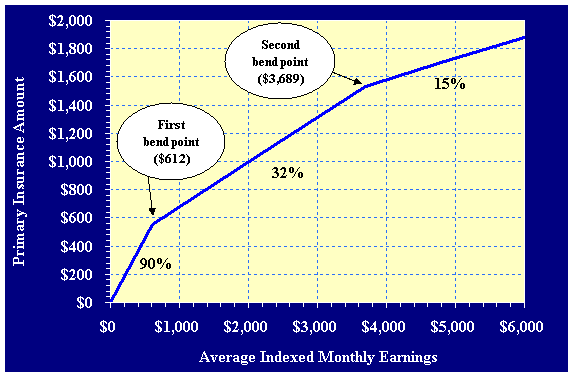
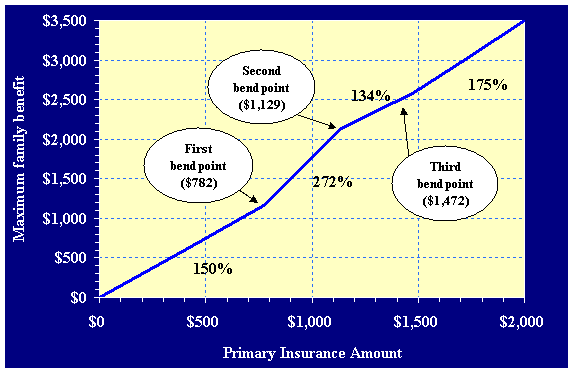
Other wage-indexed amounts are shown in table V.C2. The table provides historical values from 1978, when the amount of earnings required for a quarter of coverage was first indexed, through 2004, and also shows projected amounts through 2013. These other wage-indexed program amounts are:
|
Calendar year
|
|
Earnings
required for a quarter of coverage |
|||||||
|---|---|---|---|---|---|---|---|---|---|
|
First
|
Second
|
First
|
Second
|
Third
|
|||||
|
Historical data:
|
|||||||||
| |
1978
|
|
5 $250
|
||||||
| |
1979
|
5 $180
|
5 $1,085
|
|
5 $230
|
5 $332
|
5 $433
|
260
|
$18,900
|
| |
|
|
|
|
|
|
|
|
|
| |
1980
|
194
|
1,171
|
|
248
|
358
|
467
|
290
|
20,400
|
| |
1981
|
211
|
1,274
|
|
270
|
390
|
508
|
310
|
22,200
|
| |
1982
|
230
|
1,388
|
|
294
|
425
|
554
|
340
|
24,300
|
| |
1983
|
254
|
1,528
|
|
324
|
468
|
610
|
370
|
26,700
|
| |
1984
|
267
|
1,612
|
|
342
|
493
|
643
|
390
|
28,200
|
| |
|
|
|
|
|
|
|
|
|
| |
1985
|
280
|
1,691
|
|
358
|
517
|
675
|
410
|
29,700
|
| |
1986
|
297
|
1,790
|
|
379
|
548
|
714
|
440
|
31,500
|
| |
1987
|
310
|
1,866
|
|
396
|
571
|
745
|
460
|
32,700
|
| |
1988
|
319
|
1,922
|
|
407
|
588
|
767
|
470
|
33,600
|
| |
1989
|
339
|
2,044
|
|
433
|
626
|
816
|
500
|
35,700
|
| |
|
|
|
|
|
|
|
|
|
| |
1990
|
356
|
2,145
|
|
455
|
656
|
856
|
520
|
38,100
|
| |
1991
|
370
|
2,230
|
|
473
|
682
|
890
|
540
|
39,600
|
| |
1992
|
387
|
2,333
|
|
495
|
714
|
931
|
570
|
41,400
|
| |
1993
|
401
|
2,420
|
|
513
|
740
|
966
|
590
|
42,900
|
| |
1994
|
422
|
2,545
|
|
539
|
779
|
1,016
|
620
|
45,000
|
| |
|
|
|
|
|
|
|
|
|
| |
1995
|
426
|
2,567
|
|
544
|
785
|
1,024
|
630
|
45,300
|
| |
1996
|
437
|
2,635
|
|
559
|
806
|
1,052
|
640
|
46,500
|
| |
1997
|
455
|
2,741
|
|
581
|
839
|
1,094
|
670
|
48,600
|
| |
1998
|
477
|
2,875
|
|
609
|
880
|
1,147
|
700
|
50,700
|
| |
1999
|
505
|
3,043
|
|
645
|
931
|
1,214
|
740
|
53,700
|
| |
|
|
|
|
|
|
|
|
|
| |
2000
|
531
|
3,202
|
|
679
|
980
|
1,278
|
780
|
56,700
|
| |
2001
|
561
|
3,381
|
|
717
|
1,034
|
1,349
|
830
|
59,700
|
| |
2002
|
592
|
3,567
|
|
756
|
1,092
|
1,424
|
870
|
63,000
|
| |
2003
|
606
|
3,653
|
|
774
|
1,118
|
1,458
|
890
|
64,500
|
| |
2004
|
612
|
3,689
|
|
782
|
1,129
|
1,472
|
900
|
65,100
|
|
Intermediate:
|
|||||||||
| |
2005
|
624
|
3,760
|
|
797
|
1,151
|
1,501
|
920
|
66,600
|
| |
2006
|
645
|
3,890
|
|
825
|
1,190
|
1,552
|
950
|
68,700
|
| |
2007
|
672
|
4,050
|
|
859
|
1,239
|
1,616
|
990
|
71,700
|
| |
2008
|
698
|
4,206
|
|
892
|
1,287
|
1,678
|
1,030
|
74,400
|
| |
|
|
|
|
|
|
|
|
|
| |
2009
|
725
|
4,371
|
|
927
|
1,338
|
1,745
|
1,070
|
77,400
|
| |
2010
|
755
|
4,551
|
|
965
|
1,393
|
1,816
|
1,110
|
80,400
|
| |
2011
|
785
|
4,734
|
|
1,004
|
1,449
|
1,889
|
1,160
|
83,700
|
| |
2012
|
817
|
4,924
|
|
1,044
|
1,507
|
1,965
|
1,200
|
87,000
|
| |
2013
|
849
|
5,119
|
|
1,085
|
1,566
|
2,043
|
1,250
|
90,600
|
|
Low Cost:
|
|||||||||
| |
2005
|
624
|
3,761
|
|
797
|
1,151
|
1,501
|
920
|
66,600
|
| |
2006
|
646
|
3,894
|
|
825
|
1,191
|
1,554
|
950
|
69,000
|
| |
2007
|
672
|
4,048
|
|
858
|
1,239
|
1,615
|
990
|
71,700
|
| |
2008
|
696
|
4,194
|
|
889
|
1,283
|
1,674
|
1,020
|
74,100
|
| |
|
|
|
|
|
|
|
|
|
| |
2009
|
721
|
4,345
|
|
921
|
1,330
|
1,734
|
1,060
|
76,800
|
| |
2010
|
747
|
4,502
|
|
954
|
1,378
|
1,797
|
1,100
|
79,500
|
| |
2011
|
773
|
4,660
|
|
988
|
1,426
|
1,860
|
1,140
|
82,500
|
| |
2012
|
800
|
4,824
|
|
1,023
|
1,476
|
1,925
|
1,180
|
85,200
|
| |
2013
|
828
|
4,991
|
|
1,058
|
1,527
|
1,992
|
1,220
|
88,200
|
|
High Cost:
|
|||||||||
| |
2005
|
624
|
3,762
|
|
797
|
1,151
|
1,501
|
920
|
66,600
|
| |
2006
|
638
|
3,849
|
|
816
|
1,178
|
1,536
|
940
|
68,100
|
| |
2007
|
675
|
4,070
|
|
863
|
1,245
|
1,624
|
990
|
72,000
|
| |
2008
|
703
|
4,238
|
|
898
|
1,297
|
1,691
|
1,040
|
75,000
|
| |
|
|
|
|
|
|
|
|
|
| |
2009
|
725
|
4,368
|
|
926
|
1,336
|
1,743
|
1,070
|
77,100
|
| |
2010
|
766
|
4,619
|
|
979
|
1,413
|
1,843
|
1,130
|
81,600
|
| |
2011
|
823
|
4,960
|
|
1,051
|
1,518
|
1,980
|
1,210
|
87,600
|
| |
2012
|
868
|
5,234
|
|
1,110
|
1,602
|
2,089
|
1,280
|
92,700
|
| |
2013
|
907
|
5,469
|
|
1,159
|
1,673
|
2,182
|
1,340
|
96,600
|
| 1The formula to compute a PIA is (1) 90% of AIME below the first bend point, plus (2) 32% of AIME in excess of the first bend point but not in excess of the second, plus (3) 15% of AIME in excess of the second bend point. The bend points pertain to the first year a beneficiary becomes eligible for benefits. 2The formula to compute a family maximum is (1) 150% of PIA below the first bend point, plus (2) 272% of PIA in excess of the first bend point but not in excess of the second, plus (3) 134% of PIA in excess of the second bend point but not in excess of the third, plus (4) 175% of PIA in excess of the third bend point. 3Contribution and benefit base that would have been determined automatically under the law in effect prior to enactment of the Social Security Amendments of 1977. The bases for years after 1989 were increased slightly by changes to the indexing procedure to determine the base, as required by Public Law 101-239. 4No provision in law for this amount in this year. 5Amount specified for first year by Social Security Amendments of 1977; amounts for subsequent years subject to automatic-adjustment provisions. |
In addition to the program amounts affecting the determination of OASDI benefits that reflect changes in the economy, there are certain legislated changes that have affected, and will affect, benefits. Two such changes are the scheduled increases in the normal retirement age and in the delayed retirement credits. Table V.C3 shows the scheduled changes in these two important items and their effect on benefits expressed as a percentage of PIA.
Projections of the total labor force and unemployment rate are based on Bureau of Labor Statistics definitions from the Current Population Survey (CPS), and thus represent the average weekly number of employed and unemployed persons, aged 16 and over, in the U.S. in a calendar year. Total covered workers in a year are the number of persons who have any OASDI covered earnings at any time during the year. For those aged 16 and over, projected covered employment is the sum of age-sex components, each of which is projected as a ratio to the CPS concept of employment. For those under age 16, projected covered employment is the sum of age-sex components, each of which is projected as a ratio to the Social Security area population. The projection methodology accounts for changes in the business cycle, the quarterly pattern of growth in employment within each year, changes in non-OASDI covered employment, the increase in coverage of Federal civilian employment as a result of the 1983 Social Security Amendments, and changes in the number of other immigrants estimated to be residing within the Social Security coverage area.
Covered worker rates are defined as the ratio of OASDI covered workers to the Social Security area population. The projected age-adjusted coverage rate for men, aged 16 and over, changes from its 2003 level of 71.7 percent to 72.0, 71.7, and 71.8 percent for 2080 for the low cost, intermediate, and high cost assumptions, respectively. (Age-adjusted covered worker rates are adjusted to the 2002 age distribution of the Social Security area population.) For women, it changes from its 2003 level of 60.6 percent to 63.1, 62.9, and 62.6 percent for 2080 for the low cost, intermediate, and high cost assumptions, respectively.
The OASDI taxable payroll is the amount of earnings in a year which, when multiplied by the combined employee-employer tax rate, yields the total amount of taxes due from wages and self-employed income in the year. Taxable payroll is used in estimating OASDI income and in determining income and cost rates and actuarial balances. (See section IV.B.1, Annual Income Rates, Cost Rates, and Balances, for definitions of these terms.) Taxable payroll is computed from taxable earnings, defined as the sum of wages and self-employment earnings subject to the Social Security tax. Wages are adjusted to take into account the "excess wages" earned by workers with multiple jobs whose combined wages exceed the taxable earnings base. Also, from 1983 through 2001, taxable payroll includes deemed wage credits for military service. Prior to 1984, the self-employed tax rate was less than the combined employee-employer rate, thus taxable self-employed earnings were weighted to reflect this. Also, prior to 1988, employers were exempt from Social Security tax on part of their employees' tips; taxable payroll was reduced by half of this exempt amount to take this into account.
Taxable earnings for employees, employers, and the self-employed are estimated from total earnings in covered employment. Covered earnings are summed from component sectors, each of which is based on the projected growth of U.S. earnings and a factor that reflects any projected change in coverage (e.g., the increase in coverage in the Federal civilian sector due to mandatory coverage of newly hired employees). The level of taxable earnings, that is, covered earnings at or below the contribution and benefit base, is then estimated based on recent historical earnings distributions for wage and self-employed workers. The ratio of taxable to covered earnings decreased from about 90.2 percent in 1983 to 87.4 percent in 1994, or by an average annual rate of -0.3 percent. The ratio decreased further to 83.3 in 2000, then increased to 84.9 in 2001, to 85.9 in 2002, and to a preliminary level of 86.0 in 2003. The decline from 1994 through 2000 was mainly due to a relative increase in wages for high wage earners. At least some of this decline and subsequent increase is believed to be due to stock option activity surrounding the stock market bubble in 2000 and is not likely to recur.
However, some of the decline since 1983 is believed to be due to the change in the age-sex distribution of the workforce and other trend-like factors that are expected to continue through 2013 in all three alternatives. The projected taxable earnings ratios in 2013 are 84.2, 83.4, and 82.6 for the low cost, intermediate, and high cost assumptions, respectively. This represents average annual rates of change from 2003 of -0.2, -0.3, and -0.4 percent. After 2013, the taxable to covered ratio is held approximately constant.
Payroll tax revenue is computed by applying the appropriate tax rates to taxable wages and self-employment income, taking into account the lag between the time the tax liability is incurred and when the taxes are collected. In the case of wages, employers are required to deposit withholding taxes with the Treasury on a schedule determined by the amount of tax liability incurred. (Generally, the higher the amount of liability, the sooner the taxes must be paid--ranging from the middle of the following month to, for companies with very large payrolls, the next banking day after wages are paid.) Self-employed workers are required to make estimated tax payments on their earnings four times during the year, as well as making up any under-estimate on their individual income tax return. The pattern of actual receipts by the Treasury is taken into account when estimating self-employed tax collections.
Eligibility for benefits under the OASDI program requires some minimal level of work in covered employment. This requirement is established by a worker's accumulation of quarters of coverage (QCs). Prior to 1978, one QC was credited for each calendar quarter in which at least $50 was earned. In 1978, when quarterly reporting of earnings was replaced by annual reporting, the amount required to earn a QC (up to a maximum of four per year) was set at $250. Since then, this amount has been adjusted each year according to the Average Wage Index. Its value in 2004 is $900.
There are three types of insured status which can be acquired by a worker under the OASDI program. Each of these statuses is determined by the number and recency of QCs earned. Fully insured status is acquired by any worker whose total number of QCs is greater than or equal to the number of years elapsed after the year of attainment of age 21 (and at least 6). Once a worker has accumulated 40 QCs, he or she remains permanently fully insured. Disability-insured status is acquired by any fully insured worker over age 30 who has accumulated 20 QCs during the 40-quarter period ending with the current quarter; any fully insured worker aged 24-30 who has accumulated QCs during one-half of the quarters elapsed after the quarter of attainment of age 21 and up to and including the current quarter; and any fully insured worker under age 24 who has accumulated 6 QCs during the 12-quarter period ending with the current quarter. Currently insured status is acquired by any worker who has accumulated 6 QCs during the 13-quarter period ending with the current quarter. Periods of disability are excluded from the above described QC requirements for insured status (but do not reduce the minimum of 6 QCs).
There are many types of benefits payable to workers and their family members under the OASDI program. One of the requirements of eligibility for these benefits is the insured status of the worker. A worker must be fully insured to be eligible for a primary retirement benefit, and for his or her spouse or children to be eligible for auxiliary benefits. A deceased worker must have been either currently insured or fully insured at the time of death for his or her children (and their mother or father) to be eligible for benefits. If there are no eligible surviving children, the deceased worker must have been fully insured at the time of death for his or her surviving spouse to be eligible. A worker must be disability insured to be eligible for a primary disability benefit, and for his or her spouse or children to be eligible for auxiliary benefits.
Projections of the fully insured population, as a percentage of the Social Security area population, are made by age and sex for each birth cohort beginning with 1900. These percentages are based on 30,000 simulated work histories for each sex and birth cohort, which are constructed from past and projected coverage rates, median earnings, and amounts required for crediting QCs. These work histories are developed by a model which assumes that persons who have recently been out of covered employment are likely to remain out of covered employment. This model is driven by two sets of age-sex-specific parameters which are empirically set such that the simulated fully insured percentages reproduce fairly closely the fully insured percentages estimated from the Continuous Work History Sample from 1970 to date.
Projections of the disability-insured population, as a percentage of the fully insured population, are made by age and sex for each birth cohort beginning with 1900. These percentages are based on the same simulated work histories used to project the fully insured percentages. Additional adjustments are made to bring the simulated disability-insured percentages into close agreement with those estimated from the Continuous Work History Sample. The principal adjustment is for periods of disability (which are not explicitly taken into account in the model). These periods (which reduce the normally applicable QC requirements) have a negligible effect on fully insured status at retirement age, but a substantial effect on disability-insured status.
Projections of the currently insured population are not made. This is because the number of beneficiaries who are entitled to benefits based solely on currently insured status has been very small, and is expected to remain small in the future.
Under this procedure, the percentage of the Social Security area population aged 62 and over that is fully insured is projected to increase from its estimated level of 79.8 for December 31, 2001, to 90.1, 90.8, and 91.3 for December 31, 2080, under alternatives I, II, and III, respectively. The percentage for females is projected to increase significantly, while that for males is projected to remain relatively unchanged. Under alternative II, for example, the percentage for males is projected to decrease slightly during this period from 92.7 to 92.5, while that for females is projected to increase from 70.2 to 89.3.
The number of OASI beneficiaries is projected for each type of benefit separately, by the sex of the worker on whose earnings the benefits are based, and by the age of the beneficiary. For selected types of benefits, the number of beneficiaries is also projected by marital status.
For the short-range period, the number of retired-worker beneficiaries is developed by applying award rates to the aged fully insured population less those insured persons entitled to retired-worker, disabled-worker, aged widow(er)'s, or aged spouse's benefits, and by applying termination rates to the number of persons already receiving retired-worker benefits.
For the long-range period, the number of retired-worker beneficiaries not previously converted from disabled-worker beneficiary status is projected as a percentage of the exposed population, i.e., the aged fully insured population less persons entitled to or converted from disability benefits and insured persons entitled to widow(er)'s benefits. For age 62, a linear regression is developed based on the relationship between the historical exposed percentage and the labor force participation rate. The regression coefficients are then used to project the percentage based on the projected labor force participation rate for age 62. The percentage for ages 70 and over is assumed to be nearly 100, because the retirement earnings test and delayed retirement credit do not apply after age 70, but is adjusted for the statistical difference between in-force data and in-current-payment data. The percentage for each age 63 through 69 is projected from the December 31, 2003 retired-worker beneficiaries data which reflects the elimination of the earnings test after normal retirement age, with an adjustment for changes in the portion of the primary insurance amount that is payable at each age of entitlement. As the normal retirement age increases, the number of retired-worker beneficiaries not automatically converted from disabled-worker beneficiary status as a percentage of the exposed population is gradually adjusted downward at each age 63 through 69.
For the long-range period also, the number of retired-worker beneficiaries previously converted from disabled-worker beneficiaries is calculated separately in a manner consistent with the calculation of disabled-worker beneficiaries.
The number of aged-spouse beneficiaries is estimated from the population projected by age and sex. The benefits of aged-spouse beneficiaries are based on the earnings records of their husbands or wives, who are referred to as "wage earners." In the short-range period, insured aged-spouse beneficiaries are projected concurrently with the retired-worker beneficiaries. Uninsured aged-spouse beneficiaries are projected, on the other hand, by applying award rates to the aged uninsured male or female population, and by applying termination rates to the population already receiving such benefits. In the long-range period, aged-spouse beneficiaries are estimated from the population projected by age, sex, and marital status. To the number of spouses aged 62 and over in the population, a series of factors are applied, representing the probabilities that the spouse and the wage earner meet all of the conditions of eligibility--i.e., the probabilities that (1) the wage earner is 62 or over, (2) the wage earner is insured, (3) the wage earner is receiving benefits, (4) the spouse is not receiving a benefit for the care of an entitled child, (5) the spouse is not insured, and (6) the spouse is not eligible to receive a significant government pension based on earnings in noncovered employment. To the resulting number of spouses a projected prevalence rate is applied to calculate the estimated number of aged-spouse beneficiaries.
In addition, the same factors are applied to the number of divorced persons aged 62 and over in the population, with three differences. First, an additional factor is required to reflect the probability that the person's former wage-earner spouse is still alive (otherwise, the person may be entitled to a divorced widow(er)'s benefit). Second, a factor is required to reflect the probability that the marriage to the wage-earner spouse is at least 10 years in duration. Third, factor (3) above is not applied because, effective for January 1985, a divorced person generally need not wait to receive benefits until the former wage-earner spouse is receiving benefits.
The projected numbers of children under age 18, and students aged 18, who are eligible for benefits as children of retired-worker beneficiaries, are based on the projected number of children in the population. In the short-range period, the number of entitled children is developed by applying award rates to the number of children in the population where both parents are alive, and by applying termination rates to the number of children already receiving benefits.
In the long-range period, the number of entitled children is projected separately by sex of the wage-earner parent. To the number of children in the population, factors are applied representing the probabilities that the parent is alive, aged 62 or over, insured, and receiving a retired-worker benefit. Another factor is applied representing the probability that the child is not entitled to a benefit based on the other parent's earnings. For children aged 18, a factor representing the probability that the child is attending a secondary school is also applied.
The number of disabled children aged 18 and over of retired-worker beneficiaries is projected from the adult population. In the short-range period, award rates are applied to the population, and termination rates are applied to the number of disabled children already receiving benefits. In the long-range period, disabled children are projected in a manner similar to that for children under 18, with the inclusion of a factor representing the probability of being disabled since childhood.
In the short-range period, the number of entitled young-spouse beneficiaries is developed by applying award rates to the number of awards to children of retired workers, where the children are either under age 16 or disabled, and by applying termination rates to the number of young-spouses already receiving benefits. In the long-range period, young-spouse beneficiaries are projected as a proportion of the projected number of child beneficiaries of retired workers, taking into account projected changes in average family size.
The number of aged-widow(er) beneficiaries is projected from the population by age and sex. In the short-range period, insured aged-widow(er) beneficiaries are projected concurrently with the retired-worker beneficiaries. Uninsured aged-widow(er) beneficiaries are projected, on the other hand, by applying award rates to the aged uninsured male or female population, and by applying termination rates to the population already receiving such benefits. In the long-range period, aged-widow(er) beneficiaries are projected from the population by age, sex, and marital status. Four factors are applied to the number of widow(er)s in the population aged 60 and over. These factors represent the probabilities that (1) the deceased wage earner is fully insured at death, (2) the widow(er) is not receiving a benefit for the care of an entitled child, (3) the widow(er) is not fully insured, and (4) the widow(er)'s benefits are not withheld because of receipt of a significant government pension based on earnings in noncovered employment. In addition, some insured widow(er)s who had not applied for their retired-worker benefits are assumed to receive widow(er)'s benefits. Also, the same factors are applied to the number of divorced persons aged 60 and over in the population, with additional factors representing the probability that the person's former wage-earner spouse is deceased and that the marriage is at least 10 years in duration.
In the short-range period, the number of disabled-widow(er) beneficiaries is developed by applying award rates to the uninsured male or female population, and by applying termination rates to the population already receiving a disabled widow(er) benefit. In the long-range period, the number is projected for each age 50 up to NRA as a percentage of the widowed and divorced populations, adjusted for the insured status of the deceased spouse and the prevalence of disability.
The projected numbers of children under age 18, and students aged 18, who are eligible for benefits as survivors of deceased workers, are based on the projected number of children in the population whose mothers or fathers are deceased. In the short-range period, the number of entitled children is developed by applying award rates to the number of orphaned children, and by applying termination rates to the number of children already receiving benefits.
In the long-range period, the number of child-survivor beneficiaries is projected in a manner analogous to that for child beneficiaries of retired workers, with the factor representing the probability that the parent is aged 62 or over replaced by a factor that represents the probability that the parent is deceased.
In the short-range period, the numbers of entitled mother-survivor and father-survivor beneficiaries are developed by applying award rates to the number of awards to child-survivor beneficiaries, where the children are either under age 16 or disabled, and by applying termination rates to the number of mother-survivors and father-survivors already receiving benefits. In the long-range period, mother-survivor and father-survivor beneficiaries are estimated from the number of child-survivor beneficiaries, taking into account projected changes in average family size.
The number of parent-survivor beneficiaries is projected based on the historical pattern of the number of such beneficiaries.
Table V.C4 shows the projected number of beneficiaries under the OASI program by type of benefit. Included among the beneficiaries who receive retired-worker benefits are some persons who also receive a residual benefit consisting of the excess of an auxiliary benefit over their retired-worker benefit. Estimates of the number of such residual payments are made separately for spouses and widow(er)s.
Notes:
1. The number of beneficiaries does not include certain uninsured persons, most of whom both attained age 72 before 1968 and have fewer than 3 quarters of coverage, in which case the costs are reimbursed by the General Fund of the Treasury.
2. Totals do not necessarily equal the sums of rounded components.
Benefits are paid from the DI Trust Fund to individuals who satisfy the disability-insured requirements, who are unable to engage in substantial gainful activity due to medically determinable physical or mental impairment severe enough to satisfy the requirements of the program, and have not yet attained normal retirement age. Spouses and children of such disabled workers may also receive DI benefits provided they satisfy certain criteria, mostly depending upon age or the age of a child in the care of the non-disabled spouse. In projecting future benefit outlays from the DI Trust Fund, the number of DI beneficiaries is projected for each type of beneficiary separately, by the sex of the disabled worker on whose earnings the benefits are based, and the age of the beneficiary. Such projections are accomplished using standard actuarial methods reflecting future additions to the DI rolls through awards of new benefits, and subtractions from the rolls due to death, recovery, or administrative conversion upon attainment of normal retirement age from status as a disabled-worker beneficiary to status as a retired-worker beneficiary. The long-range and short-range models used to make these projections are both constructed from this basic outline, but differ in some details reflecting their respective uses.
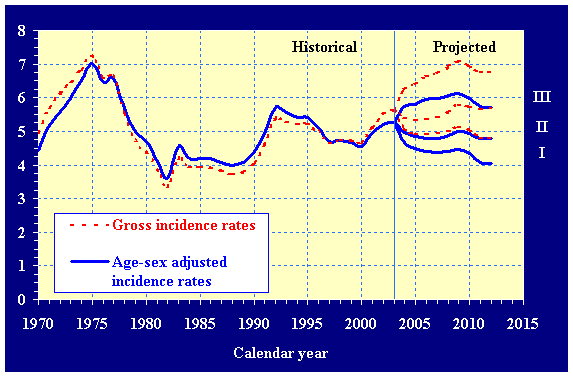
The number of new entitlements to disabled-worker benefits during each year is projected by applying assumed age-sex specific disability incidence rates to the projected disability-exposed population.2 Long-range ultimate disability incidence rates are selected based on careful analysis of historical patterns and expected future conditions, including the impact of scheduled increases in the normal retirement age.3 Incidence rates for the first half of the short-range period reflect the most recent actual experience along with consideration of other factors expected to affect the processing of disability claims in the near term. Over the latter half of the short-range period, incidence rates are assumed to trend into levels consistent with the long-range ultimate incidence rate assumptions.
These assumed incidence rates are summarized in figure V.C3 and table V.C5. As illustrated in figure V.C3, incidence rates have varied within a wide range over the past 30 years. Although not completely understood, this variation is attributed in large part to a variety of demographic and economic factors, along with the effects of changes due to legislation and program administration.4 The solid lines in figure V.C3 illustrate values of the summarized incidence rate, age-sex adjusted to the distribution of the disability-exposed population for 1998. Such adjustment facilitates meaningful comparisons over long periods of time. >From a historically high level of about 7 awards per thousand insured in 1975, age-sex-adjusted rates declined to about 3.6 per thousand by 1982. Following a gradual trend upward, rates increased to about 5.7 per thousand by 1992, but declined from that point to about 4.6 per thousand in 2000. As described in chapter IV, in the discussion of the short-range DI estimates, the incidence rate experience for 2001-03, and the projections for 2004-10, are affected by a one-time special workload. In addition to historical values, figure V.C3 displays the age-sex-adjusted short-range incidence rates under the three alternative sets of assumptions. Gross (unadjusted) incidence rates are also shown in figure V.C3 in dashed lines. These unadjusted rates are heavily influenced by the changing age-sex distribution of the exposed population over time. This is especially noticeable in the period 2004 to 2013 when the aging baby-boom generation will be concentrated in the ages of highest disability incidence.
Table V.C5 presents the long-range ultimate incidence rate assumptions age-sex adjusted to the disability-exposed population as of January 1, 2000. The table also indicates the year in which the ultimate values are attained, along with an indication of the relationship between those ultimate rates and the rates for the base period (1994-96) that was used to develop relative levels of disability incidence by age and sex for long-range assumptions. These values are not directly comparable with those in last year's report since the disability exposed population used in age-sex adjustment for last year's report was as of January 1, 1996.
For the 2004 report, the incidence rates for both males and females are slightly lower than last year's report to reflect lower estimates of future SSI disabled-worker beneficiaries becoming entitled to DI benefits.
| |
Ultimate
incidence rate |
|
Year ultimate
rate is attained 2 |
|
Percent change from
base period 3 to ultimate rate |
|---|---|---|---|---|---|
|
Intermediate assumption
|
5.8
|
|
2027
|
|
+7
|
|
Low cost assumption
|
4.6
|
|
2027
|
|
-14
|
|
High cost assumption
|
7.0
|
|
2027
|
|
+29
|
| 1Number of annual new disabled-worker entitlements per thousand disability-exposed, age-sex adjusted to the disability-exposed population as of January 1, 2000. 2The transition to ultimate incidence rates is generally completed in 2023. However, for ages 61 through 66 incidence rates are adjusted through 2027 in order to reflect increases in the normal retirement age (NRA) that are scheduled in the law. 3Base period rate for long-range incidence rate assumptions is 5.4 per thousand representing the average age-sex adjusted incidence rate for 1994-96. |
The number of disabled-worker beneficiaries having their benefits terminated during each year is projected by applying assumed termination rates to the disabled-worker population. The termination rates are developed by age, sex, and reason for termination.5 In addition, in the long-range period, termination rates are also assumed to vary by duration of entitlement to disabled-worker benefits. To this number of terminations is added the number of disabled-worker beneficiaries who would be automatically converted to retired-worker beneficiaries upon attainment of the normal retirement age.
In the short-range period, gross death rates under the intermediate assumptions are projected to remain between 31 and 32 deaths per thousand disabled workers. The pattern of projected recovery rates under the intermediate assumptions is consistent with assumed levels of continuing disability reviews required to fulfill the legislative mandate for regular reviews of all disabled beneficiaries. Under low cost (high cost) assumptions, terminations due to death, recovery, and other reasons increase (decrease) to levels roughly 8 percent higher (lower) than those under the intermediate assumptions.
For the long-range period, projection of death rates and recovery rates begins with an analysis of such rates split by age, sex, and duration of entitlement over the base period 1991-95.6 For all three sets of assumptions the ultimate level for recovery rates for both males and females are reached in the twentieth year of the projection period. Under the intermediate assumptions ultimate recovery rates are assumed higher than the base period rate by 95 percent for males and by 93 percent for females. Death rates over the long-range period are assumed to change gradually, at about the same trend as for death rates in the general population, reaching levels in 2080 which are lower than the base period level by 62 percent for males and 56 percent for females.
Under the low cost assumptions, recovery rates and death rates are assumed to be higher than the corresponding levels assumed for the intermediate assumptions. Ultimate recovery rates are assumed to be higher than the base period rate by 134 percent for males and by 131 percent for females, while death rates are assumed to change gradually reaching levels for 2080 which are lower than the base period level by 48 percent for males and 40 percent for females.
Under the high cost assumptions, recovery rates and death rates are assumed to be lower than the corresponding levels assumed for the intermediate assumptions. Ultimate recovery rates are assumed to be higher than the base period rate by 56 percent for males and by 54 percent for females, while death rates are assumed to change gradually reaching levels for 2080 which are lower than the base period level by 77 percent for males and 74 percent for females.
For the 2004 report, recovery rates for both males and females are assumed higher than last year's report to reflect the experience over the last 20 years.
These detailed projections of disabled-worker entitlements and terminations are combined using standard multiple decrement techniques to produce projections of numbers of disabled workers in current-payment status over the 75-year projection period. These projections are presented in table V.C6. As indicated in that table, the number of disabled workers in current-payment status is projected to grow from 5.9 million at the end of 2003, to 11.3 million, 12.5 million, or 13.6 million at the end of 2080, under the low cost, intermediate, or high cost assumptions, respectively. Of course, much of this growth is a direct result of the growth and aging of the population described earlier in this chapter.
Another way to view this projected growth in disabled workers is to compare the size of the projected disabled-worker population to the size of the underlying disability-insured population reflecting the age-sex distribution of the insured population as of January 1, 2000. Such a ratio eliminates the effects of the aging population and is referred to as the disabled worker age-sex adjusted prevalence rate. Expressed in these terms, the prevalence of disability is projected to grow from 37.0 per thousand disability insured at the beginning of 2003, to 48.0 per thousand, and 61.2 per thousand at the beginning of 2080, under the intermediate, and high cost assumptions, respectively. Under the low cost assumptions, the disability prevalence rate is projected to decrease to 36.3 per thousand.
Table V.C6 also presents projections of the numbers of auxiliary beneficiaries paid from the DI Trust Fund. As indicated at the beginning of this subsection, such auxiliary beneficiaries consist of qualifying spouses and children of disabled workers. In the case of children, the child must be either (1) under age 18, (2) age 18 and still a student in high school, or (3) over age 18 and disabled prior to age 22. In the case of spouses, the spouse must either be at least age 62, or have an eligible child beneficiary who is either under age 16 or disabled in his or her care.
In general, such auxiliary beneficiaries are projected in a manner that is related to the projected number of disabled-worker beneficiaries. In the short-range period, this is accomplished for family members of disabled-worker beneficiaries by projecting incidence and termination rates for each category of auxiliary beneficiary. In the long-range period, the child beneficiaries at ages 18 and under are projected in relation to the projected number of children in the population, by applying factors representing the probability that either of their parents is insured and disabled. Spouses eligible because they have an eligible child in care are projected relative to the projected number of such children. The remaining categories of children and spouses are projected in relation to the projected number of disabled-worker beneficiaries.
Note: Totals do not necessarily equal the sums of rounded components.
Average benefits are projected by type of benefit based on recent historical averages, projected average primary insurance amounts (PIAs), and projected ratios of average benefits to average PIAs. Average PIAs are calculated from projected distributions of beneficiaries by duration from year of award, average awarded PIAs, and increases thereto since the year of award, reflecting automatic benefit increases, recomputations to reflect additional covered earnings, and other factors. Average awarded PIAs are calculated from projected earnings histories, which are developed from the actual earnings histories associated with a sample of awards made in 2003. A sample of 2002 awards was used for the 2003 report.
For several types of benefits--retired-worker, aged-spouse, and aged-widow(er) benefits--the percentage of the PIA that is payable depends on the age at initial entitlement to benefits. Projected ratios of average benefits to average PIAs for these types of benefits are based on projections of age distributions at initial entitlement.
For each type of benefit, benefit payments are calculated as the product of a number of beneficiaries and a corresponding average monthly benefit. In the short-range period, benefit payments are calculated on a quarterly basis. In the long-range period, all benefit payments are calculated on an annual basis, using the number of beneficiaries on December 31. These amounts are adjusted to include retroactive payments to newly awarded beneficiaries, and other amounts not reflected in the regular monthly benefit payments.
Lump-sum death payments are calculated as the product of (1) the number of such payments, which is projected on the basis of the assumed death rates, the projected fully insured population, and the estimated percentage of the fully insured population that would qualify for benefits, and (2) the amount of the lump-sum death payment, which is $255 (not indexed in future years).
The projection of administrative expenses through 2013 is based on historical experience and the expected growth in average wages. Additionally, estimates for the first several years of the projection are provided by the Office of Budget. For years after 2013, administrative expenses are assumed to increase because of increases in the number of beneficiaries and increases in the average wage which will more than offset assumed improvements in administrative productivity.
Railroad workers are covered under a separate multi-tiered plan, the first tier being very similar to OASDI coverage. An annual financial interchange between the Railroad Retirement fund and the OASI and DI funds is made reflecting the difference between (1) the amount of OASDI benefits that would be paid to railroad workers and their families if railroad employment had been covered under the OASDI program and administrative expenses associated with these benefits, and (2) the amount of OASDI payroll tax and income tax that would be received with allowances for interest from railroad workers.
The effect of the financial interchange with the Railroad Retirement program is evaluated on the basis of trends similar to those used in estimating the cost of OASDI benefits. The resulting effect is annual short-range costs of about $3-4 billion and a long-range summarized cost of 0.03 percent of taxable payroll to the OASDI program.
Some older persons had little or no chance to become fully insured for Social Security benefits during their working lifetimes. Special payments from the OASI Trust Fund may be granted to uninsured persons who either: (1) attained age 72 before 1968, or (2) attained age 72 in 1968 or later and had 3 quarters of coverage for each year after 1966 and before the year of attainment of age 72. Benefits and costs associated with uninsured persons of the first type above are reimbursable from the General Fund of the Treasury. All projected costs associated with reimbursable and non-reimbursable payments to uninsured persons are insignificant.
Beginning in 1966, the OASI and DI Trust Funds were reimbursed annually for the cost (including administrative expenses) of providing additional benefit payments resulting from noncontributory wage credits for military service performed prior to 1957. The 1983 amendments modified the reimbursement mechanism and the timing of the reimbursements, and required a transfer in 1983 to include all future costs attributable to the wage credits. The amendments also require adjustments to that 1983 transfer every fifth year, beginning with 1985, to account for actual data.
Under present law, the OASI and DI Trust Funds are credited with the additional income taxes attributable to the taxation of up to the first 50 percent of OASI and DI benefit payments. (The remainder of the income taxes attributable to the taxation of up to 85 percent of OASI and DI benefit payments is credited to the HI Trust Fund.)
For the short-range period, income to the trust funds from such taxation is estimated by applying the following two factors to total OASI and DI benefit payments: (1) the percentage of benefit payments (limited to 50 percent) that is taxable, and (2) the average marginal tax rate applicable to those benefits.
For the long-range period, income to the trust funds from such taxation is estimated by applying projected ratios of taxation of OASI and DI benefits to total OASI and DI benefit payments. Because the income thresholds used for benefit taxation are, by law, constant in the future, their values in relation to future income and benefit levels will decline. Thus, ratios of income from taxation of benefits to the amount of benefits are projected to increase gradually. The ultimate ratios of taxation of OASI and DI benefits are estimated by the Office of Tax Analysis, Department of the Treasury, relating the Current Population Survey income distribution of OASDI beneficiaries to tax rates in a sample of recent tax returns.
1Details of these indexation procedures are published annually in the Federal Register, and are also available on the Internet at www.socialsecurity.gov/OACT/COLA/index.html.
2The disability-exposed population is the disability-insured population that is not currently entitled for disabled-worker benefits.
3Incidence rates are adjusted upward to account for the additional workers who are expected to file for disability benefits rather than for reduced retirement benefits that are even more reduced when the NRA is greater than age 65.
4A more detailed discussion of the recent history of the DI program is presented in Actuarial Study 114, "Social Security Disability Insurance Program Worker Experience", June 1999. This study can be found on the Internet at www.socialsecurity.gov/OACT/NOTES/AS114/as114Foreword.html.
5Reasons for termination include death, recovery and (in the short range only) a small residual category of terminations for special administrative reasons.
6The termination rate analysis was based on work presented in Actuarial Study 114 referenced previously.
|
|
|
|
|
|
 |
Privacy Policy | Website Policies & Other Important Information | Site Map | Actuarial Publications | 3/23/2004 |