|
Remarks by the President in Small
Business Roundtable -- February 28, 2001
Control Concepts
Pittsburgh, Pennsylvania
9:35 A.M. EST
Q What a distinct honor and privilege to have you here today.
I guess I have to open up with a tough question. I have a four-year-old
daughter and a two-year-old daughter who are out here in the crowd.
My four-year-old wants to know the name of your puppies. (Laughter.)
THE PRESIDENT: Let me see if I can get it right. (Laughter.)
We're the proud owner of Spot. She was born in the White House
in 1989 to Millie. (Applause.) On November the 4th, I was campaigning
in New Jersey. It happened to be my wife's birthday. And the then
governor of New Jersey said, well, Governor, what did you buy your
wife for her birthday. I said, nothing, which wasn't the right answer.
(Laughter.) Certainly not politically correct, as they say.
It then happened that Laura and Christie Todd started talking
about the fact that Christie Todd raises Scottish terriers. It turns
out I did buy my wife something for her birthday, a Scottish terrier
named Barney, who is having a heck of a time on the carpet upstairs
in the White House, by the way.
I think the answer is Spot and Barney -- (laughter) -- and one
cat named India.
Q Thank you, sir.
I would like to say a little bit about Control Concepts, who we
are and what we do. We are a manufacturer of industrial electrical
switches for heavy-duty machinery. We have been in business since
1976, when the company was founded by my father in 1976. I am second
generation in the business.
The electrical switches that we manufacture are used in things
like food processing industry, the package industry, the machine
tool industry, petrochem facilities, offshore oil rigs, et cetera,
and they are used to basically start or stop a piece of equipment
or have an indicator light on it that will indicate the status of
what a machine is in.
We do something a little unique in our industry, especially for
a small to medium-size company, where we actually manufacture every
single thing here under one roof. Now, we don't make light bulbs
and we don't make the raw materials, but we actually manufacture
our own tools, dies and molds to do our own injection molding, do
our own assembly. Everything, you name it, it is done here under
this roof and we can control the quality of the product that way,
we can control the quality of the service and the delivery of the
product -- ship every order the same day we receive it 95 percent
of the time. And we also control the cost and pass on a significant
cost savings to our customers.
As a small to medium-size business, a capital intensive kind of
business, we were very interested to hear your budget proposal in
your tax plan last night. It appears that it is going to be of great
benefit to Control Concepts and hopefully of great benefit to the
rest of the nation and to small companies across the nation.
THE PRESIDENT: Well, thank you, sir.
I want to thank you all for having me. First, the greatness --
this country's greatness is because there are a lot of entrepreneurs
in America, and you are an entrepreneur. And I'm honored to be sitting
next to you and your son.
I love the concept of a family-owned business, the idea of a mom
and her son working together to not only produce a product but,
more importantly, to employ capital so people can find work. After
all, small businesses are the main creators of jobs in America.
And all public policy and tax policy must work to create an environment
in which entrepreneurship can flourish.
So my speech last night was speaking not only about a budget,
but was also talking about the entrepreneurial spirit in our country.
And one of the reasons we came here is because the entrepreneurial
spirit is alive and well here and I appreciate it very much. (Applause.)
It is important to remember the role of government is not to create
wealth. The role of government is to create an environment in which
businesses, small and large, can flourish. That's the role of government.
(Applause.)
I want to thank my friend the governor of Pennsylvania for being
here. We hosted the governors at the White House last Sunday night.
It happened to be the first lady of Pennsylvania's birthday as well.
And it was good to see you, Tom. Thanks for coming. (Applause.)
Pennsylvania is well represented in the United States Senate by
two very capable, smart, concerned Pennsylvania citizens. So concerned
we spent most of the flight from Washington to Pennsylvania talking
about how to make the economy of Pennsylvania a better place. Senator
Spector and Senator Santorum are not shrinking violets when it comes
to making the case for the citizens of Pennsylvania and the country.
I want to thank you all for traveling with me. (Applause.)
Finally, a freshman, just like me, Melissa Hart. And Melissa is
an active soul -- (applause).
I appreciate you giving me the chance to explain the rationale
behind my budget. It was very important for people to hear that
what I think is -- what I know is true, and that is we've got a
lot of cash flow coming into the U.S. Treasury. And the fundamental
question is what to do with it. How best can we spend the people's
money?
Last night I made the case that our nation can achieve the following
priorities: One, set aside all payroll taxes that are designed for
Social Security to be spent only on Social Security. That is $2.6
trillion over the next 10 years will be set aside to be spent only
-- only -- on Social Security. I believe there's wide consensus
on both sides of the aisle that that is prudent fiscal policy.
Secondly, I made the case that we can prioritize and fund Medicare
for our senior citizens, that we're going to spend -- we're going
to double the Medicare budget over the next 10 years. And if we
have the right kind of leadership in the Congress, someone willing
to -- people willing to work with the President to reform Medicare,
we will not only have money to fund Medicare, we will have a Medicare
system that will enable seniors to choose the health care plan that
meets their needs, all of which will include prescription drugs.
I made the case that we can meet our needs by funding what's called
discretionary spending at a 4 percent increase. Some says 4 percent
sounds like a small number, but I want to remind you it's greater
than the rate of inflation.
It is less than what Congress spent during the last three session,
I readily concede. But we've got to be careful about over-spending
in Washington, D.C. We shouldn't have bidding contests in Washington.
What we ought to have is rewards for people who are concerned about
over-spending, it seems like to me. And so I propose increasing
the discretionary spending at 4 percent.
It means, for example, that public schools will get a significant
increase in spending out of the federal government. Now, having
said that, I promise you I will stand tough to the principle that
we ought to run our schools locally -- that local control of the
schools -- (applause.) We've got to run our schools locally in order
to achieve excellence for every single child.
We need to pay our soldiers more money. (Applause.) But before
we spend a lot of money on the Defense Department, it seems wise
-- and I think business people will agree with this -- that we ought
to have a strategy about what our military ought to look like in
the long-term. We've got to make sure we have a proper strategy
on how to prioritize our military spending before we do so.
There is still money left in the budget, after growing discretionary
spending by 4 percent, after funding the entitlement programs, after
meeting priorities. Over the next 10 years, we set aside a trillion
dollars for what I call contingencies, a trillion dollars in case
we need money for additional Medicare spending or military spending
or spending on farmers in America. So there is money set aside for
that and there is still money left over.
Now, the debate always seems to come out of Washington that if
you have tax relief, somebody is not going to get their Medicare
check. Or, if you have tax relief, somebody is not going to get
a Social Security check. My point to you is that we set priorities
and fund them. We protect Social Security and Medicare and fund
them. We spend money on the military to keep the peace. We set aside
contingencies, money for contingencies, and there's still money.
And what I want to do is to remind Americans -- this is why I've
come to Western Pennsylvania -- remind Americans that the surplus
is your money, it is not the government's money, and once -- (applause).
One reason Dave and Janet sit here is because I think it is very
important for people to know that behind every statistic there are
Americans who -- in whom we ought to place our trust. These good
folks pay $4,400 in federal income taxes. Under the plan I proposed
last night in the Congress -- which doubles the child credit from
$500 to $1,000, reduces all rates for everybody who pays taxes,
drops the top rate from 39 to 33, reduces the bottom rate from 15
to 10, reduces the effects of the marriage penalty, eliminates the
death tax -- these good folks will save $1,980.
Now, for a lot of folks, they'll yawn and say, gosh, that's $1,980,
that's really nothing. We disagree. We disagree -- $1,980 a year
can make a big difference to people who are raising two lovely children,
to people who want to set aside money for savings. It is so important
for members of the Congress to realize what the average citizen
is going through today.
When you couple high energy prices with consumer debt, there's
a lot of good folks who struggle in America. And it seems like to
me the right thing for Washington to do is, once we fund our priorities,
enhance the cash flows of the people who pay the bill in the first
place in America. (Applause.) In so doing, not only do we help working
Americans, but we also will add a second wind to an economy that
is slowing down.
I come from the school of thought, I know many of you do as well,
that sound fiscal policy, coupled with sound monetary policy, is
going to make a difference in this economy; that by giving people
their own money back will be a part of sound fiscal policy. The
more money you have to spend, the more money circulating, the more
likely it is the economy will recover. And all of us in Washington
must do everything we can to make sure that the economy is strong
enough for people to be able to keep jobs and find work, if they're
looking for work. That's the whole purpose of economic growth, is
for people to be able to find work.
I'm so thankful that you gave me a chance to come to make my case.
I can't think of a better place to make the case than in a business
run by a family, a business run by entrepreneurs, a business who
care more about their employees than they do about themselves because
they recognize if the employee is happy, an employee can work, an
employee is satisfied, that the business it self will run well.
It's my honor also to be here with Dave and Janet and Erin and
Jonathan -- Americans who, under our plan, will receive real, tangible
benefits. But that's not really the right way to say it, is it?
It's your money to begin with. Americans under our plan will keep
more of their own money so they can spend it where they see fit.
Thank you very much. (Applause.)
Q Thank you, Mr. President.
Dave, would you like to tell the President how you started here
at Control Concept?
MR. BERGER: Yes, I would. About 10 and a half years ago, I was
out on the golf course with the founder of the company, Glen Taylor.
And he knew I went back to college recently. And he was always asking
me when I was going, how is it going, and I'd say, oh, not too bad.
I was 33 at the time. I was working at Westinghouse and got laid
off, and really basically decided what are we going to do from here
on in.
And after a while, I guess Glen was watching me for over a year
or so -- he called me in after we got some things --- he says, I
own a small business. He said, I'm thinking of adding a position
down there that you could get into. He said, why don't you come
down and take a look.
So I came down and looked around at Control Concepts. It was really
small at the time. The dog ran out at you whenever you walked anywhere.
(Laughter.) And barked at you. And I said, oh, boy. Walked in, talked
to Glen, he gave me the tour. He showed me, and he asked, well,
what did you think? And I had good feelings about this place. It
was a homey feeling. Everybody stopped and said, hi, how are you
doing, introduced themselves, showed me what they were doing, explained
a little bit about their job. And I know they weren't told about
it, they just naturally volunteered the information. And over the
10 and a half years since I've been here, the company has grown
enormously. It's been a great 10 and a half years. I hope it's another
20 and a half years.
THE PRESIDENT: I'll give you a loaded question. Do you want some
tax relief? (Laughter.)
MR. BERGER: All you can give. (Applause.)
THE PRESIDENT: You know, I'm constantly amazed that -- first of
all, one of the things that happens when you talk about tax relief,
people immediately go to the class warfare argument, the only the
rich people will benefit, which obscures reality, and reality is,
$1,980 is a lot of money. And I'm not going to ask you what you're
going to do with it, because I trust you to do the right thing with
it. Frankly, it's none of the government's business about what you
decide to do with your own money. (Applause.) But I bet it may have
something to do with your children's future education, for example.
MR. BERGER: Yes, it will. My wife would like to talk about her
job, and also how that might affect her thoughts on that amount
of money.
MRS. BERGER: I'm an administrative technician at Medical Center
Beaver, and I've been there almost 20 years. And I worked in --
where we do all of the pre-op testing and patient education for
patients having surgery in the near future. I get to talk a lot
with patients on anything, and I'm very glad -- and they are very
glad that -- especially senior citizens -- that you're discussing
their health care needs.
THE PRESIDENT: Yes. Well, we're concerned, all of us are concerned
about making sure that Medicare fulfills the promise to our seniors.
It is a solemn obligation that the federal government has assumed,
and it's a solemn obligation that the federal government will keep.
And there will be a lot of discussion, a lot of argument and we're
going to end up with reform that will make the system solvent and
give seniors a variety of options and a plan that meets their needs,
all of which will include prescription drugs. And it's going to
be a titanic struggle. But it's one that, with the right leadership
and the right tone in Washington, D.C., people I think are going
to be able to come together on, and I think we'll get something
done.
Q And on a personal note, I'm glad to hear that your tax reform
will refund almost $2,000 for our family for education and our needs.
THE PRESIDENT: Well, thanks. I -- let me talk about a couple of
aspects of this tax relief plan that I want to explain to you.
First of all, I believe that the government should not decide,
oh, you get tax relief and you don't get tax relief. To me, the
best tax policy is to treat everybody fairly and to say if you pay
taxes, you get relief. (Applause.)
Secondly, it is very important to understand that the tax code
is unfair for people at the bottom end of the economic ladder. If
you're say a single mom struggling to get ahead in life and you're
making about $22,000 a year, as she begins to earn additional money,
she loses earned income tax credit, she pays payroll taxes and she
pays income taxes, which means that every additional dollar above
a level of $22,000 is taxed at nearly 50 percent. That's the way
this tax code is structured.
It means that folks who struggle to get to the middle class pay
a higher marginal rate than someone who is successful, someone who
has got quite a bit of cash flow, and that's not fair.
Part of the tax relief package has got to be aimed at making the
code easy to understand and fair. One thing our country is known
for is being a fair country. Another thing we ought to be known
for is we want people to succeed and the code ought to reward success.
Secondly, a lot of small businesses, as I mentioned earlier, these
small businesses provide, by far, the vast majority of new jobs
in America. And dropping the top rate will serve as a catalyst to
attract capital to small businesses. Many small businesses are unincorporated
small businesses; many are what's called Subchapter S businesses,
and they pay the high rate. And by dropping the rate it will provide
capital for small business expansion. And that's very important
for this country. And I know the rhetoric will be, oh, he's focused
on the billionaires and all that business. That's called class warfare.
The truth of the matter is, this plan is aimed at helping small
businesses flourish and grow and succeed.
It is important for America that the small business person remain
vital and healthy. And so this is a plan that is well-thought-out.
It is -- I found it interesting during the course of the speech
last night, I said, some think it's too big -- and of course, those
who thought it was too big cheered -- and some think it's too little
-- and they cheered. Of course, I thought it was just right. (Laughter
and applause.)
Let me say that part of my job as President, as well -- I might
as well be just very up-front -- is to travel the country ginning
up support for this plan. And that's why I'm here. I would hope
that you would not only contact your immediate representatives --
I don't think you need to in the case of the three here (laughter)
-- but I would hope that if you find others that may be reluctant
to listen to what we have to offer -- and I say "we" because
this is a plan that really is aimed for people -- that you'd help,
that you would write, that you would e-mail , that you would call
folks to encourage them to be open-minded and to think about you
when they cast votes.
And this is a plan that will benefit hard-working Americans. I
find it such an honor to be your President, and I love traveling
the country to go out and -- I'm going from here to Nebraska and
Iowa and Arkansas and Georgia. And it is exciting because this is
a great country, made great by the fact that it's got such wonderful
people. And it's so important for all of us who have the honor of
representing you to have public policy in mind that makes lives
easier. And this series of initiatives that we're going to be debating
over the next months will be aimed, if it's done right, at easing
the burden of the working people in the country. And America will
be even stronger as a result.
So it's an honor to be here. (Applause.)
Q As a business center, we couldn't agree more -- marginal tax
rate is increased. Not only is it good for the economy now to give
a jump-start again, it's good for the employees who are able to
take that money and do with it as they please, whether it be in
education, or back into the economy. But as a business owner, if
the marginal tax rate can be decreased, we now have more positive
cash flow. And as a result of that more positive cash flow, we can
reinvest back into technology, into equipment, into product development,
sales and marketing. All those things will help grow our business
from a sales revenue standpoint.
And as our business grows, we're now able to have more jobs. Job
employment will increase. As a result of that, there is going to
be more money back into the economy. So not only does it help our
business, it helps most small businesses across the country and
the economy as a whole. So we are very thankful and we're looking
forward to this plan.
The other thing, Mr. President, that we're interested in hearing
about, too, and we're excited about is the long-term debt reduction.
What a great thing for this economy, not just for the economy as
a whole, but also for individuals and small businesses as well.
THE PRESIDENT: I appreciate you bringing that up. We have set
aside $2 trillion over the next 10 years to pay down debt. Now,
people say, well, why don't you pay all the debt off. The one reason
why you don't pay all the debt off is because at the end of 10 years,
a number of bonds will have not matured. It does not make economic
sense to pre-pay American debt that will cost American taxpayers
a premium to do so.
And so we pay down all available debt, all the debt that matures
will be paid off. And it's going to ease the interest burden on
the country. It makes fiscal sanity and sense to do so. And there's
ample cash flow to be able to meet the debt requirements, and put
aside a contingency fee, and provide tax relief.
I urge the Congress to be cautious about over-spending. The rate
of spending increased last year by 8 percent. That is a significant
number, particularly when you're talking in terms of trillions.
And there was something like over 5,000 one-time expenditures in
the budget at the end of the year. And so we're going to have to
work with the appropriators to say, let's be reasonable about how
we spend the people's money.
A sure way to make sure this economy gets drug down is to over-spend.
A bloated federal government will affect economic vitality. And
so it's going to require a lot of us working together to say, well,
wait a minute, it's important to set priorities. One thing business
owners learn how to do is how to prioritize and then have the discipline
necessary to meet priorities.
So I appreciate you bringing up the debt retirement, and it's
an issue that I'm confident we can work together on. It's just important
for people to know that it's only wise to pay down a certain portion
of the debt before it costs taxpayers an additional premium. And
that doesn't make any sense. It doesn't make any sense to do that.
(Applause.)
MR. BERGER: The education reform that you stated last night --
as a parent, Janet and I were very interested in that. We have two
reasons sitting out in the audience right there. We were impressed
that you were going to increase spending for children's reading.
THE PRESIDENT: I am. You all know I used to be a governor, and
therefore, I'm a little suspect about federal involvement in any
way, shape or form in education. I do, however, think that it is
appropriate for the federal government to spend money, so long as
it's spent wisely. I can't think of anything more important than
to increase the amount of money available at the federal level for
reading programs -- so long as the strategy makes sense.
And there has been a lot of thought and a lot of research about
what works. A lot of programs in states, you know, abandoned the
concept of phonics and, as a result, many children weren't learning
to read.
The reason I bring that up is I want to reinvigorate the curriculum
debate, all based upon -- the conclusion of which we based upon
a simple concept: If it works, use it. So part of the reading initiative
is to encourage people to analyze the facts about reading.
Secondly, I strongly believe in diagnosis. And I believe we've
got to measure children. And I believe we've got to measure children
to make sure that not any children get left behind. And that includes
K through 2 little children. We ought to develop a reading diagnostic
tool that can be easy to administer but point up where there are
some reading deficiencies that need to be corrected early before
it's too late. That is a very feasible and logical approach to reading.
Finally, I know we need to retrain teachers. Part of the failures
in our society thus far have been that some teacher colleges --
I'm certainly not accusing any here in the state of Pennsylvania
-- that have not taught teachers how to teach reading. And if that
be the case, we need to retrain teachers in the science of reading,
so they can teach reading. So I believe this makes sense, the initiative.
(Applause).
I used to be a business person. As a matter of fact, I was in
a business where the results were posted every day. It's called
baseball. Generally, the results weren't all that good. (Laughter.)
So I understand when the president of a company says, what is
the bottom line. It is a philosophy to which I adhere. I ask the
question, are the children learning? And if we spend federal money,
particularly on disadvantaged children, the debate ought to be not
whether or not we ought to spend money on disadvantaged children;
the debate ought to be, are we getting our money's worth?
I believe every child can learn. I refuse to accept excuses that
there are certain children who can't learn; therefore, let's don't
measure or let's just move them through the system.
And so therefore, I'm asking Congress to say -- to enact this
reform. If you receive federal money, you the state of Pennsylvania
or the state of Texas or any other state, must devise and implement
an accountability system that determines whether or not children
are learning basic English skills and math skills. That's what we
want to know. Accountability becomes the whole cornerstone for reform.
Without measurement, we're just guessing. With measurement, it
would enable policymakers and educators to devise programs that
will meet needs. You don't know if you don't measure. And so the
crux of the reform is that we do spend some more money, and that's
fine. But money alone is simply not the answer. There must be reform.
There must be a system in place that creates the incentive for people
to change when there's failure and to address problems early before
it's too late. It's the whole cornerstone of what we're trying to
do.
The state of Pennsylvania can design the remedies. They can design
what remedies will ultimately make a difference in terms of creating
educational excellence. The federal government ought to be focused
on some targeted spending, but also understanding that systemic
reform will yield positive results for children from all walks of
life. It is an incredibly important debate that is taking place
in Washington.
You will hear much of the dialogue that will be all focused on
dollars. That's an important part of the debate. But the truth of
the matter is that federal government only funds about 7 percent
of the education budgets in aggregate across the nation. Most funding,
as you well know, in Pennsylvania comes from either state government
or local property taxes. And that's where the power ought to be.
It ought to be closest to the people who are paying the bills in
order to make sure that schools chart the path to excellence necessary
so every child learns.
But at the federal level, we can institute structural reform or
insist upon changes that will eventually yield to structural reform,
and that's what the whole educational debate is about, and it's
an important debate in America and I'm really glad we've engaged
early on that subject in the Senate and the House. We've got more
than one. (Applause.)
MR. TAYLOR: Education is also very important to me. As I had mentioned
earlier, I have two small children. And as they grow up, we need
to have some type of accountability so that they are learning the
reading and writing skills necessary.
THE PRESIDENT: It starts with you, however, as you know -- (applause).
MR. TAYLOR: By the way, just like you, I also married a teacher.
THE PRESIDENT: Did you? Good.
MR. TAYLOR: My wife's mother had started a reading program here
in the local Beaver community several years ago. She passed away
two years ago, unfortunately, but I think it does support greatly
your idea that the local government and the state governor are the
ones who should support. They know what's best for the children
in the area.
THE PRESIDENT: Amen.
MR. TAYLOR: And it is still a thriving reading program.
Would you like to describe maybe how the company got started,
so he has a little more background on Control Concepts?
MS. RENNINGER: Before I got into the company, I also was a former
teacher. So I --
THE PRESIDENT: You did a pretty good job teaching this guy, didn't
you?
MS. RENNINGER: Well, I have two other sons, I have to mention
their names, Greg and Gary. And Gary is in the audience today. And
I applaud you on this support that you have for the education. It's
certainly an investment into the future.
Twenty-five years ago, my husband had a dream. He decided that
he needed to start up his own company. Well, he was the visionary,
he was the genius. I was the woman behind the man. And the plastic
would go into the oven to dry before dinner could get ready. And
then we would have dinner or I'd throw a load into the laundry --
but, believe me, we've come a long way since then. Back in 1996,
my husband passed away suddenly. That left a business that needed
to be taken care of, and employees that needed to be mothered and
fathered at that point. We all needed to be nurtured. And that's
what we've done. We are a family of employees. (Applause.)
My son and I pulled ourselves up by the bootstraps and within
less than a week we were back in the office and assuming our positions,
me as CEO and Jeffery in the position that he is now.
We've been able to continue. It's been a dynamic growing business.
We are excited, and so are the employees. We try and return as much
as we can to the employees because they are such an important part
of our business. When we received last fall the entrepreneurial
award for the county, this was due to my husband, my son, and also
the employees, because Control Concepts is nothing without all of
us working together.
And again, I applaud you on your plan for small business because
this is how we have grown. It took a lot of risk, a lot of hard
work, a lot of love for employees and their love for us. But we
work together, and this is what we hoping to return -- because with
that, they will not only return to the employee, but the community
and to the nation. (Applause.)
THE PRESIDENT: Well, it looks like Jeff and I did a pretty good
job in picking our own mothers. (Laughter and applause.)
Q Mr. President, thank you very much. Our business over the past
10 years has continued to grow, and it started when your father
was in the position you are now. We are excited about it, excited
that your budget plan, your economic plan is going to bring the
wealth and keep the wealth here in the United States and bring prosperity
to all Americans.
So thank you very much for being here. We have opened up our house
to you, of all of our employees. So, thank you, everyone. (Applause.)
END 10:15 A.M. EST
Remarks by the President at Nebraska
Welcome -- February 28, 2001
Omaha Civic Center
Omaha, Nebraska
Listen to the President's Remarks
1:46 P.M. CST
THE PRESIDENT: Thank you all. (Applause.) Thank you very much. (Applause.)
I'm glad I came. (Applause.) I'm not saying I don't like my new
address, I do. But it's good to get out in the countryside, too.
(Applause.) It's good to get out so I can shake hands with the folks
that make America work. (Applause.) It's good to get to the heartland.
(Applause.) Where people proudly stand on values of faith and family.
(Applause.)
I'm honored you'd invite me. I'm glad I came. Mr. Mayor, thank
you for your friendship. It's great to be here with the Governor
and First Lady of the state of Nebraska, two fine people. (Applause.)
And two good friends of Laura and mine.
It's also a thrill to travel from Washington with two fine United
States Senators. (Applause.) Senator Hagel -- (applause) -- and
Senator Nelson. (Applause.) The good thing about these two Senators
is this: I know I'm going to be able to count on them in the pinch.
(Applause.) I know when it comes to doing the right thing, they'll
listen to the people of Nebraska. (Applause.)
I'm also honored to be traveling with the Congressman Lee Terry.
He's a good, solid man. (Applause.) I'm proud to be on the stage
with three Iowa Congressmen. And I appreciate you relaxing your
border standards to let them in. (Laughter.) The Lt. Governor is
here. My fellow citizens, it is an honor to be your President. (Applause.)
I'm proud to call 1600 Pennsylvania Avenue home. And so is the
First Lady. (Applause.) And I was proud to stand up in front of
the United States Congress last night to bring a message of the
American people, a common-sense message, a message of budgets and
priorities. I truly felt like I was representing you when I talked
about fiscal sanity and talked about the need for our government
to set clear priorities.
One of our priorities in the budget and one of our national priorities
must be to make sure that every child -- I mean every child -- gets
educated in the great land called America. (Applause.) Even though
I have a Washington, D.C., temporary address, I want you to know
I strongly believe in local control of schools. (Applause.) I believe
the people who care more about the children of Nebraska are the
citizens of Nebraska -- (applause) -- and we must work together,
the Congress and the Executive Branch must work together to pass
power out of Washington to provide flexibility at the local level.
One size does not fit all when it comes to educating the children
of our country.
I want to insist that we spend more money on programs like reading
initiatives, an initiative that will help all children learn to
read, an initiative that will be based upon the fact that reading
is a science and we must use curriculum that will work. Phonics
needs to be an integral part of the curriculum. (Applause.)
We're going to raise the standards. You see, what we believe is
that every child in America can learn. We're going to reject the
thought that certain children can't learn, so we'll just move them
through the system. That's got to end. It's got to end. And what
we stand for, what the people know makes sense is that, in order
to determine whether or not all children are learning, it's essential
that we measure. It's essential that local folks develop strong
accountability systems. So we ask the question, do you know how
to read?
And if you do, we'll praise the teachers. And we always have got
to praise the teachers. But if our accountability system shows that
children are not learning to read, instead of sitting by and saying,
oh, maybe something positive will happen, it will serve as a go-by,
it will serve as an opportunity for us to say, let's solve the problems
early before it's too late. There are no second-rate children in
America and there are no second-rate dreams. (Applause.) So our
budget prioritizes education with the understanding, however, that
the schools should be run at the local level.
I set another priority, and that's to pay the men and women who
wear our uniform better wages. (Applause.) I am proud to be the
Commander in Chief. (Applause.) The mission of the United States
military will be to train our troops to be prepared to fight and
win war, and therefore, prevent war from happening in the first
place. (Applause.)
A priority in the budget is to make sure the people who don't
have health care insurance who work have health care insurance.
A priority in the budget is to fulfill our promise to the seniors
by funding Medicare. I want you to know you can hear all the rhetoric
about the apologists for bigger government in Washington, but with
the right priorities and the right focus, we will double the Medicare
budget over the next 10 years, to make sure our seniors have got
a Medicare system that we can be proud of; one that, by the way,
includes prescription drugs. (Applause.)
Oh, I know you'll hear a lot of talk about Social Security, and
we should talk about Social Security. But under our vision of what
we ought to do with the budget, we set aside all $2.6 trillion of
the payroll taxes that are heading into Social Security and spend
them only on Social Security. (Applause.)
Now, some of the people in Washington aren't going to like my
budget because we don't grow the budget quite as fast as they would
like. The budget increased last year by 8 percent. That's significantly
higher than the rate of inflation. That was higher than real income
grew. I mean, they were growing that budget, it was like a bidding
contest to see who could spend the most money got out of town first.
Those days must end. (Applause.) The budget I submitted to the Congress
is one that said we could meet our needs and grow our discretionary
spending at a realistic and reasonable 4 percent. (Applause.)
There's a lot of talk in Washington about debt, and like you I'm
concerned about debt. I want to remind you there's two types of
debt; one is at the government level, and one is at the individual
level. First let me talk about government debt. With the right kind
of leadership and the right kind of focus, and working with members
of both parties, we can pay down $2 trillion of the national debt
over the next decade. (Applause.)
Somebody said, well, why don't you pay down more than that. Well,
first of all, a lot of the bonds don't retire, aren't to be retired,
they don't expire during the 10-year period. It makes absolutely
no sense to prepay debt which will cost the taxpayers more money.
That doesn't make any sense. We ought to pay debt as it comes due.
And the only debt that comes due is $2 trillion over the next 10
years, and that's the debt we'll repay. (Applause.)
We paid down debt, we've met our priorities, there's still money
left over. And like any wise -- any wise person who cares about
budgets, we ought to set some aside for contingencies. So we set
aside a trillion dollars over the next 10 years for contingencies.
And what might some of those contingencies be? Well, making sure
we take care of the seniors. As you know, one of the things I'm
going to do is have a full review of our military's capabilities
and how we ought to restructure our forces to meet the future. (Applause.)
And perhaps we'll need more money to fund those priorities.
I can assure you, we're going to worry about the agricultural
sector here in the United States. (Applause.) And perhaps -- and
perhaps we'll need to spend some of that contingency money on the
ag sector as we transform our agriculture sector to one that is
going to be able to trade freely around the world.
Let me say as an aside, I strongly support ethanol. Let me say
as an aside -- (applause) -- we should not use food as a diplomatic
weapon from this point forward. (Applause.) We shouldn't view agriculture
as a stepchild when it comes to international trade negotiations.
(Applause.)
So we've set priorities, we've paid down $2 trillion dollars of
debt. We've got a trillion dollars of contingency set aside over
the next 10 years and there's still money left over -- there's still
money left over, and there's a fundamental choice -- do we spend
it?
AUDIENCE: Nooo!
THE PRESIDENT: Or do we remember whose money it is in the first
place? (Applause.)
The surplus is not the government's money. The surplus is the
people's money. (Applause.) And I'm here to ask you to join me in
making that case to any federal official you can find. I think we're
in pretty good shape with the Nebraska delegation. (Applause.) I
certainly hope so. I certainly hope so.
But this is a plan that hears the voices of thousands of working
Americans, people who are struggling to get ahead. I'm keenly aware
the energy bills are going up all across the country. We need an
energy policy. We also must have a tax relief policy that understands
working Americans are paying energy costs than ever before.
I'm keenly aware that many of our citizens have got a lot of consumer
debt. There's a lot of talk about debt at the national level, and
I'm worried about it. I'm also worried about consumer debt on individual
families. I'm aware that this economy is beginning to sputter a
little bit, and it makes sense to combine good monetary policy with
good fiscal policy. I believe by giving people some of your own
money back it will help kick-start this economy so people will be
able to find work who's looking for a job. (Applause.)
In case anybody asks you, here's the plan. We're going to drop
the bottom rate from 15 percent to 10 percent. (Applause.) We increase
the child credit from $500 to $1,000. (Applause.) We drop all rates
and simplify the code. We drop the top rate from 39.6 to 33 percent,
and there's two primary reasons, two reasons I want to share with
you. One is there ought to be some principle involved in the tax
code, and one of the principles is the federal government should
take no more than a third of anybody's check. (Applause.)
But there is a second principle. We must understand that there
are thousands of unincorporated small businesses in America and
thousands of sub-S corporations that pay the highest income tax
rate. And in order to stimulate the entrepreneurial spirit of America,
in order to encourage capital formation in small businesses, it
makes sense to drop the top rate from 39.6 to 33 percent. (Applause.)
I know the advocates -- I can already hear some of the voices
of the advocates for big government, the folks that want to keep
your money in Washington to expand the size of the government. They're
going to say, oh, this is only for the rich. Well, first of all,
we're going to reject class warfare. (Applause.) Secondly, we don't
believe in targeting some people in or some people out. We believe
everybody who pays taxes ought to get tax relief. (Applause.)
Thirdly, ours is a philosophy that says we know government's role
is not to create wealth, but to create an environment in which entrepreneurs
and small businesses can realize their dreams in America. (Applause.)
Fifthly, we understand the marriage penalty is unfair and we better
do something about it. (Applause.) And those of us who have spent
some time in the agricultural sector and in the heartland, understand
how unfair the death penalty is -- the death tax is, and we need
to get rid of it. (Applause.)
I don't want to get rid of the death penalty -- (laughter) --
just the death tax. (Applause.)
There is a lot of talk, there is a lot of talk about how this
plan isn't really going to affect people. Today, the Ojedas are
with us, Tony and Cynthia, and I want to thank you all for coming.
And I appreciate the patience of your children. (Laughter.) As you
can see, they are proud parents of three children. Right now, last
year, they paid $3,170 in federal income taxes.
Under our plan, a plan that benefits everybody who pays taxes,
a plan where the greatest percentage of tax relief goes to the people
at the bottom end of the economic ladder, a plan that is eminently
fair, a plan that doesn't affect the size of the federal government
in a negative way, a plan that helps meet priorities -- these folks
will save $2,120. (Applause.)
Oh, I know that doesn't sound like a lot of money to folks that
are rolling in dough. But $2,120 means a lot to the Ojeda family.
It means a lot when you're paying high energy bills. It means a
lot when you are worried about the education of your three children.
It means a lot when you want to save. It means a lot when you want
to do your duty as a mom and a dad to prepare for your children's
future. No, $2,120 is a significant amount of money. (Applause.)
It's the right thing to do for America.
Now, we've submitted the people's budget to Congress. It's a budget
that sets priorities, a budget that pays down debt, a budget that
worries about the future. But a budget that keeps in mind that our
people are overtaxed. And I am here asking Congress to give you
a refund. (Applause.)
AUDIENCE: Re-fund! Re-fund!
THE PRESIDENT: I want to thank you all for coming out. It is so
refreshing to travel the -- to travel your streets and to see people
come out. I know there is an overflow room here of a thousand people
and I want to thank you all for coming.
I want to tell you -- (applause) -- there is something bigger
though than just a legislative agenda at hand. It is truly the greatness
of the country. My job is to remind all of us that responsibility
begins at home, that the biggest job, if you happen to be fortunate
enough to be a mom or a dad, your biggest job is not your day job.
Your biggest job is your 24-hour job of loving your children with
all your heart and all your soul. (Applause.) That's the best thing
all of us can do.
The best thing all of us can do in this nation, whether our job
is President or Boy Scout leader or Sunday school teacher, or teacher,
is to teach our youngsters the difference between right and wrong.
Is to encourage them to be responsible for the decisions they make
in life -- (applause) -- is to make sure that every child, regardless
of how he or she are born, knows somebody cares for them, somebody
loves them.
No, the great strength of this country, the great strength of
this country can be found in the heartland of America, where neighbor
turns to neighbor and says, what can I do to help you, neighbor,
if you've got a problem, where there are thousands of people saying,
I want to help somebody in need, coming out of our churches and
synagogues and mosques.
My job -- my job is not only to argue and work to get a legislative
agenda passed that will help Americans help themselves. My job is
also to remind America how great we are, that we're a blessed nation,
a nation indivisible under God, the greatest nation on the face
of the earth. (Applause.)
Together, together we can help this nation fulfill its greatest
promise, where every child realizes the American experience is meant
for them, where every child can learn to read, where moms and dads
understand the top priority is to love their children.
No, the greatness of this country is ahead of us. We've been great
in the past, but the future has never been brighter. (Applause.)
And the future has never been brighter. The future has never been
brighter because the people of this country have never been greater.
It is my honor to be your President.
Thank you for coming and God bless. (Applause.)
END 2:15 P.M. CST
Remarks by the President at Leadership
Forum -- March 1, 2001
Egleston Children's Hospital
Atlanta, Georgia
3:17 P.M. EST
THE PRESIDENT: Thank you very much. And, Lydia, thank you for the
tour. This is a hospital, but it's also -- it's a place full of
love. And I was most touched by meeting the parents and the kids
and the nurses and the docs, all of whom are working hard to save
lives. I want to thank the moms who are here. Thank you very much
for you hospitality. And, Tommy, I'll get to you in a minute. (Laughter.)
There's a lot of talk about budgets right now, and I'm here to
talk about the budget. My job as the President is to submit a budget
to the Congress and to set priorities, and one of the priorities
that we've talked about is making sure the health care systems are
funded. And Dr. Woods talked about our commitment -- and it's a
joint commitment -- it's a commitment I'm confident the Congress
will make with me to double the NIH funding by the year 2003. That's
an important commitment of the federal government.
You know more than me about how effective those dollars can be,
and it's a wise use of federal taxpayers' money. It means that the
budget will be increased to $28 billion a year by the year 2003.
Secondly, I want to talk about two other aspects of health care
before I get into how this all works. One is we're going to double
Medicare over the next 10 years, from $216 billion to $549 billion.
It's a significant increase of expenditures. It's $159 billion in
new Medicare spending above and beyond that which was projected.
It means that our country is going to make a firm commitment to
those who rely upon Medicare dollars -- the elderly, the teaching
hospitals. It is an important federal commitment.
By the way, with the expenditure of Medicare money, we also have
got to have the courage to reform Medicare to make it a program
where seniors have got more choices and more options from which
to choose to match their particular needs. And all the reforms must
insist that prescription drug coverage becomes an integral part
of the Medicare package.
And finally, an interesting opportunity we have in the country
as far as I'm concerned is to increase funding to community health
centers. I'd like to increase the number of community health centers
from 3,000 to 4,200 over the next five years, doubling the number
of people who will be served.
Community health centers are good opportunities to take pressure
off of hospital emergency room, for starters. They're opportunities
for people to get primary care who are indigent poor, maybe newly
arrived to America. It is a wise expenditure of taxpayers' money.
The point I'm trying to make to the people of Georgia and will
make around the country is the first job of a President is to set
priorities. Not only are these -- the items I just talked about
priorities, so is public schools. It's a priority. As a matter of
fact, the largest increase in my budget is for public education.
However, I'm mindful of the fact that the federal government is
only a partial provider of funds and should never run the schools.
I strongly advocate and strongly will fight for local control of
schools. One size does not fit all when it comes to the education
of children.
As an aside, one of the interesting reforms that I hope we get
through the Congress says two things -- one, we're going to provide
flexibility to local folks to run the schools. And secondly, if
you receive federal money, you must measure -- you must show us
whether or not children are learning to read and write and add and
subtract and, if not, correct.
This is an interesting place to talk about diagnosing problems,
right here in a hospital. Well, we need to do the same thing in
education, particularly in early years. We must diagnose whether
or not a child has deficiencies in reading, for example, and solve
them early -- and solve them early. And that's the whole spirit
of reform that we're proposing.
I want to pay the military more, folks. In my budget, we increase
military pay by a billion dollars over the current pay. But having
met all these -- and set aside all the payroll taxes for Social
Security -- that's what we do, $2.6 trillion over 10 years will
only be spent on Social Security. Now, that sounds like a lot of
money, and it is. Except, we've got much more money than that available
to figure out what to do with. And so $2 trillion will be spent
to pay down debt over the next 10 years.
And people say, well, you need -- why not more? Why not 800 billion
more, or maybe a trillion more? And the reason why is because the
debt doesn't come due over -- the amount of debt that comes due
in a 10-year period is $2 trillion. There is no need to pay a premium
to retire debt early. It would cost taxpayers more money, and that
doesn't make any sense.
We still have money left. We've got pretty good cash flows at
the federal level. And what I want to do is set aside a trillion
dollars for contingencies and with the remaining money, which amounts
to $1.6 trillion over 10 years, remember who paid the money in the
first place.
The point I want to make in this haven of love, a place of deep
concern about children's health, is that we can fund priorities.
If we're wise about how we budget money, we can set aside important
priorities and we can give people some money back, and I think that's
really important. I know it's important at this moment in today's
-- in history, because, one, our economy is sputtering. And the
money -- if we can accelerate a tax relief plan to people like Tommy
and Cynthia and everybody else up here, it will put more money in
people's pockets, which will cause them to spend, which will cause
the economy to get a second wind, we hope.
Secondly, there are a lot of people paying higher energy bills
than they paid in the past. It's like a tax. And I think it's wise
if we're able to prioritize and realize we have more money to help
people manage their own personal accounts, their own balance sheets.
A lot of people have consumer debt that they're worried about. And
there's a lot of focus on national debt; I focus on the people's
balance sheets as well.
And so I'm confident that not only can we meet our priorities,
but make sure a guy like Tommy Winfield and his family who pay $1,380
of federal income taxes gets relief. In his case, he will end up
paying no federal income taxes under this plan. His tax burden will
go from $1,380 to zero. Now, there are some sophisticates who will
say that's not very much money. But it's plenty for him.
MR. WINFIELD: Mr. President, let them ask me.
THE PRESIDENT: Let the record note, this was not rehearsed. (Laughter.)
At any rate, I appreciate the chance to come and make my case
for the budget, for the budget. And we had a great rally in DeKalb
County and it gave me an opportunity to remind people that if you're
concerned about the budget and you want there to be fiscal sanity
in Washington with priorities set and funded, write your senators
and your congressmen.
I have great faith in the people of America. And coming to this
hospital and seeing and feeling the love on the floor we were on,
knowing there's dedicated doctors, loving nurses, spending a lot
of time trying to help kids renews my faith in the greatness of
America.
I told the people earlier, the great strength of this country
is not because of our government; it is because of our people. And
this hospital is a living example of what I'm talking about.
So, Dr. Woods, thank you for giving me a chance to come and I'm
looking forward to hearing from our other panelists.
* * * * *
THE PRESIDENT: Thanks, Tommy, I appreciate you saying that.
You triggered something in my mind when you said that. Again,
I want everybody to understand we've set priorities and funded them.
There's a fundamental issue at stake here. And that is, do you trust
Tommy to spend his own money? That's really one of the issues, if
you think about it.
And I want the people of Georgia to hear loud and clear my plan
trusts the Tommys of the world to make the decisions. You see, I
think he -- you can best decide what's best for your family, better
than I can decide what's best for your family.
And I shouldn't be trying to decide what's best for your family,
after we meet some common needs in the country. Defense is a common
need, health care, health research is a common need. Education is
a common need.
Again, I just want to repeat, please don't hope that the federal
government is going to wave a magic wand and there will be educational
excellence. As a matter of fact, it's less likely there will be
educational excellence if there's power in Washington, D.C., because
the schools in Georgia are different in many ways from the issues
that face Texas schools. And so we should not try to federalize
education, but there are some things we can do by spending money
wisely, and insisting upon local control of schools and accountability.
After those needs are met, you're the person I want spending your
own money. As a matter of fact, it's not the government's money;
it's yours to begin with. And that's kind of what I'm trying to
get changed, the whole attitude about the people's money.
As a matter of fact, we're not giving you any money back. As a
matter of fact, I am trying to advocate that we're not going to
take it in the first place, so you get to keep it. You know, we're
spending on tax cuts. Well, that's kind of contradictory language
because it's your money. And anyway, it's a mind set that I'm trying
to get -- trying to impress upon the people.
And the best way to get this done, in my opinion, is to rally
the will of the people. I've got great faith in the American people
and that's what this is all about. And so I'm so honored that you
all are giving me a chance. It's an educational experience for me,
it's a heartening experience for me, and it's a chance for me to
move around the country, to get outside of Washington and sit face
to face with real Americans who are working hard for their families,
love their kids, love their country.
And so it's an honor to be here, Bill. And thank you all very
much, Lydia, thanks to the moms. I thank you for your courage and
your love and God bless you all.
Q Thank you, Mr. President. God bless America.
THE PRESIDENT: Thank you. Thanks for coming. (Applause.)
END 3:46 P.M. EST
Remarks by the President at Welcome
Event -- March 1, 2001
Fernbank Museum
Atlanta, Georgia
2:10 P.M. EST
THE PRESIDENT: Thank you all. Thank you very much. (Applause.)
I'm glad I came to Georgia. (Applause.)
Thanks so much for that warm welcome, Vernon. It's great to be
here in DeKalb County. It is great to be introduced by one of the
rising stars in DeKalb County, one of the rising stars in the state
of Georgia. (Applause.) Vernon Jones is a good man. He's a good
man. And I'm proud -- I'm proud to have been introduced by him.
I'm also proud to share the stage with both Republican and Democrat
elected officials here from Georgia, who are sending an interesting
message. (Applause.) An interesting message, when the Georgia State
Senate voted overwhelmingly to urge all the federal elected officials
from the state of Georgia to support the tax relief package that
I introduced yesterday -- (applause.)
I'm honored that Senators Starr, Dean and Johnson would be here
with me today. Both Republicans and Democrats took a look at what
I proposed and realized it's fair. And I'm honored that members
of the General Assembly, Westmoreland and Buck, have joined as well,
one Republican and one Democrat.
See, this is not a -- the budget I submitted wasn't a Republican
budget, it wasn't a Democrat budget; it was the people's budget.
(Applause.) Maybe one reason why the good folks of Georgia understand
that it's a reasonable is it's a common -- it's a budget based on
good, sound common sense. There are not a lot of things fancy about
it. Maybe it's because I was raised in West Texas and I was taught
some good common sense. (Applause.)
I'm so proud of members of the Georgia delegation who are here
from the federal delegation, Kingston, Deal and Norwood, members
of the United States Congress -- (applause). One member of your
delegation wasn't able to be here, but I would like to read a letter
from him, if you don't mind:
Dear Mr. President, welcome back to Georgia. I regret that I could
not be with you today. I had to be in Washington for a meeting with
the Department of Justice officials that was scheduled long ago,
but I wanted you and my fellow Georgians to know that I am with
you in spirit. I support your tax code proposal strongly, without
any reservations. This is an overpayment of taxes and you are correct
that those who paid it know better how to spend it than the Congress.
As the old Elvis Presley song goes, we should return to sender.
Zell Miller. (Applause.)
I can't tell you how much I appreciate Senator Zell Miller standing
up side by side with the President. Oh, I know he's a Democrat and,
of course, I'm a Republican. But both of us put America first --
(applause) -- and this budget is an American budget, because it
sets priorities. It is a budget that sets important priorities,
starting with the education of our children.
The largest increase of any department in my budget goes to the
Department of Education. But, lest you become too concerned, I want
you to hear loud and clear, the best schools are those that are
run by the local people. We strongly believe in local control of
schools. (Applause.)
We will spend more money but we will also insist upon reform.
And the catalyst for reform, the agent for change is to insist that
states and local jurisdictions develop strong accountability systems
so that we know. We know when children are learning.
If you don't measure, how do you know? If you don't measure, how
can you correct problems early before it's too late? The cornerstone
of reform is local control of schools and strong accountability
systems at the local level, so we can diagnose problems early, solve
them early, so that not one single child in America is ever left
behind. (Applause.)
Another priority in my budget is to pay the men and women who
wear the uniform more money. (Applause.) It is to make sure there
is a high morale in the military by having better pay, better housing.
But also it's important to have a Commander-in-Chief who will clarify
the mission of the military. (Applause.) And the mission in to be
well prepared, to fight and win war and therefore prevent war from
happening in the first place. (Applause.)
A priority in the budget -- a priority in the budget is to take
all the payroll taxes that are supposed to go to Social Security
and make sure they only go to Social Security. (Applause.) Oh, I
know you've heard the talk -- I certainly have heard it -- about
how any kind of tax relief that has got any meaning to it will mean
somebody is not going to get their Social Security check. That's
Washington talk for we want more of your money to stay in Washington.
That's what that is.
Republicans and Democrats agree that we're going to set aside
all the payroll taxes from Social Security, and that's what's going
to happen. Another line you'll hear is that the elderly will suffer.
Well, my budget doubles Medicare spending over 10 years. We're setting
aside money to make sure we fulfill the promise to the elderly.
And we've got to not only set aside money for Medicare, we must
reform the system so that our seniors have got more choices, more
options, all of which will include prescription drug benefits. (Applause.)
No, we set aside money for priorities, and we fund them. The thing
that's got some people concerned though, is we're not exploding
the budget, like has happened in the past. The budget was skyrocketing
at the end of last year. It was much higher than the rate of inflation
and higher than disposable income.
Had we kept spending at that rate, we would not only have spent
all the surplus, we would have had to have dipped into Social Security
to meet the programs. What this government needs is a fiscal, responsible
approach to the budgeting -- (applause) -- the kind of budgeting
that you, yourselves, do with your families. That's what the government
needs, and I'm willing to provide that kind of leadership.
So we meet priorities. We make sure Social Security is safe and
secure, and we also pay down debt. There's a lot of discussion about
debt at the national level, and there should be. So part of the
budget that I've sent to the Congress sets aside $2 trillion to
pay down debt over the next 10 years.
People say, why don't you pay it all off, all the national debt
off? Well, that doesn't make any sense, because not all the debt
retires -- comes due at the end of 10 years. We shouldn't prepay
debt at a premium that will cost the taxpayers more money. Let's
just retire the debt as it comes due. That's $2 trillion worth of
debt.
And it also makes sense to set aside money for contingencies,
which we have done. We set aside a trillion dollars for contingencies.
People say, what kind of contingencies are you talking about? Well,
we may need some contingencies for America's farmers. (Applause.)
Or, after we end up reviewing the military -- and remember in
my speech, if you paid attention, or at least listened -- (laughter)
-- I said we're going to have our defense vision drive the budgeting,
and not the other way around. (Applause.) And we've got to make
sure that we've got a plan. And we've got to figure out what systems
make sense, as we head into the 21st century.
Instead of having military budget spending be based upon politics,
let's have it be based upon a strategic vision of how best to keep
the peace, not only today, but down the road. We may need money
for that. And so we've got a trillion dollars set aside in contingencies.
As I tried to explain to the Congress, we increase spending, not
nearly as much as they did the last time, but we increase it. We
set aside money for Social Security and Medicare. We pay down debt.
And we set aside contingency money. And you know what? There's still
money left over. (Applause.) And the fundamental question is, what
do we do with it? What do we do with it?
Guess what's going to happen. (Applause.) When you have more money
than you need, it seems like somebody is getting overtaxed and overcharged.
And what I am going to do is remind the Congress that if we've overcharged
somebody, it's time for a refund. (Applause.)
It's time to remind people on a regular basis in Washington the
surplus is not the government's money; the surplus is the people's
money. (Applause.) And now is the time. Before this money gets all
spent, now is the time to send some of it back.
But it's also the time to send it back because our economy is
beginning to sputter. And one of the things we can do to make sure
the economy gets a second wind is to let people have money in their
pockets so they can spend it. (Applause.) One way to make sure that
people can find work who want to find work is to set priorities,
set contingencies, pay down debt, and give people some of their
own money back. Or how about not taking it in the first place? (Applause.)
So we reduce the rates on everybody who pays taxes.
There are some in Washington who say, well, some people need to
be targeted in and some people need to be targeted out of tax relief.
THE AUDIENCE: No.
THE PRESIDENT: The fairest tax relief is to say if you pay taxes,
you get relief. That's the fairest way to do something. (Applause.)
We drop all rates. We dropped the bottom rate from 15 percent to
10 percent. We dropped the top rate from 39.6 to 33 percent. (Applause.)
And one of the reasons why it is important to drop the top rate
is to recognize the contributions that small businesses play in
America. Small business -- (applause) -- small businesses are really
the backbone of the capitalist system. The entrepreneur is a soul
who dreams big and works hard to realize a dream and therefore ends
up employing people. That's what the small business is all about.
(Applause.)
What I hope Congress recognizes is that many small business folks
are unincorporated and many of them are sub-chapter S, which means
they pay the highest rate. And by dropping the rate, we increase
the ability of small businesses to grow and to employ more Americans.
(Applause.)
Our current tax code is unfair. It is unfair for folks who live
on the outskirts of poverty, who are struggling to get ahead. It's
unfair. It's unfair that if you're a single mother, working hard,
and you're in the $22,000 range, for every additional dollar she
earns, what's unfair is that's taxed at a higher rate then someone
who is very successful.
I used to try to paint the picture during the campaign about the
toll booth in the road to the middle class. It meant people on one
side of the toll booth paid a lower marginal rate than those trying
to get through. That's not what America's about, as far as I'm concerned,
and I know it's not about what -- as far as you're concerned.
This is a country that says, the harder you work, the more you
struggle, the more likely it should be you're able to realize your
dreams. No, we need to drop the bottom rate, and we need to make
sure that that hard working waitress is more likely to be able to
save and dream and build. (Applause.)
We penalize marriage in the tax code, and that's not right. And
the death tax is wrong. (Applause.) It taxes people assets-wise.
Now, this is a tax plan that is well thought out. And it's fair.
As I said in my speech, some folks will say it's too big. Some folks
will say it's too small. We need to send the message to Republican
and Democrat legislators and senators that it is just right. (Applause.)
And so I'm here to ask for your help. I'm here to ask for your
help. You don't have to worry about Zell Miller. You don't have
to worry about these three U.S. congressmen who are here. But there
may be some other folks from the state of Georgia who might be a
little nervous about the plan. I certainly hope not. We're not going
to take anything for granted, though.
So if you find a member that you may have some influence with,
or know an email address, or can figure out where to write a letter,
and find out somebody isn't listening to you, to do what's right
for the country, just drop them a line. I could use your help. (Applause.)
And if somebody argues with you, just remind them of these facts,
that the average family will receive $1,600 in tax relief. That
doesn't seem like a lot, to some of the folks who may be doing all
right, but it's a lot to a lot of people. It's a lot to people whose
energy bills have gone up because we don't have an energy policy
in America. (Applause.) There's a lot of talk about national debt.
And that's important. But there's a lot of credit card debt that
are burdening people.
$1,600 can help a lot. $1,600 can help set money aside for a child.
$1,600 is real money, and I'm going to remind those folks again
whose money it is: It's the people's money, your money. (Applause.)
I haven't been your President for a long period of time, but I
can report that it is a fantastic experience. (Applause.) I can't
tell you what an honor it is. I can't tell you what a high honor
it is to represent the American people in Washington. That's why
it's important to come out and get my batteries charged, in places
like DeKalb County, Georgia. (Applause.)
To be able to look my fellow citizens in the eye and say, I know
you're counting on me, but I'm counting on you as well. I'm counting
on you, when you find a neighbor in need, to reach out a hand, and
say, what can I do, brother or sister, to help you? I'm counting
on you to run a Boy Scout troop, and to teach our children right
from wrong. (Applause.)
Our nation counts on people who have got good heart and good will
to say, what can I do to make my neighborhood a better place, instead
of hoping that the federal government, in its infinite wisdom, waves
a magic wand and there's educational excellence in every school
in Georgia. We need the good citizens of these communities to get
involved with public education, to make sure our teachers are supported,
excellence is demanded, accountability is in place so no children
are left behind. No, I'm counting on you. (Applause.)
The reason I'm so optimistic about America, though, is that our
land is full of loving people. The great strength of the country
doesn't lie in the halls of our governments, it lies in the homes
of our people. The great strength of America is the fact that America
is full of caring and loving, God-fearing and decent souls, and
I am proud to be your President. Thank you all for coming. God bless.
And God bless America. (Applause.)
END 2:28 P.M. EST
Remarks by the President to National
Conference of State Legislatures -- March 2, 2001
Presidential Hall
Dwight Eisenhower Office Building
10:20 A.M. EST
THE PRESIDENT: Mr. Secretary, thank you for the three introductions.
(Laughter.) When I was looking for people to serve in the Cabinet,
one of the places I looked was for fellow governors. Because I strongly
believe that there needs to be appropriate balance between the federal
government and the state governments. And I found a good one in
Tommy Thompson. He's going to do a great job, and I'm so honored
that you're here. (Applause.) I appreciate you all having me. I
see some familiar faces -- Mr. Speaker. I'm glad you all are here.
I want to thank Senator Costa and Senator Saland for inviting me.
I've got something to say about the budget, and this is a pretty
darn good forum to do so.
Before I begin, though, I want to thank the folks from Quebec
who are here. And, where are you? There you are, sir. Thank you
for being here. I'm looking forward to coming to Quebec City in
April. I had a good visit with the Prime Minister of Canada the
other day, and I'm confident our nations will continue our long
friendship together -- work together for the good of our two countries
and our hemisphere. I understand we've got some folks from South
Africa as well.
Well, thank you all for coming. Welcome. I'm sure glad you're
here. Any Texans here, speaking about foreign countries? (Laughter.)
Darn it. (Laughter.) One of the things that I talked about with
the governors, all of whom were here the other day, was a new federalism
initiative. And my administration that's going to listen to people
at the state and local level to make sure we clearly define the
role of federal government and state governments. And then, have
a -- by executive order, put a group together to make sure it actually
happens.
A lot of times in Washington, as you know, we tend to talk; and
sometimes, the talk isn't backed up by action. And so we're going
to work hard to make sure that the new federalism becomes reality.
And it's important. Take a matter like education. One of my priorities
as the Governor of Texas was education; one of my priorities as
the President is to make sure every child gets educated. But I can
assure you, this administration understands the importance of local
control of schools. And we don't believe in the federalization of
the public school system, that one size does not fit all when it
comes to education. (Applause.)
And, of course, ours is an administration that doesn't care whether
you're governor or you're speaker or you're leader of the Senate.
As a Republican or a Democrat, if you believe in local control of
schools, you do so in a nonpartisan way. So we look forward to working
with the Congress to pass power out of Washington, to make those
federal programs that are prescriptive in nature become supportive
of local efforts to meet -- so that each local state and district
can chart their own path to excellence for children.
One of the reforms that I think that is going to be crucial is
to work with states and local jurisdictions to develop strong accountability
systems, that in return for federal money that you must show us
whether or not children are learning to read and write and add and
subtract.
We will not have a national test. A test devised at the national
level will undermine local control of schools. But I think it's
a perfectly appropriate question to say, for example, with disadvantaged
students, those with Title I money, that -- measure, measure on
an annual basis. You develop the standards, you develop the test,
but show not only the President, but show everybody else whether
or not the schools are meeting the objectives.
And if they are, we'll praise teachers like we should, all across
the country. But if not, instead of just accepting the status quo,
if it's okay to shuffle kids through the system who can't read,
it will serve as a catalyst to change.
And this is a substantial reform. On one side, you'll have people
say, well this is not the proper role of the federal government,
to insist that local jurisdictions show us whether or not children
are learning. I reject that argument. We're a results-oriented nation.
And there's no better -- no important place to find positive results
than in our public schools, and no important place to find negative
results, and correct them early than in our public schools.
And they're going to hear people say, well, it's racist to test.
Listen, I went through this argument in the state of Texas. It is
racist not to test. It is important to test, because we believe
all children can learn, and therefore, when we find certain children
not learning, let's correct it. See, the attitude is, if certain
kids can't learn, let's just not hold people accountable; let's
just quit and move them through the system.
That's unacceptable to me. I know it's unacceptable to you. I
believe it's going to be unacceptable to both Republicans and Democrats
in the Congress. The cornerstone of reform is flexibility at the
local level, coupled with strong accountability measures. (Applause.)
Many of you all know the debates, oftentimes, on important matters
like education, revolve around who spends the most money. And the
truth of the matter is, the federal government's got a limited role
when it comes to the expenditure of taxpayer's money in public schools.
I mean, we fund about 7 percent of the total budgets across the
nation.
But there is an important role for the federal government, particularly
for disadvantaged children. And so we've increased our education
budget by more than any other department in the federal government.
The debate here of course will be, well, it's not enough. But for
those who argue that, sometimes they're not -- they don't have to
do what the Executive Branch does, which is to present an overall
budget, to make it work. And that's what I want to explain to you
all, how our overall budget works.
First, there was a contest at the end of the last session to figure
out who could spend the most money. It didn't matter what your party
was, it looked like. The budget grew by 8 percent. That's a substantial
growth in federal expenditures. My budget slows discretionary spending
down to 4 percent. That's more than the rate of inflation. It's
a pretty high increase in the expenditures, but it's nothing close
to what was happening over the last three years, on average, at
the end of last year.
That's caused some consternation because in Washington, the definition
of a cut is that you haven't increased the budget as much as anticipated.
You may be actually increasing spending, but that's called a cut
up here. We've had to learn new accounting. (Laughter.) But we grow
the discretionary spending by 4 percent.
We protect entitlements. All of the payroll taxes will be set
aside for Social Security and only Social Security. We double the
Medicare budget over a 10-year period of time. We increase Medicare
in the first year, to meet all needs, and including having a prescription
drug program for poor seniors to be administered by the states.
It is a budget that meets needs. And, by the way, we pay our soldiers
more money; we've got an increase in pay for the men and women who
wear the uniform. As an aside, I think it's very important for my
administration to send this message to Congress and to the country
-- that we'll first develop a strategic vision of military spending,
a strategic vision of the military, and then we'll figure out how
to spend the money; as opposed to let's spend the money first and
then maybe develop a strategic vision afterwards. It's called planning.
And one of the things that Executive Branch folks must do is to
help plan the proper expenditure of money, and that's what we're
going to do.
But we do increase the military budget, starting with the personnel,
to make sure folks are better housed, better paid and better trained.
And as an aside -- a second aside -- the Commander-In-Chief must
set a clear mission for all departments, particularly the Department
of Defense. And the mission is to be prepared to fight and win war,
and therefore prevent war from happening in the first place. It's
a clear mission and a clear statement of purpose. (Applause.)
There is a lot of discussion about paying down debt. And it's
a healthy discussion. We pay down $2 trillion debt over a 10-year
period of time in our budget. That's the largest amount of debt
ever paid by a country in history. I think that's an accurate statement.
There is also debt at the local level. It's called consumer debt.
And so, while a lot of us up here talk about federal debt, one of
my jobs is to make sure the nation stays focused on the debt that
burdens the working folks in America. People have got a lot of credit
card debt. And when you couple that with high energy prices, some
of the people that you know are in a pinch. And we'd better do something
about it.
It's important for our economy to do something about that. It's
important for the lives of people who struggle to get ahead to do
something about it. And that's part of the basis for the tax relief
package. But before I talk about the tax relief, I also want to
tell you, we've set aside $1 trillion over 10 years for contingencies.
That can mean a lot of things. Contingencies can mean -- well,
maybe the numbers weren't as good, or -- I think they're going to
be better than they anticipate, by the way. It could be that we
need money for emergencies, which we probably will. Maybe need a
little more money for some of the agricultural sector around the
country. There are contingencies set aside.
And finally, that leaves money left over. And the big debate here
-- and you go through the debate every single budget session --
is what to do with it. And I am going to make the case, not only
here in Washington, but traveling around the country, that we need
to remember who paid the bills in the first place. (Applause.)
I'm trying to be as -- to bring as much common sense to Washington
as I can. And the speech I gave the other night was an attempt to
say, here's the priorities; there's money left over. Here's the
debt repayment; there's money left over. There's a common-sensical
way to budget by setting aside contingencies, and there's still
money left over. And, by the way, these numbers are based upon conservative
assumptions.
The first year, the budget is based upon a 2.4 percent growth.
It averages a little more than a 3 percent growth over the next
10 years. We can do better than that in America. America can grow
our economy -- we're too strong a nation; we're an entrepreneurial
nation. We've just got some unbelievable productivity gains to be
achieved in our economy.
People take a pessimistic view about how to project revenues,
and that's fine. But I just want you to know I'm much more optimistic
than the point of view here in Washington. People say, well, what
happens if -- you know, gosh, what happens -- maybe we need a trigger
mechanism, that's kind of the discussion. So, therefore, if the
surpluses don't materialize, well, there's two reasons why surpluses
won't materialize. One is that the revenues aren't quite as expected
because the economy has slowed down, in which case we need to accelerate
tax cuts.
You see, tax relief will put money in people's pockets, which
will help give the economy a second wind. Or, a reason the surplus
may not materialize is because Congress has overspent. So it seems
like to me we need to be careful about any trigger mechanism that
ought to be on spending to make sure that we don't overspend surpluses.
(Applause.)
The tax relief package is well thought out and well designed.
Of course, I would say that. (Laughter.) But we've spent a lot of
time on it; as opposed to trying to figure out what number sounded
like it made sense, we actually calculated the cost of fixing parts
of the tax code that are unfair. For example, the death tax is unfair.
Many of you come from agricultural states; you know exactly what
I'm talking about.
The marriage penalty is unfair. The tax code itself is unfair,
because it's like we erect, as I said in the campaign, a toll booth
right in the middle of the road to the middle class. One on one
side, people struggling to get to the toll booth pay a higher marginal
rate on additional dollars earned than people who are successful.
If you're a single mom, like I said in my speech, and you're trying
to get ahead, and you're making in the low $20,000 salary range,
as you lose earned income tax credit, as you start paying the 15
percent bracket, as you pay payroll taxes, your marginal rate is
nearly 50 percent on additional dollars earned; and that is not
right. And that's not the America that we all want our country to
be. It sends the wrong message.
And, therefore, we dropped the bottom rate from 15 percent to
10 percent and doubled the child credit, which will make the marginal
rates on people starting to get ahead less, and that's important.
Access to the middle class is a fundamental part of the American
experience.
We also drop all rates. The temptation, of course, as you know,
in tax policy is for people to say, well, I'll get to decide who
gets the tax breaks; let me make those decisions. It's called targeting.
I don't think we ought to try to figure out who is targeted in and
targeted out. I think if you pay taxes, you ought to get relief.
(Applause.)
Finally, there will be a lot of discussion about whether or not
we ought to drop the top rate. Well, first of all, if everybody
who pays taxes ought to get relief, then you ought to -- need to
drop all rates. But secondly, I want to remind you all that when
you drop the top rate from 39.6 percent to 33 percent, it enables
small businesses and entrepreneurs to more likely be able to expand
their businesses. Because if you inquire, you'll find a lot of the
small businesses in your districts and in your states are unincorporated
small businesses and/or sub-Chapter S businesses. And the top rate
reduction I view as a way to create an environment in which the
entrepreneurial spirit can continue to move in America.
One of the most hopeful statistics I heard was in the great state
of California, where there are over 700,000 Latino-owned small businesses
in that state. That's a fantastic statistic about the American dream
and the American experience and the whole concept of owning something.
One of the things that distinguishes our great land is people
can own their own business, or own their own home. And the idea
of encouraging the entrepreneurial experience to flourish, particularly
in the small business sector, is what I think good public policy
is all about.
So tax relief is not only to -- as a way to kick-start the economy
that is in fact slowing down, but tax relief is also an opportunity
to achieve certain objectives, to make the code more fair, and to
make the small business person more likely to employ additional
folks. And that's my case. I think we're going to get it done. (Applause.)
And I'd like your help. I'm going to travel the country a lot,
which I'm finding to be is important, not only to make the case;
but it's important to remember where I came from. And I came from
many of the neighborhoods that you all represent, just good, honorable,
hard-working people. I cannot tell you what an honor it is to be
the President, and to drive in those cars with the American flag
flying, and to see people lining the roads, waving to the office.
It reminds me of the greatness of the country.
And it's the people of America. You know that just as well as
I do. The people of this great country is what makes this place
so special, this land so special. And all public policy must recognize
that, and work to empower people, so they can help themselves. My
budget does so. That's what the budget is all about. And I want
to thank you for giving me a chance to come by and make my case.
God bless.
END 10:36 A.M. EST
RADIO ADDRESS OF THE PRESIDENT
TO THE NATION-- March 3, 2001
THE PRESIDENT: Good morning. As
I begin, I want to say a few words about the people of Washington
state. Earlier this week, that state was rocked by a
powerful earthquake, which affected countless lives and caused billion
dollars of damage. The Director of the Federal Emergency
Management Association, Joe Allbaugh, went immediately to Seattle. And
my administration is providing help. Our prayers are
with the people of Washington state.
A few days ago, I had the honor of addressing
a joint session of Congress. I hope you had a chance
to tune in and hear my plans for the federal budget and my priorities
for the country. After making my case to Congress, I
headed out early the next morning on a swing through five states,
to bring my case directly to you, the American people.
I approach our budget as American families
do. First, we set priorities, and funded them. My
top priority is education reform. And I have asked that
the Department of Education receive the largest percentage increase
of any federal agency. We increase funding for our reading
programs and character education and recruiting good teachers. This
time around, however, we won't be just spending more money. We
will be setting higher standards, and expecting real results for
all our children.
We're going to keep the promise of Social
Security and keep the government from raiding the Social Security
surplus. And to safeguard the system against long-term
threats, I will form a Presidential commission to reform Social
Security, and place it on firm financial ground.
We will spend more on Medicare, as well, nearly doubling its budget
in 10 years. But just as important, we will modernize
Medicare, to provide a prescription drug benefit for senior citizens. We
will also support and strengthen America's military, starting with
a pay increase, and better housing for our troops.
After meeting these national priorities,
my budget pays down a record amount of national debt. We
will pay off $2 trillion of debt over the next decade. That
will be the largest debt reduction of any country, ever. Future
generations shouldn't be forced to pay back money that we have borrowed. We
owe this kind of responsibility to our children and grandchildren.
And in addition to funding our priorities,
and reducing debt by a record amount, we set up a contingency fund
of nearly $1 trillion, and we still have money left over. The
surplus money that remains will be used for a broad, fair tax relief. A
surplus, after all, is an over-charge of American tax payers. And
on your behalf, I am asking for a refund.
My tax plan reduces income tax rates across
the board, giving the largest percentage reductions to working families
who need the most help. My plan reduces the marriage penalty, and
gets rid of the death tax. It will boost the economy,
and help create new businesses, new jobs and new growth, at a time
when we need all three.
When the tax cut takes effect, the typical
family of four will save $1,600 every year. Some say
that's not much. But they ought to talk to people like
Steven and Josefina Aramos, young parents trying to build a better
life for their family. Right now they pay about $8,000
a year in federal income taxes. My plan will save this
hard working family more than $2,000. Steven says, "Two
thousand dollars is a lot to my family. If we had this
money, it would help us reach our goal of paying off our personal
debt in two years time."
Well, I want the Aramos family and millions
of others like them to meet their goals, and to live out their best
hopes for themselves and their children. Our federal
budget must be good for the family budget.
That was my message to Congress on Tuesday. And now,
I hope you'll send a message in favor of tax relief to your congressman
or your senator. After all, the surplus is your money.
Thank you for listening.
Remarks by the President at Chicago
Mercantile Exchange -- March 6, 2001
Chicago, Illinois
2:27 P.M. CST

White House photo
THE PRESIDENT: Well, thank you all. Thank you very much. Scott,
thank you very much. I thought I had seen just about everything
in life, until I came here. (Laughter.) It is an honor to be in
entrepreneurial heaven. What an exciting place. Thanks for having
me. I appreciate the hospitality, and I appreciate you giving me
a chance to come and talk a little tax policy with you. (Applause.)
I've had quite a day here in Chicago. I got a Chicago political
lesson for lunch. (Laughter.) I dined with the Mayor. It's the second
political lesson I've had in recent weeks. (Laughter.) The first
lesson I got was in early November -- (laughter) -- if you know
what I mean. (Laughter.) I told the people of Illinois every time
I came here, I said, I wish the Mayor were on my side. Because he's
good.
But more importantly, he's a really good Mayor. He's a good Mayor
of a big city. (Applause.) We've had our time for politics; now
it's time to do what's right for our country and for the cities.
The Mayor and I share something in common -- we're both problem
solvers. We try to have a clear-eyed view and a common sense approach
to solving problems. And so we're going to have a good relationship.
And I'm so honored the Mayor was gracious in dining with me.
I'm also honored to be here with the Speaker of the House -- just
happens to be from the state of Illinois. (Applause.) I'd like to
describe the Speaker as a trustworthy man. He's the kind of fellow
who says, when he gives you his word he means it. Sometimes that
doesn't happen all the time in the political process. Sometimes
they'll look you in the eye and not mean it. (Laughter.) The Speaker
means it when he tells you something.
I look forward to working with you, Mr. Speaker. I'm honored to
be traveling with your United States Senator Fitzgerald. We flew
down on Air Force One today -- he's a good young leader. (Applause.)
Congressman Lipinsky is with us. We're going to fly back from here
to Washington. He and I will have a little quality time together.
(Laughter.) I'm looking forward to it because he's a quality person.
I appreciate the Lt. Governor coming as well. And thank you very
much for your hospitality. (Applause.)
There's a lot of people here reminding me that they're from Texas,
and I appreciate my fellow Texans who are here. A lot of Chicago
folks thanking me for the Sammy Sosa trade. (Laughter.) I'm reminded
about the truth when I come to a place like this -- the entrepreneurial
spirit is what America is all about. That's what this country is
about. (Applause.)
The job of government is not to try to create wealth. That's not
the role of our government. The role of government is to create
an environment in which the entrepreneur can realize his or her
dreams, which the small business person can start a company and
make it grow. So my job is not only to deal with problems; my job
is to understand the philosophy that has made the country great
-- and never forget it, never forget it -- and that is that we're
going to have dreamers in America. (Applause.)
We're facing a problem. And the problem is our economy's slowing
down. You all know that as well as anybody does. This kind of great
boom is beginning to sputter a little bit. And the question you
need to be asking the President is, what do you intend to do about
it, Mr. President. And here it is.
One, have sound budgeting in the federal government. It's to say
to the spenders in Washington, D.C., here are the priorities for
our country. A priority is educating children. And let me -- as
an aside, as I continue to praise the Mayor, he has done a good
job of setting high standards, strong accountability in the schools
of Chicago. So a priority of mine is public education. I believe
every child -- every child -- ought to be educated, and not one
child left behind.
A priority is to make sure we keep the peace by having a strong
military. We need to pay the men and women who wear the uniform
more money, to keep morale high. (Applause.) A priority is Social
Security, to make sure the moms and dads of the World War II generation
get the promises made. But it's also to be bold enough to reform
the system, to let younger workers take some of your own payroll
taxes and manage it for your own account. That's a priority of mine.
(Applause.)
Medicare and health care is a priority. And we double the Medicare
budget over 10 years; we pay down $2 trillion of debt. But guess
what? There's still money left over. If you don't spend like they
spent the last couple of years, if you're wise and set priorities,
there's still money. And the fundamental question is, do we grow
the government, or do we trust people with their own money? That's
the fundamental question facing the United States Congress. (Applause.)
I had the honor of speaking to the Congress. I reminded them that
when the government has a surplus, somebody is getting overcharged.
And I'm here asking for a refund, I said. I want to reduce those
taxes. (Applause.)
I think it is particularly appropriate to not only cut taxes to
make sure there's fiscal discipline in Washington, but it's necessary
to make sure this economy doesn't continue to sputter. When you
give people some of their own money back, or don't take it in the
first place, they will have money in their pockets to spend.
There's some debt, all right, at the national level, and there's
plenty of debt on the consumers of America. I bet you've got friends,
and maybe yourself, understand what it means to have credit card
debt. And when you couple that with high energy bills, there are
some people beginning to feel pinched.
It makes sense to take some of your money and pass it back to
the people who pay the bills. And that's exactly what my tax relief
plan does. It drops all rates. (Applause.) It dropped all rates
on all payers. Sometimes in Washington, you hear the talk, we'll
have targeted tax cuts. That means the elected officials get to
decide who's targeted in and who's targeted out. That's not fair,
and that's not the right way to do it. If you're going to have tax
relief, everybody who pays taxes ought to get tax relief.
So we drop all the rates, and simplify the code. We drop the bottom
rate from 15 percent to 10 percent, and increase the child credit
from $500 to $1,000 to make the code more fair. The tax code's unfair
for people at the bottom end of the economic ladder. The harder
you struggle, the more -- higher marginal rate you pay in America.
And that's not right. So we make the code more fair.
But we also drop that top rate, from 39.6 to 33 percent. And we
do so for this reason: Much of the capital that accumulates in the
private sector ends up being managed by small business owners. Small
business is the backbone of the country. Many of you all are small
business owners. Ninety-five percent of small business owners pay
the highest marginal rate in our tax code. They're unincorporated
businesses. They're what we call sole proprietors.
When we cut that top rate from 39.6 percent to 33 percent, we're
saying a loud and clear message that the entrepreneurial spirit
will be reinvigorated as we head into the 21st century. It's a way
to pass capital formation in the small business sector in America.
And it's the right thing to do.
It's the right thing to set priorities, it's the right thing to
pay down $2 trillion of debt over 10 years, and it is the right
thing not to grow the federal government bigger than it needs to
be, and trust people with your own money. I like to tell people
in Washington, the surplus isn't the government's money. The surplus
is the people's money, and we need to share it with the people.
(Applause.)
I like to move around the country. I like to get out of Washington,
because you see a lot of interesting things and you hear a lot of
wisdom from people who are just average, everyday people. And I
want to tell you what a grandmother told the other day, in Council
Bluffs, Iowa. She said, I have a lot of children and grandchildren
go through my house. She said, and I know if there are cookies left
on the table, they will be eaten. She said that in the context of
your taxpayers -- of tax dollars. That's what she was talking about.
And her point is this: If we leave the money up in Washington, and
don't send it back to the people, it's, sure enough, going to be
spent.
Now is the time, now is the time for meaningful, real tax relief.
And as we're changing the tax code, by the way, we need to eliminate
the death tax, too. We need to allow it so that you don't get taxed
twice for your assets. (Applause.) And we need to do something about
the marriage penalty. (Applause.) It doesn't make sense to tax marriage.
And so I'm here to ask for your help. See, I believe in the power
of the people. I truly do. I do. I believe that when you email a
congressman or a senator, it makes a difference. It makes a difference.
And so that's why I'm traveling the country. And that's why I came
here. I'd like for you to contact your congressman, and contact
your senator, and tell them to come on the side of the people, when
it comes to what to do with your money. We have a fundamental choice,
and the right choice is to stand on the side of the people.
And let me conclude by telling you, the tax policy's important
and there will be a lot of tax policy. And, of course, good health
policy's important, and keeping the peace is important. But there's
nothing more important than remembering that the most important
job you'll ever have, if you happen to be a mom or a dad, is to
love your children with all your heart and all your soul. (Applause.)
I was reminded of that when I walked through and saw the pictures
that many of the entrepreneurs here in the Merc had of their children
-- it's such a refreshing sight to know that priorities are kept
all across America.
This is a fabulous nation we live in. It's a nation based upon
great values. It's a nation based upon the principle that if you
work hard, anybody, regardless of where you're from, can get ahead.
But it's going to be made better when all of us understand that
there are certain responsibilities in life. I have a responsibility
as your President. And when I put my hand on the Bible, I swore
to uphold that responsibility, and I will. And you have the responsibility
to love a neighbor like you'd like to be loved yourself. But it
all starts with loving your children.
Thank you for letting me come by. God bless. (Applause.)
END 2:40 P.M. CST
Remarks by the President at North
Dakota Welcome Event North Dakota State University Bison Arena --
March 8, 2001
Fargo, North Dakota
5:18 P.M. CST
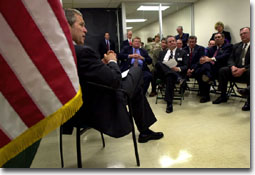
White House photo
THE PRESIDENT: Thank you very much. The air may be cold, but the
reception is unbelievably warm. (Applause.) Thank you all for that
warm reception. Governor, thank you very much. I appreciate you
and Mike meeting me at the airport. It's good to see public servants,
such as your Governor, who are willing to do what they think is
right. He follows the footsteps of a good friend of mine, a man
who did a fine job as the governor of North Dakota over the past
years, and that's Ed Schafer. It's good to see Ed here as well.
(Applause.)
I don't want to jump the gun on my speech here, but I just got
off the phone with the Speaker of the House. He informed me that
the House of Representatives just took a major vote on -- a vote
on a major portion of my tax relief package, and by the margin of
230 to 198, the tax rate cut passed the House of Representatives.
(Applause.)
The American people -- the American people had a victory today.
The American family had a victory today. The American entrepreneur
had a victory today. One House down, and now the Senate to go. (Applause.)
I'm here for a lot of reasons; one is to ask for your help. I
wasn't sure how many folks were going to show up to hear a budget
speech. It seems like a lot of people are interested in the national
budget, and more particularly, your own personal budgets. (Applause.)
And so I'm here to ask for you -- if you like what you hear today,
to maybe e-mail some of the good folks from the United States Senate
from your state. (Applause.) If you like what you hear, why don't
you just give them a call or write them a letter and let them know
that the people are speaking. You see, one of the important things
for the President, if the truth be known, people who hold federal
office, to make sure you get out of Washington, D.C., on a regular
basis. (Applause.)
It is important to make sure you get outside the D.C. scene and
listen to the people. I'll tell you, I love traveling our country.
I'm so proud to be landing in Air Force One and getting off the
airplane and driving into this hall and seeing people lining the
streets, waving at the office of the President. It makes me proud
to be your President. (Applause.)
No, they wave because they respect the office. And sometimes,
at least in this state, it seems like the people like the occupant,
too. (Applause.) It's a huge honor to be your President. It's a
huge honor.
One of the things I hope the people figure out about me is that
I like to bring common-sense approaches to our government. Take
budgeting. It seems like we need to have a common-sense approach
on how we spend the people's money, which means it's important to
set priorities. You set priorities in your family budgets, the federal
government ought to set priorities with your money. (Applause.)
Let me describe some of our priorities. Educating our children
is a priority. (Applause.) But, lest you think I forgot where I
came from, I want you to understand I firmly believe that the people
who are best able to run the schools in North Dakota are the citizens
of North Dakota. I believe in strong -- (applause) -- mine is an
administration -- mine is an administration that strongly supports
local control of schools.
But we also understand in Washington that we need to set high
standards, that every child, regardless of his or her background,
can learn, that we must have the highest of high expectations, and
that we must work with states and local jurisdictions to measure
so that we know whether or not we're leaving any child behind in
America today.
Not only today do we have good news out of the House of Representatives,
but the Senate Education Committee passed our education reform package
20-0. (Applause.) We're making progress because these pieces of
legislation are right for America. These aren't political documents,
this is public policy that's good for American families and American
children. So education is one of our priorities.
We've increased spending for education, but we've also insisted
upon more flexibility so governors and local folks can use federal
dollars to meet their specific needs. One size does not fit all
when it comes to the education of American children. (Applause.)
Secondly, a priority is to keep the peace. In order to keep the
peace, our military must be well-paid and well-housed and well-trained.
(Applause.) So my budget sets aside money for increasing military
pay. But as importantly, it is important to have a commander-in-chief
who sets a clear mission for the military. (Applause.) And the mission
of the United States military must be well -- to be well-trained
and well-prepared to fight and win war, and therefore prevent war
from happening in the first place. (Applause.)
Another priority is the health care of our citizens. We've set
aside money in the budget to make sure the working uninsured have
got the capacity to purchase health insurance. We've set aside money
in the budget to make sure we fulfill the promise to our senior
citizens, by doubling the Medicare budget over the next 10 years.
We've set aside money in the budget to increase the number of
community health centers around America, to make sure the poor have
got access to primary care. We've set our priorities, and the health
care of our citizenry is a priority.
Another priority is the retirement accounts of the U.S. citizens.
We've set aside all the money -- all of the money aimed for Social
Security will be spent on only one thing: Social Security. (Applause.)
The days of the Congress dipping into the Social Security trust
for other programs are over. (Applause.) And, by the way, down the
road, we're going to be thinking differently about Social Security.
You see, the Social Security trust now only earns 2 percent on your
money.
AUDIENCE: Booooo!
THE PRESIDENT: Yes. I'd be booing, too. (Laughter.) What we need
to do is to give younger workers the option of taking some of your
own money and managing it in personal savings accounts. (Applause.)
Ours is a budget that sets priorities. We've actually grown what
they call the discretionary spending by 4 percent. That's greater
than the rate of inflation. That's greater than the increase in
disposable income. That's a significant increase in expenditures.
But the debate is, it's not as big as some of the big spenders
in Washington would like it to be. You see, they're used to a different
attitude out of the White House. The discretionary spending at the
end of last year increased by 8 percent. So we're saying we're going
to meet our needs, but we're just not going to spend the people's
money quite as extravagantly as has been done in the past. (Applause.)
That's called common-sense fiscal responsibility. (Applause.) That's
the kind of message the people in North Dakota like to hear. (Applause.)
I was in Council Bluffs, Iowa, the other day, taking this message
around to the people. And a grandmother gave a speech, or talked
a little bit. And she said, she's had a lot of children go through
her house, and a lot of grandchildren go through their house. And
every time she has left cookies on the table, they got eaten. (Laughter.)
That's kind of how I view the federal budget. If we leave money
sitting around on the table, it will get spent. And so what we need
to do is set priorities. (Applause.) And clear priorities, and work
to achieve those priorities. (Applause.)
Another priority is to pay down debt. In our budget we've submitted,
we've increased discretionary spending by 4 percent, but we've paid
down $2 trillion of debt over 10 years. It's the biggest amount
of debt that any nation has ever paid off that passed in history,
in the history. (Applause.)
Increased spending, we've paid down debt and we set aside another
$1 trillion over 10 years for contingencies. An important contingency
could be making sure that we get money into the ag sector, like
we've done in the past year. (Applause.) We certainly hope that's
not the case, we hope that the ag economy recovers. We hope that
we can increase demand for North Dakota products all around the
world. (Applause.)
By the way, my attitude is this: If given a level playing field,
if we have free trade, true free trade, North Dakota farmers can
compete anywhere, any place, any time. I would like our farmers
in America to be feeding the world. And therefore, I am going to
work hard to open up markets. When it comes to international trade
discussions, the American farmer is not going to be treated like
a stepchild anymore. (Applause.) The American farmer -- the American
farmer will be a primary concern. We shouldn't use food as a diplomatic
weapon, from this point forward. We ought to implement the Food
For Peace program. But if we have an emergency in the farm economy,
we've set aside contingency money to do that. Contingency money.
There you go. (Laughter.) And guess what, though? By not overspending
on the discretionary count, there's still money left over, and the
fundamental debate in Washington is what do we do with it? What
do we do with your money? (Applause.) The fundamental question is,
do we increase the size of government?
AUDIENCE: Nooo!
THE PRESIDENT: Or do we remember that the surplus is not the government's
money, it's the people's money? (Applause.) The other day, I noticed
that the cash flow into the country -- the surplus for the first
four months was $72 billion. That's significantly higher than the
first four months of last year. It tells me that the American people
are overtaxed. That's what that says. (Applause.)
When you're running surpluses that big -- when you're running
surpluses that big, particularly with your economy beginning to
sputter, it ought to say something loud and clear, if you take a
common-sense approach to government. And that means the folks are
overtaxed. And if you're overcharged for something, you ought to
demand a refund. And I stepped in front of the Congress and demanded
a refund on your behalf. (Applause.)
And so, as I mentioned -- so, as I mentioned, the United States
House of Representatives began the process, the long, arduous process
of providing tax relief for the American people. Today, they took
a hold of our plan to reduce marginal rates on everybody who pays
taxes and, as I mentioned, they passed that piece of legislation.
I want you to hear some of the principles involved.
First of all, my administration did not believe in what they call
targeted tax cuts, because I don't believe that the federal government
ought to try to pick and choose winners in the tax code. Everybody
who pays taxes ought to get tax relief. (Applause.)
So we cut all rates. We drop the top rate from 39.6 to 33 percent.
And there is a lot of squawking about that. But let me explain to
you the rationale. First of all, there ought to be some principles
involved at the federal level, and a principle is the federal government
should take no more than a third of anybody's check. (Applause.)
But, also, a principle is -- a second principle is the role of
government is not to create wealth; the role of government is to
create an environment in which the entrepreneur and the small business
person and the dreamer and worker can realize his or her dreams.
(Applause.) And the facts are, and the facts are, by far, the vast
majority of small business people in America, the backbone of our
economy, pay the highest rate possible, because most small businesses
are unincorporated. Most are sub-chapter S -- many are sub-chapter
S. And so by dropping the top rate from 39.6 percent to 33 percent,
we're sending a clear message to America that the small business
person, the entrepreneur is the backbone of the future of this country.
(Applause.)
Our tax code is unfair. It's unfair to the small business people.
It's unfair to people struggling to get into the middle class. You're
on the outskirts of poverty, and you're working hard to get ahead,
and you're trying to raise children -- and by the way, being a single
mom, raising children, is the toughest job in America. That's the
toughest job in this country. (Applause.) And we penalize those
on the outskirts of poverty trying to get ahead, trying to get into
the middle class.
If you're making $20,000 a year, and you're earning money, for
every addition -- you're raising two kids. For every additional
dollar you earn, the way they've got the earned income tax credit,
and the way they've put you in the brackets, is that you pay a higher
marginal rate on that dollar than someone who's successful. That's
the facts in the tax code. For every additional dollar you earn,
if you are making $22,000 a year raising two children as a single
mom, you pay nearly 50 percent on that dollar. That's not right
in America. That's not what this country stands for.
And so our tax code not only serves as a stimulus to foreign capital
and the private sector for small business growth, ours also makes
the tax code fair for people struggling to get ahead. We dropped
the bottom rate from 15 percent to 10 percent. We doubled the child
credit from $500 to $1,000, we made the code fair for people working
to get ahead. (Applause.)
The marriage penalty is unfair. (Applause.) And the Congress will
be taking that up pretty soon to make sure the marriage penalty
is fixed. But let me tell you what else is unfair. And if anybody
understands it, it's the good people of this state. The death tax
is unfair. (Applause.) It is particularly unfair for American farmers
and ranchers. That's particularly unfair.
There is a lot of talk about making sure that we have green spaces
and open spaces, and that's good and that's important. But probably
the best reform to make sure that happens is to eliminate the death
tax so family farmers aren't forced to sell their farms before they
want to. (Applause.)
With us today is the Wightman family. You probably -- maybe you
know them, maybe you don't. But they're here for a reason. Because
behind every tax relief plan are real Americans, Americans who will
benefit. These good folks both work, they've got Melissa and Paige.
Melissa's 14, Paige is 10. They right now pay $3,700 in federal
income taxes. When our plan is fully implemented, these good folks
will save $1,900. (Applause.)
The reason I bring up the Wighmtans is because I want America
to know what our philosophy is when it comes to the people's money.
Once we set priorities, once we pay down debt, once we set aside
contingencies, it's important for Congress and the United States
Senate to send this message to the American people: We trust you
with your own money. It's your money to begin with. (Applause.)
Instead of figuring out new programs our new ways to get reelected,
why don't we figure out ways to let the Wightmans plan for their
future? No, I know some say, well $1,900 isn't a lot. Just ask them
what it means. Ask the people who are paying higher energy bills
what it means. Ask the people who are struggling under consumer,
credit card debt what it means to have their own money back. As
a matter of fact, we shouldn't take it in the first place. (Applause.)
I'm here with a message. My message is with fiscal discipline,
with planning, with leadership, our nation can fund important priorities.
We can pay down debt. We can meet emergencies or contingencies.
But in order to make sure this economy gets a second wind, we better
start passing money back quickly.
And so not only should we have tax relief, we need to make a lot
of it retroactive. We need to get money in the pockets -- (applause)
-- so the President gets to make some suggestions, gets to make
some phone calls on occasion to members. But the best way I can
garner support is to come to you and ask for your help. And to say,
there is nothing more powerful than the voice of the people. There
is nothing that will get anybody's attention more than good, hardworking
people. Standing up, saying, let's have some common sense up in
the Nation's Capitol about our money. (Applause.)
And it's so important to trust the American people, so important
for our government to trust people, because the people are the strength
of this country. This is a fabulous land, it's the greatest country
on the face of the earth. (Applause.) Not only -- not only because
of the fantastic principles -- we believe in freedom of religion,
freedom of press, the freedoms to achieve your dream, regardless
of where you're from, but it's the greatest land on the face of
the earth because of our people, God-fearing, hardworking, neighborly
citizens all across America. That's the true strength of the country.
(Applause.)
I'll be involved a lot -- part of my job is to argue for fiscal
sanity in Washington. Part of my job is to represent your interests
when it comes to how your money is spent. A big part of my job will
be to work to keep the peace by making sure our military is strong.
But a significant part of my job is to invigorate the American
spirit, that spirit that says when a neighbor sees somebody in need,
what can I do to help. You see, the strength of America, if it is
in the hearts and souls of our citizens, it must be used to make
sure people aren't left behind, that the downtrodden is lifted up,
that people in need get help. Often times we turn to government.
But the true love and true compassion in this country begins when
neighbors help neighbors in need.
So if you've got a mentoring program in the state of North Dakota
that needs some help, say, what can I do to help? If you've got
a church program that's trying to help people that are hungry, take
the extra step and see if you can't help. If you know some people
that are wondering whether or not somebody loves them, take a little
extra time, put your arm around them, and say, we do. I also want
you all to remember that the most important job any of us will have,
the most important job if you happen to be a mother or dad, isn't
president or governor, is to love your children with all your heart,
and all your soul, and all your mind. (Applause.)
No, we're a blessed nation. We can achieve anything we set our
mind to. We can have sound fiscal policy. We'll work hard to keep
the peace. But most of all, we can make sure this great American
experience shines brightly for every citizen, everybody in this
great country. People are willing to role up their sleeves and work,
because we've got a country of people who are willing to roll up
their sleeves and help.
I can't tell you what an honor it is to be your President. (Applause.)
I am so grateful, I am so grateful that so many came out to say
hello. God bless you all, and God bless America. (Applause.)
END
5:53 P.M. CST
Remarks by the President in Sioux
Falls, South Dakota Send Off -- March 9, 2001
Joe Foss Field
National Guard Hangar
Sioux Falls, South Dakota
10:03 A.M. CST
THE PRESIDENT: Thank you all very much. I am glad to be here in
South Dakota. (Applause.) I was telling the good Governor, the air
may be a little chilly, but the people are awfully warm. (Applause.)
I want to thank your warm hospitality. I particularly want to
thank those who were on the road, waving to us as we came in, and
those who have lined up outside the hangar. It's really -- really
makes me feel great to be here. Thank you for your hospitality.
I'm so proud to be able to call your Governor my friend. He's
a good man, Janklow. (Applause.) He's kind of hard to settle down,
sometimes. (Laughter.) But the thing I like about him is he married
well -- (laughter) -- he's honest and he loves the people, and he
loves the people. (Applause.)
Earlier today, we toured a community health center here in Sioux
Falls. And I was honored and so pleased that the Minority Leader
in the Senate, Tom Daschle, greeted me. It's very thoughtful of
him to do so. I appreciate -- I appreciate the dialogues we have
had. He treats me with respect; I will treat him with respect. (Applause.)
I'm also appreciative of the fact that we've got two United States
Congressmen on the stage with me today. A very capable, strong,
able man from South Dakota, John Thune. (Applause.) And I've noticed
you've relaxed your border policy and allowed Congressman Mark Kennedy
from Minnesota to come today, too. (Applause.) I appreciate these
two men being here. It gives me a chance to personally thank them
for casting an important vote on behalf of the American people yesterday,
when they cast a vote to cut the taxes on the people who pay the
bills. (Applause.) I want to thank you all.
I appreciate the Mayor, I appreciate the former Senator, I appreciate
my fellow citizens. I appreciate the fact that you've given me a
chance to get outside of Washington -- (laughter) -- remember where
I came from, to come to the heartland of America. (Applause.) It's
important for all of us in the federal government to continue to
come to the heartland, because it's the land of good heart and the
land of common-sense people. (Applause.)
And I am here to talk about a common sense way to budget in Washington,
a common sense approach for what to do with your money. I want you
to understand, first and foremost, all the talk about the surplus.
The surplus is not the government's money. (Applause.) The surplus
is the people's money, it's the hard-working people of America's
money. (Applause.)
And I'm going to remind the good folks in the nation's capital,
some of whom don't need reminding, some of whom may need to be occasionally
reminded, that we work for you. And it's your money we're talking
about when it comes to setting budgets. (Applause.)
It's important to be fiscally sound and fiscally responsible with
your money, which starts with setting priorities, clear priorities.
And so I want to share some of the priorities that I've set.
First, educating our children is an important priority for our
nation. (Applause.) So we spend money on public education -- but
I always remember where I came from. I hope you don't get too nervous,
Governor, because I have always believed and will always believe
in local control of schools. And so, while the government will spend
money, we've got to trust you to run your schools. (Applause.)
We got a good vote out of the Senate Education Committee that
passes power out of Washington, so the local folks can chart the
path to excellence for every child. Education is a priority; but
it must be a priority in the context of empowering local folks and
strong accountability measures, and trusting parents, and always
challenging failure. Because in our vision, there are no second-rate
children in this great land of ours; and there are no second-rate
dreams in America. (Applause.)
Health care is an issue, and it's a priority. I believe we ought
to double the amount of patients we cover in community health centers,
to make sure that the poor and those on the outskirts of poverty
are able to find primary care.
I know we've got to make sure we take care of our elderly, and
so we've doubled the Medicare budget in my budget. It says loud
and clear to our seniors the promises that we have made to you will
be a promise we will keep. But it also requires new thinking and
new leadership. We must reform Medicare, to give seniors more options,
more choices, more opportunities to tailor their health care programs
to meet their needs, all of which ought to include prescription
drug benefits for our seniors. (Applause.)
A priority is to work with states on important development projects.
And the Lewis and Clark Rural Water Project is a project that will
be in my budget, and something that we can work together on. (Applause.)
Our retirement systems are a priority in the budget. And so we've
sent the clear message to the Congress -- and it's being well-received,
by the way, by both Republicans and Democrats -- that the payroll
taxes, all your hard-earned taxes, aiming for Social Security, will
be only spent on one thing, and that's Social Security -- that we
set aside, that money. (Applause.)
One of the biggest jobs I have is to serve as the Commander-in-Chief,
and I do so proudly. (Applause.) I want to be the Commander-in-Chief
of troops that have got high standing and high morale; people that
have got a clear mission stated to them by the Commander-in-Chief,
which is to make sure that our military is properly trained, ready
to fight and win war and, therefore, prevent war from happening
in the first place. (Applause.) So a priority is to make sure our
military is better-paid, better-housed, and better-trained. (Applause.)
Those are priorities of ours. We grow what's called the discretionary
part of the budget by 4 percent. That's greater than the rate of
inflation. That's a lot of money, by the way, when you're talking
in terms of billions. We grow the budget.
But if you listen to the voices of those who would rather keep
your money in Washington, D.C., they say we can't meet the needs.
I'm telling you, we can meet the needs with the right kind of priorities.
We can meet the needs with the right kind of focus. (Applause.)
So we grow that budget. But the problem is, some of the folks
in Washington are used to spending orgies. At the end of the last
session, the discretionary spending grew at 8 percent. I mean, it's
like, let's have a contest to see who can spend the most in order
to get out of town. Those days are over. We're going to bring some
fiscal sanity to the budget. (Applause.)
We can meet our priorities, and we can fund them. And we can also
pay down debt. I know a lot of folks around America are worried
about national debt, as am I. We pay down $2 trillion of debt over
the next 10 years. That's all the debt that's available to be retired
without having to pay a premium for prepaying debt. That's a lot
of debt retirement. It will be the biggest repayment of debt in
the history of the world. And so we pay down debt.
In order to make sure that the American people are comfortable
with our plan, we also set aside a trillion dollars over 10 years
for contingencies, emergencies, money for the unforeseen. So people
say, what do you mean by that. Well, I'm concerned about the agricultural
sector here in our country, the agricultural economy. (Applause.)
I want to increase demand for South Dakota products. (Applause.)
I believe that the South Dakota farmer and rancher is the best in
the world. (Applause.) And, if given the opportunity, they can compete
with anybody in the world, so long as the opportunity is fair. So
my administration will work hard to increase demand for South Dakota
products. (Applause.)
When it comes time to negotiating trade agreements, we're not
going to leave the farmer behind. We understand the significance.
(Applause.) But we may need some contingency money to help the farmers
transition from the old ways to the market-oriented approaches for
agriculture.
And speaking about agriculture, let me reiterate my commitment
to value-added processing, to making sure that ethanol is an integral
part of the gasoline mixes in the United States. (Applause.) It
makes common sense to set aside money for priorities and contingencies
and debt. But there is still money left over.
The people are working so hard, and long hours, and are overtaxed
-- that there's money left over. And the fundamental debate that's
taking place in Washington, D.C. is what to do with the money. That's
the fundamental debate. And I'm here to make my case: if the American
people are overcharged, they deserve a refund. They deserve some
money back. (Applause.)
It's really a matter of who you trust. It's a matter of trust.
Once the priorities are met, once debt is repaid, once the money
is set aside in case something goes wrong, it's who do you trust.
And I want to make it clear to the people of South Dakota: I trust
you, rather than the government, to spend your money. I trust you.
(Applause.)
I also don't trust the Congress to pick winners and losers in
the tax code. You're going to hear the words, "targeted tax
cuts." That means a group of folks get to decide who is targeted
in and who is targeted out. That's not my view of government. My
attitude is, if you pay income taxes, you ought to get relief. Everybody
who pays taxes ought to get relief. (Applause.)
And so, yesterday, the Congress did the right thing. They heard
the call that if we're going to have tax relief, reduce all rates.
And we have done so. We've made the code -- we're trying to make
the code more simple. We dropped the bottom rate from 15 percent
to 10 percent and increased the child credit from $500 to $1,000
per child. (Applause.)
And there is a reason, and the Congress must hear the reason.
It's because we want the code to be more fair. That if you're living
on the outskirts of poverty and you're struggling to get ahead,
today's tax code penalizes hardworking people. I want you all to
remind folks who need to be reminded, that if you're making about
$22,000 a year and you're a single mom raising two kids -- which
I know and many of you know is the toughest job in America, that's
the hardest work in this country. (Applause.)
For every additional dollar under this code -- under this code
that some label progressive, for every additional dollar, that hardworking
lady earns, she pays nearly 50 percent tax. The way the code is
structured, she loses part of her earned income tax credit. She
pays the 15 percent bracket. She's paying her payroll taxes. She
pays more on the margin than Wall Street bankers do. And that's
not right. And that's not fair. And we're going to do something
about it in the tax code. (Applause.)
We're also dropping the top rate from 39.6 percent to 33 percent.
There's a lot of hollering about that. A lot of people -- you know,
they like the targeted tax cut; we're going to try to pick and choose
the winners. But I want you all to remember this: that an integral
part of America is the small business owner. (Applause.) The small
business owner not only provides many of the new jobs we create,
but the entrepreneur and the small business owner represents the
best of America. It talks about the American Dream and the American
experience of starting and owning your own business. (Applause.)
There are a lot of folks who have come to this country, whether
or not America is meant for them, and they start their business
and they work hard, and they own a piece of the future. That's what
America is about. And I want you to remind the skeptics and the
naysayers and the doubters that many small businesses are unincorporated,
many are what they call Sub-chapter S, and they pay the highest
marginal rate in the tax code. And by dropping the top rate from
39.6 percent to 33 percent, we provide capital infusion into the
small business sector of America. This is a plan that is good for
the entrepreneur and small business people. It makes sense to be
that way. (Applause.)
And, by the way, there is a need to make this happen quickly.
We've got an issue with our economy. It's beginning to sputter.
It's beginning to get a little shaky. And one way to make sure that
we provide a second wind to the economy is to give people their
own money back. That's called economic recovery. (Applause.)
And so I appreciate so very much the Congress working with the
White House to make the tax relief retroactive. In other words,
when we pass the bill, it will be as if it went into effect on January
1st of this year, to get money in your pockets quicker. (Applause.)
I also want to thank those 10 Democrats who voted with us yesterday.
(Applause.) People are beginning to hear from the people. People
are beginning to hear. The elected members are beginning to hear
from the people. That's why I'm here. I want to remind you that
you all have an incredibly positive effect. You can help a lot and
I appreciate so very much -- (interruption). As I said, you can
have a positive effect. (Laughter and applause.)
It's a sign from above. (Applause.) I'll keep an eye on it. (Laughter.)
Let me say one thing, quickly. I am concerned about our economy.
And therefore, today, in order to make sure our transportation hubs
continue to flourish and we continue to fly, I'm issuing an executive
order to protect the flying public in a time when Northwest Airlines
and the mechanics are having trouble resolving differences, and
they need time to do so. This order that I signed today will prevent
any disruption of air service for the next 60 days. (Applause.)
It is significant to the people living in South Dakota that I
do this. Northwest is the first airline this year to reach a critical
point in labor/management negotiations. Several other negotiations
involving other national carriers face deadlines within the next
few weeks and I am concerned about their impact, concerned about
what it could mean to this economy. And I intend to take the necessary
steps to prevent airline strikes from happening this year. (Applause.)
I urge the National Mediation Board to make sure that the parties
work toward a solution and negotiate in good faith. It's important
for our economy but, more important, it's important for the hardworking
people of America to make sure air service is not disrupted. (Applause.)
I'm watching. And I'm winding down, but I want to do one other
thing. I want to remind you that tax relief is good for families.
It's good for our families. (Applause.) And it is going to be better
for families when we do something about the marriage penalty in
the tax code. (Applause.) The tax code is unfair to farmers and
small business people. We need to get rid of the death tax in the
tax code. (Applause.) There's a lot of talk about taxes. I want
to put a face on taxes. I want people to understand that tax relief
is real for people.
We've got the Hagen family here. You all stand up, Scott -- and
their family, Tiffany and Christian and Austin and Kyler. This is
a hard-working family. They're raising their three children. They
now pay $1,500 in federal income taxes. When it's all said and done,
after the Congress passes its plan and when it's all said and done,
they'll end up paying zero in federal income taxes. (Applause.)
No, I know they're going to say, and you'll hear them say in some
of the parlors around the country, you know, $1,500, that's not
much. Just ask the Hagens. Just ask the working families who have
energy bills that are high. Ask the people -- (applause) -- I want
the skeptics to ask the question to people, what it's like to have
huge consumer debt.
There's a lot of talk about debt at the national level. We need
to worry about debt in the communities all around America. (Applause.)
No, that $1,500 -- $1,500 may not mean a lot to some; it means a
lot to the Hagens, and there's a principle involved. And the principle
is, we trust them to spend the $1,500 the way they see fit. It's
their money to begin with. (Applause.)
And so I'm here to thank you for your support, thank you for your
friendship, and ask for your help. You're just an e-mail away from
making a difference in somebody's attitude. (Applause.) It's the
right thing to do. This is common-sense approach to your money.
It's a common-sense approach. It requires some discipline. It requires
reordering priorities. And the priority with your money is not to
grow the federal government -- the priority of your money is so
you can grow your own families and meet your own needs and meet
your own responsibilities. (Applause.)
And that, after all, is what's important about America: responsibility.
We have a responsibility. Those of us elected to office have a high
responsibility -- responsibilities that I will keep. But it doesn't
just start in Washington, D.C. It starts in neighborhoods. At the
community health center today, I had the honor of meeting people
who assume the responsibility of not only providing health care,
but of saying to a neighbor in need, what can I do to help? They
call it the heartland because people have got good hearts in this
part of the world. People care about neighbors. (Applause.)
We can argue about budgets, but that's not the greatness of America.
The greatness of America is our people, the fact that we've got
people who care about somebody. And so I urge you, become a Boy
Scout or Girl Scout leader to teach a youngster right from wrong.
(Applause.) I urge you -- I urge you, don't hope that Washington
fixes schools, don't hope that the federal government waves some
magic wand to make the schools better. Get involved with your education
systems at the local level. Thank a teacher, thank a principal for
their hard work. (Applause.)
If your church, your synagogue or mosque, you're looking for something
to do, find a program that will help mentor a child. Put your arm
around somebody; it says, we love you. America is meant for -- you
know, the greatness of this country lies in the hearts and souls
of our citizens. My job will be to argue smart budgets. My job will
be to represent you when it comes to making sure you've got your
money back. My job will be to keep the peace.
But my job will also be to call upon the best of America, to lift
this nation's spirits, to set our sights high, to call upon the
goodness and kindness of America. (Applause.) To remind the moms
and dads of our country, if you're fortunate to be a mom or dad,
love your child every day, love them with all your heart and all
your soul. (Applause.)
And that's why it's such an honor to be here, an honor to be your
President. I'm so optimistic, with the right focus, the right attitude,
the right approach, that this great nation can achieve anything
we set our minds to.
Thanks for coming out today. God bless. God bless America. Thank
you all. (Applause.)
END 10:33 A.M. CST
Remarks by the President in Lafayette,
Louisiana Send Off -- March 9, 2001
Lafayette Regional Airport
Lafayette, Louisiana
4:30 P.M. CST
THE PRESIDENT: Thank you all very much. I'm sure glad I came here
to Louisiana; thank you for coming. (Applause.) I want to thank
you all for coming. I want to thank the thousands of people who
lined the road on the way in here. I wish the hangar were ten times
bigger, but thank you all so much for being here.
First, I want to thank my friend, and your Governor, Mike Foster.
I appreciate his friendship. One thing you can say about him is,
you know where he stands. (Applause.) And I know he stands as my
friend, and I appreciate that so very much.
I appreciate John Cooksey, the Congressman who is here. (Applause.)
I appreciate Susie Terrell, who is here. (Applause.) I want to thank
Senator Michot for being here. (Applause.) Ernie Alexander, my friend,
is here, I want to thank him. (Applause.) My friend, Ernest Johnson,
who heads the Louisiana NAACP is with us today; and I want to thank
you, Ernest, for coming. (Applause.)
There is one other fellow, a man who stuck his neck out in the
course of the campaign. You see, he doesn't happen to have the Republican
label by his name -- his name is Dan Morrish, he's a Democrat. (Applause.)
He put party aside and did what he thought was right for the country.
And, Dan, I'm honored to have your support, I thank you for your
friendship. (Applause.)
And it's great to be here. I tell you, it is important for me
to make sure I get outside the nation's capital on a regular basis.
I love people in Louisiana. (Applause.) I like the idea of coming
to bring my message to you. I hope by now the people of the country
are beginning to realize that we all have adopted a common-sense
message. It's a message of the people. It's a message that understands
that the most important element of politics are the people of this
country -- the hardworking Americans who make the country go. (Applause.)
I get proposed things in Washington -- I don't get to vote on
them. I'm not a member of the legislative branch. But the biggest
influence in our government is the people, and I know that. So I'm
here today in Lafayette, Louisiana to explain a common-sense budget.
And if you like what you hear, you might decide to maybe e-mail
or call some of those who represent you and let them hear from you.
(Applause.)
If you like the common-sense approach to how we spend your money,
it may make sense to pick up the phone or drop a note to people
who may not see it our way. That's what politics is all about, as
far as I'm concerned -- it's the people's will. And I'm here to
talk about the people's business. And the people's business is to
bring some fiscal sanity to the budgeting process in Washington,
D.C. (Applause.)
It starts with understanding this important principle: that the
surplus is not the government's money. (Applause.) The surplus is
the people's money. (Applause.) And so what makes sense? Well, what
makes sense is to set priorities. That's what makes sense. Here's
some of my priorities: education is a priority. (Applause.) Making
sure children learn is a priority.
So we increase spending at the Education Department. It's a priority
of the country, but in case you might think that I forgot where
I came from, I'll understand that the people who can run the schools
best in Louisiana are not people in Washington, D.C., but the folks
of Louisiana. (Applause.)
So we're spending a little more at the federal level, but we're
going to work with Congress to pass power out of Washington, to
empower the local folks, to empower parents and teachers to make
the right decision for the children of the great state of Louisiana.
(Applause.)
The people's health is a priority. Today, I talked about expanding
a number of community health centers around America to make sure
that the poor are able to get primary care. I also want to make
it crystal clear in the budget I submitted to the Congress that
we have doubled Medicare spending over a 10-year period of time,
that we're going to make the commitment that we have made to the
elderly.
It not only requires more spending, which we will do, it also
requires an attitude of reform that says we'll trust seniors to
make choices for themselves, seniors to match their needs with a
variety of programs, all of which include prescription drugs. (Applause.)
And I want to praise one of your senators from Louisiana. John
Breaux and I are going to work on this issue. We will spend a lot
of time making sure that Medicare is properly reformed, so that
the promise we have made to our seniors will be a promise that will
be kept. (Applause.)
There's a lot of talk about Social Security, as there should be.
The message to the Congress is loud and clear: we're not going to
spend payroll taxes on anything other than Social Security. We're
not going to take the money aimed for Social Security and spend
it on anything else. (Applause.)
There's money in my budget to make sure that we're able to keep
the peace by making sure we pay our military folks a good wage.
(Applause.) There's money in the budget for priorities. As a matter
of fact, we increased what's called the discretionary spending by
4 percent. That's greater than the rate of inflation.
But it's not enough for some in Washington. Because, you see,
they're used to spending a lot of money up there. The last session,
they spent your money to the tune of 8 percent. It's like they had
a bidding contest to see who could get out of town. Those days are
over with. (Applause.)
We will set priorities and fund them. But we'll be wise about
how we spend your money. We don't want the federal government exploding
in growth. We want the federal government to be lean and efficient
and focused with your money. And that's exactly what's going to
happen with new leadership in Washington. (Applause.)
There's a lot of discussion about paying down debt. I want to
remind you, there are two types of debt -- there are a lot of types
of debt, but there are two types of debt that I worry about. One
is debt at the national level. And under the plan I submitted to
the Congress, we pay down $2 trillion in national debt over 10 years
-- $2 trillion. It's the biggest amount of debt repayment ever.
There's also consumer debt, the credit card debt that burdens
many of the working families in America. Yes, we talk about national
debt, and we're paying a lot down. But you're fixing to hear me
tell you part of the remedy for people who have got a lot of credit
card debt is to make sure people get some of their own money back.
(Applause.)
We have met priorities. We grew the budget at a reasonable rate;
not this fantastic rates that exploded during the last session.
We pay down debt, we protected Social Security. We have also set
aside $1 trillion over 10 years for contingencies.
Who knows what will happen. And so, we put $1 trillion aside.
That makes sense. That's common sense to do that, it seems like,
to me. We may need money for our farmers. And I'm going to tell
you something about agriculture in America. It is an incredibly
important part of our economy. Who knows what we'll need money for.
So we set aside money to do so but, guess what? There's still
money left over. The fundamental question is: what do we do with
that money? The fundamental question that I want Congress to hear
from you about is what to do with the money. Do we increase the
size and scope of the federal government?
AUDIENCE: No!
THE PRESIDENT: Or do we trust you with your own money?
AUDIENCE: Yes! (Applause.)
THE PRESIDENT: There's a lot of discussion about how to get tax
relief. I worry about what's called targeted tax cuts. I worry about
people sitting around Washington saying, you're targeted in; but,
oh, by the way, you're targeted out. It seems like to me the fairest
way to handle the people's money is to say that everybody who pays
taxes ought to get relief. (Applause.) The federal government ought
not to try to play favorites. It's likely people in Louisiana may
not be considered a favorite. You will be, as far as this President
is concerned. (Applause.)
So the plan that was passed out of the House -- and, John, thank
you for your support -- is fair. It reduces all rates on everybody
that pays taxes, and it simplifies the code. It drops the bottom
rate from 15 percent to 10 percent. It increases the child credit
from $500 to $1,000 per child. And let me explain to you why. Let
me explain to you why this tax code we have is unfair.
One of the things that the people must stand for is fairness in
life. If you're a single mother in the state of Louisiana trying
to raise two children, and you're making twenty-something thousand
dollars a year, under the code that's written today, for every dollar
you earn above $22,000, you pay a higher marginal rate on that dollar
than someone who is successful. You pay nearly 50 percent on that
dollar. And that's not right, and that's not what America is all
about.
No, this country stands for rewarding hard work, not penalizing
it. And we must understand -- (applause) -- and when we find people
working the hardest job in America, which is the single moms in
this country, and they're struggling to get ahead, we ought to have
a tax code that welcomes hard work and says, you can access the
middle class, and you can realize your dreams.
This plan that passed the House yesterday makes this code imminently
more fair. It also reduces the top rate. And oh, I know there's
a lot of discussion about that, dropping the top rate, but let me
tell you why. First, there ought to be some principle involved in
the tax code. And this principle is, the federal government ought
to take no more than a third of anybody's check. (Applause.)
But there's another principle. And that is, our nation must understand
that the small businessman and the small businesswoman is the backbone
of job creation. Our nation must never forget. (Applause.) We must
never forget that good public policy will encourage entrepreneurial
spirit in America, encourage the growth of the small business owner.
And we must also realize that many small businesses are unincorporated.
They're sole proprietorships. They're Sub-chapter S's. They pay
the high marginal rate. And by cutting the rates from 39.6 percent
to 33 percent, we send a clear signal that we encourage entrepreneurship
and small business growth, that we understand. (Applause.)
That we send a loud message to Washington that the role of government
is not to create wealth, but the role of government is to create
an environment in which American risk-takers and dreamers and people
willing to work for a dream have got a better opportunity to realize
those dreams. (Applause.)
The plan that we've submitted to the United States Congress recognizes
that the death tax is unfair to Louisiana farmers and small business
owners, and we need to get rid of the death tax. (Applause.) The
plan that I submitted to the United States Congress recognizes that
when you penalize marriage, we send a bad signal about families
and the role of families in our society. (Applause.)
We've submitted a good plan, and it's working its way through
the system. It came -- a major portion came out of the House, and
I want to thank the 10 Democrats that stood with a hundred percent
of the Republicans that spoke on your behalf. (Applause.)
And now it's headed to the Senate, and it's time for your voices
to be heard. Now, I want to give you some ammunition if you agree
with what I'm saying. Not only have we got a common-sense budget
-- in other words, we can afford what I'm telling you, we can afford
it -- but that makes economic sense to give people their own money
back. You see, our economy is beginning to sputter a little bit.
There are some places around the country where people are beginning
to get laid off; economic growth is slowing down.
It is important to act quickly to get people their own money back,
so you can spend it and serve as a second wind for our economy.
It makes sense. (Applause.) It makes sense. We need it now. And
so I appreciate the fact that the plan that came out of the House
will make some of the tax cut retroactive, which means when it passes,
it's as if it took effect of January of this year. (Applause.)
But there's another reason why this tax plan is important -- because
it sends a signal about the priorities of our government. And the
priorities of our government is to trust people with their own money.
We must send a clear message that once we meet our priorities, the
people who can best handle the people's money is the people, themselves.
(Applause.)
Today, I've asked the Anderson family to join us here from Lafayette.
We've got Richard and Jenifer and first, I want to say to their
teachers, and you can't thank teachers enough for being a teacher.
(Applause.) And with Richard and Jenifer are Jane, Noah, and Sam,
their three children, who they love more than life.
And the reason I've asked them to join us is to help make my point
-- that when we're talking about taxes and budgets, it's more than
numbers that we're talking about. We're talking about people's lives.
We're talking about the fact that this is a plan that understands
that there are a lot of folks working hard to get ahead.
Remember, we haven't had an energy policy for a while. And anybody
that understands that is the people of this part of the world. (Applause.)
There's a lot of people paying high energy bills in America now.
It's like a new tax on American families. By the way, we're going
to have an energy policy, and it starts with finding more energy
here in America. (Applause.)
But I'm worried about hardworking folks like the Andersons. I'm
worried about the fact that people all across America are paying
high energy bills. I'm worried about the fact that a lot of folks
have got credit card debt. I'm worried about the folks -- folks
who are working longer hours. And it seems like to me that if you've
got a little extra money in Washington, instead of spending it on
programs, why don't we let people spend their own money. (Applause.)
And so, here are the facts -- here are the facts. These good folks
now pay $4,300 in federal income taxes on an annual basis. Under
our plan, they will save $2,600. (Applause.) Oh, that may not sound
like a lot to some -- it's a lot to me, and it's a lot to the Andersons.
You see, the principle is, do we want that $2,600 that's their
money to begin with to go to excess federal spending? Or do we think
it's better spent by them? Would we rather have the government spend
it, or would we rather have it for them to save for their children,
to meet their priorities? (Applause.)
I want to tell you what a grandmother said the other day in Council
Bluffs, Iowa -- you see, I've been moving around the country, making
our case. And she said -- she's had a lot of children and grandchildren
go through her house. And when you bake cookies and you leave them
on the table, sure enough, they'll be eaten. (Laughter.) That's
kind of how I view that $2,600. If you leave it on the table, sure
enough, it will be spent. (Applause.)
The right thing to do, the fair thing to do, the thing to do that's
based upon common sense, is to understand whose money it is to begin
with, and to trust the good people of America to spend their own
money to meet their own priorities. (Applause.)
I have great trust in the American people. I can't tell you what
an honor it is to be your President, and to travel our land, and
to see people come out and wave. It reinvigorates my spirit, because
it helps me understand yet again the spirit of America. The true
greatness of this country does not lie in the halls of our governments;
the true greatness of our country lies in the hearts and souls of
the American people. (Applause.)
My job is to represent the folks in Washington and to fight for
sound budget and tax relief. But my job also is to call upon the
spirit of this country, is to say to the moms and dads of America,
your most important job is to love your children with all your heart
and all your soul. (Applause.) It's to thank the Boy Scouts and
Girl Scouts and Boys and Girls Club leaders who are teaching our
children common-sense values, the difference between right and wrong.
(Applause.) It's to thank those folks who, when they see a neighbor
in need, put their arm around them and say, what can I do to help
you, brother or sister? What can I do to help you on your walk?
No, the greatness of America is our people. It's important to
trust the people. It's important to trust the people with their
own money. But it's also important for our President to understand
that by rallying the spirit of America, we can trust the people
to make America a compassionate, decent place for all of us who
are fortunate enough to live in this land.
I'm proud to be your President. Thank you for coming. God bless.
(Applause.)
END 4:55 P.M. CST
Remarks by the President to the
Panama City Area Joint Rotary Club and Chamber of Commerce Meeting
-- March 12, 2001
Marina Civic Center
Panama City, Florida
1:38 P.M. CST
THE PRESIDENT: Thank you all. Sit down, Governor. (Laughter.)
Well, I'm glad I came. Thank you for the invitation.
AUDIENCE: We're glad to have you. (Laughter.)
THE PRESIDENT: It's one of these responsive meetings. (Laughter.)
Governor, what a good man he is. (Applause.) The key to our success
is pretty simple, we listen to our mother. (Applause.) And she is
still telling us what to do. I'm listening about half the time.
I appreciate the two United States Congressmen who are here. Joe,
thank you very much and Allen, thank you very much, as well. I'm
honored to have you both here. (Applause.)
I've had some good visits with both of the members. Sometimes
we agree, sometimes we don't agree. But the thing about these two
men is that we're going to agree to be respectful to each other.
And that's what this country wants. (Applause.) I want to thank
the members of the Rotary. I want to thank the members of the Chamber.
I want to thank the economic development folks who gave me an opportunity
to come and talk about what's on my mind. Walking in, the man from
the Rotary said, our slogan: is create awareness and take action.
And that's exactly why I'm here. I want to create awareness about
a common-sense budget, and ask you to take action to help me get
it passed. (Applause.)
It's good to see the leaders of the Florida legislature, members
elected to the state wide on the ticket here in Florida. I want
to thank you all for coming. I know there's a lot of local officials
here. I always believe the government closest to the people is that
which governs best. (Applause.)
So I appreciate you all being here. It was my honor to go to Tyndall
today, to see the good folks who wear the uniform of the United
States military. (Applause.) To tell them how much I appreciate
their service to the country. I'm reminded today of how dangerous
service can be. We lost some servicemen today in Kuwait, on a training
accident. I hope you'll join me in a moment of silence for those
soldiers and their families.
(A moment of silence was observed.)
THE PRESIDENT: God bless.
I'm here to talk about a budget. And there's a lot of talk in
Washington about budgets. But here's what I believe. I believe the
people who can best affect the budget are the people who pay the
bills in the first place, the taxpayers of America. (Applause.)
Sometimes it seems like we tend to talk to ourselves in Washington.
And that's why I like to travel around the country, talking to the
people who have got most at stake in the budget negotiations that
go on in the nation's capital.
First, let me tell you that good budgeting means setting priorities.
And part of my travels around the country is to explain where I
think our priorities are. It is a priority to make sure we pay the
men and women who wear our uniform good wages. It's a priority in
my budget to do so. (Applause.) It's a priority to make sure they're
housed well. (Applause.)
But it's also a priority to make sure if we spend money, that
we spend it wisely. That's why I've asked the Secretary of Defense
to do a bottom-to-top review about missions and spending and research
and development dollars, to come up with a strategic vision of our
military, not only today, but what the military ought to look like
tomorrow, to make sure that money is wisely spent when we spend
your money on the military.
You see, I think we have a fantastic opportunity, not only to
keep the peace today, but to redefine the terms of war, to use our
new technologies to redefine how the battlefields are configured,
so we have a better chance of keeping the peace. So we'll set priorities.
The first priority is the people who wear the uniform. (Applause.)
The second priority is to make sure long-term objectives are clearly
set, and as we spend money, to make sure we meet those objectives.
But there's one priority of the Commander-in-Chief that requires
no money, and that's to make it clear the mission of the military,
to make clear the mission of those who wear our uniform, and it
is this: to be well-trained, to be ready to fight and win war, and
therefore prevent war from happening in the first place. (Applause.)
A second priority has been education. Now, we've increased the
budget at the federal level but, Governor, don't be too nervous.
I remember where I come from. I believe in local control of schools.
I strongly believe we ought to pass power. (Applause.) I know your
Secretary of Education is here. It's good to see you, Charlie. (Applause.)
The reason I mention Charlie is I believe that the people who
care more about the education of the children who live in the Panhandle
of Florida than anybody else are the citizens of this part of the
state. I know the Governor understands that, I know Charlie understands
that. (Applause.) And the people in Washington have got to understand
that. And that's why I look forward to working with Congress to
pass power out of Washington, to provide as much flexibility with
federal money at the local level as needed, so that you all chart
the path to excellence; so you figure out whether or not children
are learning and, if not, make sure they do.
The temptation in Washington is to say, one-size-fits-all will
work. But we know better than that. One size doesn't fit all when
it comes to the education of our children. There needs to be local
control of schools. There needs to be strong accountability measures.
And when we find failure, we've got to free parents to make different
choices for their children. (Applause.)
Social Security is a priority. I know there is a lot of talk,
and there was during the campaign. I suspect there may be some,
and for people who are trying to keep your money in Washington,
they'll say, well, you can't have meaningful tax relief; otherwise
the Social Security system will fail. You read these polls, they're
saying, you know, do you want to take away somebody's Social Security
check or do you want to have tax relief. But that's not the choice.
That's not the choice that we have here, as we work on this budget.
Because we set aside every dime of payroll taxes for one thing,
and that is to spend it on Social Security. All this business about
threatening people's Social Security checks is just not real and
it's not valid. The Congress and the White House agree that all
the payroll taxes ought to be spent on only one thing, and that's
the Social Security systems. (Applause.)
There's a lot of talk about health care and there should be. The
budget I submitted to Congress doubles the Medicare budget, for
example. The budget I submitted to Congress increases by two times
the amount of people who will be taken care of in community health
centers.
Now, we focus on health, and there is money in the budget to do
so. And so we've set priorities. Education is a priority, keeping
the peace is a priority, the health care of our citizens is a priority,
retirement accounts are a priority. And there is still money left
over.
But the difference between this administration and what happens
in the past is that we grow discretionary spending by 4 percent.
And I said, well, that seems like a reasonable number. But that's
not what happened last time around. Last time, as the Congress was
trying to get out of town, they had a bidding contest, and the discretionary
spending increased by 8 percent. That's a huge amount of money.
The baselines of the budget were that much higher, and we're adding
on top of that.
And yet there are some saying, he doesn't want to meet basic needs.
What we need in Washington is fiscal discipline; we need priorities.
(Applause.) We need to set priorities and fund it, so our budget
increases by 4 percent. And, by the way, just so you understand,
the accounting talk there in the nation's capital, the definition
of a budget cut is when numbers don't increase to expected levels.
So like, for example, if the baseline is one and the expected
level is 1.5 and I propose 1.4, that's called a spending cut. It's
the darnedest accounting system I've ever seen. (Laughter.) That's
why I'm trying to bring some common sense into the budgeting of
your money. (Applause.)
In the budget I submitted to the Congress, we pay down debt by
$2 trillion. (Applause.) Over the next 10 years, we will reduce
the amount of debt at the federal level by $2 trillion. But let
me also remind you all, as we talk about numbers, remember there
is a lot of debt around our society. There is debt at the federal
level and we do a good job of paying down a lot. But there is also
consumer debt, credit card debt, debt that burdens the working people.
So as we talk about budgets, I just want you all to also keep
in mind the budgets of the families who live in your neighborhood,
budgets of people struggling to get ahead. You bet we're going to
pay down debt at the national level. But we need to be mindful of
the debt that burdens those who are struggling to get ahead and
get into the middle class, as well.
Then I set aside a trillion dollars for contingencies. That can
mean money to help our farmers. And one of the things you'll find
out about my administration is I respect and understand the importance
of American agriculture, not only for our domestic consumption,
but for international trade purposes as well. Farming is a very
important part of our vision for the future. (Applause.)
And after setting priorities and growing the budget at what I
believe is a reasonable rate of 4 percent and setting aside the
payroll taxes, paying down debt and putting aside a trillion over
10 years for contingencies, there is still money left over. And
that's the fundamental debate.
There's a lady in -- there's a lady in Iowa, western Iowa, a grandmother
who stood up at an event I had. And she said, I've seen a lot of
children and grandchildren go through my house. And every time I
leave a plate of cookies on the table, they eat it. And that's how
I view surpluses. That's what I'm afraid is going to happen if we
don't have fiscal discipline, and are willing to say that the surplus
is the people's money. It's not the government's money. (Applause.)
It's the people's money. And that's the important thing for the
members of Congress and the Senate to keep in mind. It's not the
government's money. It's your money to begin with. And oh, there
are some priorities that need to be kept, and we're keeping them.
But there's another priority, as far as I'm concerned, and that
is, how best to help American families to help themselves; how best
to help people access the middle class. And there's another important
priority. And that is, let people have money as quickly as possible,
that otherwise would go to government, to provide a second wind
to an economy that's slowing down. (Applause.)
One of the things that concerns me about tax relief is what they
call targeted tax relief. That means federal officials get to decide
who's targeted in, and who's targeted out. To me, that's not good
public policy. I don't think we ought to try to pick winners and
losers in Washington, D.C. I think everybody's a winner in America,
and I think if you pay taxes, you ought to get tax relief. And so
I submitted a plan that reduces all rates, on everybody who pays
taxes. We simplified the code. (Applause.)
This tax code of ours is unfair. It is unfair to people who are
struggling to get ahead. Incredibly enough, if somebody has -- a
single mom, for example, raising two children, if she earns more
money above $22,000, she pays a higher marginal rate on every additional
dollar she earns than somebody who is successful. And she looses
her earned income tax credit, goes into the 15 percent bracket for
the first time, and pays payroll taxes. She's paying nearly 50 percent
on every dollar. This is somebody struggling to get ahead. Somebody
who's working the toughest job in America, by the way, and that's
raising children on her own. (Applause.)
And yet, the tax code we have makes it unfair. And so we've reduced
the bottom rate from 15 percent to 10 percent, and increased the
child credit from $500 to $1,000, to make it easier for that person
to realize her dreams. (Applause.) The message is, the harder you
work, the more money you have in your pocket in America. The harder
you work, the easier it is to get ahead, and not the other way around.
But we also drop the top rate from 39.6 to 33 percent. And I know
that's created a lot of howling in Washington, but I think you can
help remind people over whom you've got some influence that the
whole notion of dropping the top rate is to stimulate growth in
the small business sector of America. There are hundreds of small
business owners who are unincorporated, who are sole proprietors,
who may be organized along Subchapter S lines, that pay that high
marginal rate. And by dropping the rate, we're sending a clear message
to America, the role of government is not to create wealth; the
role of government is to create an environment in which a small
business owner can flourish, in which the entrepreneur can realize
their dream. (Applause.)
The small business owner is a job creator. The small business
owner also represents the best of America, which says if you dream
big and work hard, you can own your own business. And, by the way,
when it comes time to pass that business on to your heir, we need
to get rid of the death tax to make sure you can do so. (Applause.)
The House moved out our cut on marginal rates. I look forward
to working with them on the rest of the package, including doing
something about the marriage penalty and the -- we send the wrong
signal. (Applause.) Our tax code ought to encourage marriage. We
ought to encourage families. We ought not to penalize people who
said "I do" at the altar. (Applause.)
So there is a lot of work to be done and I am here to ask for
your help. Instead of sending people your check, why don't you send
them your check and send them an e-mail while you're at it. Why
don't you let your senators know that you think tax relief is not
only good for the economy, but you think tax relief is good for
working families here in the state of Florida.
And let me talk about two such people, Darrell Calhoun and Andrea
Calhoun. They're here with their children. Raise your hand, Darrell.
Darrell is a small business owner. He owns a fence company. Today
in America, he pays $1,200 in federal income taxes. When this plan
is fully enacted, he will pay zero in federal income taxes. (Applause.)
He and Andrea are raising Garrett and Madison.
Oh, I know some will say, well, $1,200 isn't all that much. It's
a lot to them. It's a lot to people who are paying high energy bills
today in America. It's a lot to people who struggle with their own
personal debt. I think it makes sense to set priorities. I think
it makes sense to pay down debt at the national level. I think it
makes sense to make sure the retirement systems work.
But I think instead of spending on bigger government, I think
we ought to trust people with their own money. I'd rather have these
good people spend the $1,200 than the people in Washington, D.C.
(Applause.)
And that's the fundamental debate that's taking place, and I'm
glad we're discussing it. It's really what democracy is about. It
would be better if they did everything the President said. (Laughter.)
Sometimes it doesn't work that way. But they darn sure better
listen to the people. And the people can have a large say as to
whether or not we want fiscally responsible government in Washington,
D.C., or whether we're going to continue those spending orgies that
spend your money on bigger and bigger and bigger baselines of budgets.
It's time to have fiscal sanity in our nation's capital, and it's
time to remember who pays the bills. It's the working people of
America who pay the bills. (Applause.) It's so important for those
of us who hold the high honor of representing you to trust the people.
After all, that's the strength of America, the people. But the great
strength of the country is not our governments. The great strength
of the country are the people. The people who will help to make
this country the -- fulfil its promise for everyone who's lucky
to live here.
I say that because the common acts of decency and courtesy that
take place neighborhood to neighborhood are really part of the strength
of America. The fact that there are moms and dads who become Boy
Scouts, Girl Scouts, Boys and Girls Club leaders that take a child
around the shoulders and say, somebody loves you, and somebody cares,
that's the strength of America. (Applause.)
The fact that there are little centers of love that exist because
somebody says, what can I do to help? What can I do to live that
common call to love a neighbor like I'd like to be loved myself.
Now that's the strength of America. The great strength of our country
lie in the hearts and souls of the American citizens. My job is
to lift the spirit of the country. I'll argue on your behalf, and
I'm going to argue until I get a bill to sign. It's out of the House,
come on out of the Senate, and I'll sign it. (Applause.) And I'll
argue on your behalf.
We'll have our agreements, and we'll have our disagreements. But
my pledge is to have those agreements and disagreements in a respectful
way. But there's more to the job than just arguing on your behalf
when it comes to fiscal sanity in Washington. The job really is
to lift the spirit of the country, to call upon the best, to remind
the moms and dads, your most important job is to love your children
with all your heart and all your soul. To call upon the compassion
of America, and by doing so, we as a nation can unite, and we as
a nation can hold out that great beacon of hope we want it to be
for every person who lives in our country.
What an honor it is to represent you all, and what an honor it
is to be the President of the greatest country on the face of the
earth. Write your Senators, let your Congressmen know, and God bless.
Thank you all. (Applause.)
END 2:00 P.M. CST
REMARKS BY THE PRESIDENT IN JOINT
MEETING OF THE NEW JERSEY CHAMBER OF COMMERCE-- March 14, 2001
East Brunswick Hilton
East Brunswick, New Jersey
12:35 P.M. EST
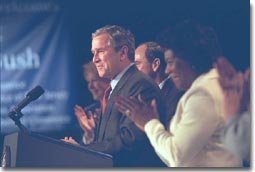 |
| White House photo |
THE PRESIDENT: Well, Governor,
thank you very much. I appreciate your kind words, and
I appreciate your friendship. I got to know Donny and
his wife, and I respect them a lot. And I know the people
of New Jersey do, as well. (Applause.)
It's good to see my friend, the Speaker. (Applause.) I
had him down to the Governor's Mansion in Texas, and I want you
to know he didn't spill. (Laughter.)
I'm honored to be traveling with members
of the New Jersey congressional delegation today. We
flew down on Air Force One. I am thrilled that members
of the House of Representatives came -- Rodney Frelinghuysen and
Marge Roukema, Jim Saxton, Chris Smith, Rush Holt, and the newly
elected Mike Ferguson. And I want to thank you all very
much. (Applause.)
I'm also very pleased the Senator Corzine
and Senator Torricelli came, as well. (Applause.) I
have been most pleased with the comments Senator Torricelli has
been making. It shows that -- (applause) -- I don't want
to single anybody out. (Laughter.) Not one
vote is more important than any other vote. But he has
shown a lot of common sense as far as I'm concerned. (Applause.)
I am thankful they're here; it gives me
a chance to sing the praises of those in Congress who are joining
my administration in changing the tone in Washington. We'll
have a lot of debates on important issues. And we're
in the middle of one that I want to talk about today. But
we're going to show, Senator Torricelli and me, Senator Corzine
and me, Senator Holt and me, that Republicans and -- I mean, Congressman
Holt and me. (Laughter.) Don't want to be rushing your
career. (Laughter.) But we can show that Republicans
and Democrats can differ, but we can do so in a civil way. We
can set a better example for people who look at our government than
the example that had been set in the past; that we can have disagreements
-- (applause.)
So I like to tell people I'm beginning
to see a culture of respect develop in our Nation's Capital, and
also, by the way, a culture of achievement that I hope people will
judge us based upon results, not how we say things. And
recently, the Congress has shown their willingness to focus on results. The
ergonomic regulation reform that took place shows a positive development
and our willingness of people to get things done. (Applause.)
We got a good piece of legislation moving
out of the Senate in terms of education, which I'll talk about in
a little while. I mean, we're showing people around the
country that it's possible to have a culture of positive achievement
in the Nation's Capital. And for that I'm grateful. And
I want to thank the members of Congress who are willing to work
together to get some positive things done on behalf of the people.
Joan, I want to thank you very much for
inviting me, and I want to thank all the folks who worked so hard
to put this event on. We didn't give you very much notice. (Laughter.) But
you responded, and I appreciate your hard work. And I
appreciate those who spent hours over the weekend making sure that
this event gave me a chance to come and talk about an incredibly
important issue, and that's the people's budget. (Applause.)
I like to remind people it makes sense
to have common sense in Washington. Particularly when
it comes to spending your money. And the first principle
involved with budgeting is for our government to remember whose
money it is that we're spending. (Applause.) We're
working with the taxpayers' money. It's not the federal
government's money. I like to remind people that the
surplus is the people's money, and we better be wise about how we
spend it.
And it means setting priorities. It's
important for the President to set priorities, to set
clear priorities so that Congress doesn't overspend or get exuberant
in their attempts to get reelected with your money. And
so some of my priorities are these: education is a priority. I
think it's incredibly important. (Applause.) So
we've increased the education budget by a significant amount of
money.
But lest you forget where I came from,
I also strongly believe in local control of schools. I
believe we've got to trust the people in New Jersey to run the schools
of New Jersey. (Applause.) I also believe,
though, in return for federal money, states and local jurisdictions
should measure to determine whether or not children are learning
to read and write and add and subtract.
I believe the cornerstone of reform is
not only to insist upon local control of schools -- which means
flexibility and authority at the local level, when it comes to spending
federal money -- but it also means that if you receive help, you
and the citizens of New Jersey must devise accountability systems
to show us all whether or not children are learning to read and
write and add and subtract. And, if so, the teachers
need to be praised, and the principals and superintendents. But
if not, if our society finds children trapped in schools that will
not teach and will not change, instead of standing by and saying
it's okay, good public policy demands something to challenge the
status quo. (Applause.)
Oh, I've heard all the arguments about
accountability. Some say, well, we can't measure; the
federal government does not have a role in education and, therefore,
should not insist upon results. I disagree. We're results-oriented
people in this country. And in return for taxpayers'
money, we ought to insist upon results.
And I don't believe in a national test,
nor do I believe the federal government ought to tell New Jersey
how to test its students. If you believe in local control
of schools, you trust your governor, and you trust the local folks. But
I darn sure believe in asking the question, are the children learning.
I'm told some say, well, it's racist to
test. It's racist not to test -- (applause) -- because
the people who generally are left behind in a system that does not
measure are those who it's so much easier to quit on. It's so much
easier to say that an inner-city child can't learn, let's just move
him through, let's have no accountability. It's so much
easier to quit on a child whose parents may not speak English as
a first language.
No, we need accountability in the public
school system. We need results. And we'll
herald success and we need to be bold enough to blow the whistle
on failure by giving parents different options if their children
are trapped in failing schools. (Applause.)
A priority of mine is to keep the peace. And
it starts with making sure the military is well-paid and well-housed. (Applause.) So
in the budget I submitted to Congress we increased the pay of the
people who wear the uniform. (Applause.) And
we've got a housing initiative to make sure they're well-housed.
It's one thing to pay people well; it's
another thing to make sure the mission is clearly defined. In
order to increase morale in the military, we must have a clearly
defined mission, which is to be able to fight and win war and, therefore,
prevent war from happening in the first place.
A priority of mine is to make sure the
retirement systems in the country work well, which basically means
that all the money going into the Social Security system be spent
only on one thing -- and that is Social Security. There
is universal agreement with Republicans and Democrats in the Congress
that we're not going to use the payroll taxes for anything other
than Social Security. And that makes sense.
It not only makes sense, good fiscal sense,
it also makes sense because a substantive reform that I look forward
to working with Congress on is to make sure the Social Security
system is vibrant and strong, particularly as we head into the 21st
century -- which means not only will we guarantee payments to the
seniors who rely upon Social Security today, but we need to think
differently and let younger workers manage some of their own money
in the private markets, to make sure there is a Social Security
system around tomorrow. (Applause.)
Another priority is the health care system. And
as an example, the budget I submitted to Congress doubles the Medicare
payments over the next 10 years -- got over hundred-and-something
million new dollars of spending in Medicare. And that
makes sense, because we must fulfill the obligation to our seniors,
meet the promise of a health care system that works for seniors. It's
one thing to spend money, but the system also needs to be reformed. And
we need to give seniors a variety of options from which to choose,
all of which will include prescription drugs, in order to make sure
the Medicare system works as we go into the 21st century. (Applause.)
So we're setting priorities. Community
health centers is an incredibly important part of the health care
mix in America. It's a place where the poor or near-poor
can find primary care. The budget I submitted doubles
the number of people who will be served in community health centers
over the next five years.
It's also a budget that understands the
great role of faith programs in our society. I went to
one today, run by Reverend LaVerne Ball of the Youth Entertainment
Academy, housed in the basement of a church in Plainfield, New Jersey. It's
a place that is staffed by people who have heard the universal call
to love a neighbor like they would like to be loved themselves. I've
expanded in my budget the amount of money for after-school programs
and have said loud and clear, if you're a faith-based program you
ought to be able to access that money in order to provide after-care
programs for children who are looking for something other than just
the standard old way of conducting after-school programs; who are
looking for somebody to put their arm around them and say, I love
you and I care. (Applause.)
Now, this is a budget that meets priorities. We
grow the discretionary spending in the budget by 4 percent. Now,
that's where the friction is coming in Washington, because the discretionary
spending at the end of last year grew at 8 percent. And
when you're talking in terms of trillions, that's a huge amount
of the increase of -- the role of federal government.
So we say to the Congress, there are not
many workers in America who got a 4 percent pay raise last year;
surely, you can live within 4 percent discretionary spending. By
focusing on priorities, surely the members of Congress, both Republicans
and Democrats, can live within a 4 percent increase of discretionary
spending. (Applause.)
I have made it clear that debt reduction
is a priority of this administration. And so we pay down,
in the budget I submitted, $2 trillion of debt over the next 10
years. That's all the available debt. That's
all the debt that becomes available to pay off during that period
of time. That's $2 trillion; that's the largest debt repayment of
any nation at any time in any history. (Applause.)
So the budget sets priorities. It
grows discretionary spending at 4 percent, considerably less than
the spending orgy that took place last year, but nevertheless, enough
to meet the needs. It pays down $2 trillion of debt. It
sets aside the payroll tax for Social Security. It doubles
the Medicare budget. And there's also a trillion dollar
contingency fund, so there's another trillion over 10 years that's
set aside for contingencies. It may be an agricultural
issue that we need to deal with. We may need to bolster the payment
of FEMA, the Federal Emergency Management Agency. There's
money set aside. It makes common sense not to spend all
the money, and so, therefore, we've got money set aside. We
pay down debt; we meet discretionary spending; and there's still
money left over. And that's where the battle is.
And the fundamental question is what to
do with it. My belief is that once we meet priorities,
instead of increasing the size and the scope of the federal government,
we better remember who pays the bills in America. We better remember
the working people. (Applause.) We better
remember who created this surplus in the first place.
And so I submitted a plan that says, instead
of increasing discretionary spending, let's give people more of
their own money back. And it makes sense to do so. It
makes sense to do so. Our economy is beginning to sputter. I
believe -- I was asked about the markets today; I'm sorry people
are losing value in their portfolios. That worries me.
But with the right policies, I'm confident our economy will recover. The
right policies -- fiscal policies. And that means giving
people money back, in plain language. (Applause.)
Or, better yet, don't take it in the first
place. (Applause.) And we're making good progress
on this issue. We're making good progress -- the House
passed the cut on marginal rates. And I want to thank
the members of the House who were with me on that. It
makes sense.
Let me tell you the principles behind
that part of the tax relief plan. I don't believe the
proper role of government is to try to pick and choose winners when
it comes to tax relief. See, I don't think there's a
right American or wrong American when it comes to those who pay
taxes. I think if we're going to have tax relief all
Americans ought to get tax relief. (Applause.)
So we reduced all the rates on everybody
who pays taxes, and simplified the code. Reduced the
rates from 5 to 4; we dropped the bottom rate from 15 percent to
10 percent. I'm asking Congress to increase the child
credit from $500 to $1,000 per child. And let me give
you the benefits.
The benefits of that are -- is this: We
have a tax code that is unfair for people who are trying to get
ahead in life, people who are struggling on the outskirts of poverty. If
you're a single mom raising your children -- two children, for example,
and you're making about $22,000 a year, for every additional dollar
you earn in working the toughest job in America, raising those kids
-- for every additional dollar you earn, you pay a higher marginal
rate than a Wall Street banker. And that's the facts. As
you begin to lose your earned income tax credit and go in the 15
percent bracket, and pay payroll taxes, the hardest dollar you earn
is taxed at nearly 50 percent.
And, folks, that isn't right. That's
not what the American experience should be. It seems
like to me the harder you work, the more money you ought to put
in your pocket. And our tax code ought to reflect that,
and that's why we dropped the bottom rate from 15 to 10, and increased
the child credit.
But we also dropped the top rate, from
39.6 to 33 percent. And I know there's a lot of people
that are hollering about that part of the tax package. First,
if you pay taxes you ought to get relief. But I want
the members of Congress to understand that part of this plan is
to stimulate the growth of small businesses and entrepreneurs, and
that thousands of small business owners in America are unincorporated
or sole proprietors, or sub-chapter S's, and pay taxes at the highest
marginal rates. And by cutting the top rate we stimulate
the growth of small business in America. (Applause.)
Those who would like to leave your money
in Washington try to make us feel bad about cutting the top rate. But
I come from the school of thought that the American Dream must be
alive and well. The role of government is not to create
wealth, but an environment in which the entrepreneur can realize
his or her dreams; in which the small business owner can find capital
in order to fuel an idea. And cutting that top rate is
an infusion of capital for the small business owner in America,
and it makes good economic sense. And it makes good sense
to reenforce the American Dream through good tax policy. (Applause.)
This tax code is not only unfair to people
struggling to get ahead at the bottom end of the economic ladder. It
sends the wrong signals -- it doesn't make sense and it's unfair
to tax marriage in America. We need to do something about
the marriage penalty in the tax code. And it's unfair
to tax a person's assets twice, and we ought to get rid of the death
tax in the tax code, as well. (Applause.)
This plan is fiscally sound. It
makes common sense. We meet priorities; we pay down debt;
we set aside money for Social Security. But we also remember
who pays the bills. It makes sense for our economy to
give people their money back, and that's why I look forward to working
with Congress to make sure this tax relief package is retroactive.
Senator Corzine and I on the plane talked
about how we make sure money gets in the economy as quickly as possible. And
I appreciate his thoughts along those lines. This is
part of an economic recovery plan. But this plan is also
good for American families. And the Dietrich family is
with us today. Where are you? There you go. Thank
you for coming. (Applause.)
Mark and Kim and Mark, Jr. and Christopher. And
I've asked them to come because oftentimes during the course of
these tax debates and budgets, all you hear are numbers. But
it's important for me to remind people in America that there are
lives affected by our discussions.
And there's a lot of focus, for example,
on debt at the national level, and that's fine, that makes sense. But
I also want the policymakers to understand there's debt at the local
level, too. That a lot of hardworking Americans have
got credit card debt. And when you couple credit card
debt, for example, with high energy prices, it puts people in a
bind. And good public policy frees Americans to be able
to make more decisions for their families.
These good folks pay $5,700 in federal
income taxes. When our plan is fully implemented, they
will save $2,000. Now, that may not sound like a lot
-- (applause.) Oh, I know, in this land of big numbers,
$2,000 may not sound like a lot. But it's a lot to them. It's
a lot to a family who is worrying about high energy bills. It's
a lot to a family who wants to put aside money for their children. It's
a lot for moms and dads who are concerned about the future of their
family. It's a lot. And my attitude is, once
we made basic needs, I'd rather have these good people spending
the $2,000 than the United States Congress spending it. (Applause.)
It's a fundamental decision where we put our trust. And
that's what I want this debate to focus on, who do you trust. Oh,
I love dealing with the members of the Congress, and they're good
folks, they care a lot about their country. But we ought
to trust the people of America. We ought to trust them
to spend their own money. We ought to trust them to make
the right decisions for their families. We ought to have
a limited and focused and energetic federal government that, when
it's all said and done, holds the people up in our trust.
And, after all, that's not only important
for good economic policy, that's important to make sure America
fulfills its promise for everybody who is fortunate enough to live
here. Because, you see, the great strength of the country
really doesn't exist in the halls of our governments; the great
strength of America is in the hearts and souls of the American citizens. (Applause.)
One of the biggest honors of my job is
to be able to travel the country and say thanks to those social
entrepreneurs who literally change America, one face at a time. People
who don't wait for government to act and who say to a neighbor in
need, what can I do to help; what can I do, brother or sister, to
help you on your walk. I think of Catholic Charities,
that provide such incredible service all around America. I
think about homeless shelters staffed by volunteers who feel the
need to help somebody in need. No, the great strength
of this country, folks, exists in neighborhood after neighborhood
after neighborhood, where people of religion and people who don't
give a hoot about religion say, what can I do to help a neighbor
in need.
My job is not only to argue good policy
on behalf of the people, and argue on your behalf to make sure your
money ends up in your pocket after needs are met; my job is also
to lift the spirit of the country and to call upon the best. To
work to unite our nation, but always remember that the true strength
of America is our people and the hearts of our people and the compassion
of America.
I'm fortunate to the be President of the
greatest land on the face of the Earth. (Applause.) It's
an unimaginable honor. And I want to thank you all for
giving me the chance to come and talk about a common-sense policy
for the budget, but to remind you that if you see somebody in need,
put your arm around them, tell them God loves them.
Godspeed to you all and God bless. (Applause.)
END 1:04
P.M. EST
REMARKS BY THE PRESIDENT TO THE
HISPANIC CHAMBER OF COMMERCE-- March 19, 2001
Presidential Hall
Dwight D. Eisenhower Executive Office Building
1:15 P.M. EST
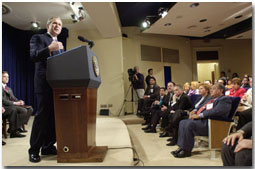 |
| White House photo |
THE PRESIDENT: Well, thank
you very much, Abel. I don't know what you said, but
-- (laughter) -- it worked.
I want to thank you very much for being
here. I appreciate Mitch and Margaret and Ruben and Mark
to be here to talk to you all and brief you about what we're trying
to do here in the administration. And thank you all for
your interest.
Before I begin, I do want to say hello
to Hector, who is the designated nominee to the Small Business Administration. (Applause.) And
George Herrera, thank you very much, Jorge -- (laughter and applause.) And
thank you all for what you do to make America a unique and wonderful
place.
I don't think enough people in our country
pay attention to the role of the small business person, the incredible
impact the Hispanic small business person has on the country. I
remember campaigning in California and Hector said, you know, you've
got an amazing statistic -- there are thousands of Hispanic-owned
small businesses in our state.
And I said, oh, really, by thousands,
what do you mean? He said, would you believe 600,000? And
I said, I do. Because this is what America is all about,
the idea of somebody having a dream. It doesn't matter
what your background is, where you're from. If you work
hard and dream big, you can realize your dream.
And that's what good public policy is
all about, too. It firmly recognizes that the role of
government is not to create wealth, but an environment in which
the entrepreneurial spirit can flourish. And I want to
talk to you about that today in terms of the U.S. budget.
But, first, I want to confirm our commitment
to free trade in this administration. I believe free
trade is an incredibly important part of making sure the environment
is hospitable to the formation of small businesses. And
trade with Mexico is an integral part of making sure that our hemisphere
is safe, secure and prosperous. (Applause.)
I had a chance to reiterate that face
to face with Vicente Fox, who is -- he's going to provide good,
strong leadership for Mexico. And I told him that a strong
Mexico is in our nations' best interests -- in our nations' best
interests that Mexico be prosperous and vibrant. And
the best way to do so is for there to be free and fair trade between
our countries. This is a message I hope the Congress
hears.
Our hemisphere, by the way, is not going
to be an after thought for this administration. It's
one of the most important parts of our foreign policy, will be to
promote prosperity and peace and freedom throughout this hemisphere. (Applause.)
And so part of making sure the environment
is hospitable to a capital formation and the entrepreneurial spirit
is trade. But another part is to make sure the federal
government does not squash opportunity by being -- over-spending
taxpayer money. It's important that we budget wisely. And
I want to talk a little bit about our budget and I want
to thank you all for paying attention to the debate in the budget,
because it directly affects your lives.
First, the fundamental question a lot
of people ask is, are we spending enough money to meet the needs
of the government. And the answer is, yes, we are. The
budget I submitted to Congress increases discretionary spending
by 4 percent. Now, keep in mind, that's greater than
the rate of inflation, it's greater than generally the pay raises
that the people who are paying the bills have received.
In other words, we're spending quite a
bit of money. And that 4 percent, when you look at the
budget in terms of trillions, is a lot of money. It's
a lot of money. It allows us to set priorities. I
mean, I have set priorities, which allows us to be fiscally responsible
with your money. Education is a priority. Funding
the defense budget, making sure our folks are paid better, who wear
the uniform, is a priority. Medicare and Social Security
are priorities. We doubled the Medicare budget. And we
say to the Congress that the payroll taxes for Social Security will
be only spent on Social Security.
We've set priorities. We've
made it clear that education is important. We made it
clear that health care is important. We made it clear
that retirement systems are important. And we grew the
discretionary spending by 4 percent. Now, the reason
there is some hollering up here is because last year they grew the
discretionary budget by 8 percent. It's unbelievable
how much money they spent on the way out of town. And
we're saying, let's be realistic with the people's money. (Applause.)
On the Medicare and Social Security issue,
these are more than just spending issues. These two are
issues that are important for the future of the country and require
the Congress and the President working together. Today, the trustees
issued their reports on the financial status of Social Security
and Medicare. These nonpartisan reports underline and
add an exclamation point to the need to reform and strengthen both.
Social Security and Medicare are vital
programs and they need major reforms. We must act, and
do so courageously. And that's part of my message to
the Congress. These are issues that we need to work together
on. Today's report show health care costs are rising
at a faster rate than was previously estimated. By 2016,
expenses in both Medicare Part A and Social Security will be greater
than the payroll taxes coming in to support them. And 2016 isn't
very far down the road.
The financing deficit for the entire Medicare
program, including Parts A and B, is larger than ever. We
must respond and act with courage to keep Medicare and Social Security
benefits secure. In the words of the board of trustees,
both Social Security and Medicare need to be reformed and strengthened
at the earliest opportunity. And that's what I'm going
to ask both Republicans and Democrats to do on the Hill.
It's one thing to double the Medicare
budget over 10 years. We need to work together to make
sure the Medicare system responds to the needs of the elderly, to
give elderly more choices, including prescription drug benefits,
so we can say -- firmly say, we're going to keep our promises to
the elderly in America.
This requires a sense that -- of urgency. We
have only so many years to get the systems back on track. It's
time to quit the posturing and time to reform the systems. And
I'm prepared to spend the political capital, along with both Republicans
and Democrats, to do so.
We have long term commitments, and we'll
keep them. And Medicare and Social Security have long
term problems that we're going to solve. (Applause.) Part
of the Social Security reform must include allowing younger workers
the option to take some of their own money and put it in the private
markets, under safe conditions. In order to make sure
that there is a Social Security system around tomorrow, we've got
to get a better rate of return on the money in the Social Security
trust. And that means trusting people with their own
money, to make wise decisions as to how to get a better rate of
return than the 2 percent in the Social Security trust.
I fully recognize that reforming Medicare
and Social Security are going to require a new way of thinking in
Washington. But it's time for there to be a new way of
thinking in Washington. (Applause.)
There is also a lot of talk about paying
down debt, as I'm sure the OMB Director will tell you. We
pay down a lot of debt. We pay down $2 trillion of debt
over the next 10 years. And that's important. It
improves the balance sheet of our government. But I want
to remind the folks that there is more than just government debt
in our society. There is credit card debt that affects
the ability of many of our citizens to be able to save, for example.
And when you couple high energy prices
with credit card debt, there are some of our families in this country
beginning to strain. And it seems wise and common sense
policy to meet our needs at the federal level, pay down debt and
always remember, if we have any money left over, whose it is to
begin with.
And so one of the things I'm asking Congress
to do is to be fiscally sane with the people's money -- pay down
debt, set aside some money for contingencies; but with that money
left over, not try to spend it on bigger government, but let it
be spent on bigger family -- on family needs. It's to
pass it back to the people who paid the bills.
That's the fundamental debate taking place
here in Washington. It's a debate as to whether or not,
after we meet needs, we grow the government or we trust people with
their own money. And this is an issue of trust. And
I want your help on the issue.
As I've said, it directly affects you,
and let me explain how, besides the fact that if you pay taxes you're
going to get tax relief. And that's one of the principles
of this debate. There are some in Washington who would
like to have what they call targeted tax relief. It means
the federal government gets to pick and choose the winners and losers. That's
not the role of government. The role of government, in
my judgment, is to be fair and even-handed; and it says if you pay
taxes, you get relief. That's what the role of government ought
to be. (Applause.)
A lot of times in the rhetoric, people
forget the facts. And the facts are that thousands of
small businesses -- Hispanically-owned or otherwise -- pay taxes
at the highest marginal rate, because most small businesses are
not incorporated, they're sole proprietorships, or they're sub-chapter
S's. And they're subject to the 39.6 percent income tax
rate.
And so when you hear us talking about
dropping the top rate from 39.6 to 33 percent, I hope Americans
understand the positive effect this will have on the small business
communities. (Applause.)
It is the message that I hope Congress
joins me on in saying we understand how small businesses grow, and
they grow by being able to have more cash flow to reinvest in their
own business. The small business person is an integral
part of new employment in America. But more importantly,
the small business owner represents the great dreams of Americans. And
the role of government is to create an environment that encourages
Hispanic-owned businesses, women-owned businesses, anybody kind
of owned businesses. (Applause.)
And the reduction of the top rate sends
a clear message that we appreciate what you're doing, and we want
you to continue to do it, and we want you to have some of your own
money so that you can expand your businesses and more likely realize
your dreams. That's what tax relief is all about.
We have met the needs of government; we
have paid down debt; we've set aside money for health care; we have
set aside the money -- the people's money for Social Security. And
what we're saying is, after we've grown the budget by 4 percent,
let's remember who paid the bills, and remember what drives America. And
it's the small business community and the entrepreneur.
And so I'd like your help. I'd
like your help by -- if you contact your senators, you might just
put a word in for your own self. (Laughter and applause.
And there's one other aspect of tax reform
that I think is important -- there's a lot of it, obviously. We
drop all rates; we simplify the code; we increase the child credit
from $500 to $1,000 per child, which is a very positive addition
to the code because it makes the code more fair for people struggling
to get ahead. We do something on the marriage penalty. And
as importantly to you, we eliminate the death tax.
The death tax is a tax that causes the
small business owner to pay taxes twice -- once as you build your
business, and then when you pass it on to your heirs. And
it seems like to me that part of the American experience ought to
make it easy for a mom or a dad, once he or she builds up his or
her business, to pass it on to a son or a daughter. That's
what America is all about, is the ability to transfer -- (applause.)
And so I appreciate so very much you all
being here to lend your voice -- listen to what we have to say,
and to lend your voice for reason and common sense in Washington,
D.C. All the rhetoric sometimes tries to obscure reality
and there's a lot of name-calling at times, and trying to frighten
people one way or the other. But I think when people
take an objective look at what we're trying to do, they'll realize
this is a common-sense approach to your money, and it recognizes
the great strength of America lies not here in Washington, but in
the hearts and souls of our folks, people who are willing to work
hard, take risk, dream big, and realize the great American experience
-- but not only realize it, but enrich it, to make it so much stronger
and so much better.
I used to tell the folks in my great state
of Texas, I said, I welcome the Hispanic influence in our state. It
makes Texas a richer place, a stronger place, a place that I'm proud
to call home. And that's the way I feel about America,
too.
Thank you all very much. (Applause.)
END
1:30 P.M. EST
REMARKS BY THE PRESIDENT AND THE
FIRST LADY TO WOMEN BUSINESS LEADERS--March 20, 2001
The East Room
10:50 A.M. EST
MRS. BUSH: Thank you all so
much. I want to welcome you to the White House. I'm
thrilled that such a distinguished group of women have joined us
here today in the East Room. This room, as some of you
probably know, has seen a lot of changes over the years. In
fact, Mrs. Abigail Adams actually hung her family laundry to dry
in this room -- (laughter) -- and there weren't any paned windows,
so the fresh air was abundant in this room. I'm thankful
that times have changed.
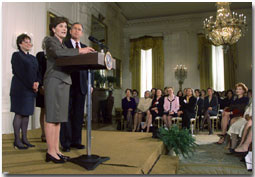 |
| White House photo |
I'm especially proud that you all joined us this month as our nation
celebrates women's history. Battles hard-fought and won
by women resulted in improvements in all aspects of American life,
and you all are proof of that.
Abigail Adams, by the way, cautioned her
husband when he was writing the Constitution of the new United States,
to not forget the women. But women didn't get the right
to vote in that Constitution and, in fact, it took a long time. Our
daughters probably don't believe, or find it very hard to believe,
that just 75 years ago, women didn't even have the right to vote.
I'll never forget one day when George
was governor and we were celebrating the 75th anniversary of women's
suffrage in Texas. We were on the steps of the Texas
State Capitol Building, my mother happened to be there; she was
in town, so she joined me that day. Liz Carpenter was
there, and both of those women were babies when women won the right
to vote. My daughters were also there, much to their
chagrin. They represented the present and the future. They
represent the women, the girls and the women who will benefit fully
from women's struggle for increased inclusion in American life.
Everybody was dressed in historically
correct costumes. We were wearing white gowns, white
dresses with yellow sashes. Everyone was dressed like
that, except, of course, for my teenage girls -- (laughter) -- who
would have rather been anywhere else than on that stage.
But, finally, we came to the part in the
program where, in a great show of unity, my mother, Liz Carpenter
and I, joined hands and raised our hands to give the hip, hip, hooray
for women's suffrage. As we did it, I reached out with
my free hand and found a vacant space where my daughters were supposed
to be standing -- (laughter) -- and in fact, I looked over and they
were totally humiliated, and trying to shrink into their seats.
You know teenagers; they were mortified that we had made such a
spectacle of ourselves.
For our girls, women's suffrage is ancient
history. They've never known the inequalities that women
had to endure and overcome a couple of generations ago. That's
why it's so important for us to be vigilant in our remembrance,
and vocal in our celebration of women's history -- because we owe
the great women in our past for the opportunities that we enjoy
today.
And now, I'm proud to introduce the father
of those girls -- (laughter) -- who raised them to believe that
every option is open to them. In fact, he's devoted to making the
future brighter for all Americans. I'm proud to introduce
my husband, the President of the United States, George Bush. (Applause.)
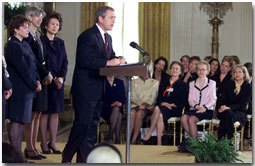 |
| White House photo |
THE PRESIDENT: Thank you. Thank
you for being here. Please sit down. First
Lady -- it's got a nice ring to it. (Laughter.) I'm
proud of Laura. She is -- she makes this White House
special for me. She is -- brings a lot of perspective
to our household. She kind of reminds the President where
he came from. (Laughter.) And always makes
sure my tie lies straight. But I'm proud of the job she's
doing for America, and she's going to be a great First Lady. (Applause.)
And I am proud of the ladies behind me,
as well. We've put together a great Cabinet. (Applause.) They're
not afraid to speak their mind. They're smart, they're capable,
and they represent America. And they're good, they're
really good. We've got a great Cabinet, and these good
folks up here make a big difference. (Applause.)
And I've got a great staff, as well. And
I appreciate Margaret LaMontagne being here. Margaret's
the Domestic Policy Advisor to the President. And I've
known here a long time. She's plenty capable, and she's
spending a lot of time on education, which is one of the subjects
I want to discuss with you today. And I appreciate you,
Margaret.
I also want to thank Bonnie for your hard
work, and for putting this on. I want to thank you all
for coming. I know you all are going to Capitol Hill
today. I hope you help us deliver a couple of messages. One
is going to be on education. Another is on common-sense
budgeting and tax relief, and why it's important to all people,
particularly those who have decided to invest capital in the private
sector. And I want to explain why this tax relief package
will spur economic activity and entrepreneurship in America.
First let me talk about education. I
said it was my priority in the campaign. It is our priority
in this administration. An educated child is one much
more likely to realize his or her dreams. And we've got
to do a better job of making sure every child -- I mean every child
-- is educated.
One of things about this administration
I think people will find is that we are consistent. We
set out a set of principles and stand by them, that we don't try
to figure out polls and focus groups -- we don't use polls and focus
groups to figure out where to head.
And there are some solid principles involved
with our education plan. One of them is setting high standards and
high expectations for every child. We believe if you
have low expectations, you get lousy results. If you
believe in the best in every single child, and set high expectations,
good folks will follow.
Secondly, we believe strongly in local
control of schools. We believe in aligning authority
and responsibility at the local level. Many of you, as
you run your own businesses, know full well that when you separate
accountability and responsibility or responsibility and authority,
it creates an excuse for failure. Oh, I would have done
it a different way. And so we align authority and responsibility
where it belongs, at the local level. And I hope you
help Congress understand the importance to pass power out of Washington,
to provide flexibility at the state and local level. (Applause.)
Thirdly, we believe strongly in a results-oriented
system. A lot of times in education people focus on process. We
think the world needs to start focusing on results. People
need to start asking the question, what do you know -- not how old
are you. (Applause.) In a world that asked
the question, how old are you, oftentimes people just get shuffled
through, regardless of what they know. If you're 12,
you're here; if you're 14, you're here; and let's just move you
through. And those of us who have been involved in public
education know full well who gets left behind.
Children whose parents don't speak English
as a first language, for example. Inner-city kids --
it's so much easier to quit on children. We strongly
believe that by insisting upon results, it will begin to change
the mentality of public schools all across America.
And so, one, we've asked for more money
for our budgets. We've increased education spending quite
significantly. And we've said, in return, however, we
expect states and local jurisdictions to measure, to show us whether
or not students can read and write and add and subtract; to focus
on every child since every child matters. We've got to
end the process-oriented world of public schools.
And we firmly believe that, through accountability,
not only can we diagnose and solve problems, but accountability
serves as a catalyst for reforms. It's the accountability
system that encourages local folks to say, wait a minute, the status
quo is unacceptable; let's try something else. It's strong
accountability measures that will foster charter school movements,
or public school choice movements, if necessary, to make sure not
one single child gets left behind.
So we've got an education vision that
says, there will be more money in the system, but let's make sure
that we have high standards, local control of schools, and strong,
results-oriented systems. I firmly believe that when
we get the system right, the results will begin to improve dramatically. And
we've targeted some money -- we've set aside $5 billion for a national
reading agenda.
It's not the federal government saying,
here's money available for K through 2 diagnostic tools, so that
we can determine early in a child's career where that child may
need extra help. There's teacher training money. One
of the failures, one of the deficiencies -- I wouldn't call it a
failure, but deficiencies in the system is that oftentimes, our
teachers are not given a -- taught how to teach a curriculum that
works.
We need to retrain teachers. So
we've got money available to do that. We've got intense -- money
available for after school programs or schools within schools to
help young readers get up to speed early. We've set a
goal that all children ought to be reading by third grade. And
I look forward to working with the Congress to make sure the program
gets funded, and our Secretary of Education to make sure it gets
implemented in such a way as we don't erode local responsibility
of schools.
So that's the education plan. Oh,
there's a lot of discussion you'll hear about, we can't measure,
it's too much government to measure. I just disagree. If
we're spending money, we ought to get results for the money. But
this isn't a national test. This is a test where local
folks will design the test. The great state of Pennsylvania
can design its own test. Texas designs its own test.
But there needs to be a sense of accountability
in the system. And then you'll hear people say it's racist
to test. It's racist not to test. It's racist not to
hold people accountable. (Applause.) Those
who say it's racist to test must assume that certain children can't
learn. We don't believe that. We believe all
children can learn.
So the principles involved in the education
reform are sound and solid and they reflect what I hope you all
agree with, that there is a better way. We need to challenge
the status quo when we find our children trapped in schools that
are just not going to teach, and won't change.
Secondly, I want to talk about the budget. There's
a lot of talk about the budget, of course. And I made
some people nervous up here, to be frank with you, because I've
decided that instead of increasing discretionary spending by 8 percent
on an annual basis, which is a lot, when you're talking in terms
of trillions, that we'll have spending increase at 4 percent, greater
than the rate of inflation, larger than most people's pay raises
last year.
And it's caused some consternation,
because the temptation is for people to appropriate when money's
available. I was in Council Bluffs, Iowa, and a grandmother
stood up and she said, you know, she said, I've baked a lot of cookies
in my day. And I've had children and grandchildren go
through the house. And every time I leave them on the
table, they get eaten. And that's kind of what happens
to federal taxpayers' money. (Applause.)
So I've presented a realistic budget to
the Congress. It says, like many of you all do in your
businesses, set priorities. I realize that -- we've got
to realize it's important to set priorities. Education
is a priority. The military is a priority of mine, starting
with making sure people get better pay and better housing.
Now, we have stepped back from some of
the big appropriation requests, because I want Don Rumsfeld to take
a full look at the military, to make sure military spending meets
a military strategy that will help us keep the peace in the out-years. And
it's important to do that. It's important to make sure
taxpayer's money is well-spent and well-focused, on all areas of
concern. And the Defense budget requires a good scrubbing
and a good looking at. And that's exactly what this administration
is doing.
But in the meantime, we need to send a
clear signal to the men and women who wear the troop -- who wear
the uniform, the troops who wear the uniforms, we appreciate what
you do on behalf of America, so we're going to pay you to do better,
and house you better, and have a mission that is more focused, which
is to be able to fight and win war, and therefore prevent war from
happening in the first place.
We've got money in the budget for Medicare. Our
Medicare budget doubles over the next 10 years. And that's
part of what's needed, but also -- (applause) -- but we also need
to make sure the system is modern, that it meets the needs of our
seniors, it gives seniors a variety of options from which to choose,
and all the options should include prescription drugs.
So there's money in the budget for Medicare. It's
a doubling. And we set aside all the money for Social
Security for only one thing, and that is Social Security. Take
all the payroll taxes and make sure it's only spent on Social Security. And,
by the way, its system needs to be reformed as well.
One of the major components of reform
is to allow younger workers to take some of their own money and
put it in safe and secure market-oriented investment vehicles which
will yield a greater rate of return than the paltry 2 percent our
money now gets in the Social Security trust today. (Applause.)
And we pay down $2 trillion worth of debt
in our budget. Somebody said, why don't you take all
the excess money and pay down debt? Well, first of all,
excess money tends to be spent on bigger baselines of the government. And
-- but the $2 trillion is all that's retiring over the next 10 years
-- all that's to be retired over the next 10 years. And
it doesn't make any sense to pay a premium to prepay debt. And
so, we're paying down all the debt that's available.
We set aside money for contingencies. I
know this is getting to be quite a long laundry list, but I'm trying
to make a point that you all can help me make: is that
we've increased discretionary spending by 4 percent, we pay down
debt, we protect Social Security, we set aside $1 trillion over
10 years for contingencies. And there is still money
left over. And that's where the fundamental debate comes
in Washington, D.C. There are those who want to increase
the size and scope of the federal government. I believe
-- I believe we need to remember who paid the money in the first
place. And I believe we need to pass it back. (Applause.)
Now, we drop all rates and simplify the
code. Drop the bottom rate from 15 percent to 10 percent. We
increase the child credit from $500 to $1,000. And the
purpose of that is to make sure that those who work hard to get
into the middle class are more likely to succeed. The
tax code today penalizes people in the outskirts of poverty.
The marginal rate for folks coming from
-- a single mom -- the example I like to use is a single mom making
$22,000 a year who is struggling to get ahead and trying to raise
her two children -- which I also happen to believe is the toughest
job in America -- for every additional dollar she earns above the
$22,000, she pays a higher marginal rate than someone making $200,000. And
that's just not fair. And so we address the inequity
in the tax code by dropping the bottom rate and increasing the child
credit.
And we also drop the top rate, of course,
from 39.6 percent to 33 percent. If you pay taxes, you
ought to get relief. Everybody who -- but everybody benefits,
I'm convinced, when the top rate drops because of the effect it
will have on the entrepreneurial class in America. (Applause.)
What the Congress needs to hear is that most small businesses are
unincorporated businesses, sole proprietorships. Many
are subchapter S corps, who pay at the highest marginal rate. And
when you drop the top rate from 39.6 percent to 33 percent, you
encourage the growth of small businesses, whether they be women-owned
small businesses, or any other small businesses. (Applause.)
People like to deflect the debate. They
like to turn it into a class warfare debate. And you
all can help by explaining clearly to people that reducing the top
rate will help with job creation and capital formation; and as importantly,
will help highlight the American Dream. And that is,
you can own your own business -- that ownership is not limited to
just a few. (Applause.)
And we're going to do something on the
marriage penalty. And we need to eliminate the death
tax. (Applause.) This is a realistic plan
with the people's money. It's a plan that meets needs. Admittedly,
it doesn't grow the budget the way people are used to in Washington. But
it's time to change that attitude about how prolific we're going
to be with the people's money. There needs to be a focus
and a strategy and a discipline.
It seems like at times, people forgot
whose money it is we're dealing with up here. It's not
the government's money. The rhetoric sounds like, oh,
we're going to -- it's government's money. But the money
is here in Washington because of the hard work of people -- people
working hard, people who care. (Applause.) The
cash flow coming into the treasury of the United States is exceeding
expectations, even though we're in an economic slowdown, which says
to me, somebody is being over-charged. (Laughter.) And
I know who it is.
And so that's what the debate is all about. And
I'd like your help. You can influence members of Congress and people
listen to you. And so I hope you take folks aside and
say, be realistic about our money. Let's don't balloon
the size of the federal government. And let's also remember
that by giving people their money back, it will help provide a second
wind for our economy.
Many of you know better than me that our
economy is slowing down. And we've got some issues with
which we'll deal. Yesterday, the Vice President brought
to me an interim report on energy -- we've got a problem with energy
in America. Our demand is increasing, but our supplies
aren't. And it doesn't take much economics to figure
out what will happen.
And we're going to do something about
it. This is going to be a very practical administration. We
will view problems, analyze them, and deal with them. We'll
be as up front as we can with the American people. We'll
explain when we can get something done quickly, and we'll explain
when we can't get something done quickly. We're not going
to shirk from the problems with which we're confronted. And
one of the problems is an energy crisis.
Another problem is a slowing economy. And
we're going to deal with it. We'll deal with it in a
forthright way. And part of it is good fiscal policy,
which means when we give people their money back, it should serve
as a stimulus to economic growth.
So this is a plan that not only brings
fiscal discipline to the budgeting process, it's a plan that sets
priorities. But it's also a plan that remembers how America
grows. And it grows through entrepreneurship and the
creation of small businesses and providing capital in the private
sector for the expansion of jobs and the purchase of equipment. And
that's what the plan is.
And I'd like your help. I'd
like your help to sell it on the Hill. (Applause.) Two
things I hope that you notice when you go up there is that I believe
the country is beginning -- or the Capitol is beginning to develop
a culture of respect.
I want the members -- I fully recognize
not everybody is going to agree with me -- or us. And
I respect that. I do. I may not agree with
it, but I respect it. One of my jobs is to change the
tone of Washington. Oh, occasionally, there's the voice out there
that sounds a little disgruntled. But that's okay. That's
part of the democracy. But our administration, or at
least the people in my administration will treat people with respect.
I respect those who don't agree with me
on every single issue. I expect there not to be unanimity. And
I believe by treating people respectfully, it is possible to do
some positive things. This is a Congress that is beginning
to get a sense of accomplishment. There is a culture
of accomplishment in Washington. There's a bankruptcy
bill that's working its way through the House and the Senate; there's
an ergonomics -- change in ergonomics regulations that I believe
is positive, and I intend to sign today. There are some
positive developments. Things are getting done.
And that's important. That
will be a little change from the way people have viewed Washington
in the past. Washington seemed to be a place of bitterness
and acrimony, and it doesn't have to be that way. It's
important to change it not only to get good public policy done,
but it's important to change the tone of Washington so that when
people look at our Nation's Capital they understand that public
service can be noble and positive. Just like these ladies
up here understand.
And our job is bigger than just legislation. Our
job is to set a good tone, a tone of respect, a tone of accomplishment
for the nation. And that's exactly what we're going to
do. And I want to thank you all for being here to help
us get it done. Thank you. (Applause.)
10:56 A.M. EST
REMARKS BY THE PRESIDENT TO THE
AMERICAN COLLEGE OF CARDIOLOGY ANNUAL CONVENTION--March 21, 2001
Orange County Convention Center
Orlando, Florida
10:24 A.M. EST
THE PRESIDENT: Thank you all. Thank
you very much. George, thank you very much for your kind
introduction. Doctor. Doctor. (Laughter.)
I'm honored to be here, and it's an honor to be your President.
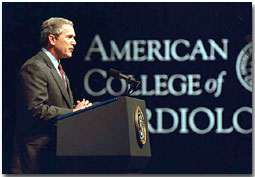 |
| White House photo |
I thought about inviting Vice President
Cheney to travel with me today -- (laughter) -- he said he's seen
enough cardiologists lately. (Laughter.) I'm pleased
to report that he's feeling great. (Applause.) And you'll
be happy to know that when it comes to following doctor's orders,
he's a model patient.
I appreciate so very much the leadership
of this august organization having me here, and I appreciate the
fact that they invited my bigger little brother. (Laughter.) I
can't tell you how proud I am of Jeb. He is a really
fine governor of this important state. (Applause.)
I'm also pleased to be traveling with
members of the United States Congress from the state of Florida: John
Mica, Ric Keller and Dave Weldon. Thank you all for
coming with me. (Applause.) Weldon informed
me he's a doctor. He's representing your interests in
the halls of Congress.
And today we're in the home town of the
new Secretary of Housing, Mel Martinez. (Applause.) I'm
proud that Mel is the first Cuban American to serve in a President's
Cabinet. Mr. Secretary, welcome home -- but don't stay
too long. (Laughter.) You're going back to
Washington with me, we've got a lot of work to do.
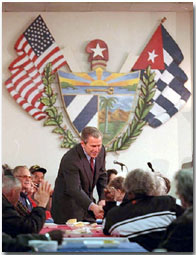 |
| White House photo |
You know, I haven't been in front of so
money people who poke and prod and examine since my last press conference. (Laughter.) And
I appreciate the chance to visit with so many distinguished doctors
and their families. So many Americans live longer, healthier
and happier lives because of the important work you all do every
single day. And I'm glad to have an opportunity to thank
you in person.
Modern medicine continues to bring a revolution
of hope and dignity into countless lives. The average
[life] expectancy in America today is 29 years longer than it was
just a century ago. And those added years now have added
vigor. Many forms of cancer, once incurable, are routinely
treated and often cured.
Diseases that grow more common with age,
such as arthritis and osteoporosis can be less debilitating than
they once were. And heart disease, though still the leading cause
of death in America for both men and women, is claiming fewer lives
than ever before. Just 40 years ago, when patients were
diagnosed with serious heart disease, treatment meant putting them
in a hospital bed and trying to make them comfortable.
Today, thanks to new surgeries, devices
and drugs, and thanks to doctors and researchers behind them, millions
of Americans with heart disease live vigorous, productive lives. And
Dick Cheney serves his country as Vice President of the United States. (Applause.)
This ongoing revolution in medicine is
centered in America, and for good reason -- medical advances depend
on innovation and innovation depends on freedom. America
has wisely resisted efforts to place medicine and health care into
the hands of central planners. (Applause.) Government-controlled
health care may spring from the best of motives, but a cumbersome
bureaucracy and one-size-fits-all approach stifle innovation and
do not produce the best of results.
There is an appropriate role for government
in funding medical research, protecting consumers and providing
health care for our senior citizens. Our health care
system is strong and it can be stronger. And as we improve
and reform it, we must always respect the freedom that makes America's
health care system the best in the world.
This year we have a real opportunity to
improve health care. Today, I want to talk about protecting
the doctor-patient relationships with a patients' bill of rights. But,
first, I can't resist putting in a plug for my budget and for tax
relief. (Applause.)
My budget funds our nation's important
priorities, including many health care priorities. We
increase funding for education and for military pay and benefits. We
set aside $2.6 trillion of payroll taxes over the next 10 years
for Social Security and for only Social Security. We
double funding for Medicare over the next 10 years, and make sure
that every dime that comes in for Medicare is spent only on Medicare.
And as you know better than most, Medicare
urgently needs reform. At a time when prescription drugs
are often the treatment of choice for heart disease and many other
illnesses, 99 percent of employer-provided health care plans offer
some form of prescription drug coverage; yet, Medicare does not. Often,
Medicare does not cover new treatments and innovative technologies. The
Medicare bureaucracy is rigid and difficult and too often treats
doctors as if you have nothing better to do than fill out forms. (Applause.)
To offer our seniors better coverage and
better health care, Medicare needs new life and new vitality. One
of the leaders in the effort to modernize Medicare is a heart surgeon,
Senator Bill Frist of Tennessee. (Applause.) He's joined
with Democrat Senator John Breaux and Republican Congressman Bill
Thomas to set out a framework for reform. And I'm committed
to working with Congress to reform Medicare and to make sure that
every senior has access to affordable prescription drug coverage.
(Applause.) My budget also proposes refundable
tax credits to make health insurance more affordable for working
families. I propose making it easier for small businesses
to join together so that they can purchase better and more affordable
health coverage for their workers. And we increase funding
for community and migrant health centers, so that over the next
five years we double the number of people served at community centers
in rural and low income neighborhoods.
I've also asked Congress to increase funding
for medical research, which gives hope to many who struggle with
serious disease. My budget for next year requests an
additional $2.8 billion for the National Institutes of Health, an
important step toward our goal of doubling the budget for the NIH
by the year 2003. (Applause.)
We've increased discretionary spending
by 4 percent, greater than the rate of inflation. And
after we fund important priorities in the ongoing operations of
our government, I believe we ought to pay down national debt. And
so my budget pays down a record $2 trillion in debt over the next
10 years. And that sets up a $1 trillion contingency
fund for emergencies or additional expenses. After funding
priorities, after paying down debt, after setting up a contingency
fund we still have money left over.
And the fundamental question is, what
do we do with it? Well, some in Congress want to spend
it. They want to increase the size and scope of the federal
government. That's not my vision. You see,
I understand the surplus is not the government's money. The
surplus is the peoples' money. (Applause.) And
I believe after meeting priorities, we need to send it back to the
people who earned it in the first place. Not only send it back,
we don't need to take it in the first place. (Applause.)
This debate in Washington has moved beyond
whether we should have tax relief, to how much it should be and
who should get it. Now, to put it bluntly, some folks
in Washington think all of the doctors in this room make too much
money and you shouldn't get any of your money back. That's
a fact. I know you've worked hard to get to where you
are. You spent long hours in training and school. You
do important, life-saving work. You also pay a lot of
taxes. And I think everybody, everyone who pay taxes
-- from the school teacher to the truck driver to the doctor --
should get tax relief. (Applause.)
Be wary of those who talk about targeted
tax cuts in Washington. Those who want to pick the winners and losers. That's
not my vision for government. I don't believe the government
is to try to pick winners and losers in the tax code. The
only fair way to do it is to say if you pay taxes, you ought to
get relief. My plan helps those at the bottom end of
the economic scale. It lowers the rate to 10 percent
and doubles the child credit. In fact, the greatest percentage
benefits in my plan go to those at the lowest end of the economic
ladder.
But my plan also drops the top rate from
39.6 to 33 percent, because I believe on principle that nobody in
America, nobody in this room, should pay more than a third of his
or her income to the federal government. (Applause.) I
hope you'll join me in making the case to Congress to enact a fiscally
responsible budget and provide meaningful tax relief. It
is necessary and we can afford it. Don't be afraid of
contacting a senator of yours, or a member of the Congress. I'm
sure they'd like to hear from you. (Laughter.)
And there is another issue I hope you'll
join me on -- persuading those very same members of both parties
to work together to pass a comprehensive and meaningful patients'
bill of rights. (Applause.) I'm very familiar
with this issue. When I was Governor of Texas I had to
veto a bad patients' bill of rights. And then I signed
some good ones.
First, I was presented a bill that gave
special interest treatment to selected HMOs. So I vetoed
it. (Applause.) And then worked with our insurance
commissioner to write new patient protections that I proudly signed
into law the next legislative session. I don't want that
to happen again. This time I hope we can get it right
the first time.
Doctors and their patients should be in
charge of medical decisions. I want to sign a patients' bill of
rights this year, but I will not sign a bad one. And
I cannot sign any one that is now before the Congress. So
enacting a patients' bill of rights this year is going to require
some different thinking, a new approach, based on sound principles.
First, a federal patients' bill of rights
must cover everyone, all patients in all private health plans. The
standard should be strong enough to protect everyone, yet flexible
enough to preserve the good work that has already been done in many
states.
Second, we must guarantee all patients
important rights: the right to get emergency treatment
at the nearest emergency room; the right to see a specialist when
they need one -- say, just for an example, the right to see a cardiologist
for a heart problem. (Applause.)
Women should be able to visit their gynecologist
and parents their children's pediatrician without going through
a gatekeeper. (Applause.) All patients should have the
right to participate in potentially life-saving clinical trials
when standard treatment is not effective. (Applause.)
Third, if medical care is denied, patients
should have the right to a fair and immediate review. (Applause.) People
want health care quickly. They don't want to have to go through
a legal, lengthy process to get it. I want to sign a bill that protects
patients' rights with a strong, binding, independent review process. If
your health plan -- if your health plan denies you care, you should
be able to appeal immediately to an independent, impartial review
panel of medical doctors.
And if they say you need the care, your
health care plan must provide it. (Applause.) An
effective medical review is the key to protecting patients' rights
and the key to maintaining the doctor-patient relationship you work
so hard to develop and preserve.
Fourth, a patients' bill of rights should
offer patients who have been harmed a meaningful remedy, without
inviting frivolous lawsuits. After independent review,
if you have been harmed by your HMO's refusal to provide care, you
have a legitimate complaint, and you should have recourse in court.
(applause) With a strong, independent review process,
most disagreements should not wind up in court. Our federal
legislation must allow the review process to work, not short-circuit
it by inviting unnecessary lawsuits. With strong independent
review, doctors make medical decisions; not the lawyers. (Applause.)
The fifth guideline for a patients' bill
of rights ensures that Americans will have access to affordable
health care coverage. I want to sign protections that
improve medical care, not make it impossible for patients to afford
it, or employers to provide coverage. Excess and frivolous
litigation does harm to our health care system. It clogs
the courts and consumes time and money. It undermines
the trust between doctor and patient. It drives up insurance
premiums for everyone.
We've enacted civil justice reforms in
Texas to guard against frivolous litigation and excessive awards. To
make sure health care coverage remains affordable, I will insist
any federal bill have reasonable caps on damage awards. And
the caps in proposed legislation before Congress are too high, and
will drive up the costs of health care in America. (Applause.)
To encourage employers to continue to
provide health care insurance for their employees, we must protect
them from unnecessary litigation. Some proposals now before Congress
fail to adequately address this problem, and would even make it
worse. Employers who decide up front they will not make
medical decisions should not be required to go to court all the
time to prove they were not involved in those decisions. And
I will not support a federal law that subjects employers to new
multiple lawsuits in 50 different states.
With these principles as our guide, I
believe we can enact a patients' bill of rights in the Congress
this year. This issue has been debated in Washington
time and time again. Over the years, alliances have been
formed, and divisions have deepened. I hope members of
Congress will join me in advancing this debate beyond the arguments
of the past.
Just as doctors no longer treat heart
disease with bed rest, we should not approach this year's patients'
bill of rights stuck in last year's rut. Just as innovative
approaches in medicine spur new breakthroughs, a new approach in
Washington offers the hope that we will share the credit for success. Americans
deserve comprehensive patient protections; and a new, common-sense
approach may be just what the doctor ordered.
On this issue, the rewards are far greater
than shared political success. The real reward will be
knowing that we have helped put the healing powers of modern medicine
within the reach of all who need them. Each of you holds that incredible
power and upholds a great trust.
I appreciate the important work you do. You
have my gratitude and my respect. And in the days ahead,
I hope my plans for reform will have your support. Thank
you for having me.
God bless. God bless America. Thank
you all. (Applause.)
END 10:44 A.M. EST
REMARKS BY THE PRESIDENT TO THE
NATIONAL NEWSPAPER ASSOCIATION 40TH ANNUAL GOVERNMENT AFFAIRS CONFERENCE--March 22, 2001
The Hyatt Regency Capitol Hill
Washington, D.C.
10:47 A.M. EST
THE
PRESIDENT: Thanks for coming and thanks for having me.
Diane, I appreciate so very much the invitation. Ken,
thank you for escorting me up here. And, Jerry, thank
you for that kind introduction. I do remember the 4th
of July parade. I remember how hot it was. And
next time, let's make it a Christmas parade. (Laughter.) He
comes from a great town in a state I love a lot.
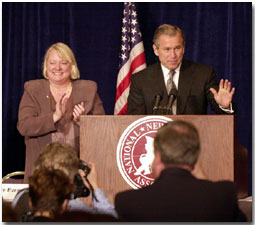 |
| White House photo |
You
said you never thought you would be introducing me the last time
you saw me. But I can assure you in 1978 when I was running
for the U.S. Congress, and you were running the newspaper in Lamb
County, Texas, you certainly didn't think you would be introducing
me as President -- (laughter) -- because you had that funny feeling
I wasn't even going to win the race for the U.S. Congress, which
was true. (Laughter.) It's amazing how life
works.
One
of the interesting things I did learn in that race, we had a lot
of little, bitty counties in far West Texas. And Jerry
ran one of the newspapers -- he worked for a man named James Roberts. Maybe
some of you all got to know James over time. He's a fine,
distinguished Texan. Lord rest his soul.
But
he owned a string of little newspapers, in Andrews and Lamb County,
and I think maybe in Mule Shoe, Texas. And I can remember
knocking on the doors of the newspapers when I was traveling the
district. It was a magnificent place to learn about what
was going on in each county. It gave me a chance to get
a feel for what the people were really all about. I got
to hear the gossip, got to maybe spread a little good news on my
side. But I came away with a deep respect for the small
newspapers that dominate the landscape of America. There's
a real sense of community when you walk into those newspapers and
sit down with the publishers and the editors and the writers. It's
really the best of America in many ways. (Applause.)
I sound
somewhat nostalgic about those days. I'm loving what
I'm doing. It's interesting that in spite of the fact
that my first race for public office I came in second in a two-man
race. Life has its interesting twists and turns. Life
is unpredictable. But it turns out if you aim -- work
hard and treat people with respect, keep your priorities straight,
life can turn out pretty good. And it certainly has for
me. I'm honored to be your President. I'm
honored to be here to discuss some issues that are important to
our country.
I want
to thank my friend, Tommy Thompson, for having been here. Tommy
is serving our nation very well as the important Cabinet position. I
got to know Tommy as a governor; you got to know him
as a governor. And he's a fine man. He represents
the kind of Cabinet I've put together, distinguished citizens, all
of whom are here to serve our country; all of whom have put aside
their personal comforts to do what's right for America.
I appreciate
my friend, Roy Blunt. I understand he's coming, or has
been here, a member of the United States Congress, a fellow I'm
working closely with to try to get some legislation through the
legislative process.
 |
| White House photo |
I
want to talk about a couple of things, and then I'd like to weave
issues in in context of the budget that I presented to the Congress.
I's important for opinion-makers such as yourself to hear my side
of the budget.
See, there's a
lot of folks in Washington that would like to send out information
that might cloud the picture so that they get to keep more of the
taxpayers money here in Washington. We're in the midst
of a big debate, and it's a healthy debate, as to what to do with
the people's money. That's what the budget is all about. Remember,
the context I come from, though, is not to do with what to do with
the government's money, it's what to do with the people's money. All
the talk about the surplus as the government's money misses the
point. They forget who pay the bills. Those who say the
surplus is the government's money forget where it comes from.
And
one of the things I'm not going to forget where it comes from, I'm
going to remember where it comes from. It comes from
hardworking people. It comes from entrepreneurs, small
business owners, hardworking folks who pay the bills for this government.
So
we sent up a common-sense budget to the Congress -- I say common
sense because it sets priorities. When you run your businesses,
you set priorities. That's sometimes the definition of
success, is somebody who figures out how to set priorities and stay
on those priorities. And that's what we did, we set some
clear priorities. We funded public education, increased
the funding of public education. It's the biggest increase
of any department in my budget.
Now,
lest you forget where I came from, it's one thing to provide money
at the federal level. But I can assure you I'm a strong
supporter of local control of schools. I believe that
the best way to run the schools is to trust the local people. So
we're increasing spending, but were going to also increase power
at the local level. One size does not fit all when it
comes to the education of the children in America. We've
got to have local control of schools; we've got to align authority
and responsibility at the local level. And I'm working
with Congress to do that.
But
one of the cornerstones of reform for education is to hold people
accountable for results. I'm a strong believer that in
return for the receipt of taxpayers' money, states and local jurisdictions
must develop accountability systems to tell us whether or not children
can read. It's in your best interests, by the way, that we have
a literate tomorrow. You're irrelevant if people can't read. And
we need to start figuring out whether they can or cannot early in
a child's career. And so, the only way to do that is
to measure.
Now,
I'm against a national test because a national test would undermine
local curriculum and local control of schools. But I
am for saying, in return for money, show us. Show us
whether or not children can read and write and add and subtract. Hold
people accountable. Use the accountability system not
as a way to punish, but as a way to correct problems early, before
it's too late.
And
you mark my words, when you have a system based upon the principles
of high accountability and high -- of high standards and strong
accountability, and local control of schools, children will learn. And
that's what this country needs. They need an education
system that's responsive, results-oriented, that focuses on each
child as a child, that challenges the process-oriented system that
asks the question, how old are you. Oh, if you're 10,
we'll just put you here. And if you're 14, you go here. And
if you're 16, you go here. It's time in America we start
asking the question, what do you know. And if you don't
know what you're supposed to know, we're all going to come together
to make sure you do early, before it's too late.
I'm
so confident that we can achieve what we all want --
an educated tomorrow. And it starts with having systems
in place, systems in place that encourage reform, based upon accountability.
Another
priority in the budget I sent is more pay for the military. I
am concerned about morale and the troops. It was a big
issue during the course of the campaign. I said, if you
give me a chance to be the President, we'll begin by increasing
morale two ways: one, is pay people more money. So,
in our budget -- we've increased the budget that I've submitted
to Congress for better pay and better housing. And two,
to have a Commander-in-Chief who will clarify the mission of the
U.S. military. And the mission of the United States military
is to have our troops well-prepared and well-trained, to be ready
to fight and win war, and therefore, prevent war from happening
in the first place.
The
mission of the military must be focused, and the job of the Commander-in-Chief
is to focus that mission. And it's what I've done. There
will be a lot of talk on Capitol Hill about increasing military
budgets, and my answer is, let's make sure we have a strategic plan
before we do so. Let's have a blueprint of what the future
ought to look like. Let's make sure -- not only make sure morale
is high today, but as we begin to spend on weapons systems, let's
make sure they fit into a plan so we can keep the peace as we go
down the road.
Many
of the decisions that are made in the Defense Department today will
affect how the military looks like 20 to 30 years from now. And
I want to make sure that money is wisely spent and focused on how
to keep the peace in the long run.
Another
priority is retirement systems of Americans. And so the
budget I set up says the payroll taxes are only going to be spent
on one thing, and that's Social Security -- that the Congress won't
be using the payroll taxes for other programs. So --
lockbox I think is the terminology they like to use up here. (Laughter.) Rest
assured, it's set aside only for Social Security.
And
later on in the year we're going to begin the process of debating
how to make sure the Social Security system works as we go down
the road. One of the things that -- I went to a senior
citizen center yesterday in Orlando, Florida, home of the great
Governor Bush. (Laughter.) And a couple of folks said
there, now, you're not going to be messing with my Social Security
check. They didn't quite put it that eloquently. (Laughter.) But
I said, no.
Every
time there's a campaign there's a lot of noise and ads and stuff
that try to frighten people into the voting booths. And
by setting aside all the money that goes into Social Security for
only Social Security, we can assure folks who rely upon Social Security
that they're going to get their check.
But
the fundamental question is what happens to the younger workers,
younger folks in America, will there be a system available for them. And
one of the things that we're going to start thinking about and encourage
a lot of debate about is this notion about letting younger workers
take some of their own money, some of their own payroll taxes and
invest them in the private markets to get a better rate of return
on the money than we get now under the Social Security trust.
You
see, we've got to get a better rate of return on payroll taxes;
otherwise, there's not going to be enough people putting money in
the system, compared to those who are taking it out of the system. I'm
willing to think differently on the issue, and encourage others
to do so up here, as well.
Health
care is a priority in our budget. We double the number,
if we put enough money aside, double the number of folks who will
be served by what's called community health centers. Perhaps
you've got a community health center in your neighborhood. These
are fundamentally important health care delivery systems that enable
the indigent or other folks who are struggling with health care
to be able to get primary care. These are good programs
and it's an effective part of the delivery of health care.
We
double the Medicare budget in the budget I submitted to the United
States Congress. We've increased funding so we can double
the NIH budget by 2003 from when that initiative first started. There's
a lot of programs that we focus on.
We
increase discretionary spending by 4 percent. That's
greater than the rate of inflation. It's probably greater
than the pay raises you gave the people working for you. It's
a pretty healthy increase. But the problem is, they're
not used to that kind of fiscal responsibility in Washington. The
discretionary spending at the end of last year increased by 8 percent.
So
you've got a new President who comes to town and says, why don't
we be fiscally responsible with the people's money? Why
don't we, instead of increasing spending by 8 percent, be reasonable,
take a common-sense approach? Not try to be all things
to all people at the federal level. And that's where
the squawking started. That's where people started getting
nervous. Because fiscal responsible spending is something
that they're not used to. But it's important. It's
important to be responsible with the money. My point
to you is, we can make priorities. Four percent of a budget that
we're talking about of billions of dollars is a lot of money.
Now,
there's a lot of talk about paying down debt, and we do so. The
budget I submitted pays down $2 trillion of debt over a 10-year
period of time. One of the things I want to try to remind
Congress to think about is there's not only debt at the national
level, there's a lot of folks in your communities who have got credit
card debt. There's all kinds of debt. And we pay down
debt at the national level, but it's important to also remember,
there are people struggling to get ahead, particularly with energy
bills going up, the economy slowing down. We've got personal
debt. And with people's money, it seems like to me we ought to encourage
them to be able to manage their own accounts with some of their
own back.
I also
am aware that sometimes things don't go as planned. So
in the budget we submitted, there's $1 trillion over 10 years for
contingencies. Now, you're probably saying to yourself,
he's talking about a lot of money -- and I am. But incredibly
enough, after meeting priorities and by slowing down discretionary
spending to 4 percent, and paying down debt and putting aside contingency
money, there's still money left over -- about $1.6 trillion. And
the fundamental question is what to do with it.
And
the debate is this: Do we increase the baselines of our
budgets, or do we understand where the money came from and let the
people keep it? I stand squarely on the side of letting
the people keep it. I think it is so important for a
couple of reasons: one, more money in people's pockets. More
money in people's pockets will help provide a second wind for our
economy. And, two, I trust people with their own money. I
trust them more than I trust the federal government to make decisions
on their behalf.
There
is a fundamental, philosophical divide in Washington. It's
basically, who do you trust? Who do you trust? I
used to travel the country, and everytime I'd go somewhere there
would be tax families at a stop. And I would say, well,
so-and-so Smith family. And they would say, well, they
pay, $3,000 of federal income taxes, and under our plan in which
everybody who pays taxes gets relief, they're going to save $2,000
-- that would be the example, say. And I would say, who
would you rather spend the money? Once you meet priorities
in Washington, D.C., the debate is, who would you rather spend their
$2,000, the Smith family, or the federal government? And
I'm coming down on the side of the family every time. And
that's what the debate is about.
We've
got pretty good cash flow coming into the treasury. In
spite of the fact the economy is slowing down in the first four
months of the year, the cash flow was $40 billion more than anticipated
-- $40 billion more. It sounds like to me, somebody is
getting over-charged. And I'm asking Congress for the
refund for the people. And that's what the debate is.
And
so, the tax plan we submitted is based upon some principles, as
well. First of all, you will hear a lot of talk up here
about targeted tax cuts. Basically, what that says is,
Congress wants to decide who gets a tax cut and who doesn't, obviously. They
want to decide who the winners are and who is not a winner when
it comes to tax relief. That is not my view of government.
My
view of government is that everybody who pays taxes ought to get
tax relief; that the United States Congress, nor the federal government
should try to say, okay, you pay, but you don't get anything, and
you pay, and you do. That's not my vision of fairness
and fair play when it comes to the federal government. So
everybody who pays gets relief.
We
drop all rates, and we simplify the code. Instead of
five rates, there's four rates. We drop the bottom rate
from 15 percent to 10 percent, and increase the child credit from
$500 to $1,000 per child. That's a very important part of the reform,
because the tax code we have today is incredibly unfair to people
who are struggling -- what I like to call struggling on the outskirts
of poverty -- people who are working hard to get to the middle class.
And
under this tax code, take the example of the single mother making
$22,000 a year. The lady is raising two children. First
of all, she has got the toughest job in America. And
secondly, under her circumstances, for every additional dollar she
earns, she pays a higher marginal rate on that dollar than someone
who is successful. She starts
to lose earned income tax credit. She pays the 15 percent
bracket, and she pays payroll tax. The marginal rate
on her additional dollar is nearly 50 percent. And that
is not fair. That's not what America is about.
America
is, the harder you work, the easier the middle class ought to become,
and the more money you get to keep. And by dropping the
bottom rate and increasing the child credit, we make the code much
more fair to people at the bottom end of the economic ladder. And
I think there's universal agreement about that point here in Washington.
I also
strongly believe we need to cut all rates, including the top rate,
from 39.6 to 33 percent. And there's a lot of rhetoric
about that. I'm sure you've heard it. But
it's very important for Congress to understand this fact: Most
small businesses in America are unincorporated, or subchapter S's. Most
small businesses pay at the 39.6 percent rate. And by dropping the
top rate to 33 percent, we stimulate small businesses in America. We
encourage entrepreneurship.
One
of the things I like to tell people is, the role of government is
not to create wealth. The role of government is to create
an environment in which the entrepreneur or the small business owner
can flourish. That's the role of government. And
dropping the top rate will provide more cash flow for small business
owners to be able to invest, to buy new printers, to employ more
people.
Now,
I've heard the rhetoric. But they're missing the point.
The point is, how do we encourage growth, particularly when the
economy is beginning to slow down? And a good way to
do so is to drop that top rate.
We
also have got two other reforms that I want to mention to you. One
is, we do something about the marriage penalty. Our tax
code taxes marriages, it doesn't -- I mean, penalizes marriage. It
doesn't make any sense; so mitigate what the marriage penalty does. And
we also eliminate the death tax.
I want
to quote one of your own -- publisher from Eufala, Alabama, the
Tribune -- Joel Smith. I hope I'm -- if Joel is here,
I hope I'm not embarrassing you. But sometimes, when
we say things, words come back to haunt us. (Laughter.) Well,
not exactly haunt in this case. (Laughter.) Here's what
he wrote: "I hope the President and Congress will
repeal the death tax and help my family keep publishing our 72-year-old,
twice-weekly newspaper." That's what he said. He
represents the sentiments of hundreds of Americans who work hard
to build up their asset base, with the dream of being able to pass
it on to a family member.
It
doesn't matter whether you're a newspaper publisher or a farmer,
or a rancher, or a small business person. Many folks
have got the dream of working hard as they can to build up an asset
base and to have the pleasure of knowing a family member is going
to run the newspaper, or manage the farm. And, yet, our
tax code makes it awfully hard for people to realize that dream. The
death tax is unfair. It is unfair to tax a person's assets
twice. And it's not fair to prevent people from passing
their own business, their own property from one generation to the
next. We've go to get rid of the death tax. (Applause.)
And
so that's the rationale of the budget I submitted. And
we're making progress, I think. It used to be, well,
we're never going to have any tax relief. And now, the
discussion is, how much and how soon. And as far as I'm
concerned, the sooner, the better. And I look forward
to working with both Republicans and Democrats to get this done. This
is the right thing for America. It's the right thing
for our country to have meaningful, real, fair tax relief.
There
are a lot of other issues that, of course, I'm involved with. One
of the biggest issues is changing the tone in our Nation's Capital. It's
not really an issue like we know it. It's not the kind
of thing that requires a piece of legislation, but does require
an attitude, and it starts with the President.
We
need more respect in our Nation's Capital. We need people
that respect other's opinions. I used to remember looking
up at Washington from Austin, Texas, and thinking about, surely
there's a better way to have discourse on important issues than
without the name-calling and finger-pointing and unnecessary politics
on important issues that affect the people.
One
of my hopes -- and I believe we're making progress -- is to convince
people of both parties to treat each other with respect. And
it starts with the President being respectful of somebody else's
opinion. I hope that by changing the tone in Washington
we can change the tone in other places around the country, too,
where we can prove that there can be respectful disagreement.
I know
you and your newspapers try
to do that all the time. You put out opinions, and you do so in
a way that I'm confident is respectful. And it's important. It's
important for our country to be a nation that honors -- that respects
other people's opinions. That's what democracy should
be all about.
We're
not all the same. We don't always agree, but we can do
so in a way that brings honor to the process. And it's
important to do that, as well, because our system is only as good
as those who are willing to participate. And I hope --
my hope of hopes is once my stay is through up here -- and by the
way, I'm heading back to Texas once it's over -- I hope somebody
says, well, you know, I think I might try to enter the public arena. I'd
like to try to serve my country. You don't have to try
to serve your country as the President. You can serve
your country as a school board member, or as a county commissioner. There's
all kinds of ways to serve our nation.
It's
important for those of us who have got the high honor and responsibility
of public service to remember that there's something more than personal
ambition involved. We have a responsibility to set a
tone, and to call upon the best. And that's my pledge
to you. You may not agree with my budget or how I'm approaching
things. But when it's all said and done, I think you
will agree with how I conduct myself in public office. (Applause.) It's
a big responsibility.
I think
there's a second change taking place up here. On the
one hand, we've got a culture of respect developing. Another
is a culture of achievement. We're beginning to get some
things done. Again, people may not agree with some of
the things that are happening, but for example, the other day I
signed a Senate resolution to change the ergonomic rules. Both
Republicans and Democrats came together. Some people
liked it, some people didn't like it, but nevertheless it happened
quickly. It's a good piece of public policy, as far as
I was concerned. It's the ability for our government
to analyze regulations and to put a cost benefit analysis to them. And
the cost in this case looked far to exceed the benefits. And,
therefore, Congress acted.
I believe
we're going to see that happen. I believe people -- that
there's going to be a culture of success and results. My
job as your President is to share success, is to say to both parties
that are involved, come together and get some things done. And
I'll do my best to explain to the people that you were involved.
See,
there's a time for politics, and there's a time for policy. And
the way I view it is, once you get sworn in, that the politics is
over. In my case, it took a little longer. (Laughter.) And
now it's time to do the people's business. And I believe
we're making progress.
I want
to thank both the Republicans and the Democrats who are joining
in this effort. I hope America's taking notice. It's
the right thing to do, and it's the right way to conduct the people's
business. I'm honored you let me come by to listen with
you. I'm honored to be your President.
God
bless you all. (Applause.)
(A
gift of a T-shirt is presented.)
THE
PRESIDENT: It will play good in Crawford, Texas. (Laughter
and applause.)
END
11:10 A.M. EST
|
 www.socialsecurity.gov