www.socialsecurity.gov
| Skip to content Social Security Online |
HISTORY | |
| www.socialsecurity.gov |
Home FAQs Contact Us Search |
| History Home | This is an archival or historical document and may not reflect current policies or procedures | |
Presidential StatementsGeorge W. Bush -
|
||
President Bush Meets with Social Security Trustees, January 9, 2005 President Participates in Conversation on Social Security Reform, January 11, 2005 State of the Union Address, February 2, 2005 President Discusses Strengthening Social Security in Montana, February 3, 2005 President Participates in Social Security Conversation in North Dakota, February 3, 2005 President Discusses Strengthening Social Security in Florida, February 4, 2005 President Participates in Conversation on Social Security in Arkansas, February 4, 2005 President Discusses Strengthening Social Security in Nebraska, February 4, 2005 President Participates in Social Security Conversation in Pennsylvania, February 10, 2005 President Discusses Strengthening Social Security in North Carolina, February 10, 2005 President Discusses Social Security in Radio Address, February 12, 2005 President Discusses Strengthening Social Security in New Hampshire, February 16, 2005 President Discusses Strengthening Social Security in Radio Address, February 26, 2005 President Participates in Social Security Conversation in Indiana, March 4, 2005 President Discusses Strengthening Social Security in Kentucky, March 10, 2005 President Participates in Social Security Conversation in Alabama, March 10, 2005 President Discusses Strengthening Social Security in Louisiana, March 11, 2005 President Participates in Social Security Conversation in Tennessee, March 11, 2005 President's Radio Address, March 12, 2005 President Discusses Strengthening Social Security in Pensacola, Florida, March 18, 2005 President Discusses Strengthening Social Security in Orlando, Florida, March 18, 2005 President Participates in Social Security Conversation in Arizona, March 21, 2005 President Discusses Strengthening Social Security in Colorado, March 21, 2005 President Meets with Seniors at Senior Center in New Mexico, March 22, 2005 President Participates in Social Security Conversation in New Mexico, March 22, 2005 President Discusses Social Security with Jan Mickelson, WHO Radio, March 30, 2005 President Discusses Strengthening Social Security in Iowa, March 30, 2005
PRESIDENT'S 2005 STATEMENTS PRESIDENT'S 2006-2009 STATEMENTS President Bush Meets with Social Security Trustees
THE PRESIDENT: It's been my honor to welcome the Social Security Trustees here to the Oval Office. We had a good discussion about the problems that face the Social Security system, and there is a recognition among the experts that we have a problem. And the problem is America is getting older and that there are fewer people to pay into the system to support a baby boomer generation which is about to retire. Therefore, the question is, does this country have the will to address the problem. I think it must. I think we have a responsibility to solve problems before they become acute. And, therefore, I want to thank the trustees for their understanding and their work. I want to thank them for their recognition that this country must deal with this issue now. I look forward to working with the members of Congress to do just that. I had a meeting earlier on this week with members of the United States House and Senate to discuss the importance of the Social Security issue. I fully recognize it's going to require a bipartisan effort to address this issue. I have articulated principles in the course of my campaign that I think are important. And it's very important for our -- those who have retired to recognize that nothing is going to change when it comes to Social Security. And it's very important for those who are near retirement to understand nothing will change. But for the sake of our younger workers, for the sake of younger Americans, we must be willing to address this problem. And I think it's vital to consider allowing younger workers, on a voluntary basis, set aside some of their own payroll tax in personal accounts as part of a comprehensive solution to dealing with the Social Security issue. So I want to thank the trustees for their hard work. I want to thank you for your understanding of the issue. And I appreciate your willingness to go out and help explain to the American people that the time is now, the time is ready for us to solve this problem. I'll answer two questions. Scott. Q Thanks, Mr. President. Secretary Rumsfeld heard some complaints from soldiers yesterday, who said, among other things, they've got inadequate armor as they head into Iraq. Do you know how widespread this problem is, and what are we doing about it? THE PRESIDENT: First, I appreciate the fact that the Secretary went and visited our troops and took questions from the troops. I had the honor of visiting with our troops at Camp Pendleton on Tuesday. It's such an uplifting experience to be able to speak directly to the troops. And I had the honor of meeting with the families of the fallen, as well. The concerns expressed are being addressed, and that is we expect our troops to have the best possible equipment. And if I were a soldier overseas wanting to defend my country, I'd want to ask the Secretary of Defense the same question, and that is, are we getting the best we can get us? And they deserve the best. And I have told many families I met with, we're doing everything we possibly can to protect your loved ones in a mission which is vital and important. And that mission is to spread freedom and peace. And I want to thank all the troops who will be spending their Christmas season overseas, away from their families, for their sacrifice; and I want to thank the families once again for the sacrifices they have made, as well. Steve. Q The transition to personal accounts may cost $2 trillion. Can the country afford to borrow that much? THE PRESIDENT: I think what's really important in the discussions is to understand the size of the problem. And that is we are faced with a present value of unfunded liabilities of about $11 trillion. What's important, Steve, is before we begin any discussion is to understand the scope of the problem. And that's why these trustees are vital in helping educate the American people, and Congress, as to the size of the problem. And I will not prejudge any solution. I think it's very important for the first step to be a common understanding of the size of the problem; and then for members of both parties, in both bodies, to come together, to come and listen to the options available. We have got a member of what was called the Moynihan Commission with us. They studied this problem in detail. They made some suggestions about how to move forward in solving the problem. Much of my thinking has been colored by the work of the late Senator Moynihan and the other members of the commission who took a lot of time to take a look at this problem, and who came up with some creative suggestions. And so I look forward to working with Congress to address this issue in a straightforward manner. Thank you all. Q Are you against any withholding tax increase to pay for the transition, sir? Are you against -- THE PRESIDENT: We will not raise payroll taxes to solve this problem. END 10:34 A.M. ES President Participates in Conversation on Social
Security Reform
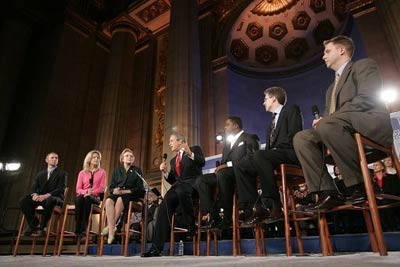
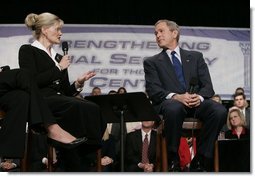
10:50 A.M. EST THE PRESIDENT: Listen, thanks for coming today. As you can see, I am joined by some fellow citizens here on the stage who have come to talk about one of the great causes of our generation, and that is how to strengthen and save Social Security for generations to come. I know this is an issue that some would rather not be talking about. It's an issue that is kind of -- I think some think has got too much political danger attached to it, and so, therefore, let's just kind of, maybe, move it down to the next group of people coming to Washington, or maybe things will get better by ignoring it. That's not what I think. And today I want to talk about why we have an issue with Social Security, why I believe those of us who have been elected to office have an obligation to do something about it, and then I want -- and give some ideas, some constructive ideas to Congress as to how to deal with the issue, and then I want others to share with me their ideas. And we've got some people who have come a long way -- flown all the way to Washington, D.C., to share some thoughts with the President. And I think you'll find their stories interesting. I certainly did, when we had a little discussion a little bit ago. First, let me tell you how much, I understand, Social Security has meant for generations of Americans. I mean, Franklin Roosevelt, in thinking boldly, envisioned a Social Security system where Social Security would help seniors with their retirement. And the system worked for a lot of people. And it's been a -- an incredible achievement, if you think about a piece of legislation being relevant for nearly 70 years. The problem is, is that times have changed since 1935. Then, most women did not work outside the house, and the average life expectancy was about 60 years old -- which for a guy 58 years old, must have been a little discouraging. (Laughter.) Today, Americans, fortunately, are living longer and longer. I mean, we're living way beyond 60 years old, and most women are working outside the house. Things have shifted. The Social Security system is not a personal savings account. The Social Security system is not an account where money is earned. The Social Security system is an account where money comes out to pay for retirees and is put in the system by people who are working. And that's changed. More and more retirees have taken out money relative to the number of people putting money in. In the '50s, there were 16 workers for every beneficiary. So the system was in pretty good shape. Today, there's three workers for every beneficiary. Relatively quickly, there's going to be two workers for every beneficiary. And that's a problem. And that's a problem because in the year 2018, in order to take care of baby boomers like me and -- (laughter) -- some others I see out there -- (laughter) -- the money going out is going to exceed the money coming in. That's not a good thing. It means that you're either going to have to raise the taxes of people, or reduce the benefits. And the longer you wait, the more severe the pain is going to be to fulfill the promise for a younger generation of workers coming up. As a matter of fact, by the time today's workers who are in their mid-20s begin to retire, the system will be bankrupt. So if you're 20 years old, in your mid-20s, and you're beginning to work, I want you to think about a Social Security system that will be flat bust, bankrupt, unless the United States Congress has got the willingness to act now. And that's what we're here to talk about, a system that will be bankrupt.
Now, I readily concede some would say, well, it's not bankrupt yet; why don't we wait until it's bankrupt? The problem with that notion is that the longer you wait, the more difficult it is to fix. You realize that this system of ours is going to be short the difference between obligations and money coming in, by about $11 trillion, unless we act. And that's an issue. That's trillion with a "T." That's a lot of money, even for this town. And so I'm looking forward to working with Congress to act. We've got an expert from the Social Security system that will talk about "the problem." And I'm going to talk about "the problem." You know, the problem is that some in Congress don't see it as the problem. They just kind of think that maybe things will be okay. But the structure of Social Security is such that you can't avoid the fact that there is a problem. And now is the time to get something done. Now, I've talked about this, and I want the people to clearly understand, if you're a senior receiving your Social Security check, nothing is going to change. Those days of politicizing Social Security, I hope, are in the past. A lot of people who ran for office and if they even mentioned the word, Social Security, there would be TV ads and flyers and people knocking on doors saying, so-and-so is going to ruin Social Security for you. There is plenty of money in the system today to take care of those who have retired or near retirement. The issue really is for younger folks. That's why we've got some younger folks up here. Not all of us are younger folks, are we? (Laughter.) Most of them are younger folks. I no longer qualify. (Laughter.) But younger people are listening to this issue. You know, I've traveled a lot. I campaigned on this issue of Social Security, and the need to strengthen it and reform it. I didn't shy away from it in 2000; I certainly didn't shy away from it in 2004. I laid it out there for the people to hear. I said, vote for me, and I'm going to work with Congress, see if we can't get something done to solve the system. This is part of what -- this is part of fulfilling a campaign pledge. I wouldn't be sitting here if the people said, we don't want anybody to touch it; we think it's okay. Most younger people in America think they'll never see a dime. That's probably an exaggeration to a certain extent, but a lot of people who are young, who understand how Social Security works, really do wonder whether they'll see anything. My attitude is, once we assure the seniors who will receive Social Security today that everything is fine, I think we've got a shot to get something done, because younger Americans really want to see some leadership. I said we're not going to run up the payroll taxes. I think running up payroll taxes will slow down economic growth. This economy is beginning to kick in, it's beginning to make sense. I think we can solve the problem without increasing payroll taxes. (Applause.) I also threw out another interesting idea -- it's certainly not my idea, because others have talked about it, and that is to allow younger workers, on a voluntary basis, to take some of their own money and set it aside in the form of a personal savings account -- a personal savings account which is their own; a personal savings account which would earn a better rate of return than the money -- their money currently held within the Social Security trust; a personal savings account which will compound over time and grow over time; a personal savings account which can't be used to bet on the lottery, or a dice game, or the track. In other words, there will be guidelines. There will be certain -- you won't be allowed just to take that money and dump it somewhere. In other words, there will be a safe way to invest, to be able to realize the compounding rate of interest. I've heard some say, well, this is risky to allow people to invest their own money. It's risky to let people say, you can take your money that's supposed to be for a retirement account and put it on the lottery, I realize that. But it's not risky. Federal employees -- the Thrift Savings plans invest under certain guidelines, and I don't hear them screaming it's risky. It makes sense to try to get a better rate of return on your money, if you expect there to be a Social Security system which is going broke. And that's what we're talking about. Owning your own personal savings account does two other things. One, it allows you to pass on your savings to whoever you choose. You can't do that in Social Security today. If you pass away earlier than expected, that money that you put in the system is gone. And at the same time that you manage your own account, you own your own account. I love promoting ownership in America. I like the idea of encouraging more people to say, I own my own home, I own my own business, I own and manage my health accounts, and now I own a significant part of my retirement account. Promoting ownership in America makes sense to me to make sure people continue to have a vital stake in the future of our country. And so I want to thank you all for coming today to give me a chance to address the Social Security issue. I plan on talking about it a lot. This isn't the first time I've talked about it since the campaign is over, and it's certainly not going to be the last, because I believe it is a vital issue. And I know that if we don't address the problem now, it will only get worse with time. And I believe there is a fundamental duty, for those of us who have been given the honor of serving the American people, to solve problems before they become acute, and not to pass them on to future Presidents and future generations. Now, I want to talk to Andrew Biggs. He is the Associate Commissioner for Retirement Policy at the Social Security Administration. To me, that says, expert. (Laughter.) I don't know if that's fair to call you an expert or not. * * * * * THE PRESIDENT: Yes, that's good. How old are you? MR. BIGGS: I'm 37. THE PRESIDENT: Man, I wish I was 37. (Laughter.) Thirty-seven, talking to the President. That's great. (Laughter.) You ought to be concerned. I mean, you're one of these people -- yes, good. Well, I appreciate you helping. You see, what he just said is, there is a problem. I happen to believe people who have been elected to office who ignore problems will face the price at the ballot box. I think more and more people recognize we have a problem. We've got a 37-year-old person here describing a problem. More and more people understand we have a problem. And the more people see it, the more it's expected we do something about it. And as Andrew said, he said, we better start now. That's why it's important that we have this dialogue. And that's why I'm going to continue dialoguing and talking to the leadership in Congress about, let's solve it now, let's do our duty. Let me talk to Scott Ballard. He is from the great state of Washington. That's a long way away. MR. BALLARD: That's right. THE PRESIDENT: Brought your lads with you, I noticed. MR. BALLARD: Yes. THE PRESIDENT: Your sons. Yes, they had never been to Washington -- I said, have you ever been to Washington? He said, I live in Washington. (Laughter.) MR. BALLARD: Yes. (Laughter.) THE PRESIDENT: Pretty good line, you know? I meant, the District of Columbia, Washington. So what do you do, Scott? MR. BALLARD: Well, my brother and I own and operate a private ambulance service. It was started by our parents in 1967. And my brother and I purchased it from them in 1986. THE PRESIDENT: And why are you here? Besides bring your lads to the other Washington? MR. BALLARD: Right. Well, first of all, I'm in a fairly unique situation, in that probably two-thirds of our customers are on Social Security. Yet the majority of my work force are in their early 20s, some of them are in their early 30s. So we have a lot of people that I work with currently who are on Social Security, and a lot of younger employees who will be impacted by these proposed changes. THE PRESIDENT: So, like, if they were here, what would your younger employees say about Social Security? Do they ever talk about it? Do they ever think about it, do they ever -- MR. BALLARD: Not really. They don't talk about it too much, but I think if some of the changes that you are proposing are implemented, I think they will talk about it a lot more, and I think they'll take a much greater interest in it. We've seen that with our company 401(k) plan. Most of them, they don't talk about retirement at all, but once they start seeing something on paper, saying, oh, that's mine, and it's been in there a few years and they start to see it build, they become more interested in it, and they start doing whatever they can to manage it and make it grow so it's there when they retire. THE PRESIDENT: That's kind of an interesting thought, isn't it -- when you see it on paper, the value of something, you begin to actually pay attention to what causes values to go up -- good policies that enhance growth. And what Scott just said is, he talked about the first change in retirement in America was the movement toward defined contribution plans, which 401(k)s, which really has promoted an ownership society, hasn't it? I mean, people wake up and they look at their account, and say, I'm so sure this person's policies are beneficial to my being able to earn a better rate of return. You pay attention because it's their own money. It's one of the benefits of a personal account in Social Security. * * * * * THE PRESIDENT: Right. Good. I appreciate you sharing that. (Applause.) Make sure you tell your customers -- tell your customers, nothing changes with Social Security for them. And tell your younger workers, they can do something about it. They can write their senators, they can write their congresspeople. You can let them know you expect the members of the United States Congress to hear the fact that there's a problem, and then to do something about it. That's what they can do. We've got with us Bob McFadden. Looking sharp. (Laughter.) I didn't come close, I know. (Laughter.) Thanks for coming. I appreciate you taking time to be here. You are from Medford, New Jersey. MR. McFADDEN: Yes, sir. THE PRESIDENT: And why have you come from Medford, New Jersey to share some thoughts? * * * * * THE PRESIDENT: The 1 or 2 percent that the money inside the Social Security trust now earns -- is that right? Is he right at -- is it even as high as 1 percent? MR. BIGGS: No, it's -- right now it is low because interest rates are low. Over the long-term, we're looking at around 3 percent. So you still do have a -- THE PRESIDENT: So it's more than double. But right now, it's, like -- yes, never mind. (Laughter.) Don't worry about it. (Laughter.) You can still keep your job. (Laughter.) Go ahead. Seven and a half percent since 1924. That's a great rate of return. Imagine if you're 50 years old and you start -- if you start -- if you hold that money for 50 years at that rate, it compounds and grows and ends up being a lot of money, is what you're saying. MR. McFADDEN: Yes, sir. THE PRESIDENT: Yes, okay. I'm glad I invited you. (Laughter.) * * * * * THE PRESIDENT: Let me say this. You brought up a very interesting point. There's kind of an assumption that only a certain group of people at a certain income can manage an account. It's -- it's as if you've got to have a net worth of "X" before savings becomes a real part of your life. I reject that. Bob rejects that. Secondly, the interesting -- there's a -- African American males die sooner than other males do, which means the system is inherently unfair to a certain group of people. And that needs to be fixed. It's not a -- (applause.) MR. McFADDEN: I agree, Mr. President, because from the minimal research that I've done, the average African American male right now is -- the life expectancy is 69, and I may be off a little bit. But if you're telling me that it's 69, and the age is going to go to 67, you do the math. (Laughter.) THE PRESIDENT: Right. MR. McFADDEN: That's two years. (Laughter.) THE PRESIDENT: Glad you came. Thanks. Welcome, girls. Glad you all came. (Applause.) Okay, I thought we would try to find somebody who represents the youth movement. I'm not saying you all are old, but we have found us a dairy farmer from the great state of Utah, Josh Wright. Welcome, Josh. Thanks for coming. He asked me if I could fix the BCS -- (laughter and applause.) No, I'm not going there, Josh. I'm staying on Social Security. It may be a little easier to fix, anyway. (Laughter.) MR. WRIGHT: But he said that they wouldn't be able to take Texas, and -- THE PRESIDENT: Wait a minute. You don't need to talk about private conversations. (Laughter.) Okay, you're a dairy farmer? MR. WRIGHT: That's correct. THE PRESIDENT: Good. Milking those cows. MR. WRIGHT: Yes. Not today, obviously. I made my dad stay home and do it. But we have a dairy farm in central Utah, and you can fit the whole town in this building here. THE PRESIDENT: Kind of like Crawford. MR. WRIGHT: There's a lot more cows than there are people, so I spend a lot of time talking to animals. (Laughter.) THE PRESIDENT: Are they talking back yet? (Laughter.) When they start talking back, give me a call. (Laughter.) MR. WRIGHT: Not when I have a stick in my hand, they don't say a lot. (Laughter.) * * * * * THE PRESIDENT: Do you think he's listening? Have they got C-SPAN out there in Utah? MR. WRIGHT: I don't know. (Laughter.) THE PRESIDENT: See that red dot? That's him, if he's listening. MR. WRIGHT: He's probably watching the horse channel. He loves that channel. (Laughter.) THE PRESIDENT: I appreciate you coming. MR. WRIGHT: Thank you for letting me. THE PRESIDENT: If nothing happens, at your age, it will be bust by the time it comes time for you to retire. That's why we have a person in the mid-20s here -- besides the fact the guy's got a pretty good sense of humor. (Laughter.) If nothing takes place, if Congress says, oh, don't worry, we'll just push it down the road; why do we need to deal with it, there's no crisis -- if nothing happens, and we don't start moving on it now, by the time Josh gets to retirement age, the system will be flat broke. And that's not right, it doesn't seem like to me. It seems like people who have been elected to office must say, we want it to be wholesome and healthy, like it has been for other generations. Oh, I know there's a lot of politics here in Washington, and people are -- some are afraid to touch it, some don't want to touch it, some provide excuses not to touch it. I know, I've heard it before. But I believe that the President has a responsibility for setting the agenda, and I believe people who have been elected to the House of Representatives and the United States Senate has an obligation to confront problems head on. (Applause.) By the way, tell the old man, 1946 was a great year. MR. WRIGHT: It was a great year. THE PRESIDENT: You wouldn't be sitting here if it wasn't, you know. Anyway. (Laughter.) We've got a mom and her daughter with us. I'm so glad you both came. Thanks for being here. Sonya is the daughter. Rhoda is the mom. And I want the Stone women to talk about their lives and how it relates to Social Security. If you don't mind, Sonya, why don't you start? What do you do? MS. STONE: Sure. I'm a chief financial officer for a firm here in Washington. But I'm really here as a mom. I happen to be a divorced mom, raising three children -- two wonderful boys, Jeff and Eric, that are here with me -- and I have a beautiful daughter, Emily, who is also here with me. She's nine years old. Emily has been severely disabled since birth, both mentally and physically, and she will be dependent on Social Security for her lifetime. And I would like to make sure that Social Security is going to be there for her as its been for my mother. THE PRESIDENT: Good. A CFO, like, you know something about numbers? MS. STONE: I know a little bit about numbers, and I -- THE PRESIDENT: I presume you've looked at the numbers. MS. STONE: I have looked at the numbers. And I would very much like to see the current Social Security system improved with the establishment of personal accounts, so that families could harness the power of the capital markets to allow them to build a nest egg over the course of their lifetimes that could then be passed on to their families. And I know that if my father, who paid in for over 40 years, had had the opportunity to establish an account like that, that would then have grown and survived him, and been available to not only provide for my mom, but ultimately for his grandchildren and his granddaughter, who he never knew, I think that would have made him very happy. THE PRESIDENT: Sure. I think it's important for people to understand compounding rate of interest. In other words, if you take a dollar, set it aside and it grows at three percent over 30 years or 40 years, and compare that to the same dollar that grows at 7 percent on an average basis over 30 years, there is a huge difference in money. So it matters how much money -- how much interest, or how much rate of return your money earns. We're kind of throwing around these words as if everybody understands compounding rate of interest and rate of return, but what people need to understand is that the money that's now -- your money in the government is earning much less than it's capable of generating under safe conditions. Safe conditions -- I think that's what you're saying. MS. STONE: That's what I'm saying. And I would just add that, as a mom, I know what it's like to lay awake at night and worry about the future of your children. And I know one thing about moms, they know how to make tough choices; we make them every day, on everything from health care to education to which bill to pay next. And I think we understand that whenever you're faced with a difficult problem, the sooner you start and the more honest you are about the nature of the problem, the greater chance you have of success. So I'm very hopeful that we would get started. THE PRESIDENT: Good, thanks. Well done. (Applause.) Now what about your -- introduce your mom. MS. STONE: I would like to introduce my mom. This is my mother, Rhoda Stone. And she is grandmother of three, and originally from Helsinki, Finland, and has been here over 40 years. THE PRESIDENT: Fantastic. Same age as my mother. MS. STONE: Just turned 80. THE PRESIDENT: Is she still giving you instructions? MS. STONE: Every day, and I do my best. THE PRESIDENT: It never stops, does it? (Laughter.) No. MRS. STONE: It shouldn't stop. THE PRESIDENT: That's right. (Laughter.) Let her rip. * * * * * THE PRESIDENT: Thank you for saying that. Good job. Yes, I think one of the interesting things that Rhoda talked about is the need for people to understand that Social Security is a part of retirement income. That's why it was created, and therefore, the idea of developing the habits early -- necessary to make sure you've got that which is necessary to live on, such as saving money, is important. I happen to believe that once personal savings accounts are part of the Social Security system, that it will encourage other savings to take place, as well. People will be able to see the benefits of savings, understand how important it is as a dad to, say, two beautiful little girls, to start setting aside money for college education is a way to save, not necessarily for retirement in this case, but to be a good -- to be a good dad and do your duty as a father. And so I appreciate that point. In other words, it's a point that says that people have got to understand you have a responsibility to set aside money so that you can live comfortably. And it worked in your case. Thankfully you had a wise husband. MS. STONE: I wish we would have had a chance to put -- THE PRESIDENT: As additional -- as addition to the savings you set aside out of the personal savings accounts. I agree. And that's -- so it's a -- this is a -- I hope you've -- I hope you have come away with a better understanding of the importance of this issue. I mean, we've got people of all generations here, people who say, look, this is an issue. And the fundamental question confronting the people elected to the United States Congress is, will they act? I will assure you, I'm going to ask them to act. I think that one of the reasons I'm sitting here is because I said to the people of the country, we have an issue with Social Security, we have a problem, I think it's important to be a problem solver; give me four more years, and I intend to work with people of both parties and solve problems. And there is a problem with Social Security. (Applause.) I see a problem. I also see a solution. And I realize that it's going to require bipartisan cooperation. And I look forward to working with members of both political parties in both Houses, to come together and do our duty. (Applause.) I realize it's not going to be easy. This isn't easy. If it were easy, it would have already been done. It kind of makes it fun, though, doesn't it? Take on the tough jobs. Members who will work -- constructively work with us will be able to look back and say, I did my duty. I came to Washington to be more than just a place holder. I came to Washington to analyze a problem, to deal with a problem, and to leave a legacy behind of fixing the problem. And so I'm looking forward to working with the members of Congress. I want to thank our panelists who are here. I want to thank our audience for coming. May God bless you all. (Applause.) END 11:33 A.M. EST
State of the Union Address- February 2, 2005
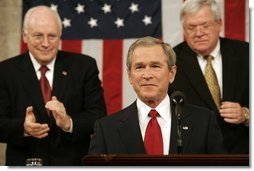
THE PRESIDENT: Mr. Speaker, Vice President Cheney, members of Congress, fellow citizens: As a new Congress gathers, all of us in the elected branches of government share a great privilege: We've been placed in office by the votes of the people we serve. And tonight that is a privilege we share with newly-elected leaders of Afghanistan, the Palestinian Territories, Ukraine, and a free and sovereign Iraq. (Applause.) Two weeks ago, I stood on the steps of this Capitol and renewed the commitment of our nation to the guiding ideal of liberty for all. This evening I will set forth policies to advance that ideal at home and around the world. Tonight, with a healthy, growing economy, with more Americans going back to work, with our nation an active force for good in the world -- the state of our union is confident and strong. (Applause.) Our generation has been blessed -- by the expansion of opportunity, by advances in medicine, by the security purchased by our parents' sacrifice. Now, as we see a little gray in the mirror -- or a lot of gray -- (laughter) -- and we watch our children moving into adulthood, we ask the question: What will be the state of their union? Members of Congress, the choices we make together will answer that question. Over the next several months, on issue after issue, let us do what Americans have always done, and build a better world for our children and our grandchildren. (Applause.) First, we must be good stewards of this economy, and renew the great institutions on which millions of our fellow citizens rely. America's economy is the fastest growing of any major industrialized nation. In the past four years, we provided tax relief to every person who pays income taxes, overcome a recession, opened up new markets abroad, prosecuted corporate criminals, raised homeownership to its highest level in history, and in the last year alone, the United States has added 2.3 million new jobs. (Applause.) When action was needed, the Congress delivered -- and the nation is grateful. Now we must add to these achievements. By making our economy more flexible, more innovative, and more competitive, we will keep America the economic leader of the world. (Applause.) America's prosperity requires restraining the spending appetite of the federal government. I welcome the bipartisan enthusiasm for spending discipline. I will send you a budget that holds the growth of discretionary spending below inflation, makes tax relief permanent, and stays on track to cut the deficit in half by 2009. (Applause.) My budget substantially reduces or eliminates more than 150 government programs that are not getting results, or duplicate current efforts, or do not fulfill essential priorities. The principle here is clear: Taxpayer dollars must be spent wisely, or not at all. (Applause.) To make our economy stronger and more dynamic, we must prepare a rising generation to fill the jobs of the 21st century. Under the No Child Left Behind Act, standards are higher, test scores are on the rise, and we're closing the achievement gap for minority students. Now we must demand better results from our high schools, so every high school diploma is a ticket to success. We will help an additional 200,000 workers to get training for a better career, by reforming our job training system and strengthening America's community colleges. And we'll make it easier for Americans to afford a college education, by increasing the size of Pell Grants. (Applause.) To make our economy stronger and more competitive, America must reward, not punish, the efforts and dreams of entrepreneurs. Small business is the path of advancement, especially for women and minorities, so we must free small businesses from needless regulation and protect honest job-creators from junk lawsuits. (Applause.) Justice is distorted, and our economy is held back by irresponsible class-actions and frivolous asbestos claims -- and I urge Congress to pass legal reforms this year. (Applause.) To make our economy stronger and more productive, we must make health care more affordable, and give families greater access to good coverage -- (applause) -- and more control over their health decisions. (Applause.) I ask Congress to move forward on a comprehensive health care agenda with tax credits to help low-income workers buy insurance, a community health center in every poor county, improved information technology to prevent medical error and needless costs, association health plans for small businesses and their employees -- (applause) -- expanded health savings accounts -- (applause) -- and medical liability reform that will reduce health care costs and make sure patients have the doctors and care they need. (Applause.) To keep our economy growing, we also need reliable supplies of affordable, environmentally responsible energy. (Applause.) Nearly four years ago, I submitted a comprehensive energy strategy that encourages conservation, alternative sources, a modernized electricity grid, and more production here at home -- including safe, clean nuclear energy. (Applause.) My Clear Skies legislation will cut power plant pollution and improve the health of our citizens. (Applause.) And my budget provides strong funding for leading-edge technology -- from hydrogen-fueled cars, to clean coal, to renewable sources such as ethanol. (Applause.) Four years of debate is enough: I urge Congress to pass legislation that makes America more secure and less dependent on foreign energy. (Applause.) All these proposals are essential to expand this economy and add new jobs -- but they are just the beginning of our duty. To build the prosperity of future generations, we must update institutions that were created to meet the needs of an earlier time. Year after year, Americans are burdened by an archaic, incoherent federal tax code. I've appointed a bipartisan panel to examine the tax code from top to bottom. And when their recommendations are delivered, you and I will work together to give this nation a tax code that is pro-growth, easy to understand, and fair to all. (Applause.) America's immigration system is also outdated -- unsuited to the needs of our economy and to the values of our country. We should not be content with laws that punish hardworking people who want only to provide for their families, and deny businesses willing workers, and invite chaos at our border. It is time for an immigration policy that permits temporary guest workers to fill jobs Americans will not take, that rejects amnesty, that tells us who is entering and leaving our country, and that closes the border to drug dealers and terrorists. (Applause.) One of America's most important institutions -- a symbol of the trust between generations -- is also in need of wise and effective reform. Social Security was a great moral success of the 20th century, and we must honor its great purposes in this new century. (Applause.) The system, however, on its current path, is headed toward bankruptcy. And so we must join together to strengthen and save Social Security. (Applause.) Today, more than 45 million Americans receive Social Security benefits, and millions more are nearing retirement -- and for them the system is sound and fiscally strong. I have a message for every American who is 55 or older: Do not let anyone mislead you; for you, the Social Security system will not change in any way. (Applause.) For younger workers, the Social Security system has serious problems that will grow worse with time. Social Security was created decades ago, for a very different era. In those days, people did not live as long. Benefits were much lower than they are today. And a half-century ago, about sixteen workers paid into the system for each person drawing benefits. Our society has changed in ways the founders of Social Security could not have foreseen. In today's world, people are living longer and, therefore, drawing benefits longer. And those benefits are scheduled to rise dramatically over the next few decades. And instead of sixteen workers paying in for every beneficiary, right now it's only about three workers. And over the next few decades that number will fall to just two workers per beneficiary. With each passing year, fewer workers are paying ever-higher benefits to an ever-larger number of retirees. So here is the result: Thirteen years from now, in 2018, Social Security will be paying out more than it takes in. And every year afterward will bring a new shortfall, bigger than the year before. For example, in the year 2027, the government will somehow have to come up with an extra $200 billion to keep the system afloat -- and by 2033, the annual shortfall would be more than $300 billion. By the year 2042, the entire system would be exhausted and bankrupt. If steps are not taken to avert that outcome, the only solutions would be dramatically higher taxes, massive new borrowing, or sudden and severe cuts in Social Security benefits or other government programs. I recognize that 2018 and 2042 may seem a long way off. But those dates are not so distant, as any parent will tell you. If you have a five-year-old, you're already concerned about how you'll pay for college tuition 13 years down the road. If you've got children in their 20s, as some of us do, the idea of Social Security collapsing before they retire does not seem like a small matter. And it should not be a small matter to the United States Congress. (Applause.) You and I share a responsibility. We must pass reforms that solve the financial problems of Social Security once and for all. Fixing Social Security permanently will require an open, candid review of the options. Some have suggested limiting benefits for wealthy retirees. Former Congressman Tim Penny has raised the possibility of indexing benefits to prices rather than wages. During the 1990s, my predecessor, President Clinton, spoke of increasing the retirement age. Former Senator John Breaux suggested discouraging early collection of Social Security benefits. The late Senator Daniel Patrick Moynihan recommended changing the way benefits are calculated. All these ideas are on the table. I know that none of these reforms would be easy. But we have to move ahead with courage and honesty, because our children's retirement security is more important than partisan politics. (Applause.) I will work with members of Congress to find the most effective combination of reforms. I will listen to anyone who has a good idea to offer. (Applause.) We must, however, be guided by some basic principles. We must make Social Security permanently sound, not leave that task for another day. We must not jeopardize our economic strength by increasing payroll taxes. We must ensure that lower-income Americans get the help they need to have dignity and peace of mind in their retirement. We must guarantee there is no change for those now retired or nearing retirement. And we must take care that any changes in the system are gradual, so younger workers have years to prepare and plan for their future. As we fix Social Security, we also have the responsibility to make the system a better deal for younger workers. And the best way to reach that goal is through voluntary personal retirement accounts. (Applause.) Here is how the idea works. Right now, a set portion of the money you earn is taken out of your paycheck to pay for the Social Security benefits of today's retirees. If you're a younger worker, I believe you should be able to set aside part of that money in your own retirement account, so you can build a nest egg for your own future. Here's why the personal accounts are a better deal. Your money will grow, over time, at a greater rate than anything the current system can deliver -- and your account will provide money for retirement over and above the check you will receive from Social Security. In addition, you'll be able to pass along the money that accumulates in your personal account, if you wish, to your children and -- or grandchildren. And best of all, the money in the account is yours, and the government can never take it away. (Applause.) The goal here is greater security in retirement, so we will set careful guidelines for personal accounts. We'll make sure the money can only go into a conservative mix of bonds and stock funds. We'll make sure that your earnings are not eaten up by hidden Wall Street fees. We'll make sure there are good options to protect your investments from sudden market swings on the eve of your retirement. We'll make sure a personal account cannot be emptied out all at once, but rather paid out over time, as an addition to traditional Social Security benefits. And we'll make sure this plan is fiscally responsible, by starting personal retirement accounts gradually, and raising the yearly limits on contributions over time, eventually permitting all workers to set aside four percentage points of their payroll taxes in their accounts. Personal retirement accounts should be familiar to federal employees, because you already have something similar, called the Thrift Savings Plan, which lets workers deposit a portion of their paychecks into any of five different broadly-based investment funds. It's time to extend the same security, and choice, and ownership to young Americans. (Applause.) Our second great responsibility to our children and grandchildren is to honor and to pass along the values that sustain a free society. So many of my generation, after a long journey, have come home to family and faith, and are determined to bring up responsible, moral children. Government is not the source of these values, but government should never undermine them. Because marriage is a sacred institution and the foundation of society, it should not be re-defined by activist judges. For the good of families, children, and society, I support a constitutional amendment to protect the institution of marriage. (Applause.) Because a society is measured by how it treats the weak and vulnerable, we must strive to build a culture of life. Medical research can help us reach that goal, by developing treatments and cures that save lives and help people overcome disabilities -- and I thank the Congress for doubling the funding of the National Institutes of Health. (Applause.) To build a culture of life, we must also ensure that scientific advances always serve human dignity, not take advantage of some lives for the benefit of others. We should all be able to agree -- (applause) -- we should all be able to agree on some clear standards. I will work with Congress to ensure that human embryos are not created for experimentation or grown for body parts, and that human life is never bought and sold as a commodity. (Applause.) America will continue to lead the world in medical research that is ambitious, aggressive, and always ethical. Because courts must always deliver impartial justice, judges have a duty to faithfully interpret the law, not legislate from the bench. (Applause.) As President, I have a constitutional responsibility to nominate men and women who understand the role of courts in our democracy, and are well-qualified to serve on the bench -- and I have done so. (Applause.) The Constitution also gives the Senate a responsibility: Every judicial nominee deserves an up or down vote. (Applause.) Because one of the deepest values of our country is compassion, we must never turn away from any citizen who feels isolated from the opportunities of America. Our government will continue to support faith-based and community groups that bring hope to harsh places. Now we need to focus on giving young people, especially young men in our cities, better options than apathy, or gangs, or jail. Tonight I propose a three-year initiative to help organizations keep young people out of gangs, and show young men an ideal of manhood that respects women and rejects violence. (Applause.) Taking on gang life will be one part of a broader outreach to at-risk youth, which involves parents and pastors, coaches and community leaders, in programs ranging from literacy to sports. And I am proud that the leader of this nationwide effort will be our First Lady, Laura Bush. (Applause.) Because HIV/AIDS brings suffering and fear into so many lives, I ask you to reauthorize the Ryan White Act to encourage prevention, and provide care and treatment to the victims of that disease. (Applause.) And as we update this important law, we must focus our efforts on fellow citizens with the highest rates of new cases, African American men and women. (Applause.) Because one of the main sources of our national unity is our belief in equal justice, we need to make sure Americans of all races and backgrounds have confidence in the system that provides justice. In America we must make doubly sure no person is held to account for a crime he or she did not commit -- so we are dramatically expanding the use of DNA evidence to prevent wrongful conviction. (Applause.) Soon I will send to Congress a proposal to fund special training for defense counsel in capital cases, because people on trial for their lives must have competent lawyers by their side. (Applause.) Our third responsibility to future generations is to leave them an America that is safe from danger, and protected by peace. We will pass along to our children all the freedoms we enjoy -- and chief among them is freedom from fear. In the three and a half years since September the 11th, 2001, we have taken unprecedented actions to protect Americans. We've created a new department of government to defend our homeland, focused the FBI on preventing terrorism, begun to reform our intelligence agencies, broken up terror cells across the country, expanded research on defenses against biological and chemical attack, improved border security, and trained more than a half-million first responders. Police and firefighters, air marshals, researchers, and so many others are working every day to make our homeland safer, and we thank them all. (Applause.) Our nation, working with allies and friends, has also confronted the enemy abroad, with measures that are determined, successful, and continuing. The al Qaeda terror network that attacked our country still has leaders -- but many of its top commanders have been removed. There are still governments that sponsor and harbor terrorists -- but their number has declined. There are still regimes seeking weapons of mass destruction -- but no longer without attention and without consequence. Our country is still the target of terrorists who want to kill many, and intimidate us all -- and we will stay on the offensive against them, until the fight is won. (Applause.) Pursuing our enemies is a vital commitment of the war on terror -- and I thank the Congress for providing our servicemen and women with the resources they have needed. During this time of war, we must continue to support our military and give them the tools for victory. (Applause.) Other nations around the globe have stood with us. In Afghanistan, an international force is helping provide security. In Iraq, 28 countries have troops on the ground, the United Nations and the European Union provided technical assistance for the elections, and NATO is leading a mission to help train Iraqi officers. We're cooperating with 60 governments in the Proliferation Security Initiative, to detect and stop the transit of dangerous materials. We're working closely with the governments in Asia to convince North Korea to abandon its nuclear ambitions. Pakistan, Saudi Arabia, and nine other countries have captured or detained al Qaeda terrorists. In the next four years, my administration will continue to build the coalitions that will defeat the dangers of our time. (Applause.) In the long-term, the peace we seek will only be achieved by eliminating the conditions that feed radicalism and ideologies of murder. If whole regions of the world remain in despair and grow in hatred, they will be the recruiting grounds for terror, and that terror will stalk America and other free nations for decades. The only force powerful enough to stop the rise of tyranny and terror, and replace hatred with hope, is the force of human freedom. (Applause.) Our enemies know this, and that is why the terrorist Zarqawi recently declared war on what he called the "evil principle" of democracy. And we've declared our own intention: America will stand with the allies of freedom to support democratic movements in the Middle East and beyond, with the ultimate goal of ending tyranny in our world. (Applause.) The United States has no right, no desire, and no intention to impose our form of government on anyone else. That is one of the main differences between us and our enemies. They seek to impose and expand an empire of oppression, in which a tiny group of brutal, self-appointed rulers control every aspect of every life. Our aim is to build and preserve a community of free and independent nations, with governments that answer to their citizens, and reflect their own cultures. And because democracies respect their own people and their neighbors, the advance of freedom will lead to peace. (Applause.) That advance has great momentum in our time -- shown by women voting in Afghanistan, and Palestinians choosing a new direction, and the people of Ukraine asserting their democratic rights and electing a president. We are witnessing landmark events in the history of liberty. And in the coming years, we will add to that story. (Applause.) The beginnings of reform and democracy in the Palestinian territories are now showing the power of freedom to break old patterns of violence and failure. Tomorrow morning, Secretary of State Rice departs on a trip that will take her to Israel and the West Bank for meetings with Prime Minister Sharon and President Abbas. She will discuss with them how we and our friends can help the Palestinian people end terror and build the institutions of a peaceful, independent, democratic state. To promote this democracy, I will ask Congress for $350 million to support Palestinian political, economic, and security reforms. The goal of two democratic states, Israel and Palestine, living side by side in peace, is within reach -- and America will help them achieve that goal. (Applause.) To promote peace and stability in the broader Middle East, the United States will work with our friends in the region to fight the common threat of terror, while we encourage a higher standard of freedom. Hopeful reform is already taking hold in an arc from Morocco to Jordan to Bahrain. The government of Saudi Arabia can demonstrate its leadership in the region by expanding the role of its people in determining their future. And the great and proud nation of Egypt, which showed the way toward peace in the Middle East, can now show the way toward democracy in the Middle East. (Applause.) To promote peace in the broader Middle East, we must confront regimes that continue to harbor terrorists and pursue weapons of mass murder. Syria still allows its territory, and parts of Lebanon, to be used by terrorists who seek to destroy every chance of peace in the region. You have passed, and we are applying, the Syrian Accountability Act -- and we expect the Syrian government to end all support for terror and open the door to freedom. (Applause.) Today, Iran remains the world's primary state sponsor of terror -- pursuing nuclear weapons while depriving its people of the freedom they seek and deserve. We are working with European allies to make clear to the Iranian regime that it must give up its uranium enrichment program and any plutonium reprocessing, and end its support for terror. And to the Iranian people, I say tonight: As you stand for your own liberty, America stands with you. (Applause.) Our generational commitment to the advance of freedom, especially in the Middle East, is now being tested and honored in Iraq. That country is a vital front in the war on terror, which is why the terrorists have chosen to make a stand there. Our men and women in uniform are fighting terrorists in Iraq, so we do not have to face them here at home. (Applause.) And the victory of freedom in Iraq will strengthen a new ally in the war on terror, inspire democratic reformers from Damascus to Tehran, bring more hope and progress to a troubled region, and thereby lift a terrible threat from the lives of our children and grandchildren. We will succeed because the Iraqi people value their own liberty -- as they showed the world last Sunday. (Applause.) Across Iraq, often at great risk, millions of citizens went to the polls and elected 275 men and women to represent them in a new Transitional National Assembly. A young woman in Baghdad told of waking to the sound of mortar fire on election day, and wondering if it might be too dangerous to vote. She said, "Hearing those explosions, it occurred to me -- the insurgents are weak, they are afraid of democracy, they are losing. So I got my husband, and I got my parents, and we all came out and voted together." Americans recognize that spirit of liberty, because we share it. In any nation, casting your vote is an act of civic responsibility; for millions of Iraqis, it was also an act of personal courage, and they have earned the respect of us all. (Applause.) One of Iraq's leading democracy and human rights advocates is Safia Taleb al-Suhail. She says of her country, "We were occupied for 35 years by Saddam Hussein. That was the real occupation. Thank you to the American people who paid the cost, but most of all, to the soldiers." Eleven years ago, Safia's father was assassinated by Saddam's intelligence service. Three days ago in Baghdad, Safia was finally able to vote for the leaders of her country -- and we are honored that she is with us tonight. (Applause.) The terrorists and insurgents are violently opposed to democracy, and will continue to attack it. Yet, the terrorists' most powerful myth is being destroyed. The whole world is seeing that the car bombers and assassins are not only fighting coalition forces, they are trying to destroy the hopes of Iraqis, expressed in free elections. And the whole world now knows that a small group of extremists will not overturn the will of the Iraqi people. (Applause.) We will succeed in Iraq because Iraqis are determined to fight for their own freedom, and to write their own history. As Prime Minister Allawi said in his speech to Congress last September, "Ordinary Iraqis are anxious to shoulder all the security burdens of our country as quickly as possible." That is the natural desire of an independent nation, and it is also the stated mission of our coalition in Iraq. The new political situation in Iraq opens a new phase of our work in that country. At the recommendation of our commanders on the ground, and in consultation with the Iraqi government, we will increasingly focus our efforts on helping prepare more capable Iraqi security forces -- forces with skilled officers and an effective command structure. As those forces become more self-reliant and take on greater security responsibilities, America and its coalition partners will increasingly be in a supporting role. In the end, Iraqis must be able to defend their own country -- and we will help that proud, new nation secure its liberty. Recently an Iraqi interpreter said to a reporter, "Tell America not to abandon us." He and all Iraqis can be certain: While our military strategy is adapting to circumstances, our commitment remains firm and unchanging. We are standing for the freedom of our Iraqi friends, and freedom in Iraq will make America safer for generations to come. (Applause.) We will not set an artificial timetable for leaving Iraq, because that would embolden the terrorists and make them believe they can wait us out. We are in Iraq to achieve a result: A country that is democratic, representative of all its people, at peace with its neighbors, and able to defend itself. And when that result is achieved, our men and women serving in Iraq will return home with the honor they have earned. (Applause.) Right now, Americans in uniform are serving at posts across the world, often taking great risks on my orders. We have given them training and equipment; and they have given us an example of idealism and character that makes every American proud. (Applause.) The volunteers of our military are unrelenting in battle, unwavering in loyalty, unmatched in honor and decency, and every day they're making our nation more secure. Some of our servicemen and women have survived terrible injuries, and this grateful country will do everything we can to help them recover. (Applause.) And we have said farewell to some very good men and women, who died for our freedom, and whose memory this nation will honor forever. One name we honor is Marine Corps Sergeant Byron Norwood of Pflugerville, Texas, who was killed during the assault on Fallujah. His mom, Janet, sent me a letter and told me how much Byron loved being a Marine, and how proud he was to be on the front line against terror. She wrote, "When Byron was home the last time, I said that I wanted to protect him like I had since he was born. He just hugged me and said, 'You've done your job, Mom. Now it is my turn to protect you.'" Ladies and gentlemen, with grateful hearts, we honor freedom's defenders, and our military families, represented here this evening by Sergeant Norwood's mom and dad, Janet and Bill Norwood. (Applause.) In these four years, Americans have seen the unfolding of large events. We have known times of sorrow, and hours of uncertainty, and days of victory. In all this history, even when we have disagreed, we have seen threads of purpose that unite us. The attack on freedom in our world has reaffirmed our confidence in freedom's power to change the world. We are all part of a great venture: To extend the promise of freedom in our country, to renew the values that sustain our liberty, and to spread the peace that freedom brings. As Franklin Roosevelt once reminded Americans, "Each age is a dream that is dying, or one that is coming to birth." And we live in the country where the biggest dreams are born. The abolition of slavery was only a dream -- until it was fulfilled. The liberation of Europe from fascism was only a dream -- until it was achieved. The fall of imperial communism was only a dream -- until, one day, it was accomplished. Our generation has dreams of its own, and we also go forward with confidence. The road of Providence is uneven and unpredictable -- yet we know where it leads: It leads to freedom. Thank you, and may God bless America. (Applause.) END 10:03 P.M. EST President Discusses Strengthening Social Security
in Montana
3:55 P.M. MST THE PRESIDENT: Thank you all for coming. (Applause.) Thank you all for being here. Go ahead and have a seat. Thank you. Nice to be in the part of the world where the cowboy hats outnumber the ties. (Applause.) Thanks for coming. Gosh, it's wonderful to be back in Montana. What a fabulous state, full of really decent, honorable people. Conrad, thanks for introducing me. I'm glad you didn't auction me off. (Laughter.) Doing a fine job in the United States Senate, and I'm proud to call you friend. Thank you very much, sir. (Applause.) And I want to thank Max Baucus for being here. We have worked a lot together in four years. You know, we've confronted a lot of things in this country -- we've confronted a recession, and confronted the need to get this economy growing. And Max worked hard with the administration to cut taxes and open up markets. And I appreciate working with you, Max. It's been a lot of fun. We got more work to do. (Applause.) We're here to talk about an issue after a while that's going to remind us we got a lot of work to do if we're going to do our duties as public servants. But, Max, thank you. Denny Rehberg, thank you, friend, for coming. I'm honored you're here. Proud of the United States Congressman from the great state of Montana (Applause.) And Jan. The Governor met me at the airport -- the Governor is here. Governor, thank you for coming. I'm proud you're here. One of these days you're going to join the same club as me and Judy and Marc Racicot -- that's the ex-governors club. (Applause.) But right now, you may have the best job in America, being the governor of a great state. Proud you're here. Lt. Governor is here with us today. We got a lot of other officials -- Secretary of State -- thanks for coming. You know, we're flying over on Air Force One, and guess all -- guess what Burns and Rehberg -- all they wanted to talk about was cattle. (Laughter and applause.) Montana beef. (Applause.) And that's an important subject because it's part of how to make sure our economy continues to grow. They kept asking, are you talking to markets overseas to get the Montana beef into those markets? I said, you bet I am. And we'll continue to do so. One of the reasons I work with Max to -- on free trade is because I believe when we open up markets for products, U.S. products, Montana products, people are going to more likely be able to find a job. We want to be selling stuff you grow here and stuff you produce here all around the world. And so I want to tell -- tell Max and Denny and Conrad, we're going still be opening up markets. They also had a few other things on their mind. They wanted to talk about energy. Last night, I said to the United States Congress -- I said, we have been debating energy long enough. (Applause.) It is time -- it is time to get a sound energy plan to my desk so we can become less dependent on foreign sources of energy. (Applause.) People in Montana know something about energy. I know that. They said also make sure you keep in mind the needs of the rural health -- hospitals and docs. You've got some rural -- you've got some rural issues here in Montana because you've got a lot of land. (Laughter.) And not a lot of people. (Laughter.) That's the way a lot of folks probably want to keep it, too, I suspect. (Applause.) If you want to have health care available and affordable, we've got to do something about these lawsuits that are running good doctors out of practice. (Applause.) We've got a problem in that these lawsuits are making it costly for docs to stay in business, and are hurting the federal budget, too. When you're afraid of getting sued, you practice defensive medicine. In other words, you prescribe more than you need to just in case you have to go to a court of law. And that runs up the cost of Medicare, Medicaid, veterans benefits. So I've come to the conclusion that the medical liability issue is a national problem that requires a national solution. And I call upon Congress to pass real, meaningful medical liability reform. (Applause.) Before we -- before we talk about Social Security, I do want to talk a little bit about the amazing times we're living in. Just think about what has happened in the last four months. There was an election in Afghanistan. Millions -- millions of people voted for -- (applause) -- voted for a leader -- voted for a President for the first time in 5,000 years. I don't know who's counting, but that's a lot, you know. (Applause.) I mean, it's an amazing story, when you think about it. It wasn't all that long ago that the Taliban was providing safe haven to al Qaeda in Afghanistan. And that's where they plotted and trained. That's why we went in, to rout them out. We said if you harbor a terrorist, you're equally as guilty as a terrorist. The doctrine still stands. And the reason the doctrine still stands is because there's an enemy that still hates what we stand for. We will stay on the offense. No matter where they hide, where they run, the United States of America and coalition forces will be after them to keep us safe. (Applause.) That is our duty. That's the responsibility of the federal government. And I want to thank those who wear our uniform for serving this great country of ours. (Applause.) But the lesson of Afghanistan -- the lesson of Afghanistan should remind us we've got a greater force at our disposal than just our military, and that is our belief in the ability of freedom to change societies. And we saw it. The high school students and college students here are watching some amazing history unfold. Think about what you've seen. You saw people vote in Afghanistan to elect a President. You saw people vote in the Ukraine to elect a President. You saw people vote in the Palestinian Territories to elect Abu Abbas. And you saw last Sunday some incredibly brave people in Iraq defy the terrorists and cast their ballots by the millions, because of freedom. (Applause.) Freedom is powerful. Freedom is incredibly powerful. I believe that freedom is embedded in everybody's soul. That's what I believe. I believe that given a chance, people will vote. And people will -- people will adhere to the rules of self-government. It's not easy in parts of the world, though, where there's terrorists and tyrants trying to stop the march of freedom. And the reason they are, and the reason they're trying to stop the march of freedom is because they think the exact opposite. They believe in control of people's lives. They don't believe in freedom of religion. They don't believe in freedom of speech. They don't believe in freedom of the press. They don't believe in freedom, period. And we do. That's why we're still a target. but that's why we'll prevail in the long run, because deep in everybody's soul is that deep desire. And you know what I believe it's deep in everybody's soul? Because I believe it's the Almighty God's gift to every soul on the face of the Earth. (Applause.) You about ready, Leo? Let me say one other thing. They asked me -- you know, I've been asked, and they say, is there a timetable of withdrawal from Iraq? Here's the answer to that. You don't set timetables. You don't want the enemy to say, okay, we'll just wait them out. The timetable is as soon as possible. And it's going to be based upon the willingness and the capacity of the Iraqi troops to fight the enemy. And so our mission -- our mission is to provide training and command structure and officer training to the Iraqis so they can defend their own freedom. That's what they want to do. I talk to their leadership all the time. And like any independent free country, they want to defend themselves. And our job is to help them defend themselves. And when they do, and when they're ready, our troops will come home with the honor they have earned. (Applause.) And as freedom spreads -- as freedom spreads in parts of the world that have not known freedom, our children and grandchildren are more likely to grow up in peace. And that's what we want. We want to spread the peace. (Applause.) Let me talk about Social Security. You know, people say, gosh, that's a pretty tough issue to be bringing up. We've got a war to fight, why are you bringing up Social Security? Here's why: The job of the President is to confront problems, not to pass them on to future generations or future Presidents. (Applause.) That's the way Montana people think. If you see a problem, go fix it. (Applause.) Don't theorize, don't pontificate, but fix it. And so the question is, do we have a problem? First of all, let me explain why I think we -- I know we have a problem. When Social Security was designed, there were 16 workers for every beneficiary in 1950 --actually, designed in the '30s -- in 1950, there were 16 workers for every beneficiary. That meant it was a lot easier to afford that which the government promised. When you've got 16 people paying in for one person, it -- you can see why the system was solvent. What's happened since the design of the system, however, is that people are living longer -- thankfully. (Laughter.) That's good news. (Laughter.) What else is happening since the system was designed is we had what's called the baby boomers -- that would be me, Baucus, others, you know -- (laughter) -- people whose hair is getting grayer on a regular basis. And we're fixing to retire in big numbers. So you're living longer and you've got bigger -- you've got big numbers retiring, and fewer workers paying into the system -- 3.3 workers per beneficiary. Plus, Congress, over the years, has promised an increase of benefits. So think about the math. Fewer people paying into the system, more people living longer, more people retiring, for greater benefits. Now, that is -- and because Social Security is a pay-as-you-go system, there's not a great big trust of money. The money that goes in from your paycheck goes out to the beneficiaries. That's how it works. And so, obviously, as the demand for money increases as a result of more people retiring and people living longer and benefits going up, more has to come in. Now, if you look at this chart up there, in 2018, the Social Security system goes negative. That means more money is going out than is coming into the system. And every year after that, as you can see, the cash deficit -- that is the money going out is greater than the money coming in -- increases. In 2027, it's about $200 billion a year. That's above and beyond the payroll taxes we're collecting. Ten years later, it's about $300 billion. Every year, the situation gets worse. So you can imagine what will be happening if we don't do anything. You know, Congress is going to show up, and somebody says, we're $200 billion short. Where are you going to get the money? Well, you can tax somebody to get the money; you can get rid of the benefits that you promised; you can cut other programs; or you can keep borrowing debt. That's why I think we've got a problem. Now, before I start talking about what I intend to do about it, I've got to make some things just as plain as I can. If you're a senior citizen today on Social Security, you don't have to worry about it. The trust has got plenty of money to take care of you. I understand how this issue works. Everybody says, he's talking about Social Security, there goes my check. That's what happens all the time when they're talking about Social Security. You're in good shape. And if you're near retirement, 55 years or above, you're in good shape. Nothing changes. Those are the facts. The problem is, is that the younger workers have got a problem. And I think we have a duty to worry about our children and our grandchildren. You know, 2018 may not -- may seem like a long way down the road for people who are running for office every two years. It's not that far down the road. If you've got a five-year-old child, that child will be 18 years old before you know it, and the Social Security system starts losing money. In 2042, the system will be broke. Again, for some of us in politics, that may seem like ages. You know, don't worry about it; 2042 seems like forever. And in my cases, of course, I'm not going to be around in politics. I'm moving on after four years. But, nevertheless, it's not that far. And the longer you wait, the harder it is to fix the problem. So my judgment is -- and that's why I went in front of Congress yesterday, and said, okay, let's fix the problem. And I put all ideas on the table, except for running up payroll taxes. If you've got a good idea, bring it. No President, I don't think, has ever said that when it comes to Social Security. Some of you veterans may remind me whether that's the case, or not. I don't think so. I'm willing to stand up with the Congress, I don't care if it's a Republican idea, Democrat idea, independent idea -- bring them forward. Let's work together and fix the system. (Applause.) There are a lot of ideas out there -- thank you all -- there's a lot of ideas out there. I mentioned some of the authors of the ideas last night. I've got one myself that I think is a very interesting idea -- along with others. What I'm about to tell you will not permanently fix Social Security -- by the way, there's no need just to put a Band-Aid on the deal. If we're going to get after it, let's fix it permanently. Let's let people look back generations from now and say, I appreciate the way the Congress and the President worked together to do what was right on Social Security. (Applause.) So let me give you an idea that I think is worth considering. I thought it was worth considering so much, I put about five paragraphs in my speech into it, you know. (Laughter.) And it's this: I believe you ought to be able -- allowed to take some of your own money, payroll taxes, and set up a personal retirement account, on a voluntary basis. And the reason why I believe that is because the rate of return in your account will be greater than the rate of return on the money you're getting in Social Security. And that's important. Because if you're a younger worker and set aside some of your money that would normally be going into the trust, into a persona account, over time, that rate of return grows and accumulates. And you end up with a nest egg, I guess is the best way to put it -- a nest egg that will then complement your Social Security checks when you finally retire. Now, there's a lot of questions about this, of course -- can you take it to the lottery? Is that considered an investment? Can you take your payroll taxes and set up a fund and go to the lottery or the track or shoot some dice? The answer is, no. (Laughter.) Obviously. You have to have a conservative mix of stocks and bonds. And there are a lot of funds that are conservatively tailored so you can get a reasonable rate of return. Obviously, the lower the risk, the lower the rate of return. But it should be a rate of return greater than that which you're earning in the Social Security trust, and that's important over time. Secondly, you just can't once you retire pull it all out. In other words, there will be a phased withdrawal in order to make sure that the Social Security benefits you get, coupled with the money coming out of your own personal account is done in such a way to help you retire. Third, there are ways to make sure your fund can avoid swings in the market at the very end of -- right before you retire. So there's some wise things we can do, just like we do for the federal government employees, see? They've got this plan; it's called the thrift savings plan. My attitude is, if it's good enough for people working in the federal government, it ought to be good enough for people working elsewhere in America. And I -- (applause.) I like the idea of you owning something. I love an ownership society. We want more people owning their own home. We want people owning their own business. We want people owning their own farm. We want people owning and managing their own health care accounts. And I think it makes sense to have people owning and managing their own retirement account. (Applause.) So we're going to talk about Social Security. And by the way, this will be phased in. I know they're throwing out all kinds of numbers -- $1 trillion, $2 trillion, $3 trillion. When you get to the federal government, we -- it's no longer millions or billions, it's trillions at the federal government. It's amazing, isn't it? Anyway, we're going to phase it in. That doesn't all happen -- happen at once. I think it's important to -- gradually phase in the idea of personal accounts so younger workers can get used to it, and so that the plan is more affordable, so it's more fiscally sound, fiscally responsible to fade [sic] it in. And we put out such a plan that will help people understand that we can do this without busting the budgets. And that's important for people to understand, as well. No, this is doable. It's just going to take some political will. Now, I want to talk to somebody who professes to be an expert. Actually, he is an expert. We were in Fargo earlier, and he handled himself brilliantly for a professor. No. (Laughter.) Jeff Brown, from the University of Illinois, knows the subject well. He is obviously a good sport. He takes a pretty good needle. And -- but tell us -- just give us -- back me up. You've studied the issue. (Laughter.) Now, I've come here and they say, what do you expect the President to say. Put some expertise out there. DR. BROWN: Happy to do so, Mr. President. And thank you very much. (Applause.) * * * * * THE PRESIDENT: What was the life expectancy when Franklin Roosevelt designed the program -- or Congress -- 60, maybe? I think it was 60. DR. BROWN: Back in the 19 -- in the mid-1930s, a person born in the United States could expect to live, on average, around 60 -- low 60 years old. THE PRESIDENT: See, that's how the system was designed: pay-as-you-go as you work, people not living very long. It's changed. The world has changed. The system hasn't changed with it. And that's what we're talking about. You got any other thoughts, Professor? DR. BROWN: Sure, I'll go on as long as you let me. (Laughter.) THE PRESIDENT: Reminds me of my college days. (Laughter.) DR. BROWN: I'm used to having an hour and 20 minutes with an audience that can't leave. THE PRESIDENT: When I was awake. (Laughter and applause.) DR. BROWN: The other thing, I just -- THE PRESIDENT: Talk about the personal accounts. I know -- it obviously makes some people nervous. It's a new idea. It's a new concept. People -- all of a sudden, when you take a system like Social Security, that's been around so long and it has done a lot of really -- made a big difference in people's lives, and you throw out a new idea -- it's the world in which the status quo sometimes is the easy default position. And -- give us some thoughts on that. * * * * * THE PRESIDENT: So Leo Keller is with us. He said, do you mind if I wear my hat? I said, not all, Leo. It's a fine-looking hat. (Applause.) Thanks for wearing it. I'm glad you're here. Welcome. Leo, you're here to talk about Social Security. Give us some wisdom. * * * * * THE PRESIDENT: Yes, that's a really interesting idea. What he just said is very important. Once people get into the habit of savings, it encourages other savings. This society is -- Leo, first of all, a couple points. One, you made my point on life expectancy. (Laughter.) You're looking strong at 79, headed to 80. You're doing great. (Applause.) MR. KELLER: Thank you. THE PRESIDENT: Secondly, it is important for Leo to know that nothing changes. There are a lot of people out there saying, they've heard the Social Security debate, I wonder really if this means I'm not going to get my check. I cannot -- I'm just going to say it again and again and again. Matter of fact, this is stop two of five where I'm traveling around the country; I know I've got a lot of explaining to do. And one of the most important explanations of all is Leo is going to get his check. Nothing changes. The system is sound. (Applause.) Any discussion about younger workers does not mean that Leo and anybody like Leo is not going to have the promise that the government made. That's just really important to know. And thirdly, you're right about your grandkids. See, I like a guy who says, my grandkids are capable of owning and managing something. It's a different mind-set. The 401ks, for example, have changed the attitude toward investment, hasn't it? I mean, a 401k, when you were coming up, Leo, was just three numbers and a letter in the alphabet. (Laughter.) And now it's an idea, where people manage their own retirement, and they own something, they see it, it's visible. It's an important part of our society today, and it seems like to me, as we modernize the system of Social Security, we incorporate a portion of that new system into the concept of somebody owning something. So thanks for coming, Leo. You did a fabulous job. And the hat, listen, I'm telling you -- MR. KELLER: My pleasure. THE PRESIDENT: Those women look at that hat and that club, and they're going wild. (Applause.) Kelly Kost -- Kelly, thanks for coming. What do you do? MS. KOST: I am in sales and administration. I work for Mission Mountain Les Schwab Tires in Ronan, Montana. THE PRESIDENT: Ronan? MS. KOST: Ronan, yes. THE PRESIDENT: How many people live there? MS. KOST: I have no idea. (Laughter.) THE PRESIDENT: Either do I. (Laughter.) At least you know where it is. (Laughter.) Talk -- talk about Social Security. First of all, Kelly has got the hardest job in America. She's a single mom. MS. KOST: I've been a single mom since 1989. My twins are 18-years-old -- Jade and Jordan. THE PRESIDENT: Where are they? Yes. MS. KOST: Jordan is a member of the Army National Guard. THE PRESIDENT: There you go. (Applause.) MS. KOST: Jade will be the valedictorian of her class -- THE PRESIDENT: There you go. Your mom is humiliating you, but it's good to know. (Applause.) Very good. MS. KOST: Yes. And they will both be entering college this fall. THE PRESIDENT: Fabulous, mom. You're doing your job. MS. KOST: Thank you, thank you. THE PRESIDENT: Listen to your mother. (Laughter.) I'm still listening to mine. (Laughter and applause.) Let's talk about Social Security. * * * * * MS. KOST: I'm just wondering how user-friendly these will be. THE PRESIDENT: Yes, that's a fabulous question. There are a lot of people who are comfortable with making investments; there are some people who are just worried about it -- is it hard? And the answer to the question is, it will be incredibly user-friendly. It's got to be, because the options will be limited. The key is to allow people to have their own account that gets a better rate of return than the money in the current system. And over time, that will inure to your benefit. And you can do that with a very conservative mix of stocks and bonds. The Professor talked about -- Doctor or Professor, which one -- either one? How about, "Jeff?" Anyway -- (laughter) -- he talked about the thrift savings plan for federal employees. There are five options. And it spelled out what the options are. In other words, you're not going to have to go in and pick stocks. You'll pick a group of stocks or a group of bonds or a mixture of them. And they'll be described to you. So, yes, it's very user-friendly. And that's a very good question. The other questions I get are, can you just jerk your money out at any time? No. This is a retirement fund. It's meant to help you after you retire. The benefits of this idea is, one, it gets a better rate of return. It just will. Over time, you'll hear, well, the stock market will crash and, therefore, I'll lose all my money. Well, first of all, if you study the history of investment over a 15- or 16-year period of time, there's always been a positive return. Now, there may be a down year. But over time, we're talking about you get a positive return. And there are investment vehicles that would help deal with any market decline. But we're talking about a mix -- a conservative mix of stocks and bonds. And that's an important question. Now, the other benefit, of course, is that it's yours. Your Social Security benefit is simply a promise. You don't own it, the government will decide. The government can't pay for it, the government says, well, we're going to reduce your benefits. When you have your own personal account, it's yours. The government cannot take it away. And you can give it to whatever child you decide -- unless you get mad at them and then give it to somebody else. (Laughter.) But it's -- and that's an important concept about -- when you're talking about ownership. We're talking about a better rate of return on your money, something you own that cannot be taken away, and something you can pass on from one generation to the next. And that's an important concept. Young families ought to be thinking about, obviously, saving to pass on from one generation to the next. I don't see why we can't incorporate that into the Social Security system. Because I know it can work financially. As a matter of fact, it makes the system more sound. It makes it more likely a younger worker is going to end up with that which the government has promised. And that's important. Speaking about young couples, Amy and Mike Borger are with us. Welcome. MRS. BORGER: Thank you. (Applause.) THE PRESIDENT: Where do you both live? MRS. BORGER: We live in Great Falls. THE PRESIDENT: Right here. (Applause.) Beautiful town full of great people. I was touched by the number of people that came out and waved. And I thank them for that. Do you have children? MRS. BORGER: We do. We have our daughter, Jordan, is 12, right down in the front. And our son, Shane -- THE PRESIDENT: There she is, Jordan waving. That's good. MRS. BORGER: -- is two. And we're expecting our third baby in April. THE PRESIDENT: Awesome, yes. Georgia -- you're going to name it Georgia? No. (Laughter.) MRS. BORGER: No. THE PRESIDENT: I don't blame you. (Laughter.) Tell me about your ideas on Social Security. Thoughts, worries, concerns? MRS. BORGER: I guess, we're in a unique position in our life. I'm fortunate enough to still have my four grandparents living. It's very important to me that system that has been promised continues to be the same for them. Looking for our -- my husband and myself, we want to make sure that when we're ready to retire, the system is what has been promised to us, as well as for our children. And we appreciate the chance to be given an opportunity to have a hand in that with the personal accounts. THE PRESIDENT: Yes, thanks. If you look over your shoulder, which you've already done -- you can actually look right there -- you'll see it's not going to be around unless we do something now. These good folks are in the danger zone unless Congress acts, because the cash deficits increase every year starting in 2018. That's an important date for people to remember. They may argue in Washington -- it maybe 2019, or 2018 and a half. It's happening, is the point. And it gets worse every year. I repeat to you -- in 2027, we're looking for $200 billion extra to pay what has been promised. I don't know how Congress is going to deal with that in 2027 unless we act now. And we need to think about young families. You're a high school librarian? MRS. BORGER: I am. THE PRESIDENT: You lucked out, buddy. I married a school librarian, too. (Laughter and applause.) MR. BORGER: It can be hard at times, can't it? THE PRESIDENT: No, not at all. (Laughter.) Well, if it has, I'm not confessing publicly. (Laughter.) What do you do? MR. BORGER: I'm a supervisor at Poulson's. It's a home improvement center here in Great Falls. THE PRESIDENT: Great, good, good. (Applause.) Some of your fellow employees are here. That's good. They probably want a personal account, as well. MR. BORGER: A good friend of mine that I work with, his son is serving in Iraq right now. THE PRESIDENT: Where's he -- where is -- where's Dad? Appreciate it. Email your son, we're proud of him. (Applause.) It had to make you feel good, Dad, last night when the Iraqi lady hugged the mom of the fallen Marine. I know it made her feel good. It was a -- it was a show of gratitude from the Iraqi people that said, thank you for our freedom; thank you for the sacrifice. Your son is serving a noble cause, sir -- security of America and peace to the world. (Applause.) I'll tell you something really interesting that Amy is doing, by the way. We'll get to Social Security in a minute -- kind of meandering around. (Laughter.) Amy is into distance learning. Where do you go? MRS. BORGER: Boise State University. THE PRESIDENT: From your living room? MRS. BORGER: From my living room. THE PRESIDENT: Interesting thought, isn't it? The reason I bring that up is, obviously, education is vital for the future of the country. No Child Left Behind is working. We're going to keep it strong, we will not undermine it. (Applause.) On the other hand, we've got to be wise about how we use technology. Think about that -- the education system has changed; Social Security hasn't. Anyway, education -- here she is going to get a -- MRS. BORGER: Masters in educational technology. THE PRESIDENT: Yes, from your living room. Pretty cool, isn't it? We've got to keep those kind of -- keep these ideas moving. And Boise State has done a good thing to allow you to do that. All right, Mike, back to Social Security. Do you think you'll ever see anything? MR. BORGER: I hope to. THE PRESIDENT: Yes. It's an interesting question -- I just want to stop you -- I promise you're going to get more than two words in here. (Laughter.) It may be hard to tell. (Laughter.) Doesn't that kind of worry you when the young guys says, I hope to? (Laughter.) When old Leo was his age, he said, no question. Are you going to see a Social Security check? No doubt. Now we've got youngsters saying, I hope so, as if there is doubt. And there should be doubt. MR. BORGER: My wife and I work very hard for what we earn. And we have a lot of bills and day care and two children, and a third on the way. And it's hard to set money aside to start our -- to start our own IRA and that stuff. So we're very dependent on what Social Security or the personal accounts can offer. So it's real important to us that something gets reformed and things change so that there is a guarantee for us and our children. And also, it's a concern to me that people like Leo and my in-laws and my parents and friends of mine that are coming upon the age that they retire, that their Social Security that they worked very hard for won't be touched. THE PRESIDENT: Right. MR. BORGER: And that that will be there for them. THE PRESIDENT: It will be. And I can't guarantee for you. That's what we're here to discuss. See, I'm traveling around because -- first of all, I believe in the will of the people. I believe that people can influence policy. And so the next couple of months I'm going to be traveling the country, telling people I think we got a problem, and asking people to get involved. Nothing changes for Leo, but this couple that's about to be raising three kids is -- they're going to have a system that's just not going to work unless this United States Congress and the President act together. I believe it's going to happen. I really do. Oh, the pundits will say it looks too tough, and this -- somebody said it's not going to happen, and somebody opined it's not going to happen. But when the people really figure we got a problem, they're going to demand a solution. They're going to say to members of both political parties, what the heck are you doing in Washington, D.C. if you're not willing to settle down and solve the problems facing this generation? (Applause.) I'd like to answer a few questions if you've got any. I'm sure somebody has got a few. Yes, sir, with that shirt on. Fine-looking shirt you got there. Thank you all for coming out, by the way. It's a -- it's a joy to be here. (Applause.) Q Mr. President, do you foresee that if we fix this program, we can move the retirement age back to 65? For some people it's 66, 67, 68, and on and on. THE PRESIDENT: Yes. Well, there's a lot of discussions about whether we ought to move it back or move it forward. And that idea is on the table. Again, this is one of those ideas where, in the past, if you talked about it, somebody would club you over the head with it in a political race. And I think we ought to debate whether or not the age ought to be 65, 66, 67. These are for younger workers now -- nothing changes for older workers. And that's on the table. That's what I said last night. I reminded people that my predecessor, President Clinton, suggested that that might be part of a solution, to raise the retirement age. But I don't think you can end up making that decision now until you look at all the other options. And we're just going to have to take the hard look at all the different options on the table. And people are living longer -- but this all, again, pertains to younger workers. And it's -- it will be part of the debate that goes on in Washington, D.C. And I'm willing to have it. Yes, ma'am. Just can barely stand it. (Laughter.) Q Sir, you are a blessing. And our family prays for you every day. THE PRESIDENT: Thank you. (Applause.) Thank you for saying that. Q My husband and I are privileged to have a 35-year-old daughter who is mentally disabled. And she works hard in a supportive living center in Helena, Montana. And many people against your proposal are trying to scare the disabled by saying they will lose their Social Security -- THE PRESIDENT: Not true. Nothing changes. Q -- which she needs. So is she okay? THE PRESIDENT: Nothing changes when it comes to the disabled -- the disability aspect of Social Security. This is all aimed -- all discussions about the retirement aspects of Social Security. (Applause.) I'm glad you asked that. Thank you for your prayer. I tell people this -- I tell people this: I don't see how a President can do the job without the prayers of the people. I know other Presidents probably wouldn't agree with that, necessarily. (Applause.) I quoted Abraham Lincoln today. He said, "I would be," -- I think -- I kind of paraphrased him. We actually had the National Prayer Breakfast this morning. Started off by saying the State of the Union was kind of like a prayerful session. They were praying I'd hurry up and finish the speech. But it's -- (laughter.) Anyway, I quoted Abraham Lincoln who said, I don't see how you can be President without prayer, is what he said. And I agree with that assessment. One of the most powerful -- (applause) -- of the presidency is to know that people are praying for me and Laura. And I want to thank you for that. Having said that, I also want to -- I know there's a lot of talk about religion and politics. It is essential that whoever the President is and whoever is in Congress always honor the fact that in this country, you can pray, or not pray, and be equally American. You can be a religious person, or not a religious person and be equally viewed as a patriot. And if you're religious, you're equally American if you're a Jew, Christian, Muslim, Hindu. That's the greatest thing about our country. That's what distinguishes us from the Taliban, is the freedom to be -- the freedom to choose what you want to choose. (Applause.) You've got a question? All right, thank you. Q Mr. President, I was reading in a liberal newspaper today -- (laughter.) THE PRESIDENT: Sounds like a loaded question to me. (Laughter.) Q An opinion was that, on the average, individuals will make about six-and-a-half percent on the market over time, and that that was less than what is being made in the Social Security system. THE PRESIDENT: No, that's -- I don't want to subscribe a political label -- I would describe as somebody who doesn't know what they're talking about. (Laughter.) That's just not the truth. Professor? DR. BROWN: That's what I'm here for, is to find the truth. THE PRESIDENT: Thank you, sir. Thank you. Thanks for coming. DR. BROWN: Yes, historically, over the last 80 years, the stock market has returned about seven-and-a-half percent over inflation, and that's far higher than you get from government bonds or on the return from the current system. THE PRESIDENT: Well, he's talking about the return within the Social Security system, and it's, like, near zero. DR. BROWN: It's about 1 to 2 percent for -- THE PRESIDENT: And the difference between 1 percent return on your money and 4 percent return on your money over time is significant? DR. BROWN: Yes. Just to give you an idea of the difference between -- suppose you invested $1,000 a year from the time you're in your early 20s until you retire, suppose you get a 3 percent rate of return, you might have about $65,000. Get a 7 percent rate of return, you're going to have over $200,000. So it's a very big difference. THE PRESIDENT: That's how money grows. And that's an important concept that we need to incorporate if we want the Social Security system to be available for younger families and younger workers. It's a really important part of a reform package. Okay, any more questions? I'm kind of winding down here because I've got to head on to Nebraska. Yes, ma'am? The red shirt. Q I have one -- I kind of have one question for you. THE PRESIDENT: Sure. Q Can you quote Proverbs 17:17 for me? THE PRESIDENT: Do what? Q Can you quote Proverbs 17:17 for me? THE PRESIDENT: No. (Laughter.) That's an easy one. Can you? Quote it. Q "A friend loves at all times, and a brother is born for adversity." THE PRESIDENT: Thank you. (Applause.) Very good. I thought you were going to ask me if I knew how to get to Livingston. (Laughter.) It's like that guy, said, what color -- he said, to get to Livingston, you've got to go down the highway and you go through the cattle guard, and you -- (laughter) -- turn left, and go through another cattle guard. And a fellow comes back and says, hey, what color uniforms do those cattle guards have on? (Laughter and applause.) That never happens in Montana. Yes, sir. Q Thank you, Mr. President, for coming to Montana. THE PRESIDENT: Nice to be back. Big Sky. (Applause.) Q When my wife and I continue to pay into the system, what percentage of that will we have the opportunity -- THE PRESIDENT: Yes. Q -- to invest in? And what kind of mountain bike do you ride? (Laughter.) THE PRESIDENT: I'm not supposed to endorse products, but it's called a Trek. (Laughter.) Are you a mountain bike, guy? Q Yes, I am. THE PRESIDENT: Oh, listen, let me -- I'll get to the -- I'll try to remember what -- the real question you asked. (Laughter.) First of all, I hope people exercise on a regular basis. It's -- I can't tell you how important it is for you. Unfortunately, I exercised too hard for a while and can't run anymore. But I did discover mountain biking. It's got to be fabulous mountain bike country, right? Q It is. THE PRESIDENT: Yes. Unlike, you however, I'm a safe mountain biker. I'm looking at -- you look like a risk-taker, you know? (Laughter.) Like ride those little tiny trails -- that's not me. (Laughter.) Now, I really -- the best health care plan -- one of the aspects of the best health care -- any good health care plan is to encourage right choices. What you put into your body matters, and how you treat your body matters. And so I -- thank you for bringing up -- giving me a chance to segue into exercise. As a matter of fact, prayer and exercise are what keeps me going as -- (laughter) -- as the President. (Applause.) And family and friends -- family and friends, especially Laura. (Applause.) The way the system works -- in order to make it work fiscally, is that you can start off with $1,000 into your account growing $100 a year up to 4 percent of your income. That's to answer your question. The idea is ultimately there will be -- if you're making $90,000, you can put $3,600 a year into your personal account. That's how you keep it more affordable than the numbers that have been -- being tossed about. Yes, ma'am. Good to see you again. Q Hi, how are you? As usual our prayers and love are with you. But I -- I could have several questions. One of them, though, going -- THE PRESIDENT: Just ask an easy one. Q It is. (Laughter.) THE PRESIDENT: Kind of getting late in the day. Q The medical -- it's a medical issue. THE PRESIDENT: Yes. Q With the frivolous lawsuits, one of the problems, too, is that attorneys charge so much to bring even a fair lawsuit to the court system, that the victim, the patient winds up with nothing and the attorney winds up with all the money. THE PRESIDENT: Right. Q And the doctor is being run out of business. Can that somehow be worked in there? THE PRESIDENT: I don't believe that -- no, I'm -- I just -- I guess, I could give you a political answer and say, I'll think about it. I actually don't think the government should regulate legal fees. I think that ought to be set by the market, so to speak. (Applause.) I don't think government ought to set price. I do think government, though, can set limits for lawsuits that -- that are filed. And the thing in medical liability reform that I think will make a big difference is to have a hard cap on non-economic damages. In other words, you're allowed to get economic damages, but the non-economic damages need to have a hard cap, which will reduce the desire for people to keep filing lawsuits as if the medical liability system were a lottery. But in terms of whether or not the government ought to be setting legal fees, I don't think so. I don't think so. Let's see, a couple of more, then I got to hop. Yes, ma'am. Boom. (Laughter.) Q Thank you, Mr. President. We're excited to have you for another four years, and we stayed up half the night waiting for the election results. THE PRESIDENT: Yes, thank you. (Laughter.) Thanks. Well --(Laughter.) Q My question is, as this privatization of Social Security comes into effect, who will manage that? Has that been talked about at this point? THE PRESIDENT: I would call it, personal retirement accounts, is the proper terminology, because it basically means, you own it. See, privatization says the whole thing changes. Not true. A portion, as I said, 4 percent ultimately, of the money that you earn can go into a personal account that you call your own. Who manages it? You do. You make the decisions. You make the -- on that aspect. The Social Security Administration will still exist for the other aspect of Social Security. It's a mixture. It's a blend. In other words, part of your money goes into the system, and the government will pay out benefits. Part of your money goes into your own personal account, which you will manage. You will get on a quarterly basis, your statement about how much of your money has grown over -- and how has it grown over a period of time. But the other portion of the Social Security will continue to be managed by the federal government, the Social Security trust. How about the little guy in the hat? Number seven. Q Can me and my friend shake your hand? THE PRESIDENT: Yes. Move on over here. (Applause.) Okay, last question. Have you got a question? You don't have a question. You want to shake my hand, stay right there. I'm coming down. Yes, ma'am. Q As an employer of a small business, I have to express a concern. How will employers handle these deposits for our employees? THE PRESIDENT: The federal government will be the administrator to make sure that the accounts are properly set up. Q Wonderful. THE PRESIDENT: This is -- this can be done without a lot of additional paperwork. And again, this is a -- the purpose is not to create excess bureaucracy. Quite the opposite. The purpose is to empower individuals, and that the employer won't be charged with making sure that the paperwork is managed properly. Let me talk about small businesses real quick. The tax cut that Max and I and Conrad and Dennis -- Denny worked on is really important for small businesses. That's why it's really important we not allow taxes to go up. Seventy percent of new jobs are created by small businesses in America. And I'm proud to report the small business sector of our country is strong and vibrant and doing well. And we need to keep it that way. (Applause.) Thanks for being an entrepreneur. You staying in business? That's good. Listen, let me conclude by thanking you all very much for your hospitality, your generosity of your time, and your strong love for our country. We are lucky people to live in the greatest country on the face of the Earth. May God bless you all, and may God continue to bless our land. (Applause.) END 4:50 P.M. MST President Participates in Social Security Conversation
in North Dakota 11:33 A.M. CST
THE PRESIDENT: Thanks for coming out. Please be seated. Thanks for coming. The Governor told me -- he said, you come over here to North Dakota, we might be able to get a few people around to discuss Social Security. I said, okay, I'll come. (Applause.) Governor, looks like you got more than a few. I'm honored so many came out to hear what I think you're going to find to be an interesting discussion about a very important issue. It's an issue that relates to our children's future; it's an issue that will determine whether or not those of us in elective office have got the courage and the wisdom to solve problems now. And that's Social Security. But before I talk about that, I do want to thank our host, Joe Chapman, and North Dakota State University, for welcoming us here. (Applause.) I'm glad a lot of the college kids are here because we're talking about something that's going to affect your life. That's what we're here to talk about. (Applause.) And I want you to pay attention. (Laughter.) Something I didn't necessarily do when I was in college. (Laughter.) I know the Bison Women's Basketball Team is playing pretty well -- after all, undefeated. Congratulations. (Applause.) I want to thank the First Lady of North Dakota for being here. Mikey, welcome, thanks for coming. I'm proud of your -- proud of the job you're doing. (Applause.) Governor Hoeven is doing a fine job, as well, and like me, he married well. (Applause.) I'm sorry Laura is not here. AUDIENCE: Awww -- THE PRESIDENT: Yes, that's generally the reaction, which is like -- (laughter) -- why didn't you send her and you stay at home? I get it. (Laughter.) But she is a unbelievably beautiful woman, great wife, terrific First Lady. (Applause.) I'm -- I was proud that the Governor was at the State of the Union address last night, and I was proud that he flew back from Washington with me, and I really enjoyed flying back, as well, with Senator Kent Conrad. I'm proud you're here, Senator. Thank you for coming. I enjoyed our visit. (Applause.) And Senator Conrad asked permission if he could bring a Senator with him from another state. I said, fine, who is it? And he said, well, that would be Senator Conrad Burns from Montana. I said, bring him on. Welcome, Senator. I'm glad you're here. (Applause.) After here, we're going to Montana, then I'm going to Nebraska, then I'm going to Arkansas, and then I'm going to Florida. See, I think it's important to get out amongst the people and talk about important issues. And that's what I'm doing. (Applause.) And Congressman Denny Rehberg is with us from Montana, as well. Denny, thank you for joining us, proud that you're here. (Applause.) Guess what we spent a lot of time talking about -- with the Senator -- both Senators and the Congressman and the Governor. We spent time talking about beef. (Applause.) We spent time talking about the cattlemen and women of North Dakota and Montana to make sure people can make -- we spent time talking about rural health care, to make sure that people can find health care in America. Let me tell you one thing we need to do to make sure people in rural America can find health care, and that's to do something about these junk lawsuits that are running good doctors out of practice. (Applause.) Lawsuit after lawsuit after lawsuit is running up the cost of your health care, and it's making it hard for people to find a good doctor. I met too many women who are worried about their pregnancy because the OB/GYN they had been using is no longer in practice. We have a problem. I used to think these problems could be solved at the state level, but I recognized that these frivolous lawsuits are running up the cost of medicine, and therefore, they're affecting federal budgets. I believe the medical liability crisis is a national problem that requires a national solution, and Congress needs to get a good bill to my desk this year. (Applause.) We also spent some time talking about energy. We've been debating energy for four years in the United States Congress. Now is the time to quit debating and get something done. And that means good conservation; it means renewable sources of energy like biodiesel and ethanol; it means clean, safe nuclear power. It means an energy plan that will make us less dependent on foreign sources of energy. (Applause.) I'll tell you what's going to be a great day for a President -- when somebody comes in with the crop report and says that the amount of corn is up, and therefore, were less dependent on foreign sources of energy. I believe it's possible. And I believe it's a wise use of taxpayers' money to explore ways to develop energy here at home that's renewable, clean and safe. (Applause.) I want to thank your Lt. Governor Jack Dalrymple, and Betsy, for being with us. Governor, thanks for coming. Betsy, I appreciate you being out at the airport. (Applause.) I want to thank the Attorney General for being here today. Mr. Attorney General, thanks for coming. I want to thank the leaders of the House and the Senate who have joined us. I appreciate my friend, Ed Schaefer and Nancy -- the former governor of North Dakota and former First Lady. (Applause.) We're both members of the ex-governors club. (Laughter.) Tired old guys who can't run anymore. (Laughter.) But I fondly remember the Schaefers during our tenures as governors of our respective states. It's great to see you all. I met Fran Rickers today at the airport. She was out there, standing right there when I came off the airplane, on Air Force One. Fran is a volunteer at the Veterans Center. And the reason I bring that up is, as I mentioned last night in the speech, one of the great values of America is compassion. And one of the great strengths of America is the fact that thousands of our citizens volunteer on a daily basis. It doesn't even require a federal law, by the way. (Laughter.) They do it out of the goodness of their heart. They do it because they're answering a call to love a neighbor just like they would like to be loved themselves. If any of the youngsters who are here are interested in how you can serve our country, find somebody whose heart needs healing, find somebody who's hungry, find somebody who is looking for shelter, and make that person's life better. You see, you can serve America and change our country one heart, one soul, one conscience at a time. (Applause.) Fran, I want to thank you for setting such a good example by volunteering your time at the Veterans Center. (Applause.) Before I get to Social Security, I do want to talk about how amazing these past couple of months have been in the history of our world. I want the youngsters here to think about what has happened in such a brief period of time. First, there were elections in Afghanistan. Now, that's -- (applause.) Are you from Afghanistan? From? You're from Iraq? AUDIENCE MEMBER: -- (inaudible) -- (applause.) THE PRESIDENT: Yes -- thank you. Thank you. (Applause.) Okay, wait a minute, you got ahead of the story. (Laughter.) You got me to Iraq before we even got out of Afghanistan. (Laughter.) You see, Afghanistan used to be a training center, a safe haven for al Qaeda. That's where they plotted the attacks on America. So I set out a doctrine that said, if you harbor a terrorist, you're equally as guilty as the terrorist. We enforced the doctrine to protect ourselves. And by doing so, we removed the Taliban from power, and when that happened, it gave the chance for the Afghan citizens to rise up and vote, and to develop a democracy -- (applause.) And it happened. Millions of people voted. (Applause.) There was a vote in the Ukraine that elected a new President. There was a vote in the Palestinian Territories that elected Abu Abbas as the leader. And then, as you know, last Sunday -- I'm getting to you -- (laughter) -- the people of Iraq, when given a chance, went to the polls and said, we reject terrorism and we love freedom. That's what they said. (Applause.) And that matters. Let me tell you why it matters. It matters because free societies are peaceful societies. It matters because in the long run, as freedom spreads, our children and grandchildren will more likely grow up in a peaceful world. This good-hearted country of ours longs for peace. We will do everything to defend ourselves against the threats of this era, and as we do so, we will spread freedom, because we know that freedom leads to peace, and that's what we want. (Applause.) The interesting -- the lessons we should take away from what happened in the last four months is that, deep within everybody's soul is the desire to be free. It doesn't matter where you're from or the nature of your religion, freedom is universal. Freedom is God's gift to every single person in this world. And if given the chance, people -- people will express their desire to be free and take great risks to do so, like you saw in Iraq. Last night there was a touching moment when the mom and the vote hugged each other. It was a sincere expression of compassion and appreciation by a woman whose dad had been -- whose assassination had been ordered by Saddam Hussein, who now had finally been given a chance to vote. It was an indication to me, and I think our country, that the Iraqi people so appreciate the sacrifices, especially those by our military and the military families, in order to free them. (Applause.) These are historic times. We're living in historic times. Freedom -- AUDIENCE MEMBER: Mr. President, thank you for liberating Iraq! THE PRESIDENT: You're welcome. AUDIENCE MEMBER: You are right; they are wrong! We are -- all the way with you! THE PRESIDENT: Thank you, sir. (Applause.) Nothing better than a little free speech to liven up the crowd, you know. (Applause.) Very well-spoken. Got it. Got the message. (Laughter.) These are historic times, and the United States of America will continue to lead with friends and allies by our side. I set a goal in my inaugural speech that said, over the generations, over time, the free world must work to end tyranny. If you believe that freedom is the Almighty's gift to every soul, it makes sense to assume the duty to work with others to spread freedom so everybody, every soul can be free. That's what I believe the role of America must be. (Applause.) That's the call of our generation. And in so doing, we'll leave a peaceful world behind for our children and grandchildren. Thank you for letting me share that with you. I'm -- as you can tell, I'm upbeat about where we're headed. (Applause.) And so the subject at hand is Social Security. Now, Social Security worked. We're going to talk to a soul who will tell you how important Social Security is to her and her family. Not yet. (Laughter.) Pretty soon. (Laughter.) And it's been important, and it's worked. But the problem is, Social Security has changed dramatically since it was created. You see, when it was created, most people's life expectancy was, what, around 60 years old, I guess. And today, people are living longer. There was -- in 1950, there was 16 workers, as this chart will show you, paying for every beneficiary. In other words, there's a lot of workers putting taxes in to pay for the benefits promised. That made it easy to fund the system. Today, there are about 3.3 workers. When the college kids here get older, there's going to be two workers. The benefit structure has gone up over time. And so you've got fewer workers paying for more retirees who are living longer, greater benefits. And if you start kind of thinking about the math there, you begin to realize, we've got a problem. In other words, there's not enough money coming into the system to pay for the promises for all those who are retiring, like baby boomers like me. There's a bunch of us getting ready to retire. We're living longer, we've been promised greater benefits, and there's few people -- fewer people writing the check. In other words, the system has changed. Now, if you're retired or near retirement, you don't have a thing to worry about. The Social Security trust is solvent. As I said last night, and I will continue to say, for those of you who have received your check or about to receive a check, not one thing will change. That's a fact. I fully understand that oftentimes when they stress the Social Security issue, people try to scare you about it, saying, if old George W. has his way, you're not going to get a dime. Well, that's not the way it's going to work. The truth of the matter is, you're going to get your checks if you're -- if you're retired or near retirement. It's just a fact. The problem comes from younger folks. That's the problem. The math doesn't work. As a matter of fact, as you can see from this chart, starting in the year 2018, more money goes out of Social Security than comes in. Right now, it's the other way around. More money is coming in than is going out. But a bunch of baby boomers who are going to live longer and have been promised greater benefits are fixing to retire. And so the system goes into the red. And it goes into the red -- that means negative, that means losing money -- quite dramatically. In the year 2027, it will be $200 billion in the red -- $200 billion for one year alone. And in 3032 [sic], it's like $300 billion. And in 20 -- I mean, 2032. And in 2042, it's bust. Now, for people who have been elected, I guess that seems like a long time down the road. If you've got a two-year horizon, you're only thinking about two years -- or four years, in my case. But I believe the role of a President, and I believe the role of a Congress is to confront problems and not pass them on to future generations. I believe that -- (applause.) It's a problem when you're $200 billion a year short. Now, what does that mean? It means you either have to run up taxes, cut benefits, cut programs, or borrow money. That's what it means. In big ways. And so I went to Congress last night and said, I see a problem. Some of them doesn't see -- didn't see the problem, evidently. A lot of them do. A lot of really good people on both sides of the aisle recognize we have a problem. I'm going to spend the next couple of days going around the country explaining to people as clearly as I can, the problem, because I expect people in Congress, when they see a problem, to then come up with solutions. And so last night, I said, all options are on the table expect for running up payroll taxes. (Applause.) I said, everybody -- all different -- all different ideas as to how to solve the problem are on the table. And that's important for members of Congress to hear. In other words, we're not going to play politics with the issue. We're going to say, if you've got a good idea, come forth with your idea, because now is the time to put partisanship aside and focus on saving Social Security for young workers. (Applause.) I put out an idea last night that I think is important. It's a novel way of saying to young workers, we understand whose money we're spending; and two, we want you to be able to have more security in your retirement -- and that is to allow younger workers to take some of their own payroll taxes and set aside -- set it aside in what's called a personal retirement account, a personal retirement account that will earn a better rate of return than the current Social Security trust earns; a personal retirement account which you will call your own; a personal retirement account that can be only invested in conservative stocks and bonds; a conservative account that you can't withdraw all your money upon retirement. But it's your own account, and it grows. And it supplements Social Security. In other words, you'll get a Social Security check, but you'll also be able to withdraw money from your own personal retirement account to supplement that money. And why it's a good deal for younger workers is, is because it compounds at a rate of interest faster than the money inside the Social Security trust. You start setting aside money at a young age, it grows over time. It's your money. It's money that you can decide to leave to whomever you want. It's money that the government can never take away. It's an interesting idea -- (applause) -- it's an interesting idea to make sure the Social Security beneficiaries of the future get as close to that which the government is possible -- guaranteed is possible -- has promised as possible, but it's a new idea to encourage ownership in our society. You know, federal employees have this under the thrift savings plan, this kind of idea. If it's good enough for federal employees, it ought to be good enough for workers out there working every single day, it seems like to me. (Applause.) Now, I've heard all of the complaints, and you'll hear a lot more -- how this is going to ruin Social Security. Forget it, it's going to make it stronger. We're going to phase it in so that we can be more fiscally responsible with the budget. And I want to work with Congress on the idea. I mean, I think it makes sense to put out new ideas for an old and important system to make sure it works. And that's exactly what we are doing, and I did last night. I want the people, as I travel around this country, to know, one, there's a problem; two, I'm willing to work with members of both parties to come up with a solution; and three, I've got an innovative idea as to how to benefit the younger workers in America. And I've got some people up here on the stage that we're going to discuss this issue with right now. Some of them know a lot more about it than I do. It's kind of a hard thing for me to admit. (Laughter.) One of them, Jeffrey Brown. Why would I say that you know more about it than I do? It's probably true, but beside the fact that it's true. Like, what do you do? DR. BROWN: Well, you've just convinced me that you do know as much as I do. THE PRESIDENT: I don't know. DR. BROWN: I'm a professor of economics and finance at the University of Illinois. THE PRESIDENT: Good, yes. We won't hold that against you. Now, get started. (Laughter.) * * * * * THE PRESIDENT: Well, it doesn't sound like a long-term problem to me. Thirteen years seems like a pretty short time to me. It's, like, right around the corner. MR. BROWN: That's right. And the key here is that we have to act soon, because if we act soon, then we can phase in any changes gradually, we can give people the opportunity to build up these accounts. If we wait -- if we wait until the trust fund runs out of money, there are no good choices left except to cut benefits or raise taxes at that point. THE PRESIDENT: See, I think it's pretty -- I hope you're beginning to get a sense for the immediacy of the problem. Sometimes -- (applause) -- again, I'm going to say this a lot over the next month: if you're receiving a Social Security check, you have no problem. That's important for people to hear loud and clear. I know there's some folks that are probably nervous when they hear the President talking about changing Social Security. I know that's the case. I've run for office twice to be the President, and people got nervous when I said we needed to do something about Social Security. You have nothing to worry about. We're talking about younger workers who are coming up have got a lot to worry about because of baby boomers like me -- not those who have already retired, it's the bulge of us who are fixing to retire. That's Texas for going to retire. (Laughter.) What else do you know? (Laughter.) * * * * * THE PRESIDENT: They told me -- and tell me if I'm right on this, Jeff -- that every year we wait, the problem costs $600 billion more. Is that an accurate statement? DR. BROWN: That's right. This is a number that the Social Security actuaries have put out. And basically what's happening is, every year we wait, another year of those surpluses is gone and more years of deficits lie ahead of us. THE PRESIDENT: Do you have any -- if you don't like them, go ahead and say it, but do you have any problems with the personal retirement accounts? DR. BROWN: Absolutely not. They offer -- THE PRESIDENT: I was hoping that would be the answer. (Laughter and applause.) See if you can explain them better than I can explain them. I mean, compounding rate of interest is an important concept when it comes to the growth of money. * * * * * THE PRESIDENT: I know some of you are saying, well, gosh, if I put my money into the stock market, what happens if the market goes down the year before I retire? There are instruments that are devised or available -- will be available for younger workers when they get ready to retire to invest -- to ensure against a downturn of the market. In other words, it's a different kind of instrument. You still get a better rate than you would in the current trust, but it's a way to make sure that the money isn't lost all at once. But on the other hand, history shows that over any 17-year period of time, you don't lose money in the market -- on safe, conservative stocks and bonds. It is a fact of life. It is a way that our markets have worked in the past. (Applause.) And it's also important to know that when you have your own personal account, you can't withdraw all your money. In other words, there will be a withdrawal plan that will complement your Social Security check. These are all questions I know people are going to have, and I have the obligation to travel the country, like I'm doing, answering as many of the questions that I possibly can answer. You did a fine job, Jeff. (Applause.) Are you ready, Mary? MRS. BOND: I'm ready. THE PRESIDENT: Thanks for coming. Where do you live? MRS. BOND: I live in Walcott, North Dakota. THE PRESIDENT: Walcott, yes. (Applause.) A lot of your fellow townsmen are here today, it sounds like. (Laughter.) Perhaps the whole town. (Laughter.) MRS. BOND: There are about 200 people in Walcott. THE PRESIDENT: Two hundred people in Walcott? That's three times bigger than Crawford. (Laughter.) I think. Anyway -- MRS. BOND: Can I please say something? THE PRESIDENT: Yes -- you've got the mike. (Laughter.) Yes, ma'am. MRS. BOND: I just want you to know what an honor it is to have you here today. (Applause.) THE PRESIDENT: Thank you. I'm thrilled to be here. (Applause.) Thank you. Okay, wait, wait, we've got work to do. Thank you all. Thank you all very much. I'm thrilled to be here, too. MRS. BOND: And one more thing. You and Laura -- or Mrs. Bush -- THE PRESIDENT: Laura is fine. MRS. BOND: Okay. (Laughter.) You have brought dignity and honor back to the White House. Thank you. (Applause.) THE PRESIDENT: Thank you. (Applause.) Thank you all. Okay, okay, Mary. You've done a fine job of firing up the crowd. (Laughter.) MRS. BOND: We're running out of time. THE PRESIDENT: No, we're not running out of time. (Laughter.) I appreciate those kind words. You're here to discuss Social Security. * * * * * THE PRESIDENT: Let me stop there. MRS. BOND: Okay. (Laughter.) THE PRESIDENT: See, it's very important that when Mary Bond hears us discussing the system is going bust in 2042 that she recognizes the system isn't going broke for her. She's fine. It's these guys right here in the front -- yes, you guys -- not fine. (Laughter.) You got a problem. Thanks for coming to listen, by the way. Now, get back to the library. (Laughter.) What else did you want to say? The reason Mary is here is, again, to make the point -- and I don't believe we can make it enough as we discuss this issue -- that somebody who says, gosh, the Social Security system is very important for me, recognizes that if you've retired, or near retirement -- you fall in the near retirement category -- MRS. BOND: Pretty close. THE PRESIDENT: Have you retired yet? MRS. BOND: No. THE PRESIDENT: Then you're near retirement. (Laughter.) MRS. BOND: Sixty. THE PRESIDENT: No, I'm not asking your age. (Laughter.) I'm smarter than that, to ask the age. (Laughter.) How old are you? No -- (laughter.) MRS. BOND: Sixty. (Laughter.) THE PRESIDENT: So you were going to say something else. MRS. BOND: Well, I do have a concern, because a few years ago, my sister-in-law passed away -- we're the same age -- and she was about 57. And she had worked all of her life. She had a gift shop, she was a realtor and several other jobs. She paid into Social Security all of her life. And then when she passed away, the Social Security was gone. It would be wonderful if she could will that to her husband or her kids. Her husband now is retired and has some health concerns, and he could use that money. THE PRESIDENT: Well, it doesn't work that way. Now, what the personal retirement account would do was allow it to work that way. See, we're beginning to change a portion of Social Security to not only that which was in the current system, but as well -- a part of the system, but it's now a new owner. Right now your money goes in and it flows directly out to somebody who is receiving benefits. The new way of looking at it is some of your money would go in, and go out to paying benefits; some of your money would stay in your own account. And that is that portion that you can pass on to whomever you want. If it's not spent in your retirement, you get to decide. After all, it's your money. It's a concept that many are becoming accustomed to in our country through private pension plans, or federal employees are used to what's called the thrift savings plan -- same concept, conservative mix of investment vehicles, and to get a better rate of return than that which is being earned, in this case, inside the Social Security trust. Certain rules that will prevent gouging by Wall Street, so that the fee structure is reasonable and fair, and withdrawal rules. Obviously, you don't want somebody to either, one, invest their money in the race track or the lottery; and two, upon retirement, take it all out and take it to Vegas. As much as I -- nothing against Vegas, except we don't want the retirement things all gambled away. We want retirement funds to be around for retirement purposes. And so the system that we're talking about would enable your sister-in-law to do that. Thanks for coming. You did a heck of a job. (Applause.) MRS. BOND: Thank you. THE PRESIDENT: You bet. (Applause.) All right, Tricia Traynor, welcome. MRS. TRAYNOR: Welcome. THE PRESIDENT: Thank you. You are married? For how long? MRS. TRAYNOR: Three months -- almost three months. My husband, Dan -- THE PRESIDENT: Where is he? MRS. TRAYNOR: He is over to the right, waving his hand. THE PRESIDENT: There he is. Fine-looking man. That a boy, Dan. (Applause.) The interesting thing about Tricia is she is a -- MRS. TRAYNOR: Major in the Air Force Reserve. THE PRESIDENT: There you go. (Applause.) Have you been overseas yet? MRS. TRAYNOR: Yes. I was in the Middle East for six months in 2003, for Operation Iraqi Freedom. THE PRESIDENT: Good. Thanks for serving. (Applause.) Your nation is grateful, but I -- and equally as grateful are the good folks from Iraq that are here today. Thanks for being there. (Applause.) So tell me what's on your mind about Social Security. You're young. MRS. TRAYNOR: We're in our 30s. THE PRESIDENT: Yes, you fall in the category of those who should be worried about whether or not Congress -- and the President -- has got the will to act. MRS. TRAYNOR: We'd like to make sure that the money we are investing in Social Security now will be there 30 years from now, 40 years from now. THE PRESIDENT: Right. Well, don't look at that chart. (Laughter.) Whatever you do, don't look over your left shoulder -- (laughter) -- and see how much money -- because it's not going to be there. So, therefore, you're interested -- let me ask you something. So you've heard about personal retirement accounts. Give me -- just tell the folks here what you thought when you heard it. I mean, people need to kind of get a sense for how souls such as yourself, an educated person, obviously interested in the future, worried about your and Dan's life, think about a new concept for Social Security. MRS. TRAYNOR: Mr. President, it gives us hope that somebody is willing to address the issue. It's too easy to just push it down the road and it's better to prevent the crisis before the crisis takes place. THE PRESIDENT: That's the first threshold issue. Thank you. (Applause.) You know what I found -- yes, you want to come back in? * * * * * THE PRESIDENT: You probably think I hired her, or something. (Laughter.) Did you talk to my mother this morning? (Laughter.) Thanks. Look, here's the thing. The threshold question is whether there's a problem that needs to be solved. And if there is, then who can come up with solutions that work. And so thank you for saying that. I -- it's in my nature to confront problems. And I really enjoyed giving the speech last night and trying to do the very best I could to kind of educate people, is to explain as rationally as possible why we have a problem. And the Major is typical of many 30-year-old citizens around. In the course of two campaigns, I campaigned on this issue. Some were saying, oh, don't talk about the issue, it's the third rail of American politics. If you touch it, you know, you become politically electrocuted. (Laughter.) I don't -- I believe that the whole issue has shifted over time. Once older citizens are sure they're going to get their check -- and I assure you you're going to get your check -- that younger workers begin to -- will have a voice in deciding how this issue turns out. Once people say, well, there is a problem, what are you going to do about it? That's what the Major just said. And so, Major, personal accounts, any feel for that at all? MRS. TRAYNOR: The thrift savings plans were opened up to the military just a couple years ago. THE PRESIDENT: You're in one? MRS. TRAYNOR: I am in one. I participate. What it is, is it's a safe investment, and it allows me to take a portion of the income I'm earning and put it away to save it for the future. And I'm happy with that, and I like the idea of sharing that with the American public, and not just limiting it to federal employees. THE PRESIDENT: Federal employees. See, she's in a thrift savings plan very similar -- in other words, we're not inventing something new. What's new is that it would be associated with a retirement through Social Security. It's not new. It's already being used. It's a plan that is -- that federal employees are able to take advantage of. The way we proposed the plan is that you could put $1,000 -- up to 4 percent of your income, whichever is less -- in your account. And over time, the $1,000 grows. Is that right -- up to $1,000, 4 percent, which ever is less. Yes, I think that's right. It better be right. (Laughter.) So in other words, if you're making $90,000 you'll eventually be able to put $3,600 a year away in a personal account. But it starts at $1,000 and phases in over time, in order to make sure that the -- is fiscally responsible. So I don't want to know your income, but you could start with $1,000, and over time it grows. And as interest compounds, Tricia and her husband would have a nice nest egg to complement that which would be coming out of Social Security. Is that the way you see it? MRS. TRAYNOR: Yes. THE PRESIDENT: That's the way it's going to be. If only we can get Congress to vote it in. (Applause.) All right, Paul. Paul Thomas. MR. THOMAS: Yes, Mr. President. THE PRESIDENT: Where are you from? MR. THOMAS: I'm from Velva, North Dakota, which is very close to Karlsruhe, North Dakota. THE PRESIDENT: That's good. (Applause.) I was just thinking the same thing myself. (Laughter.) What do you do? MR. THOMAS: I -- just this past March, my wife, Karen, of five-and-a-half years, and my son, Jonathan, four, and Michael, two, returned to our family farm and took over that. We're the fourth generation of Thomases to farm that. THE PRESIDENT: Fabulous. (Applause.) Sounds like a North Dakota tradition to me. One thing, before we get in -- I've got another issue I want to drop out there. In order to make sure that Paul and future Pauls are able to stay on the farm, we need to get rid of the death tax -- (applause) -- once and for all. It's being phased out. It's being phased out, but it pops back up in 2011. It's going to make for some very interesting estate planning in 2010, if you get my drift. (Laughter.) Like you think it's gone, and then it comes back. Anyway, we'll worry about that at another time. * * * * * THE PRESIDENT: Yes, well, thank you, Paul. Look, here's an interesting -- isn't it interesting, I wonder if 30 years ago, we would be having the same conversation. I don't think so. A lot has changed. There's a lot of more -- there's a lot more awareness among younger Americans about what it means to manage your own retirement account. After all, it's happening more and more in our society -- 401ks have become a part of how people think. You've just heard from two younger Americans who are now saying, give me a chance to manage my own money. I feel more secure if I can see that money. In other words, if you own it. I strongly believe in an ownership society. I want more people owning their home, own their own business, owning and managing their own health care account, and owning and managing their retirement account. I think it makes America a better place. (Applause.) What do you farm? MR. THOMAS: We produce a number of crops, principally wheat, sunflowers, peas and lentils, granola and barely. Quite a few. THE PRESIDENT: You sure do, yes. You selling any of it overseas? MR. THOMAS: Well, they eventually make it over there. We have -- in our farm, we had also diversified into some specific IP crops that went to specific customers where we were able to get some better prices for them. THE PRESIDENT: Yes, one of the things I need to do over the next four years is to continue to open up markets. The reason why is North Dakota farmers are real good at what they do, and therefore, if you're good at what you do -- (applause) -- you ought to have as many markets available for your product as possible. And so I appreciate you doing that. And same for cattlemen, too, by the way. We want our beef going all over the world. There's great beef here in America, and people ought to be eating it -- a lot of them. (Applause.) Today, I hope you get a sense of, one, there is a problem. If you're an older American, you have no problem. You're in good shape. You don't even look older to me. (Laughter.) Two, if you're a young person, demand that Congress at least address the issue head on and not pass it down. Secondly, there are some interesting solutions on the table. All of them are on the table as far as I'm concerned. People have made interesting -- put forth interesting ideas, and I just want the good people of North Dakota to listen. It doesn't matter to me whether it's a Democrat idea, a Republican idea. If it's a good idea to make this system work, I'll listen and work with them. I'll work with people who -- (applause.) And also, I hope you can tell I'm willing to put out some ideas of my own. I believe part of the role of a leader is to say, well, there is a problem, and by the way, here are some ideas that make it work. And I also want you to know that I'm going to travel our country, speaking as plainly as I can about a problem that I see, and expecting -- because I believe, I truly believe that the American people can help decide an issue in the halls of Congress. It's -- it's what a democracy does. When the people speak, the elected officials listen. That's what you're going to find out in Iraq, by the way. That's why -- that's why, ultimately, democratic societies are peaceful societies because most people want peace. Moms and dads from all cultures want to raise their child in a peaceful environment. Moms and dads of all cultures believe in a child's education and believe in compassion and don't want war for their children. And so representative government is one that responds to the people, and I believe when the people speak clearly on this issue, when they recognize there's a problem, they're going to say to the Congress, we expect a solution to make sure that younger Americans have got a retirement system that is viable in the years to come. And so you're witnessing step one of my -- of what's going to be a series of trips around our great land. I kind of want to tell you something, though. Getting out of Washington is healthy, and getting out amongst the people is invigorating, and I want to thank you for coming out to say, hello. May God bless you all. (Applause.) END 12:23 P.M. CST President Discusses Strengthening Social Security
in Florida
THE PRESIDENT: Go ahead and sit down, please. Thanks for the warm welcome. It's good to be back in Florida. (Applause.) I'm looking for my little brother, but he didn't show. (Laughter.) It's okay, I love him anyway. Plus, he's doing a great job as the Governor. (Applause.) Thanks for coming today. This is my fifth stop after the State of the Union address to talk about important issue for our country. (Applause.) As you can see, I'm joined by some distinguished citizens who are going to share some of their thoughts about the Social Security system. That's what we're here to talk about. But before we get there, I do want to recognize some folks, and I've got some other things to say, as well. First, I am really proud to have been met at the airport and have traveled over with two members of the Congress, starting first with United States Senator Mel Martinez. (Applause.) Congresswoman Ginny Brown-Waite -- thank you for coming, Ginny Brown. (Applause.) Congressman Adam Putnam. (Applause.) The Lt. Governor came, for which I am grateful -- Toni Jennings. Thanks for being here. (Applause.) Margaret Goodson is with us today. Margaret, please stand up. I met Margaret at the base of Air Force One. (Applause.) Margaret is a volunteer for Meals on Wheels. (Applause.) The reason I like to herald volunteers is, one, to encourage people to volunteer, but as well, to remind our fellow citizens our true strength, the great strength of America, is the hearts and souls of our citizens, the fact that people like Margaret are willing to help somebody out -- somebody, in this case, who's hungry. If you're interested in serving the country, find somebody who is looking for shelter and help them find housing; love somebody who hurts; help somebody get rid of an addiction. You see, that's what -- that's how you change a society. And, Margaret, you're part of the army of compassion, and I want to thank you for your service. (Applause.) We're headed toward peace, and that's important. (Applause.) We're still at war. I wish I could report to the nation during my State of the Nation, and here in Florida, that the war is over. It's not; there's still an enemy that cannot stand America, that still wants to inflict harm on our people, precisely because we refuse to relent in our love for freedom. But we're making good progress. First, I want to thank the troops and their families for helping us -- (applause) -- for helping us stay on the offensive against the terrorists and the haters. Every time a terrorist is brought to justice, our children and grandchildren are safer. But, as well, every time a democracy is born in a part of the world and around the world, our children and grandchildren are safer, as well. We've seen a remarkable, remarkable series of events when you think about it. In a very brief period of time, Afghanistan became a democracy, people were able to vote for a President of that country -- they tell me, for the first time in 5,000 years. Millions of people showed up at the polls. The first voter was a woman who was not allowed to participate in democracy during the Taliban. (Applause.) And that's important for our children and grandchildren. The fact that Afghanistan is free sets a powerful example in a part of the world that is in need for powerful examples of a free society. The Ukraine elected a President in the last four months. The Palestinians have elected a new leader who shows he's willing to stand up and fight off the terror. And we're -- Condi Rice, by the way, is headed over there to work with both Israel and Palestinians to -- (applause) -- help Palestine develop a democracy. If you're interested in true peace in the Middle East, like I am, I fully understand that for there to be true peace, the Palestinian people must be allowed to express themselves in the ballot box, give their opinions in the public square. There must be a free press. In other words, there must be a true democracy in order for there to be peace in the Middle East. We're headed that way. And finally, as you know, last Sunday the Iraqi citizens, in spite of threats and violence and beheadings and all kinds of horrible acts, went to the polls by millions. They defied the few acts of the terrorists. (Applause.) Every time a society becomes a free society, our children and grandchildren are better off, because free societies are peaceful societies. Democracies promote peace, and that's what we're interested. So I'm enthusiastic and optimistic about what is taking place in the world, and I believe the United States has a duty and an obligation not only to future generations of Americans, but to people who live in tyranny, to promote democracy wherever tyranny exists. I believe every soul yearns to be free; that's what I believe. I believe everybody desires to be free. The Iraqi elections helped prove that point. The people did incredibly brave things in order to express their will. It's because people love freedom and if given the chance to be free, they accept freedom. Our mission in Iraq is to continue to stand with the Iraqi government. We will not put an artificial timetable of withdrawal out. That would be a -- (applause.) Such a decision would embolden an enemy. It would send the wrong signal. Here's the game plan. The game plan is to stand with the Iraqis, is to train them better, is to give them a chain of command, is to work with their junior officers so that the Iraqi units -- which did very well on election day -- have got what it takes to defend their own country. You see, this new democracy, like any new democracy, is going to want to defend itself. And as -- and people say, well, are you sure they want to defend themselves? I say, absolutely. Look what they did on election day. If they're willing to defy the terrorists by going to a ballot box, they're willing to take the training necessary to defeat the terrorists where the terrorists exist. And when Iraqis are ready to defend themselves, our troops are coming home with the honor they've earned. (Applause.) I don't know about you, but the hug between the mom from Pflugerville, Texas whose son died on the battlefield and the woman whose dad had been -- Saddam Hussein had ordered her dad's assassination, human rights activist inside of Iraq, who voted and flew over to represent her country in Laura's box -- I thought the hug was about as profound a measure of compassion and decency and respect and thanks that I've ever seen. It was a -- (applause.) And for those of you who have got a loved one in the theater, or has a loved one in the theater today, you got to know that the Iraqi people appreciate our sacrifices. And I believe generations of Americans to come will appreciate the fact that this generation not only stood strong in the face of a Saddam Hussein, but stuck it out and helped the Iraqi people develop a democracy. Democracies lead to peace. And we have a duty -- we have a duty to help this world become more free so our children and grandchildren can grow up in a peaceful world. (Applause.) We have a duty to make sure there's a retirement system for our children, too. And that's what I want to talk about. (Applause.) First of all, it's pretty interesting we're talking about Social Security, isn't it? It used to be called the third rail of American politics -- if you touched it, you would be shocked. (Laughter.) Sometimes shocked out of politics. (Laughter.) I campaigned on the issue because I thought it was important to do so. I also believe the role of a President is to confront problems -- not to pass them on to a future President, future Congress, or a future generation. (Applause.) So the question you ask is, do we have a problem. Well, here it is. When Social Security was designed, the life expectancy was about 60 years old. In other words, you were expected to live that long. Today, life expectancy is 77 years old. In other words, people are living longer. Secondly, there is a group of folks fixing to retire -- a big bulge of us. We're called the baby boomers. So not only are people living longer, but there's a whole bunch of people who are going to be living longer that are eligible for Social Security. Thirdly, benefits are going up dramatically. So you've got a lot of people living longer, getting greater -- with greater benefits promised. And what this chart will show you here is that you got fewer people paying in. In 1950, 16 workers were paying to the system to support on beneficiary. That obviously makes a system more affordable than one in which only 3.3 people are paying per beneficiary. Fewer workers putting in money to pay for more workers who are living longer and getting more benefits -- that is a problem. And it's a problem defined by that chart which shows that in 2018, the Social Security system goes negative, more money going out to beneficiaries than coming in through payroll taxes. That's a fact. And every year thereafter, the gap grows wider. So, to give you an example, in 2027, the system will be $200 billion short. In other words, they collect X amount of payroll taxes, but because baby boomers like me are living longer and have been promised greater benefits, we're $200 billion short that year -- that year. And the next year is bigger than $200 billion. In 3037 [sic}, it's like $300 billion. And finally in -- 2037, it's $300 billion. In 2042, it's bust. Those are the facts. So, I see a problem. And I think it's time to address it square on. That's why I spent a great deal of time in the State of the Union. Now, this is not a problem for people who have retired or near retired. This is not a problem for people who are now on Social Security who were born before 1950. It is not a problem. I don't care what they tell you; I don't care what the brochures say. The Social Security trust is sound and solvent for people who are counting on the checks today and people are going to be counting on the checks who are near retired. It's just the way it is. The problem exists for younger folks. The problem is younger folks are going to be coming up in a world where either you got to raise taxes dramatically, borrow significant amounts of money, slash government programs, slash benefits in order to make that red in that chart go away. And that's the dilemma we have right now. That's the problem those of us who are in Washington, D.C. must confront, because every year you wait, the problem becomes worse for our kids. I think now is the time to take on the issue. And that's exactly what I intend to do. That's why I have been to five states since the State of the Union, and that's why I'm going to continue traveling our country, saying to the American people, here's the problem. We'll have somebody else describe it, as well. And the reason I believe that's important to do is because I think the American people actually have a lot to do with how Congress responds. You may not think that, but having been up there long enough to tell you how it works, you can make a difference in how people respond. Once people recognize there's a little bit of denial in Washington -- they'll say there's not a problem. There's a fair number of people who say, it isn't a problem. If that's the prevailing view, nothing is going to happen, I fully recognize that. So step one is to say, we have a problem. And step two is to start coming up with a solution. And I have a responsibility to be involved with that, as well. It's one thing for a fellow to say, you've got a problem, you all go figure it out. That's not my style. My style is to say, we've got a problem, and we're going to figure it out. (Applause.) All ideas are on the table except running up the payroll tax. And I don't care whether it's a Democrat idea, Republican idea, independent idea, I'm interested in ideas. And so I'm going to say, like I have been saying before to the United States Congress, bring them up. Let's see what you think we ought to do to solve the problem, and I'll work with you. This is not one of these moments where we're trying to gain political advantage. I think this has got to be a moment where people from both parties come together and say, here is a problem. For generations -- it's not a problem for just Republican youngsters, it's not a problem just for Democrat youngsters. It's a problem for every youngster coming up in America. And therefore, I want to work with members of the Congress. And so I said in my speech the other day, other people have had some good ideas; they're on the table. And if you want to lay one out, I promise you there won't be political retribution for having done so. Now, I've got some of my own ideas. And I want to share one idea with you, and we've got some panelists here that think it's pretty good idea, too, and they're going to give you a different perspective, perhaps, than the one I give you. The way the system works is that you write a check -- you don't write a check -- they take it out of your check, a payroll tax, and it immediately goes to pay somebody's benefit. That's the way it works. It's a pay-as-you-go system, and we'll discuss that in a minute. What I think you ought to do is be able to take some of the money you're paying in and set up what's called a personal retirement account. First of all, there's the -- there's a simple principle, and it's -- actually, it's your money that's going into the Social Security trust. You're working and you're paying the payroll taxes, and I think some of that money ought to go into a retirement account. And why that is important is because with a conservative mix of stocks and bonds, you will be able to get -- your money will be able to get a better rate of return than the money inside the Social Security trust. And by getting a better rate of return inside the Social Security trust, your nest egg will grow big enough to help you when it comes time to retire. Not fully take care of all your retirement obligations, because you'll still have money in the Social Security trust, which you'll be able to receive at the appropriate time, but it will help complement the money. And that's important. And that's an important aspect of making sure that the promises made to the younger workers are more likely, or more closely to be delivered. Secondly, I like the idea of promoting an ownership society. I think it makes sense to have people feel a stake in the future by owning something. I like the concept of people getting a quarterly statement about how their stocks and bonds are doing in their own personal account. Thirdly, I like the idea of somebody being able to say, my money has grown to X; I'm not going to necessarily need it to retire, and I want to leave it to whomever I choose to leave it to. In other words, you're asset, your decision as to who ends up with the money that you have saved. See, I think all these concepts are an important part of helping to strengthen Social Security for generations to come, the most important aspect of which, is that the money will earn a greater rate of return than that which is now being earned in the Social Security trust. So a dollar will be a lot bigger when it comes time to retire than a dollar that had been kept in the trust. That's called the compounding rate of interest. Now, some of you are beginning to glaze over -- I understand. (Laughter.) Think about private property in an account that you can pass on to who you want, that earns a better return than the current system, and you'll end up with more money. Now, there's some rules, and it's important for you to know the rules. One, you can't take your money that you set aside in the personal account and go to the race track. (Applause.) Or take it to the lottery. You can't do that. There will be a prescribed mix of conservative stocks and bonds into which you can invest, similar to the employee thrift plan at the federal government level. See, this already exists, by the way. I haven't invented this. Federal employees now get to do that. They get to take a portion of their money and put it in a conservative mix of stocks and bonds, five different programs they get to choose from, so they get a better rate and more money. Secondly, you can't pull it all out when it comes time to your -- you can't take it all and then go to the track. (Laughter.) You're not allowed to do that. You can take it out -- withdraw it in an orderly fashion so as it complements your Social Security check. And those are important things for people to understand. Thirdly, there are ways to make sure that you can invest in very safe certificates as you head into retirement. People are going to say, well, what happens if the stock market goes down the year I'm going to retire? Well, first of all, you've had your money in the market over an extended period of time. But if you're worried about that, there are ways to invest the money prior to retirement to help kind of shield from a cyclical market. What I'm telling you is these investment vehicles will be safe. There's all kinds of rhetoric about, well, you're not going to let people gamble their money. Well, if things are done in a conservative fashion, you will be able to achieve the objective of getting a better rate of return on your money and have more money available for you on retirement than if it had sat in the Social Security trust. In other words, that money will grow better. It's very important for people to understand that there's going to be some tough decisions we have to make. And the purpose of personal accounts is not only more freedom, but it's to try to get your retirement nest egg close to that which has been promised. That's what we're talking about. Now, that's one idea. And I'm willing to debate it, and campaign on it, and talk to people about it. And I expect the Congress to take it seriously, just like I'll take every idea that they put out seriously. This is going to require a joint effort to get the job done. And I'm looking forward to working with these members. I've got -- there's some sympathetic ears here, which I appreciate. Other members are watching very carefully. They're listening carefully. If you've got a concern about Social Security, you tell your people about it. Just let me remind you, if you're a senior, nothing changes. And if you're a youngster, I'd be knocking on the members of the Congress and the Senate's door to say, what are you going to do about that chart to make sure I can grow up in a -- (applause.) Olivia Mitchell is with us. Olivia, tell them what you do. DR. MITCHELL: Thank you, Mr. President. I teach pensions and Social Security at the Wharton School at the University of Pennsylvania. And I thank you because in the last couple of years, the students are finally sitting up and paying attention because of what's in this graph. * * * * * THE PRESIDENT: Yes, it's a very important point she made. The private account -- the private retirement accounts alone don't fix Social Security. They are part of a larger solution. And that's what's important to know. It's just the fact that you can earn better rates of return within a private account that it makes it -- that it helps mitigate the other changes in the system that will be necessary to eradicate the red ink. Well, thanks for coming. Gosh, I'm -- you know, it's interesting -- well, anyway, I find it interesting that younger people are now paying attention to the issue. That's important. See, when the word gets out to the Congress that says there's a lot of young folks who are saying, I don't think I'm ever going to see a dime unless Congress acts, that will get people acting, because there's a lot of young folks. The key is to make sure our seniors fully understand that they're not going to see anything change. Dwight Dillard, right here. You worked -- you've worked most of your life, haven't you? MR. DILLARD: Yes, sir, I have. THE PRESIDENT: From where, initially? MR. DILLARD: Initially, in the Midwest. THE PRESIDENT: There you go. MR. DILLARD: Lee Summit -- THE PRESIDENT: Been there, Lee Summit -- fine place, by the way. Went to Lee Summit High School. I didn't attend Lee Summit High School. I actually gave a speech at Lee Summit High School. (Laughter.) MR. DILLARD: Yes, and your father did, too. THE PRESIDENT: Yes, he did. Ever since the Adams boys went to Lee Summit, there hadn't been a father and son President team go. (Laughter and applause.) Are you on Social Security now? MR. DILLARD: Yes, sir, I am. I've been retired for about 10 years. THE PRESIDENT: Right. So he's receiving Social Security. Dwight, when we visited him back there, he just wanted to make sure the Social Security system stayed the same for him. If you're on Social Security today, you're not interested in somebody coming along saying, let's just change the rules. And that's not happening. I hope you understand that. MR. DILLARD: Yes, I -- yes, I do. THE PRESIDENT: Good. MR. DILLARD: I understand it completely and I'm -- my worry is for my children and grandchildren. THE PRESIDENT: Right. MR. DILLARD: That's my concern. THE PRESIDENT: That ought to be the concern of every grandparent and parent, when you start thinking about the facts: $200 billion in 2027, bigger the next year, bigger the next year, bigger the next year, and bust in 2042. So I appreciate you coming. You got anything else you want to add, Dwight? MR. DILLARD: No, sir -- other than I think it should be acted on, the sooner the better. THE PRESIDENT: By the way, Dwight worked at Sheet Metal Local Number Two Union. This is -- what we're talking about here is, we're talking about a plan for everybody. This isn't just a management plan, this is an everybody plan. This is an idea that we've all got to come together. Whether you're union or management, Republican or Democrat, people from all walks of life must put their minds together to get something done, so our youngsters are not strapped with a system that's going to make it hard for this country's economy to continue to remain the best in the world, where people are going to be able to realize their dreams. That's what we're talking about. So thanks for coming, Dwight. MR. DILLARD: Thank you, sir. THE PRESIDENT: You did a heck of a job. (Applause.) Carlos -- Carlos Huertas. Bienvenidos. MR. HUERTAS: Gracias. THE PRESIDENT: Why were you interested in joining us? First of all, let's talk about your family. * * * * * THE PRESIDENT: So tell me about -- let's see, what do you do for a living? Mr. HUERTAS: I'm a support engineer for a company that makes manufacturers electronic laboratory equipment. THE PRESIDENT: Good, yes. How's business? MR. HUERTAS: It's good. PerkinElmer is a very good company. THE PRESIDENT: It's good to hear. It's nice to hear, isn't it? (Applause.) Actually, speaking about business, we had some good news today. The national unemployment rate dropped to 5.2 percent and 146,000 jobs were added in January. (Applause.) That's good. MR. HUERTAS: That's very good. THE PRESIDENT: Keep going. You're planning for your retirement, although you're awfully young. * * * * * THE PRESIDENT: Yes, see, it's an interesting thing what he's saying. First of all, he says he's got a 401k. When I was coming up, those were three -- three numbers and one letter in the alphabet. No one knew what it meant -- 401k. There's a different mentality amongst younger folks in America. A 401k means it's a plan that he owns and he manages. That's how the retirement system works. He gets the statements. MR. HUERTAS: Right. THE PRESIDENT: He sees the mix of stocks and bonds grow. I presume it's been growing. MR. HUERTAS: Yes, it has. And the thing I like about the proposed reforms to Social Security is that, just like I do on the 401k, I can invest in the market where I get a better return, plus I can keep control of my finances just like I like it. THE PRESIDENT: Yes. See, people say, well, I wonder if I can do that? In the employee thrift plan, you've got five plans to choose from. We're not talking about needing to become a great financial analyst in order to make decisions. These are decisions that are common-sense decisions that anybody can do over -- with a little -- just a little confidence. And you might explain to people how easy it is in a 401k to make rational decisions for your own money. MR. HUERTAS: Normally, there's a manager, right, that is the finance manager that controls the funds. All you need to do is decide how much money you want to put on each account. And of course, there's always a choice of -- whether you are younger, you usually put more money on the risky finances and less money on the other one. When you are older, like I'm getting, I will put less money on those risky -- (Laughter.) THE PRESIDENT: I wish I was your old. (Laughter.) MR. HUERTAS: So anyway, it's pretty simple. There's obviously a lot of funds out there. But my understanding is that in this reform, there's going to be just a few of them. THE PRESIDENT: Yes, just a few choices to choose from, and no high-flyers, reasonable -- reasonably managed risk. And that's important for people to know. Thanks for coming, Carlos. You did a fine job there. MR. HUERTAS: My pleasure. (Applause.) THE PRESIDENT: Yes, I'm looking forward to meeting your wife, sons and daughter. Jennifer. Jennifer has got the hardest job in America. She's a single mom. MS. LALANI: Well, thank you. (Applause.) Thank you. THE PRESIDENT: All right, Jennifer, what do you do? MS. LALANI: What do I do? Besides raising my two lovely children, which again -- like you said, it is the hardest job, the most challenging job, but the job I really truly love -- I'm actually a pharmacist. And I currently work for a major chain. And what I do is I manage 30 of their stores. THE PRESIDENT: So you're a manager? MS. LALANI: Yes, so being a mom was a great training ground for a corporate job. (Laughter.) It taught me about multi-tasking. THE PRESIDENT: Very good. Nice long word, multi-tasking. Very good. (Laughter.) Inject a little intellectual strength here in this conversation. MS. LALANI: Yes, there you go. Corporate talk. THE PRESIDENT: That's right. It is. All right, tell me what your concerns are on the Social Security plan. * * * * * THE PRESIDENT: Yes, that's an interesting point. I don't mean to interrupt you, but it's a great point. If you put a lot of money in the system and you die early, and your child is over a certain age, that asset of yours goes to somebody else. That's the way the system works. In other words, you have nothing left over under the current system. That's what you're saying. MS. LALANI: Absolutely. From what I've read, these personal retirement accounts, whatever is in there, would go on to your estate and to its heirs. THE PRESIDENT: Absolutely. MS. LALANI: I think the single moms out there who have to help fund their kids' college education, if they were to pass on, at least there would be something there for the children. THE PRESIDENT: Precisely. The point is, is that, as Jennifer has mentioned, it's her money that she has been paying in, But yet, there was nothing there go give. And there's something -- I think one can achieve peace of mind by having assets that you call your own, that you can pass on. And that's one of the interesting aspects of a personal account. It's, to me, promoting the idea of a mom working and saying, this is -- I'm building up this for my kids, is really an important part of a stable and generous society. And so I want to thank you for bringing that up. Good job. (Applause.) By the way, people say, can you afford to do this? Well, first of all, I don't think you can afford not to do it. But we have got a plan; our idea is that we phase in these accounts slowly so that the transition cost is manageable in the budget process. In other words, these things just don't start all at once. You can start by putting $1,000 aside, or up to 4 percent, which is ever [sic] less, and over time that grows $100 a year, so eventually, you get to the 4 percent cap -- 4 percent of your income. So if you're making $90,000, you can have an account of $3,600 a year. But it's going to be phased in so that the transition cost is manageable. We believe -- this administration believes that the slower you start and let these accounts grow, the more people will see that it's fiscally -- a fiscally responsible way to begin a brand-new idea. Jim Browne. He's the youngest guy up here. Congratulations. (Laughter.) All right, what do you do? MR. BROWNE: I work for the Pinellas County government at the tax collector's office. (Laughter.) THE PRESIDENT: Great. Thank you. (Laughter.) MR. BROWNE: Sorry. THE PRESIDENT: That's good, he knows something -- in other words, he's an expert on the subject. (Laughter.) You had some interesting things to say. MR. BROWNE: Yes. Well, first off, I'd like to say how much I appreciate you bringing up the subject of the future of Social Security. For many of my generation, we don't anticipate the system being there for us as it stands. THE PRESIDENT: Let me stop there. Hear what he said? First of all, when I was 27 years old, I don't remember having a discussion with anybody about whether or not Social Security would be there. Any other baby boomers here remember talking about Social Security and its viability when we were 27? No. The dynamic has changed. There are 27-year-olders all over the country saying, is the system going to be there, and what are you going to do about it? Go ahead. (Laughter.) Not, what are you going to do about it; what I'm going to do about it. (Laughter.) * * * * * THE PRESIDENT: Portability means, when you change jobs the account goes with you, it's yours, like, forever, until you pass it on to somebody else. Good point. I wish I'd have thought of that. (Laughter.) Is that it? You're full of wisdom; you might as well -- you're on a roll. (Laughter.) MR. BROWNE: Well, I just hope that Congress will work together in a bipartisan fashion, because this is -- (applause.) Well, this is something that is not going to be anything that's going to disappear anywhere in the near future -- well, actually, the way it stands, it just might. (Laughter.) THE PRESIDENT: No, it won't disappear in the future because there's still going to be liability -- people are still going to want the checks the government has promised. The problem won't go away, it just gets worse. That's exactly right. When you're getting your check, and the government says they're going to give you one, you expect it. And so as this thing gets redder and redder and redder, the measures become more and more draconian, to make sure we fulfill the obligations. It's not going away. You're right, it 's not. Bankrupt doesn't mean it disappears; bankrupt means it's just flat broke. And it means we're going to have to do something dramatic to fix it. And now is the time to get after it. Listen, a good presentation by all the people up here. I hope this helps you understand that this is -- I mean, it's one thing for me to come and kind of opine; it's another thing for people who have thought about the issue to give you their opinions. And there's a lot of people like them all over the country who are concerned enough to come on a stage, by the way, in front of all these cameras, and express their opinions. And I want to thank you all for doing it. Let me -- I'll answer some questions, if you've got time. (Applause.) Let me answer some questions, and we'll get out of here. You did good. Thank you. You've got the best view in the house. (Laughter.) Any questions? Yes, sir. Q (Inaudible). THE PRESIDENT: Yes, 19 -- he's worried about the notch issue. We don't think that's going to be an issue. Before 1950, everything stays the same -- before your -- before those -- for those who were born on 1950 and before, everything stays the same. And afterwards, the program will be -- a personal account will begin to affect them. Yes, ma'am. Q -- to the way you're proposing? THE PRESIDENT: Yes, she's asking about the cost of the transition. It's estimated about $600 billion over a 10-year period of time to get the personal accounts started on the -- the way we've suggested they grow. It's a good question. Yes, ma'am. Q -- really understand how is it the new plan is going to fix that problem? THE PRESIDENT: Because the -- all which is on the table begins to address the big cost drivers. For example, how benefits are calculate, for example, is on the table; whether or not benefits rise based upon wage increases or price increases. There's a series of parts of the formula that are being considered. And when you couple that, those different cost drivers, affecting those -- changing those with personal accounts, the idea is to get what has been promised more likely to be -- or closer delivered to what has been promised. Does that make any sense to you? It's kind of muddled. Look, there's a series of things that cause the -- like, for example, benefits are calculated based upon the increase of wages, as opposed to the increase of prices. Some have suggested that we calculate -- the benefits will rise based upon inflation, as opposed to wage increases. There is a reform that would help solve the red if that were put into effect. In other words, how fast benefits grow, how fast the promised benefits grow, if those -- if that growth is affected, it will help on the red. Okay, better? I'll keep working on it. (Laughter.) Yes, sir. Q How do you like these hard questions? THE PRESIDENT: You know. You watch my press conferences? (Laughter.) Please don't encourage him. (Laughter.) Q I've heard this is going to be a volunteer personal account. THE PRESIDENT: Yes, it is. Q And also would a employee or a worker be able to go above and beyond what the government is going to require if we decide to enter the program? THE PRESIDENT: Yes, interesting question. You can through an IRA, for example. I can't answer that as -- what he's saying is, is that if he has a personal account, can he contribute more beyond that which is being contributed through a part of his payroll taxes. I would think so, yes, but I'm not sure. I do know, however, that you can complement a personal retirement account through the Social Security system with an IRA, which helps to achieve the same objective, basically setting up a personal account. Thank you. Yes, sir -- yes, ma'am. Q First of all, I'd like to say that I'm a volunteer -- one of your very loyal and dedicated volunteers in Plant City. THE PRESIDENT: Well, thank you. (Applause.) Q And I'm very happy to have you as the President. (Applause.) THE PRESIDENT: Thank you. Q Thank you. (Applause.) THE PRESIDENT: Okay, okay, wait a minute. (Applause.) Thank you very much. I appreciate you saying that. Now, having said that, however -- (laughter.) Q I do have a question. I'm on Social Security. THE PRESIDENT: Right. Q And I'm disabled, and I just wondered if there's going to an intensified program into some of the disability benefits that they have now. THE PRESIDENT: No. Q Okay. (Laughter.) Whatever program that you put out for Social Security I'm fully behind it. You have my support. THE PRESIDENT: Thank you, ma'am. (Applause.) I appreciate that. Yes, ma'am. Her question was -- see, there is a Social Security benefit as a part of -- there is a disability benefit as a part of Social Security. It won't change. We're talking about the retirement aspect of Social Security. Yes, ma'am. Q Will it help me when I grow up? (Laughter.) THE PRESIDENT: That's a loaded question. (Laughter.) Yes. It's -- that's the fundamental reason we're here, is that the system isn't going to be worth a darn unless we do something about it now. Thank you for asking that question. Yes, ma'am. Q President Bush, welcome to Tampa. We're so happy you're back. THE PRESIDENT: Nice to be back, thank you. Good to see my friend, the former mayor, Martinez, here. Q Yes, we're so excited about Senator Martinez. THE PRESIDENT: The other Martinez -- I'm talking about -- Q Oh, I'm sorry. (Laughter.) My bad. THE PRESIDENT: Former Governor Martinez. Q Can I make a suggestion, as well as ask a question? THE PRESIDENT: You can do anything you want now that you got the mike. (Laughter.) Q Well, I think you'll like this. It's a simple suggestion. Regarding, the flexible spending account, my suggestion is to encourage Congress to quickly get rid of the "use it or lose it" law, which will also supplement the help with Social Security. And then, my question is, for the three or four options that will be available, will those options be federally-run options? Or will they be from like commercial providers, say, like Fidelity Investments? THE PRESIDENT: No, no, that's a great question. They'll be from providers. We don't want the federal government making stocks and bond decisions. (Applause.) They'll be private -- private sector, people who get paid to do this. And the fees, by the way, will be -- we'll make sure that you don't get gouged. I mean, obviously, what we want is people's money going into their personal account, not going into big fee structures. And so there will be a -- it will be regulated to that extent. In other words, there will a certain sense of regulation, you can only invest in certain kinds of stocks and bonds to be -- and the funds will be managed by people whose job it is to manage them, outside of the government. Let's see here -- yes, sir. Q Thank you, sir. I'm 19. THE PRESIDENT: Yes. Q And I want to invest as much money as I possibly can in the market because I feel -- I feel I can make a lot better return on my rate. THE PRESIDENT: Okay. Q What is the -- how much can we put in? What's the most we can put in to these private accounts? THE PRESIDENT: How much do you make? Q Well, I'm a student. THE PRESIDENT: Guess. (Laughter.) Go ahead, guess how much you're going to make. First of all, let's just assume you make $50,000 your first year, over time, when this is phased in, so we can afford it, you'll be able to put $2,000 a year into your personal account from the -- from the payroll taxes. In other words, there will be a 4 percent cap on what you can put in. And if you make more money, you can put more money in. But you can also -- by the way, to answer this man's question, you can set up a -- you can set up another savings account. You can set up your own IRA. And there's all kinds of options for the IRA to do that. I like your attitude, man. Good luck. Are those your buddies next to you. Just met them. Okay. (Laughter.) Would you recommend I call on them? All right, fine. Q Which one? THE PRESIDENT: Yes, sir. Either one -- both. Q Hi, I'm a high school student. I'm just wondering is there anything I can to prepare for this new Social Security reform when I grow up? THE PRESIDENT: Yes, it is. That's a good question. You know, one of the issues is financial literacy, is to pay attention to what it means, how stocks and bonds work, compounding rate of interest. That's a very good question. A lot of people, when you say, the interest grows at a certain -- over time at a certain rate, people are not really sure what we're talking about. And I think -- I think the idea of becoming more literate in financial matters is a smart idea. I also -- the fact that you're here and paying attention to the issue, this is a political issue. This is an issue that is going to require Congress moving on. And sometimes it requires the people expressing their desires to get Congress moving on the issue. And I want to thank you for coming and paying attention. I'm not so sure when I was your age I would have showed up and hear some old guy talking about -- (laughter) -- talking about an issue like that. Yes, sir. Q Thank you, Mr. President. Firstly, I'd like to say something that just -- my generation doesn't believe that it will be there in its current form. I strongly believe that. I don't believe the system will be there for me. I'm 28 years old. THE PRESIDENT: Well, there's one thing on that. That's what's changing the debate. That's what gives me confidence that people who are -- have been elected can stand up and be rewarded for taking on the issue, not punished, because there are thousands of people like him who say, I don't think I'm ever going to see anything, and what are you going to do about it, particularly once our seniors are convinced nothing is going to change. And that is a very important point. Go ahead. Q My question is, first of all, how do you prevent agendas from getting into the investment choices that we'll have? And two, what can I do to help you? THE PRESIDENT: Well, I appreciate that. You can -- well, you can start by writing your senators. One of them is sitting right here. I know he agrees with what we're doing. (Laughter.) He's in good shape. (Laughter.) Well, I'm not picking on anybody. Just -- there's two of them, and here's one. You can just verbalize with one. (Applause.) So, it's a very interesting question, what can you do to stop agendas? I'm not exactly -- I'll try to read what you mean in that question. It also -- it kind of teams up with this woman's question here about, will government be kind of -- getting people to make certain kinds of investments? And the answer is, no. Government -- government's job is to make sure that the risk portfolio -- in other words, the mix of investments -- is suited to getting a good return at lower risk. But government's job is not to try to steer you to one industry or another. We don't want government making investment decisions on behalf of the American people. We want American people with good advisors making investment decisions. And that's a good question. The government's role is to set the guidelines. In other words, there will be -- and we do this. The thrift savings account -- if anybody works for the federal government, is an investor in the thrift savings account, you know what I mean. There's a series of five different programs that you can choose from that have been, obviously, carefully screened, and it combines a mix of stocks and bonds so that, like a 401k, you can -- higher-risk portfolio the younger you are, if you feel like it, and a lower-risk portfolio with a lower rate of return the older you get. And there's -- people are expert at managing this in the private sector. Listen, I can stand here all day long answering questions, but I'm not, because I've got to go back and have dinner with First Lady Laura Bush -- and I can't wait. Thank you all for coming. God bless. Thanks for being here. (Applause.) END 4:56 P.M. EST President Participates in Conversation on Social
Security in Arkansas
THE PRESIDENT: Please be seated. Thanks for coming. It's great to be back in Little Rock. Thanks for inviting me. Thanks for coming. I've got something on my mind, which is how to make sure this country is safe for generations to come, and how to make sure this country is financially secure for generations that are coming up. So thanks for coming. As you can see, I'm joined on the stage here by some fellow citizens who are willing to discuss the Social Security issue. But before I get there I've got some other things on my mind I want to share with you. First, I want to thank the Governor, Mike Huckabee, for doing such a fine job as the Governor of the state of Arkansas. (Applause.) I want to thank his Lt. Governor, Win Rockefeller, for doing such a fine job. Thank you all for being here. (Applause.) I know we got members of the Statehouse who are here, state Senate and the state legislature. I appreciate you all serving. I appreciate you all coming. I hope you find this dialogue as interesting as I think you're going to. It's going to be an interesting discussion about a big issue, and I believe those in the legislative branch appreciate somebody from the executive branch who is willing to set a big agenda. See, the job of the President and the job of a governor is to confront problems, not pass them on to future generations, future Congresses, or future Presidents. And that's what we're here to discuss today. (Applause.) I want to thank Mayor Pat Hays from North Little Rock, for joining us. I appreciate you coming, Mayor. I want to thank all the local and -- thanks for coming, Mayor. Fill the potholes and everything will be fine. (Laughter.) Huckabee is probably saying, send me the money. Anyway -- (laughter.) I really thank you for coming. When I landed today, I met Katya Lyzhina -- where is Katya? There she is. Thanks for coming. Katya -- let me tell you about this story. I want to -- because it is, I think, representative of the true spirit of America. Katya was adopted by Jan. Where's Jan? Thanks for coming, Jan. Katya, you see was born and raised in Russia, and her parents died. And Jan, out of deep compassion for a fellow human being, adopted Katya, and here she is in America. She came as an 11-year-older. She's a teenager. I'm not going to tell you her real age. Let me just say she's under 20. But guess what? She has raised 4,000 books to help build libraries for after-school programs. She helps raise money for food banks in the Little Rock area. She started Hopes Miracle to help raise money for other -- to pay for help for families who are adopting a child. This little child has come from a faraway land and is repaying the love and compassion of her step-mom and her country by serving as a volunteer in the army of compassion. She represents what many others here and around our country represent, and that is the strength of America. The strength of America is found in our hearts and souls. We can and we will change America, one heart, one soul, one conscience at a time, by surrounding those who hurt with love and willing to dedicate our time to making our communities a better place. Thank you, Katya, for the example you've set. (Applause.) We'll talk about a couple of other things, and then we'll get to Social Security. I enjoyed giving the State of the Union. Interestingly enough, the day after the State of the Union, we had a National Prayer Breakfast. And when asked to speak, I said, it seemed like the State of the Union was a moment of prayer -- these members were praying that I'd keep my speech short. (Laughter.) But I enjoyed giving it. And I enjoyed reminding our nation we're still at war. And for every -- every time one of our brave soldiers brings to justice somebody who's trying to hurt America, we are safer. And that is why I said with confidence that we will stay on the offense until we have won this war. (Applause.) And I reminded our Congress, so long as we've got soldiers in harm's way, they deserve the best support. And I'm confident we'll get that support out of the Congress. (Applause.) And I want to thank the good folks from Arkansas whose sons and daughters have gone overseas to defend our freedom. I know a lot of people from guard units, reserve units, and on active duty from this great state have served. And I'm proud of the service, and I know you are, as well. (Applause.) Every time a country goes from tyranny to freedom we are safer, as well. On the one hand, we'll stay on the offense, working with our friends and neighbors and allies to bring people to justice. On the other hand, we'll continue to spread freedom. Think about what has happened in a quick period of time. People in Afghanistan voted for the President, the first time in 5,000 years. That's a long time. (Applause.) And we're better off for it. The world is better off when a society goes from tyranny to freedom. When a society is free, it has to listen to the demands of its people. Moms and dads universally want to raise their child in a peaceful environment. People just want the best for their kids when they grow up. They want the world to be peaceful. When governments listen to the demands of the people, it is more likely that peace will prevail. The Palestinians elected a new leader. He's showing signs that it's necessary to fight terror so that we can achieve peace with Israel. The Ukrainian people elected a new leader. Think how far that society has come. And last Sunday, the Iraqi people, in the face of incredible odds, went to the polls. (Applause.) And it's important -- that's an important moment. (Applause.) It's an important moment in history, because it showed that a few tyrants and terrorists and killers cannot stop the will of men and women. See, what we believe in America is that freedom is universal because freedom is the Almighty God's gift to each man and woman in this world. That's what we believe. (Applause.) And it's very important. It is very important for people in Arkansas and around the country to understand that a free Iraq is in our national interests. If part of our duty is to leave behind a more peaceful world for our children and grandchildren, a free Iraq, in the heart of the Middle East, will set a powerful example for others who long for freedom. We have a chance to continue this incredible march of history toward free and democratic societies. I thought the most important moment of the State of the Union, of course, was when the mom from Pflugerville, Texas hugged the woman, the human rights advocate from Baghdad. It said -- it was a powerful moment for people to see -- the gratitude of the Iraqi people expressed in a hug toward a mom who suffers as a result of her son sacrificing his life, not only for our freedom, but for the freedom of people far away. It spoke volumes to me. It said that people want to be free. And I think the freest nation on the face of the Earth has a duty to help those who desire and long for freedom to achieve that dream. And in so doing, this world of ours will be more peaceful, and Iraq will continue to stand with us. They say to me, are you going to have a timetable? Timetables -- timetables are the wrong thing to put out. All the timetable says -- (applause) -- it says to the enemy, go ahead and wait. No, the timetable is this: We will continue training the Iraqis as fast as possible so they have the capacity to meet their will, which is to defeat these terrorists. See, they voted in overwhelming numbers in the face of terrorism. I'm convinced that when given the tools, they will defeat the terrorists. And when the Iraqis are ready to defend themselves, our troops are coming home with the honor they have earned. (Applause.) A couple of other things before we get to Social Security. I was heartened to see today that we added 146,000 new jobs in the month of January. The national unemployment rate went down to 5.2 percent. We're making progress. I assure you, however, we will not rest on our laurels. There's more things we can do to create an environment in which jobs continue to expand. For example, be wise with your money. Monday, I'm submitting a budget. It says that if the program doesn't make sense, it doesn't meet priorities, it doesn't make results, we're either going to cut it back or eliminate it. (Applause.) I think we can get us -- I think we can get us an energy bill, finally. We've been talking about it for a -- we've been wasting a lot of energy talking about it. (Laughter.) Now we can get a common-sense bill that says, let's conserve more, let's spend money on research to be able to use coal in clean ways. Why don't we promote safe, clean nuclear energy? We need to do things like advance research on ethanol and biodiesel. Can you imagine, someday it will make sense for a President to say, gosh, the crop report looks strong; it means we're less dependent on foreign sources of energy. There's a lot of common-sense things we can do -- and must do -- to keep this economy growing and make us less dependent on foreign sources of crude. (Applause.) I can just hear Laura now -- keep it short, let everybody else talk. But she's not here. So anyway, I'm going to keep going. (Laughter.) I know she wishes she were here. By the way, she is a fabulous woman. I'm lucky she's my wife, and she's a great First Lady. (Applause.) A couple other points I want to make on the domestic scene. If you're a small business owner, I think you ought to be allowed to pool risk across jurisdictional boundaries. That means if you're a restauranteur in Little Rock, you ought to be teaming up with a restauranteur in Austin to be able to buy insurance for your employees so that you can better afford insurance. (Applause.) Congress needs to let -- let small businesses do that so we can get insurance to our people who work for small businesses. I tell you something else we need to do -- and I feel very strongly about this when it comes to health care -- I am deeply concerned about the number of lawsuits that are running up the cost of medicine and running good doctors our of practice. (Applause.) You may not think that people in my position are able to get out and listen to people, but we actually are able to do so. And one of the common complaints I heard about our current legal system around the country was from OB/GYNs and expectant moms. Because these lawsuits are running OB/GYNs our of practice, too many expectant moms are nervous about whether or not they're going to get good health for themselves and their babies. We have a real problem in America with these junk lawsuits. It's like a legal lottery, and it's costing our citizens, patients and doctors a lot of money. And it's costing federal government a lot of money. I believe medical liability is a national problem. I have proposed a national solution, and I call upon Congress and members from the United States Senate and the House of Representatives from Arkansas to support doctors and patients with good liability reform. (Applause.) I got the message -- get to the point. Social Security. First of all, I think it should interest you that a President is traveling the country talking about Social Security. And a -- see, I see a problem, and I'm about to describe it to you. And I have a duty, therefore, to make the problem as clear as I can to as many people as I can. I started that the other night at the State of the Union and I'm traveling to my fourth state. I'm going to Florida from here -- five states, two days -- with this message: We have a problem. And I intend to lead the Congress to fix it. But I understand problems sometimes don't get fixed until the people of the country start saying, we see the problem, and you go fix it. And that's what we're here to talk about. (Applause.) And so here's the problem. The problem is that the mathematics of Social Security has changed significantly since the program was designed. Franklin Roosevelt designed the program. It was a system where the money came in and was supposedly going to accumulate, and passed out when people retired. And there were a lot of workers for every beneficiary. By 1950, there were 16 workers paying into the system for every beneficiary. In other words, there was quite a few people whose payroll taxes went into the system to meet the promises the government had made to the retiree. And that's fine. And by the way, during that era, the life expectancy was around 60 years old. Now, what has changed is this: First of all, we're living longer. I mean, I hope to make it past 60 -- I got three more years to go. The life expectancy is 77 years now. Mom and Dad are 79 and 80. You know what I'm talking about? People are living longer. And therefore, the whole formula -- part of the formula doesn't hold up. The longer you live, the more benefits you receive. And when you couple that with the fact that the baby boomers, like me, who are fixing to retire -- not only are we living longer and, therefore, receiving benefits longer than anticipated when the system was designed, more of us will be living longer receiving more benefits. Plus, the benefits are scheduled to rise dramatically. So you've got more people living longer, receiving benefits longer at a greater level of support. Plus, the number of payers into the system have declined from 16 per beneficiary to 3.3 per beneficiary. And in relatively short order, it's going to be two people paying per beneficiary. Now, that's a problem because the system can't sustain itself. And as this chart shows you, in the year 2018, the Social Security system goes into the red. That means more money going out to baby boomers who are living longer with greater benefits promised than coming in, in payroll taxes. See, it starts to go negative. Up to now it's been positive. Up to now we've been receiving more in payroll taxes than have gone out to pay. But the dynamics shift dramatically when the baby boomers start coming into the system. And in 2027, that deficit will be $200 billion a year. It grows every year: 2018 is small; by 2027, it's going to require $200 billion extra to pay off the promises; 2033 -- these are just examples of how it increases on -- the deficit increases on an annual basis -- 2032, I believe it is, comes out to be about $300 billion. So you can see the problem. We're short. In order to fulfill the promises for the number of people paying in the system, we're going to have to come up with $200 billion a year in 2027, and more the next year, and more the next year, and more the next year -- unless we do something about it. Now, I know there's some people saying, uh-oh, how does that affect my check? I'm on Social Security now. You're fine. You don't have a thing to worry about. The Social Security system is sound for those who are -- have retired and those who are near retirement, people born before 1950. It is in good shape. Nothing will change. And part of the problem with dealing with this issue, part of the problem is seeing -- seeing the problem and coming up with a solution is, a lot of people in political life are afraid of talking about it because they're afraid somebody in their state is going to say, well, when you talk about Social Security, really what you're doing is taking away my check. You know what I'm talking about? You've seen those campaigns. Old so-and-so is going to take away my check. Well, that's just not reality. Those are scare tactics. Senior citizens are just fine. It's the younger folks that ought to be saying, what you going to do about it, Mr. President? My generation is now going to be saddled with $200 billion in 2027, and more the next year, and more the next year, until the system gets bankrupt in 2042. How about doing something about it now before it is too late? (Applause.) That's why I think -- you see, the dynamics have shifted. It used to be, people were afraid to talk about Social Security. Now, I think people should be afraid not to talk about Social Security and start coming up with some solutions. It's one thing for the President to say, we've got a problem. Now I believe I have a duty to help lead Congress toward a solution. Let me just say right off the bat, I'm open for any idea except raising payroll taxes to solve the problem. If anybody -- (applause) -- anybody has got an idea, bring it forth. I don't care if it's a Democrat idea, or a Republican idea, or an independent idea, I'm interested in working with the people who end up writing the law to come up with a good idea. And so all options are on the table, as I said in the State of the Union the other night. Bring them on, and we'll sit down and we'll have a good discussion about how to get something done. I think it's really important that the Congress understand that's how I feel. And we're not going to play political "gotcha." Dealing with our -- dealing with the security of our youngsters is vital. And now is not the time to make this issue a highly partisan issue. I really mean that when I say that. Now, I've got some interesting ideas, and I think they're worth listening to. And one of the most interesting ideas of all is whether to allow a younger worker to be able to set aside some of her -- his or her payroll taxes into a personal retirement account. I think younger workers ought to be allowed to do that. (Applause.) I'll tell you why. I'll tell you why I think they ought to be allowed to do that; because I understand that with a conservative mix of stocks and bonds, a person can earn a rate of return which is significantly greater than the rate of return that person's money now earns in the Social Security trust. And that's important because, over time, when your money compounds, and the rate of interest compounds your money, it means a younger worker will be able to accumulate a lot more money per dollar in than he or she would if the money stayed in the Social Security trust. In other words, it grows better. And that's important. It's important for a younger worker to be able to grow his or her money, particularly given the fact there's some significant cash deficits headed our way. Secondly, I like the idea of encouraging an ownership society. I think people ought to be encouraged to own something in America. (Applause.) You'll be owning a part of your retirement account. It's actually your money to begin with. It's not the government's money. You're paying it in. (Applause.) I think it makes sense for people to be given a statement on a quarterly basis: here's your money and here's how it's growing. Now, there are some legitimate questions regarding this system. One, can you take your money and put it in the lottery? No. (Laughter.) The answer is not only, no, but, heck no. (Laughter.) You can't take it and play dice with it; you can't take it to the track; you can't gamble on, you know, fly-by-night stocks. You can only put it in a conservative government-prescribed mix of stocks and bonds, just like the federal employees get to do. See, we have done this before -- it's called the federal thrift plan. Federal employees are given five programs from which to choose. The individual gets to choose what -- the mix of stocks and bonds. But they're conservatively planned. And obviously, the more conservative a mix of stocks and bonds, the less risk you'll have. But it doesn't take much risk to get a better rate of return on your money than that which is in the Social Security trust. Secondly, can you take it all out when you retire? No, it's there as part of your retirement. You're going to get some money out of the Social Security trust. And that money coming out of your personal account will be combined with the money out of the Social Security so that you can have a good retirement. Thirdly, can you leave it to who you want? You bet. And that's what -- where all of a sudden the plan begins to differ. (Applause.) Right now you can't. Right now you can't leave a dime of the money you put in the Social Security system to anybody. And under this plan, you will. And so this is something I'm asking Congress to consider. Now, I understand it's hard. It's a new idea. It's a new way of thinking. But it's a -- one good way to make sure this system is around for our younger workers. And there's a lot of benefits to it. And I'm looking forward to continue traveling our country talking about these ideas. That's one of my duties as the President -- to confront problems -- say, we got a problem. And as you know, I'm here in Little Rock. And I was in Omaha, and Fargo, and in Montana, I'm heading down to Florida. And the idea is to say, folks, we got a problem, now let's work together. And sometimes in Congress, if they start to balk -- or in the Senate they balk, maybe it helps to have the people say, I agree with the President. He says we got a problem. He showed the chart. And now let's -- why don't we all come together and get something done? And that's why I'm here -- besides being able to be with the good folks of Little Rock, Arkansas. (Applause.) Okay. Andrew Biggs is with us. He is the Associate Commissioner for Retirement Policy of the Social Security Administration, Washington, D.C. In other words, he is an expert on the subject. Andrew, step forth. Let the people of Arkansas -- no, sit forth -- let the people of Arkansas -- (applause.) DR. BIGGS: Thanks very much. THE PRESIDENT: Tell them whether or not we got a problem or not, from your perspective. DR. BIGGS: Put simply, we do, in fact, have a problem. THE PRESIDENT: By the way, this guy -- PhD. See, I was a C student. (Laughter.) He's a PhD, so he's probably got a little more credibility. I do think it's interesting and should be heartening for all C students out there, notice who's the President and who's the advisor. (Laughter and applause.) All right, Andrew, get going. (Applause.) Andrew's got a good sense of humor. DR. BIGGS: Thank you very much. (Laughter.) * * * * * THE PRESIDENT: Erma Fingers Hendrix -- she introduced me one time right here on the banks of the river -- isn't that right? MS. HENDRIX: That's right. THE PRESIDENT: Eloquent then, and still eloquent now. Thanks for coming. Proud you're here. (Applause.) Now. Thanks for coming. * * * * * THE PRESIDENT: Thank you, Erma. Let me -- it's very interesting -- (applause) -- I think Irma's discussion here is important because she basically said, I'm fine. And that's important for every senior to understand. She gets it. In other words, the -- whatever the numbers and the talk and everything, it is clear that you have analyzed the situation and understand that nothing would change for Erma. And that's important. There's a lot of -- this system is a great system. It's worked for a lot of people. It is a very important part of our society. And therefore, those folks who use their Social Security check to help bring security in their retirement need to know that nothing is changing. The interesting dynamic is that she has asked her grandson, who is 30, what do you think? See, that discussion never happened when I was 30. (Laughter.) Think about that. I don't remember anybody calling me and said, are you worried about Social Security, because it was assumed everything was right -- until our society changed, till the boomers began to retire, till the benefit promises were raised, until the number of payers paying in declined. And that's why -- that's why it's important to take the idea that Franklin Roosevelt came up with, which is a -- which worked well for a lot of people -- and make it work better for your grandson. Thank you for coming, Erma. Gloria Bennett. Where are you from, Gloria? MS. BENNETT: I'm from De Queen, Arkansas. THE PRESIDENT: That's right next to "De King." (Laughter and applause.) All right, what do you do? MS. BENNETT: I'm a part-time USDA food inspector. And as a part-time inspector, I do not get benefits for retirement. And I'm also a single parent. THE PRESIDENT: Yes. MS. BENNETT: And being 43 years old, I fall somewhat in between where the Social Security will be there, but it will decline. So this personal account will benefit me. And also if I pass away, it will also benefit my children where it could go to them. THE PRESIDENT: Yes. MS. BENNETT: And it could go to their retirement, towards their retirement, or they could get the money right then. So my fears of if they will have retirement is just diminished right now because I know there is a plan. And with a plan there, and we put it in action, I don't think we will have any problem. THE PRESIDENT: Yes, well, listen, it's a very interesting point she says -- she brings up this point, and that is that if she were to pass away and her children are over a certain age, the money she's put -- or anybody put into Social Security just goes away. It goes on to the beneficiary -- not your particular beneficiary, but a promised beneficiary. Now, think about that system. So work -- somebody works hard, doesn't live long enough to get the benefits, dies earlier than the national average, and that money that they put in the system -- unless you've got younger kids -- just is gone, goes to help somebody else. But it doesn't pass on to anybody that you decide you get to pass it on to. And that's what -- that's what Gloria wisely pointed out is a flaw in the current system. Now, you'll hear some people say, well, maybe some people don't know how to manage their account. I just don't buy that. I think -- I think we can help with financial literacy. But I'm going to tell you, the guidelines are going to be strong enough that people will be able to put their money in safe accounts. And that's important. I repeat, we have done this before -- federal employees. Not you -- I imagine you're kind of hot about that, aren't you? MS. BENNETT: Yes. (Laughter.) THE PRESIDENT: Federal employees get a thrift savings plan. They get to choose to put some of their money -- and by the way, this is voluntary, is the other thing that -- shouldn't we say to people, if it makes sense, give people a chance to make the decision as to whether or not they want this option so they can pass it on to relatives. (Applause.) All right, Mark Darr, Benton, Arkansas. MR. DARR: Yes, sir. THE PRESIDENT: Welcome. What do you do? MR. DARR: I'm an insurance agent here in Little Rock, Arkansas. THE PRESIDENT: Good. MR. DARR: And I deal with risk every day. And to me, it's a whole lot riskier not to do anything on this plan, to let it go. These numbers back here, it's red really quick. The only red we like to see is Razorback red. (Applause.) THE PRESIDENT: Yes, you're going to bring up the Texas-Arkansas game a couple of years ago. But that's all right, you know? (Laughter.) Go ahead. MR. DARR: But for us to just sit back and see these numbers go in decline is really stupid. And give us the chance to have a retirement. By the year 2042, the fund is gone. And that's about the time I'm going to retire. And I have two small kids, and if there's nothing for me, or even if it's at a lower level, what it's going to be for them when they get ready to retire? And that gets kind of scary. THE PRESIDENT: Yes, that's an interesting -- again, I'll repeat what I said earlier, I find it interesting then this -- I've traveled a lot and talked to people, but there's a lot of 30-year-old people like Mark who just say, why don't you listen to us all of a sudden when it comes to Social Security because we don't think we're going to see anything? In other words, a lot of people understand the numbers. And it's not that hard, it's not -- it's not that big a leap of logic to think about a system where more people living longer, getting greater benefits are supported by fewer people, like Mark. And the system just can't sustain itself. And a lot of young people know that in America. That's what has shifted in the politics, by the way. That's what members of the Congress and the Senate must understand, that senior citizens are coming to the conclusion that nothing is going to change for them, but there's a lot of younger citizens saying, what about me? What about somebody listening to my point of view on Social Security? Like Mark -- because he understands that these numbers spell disaster. And it's not only having no retirement system; it is how are we going to pay for people like George W. when he gets ready to retire? That's as big a burden as having no system at all, see? And that's the dilemma we're faced with. Again, I repeat to you, these numbers are real, they're justifiable. You can ask the experts; the Social Security Administration has blessed them. These aren't created in some back room. These are transparent, open numbers, that says, every year, starting in 2018, we're going to have to come up with additional money to meet the deficits, in order to meet the promises. And where that money comes from is either going to be your wallet or somebody else's wallet in the form of reduced benefits, or great debt. So now is the time, as Mark said, to be dealing with the problem. All options are on the table. I want Congress to come together, but I also want them to understand, as they look at all options, one option is to allow young workers like Mark to start putting aside some of his own money in an account that gets a better rate of return in the current trust so he is likely to be able to get as close to the promised benefits as possible when it comes time for him to retire. That's what we're here to talk about. Got anything else you want to say? How many kids you got? MR. DARR: I've got two kids. THE PRESIDENT: Are they here? MR. DARR: No, my wife is here, but we let the kids stay with somebody else today. THE PRESIDENT: That's good, probably. They get a little wiggly. (Laughter.) Afraid the President would go on too long, like the State of the Union. (Laughter.) Listen, I've enjoyed this. I want to thank our panelists. All of us who have been fortunate enough to serve our country have a duty to confront problems, and to debate in an open and honest way, be inclusive in our discussions, to welcome interesting ideas. This is a -- this is a significant problem that we've got to deal with now. And I intend to keep reminding Congress about our duty. I intend to keep traveling our country, talking to the American people, reminding them they have a chance to influence the debate. And I'll keep calling upon the best spirit of those of us in public service to put our politics aside and to leave our generations to come better off with a security system that works. We're headed toward peace in the world, more freedom at home. And that makes a guy feel pretty darn good, who's lucky to be your President. God bless you all. (Applause.) END 12:25 P.M. CST President Discusses Strengthening
Social Security in Nebraska
8:40 A.M. CST THE PRESIDENT: Thank you all for coming. (Applause.) Please be seated. Thanks for being here. (Applause.) Thanks for inviting me back. One of the last times I was here, remember, I was out there with Senator Hagel, and he said, give them your best fast ball. (Laughter.) This wasn't a political moment, this was the College World Series. (Laughter.) I finally remember the college -- Mr. Mayor, I appreciate you being able to extend the contract for the College World Series here to Omaha, Nebraska. (Applause.) We're not here to talk baseball today, and we're certainly not here to talk college football. (Laughter.) If you know what I mean. (Laughter.) We're here to talk public policy, about how to make America a better place. I want to thank the Governor for joining us today. Governor, where are you? Thanks for coming. I appreciate you being here. (Applause.) I guess you kind of like my decision-making. (Applause.) I'll be frank with you -- I didn't ask Johanns to join my Cabinet to make you Governor, although -- (laughter) -- I'm sure you're going to do a fine job. I did it because, one, he's a fine guy; two, agriculture is important to this country, and no doubt he's going to be a fine Secretary of Agriculture. (Applause.) I am pleased to be working with Senator Chuck Hagel. He is a smart, capable man. He loves his country; he loves Nebraska. Looking forward to working with you, Chuck, for four more years. (Applause.) I'm proud that Senator Ben Nelson is here. He is a man with whom I can work, a person who is willing to put partisanship aside to focus on what's right for America. Senator, thanks for coming. (Applause.) Congressman Lee Terry is with us today. Congressman, proud you're here, thanks for coming. (Applause.) Congressman Jeff Fortenberry is with us today. Thank you, Congressman. (Applause.) Sounds like they've heard of you. And of course, Congressman Tom Osborne is with us today. (Applause.) Mayor, thanks for coming -- former Mayor Hal Daub is with us today. Mayor, thank you for being here. (Applause.) He, by the way, is Chairman of the Social Security Advisory Board. The President needs a lot of advice. The country needs advice on Social Security, and that's what we're here to talk about after a while. By the way, Tom Osborne and I had the honor of being at the National Prayer Breakfast, Thursday. He gave a fantastic talk. He's a humble, decent guy. I reminded people that the State of the Union was kind of like a giant prayer session -- members of Congress were praying I'd keep my speech short. (Laughter.) It's good to be here on the -- right after the State of the Union. See, I believe one of my responsibilities is to travel our country talking about problems and how we intend to solve them, reminding people that the job of a President is to confront problems, not to pass them on to future generations and future Presidents. (Applause.) One of the problems we face is the war on terror. The war on terror goes on. And it's important as the Commander-in-Chief that I speak as bluntly and frankly as I can about the perils we face. That's why I told the Congress it's important for the Congress to continue to support our men and women who wear our nation's uniform as they pursue the terrorists around the world. (Applause.) It's important for us to continue to work with our allies and friends to make the world a safer place. Every terrorist we bring to justice makes our children and grandchildren safer. And every country that accepts democracy as a way of life makes our children and grandchildren safer. (Applause.) This has been a remarkable time in history. It has been an amazing time. In Afghanistan, millions went to vote in a country where, three years earlier, people had doomed those people to the -- to the life under the Taliban. Millions of people voted for a President for the first time in 5,000 years. It's an amazing moment in the history of mankind. (Applause.) And that matters. That matters to future generations of Americans because the more free countries there are in the world, the more likely it is we'll have peace. The Ukraine voted for a President. The Palestinian people elected Abu Abbas. And now I believe peace in the greater -- in the Middle East is within our reach. I know that we'll achieve peace when the Palestinians develop a truly free, democratic society, which is what we're going to help them achieve. And then we'll be able to achieve a goal -- two democracies living side-by-side in peace, Israeli and Palestine. And finally -- (Applause.) And finally, last Sunday an amazing thing happened in what used to be a dark and discouraged part of the world. Tyranny was firmly rejected, and the people of Iraq went to the polls in spite of violence, in spite of the ambitions of a few. They showed the United States of America, our coalition and the whole world that deep within the soul of every human being is the desire to be free. (Applause.) I was incredibly touched at the moment when the mom of the fallen Marine hugged the women from Iraq who had been given a chance to vote because of the sacrifices of this woman's son and people like her. It was a reminder that the people of Iraq truly appreciate the chance to live in freedom. It was a powerful moment when the country could see two women from different cultures embrace for the sake of peace. We're making progress in Iraq because the Iraqi people do want to be free. Our strategy is clear. We're going to help the Iraqis defend themselves. We'll accelerate training. We'll make sure there's a chain of command so that the troops that are trained can effectively operate. We'll help them stand up a high-quality security force. And when that mission is complete, and Iraq is democratic and free and able to defend herself, our troops will come home with the honor they have earned. And we will be able to look back and say that this is a part -- a part of a more peaceful future for our grandchildren. You see, free societies will be peaceful societies. And peace in the greater Middle East will be a legacy that our generation can be proud of for generations to come. (Applause.) I was pleased to see our economy added 146,000 new jobs in the month of January. That's a good sign. More people are going to work around our country. The unemployment rate dropped to 5.2 percent. But we shouldn't be content. I'm looking forward to working with the members of Congress to create the conditions for continued economic expansion. Look, I'm worried about a society in which there's too many lawsuits. I believe all these lawsuits make it hard for people to form capital. (Applause.) I called upon Congress for legal reform, reasonable, common-sense legal reform to keep our economy growing. But I also understand what these lawsuits are doing to health care. Whether it be rural health care or urban health care, we've got too many lawsuits that are running up the cost of medicine and running too many good docs out of practice. (Applause.) We've got to get us an energy plan. We've been talking about it for four years. Now is the time for Congress to get a good plan to my desk. I'm looking forward to working with members of Congress on both sides of the aisle to encourage conservation, to encourage renewable sources of energy, whether it be ethanol, biodiesel, or clean nuclear power. (Applause.) We're going to spend money on new technologies that will help us leap-frog the old command-and-control debate, so we can burn coal in clean ways that people couldn't imagine 20 years ago. I mean, there's things to be moving this process forward in a practical way. But one thing is for certain; we need an energy plan to make us less dependent on foreign sources of energy. (Applause.) I'm going to submit a budget on Monday. They've been -- the people in Congress on both sides of the aisle have said, let's worry about the deficit. I said, okay, we'll worry about it again. My last budget worried about it, this budget will really worry about it. And I'm looking forward to working with members of Congress to make tough choices. As I said in the State of the Union, we're going to eliminate or vastly reduce 150 programs that aren't meeting needs, aren't meeting priorities and are not getting the job done. It's time to be wise with the people's money. (Applause.) Anyway, we got work to do. And I'm looking forward to it. We got a lot of work to do when it comes to fulfilling the promises of our society, as well. I talked about Social Security in the State of the Union. Now, that should signal that we got a problem. Otherwise, most Presidents have shied away from talking about Social Security -- except to make the benefits better. I see a problem, and I used time at the State of the Union to speak directly to the American people about the problem. That's why I've come to Omaha -- besides saying hello to friends -- is talking about the problem. And here's the problem. When the Social Security system was designed, the average life expectancy was about 60 years old and benefits were at a certain level, and the number of payers into the system were significantly greater than they are today. As a matter of fact, in 1950, some 14 years after the system was designed, there were 16 payers into the system for every beneficiary, as that chart says. And that's important, because the more beneficiaries there are paying into the system, the more likely it is a beneficiary is going to get paid. Secondly, what has changed since then is that we're living longer. The life expectancy is now 77 years old. And as a result of living longer, you've got people who have been made promises by the government receiving checks for a longer period of time than was initially envisioned under Social Security. Secondly, the benefits that had been promised are increasing, so you've got more -- and thirdly, baby boomers like me and Hagel and a bunch of others are getting ready to retire. So you've got more people retiring, living longer, with the promise of greater benefits. The problem is, is that the number of people putting money into the system is declining. So you can see the mathematical problem, right? Greater promises to more people who are living longer, with fewer payers. That's a problem -- particularly when you start doing the math. And it's summed up by this chart, that says, in 2018 -- the facts are, in 2018, that the amount of money going out of Social Security is greater than the amount of money coming into Social Security. And as you can see from the chart, it gets worse every year. That's what that red means. So, like, for example, in 2027, the amount of money required for the government to come up with to meet the promises is $200 billion above the payroll taxes collected. And some 13 years later, the system is broke. In other words, in 2042, it is flat bust. So, because more people are receiving higher benefits and living longer with fewer people paying into the system, the system goes into the red in a pretty short order. And every year it gets worse -- $200 billion in 2027, about $300 billion in 2032. And so it just accumulates. And if we wait, it gets worse. In other words, it's more costly to solve the problem. So we have a problem. And I'm going to spend a lot of time traveling our country talking about the problem, because I fully understand that in the halls of Congress, if people do not believe we have a problem, nothing is going to happen. There's no need to take risk on a solution if you're not willing to address the problem. (Audience interruption.) THE PRESIDENT: We love free speech in America. (Applause.) I think it's important for people to be open about the truth when it comes to Social Security. That's what we're here to talk about. And I also have an obligation to help come up with solutions. It's one thing for a President to say, we've got a problem. A President, in my judgment, also needs to come up with solutions. At the State of the Union, I said, there have been some interesting suggestions, all of them on the table. I'm willing to work with anybody, Republican or Democrat or independent, who wants to come in and discuss ways to solve the problem. Everything is on the table except raising payroll taxes. (Applause.) I came up with an interesting idea that I want to discuss with you. I know some of our panelists will discuss it with you, as well. I believe that younger workers ought to be able to set aside some of their own payroll taxes in what's called a personal retirement account, and let me tell you why. (Applause.) I'll tell you why I think it makes sense. First of all, a personal retirement account will earn a greater rate of return than that which your money earns in the Social Security trust. That's an important point for people to understand. If you invest your money in conservative stocks and bonds, you're likely to get around a 4 percent rate of return, which is greater than double than the money you're earning right now in the Social Security trust. And over time, that means your own money will grow faster than that which is in the Social Security trust. In other words, you'll have more money when it comes time to retire. That's what that means. And that's an important concept. (Applause.) And it's going to take a while to explain to people, but it's called the compounding rate of interest. And it means your money grows. Some people say, well, sure, that's easy for the President to say, it's going to grow. But what happens if somebody puts it in the lottery? And I hope it grows really big -- or shoots it in dice, or something like that? Look, there's going to be guidelines. And that's important for people to understand. If we ever get the concept of personal retirement accounts started, there will be investment guidelines. You cannot take risks with your money. In other words, there will be certain mixes of stocks and bonds that are conservatively constructed to help get a better rate of return than that which is in the Social Security trust, and at the same time helps manage risk. Secondly, people say, well, can you draw it all out at some point? No, it's like a part of the Social Security system. It's your retirement account, but you can only draw money out on a regular basis to help complement the money you'll be receiving from the Social Security system. Thirdly, there are ways to mitigate risk for market down-turn. But the truth of the matter is, when you look at the history of the stock market, over time, the market has always increased with a conservative mix of stocks and bonds. Fourthly, this makes sense to me because it gives people an ownership. We want people owning more things in America. This is your account. Government cannot take it away from you. It's a part of your legacy to your family. (Applause.) And so there's some guidelines to make what I think is a practical plan to make Social Security more available for younger workers. And it will be phased in over time. I know you have all these wild estimates of costs -- Bush wants to spend this, than and the other. Look, this plan needs to start slowly and gradually so, one, workers can used to it, and, two, we can better afford the plan within projected cash flow needs. It makes sense to me. And I want the Congress to seriously debate it. And one of the things -- one of the reasons I'm traveling the country is not only to say we got a problem, let's come together and fix it, here's an interesting part of the solution. I fully recognize a personal retirement account is not the only thing needed to make -- to solve Social Security permanently. But it's a part of a solution. And I believe I have a responsibility as someone who has put the issue on the table to be a constructive voice in coming up with a solution that will save Social Security for younger workers. Let me say one other thing, and then we're going to have a discussion. It's probably hard to tell these panelists are here to be able to talk with me, talking as much as I am. One of the problems that people in the political world have is dealing with the issue of our seniors who have already retired. In other words, seniors hear "Social Security," and they say, really what he's going to do is take away my check, or part of my check. It is really important for our senior citizens, those who've retired and those near retirement, to know nothing changes. When I talk about a Social Security trust going bankrupt in 2042, there is enough money in the system to take care of the promises for those who have retired, and those who are near retirement. That's a fact. We can argue about a lot of other issues, but one fact is certain: Social Security is in good shape and will meet its promises to those who've retired, or nearly retired. The problem exists for younger workers. And that's why, in my State of the Union, I put this issue in a generational context. I said to Congress, we have a duty to leave behind a better America for generations to come, and part of that duty is to make sure the retirement system is sound and solvent. (Applause.) All right, I've been talking enough. If Laura were here, she'd have said I've been talking way too much. (Laughter.) By the way, she sends her best regards. What a fabulous woman she is. She's a -- (applause.) She's doing great. Syl Schieber is with us. Syl, where do you live and what do you do? DR. SCHIEBER: I live in -- just outside of Washington, D.C., in Chevy Chase, Maryland. THE PRESIDENT: Yes, good. DR. SCHIEBER: And I have worked on retirement issues for some 30, 35 years now. THE PRESIDENT: Wrote a book. DR. SCHIEBER: And wrote several books on this -- two on Social Security so far. May write another one some day. THE PRESIDENT: Good. Nonfiction? (Laughter.) DR. SCHIEBER: I've tried my best. There's a lot of fiction -- a lot of fiction in this area. THE PRESIDENT: That's good. Syl is an expert on the subject. In other words, he's spent a lifetime studying Social Security. I've asked him to come so he can maybe explain what I just tried to say -- in English. (Laughter.) Take Texan and convert it to English. (Laughter.) Why don't you let her rip? Let people know what's on your mind on this issue. DR. SCHIEBER: Okay, thank you, Mr. President. * * * * * THE PRESIDENT: Rose Davis. Welcome, Rose. What do you do? MS. DAVIS: I'm a college professor at Metropolitan Community College. THE PRESIDENT: Community college -- yes. Big backer, by the way, of community colleges. I think they're really important. (Applause.) MS. DAVIS: I teach social science, human relations, and criminal justice. THE PRESIDENT: Good. Thanks. Do you want to be known as "Rose," or "Professor"? MS. DAVIS: Rose is fine. THE PRESIDENT: Rose is fine -- good. (Laughter.) You have an issue with Social Security. Why don't you describe to people your view. * * * * * THE PRESIDENT: What she's saying is really an interesting point, isn't it? Mom dies at what age? MS. DAVIS: She died at 67. THE PRESIDENT: Sixty-seven, so she really didn't live long enough to take advantage of the money she had put in the system. And yet, because of survivors -- and there are survivor benefits, but there's an age limit on survivor benefits -- the survivors receive nothing. And so mom's lifetime of savings went into the system to pay for somebody else. And one of the benefits of personal accounts, a personal retirement account is that you leave something behind for your children or grandchildren. And I think it's fair. I think there's a group -- the life expectancy of certain folks in our country is less than others. And that makes the system unfair. In other words, if you're dying earlier than expected, the money you put in the system simply goes to pay somebody else. One of the benefits of an ownership society is you could decide what to do with your own assets. Remember, it's your money to begin with. You've worked, t's payroll tax. (Applause.) MS. DAVIS: That's why it's important to say that you're not lying to the American people because I'm living this right now. THE PRESIDENT: Right. MS. DAVIS: You're not lying. THE PRESIDENT: That's right. You know, one of the interesting things, by the way, again, on personal accounts -- admittedly, new concept; hard for some to understand; and it's just going to take a while for people to hear the debate and get used to the concept. The principles are easy to understand: your money, you own it, you can pass it on to whoever you want, you get a better rate of return. But it's been done before. In other words, this isn't the first time the thought of a thrift savings plan has been advanced. As a matter of fact, federal employees can now take some of their own money and put it into five different conservative portfolios of stocks and bonds as a part of their retirement package. It's an easy statement to say, but something I believe is, if it's good enough for federal employees, it ought to be good enough for younger workers. (Applause.) Mary is with us. Mary Mornin. How are you, Mary? MS. MORNIN: I'm fine. THE PRESIDENT: Good. Okay, Mary, tell us about yourself. MS. MORNIN: Okay, I'm a divorced, single mother with three grown, adult children. I have one child, Robbie, who is mentally challenged, and I have two daughters. THE PRESIDENT: Fantastic. First of all, you've got the hardest job in America, being a single mom. MS. MORNIN: Thank you. (Applause.) THE PRESIDENT: You and I are baby boomers. MS. MORNIN: Yes, and I am concerned about -- that the system stays the same for me. THE PRESIDENT: Right. MS. MORNIN: But I do want to see change and reform for my children because I realize that we will be in trouble down the road. THE PRESIDENT: It's an interesting point, and I hear this a lot -- will the system be the same for me? And the answer is, absolutely. One of the things we have to continue to clarify to people who have retired or near retirement -- you fall in the near retirement. MS. MORNIN: Yes, unfortunately, yes. (Laughter.) THE PRESIDENT: Well, I don't know. I'm not going to tell your age, but you're one year younger than me, and I'm just getting started. (Laughter.) MS. MORNIN: Okay, okay. THE PRESIDENT: I feel great, don't you? MS. MORNIN: Yes, I do. THE PRESIDENT: I remember when I turned 50, I used to think 50 was really old. Now I think it's young, and getting ready to turn 60 here in a couple of years, and I still feel young. I mean, we are living longer, and people are working longer, and the truth of the matter is, elderly baby boomers have got a lot to offer to our society, and we shouldn't think about giving up our responsibilities in society. (Applause.) Isn't that right? MS. MORNIN: That's right. THE PRESIDENT: Yes, but nevertheless, there's a certain comfort to know that the promises made will be kept by the government. MS. MORNIN: Yes. THE PRESIDENT: And so thank you for asking that. You don't have to worry. MS. MORNIN: That's good, because I work three jobs and I feel like I contribute. THE PRESIDENT: You work three jobs? MS. MORNIN: Three jobs, yes. THE PRESIDENT: Uniquely American, isn't it? I mean, that is fantastic that you're doing that. (Applause.) Get any sleep? (Laughter.) MS. MORNIN: Not much. Not much. THE PRESIDENT: Well, hopefully, this will help you get you sleep to know that when we talk about Social Security, nothing changes. MS. MORNIN: Okay, thank you. THE PRESIDENT: That's great. Jerry Rempe is with us. Jerry, tell them what you gave me. MR. REMPE: I came today because I'm married and have three children -- THE PRESIDENT: No, tell them what you gave me as -- to make me look good at the household. MR. REMPE: I work for Omaha Steaks, so we presented the President with Omaha steaks today. (Applause.) THE PRESIDENT: They know something about beef in this state, isn't that right? MR. REMPE: We know a little bit here. THE PRESIDENT: About beef. That's good thing about Johanns. He knows something about beef, too. And he'll -- (Laughter.) He'll make sure the cattlemen, as well as the -- as well as the grain growers and soybean growers all across the country are well represented in the Ag Department. Anyway, sorry to interrupt you, but I was just trying to get you kind of a subtle plug. (Laughter.) MR. REMPE: We appreciate that. THE PRESIDENT: Yes. * * * * * THE PRESIDENT: Yes, it's interesting -- I want to -- a real interesting point he made, when our folks were coming up, there wasn't anything -- there wasn't anything like a 401k. That was just numbers and a letter in the alphabet. (Laughter.) And his dad, interestingly enough, said, join. In other words, there's been a shift of attitude in our society over time. The 401k represents that shift -- where more and more people are saving for their own. In other words, savings used to be done by third parties. Social Security is saving by a third party, the federal government. Here, what he's talking about is the company plans encourage individual savings, empower the individual to make decisions, had the individual look at the portfolio decisions, had the statement of the person's savings go directly to the individual on a quarterly basis. And basically what we're talking about here is helping evolve the Social Security system, modernize the system to reflect the current way people save. And your dad was wise to give you that advice. MR. REMPE: I appreciate it. THE PRESIDENT: Yes, and you were wise to listen -- MR. REMPE: It looks amazing now. THE PRESIDENT: -- as you now know. What he's also talking about is, over time, a person's assets grow with the compounding rate of interest -- as $1,000 earns a 4 percent rate of return, for example, that accumulates over time. The base is bigger the next year, and the 4 percent means more, and it continues to grow. And that's what he's witnessing here. Now, we've got Amanda Temoshek with us. Amanda, thank you for coming. What do you do? MRS. TEMOSHEK: I own my own company, which is called Heartland Campaign Management. THE PRESIDENT: Good -- which does what? Heartland Campaign Management. MRS. TEMOSHEK: It does fundraising campaigns, consults on fundraising campaigns for nonprofit organizations. THE PRESIDENT: For nonprofits -- great, thank you for doing that. You know, one of the great strengths of the country is the fact that we're a compassionate nation; many nonprofits exist to help heal broken hearts. And if you're a part of that effort, thank you for being a soldier in the army of compassion. MRS. TEMOSHEK: Well, you're welcome. I love the opportunity to help the nonprofits. (Applause.) THE PRESIDENT: I also love the entrepreneurial spirit in America. It's strong. I mean, the truth of the matter is, a way forward for many minorities and women is through owning their own business. And we've got to promote entrepreneurship in America. So, good going. MRS. TEMOSHEK: Thank you. THE PRESIDENT: Why are you sitting here? (Laughter.) MRS. TEMOSHEK: Well, the reason why I'm interested in Social Security -- first of all, because I do own my own business. I'm not only paying my portion of the Social Security, I'm paying the employer's portion. So I'm paying the whole portion of Social Security. And I write out that check, myself, right out of my company checkbook I write that check. And I was married last year to my husband, Darren. THE PRESIDENT: Where is he? MRS. TEMOSHEK: He is right back there. THE PRESIDENT: Darren, good going. (Applause.) You did well. (Laughter.) * * * * * THE PRESIDENT: This is an interesting question many young Americans are asking: will there be benefits available. I don't remember asking that question when I was your age. I don't think many baby boomers were sitting around saying to their moms and dads or elected officials, was Social Security going to be around. We never asked that. Actually, we were asking, are they going to keep increasing benefits. We never said -- and there was no doubt in our mind. And what's shifted on Social Security -- and I saw this firsthand during my campaigns for the presidency -- what has shifted is, there are a lot of younger folks in America who wonder out loud, who come right here on the stage with the President and say, will the Social Security system not only be around for me, but will it be around for my children. That is what's shifted in the debate. Millions of younger Americans wonder whether or not the Social Security system will be healthy. And once we assure senior citizens nothing changes, or those who are soon to be -- well, not that soon, but one of these days be senior citizens -- nothing changes. The debate should really shift to those who've got the most at stake in inaction. The status quo is unacceptable to younger workers, and younger workers understand that in America. (Applause.) I want to thank our panelists -- did a fine job. (Applause.) Yes, thanks for coming. (Applause.) I hope you've enjoyed this discussion. I certainly have. I look forward to -- I like to get out of Washington. It's good to get out of the Nation's Capital and get out amongst the people. It's -- the accommodations are nice there in Washington, but it's nice to get moving around and to be in front of folks. And I'm going to spend a lot of time over the course of the next couple of months describing the issue of Social Security in as plain a terms as I can -- not only saying, we've got a problem, and pointing it out in different charts and facts and figures and getting experts and other citizens to join me, but also calling Congress to work with the administration to come up with a solution. Now, they've said, well, this is a hard issue. Why are you doing this, Mr. President, it's too hard an issue. Well, we got a job to do. It doesn't matter how hard the issue is. As a matter of fact, the harder the issue, the bigger the challenge, and the more exciting it's going to be when we get the job done. I want to thank you all for coming. I appreciate you being here. May God bless our great country. (Applause.) END 9:27 A.M. CST President Participates in Social Security Conversation
in Pennsylvania
THE PRESIDENT: Thank you all. Please be seated. Thanks a lot. Senator Santorum read that just like I wrote it. (Laughter.) Thanks for coming. I appreciate Rick -- I call him Rick -- for coming over from Washington. Today the United States Senate did something constructive; they voted to reform class-action lawsuits so that frivolous lawsuits won't drive up the cost of doing business in America, and so that people -- (applause.) And I want to thank you for your leadership on that issue, Rick. I appreciate so very much Karen Stout, the President of Montgomery County Community College, for having us. (Applause.) I want to thank all the professors and students who are here. If you're a younger student here at Montgomery Community College, this is a really interesting conversation for you to hear. I mean, it's important that you listen. I want to thank our panelists who are here. I want to thank the county commissioners who are here -- Jim Matthews being the chairman. Appreciate you, Mr. Chairman. (Applause.) Yes, lousy seat, doing a fine job, though. (Applause.) I love the community college system in America. And I'll tell you why. Community colleges are flexible, available and affordable. Community colleges can adjust curriculum to meet the needs of the time. Community colleges are a -- Rick mentioned the word, "hopeful" -- a really hopeful place for people to gain the skills necessary to fill the jobs in a changing world. And so I asked Karen, I said, have you got anything going on here that's different from the past. She said, quite a few things. We've got a biotech curriculum now that will train workers for the jobs which actually will exist. She said, we've got a fantastic nursing program. There's a huge demand for nurses. (Applause.) And she talked about medical assisting programs. I mean, there's a lot going on here, which says to me, it speaks for the vitality of an education system that's capable of adjusting to meet needs. And so I want to congratulate those of you who support your community college system. I assure you that I will work with the Congress to see to it there's funding available to make sure people are trained for the jobs which will exist as we head into the 21st century. Thanks for having us. It's a fitting place to talk about the future, in an institution that is so dedicated to the future. Today when I landed I met David Bulkley. I don't know where David is; I hope he got a better seat than the chairman. There he is -- yes, you did. (Laughter.) I'm glad you're here, David. David is what we call a USA Freedom Corps volunteer; he is a mentor. And the reason I like to herald folks like David is that the true strength of America lies in the hearts and souls of our citizens. If you really think about it, we're a remarkable country because there are millions of people who are willing to take time out of their busy lives to volunteer to help somebody else. David chose to do so through Big Brothers/Big Sisters Amachi Mentoring Program. It is a fabulous program. It's one to help youngsters whose mom or dad may be incarcerated. It is a necessary program. It is a vital program, and it works because loving people are willing to support it. If you're interested in serving your country, if you want to make your community a better place, feed the hungry, find shelter for the homeless, and surround somebody who hurts with love -- just like David Bulkley has done. I appreciate the example you've set, and thank you for coming. (Applause.) Before I talk about Social Security, I do want to talk about a few other issues. You know, when the President gets the mic -- (laughter) -- I told her, she said -- Laura said, "Where are you headed today?" I said, "I'm going down to North Carolina, and then I'm going to Pennsylvania." She said, "Let the panelists talk." (Laughter.) She knows me well. (Laughter.) But I do want to talk about what a hopeful -- how hopeful the world has been recently. There's been -- some amazing things have happened. The people of Afghanistan voted for a President. Millions of people went to the polls after the country was rid of the Taliban. We acted in our self-defense in two ways: One, we rid the country of the Taliban that was fostering and providing safe harbor to al Qaeda, which had attacked our country; but we also enhanced our defense by working with that country to promote democracy -- democracy in the part of the world that a lot of folks said it's just impossible to happen. But I don't subscribe to that kind of doubt or cynicism because I believe deep in everybody's soul is the deep desire to live in freedom. And the Afghan people when given that chance -- (applause.) I say that our security is more enhanced because democratic societies are peaceful societies. Democracies promote peace as they listen to the hopes and aspirations of their people. And then there was the vote in the Palestinian Territory. And I want to commend President Abbas for his leadership, his desire to fight off the terrorists so that a democracy can evolve in the Palestinian Territories, which will make it more likely we'll have peace with Israel. (Applause.) And, of course, the Ukranian elections were a great inspiration for all. I'm looking forward to meeting President Yuschenko on my trip here to Europe -- I think I'm going a week from today -- two weeks from today -- soon. (Laughter.) Before the month is out. (Laughter.) And then, of course, a week ago Sunday, something amazing happened -- that, in spite of terror and fear and assassination attempts and threats, millions of people in Iraq went to the polls to say, we will not be intimidated, we want to be free. (Applause.) These are important events. They're incredibly important events. And I don't know if you suffered through the State of the Union, but there was an amazing moment where the Iraq human rights activist who voted and the mom of the fallen Marine hugged, which spoke volumes to me about, one, the appreciation of the Iraqi people for the sacrifices being made on their behalf; and secondly, a mom honoring a fallen soldier, honoring her son. And I hope she realized then and I hope you all do, too, that by having a free society, not only are we more secure in the short run, but in the long run our children are more likely to grow up in a peaceful world. Freedom is on the march, and for the next four years as your President, I will continue to work with friends and allies to spread freedom and, therefore, peace around this world. (Applause.) A couple of other things I want to talk about. The economy is moving -- created 146,000 new jobs in January. The national unemployment rate is 5.2 percent. People are working. The fundamental question is, how do we keep it growing? I'm a big believer in legal reform. Today I mentioned the Senate took a big step. The House will then respond. I hope to be signing a bill relatively quickly. We need to do the same thing for asbestos lawsuits. We need to fix the system. Legal reform is an important part of making sure America is the best place in the world to do business, and that the small business sector remains strong and the entrepreneurial spirit is vibrant. And so is good budget policy. I submitted a good, lean budget to the United States Congress the other day. I've heard from business leaders, both large and small. I've heard from community activists. I've heard from members of both sides of the aisle say, let's do something about the deficit. I said, all right, let's go. And here's a budget. And inherent in that budget is, one, government must set priorities. And when government finds programs that aren't working, it must have the courage to eliminate them. And that's precisely what our budget does. It's a budget that sets priorities, and a budget that makes it clear we will be wiser about how we spend the taxpayers' money. And I expect Congress to pass that budget. (Applause.) We have an obligation to confront problems. Again, I want to talk about Social Security, which for years has been called the third rail of American politics; if you touch it, you expire politically. (Laughter.) But I believe the job of the President is to confront problems, not to pass them on, not to say, okay, somebody else will solve it. And so I want to talk about Social Security, just like I did in the State of the Union and like I will do over, and over, and over again around this country to make it clear we have a problem. (Applause.) And here's the problem. Rick mentioned it. I want to, again, say what he said. Baby boomers like me are fixing to retire, and there's a lot of us. There's a whole bunch more of us than perhaps at any other time in our history. And yet, we're living longer, and the government has promised us greater benefits than the previous generation. And yet, as Rick mentioned, fewer people are paying into the system. So you can see the math. You've got more people living longer, getting greater promises with fewer people paying for it, which means, in the year 2018, the system starts to go into the red. In other words, more money going out than coming in. Now, one of the myths about Social Security is there's a pile of money sitting there accumulating, because you put money in, the government saves it for you, and then when you retire you get it out. That's not the way the system works. Every dime that goes in from payroll taxes is spent. It's spent on retirees, and if there's excess, it's spent on government programs. The only thing that Social Security has is a pile of IOUs from one part of government to the next. This is a pay-as-you-go system. And so, therefore, when you have more retirees living longer for greater benefits, with fewer people paying in, the system inevitably will go into the red. In 2018, 13 years down the road, it starts to go negative. And every year thereafter, the situation gets worse. In other words, more money is required to meet the promises. So that by the year 2027, the government is going to have to come up with $200 billion additional above and beyond the payroll taxes to meet promises -- and greater the next year, and greater the next year; $300 billion in 2037, until 2042, it's broke. And that's the dilemma we're faced with. And the fundamental question is, are we willing to confront it? And so my first mission is to travel our country making it clear to people of all political parties, all demographics, we've got a problem. And you can define it "crisis," "big problem," whatever you want to define it. All I ask is that you look at the chart and you can define the problem however you want to define it. If you're a young person who's going to have to tote the bill, I would call it a significant problem. Now, it is not a problem for people who've retired and are near retirement. And so part of the reason I'm going to travel the country is not only to say to folks, we got a problem and here it is -- but if you've retired, the system is in good shape for you. You don't have a darn thing to worry about. I don't care what the ads say, I don't care what the spinners say, you're in good shape. The system will meet its promises to you. And that's an important thing for seniors to hear, because I fully understand a lot of seniors rely upon Social Security. There's a lot of folks that count on this very important program in order for them to live. And so for the next weeks I'll be continually traveling our country saying two things: One, we've got a problem; and, two, if you've retired or near retirement, born before 1950, you don't have a darn thing to worry about, the system will meet its promises. Now, once people see there's a problem, the next question is going to be, what are you going to do about it? And I have an obligation to participate in the process. As Rick mentioned, my predecessor, President Clinton, addressed this issue. And there was a lot of interesting ideas that were floated about how to permanently fix Social Security. There's no need to put a Band-Aid on it now. Now is the time -- if we're going to address it, we might as well fix it forever. And so we talked about different ideas. And as I said in my State of the Union, all ideas are on the table. If you've got a good idea, whether you're Republican or Democrat, bring it forth. People should feel free to be able to debate this issue without fear of political reprisal. Now, I've got some ideas myself. And one of the ideas is to allow younger workers to take some of their own money and set up a personal retirement account. (Applause.) The idea is to allow a younger worker to be able to earn a better rate of return on his or her money than that which is being earned as a result of the Social Security money going through the federal government. It's called the compounding rate of interest. I'm not going to try to get on your turf -- I was history major, C student. (Laughter and applause.) There's hope for you C students. There's hope for you. (Applause.) But let me give you an example of the compounding rate of interest. Now, the program that we're suggesting to Congress is that personal accounts start slowly so that we can better fund the transition to personal accounts, and that eventually, though, workers should be able set 4 percent of their payroll taxes aside in a personal account. So assuming that the 4 percent level is reached, a person earning $35,000 a year over their lifetime, setting aside 4 percent of the money, with the compounding rate of interest, by the time he or she retires, will have a nest egg of $250,000. Now, that's a capital base from which that person can draw money to supplement his or her Social Security check she'll be getting, however great that may be. So the personal account will be able to earn money over the course of time at a greater rate than the money that the government holds. And that's important. Now, people say to me, what does a personal account mean? Is there an example of a personal account? Tell me -- this sounds like a brand new idea. It's not a new idea. If you're a federal employee, you've got what's available -- what's called a thrift savings plan, that says you can take some of your money and invest it in stocks and bonds. So we've done this before. My view is if it's good enough for federal employees, it ought to be good enough for younger workers. In other words, it's an attractive way to build assets. (Applause.) We ought to, in Washington, at least be consistent in our thought. We ought to be fair in our dealings with people. People say, well, what kind of investments could I invest in? Well, obviously, we're not going to let you take your money and put it in the lottery. That would mean you wouldn't have anything left, in all due respect to those people who run the lotteries. Lotteries aren't meant for you to win. (Laughter.) They're meant for a few people to win at best. Or you can't take it and shake dice at the local casino to try to enhance your return. In other words, there will be -- the types of investment vehicles you'll be investing in will be regulated. There will be a conservative mix so that the risk is held down, but the reward is greater than that which is in the Social Security trust. People say, well, when I -- if I'm the $35,000-a-year person and I've got the $250,000 upon retirement, can I draw it all out? No. You can't draw it out -- all out. It is meant there to supplement your Social Security check. In other words, it is part of a retirement fund. The distinct advantage of this is not only a greater rate of return, it's your own assets. I think there is something incredibly vital about a society in which people own something. And we want more people owning things in America -- your own home, your own business, and owning and managing your own retirement account. I think it's a healthy thing for people to be able to have a quarterly statement watching their asset base grow. It certainly would cause people to pay attention to the economic policies of the federal government. (Applause.) And I know that an account will be a vital part of a person planning for their future. So, for example, if this person decides not to take all the money out of the account over time to retire, he could pass it on, or she could pass it on to whomever she chooses. It becomes a part of a family legacy. And so personal accounts have got a lot of advantage. And they're a new thought in terms of Social Security, but I think over time, as this debate takes place, people will see they're an essential thought. Personal accounts alone will not solve the problem. But personal accounts coupled with other reforms that fix the problem will make it more likely a younger worker is going to get the benefits that the government has promised -- closer to the benefits the government has promised. And that's important. (Applause.) And so I'm looking forward to not only talking about the problem and the need for those of us who have earned the trust of the people to do something about it, but also to reassure the American citizens who've retired, you don't have a thing to worry about, you're going to get your check; but also say to young people, you better pay attention to this issue. If nothing happens, you're going to get stuck with an enormous tab: $200 billion in 2027; bigger every year until it's bankrupt. The longer we wait, the more severe the fix becomes. We have an obligation and a duty to confront problems and not pass them on to future generations, and that's what we're here to talk about today. And we're going to start with Olivia Mitchell. Olivia, you live in Pennsylvania. What do you do? MS. MITCHELL: Thank you very much, Mr. President, it's a pleasure and a delight to be here. I teach at the Wharton School at the University of Pennsylvania. And I have to say I've been teaching in the area of Social Security and retirement for, shall we say, more than 25 years. What I have found over the years is that it takes an enormous amount of effort to get young folks to care about retirement planning. But this year, Mr. President, you've made a difference, because this year they're sitting up and paying attention. In fact, I was even able to get my 16-year-old daughter, sitting over here, to attend. So I thank you for that. THE PRESIDENT: Don't mention her. (Laughter.) I tried that once, introduced my 16-year-old daughters, and they didn't speak to me for months. (Laughter.) You know, since she talked about young people -- sorry to interrupt -- I'm not listening to Laura, obviously. (Laughter.) Somebody told me an interesting -- they saw a survey that said younger people believe they're likely to see a UFO than get a Social Security check. (Laughter.) Anyway. (Laughter and applause.) I don't know if it's true. * * * * * THE PRESIDENT: Thank you. (Applause.) Robin Reedy, you ready to go? MS. REEDY: I'm ready as I'll ever be. THE PRESIDENT: If that's the case, speak in the mic. (Laughter.) MS. REEDY: Yes, okay. I'm sorry. (Laughter.) Guess I wasn't ready. (Laughter.) THE PRESIDENT: Robin has got a compelling story. Why don't you share your story with us, please. * * * * * MS. REEDY: Without the income from my husband -- and without the future income that he is going to be providing, I am really struggling now to try to come up with a plan that can keep me going if, God willing, I'm around for another 20 or 40 years. THE PRESIDENT: You look like you will be. MS. REEDY: Thank you. (Laughter.) I hope so. THE PRESIDENT: She claims she's a grandmother. MS. REEDY: Guys, if you're out there, hi. (Laughter.) * * * * * THE PRESIDENT: Her husband pays into the system, he passes away unexpectedly, and for a period of time, there is -- the money he has contributed has no value to her. MS. REEDY: It's gone. He put it in -- for 45 years he's paid money in there. THE PRESIDENT: Now, there will be survivor benefits starting at the age 60. MS. REEDY: Some, yes. THE PRESIDENT: But not nearly as much as he put in. And the point of a personal account is that, for peace of mind, in this case, there would be a nest egg, your money, your assets, that -- on which you could live. And that's one of the benefits. And the system -- the system has worked great for a lot of people. But there are some glaring errors, and here is one. And a personal account, an asset base, helps address that error. MS. REEDY: It would be something that would be mine and it would not belong -- go back to the government. THE PRESIDENT: Absolutely. Are your kids taking care of you? MS. REEDY: Are my kids -- oh, my kids are great. THE PRESIDENT: Well, good, keep doing it, kids. MS. REEDY: They help -- they're wonderful. They're wonderful. THE PRESIDENT: Listen to your mother, as well. (Laughter.) MS. REEDY: But I think a lot of the young women here need to realize, too, that -- and I didn't realize it until I became a widow, that by the age of 60, one in six of us will be widows. I mean, that's just a statistical fact. And that goes up -- it goes up very rapidly after that. So to have something like that that is left behind to you, that can help you through a very difficult period, I think would be a very, very good thing. It would be a godsend, and it would be fair and it would be just. THE PRESIDENT: Good job. Thanks for coming. (Applause.) All right. Sukha Brooks. Q Hi, good evening, Mr. President. THE PRESIDENT: Sukha, where do you live? MS. BROOKS: I live in Morton, Pennsylvania. THE PRESIDENT: Morton, Pennsylvania. MS. BROOKS: Morton, Pennsylvania. THE PRESIDENT: And? MS. BROOKS: I'm currently going through a divorce, and I have three children. Social Security is very important to me. I'm 37 years old. I have an 18-year-old that's started Delaware County Community College, and she's majoring in education. She's -- her aspirations are to become a teacher. THE PRESIDENT: Good, that's good -- noble. MS. BROOKS: Two more children, and Social Security is very important being a single mother. We anticipated a lot more investing on my husband's side. I work for a small business, so we did a lot of the investing through his company. And now at the age of 37, I was happy that -- when you talked about this revamping Social Security, particularly on the aspect of personal accounts, because I need to make up some lost time. And I think what you're proposing is giving someone that's in my situation an opportunity to be able to take a personal account into my retirement and to look forward to something -- particularly a higher return in what you're proposing. THE PRESIDENT: Yes. You know something amazing, I was just thinking, listening to Sukha -- when I was her age, there wasn't a lot of talk about, one, whether Social Security was going to go down the tubes. Fellow baby boomers here, back me up, will you? There wasn't much doubt in our mind, right? It wasn't a conversation. Nor was there a lot of talk about 401(k)s, IRAs, personal accounts. The world of ours has changed. Here's Sukha saying, giving me a chance to invest my own money. There has been a shift of attitude amongst Americans -- all walks of life -- all walks of life. And I appreciate that spirit of wanting to own something to bring peace of mind, and to pass something on to your children. MS. BROOKS: I appreciate you giving us the opportunity. THE PRESIDENT: I'm glad you're here. Thanks for coming, Sukha. Great job. (Applause.) Tommy McManus. MR. McMANUS: Mr. President. THE PRESIDENT: Tom, glad to see you. MR. McMANUS: First, I want to welcome you back to the great state of Pennsylvania. THE PRESIDENT: Oh, yes, glad to be back. Thank you. (Applause.) I heartily concur. MR. McMANUS: I'm here today with my lovely wife, Kim; my young daughter Cheyenne who is four-and-a-half and my mom and dad who are Social Security participants. My young son Brendan is at home with my -- his grandmother. He's three. And I've got two major concerns with the current status of Social Security. THE PRESIDENT: First, what do you do -- give a read on what you do. I think people -- MR. McMANUS: I am a certified financial planner. THE PRESIDENT: Good. MR. McMANUS: What I do in my professional life, I help people build dream retirements. THE PRESIDENT: Right. MR. McMANUS: I work for a local company right here in Montgomery County called Lincoln Investment Planning. And my main objective every day is to help people achieve their retirement dreams. THE PRESIDENT: Before we get to why you care about Social Security, let me ask you a couple of questions about investment vehicles. See, people wonder whether or not it is possible to design a system that is simple for all to understand and achieves an investment objective which is limited risk and a better rate of return than the paltry sum that is now garnered within the Social Security. This is kind of a leading question, I'm not even a lawyer, but do you -- (laughter.) I presume that happens all the time at your business. I mean, people have got to understand. There's some concerns about what a personal account means -- what can you invest in and what can you not invest in? And is it possible to design a system that helps us achieve the objective, which is security upon retirement? MR. McMANUS: Well, I agree with you, Mr. President. My own feeling is -- and I convey this in my practice -- a dream retirement consists of three components: your employer-sponsored plan, your personal savings and investments -- IRAs, 403(b)s401(k)s,that kind of thing -- and Social Security. * * * * * THE PRESIDENT: See, that's an interesting dynamic for those political scientists out there. Let me share some -- a view on what he just said. See, I campaigned on the issue because I realized, one, we needed to do something and I wanted people to think that if the guy got in he would take on big problems; but also, I recognized there were a lot of young people in America who feel the same way Tom feels -- they're not going to see anything. In other words, the dynamic has shifted dramatically. And it will particularly shift once senior citizens fully understand nothing changes. See, once the senior citizen understands that the system is solvent for them, the drivers of this policy are going to be people like Tom, who say, wait a minute, you've taken care of one generation; how about us? And it's amazing what happens when people start to speak on an issue. Congress -- if they speak loud enough and consistently enough and long enough, Congress tends to respond. And that's why I'm hopeful we can get something done. Keep going. * * * * * THE PRESIDENT: I'm going to be holding those hands right with you, because it's the truth. No matter what the rhetoric might be, the truth is you don't have a thing to worry about. The people that have something to worry about are youngsters. You're a youngster. (Laughter.) And -- I'm no longer a youngster. And that's why we've got to act. Speaking about youngsters, Sara is with us. Sara Holcombe. Welcome. MS. HOLCOMBE: How are you? THE PRESIDENT: Well, I'm doing pretty good. Thanks very much. Feeling pretty spunky. (Laughter.) * * * * * THE PRESIDENT: Yes, see -- I'm going to say it again. People are thinking differently about their own money. It is a remarkable generational shift, isn't it? If you really think back, if those baby boomers here think back, we weren't really spending a lot of talking about, oh, I want to be able to take my own money out of Social Security and put it in something that would grow over time. It's really changed. And I think a lot of younger workers are now beginning to say, just give me a chance to do a better job than the government has done on my behalf. I repeat to you, the $35,000-a-year person -- that's $35,000 over his or her lifetime -- taking 4 percent of the payroll tax, which isn't all that much money, compounds, though, over a period of time to $250,000. So if you're -- I don't know if it works -- if you were to say the person who makes $70,000 over their lifetime and you compound the same, it actually ends up being $500,000, but it's substantially more than $250,000. We're talking about people over their lifetime being able to accumulate quite a sizeable nest egg to supplement that which the government may be able to pay. Keep going, we've got to kind of fill some time here. (Laughter.) MS. HOLCOMBE: I also have parents that are nearing the retirement age, and a grandfather who is 100 percent dependent on his Social Security check. And part of my attitude in this is I want to make sure that the system stays the same for them, but is progressive enough to be there when my generation needs it. THE PRESIDENT: Yes, that's the question. She's actually laid out the dilemma: Can we do that? And my answer is, absolutely. Now, it's going to require a political will that is a little different than what's taking place in Washington, I fully concede. I mean, if this is all viewed through the prism of, well, I can't cooperate with so-and-so because they're of a different political party, then I can't say that's going to happen. But I do believe that the people, if they speak loud enough, are able to effect policy. And I do believe if young people pay attention to this issue and start saying, we expect you -- we expect you, Mr. President, and we expect people, regardless of their party, to come together and get this thing fixed now, before it is too late, we've got a shot at getting it done. My pledge to you is I'm going to work hard on the issue. I think it is a vital issue. I like to get out of Washington and I like to travel around the country. I went to five states after the State of the Union; I went to two states today. Every week -- except that for which I'm going to be in Europe -- I'm going to keep traveling the country reminding people of the obligation that we have in Washington, D.C. to bring folks together and to fix this problem, so that people will say, when it's all said and done, they came, they went and they did their job. (Applause.) Listen, I want to thank you all for coming. I hope you found this conversation interesting, informative. It is -- I believe it's necessary. And I want to thank our panelists who did a fantastic job of sharing with us what's on your mind. There's a lot of people like you out there, that are asking the question, what are you going to do about it -- and I'm ready to lead on the issue. May God bless you all. Thanks for coming. (Applause.) END 4:59 P.M. EST President Discusses Strengthening Social Security
in North Carolina
THE PRESIDENT: Thank you all for coming. (Applause.) Thanks for coming. Okay. Thanks for the warm welcome. We got a lot of work to do here. (Laughter.) AUDIENCE MEMBER: -- (inaudible) -- (applause.) THE PRESIDENT: Okay. Listen, we're here to talk about an important subject. And I want to thank some of our fellow citizens for agreeing to join me up here on the stage. It's not easy, frankly, to go from kind of a quiet civilian life to agree to sit up here with the President and all the cameras. (Laughter.) But I think you're going to find this to be a very interesting dialogue about Social Security. I've got some things I want to say before we talk about Social Security. First, I send greetings from Laura. (Applause.) On the way out she said, when you get down to North Carolina, tell everybody hello, and make sure that the panelists get to talk. (Laughter.) She knows me well. (Laughter.) I know that Elizabeth Dole helped set up this event. I am -- she is staying back in Washington because there are crucial votes coming up. I believe that one of our -- an important initiative, and that is to bring reasonable legal reform on class-action lawsuits, will pass. (Applause.) So she and Senator Burr are staying back to vote. I hope you excuse them -- I certainly did. (Laughter.) I'm also pleased that a person who set an example of what it means to be a person who sticks to his principles and is a fine United States Senator has joined us, Senator Jesse Helms. Thank you for coming. Proud you're here. (Applause.) It sounds like to me they still remember you. (Laughter.) I want to thank the statewide officials who are here. They were bravely standing at the base of Air Force One when I arrived, and the wind was blowing hard, but they, nevertheless, stuck it out and greeted me. I want to thank you for being there. I want to thank the local folks who are here. I met a fellow named Jim Van Strien. He's what I call a USA Freedom Corps volunteer. He works for the RSVP program. He's been helping to welcome U.S. servicemen and women home. He's the kind of fellow who -- (applause.) Let me finish, and then you can thank him. He's the kind of fellow who's taken time out of his day to volunteer to make somebody else's life better. Now, the strength of this country is the fact that we've got millions of citizens who are willing to do so. The true strength of America is we've got people of open hearts and great spirit who are willing to make society a better place as a result of volunteering. If you're interested in serving our country, feed the hungry, find shelter for the homeless, put your arm around somebody who hurts and say, I love you, brother or sister. Jim, thank you for setting such a good example, and welcome. (Applause.) The world is getting more free and, therefore, a future generation of Americans and kids around the world is more likely to live in peace. (Applause.) I hope you are as enthused as I am about what has happened recently in the course of world events. Think about the elections in Afghanistan. Millions of people voted for the first time in ages for a President. And the first voter was a woman. (Applause.) And that's miles away from a time when people were tormented by idealogues of hatred called the Taliban. And the world is better off when a part of the world that has longed for freedom sees a free society emerge in Afghanistan. And then there was an election in the Palestinian Territories. And I've been impressed by President Abbas's willingness to stand and say we must defeat terror and establish a democracy in order to achieve peace with our friend Israel. And I look forward to working -- I look forward to working toward peace in that part of the world. And then we had the elections in the Ukraine, and -- which are a beginning of a -- a continuing of a democracy movement in a part of the world that hadn't known freedom for ages. And then of course, some -- a week ago last Sunday, against all odds and defying all expectations, millions of Iraqi citizens said we will not be terrorized, we want to be free. And they went to the polls. (Applause.) Freedom is on the march. And my job and the job of the United States of America, with our friends and allies, is to continue to promote free societies, because I understand freedom equals peace. And I believe we have an obligation, as we protect our homeland from terrorist thugs, to make the world a more peaceful place for generations to come. And I'm looking forward to the challenge. I'm looking forward to going to Europe in a couple of weeks to say, listen, we share a lot of values. We believe in human dignity, human rights. Most of all, we believe that every soul should be free. I laid out in my inauguration address what I think is a noble goal for generations to come, to end tyranny in our world, and the United States of America, working with friends and allies, over time has got the capacity to do so. (Applause.) One of the challenges we face is how to make sure this economy of ours continues to grow. The national unemployment rate is down to 5.2 percent; the unemployment rate here in North Carolina is lower than the national unemployment rate. That's all good. But we must continue to make sure that we advance reasonable economic policy so the entrepreneurial spirit is strong, small businesses can flourish, and most importantly, people can find work. I'm looking forward to working with Congress to put reasonable plans in place to make that happen. One of the most important things that I've done in the new term is to submit a budget that says, let's address the deficit. I've heard from business leaders, entrepreneurs, small business owners, Republicans, Democrats, congressmen, senators, all say we got an issue with the deficit. I said, fine. I have a responsibility to submit a budget; I did. It's lean, it's focused, it sets priorities, and it says if we've got programs that aren't working, let's get rid of them, for the sake of the taxpayer. (Applause.) And I'm looking forward to the deliberations, and I'm looking forward to working with people on both sides of the aisle to get a lean budget out. That's what the American people expect, and that's what I'm going to sign. I'm looking forward to working with Congress to continue to make sure health care is available and affordable. One of the ways to do that is we need medical liability reform out of the United States Senate. (Applause.) It's important for people to receive justice when they're harmed, but it's important for the scales of justice to be balanced. And the scales of justice are not balanced. Too many doctors are getting sued by frivolous lawsuits, which is running up the cost of medicine, which is costing taxpayers money, which is driving good doctors out of business. It is time for the United States Congress to pass national medical liability reform. (Applause.) I'm looking forward to working with Congress to get an energy bill out. We've been debating energy for four years. We don't need any more words on energy. It's time for them to get a bill to my desk. I have laid out a blueprint on how to get there. It encourages conservation; it encourages the use of renewable sources of energy. It says, let's -- why don't we be wise about the use of nuclear power. I believe we can expand safe nuclear energy. I know we ought to be exploring in environmentally friendly ways for natural gas here in the continental and in the state of Alaska. All of this is aimed to make us less dependent on foreign sources of energy. And Congress needs to act and get a bill to my desk. (Applause.) On taxes, I'm looking forward to getting the bipartisan commission's report to me on how to simplify the code. But in the meantime, I know this: We got to make the tax relief we passed permanent. We ought not to be running up taxes on entrepreneurs. (Applause.) I look forward to working with Congress on education matters. I will not let the United States Congress roll back the reforms of the No Child Left Behind Act. The No Child Left Behind Act is challenging the soft bigotry of low expectations. We're raising standards. We believe every child can learn, and we expect every school to teach. And we want to know, in return for our money, whether or not schools are meeting expectations. (Applause.) And I know you've got a fantastic community college system here in North Carolina. And I intend to make sure that the work force programs utilize this fantastic community college system so people are able to get the skills necessary to fill the jobs of the 21st century. And so we'll continue to work with Congress on education matters. But I'm here to talk about an issue that is going to be an interesting experience in dealing with the Congress. (Laughter.) And that is Social Security -- formerly known as the third rail of American politics. (Laughter.) That meant, if you touched it, there would be certain political death. I believe the job of a President is to confront problems and not pass them on to future Presidents and future generations. That's what I believe. (Applause.) Thank you. Thank you, all. Okay, thank you. Thank you for the warm welcome. I see a problem and I want to discuss with you why I see a problem. For those who got to worry about the politics of Social Security, let me just give you my perspective. I ran on it, twice. (Laughter.) I said, elect me and I will do the best I can to work with Congress to strengthen the system for all; give me a chance to be the President and I will take the issue head on. I did so in the 2000 campaign. Obviously, the issue wasn't solved, and so I did it again in 2004. I believe candidates are rewarded, not punished, for taking on tough issues. I say that to give assurance to the members of Congress who may feel somewhat fearful of taking on the issue. Secondly, I intend to campaign on this issue around the country. This is one of two stops today. Right after my State of the Union speech I went to five states, and I'm going to keep traveling the country talking about the problem of Social Security, assuring seniors that nothing changes, and saying I'm willing to discuss all options with members of the United States Congress. And I'm looking forward to it. I like to get out of Washington. I like to talk to people. But I also know that when the people speak, people in the Congress listen. So I'm kind of sharing with you a little bit of my strategy about how to move this issue forward. So what's the problem? The problem is, is that Social Security -- the basic assumptions of Social Security are shifting dramatically from when Social Security was founded. In 1950, there were 16 workers per one putting money into the system -- which means that when somebody retired, there's 16 workers contributing to that person's retirement. Today there's 3.3 workers contributing for each beneficiary. And when youngsters retire, it's going to be 2.1 -- two workers per beneficiary. In other words, the burden of paying for retirees is increasing on workers. That's part of the equation. The second thing that has changed is -- is that life expectancy has changed. It used to be 60 years was life expectancy; today it's 77. I suspect over the next decade, it will continue to increase. I certainly hope so. (Laughter.) As well, baby boomers are getting ready to retire. That's me -- and you. (Laughter.) And do you realize today, for example, there are 37 million people receiving Social Security benefits. In the year 2031, there will be 71 million people. Those are baby boomers. Baby boomers are living longer. And more people are retiring. So part of the equation is more people will be receiving benefits longer than anticipated when the system was first set up. Thirdly, benefits promised to people like me are dramatically higher than benefits given to today's retirees. Politicians, over time, say, we'll just -- elect me, I'll increase the benefits. So when you think about it, when you add up the equation, you've got more people living longer, receiving greater benefits, being supported by fewer people. And to me, that says, we got a problem. And as a matter of fact, the numbers say that. There is a chart over here that says "Cost of Inaction," because in 2018, the system goes red. That means there's more money going out of the system than coming into the system. The leading edge of baby boomers are retiring; they're living longer; benefit structures are bigger; fewer people paying in -- the system goes negative. Now, some of you probably think there is a kind of -- a bank, a Social Security trust bank. But that's not what's happened over time. Every dollar that goes into Social Security has been paid out, either to retirees or government programs. It is a pay-as-you-go system; it is a flow-through system. There is no kind of -- there are empty promises, but there's no pile of money that you thought was there when you retired. That's not the way the system works. To make matters worse, as more baby boomers retire, as people live longer, as more benefits kick in, the cash deficit increases. So, for example, in 2027, the government is going to have to come up $200 billion more to meet the promises that we've made, above and beyond payroll taxes. Every year from 2018 to when the system goes broke in 2042, the cash deficits required to meet promises increase. That says to me we've got a problem. Now, I know 13 years doesn't sound like a lot -- 2018 -- it may seem like a lot to people whose perspective is maybe two years. But as I told you, I think we've got to anticipate problems, particularly on this issue, because the longer we wait, the more difficult the solutions become. That's just a fact. And so step one of my strategy is to continue saying to the American people, we have got a serious problem. In other words, sometimes they say, is it serious, is it a crisis -- look, whatever you want to call it, just look at the chart and you come up with the conclusions. It is serious because if Congress says no to the President, we're not going the move forward on this, imagine what the solutions will be when the $200 billion hits, or the $210 billion a year, or the $300 billion. I mean, you're looking at either major tax increases, major cuts in benefits, major cuts in other government programs or massive debt. And so now is the time to move. And that's what I'm saying to the Congress. The second -- second goal of mine is to make sure our people who have retired, our senior citizens, and people who were born before 1950 know that nothing changes. That's important for you to understand. I fully understand a lot of people are very dependent upon their Social Security check. And when they hear somebody like me saying we're going to strengthen the system, their immediate reaction in some cases is to go, oh, that means I'm not going to get my check. You might remember those campaigns around, which I'm sure you've seen them in states where people say, elect somebody and he's going to take away your check. That happened to me, for example. They said, old George W. gets in, you're not going to get your check. Fortunately, they got their check after I got in, so they kind of rung hollow in 2004. You'll hear the same kind of thing being put out there, that seniors need to worry about this. And I'm going to spend a lot of time assuring people who've retired or are near retired, that nothing changes. The system when we talk about insolvency, the insolvency issue doesn't relate to you. It relates to your grandchildren. And that's the issue we're confronted with: What do we do about the retirees' grandchildren? As I said in my State of the Union, we have an obligation to do what others have done for my generation and that's to leave a -- leave a better world behind. And that's why I was willing to dedicate as many words as I did in the State of the Union to what used to be the third rail of American politics, Social Security. Now, it's one thing to define the problem; it's another thing to be a part of the solution. And I have an obligation as the President not just to define the problem, but to encourage dialogue by putting out some ideas of my own. I stood up in front of the Congress and said, in order to truly fix it, in order to have a permanent solution, all options are on the table, except for running up payroll taxes. And that means a lot of different things. Democrats, like Senator Moynihan, who Senator Helms served with, had some really constructive ideas as to how to address the root cause of a -- of the problems with Social Security. President Clinton had some ideas; former Democrat Congressman Tim Penny. And the ideas range from raising the retirement age, to delaying benefits, to calculating benefits not based upon wage increase, but price increase. A little esoteric here, but, in other words, there's some serious ideas on the table to how to permanently fix Social Security. And that's why I said to the Congress, all ideas are on the table, and if you got a good idea, bring it forward. Now is the time for people from both sides of the aisle to address the problem. And I'm willing to listen to anybody's idea. And I'm looking forward to a good, constructive dialogue about how to seriously address the problem, making sure that those who've retired have nothing to worry about and, at the same time, making sure there's a Social Security system for younger people coming up. I put out some ideas and I want to talk about one of them that I hope you find interesting. I certainly did; otherwise I wouldn't have put it out. (Laughter.) And that is as a way to allow younger workers to more nearly -- or come closer to the promises that have been made, but can't be fulfilled, we should allow younger workers to take some of their own money -- their own payroll taxes -- and set it aside as a personal retirement account. This is a novel idea for Social Security. But it's not -- (applause.) It's a novel idea for Social Security; it is not a novel idea for federal employees. There is such a thing that's called a thrift savings plan, which allows federal employees to take some of their own money and invest it in stocks and bonds, so as to increase their retirement benefits. And why does that happen? Because when you're able to get a rate of return on money invested, over time that money grows, that money accumulates, that money expands. And so I believe younger workers ought to be allowed to set up a personal account and invest in stocks and bonds so that their money can increase faster, at a faster rate than that which their money increases in the Social Security system. That's what I believe ought to happen. (Applause.) And so -- that's called the compounding rate of interest. Just trying to show off a little bit, kind of -- (laughter.) Not bad for a history major. (Laughter.) Let me give you an example of what I'm talking about. By the way, our plan is one where I believe we ought to phase in the accounts so they're more affordable, so that the transition costs are more manageable to get to such accounts. I believe ultimately a worker ought to be allowed to put 4 percent of the payroll tax aside as a -- 4 percent of the 12 -- as a -- in the personal account. So money stays in the system, but money also would be allowed to grow with interest. Your option, by the way. Younger workers shouldn't be forced to do this. Younger workers -- if you're interested in this, you can do so. Now, if you're a worker who earns $35 [sic] a year over your lifetime, and this system were in effect where you could put 4 percent of your payroll taxes in a personal account, and you start at age 20, by the time you retire, your personal account would grow to $250,000. That's compounding rate of interest. A couple of guidelines that need to be -- I mean, you just got to understand there will be guidelines, like there are for the employee thrift -- federal employee thrift savings plan. There's got to be -- you can't say, let's have a good retirement system, and let somebody take their money down to the lottery and invest it. That's not a wise investment, with all due respect to the lottery players. In other words, there's got to be a -- certain guidelines, a conservative mix of stocks and bonds. We don't want people taking their money and investing in high flyers. There's a way to manage risk and get a better return than that which is in the Social Security trust. I mean, there's all kinds of people that are expert at this. As a matter of fact, that's what the thrift savings plan does -- is says, here are some options for you, easy to understand options, which will defy those who say certain people aren't capable of investing -- a concept which I totally reject, by the way. (Applause.) The person with the $250,000 account couldn't take it all out the moment he retires, or she retires, and spend it. In other words, there's a -- there would be a -- guidelines for a draw-down. You see, the money coming out of the personal account is to complement the Social Security money, however much is still available after the congressional reforms. So it's a complement to Social Security. It is to mirror, it's to help out, it's to enable you to retire. There's other benefits, however, to a personal account, besides growing faster than the money if it were to stay with the federal government. One, it's your money. And that's an interesting idea, isn't it? It's your money to begin with, and it's your money at the end. And you can do with it what you want. You can't take it to the lottery, you can't gamble, you can't try to increase it with silly investments, and you can't pull it all out at once. In other words, you have to use it for retirement. On the other hand, if you choose not to spend it, you can pass it on to somebody you choose. (Applause.) Obviously, I didn't listen to Laura. (Laughter.) I've got some other things to say real quick. The current system today -- think about this -- if you work for 30 years and you start at age 20, and you're putting money in the Social Security system, and you die, that money that you put in the system, if your survivors are over 18 years old, goes away. I think it makes sense to try to encourage people, particularly for the security of their families, to be able to have something to pass on, beyond other things they're going to pass on. I like the idea of having an account where people say, I own this, and are able to look at a quarterly statement to watch their own asset base grow. And I like people being able to say, I've got an account that the government cannot take away; it's mine. (Applause.) Some people say, well, you can't afford to do this. My answer is you can't afford not to do it -- if you look at the chart. (Applause.) And I'm looking forward to working with the Congress. I've done my part, I've laid it out there. I'm going to work hard, I'm going to spend a lot of time talking to the people about this issue. And I've put out some interesting ideas. And I'm looking forward to people assuming leadership in the House and the Senate, on both sides of the aisle. And I'm willing to listen to their ideas. For the sake of the country, for the sake of a younger generation of Americans, we must act. (Applause.) Andrew Biggs. We are here with one Andrew Biggs, a fine lad, as you can see. (Laughter.) What do you do? Work for me, of course. (Laughter.) Tell them what you do, Andrew, please -- Andrew and I have done this before, see, so I'm used to needling him. (Laughter.) DR. BIGGS: My name is Andrew Biggs, and I'm Associate Commissioner for Retirement Policy at the Social Security Administration, which in short language means I think about Social Security reform quite a bit. The good news on Social Security, even it seems very complex -- THE PRESIDENT: Andrew has a PhD, by the way. (Laughter.) Which -- it's an interesting lesson for those of you who are worried about your college career. Andrew has a PhD, and I got a C. (Laughter and applause.) And look who's working for who. Anyway -- (laughter.) DR. BIGGS: All those years of effort gone to waste, I guess. THE PRESIDENT: It's a cheap shot, Andrew, I know. Do we have a problem with Social Security? You look at it, you analyze it. DR. BIGGS: Sure, we do. The good news is you don't need a PhD to understand how this works. (Laughter and applause.) The biggest misunderstanding people have -- THE PRESIDENT: I'll let it pass, Andrew. (Laughter.) * * * * * THE PRESIDENT: Noel Council. Where do you live, Noel? MR. COUNCIL: I live right here in Raleigh; born and raised right here in Raleigh. THE PRESIDENT: There you go. Did you stay up late last night watching a little basketball? (Laughter and applause.) MR. COUNCIL: No, but -- THE PRESIDENT: Never mind. Kind of old, us kind of baby boomers, isn't it, to stay up late. Anyway. MR. COUNCIL: Yes. I did watch Karl Rove, though, on the Fox channel. (Laughter.) * * * * * THE PRESIDENT: Well, I appreciate the spirit. Look, I mean, the key statement that I heard him say is, it's not going to change for him. So, evidently, the message has gotten to some -- (laughter) -- and we got to keep getting it out. Senior citizens must hear the truth, which is that the Social Security system will take care of them, and they need not fear a discussion about how the children -- a system that works for our children and grandchildren will cause them not to get the promises the government made. And that's just important, and I appreciate you bringing that up. I also love the spirit of somebody saying, I'm not worried about me, I'm worried about somebody else. And we really need to be. We really need to be. I mean, it just would be I think a dereliction of duty not to take on the tough task now. Of course, some of them are saying, he's not going to be around but for four more years -- but I can assure you this; for the next four years, we're going to be taking on the tough problems like Social Security. (Applause.) Dawn Baldwin. Are you ready to go? MS. BALDWIN: I'm ready, Mr. President. THE PRESIDENT: All right. Where do you live? MS. BALDWIN: I live in Merritt, North Carolina, down in eastern North Carolina. THE PRESIDENT: Fabulous, yes. Wish I could say I knew where it was -- I'll play like it is. (Laughter.) MS. BALDWIN: We'll have you come down there sometime. THE PRESIDENT: How far away from here is Merritt, roughly? MS. BALDWIN: About two-and-a-half hours due east of here. THE PRESIDENT: Well, fantastic. Thanks for coming. MS. BALDWIN: It's good to be here. THE PRESIDENT: You're a mom. MS. BALDWIN: I am a single mom and I do want to say quickly, though, that I thank you for mentioning the community college system, because I am a part of the community college system. I teach at Lenoir Community College in Kinston. (Applause.) THE PRESIDENT: What's your subject matter? MS. BALDWIN: English. THE PRESIDENT: English, yes. Some say I could use a little extra work. (Laughter.) * * * * * THE PRESIDENT: Is this your first home? MS. BALDWIN: This is my very first home. THE PRESIDENT: Imagine, "Welcome to my home." (Applause.) That's fantastic. You know, I was talking with Dawn and she was talking about a 401(k). It's an interesting concept; many of you know what a 401(k)is. Thirty years ago, no one would have known what a 401(k)-- maybe they would have. I don't think so. I think 401(k)s are a relatively new invention -- 401(k)-- you've got one? MS. BALDWIN: I do. And I'll tell you, Mr. President, it was a kind of scary situation when I first started at a community college system and was asked whether I wanted a 401(k). I had never gotten involved with stocks, bonds, didn't really know what it was about, but I can tell you that it is very nice every quarter getting those reports to see how well my investment is doing. THE PRESIDENT: So you get advice? MS. BALDWIN: I do. THE PRESIDENT: Yes, see, she gets advice. In other words, it's a little nervous at first. MS. BALDWIN: But it pays off well. THE PRESIDENT: Yes. (Laughter.) And you get your -- and you get your -- you see your statement quarterly. MS. BALDWIN: I do. THE PRESIDENT: Watch your asset base grow, which -- MS. BALDWIN: And it is another sense of ownership. THE PRESIDENT: Yes. MS. BALDWIN: And it makes you proud to be an American. THE PRESIDENT: Well, it's an interesting -- I think one of the -- I hope people take away -- (applause.) One of the things that I find so attractive about enabling people to save some of their own money is the sense of participation in the system, I guess is one way to say it. It's -- as you said, it makes you proud. But it's your asset base. And your little guy, 13-year-old son -- some day, if you choose, it becomes a part of his asset base. And the capacity to pass property from one generation to the next is more than just passing a piece of land -- which is a fabulous story, by the way. But there's other assets you can pass on. And I think it stabilizes society. I think it makes society more hopeful when people say, this is what I own, and I'm going to choose to pass it on to whomever I want. And I -- and it's got -- by the way, that concept must spread throughout all society. It should not be confined to just one segment of society. This isn't a Wall Street phenomena anymore. This is a -- this is a phenomena of people being able to own and manage their own money all throughout the country, and it seems like it makes sense for us to give a younger generation of Americans the same opportunity to do so through the Social Security system. You did a great job. Welcome. (Applause.) Cyndi Godfrey. MRS. GODFREY: Yes, sir. (Laughter.) THE PRESIDENT: You live? MRS. GODFREY: In Statesville, North Carolina. (Applause.) I have some friends here. THE PRESIDENT: Half the town came. (Laughter.) How many people in Statesville? MRS. GODFREY: How many live in -- THE PRESIDENT: Yes, how many live there? MRS. GODFREY: I think about 23,000 -- THE PRESIDENT: That's good, yes, it's big. Bigger than it sounds. MRS. GODFREY: Might not want to quote me on that. (Laughter.) THE PRESIDENT: How many children you got? MRS. GODFREY: I have two little girls -- one is four and one is six. THE PRESIDENT: Fabulous. MRS. GODFREY: We call them the "Princess" and the "Bulldozer." (Laughter.) THE PRESIDENT: Sounds like kind of like my mother used to talk. Anyway -- (laughter) -- you're sitting up here on the stage, here's your chance to tell me. First of all, you work? MRS. GODFREY: I do work. I believe that the world is run by those who show up. So I showed up today on behalf of my friends and my family, and about 80 employees at Godfrey Lumber. It's a small, family-owned business started by my late father-in-law, Woodrow Wilson Godfrey. You would have loved him. It's actually -- THE PRESIDENT: Woodrow Wilson? MRS. GODFREY: Woodrow Wilson. THE PRESIDENT: Yes. MRS. GODFREY: His mother was a staunch Democrat. THE PRESIDENT: Yes. (Laughter.) Guy is a heck of a businessman, though. (Laughter.) Anyway, Godfrey Lumber. * * * * * THE PRESIDENT: I kind of took your regulation statement there -- I'm kind of trying to read between the lines. Are you saying to me that you're worried about the system I'm talking about will cause you to have more regulations on you, a little bit? Maybe, in other words, small businesses are burdened by regulations, and there's a concern I've heard. MRS. GODFREY: I would very much like to know if this is going -- if your plan, if your proposed plan is going to help the small business, because we need all the help we can get. THE PRESIDENT: She doesn't want to be managing the personal accounts, is what she's saying; she doesn't need any more government telling her what to do. And the answer is, absolutely not; it will not burden small businesses. And that's important for small business owners to understand. This is not an added regulation on top. (Applause.) By the way, my suggestion is what needs to be part of an overall plan. I just want to make sure that I disabuse people of the notion, personal accounts alone won't permanently solve the problem. That's what people have got to understand. It's a part of an overall solution. It just will mean that the younger workers will get a better deal when the solution is finally decided upon. Go ahead. Here's your chance to get people to buy a little lumber. (Laughter.) * * * * * THE PRESIDENT: That's good. I appreciate you saying that. The concept of people managing their own money has changed dramatically. I promise you, when I was most of the panelists' age, we weren't sitting around wondering whether or not Social Security would be there. When I was 30 years old -- is that what you -- MRS. GODFREY: Twenty-nine. THE PRESIDENT: Yes, when I was 29 -- (laughter) -- we didn't have forums where people came and said, gosh, I wonder if Social Security is going to be around when I retire. That never entered a baby boomer's mind. Nor did the concept of people -- more and more people being able to manage their own money in the different kind of retirement systems -- Roth IRAs and all the different retirement funds that are now available for people to invest in. The world has changed. Social Security hasn't yet. And so I find it incredibly interesting to hear younger folks talk about life the way it is, workers being able to manage their own account, saving something for my son. Skip Long, he's here, he's got some ideas and thoughts. You can see he's a young-looking guy -- actually young chronologically, too. You live in Raleigh? MR. LONG: I live here in Raleigh. Most of my time has been spent in southeast Raleigh. THE PRESIDENT: Good. MR. LONG: And I want to say my wife and son -- my wife is there, and my 10-year old son -- THE PRESIDENT: Oh, yes; looking forward to seeing you afterwards. (Applause.) What do you do? Thanks for coming. * * * * * THE PRESIDENT: Before we get to Social Security, I think one of the most important initiatives of this administration is to encourage faith-based and community based organizations to help find people help they need. (Applause.) You're a faith-based man. MR. LONG: Thank you. THE PRESIDENT: I can't think of a better organization than one founded on the principle, you shall love your neighbor just like you love yourself, in order to help somebody coming out of the prison system find proper job training and get the skills and comfort necessary to know that he or she can take on life's tough problems. (Applause.) All right. So I'm going to keep pushing the faith-based initiative, is my point. Back to Social Security. * * * * * THE PRESIDENT: There you go. How about that? Great job. (Applause.) The system can be designed so that people can learn what it means to invest. And that's important for people to know. I've heard some people say, well, you know, there are certain people in society that just aren't capable. Forget it. Why do we want that kind of attitude in America -- certain people can and certain people can't? We've got to believe everybody -- everybody -- should be allowed to take their own money and, under certain guidelines, make wise choices. And that's going to happen. There's a cultural change that needs to take place, obviously, in some quarters of society. And I love the spirit you're talking about. Because if you own something, you have a vital stake in the future of your country. And that's exactly one of the key points behind this notion about allowing people to take some of their own money and investing it. I think the panelists did one heck of a job up here. I want to thank you all. (Applause.) I'm getting kind of old, so I need to stand up. Let me take some questions, a few questions. And then I've got to head on over to Pennsylvania to continue the dialogue. Yes, sir. Q My main concern is you said during your State of the Union that all option was on the table. And I support your plan to strengthen Social Security, but one thing I'm concerned about is extending the age in order to be able to fund it. I would like to receive my benefits -- my money that I paid into it, into my own personal account -- as soon as possible. THE PRESIDENT: Well, I appreciate you saying that. One way to make sure people effect policy with all options on the table is to -- first of all, let me say, I'm not taking options off the table until Congress comes to the table and starts discussing. (Applause.) And, secondly, if a lot of people, younger workers are concerned about that option, you ought to let the people know. And you're just letting me know, and I appreciate it. Yes, I'll sign that book, too. It's a fine book. If you're interested in getting some sleep, read Chapter Five. (Laughter.) Q Mr. President, on behalf of north eastern North Carolina, thank you, thank you, thank you for what you do for our country. (Applause.) THE PRESIDENT: Thank you, sir. Q God bless George W. and Laura Bush. (Applause.) THE PRESIDENT: Thank you, sir. Q Here's my question: In your effort to strengthen Social Security for the 21st century, will you be able to use your bully pulpit in, perhaps, persuading our own Congress -- who does a great job, but also has a generous retirement system -- take a look at that system, itself, in an effort to make, possibly, the retirement system for everyone in this room and throughout the country a little more generous? THE PRESIDENT: Yes, I appreciate that. See, what he's saying is, is that there is a go-by. In other words, this is a -- I haven't invented this, it's already happened. Federal employees get to do this. I said in my State of the Union, younger workers ought to have the same option of ownership, decision-making, better rate of return, that the federal employees have. And you bet I will. You're right. I mean, this is -- again, I repeat to you, this is going to be an issue that's going to require good, close cooperation. And it's not going to happen unless people of goodwill come forward and say, let's get in this -- get after this issue together. It used to be that people would feel like they were lured out on the issue and then all of a sudden had to pay a political price. What I'm saying to the members of Congress, we're all in this deal together. We're all going to -- we're going to be blamed together or we're going to be praised together. But I will do my part -- I will do my part, initially, of not only putting the issue out there for people to hear, which I did in the State of the Union, but I'm going to travel our country, state after state after state, conducting discussions just like we had here, as open and frank as we can be, talking about the problems, talking about the assurances, and assuring Congress it is now time to act. That is my duty. I look forward to doing that. It also gets me out of Washington. Q (Inaudible.) THE PRESIDENT: Yes, sir. Q (Inaudible.) THE PRESIDENT: We're not going to take away your Social Security check, for starters. Go ahead. Q (Inaudible.) THE PRESIDENT: Absolutely. (Laughter and applause.) I tell you what, that guy right there I'm delegating. (Laughter.) Q Thank you, Mr. President! (Applause.) Q Unfortunately, I don't have a letter for you to read, Mr. President, but I just want to say it's such an honor to be speaking with you. I'm very happy to be here. THE PRESIDENT: Thank you. Q I just wanted to let you know that as a young person, I think it's very inspiring and encouraging to see how much confidence you have in my generation's ability to make decisions. (Applause.) And I think that your plan to strengthen Social Security is just another reflection of your high level of trust and respect for the American people, and I wanted to thank you for that. (Applause.) THE PRESIDENT: Thank you very much. You know, it's interesting -- I appreciate you saying that. Somebody was telling me the other day -- I also had congressmen and women come into the White House, the Oval Office there -- actually, the Cabinet Room, in this case -- and I'm sitting down with them individually and talking about, just like we're talking here. And a person said -- he read an interesting poll; he said that a lot of younger workers felt like they're more likely to see a UFO than get a Social Security check. (Laughter.) It's an interesting dynamic, isn't it, when you think about it? There are a lot of young people, when they analyze Social Security and think about it, that they just don't think the government can fulfill the promise, which is a powerful -- it's powerful leverage for members of Congress to listen to. In other words, the dynamic has shifted. The reason people are comfortable about taking on the Social Security issue, in the political sense -- I believe it must be done -- that's the nature of the job, that's the nature of the presidency -- but in a political sense, it's because people are beginning to realize that once seniors understand nothing changes, there's a lot of folks out there who are demanding change -- for their sake. They're saying, what are you going to do about saving the system for me? I'm coming up; I have a better chance of seeing a UFO than getting a check from the government. What are you and the government going to do to make sure I get my check? That's the dynamic that's happening. And that's why I'm optimistic something is going to get done, because people are beginning to speak out. Younger Americans who understand the math and know the reality are beginning to say to those of us who have been elected, what are you going to do about it? You're up there in Washington, D.C. -- do more than just occupy the office, solve problems and do your job. (Applause.) Q Thank you, Mr. President. First of all, I just wanted to thank you for your service to our country. THE PRESIDENT: Thank you, sir. Q Thank you. I have a question about Social Security benefits that are related to things other than retirement, which is what you've put a lot of focus on. In 2001, I lost my father, and he left behind my mother to raise three kids, all under 18, and pay for everything that they needed and support them financially. By the year 2042, this pay-as-you-go situation is going to be pretty much exhausted. If that happens to someone after that point, they're going to pretty much be depending upon this small percentage that the government is allowing them to put into their nest egg fund. At that point they have to pull out of funds early. Their index funds they'll have to pull out of early, which won't get to grow very much; and their long-term bonds won't mature. So how does your plan really -- THE PRESIDENT: On survivor benefits? Are you talking about survivor benefits under the current system? Q Yes. Yes, sir. THE PRESIDENT: First of all, the plan is only addressed to the retirees, not to the disabled and survivor benefits. In other words, we're focused on the retirement aspect of Social Security. Secondly, the notion that a personal account -- frankly, we haven't got to the emergency withdrawal aspects of the personal account. The idea, though, is not to let people -- the main principle is not to let people withdraw money, who've retired, from the personal account because it needs to be used for retirement. In other words, you can't just lump-sum it out. This is a complement to Social Security. As to whether or not you, a young worker -- I mean, a survivor of a worker that passes on an account, whether you can draw it all out at once, that's something we just got to work out with Congress. But remember this, is that a plan that says you've been able to inherit something other than survivor benefits, a chunk of assets, is I think better -- will be better than the current system. Q Yes, sir, I completely agree. From what I've seen of the system, I absolutely love it so far. I just hadn't heard you talk to that point yet. THE PRESIDENT: No, I appreciate that. Q Thank you. THE PRESIDENT: So you lived on -- your mom and you lived on the survivor benefits of your dad? Q We didn't live on it completely. THE PRESIDENT: I mean, it helped you, helped you. Q -- helped make ends meet. Absolutely. THE PRESIDENT: Yes, well, there's survivor benefits in the current system if you're -- if you are younger than 18, or your siblings are younger than 18 years old. If you're over 18, there are no survivor benefits for the kids. There will be a permanent survivor benefit if there's an asset that's been accumulated to be able to pass on. Whether or not you can take it out or not to solve a family emergency after the person who accumulated the assets moves on, is something we just got to work out with the Congress. Q Yes, sir. One more thing, I just wanted to introduce myself so that I can say that I met you. My name is Bart Thornberg -- THE PRESIDENT: Good job. (Applause.) Yes, sir. Q Mr. President, Durham city councilman -- THE PRESIDENT: Welcome. Q Good to be here. THE PRESIDENT: Thanks for serving. Q Thank you. More importantly, I'm a husband and a father of three young daughters. And first of all, I want to say thank you for bringing faith back to the White House. (Applause.) THE PRESIDENT: Thank you. Appreciate that. (Applause.) Thank you. (Applause.) Q My question is simple. Certainly, we are very energized here today, supportive. The system is clearly broken. What can we do once you leave here today to ensure -- THE PRESIDENT: Yes. Q -- that we can assist you in helping to fix this system? THE PRESIDENT: No, I appreciate you saying that. And part of my reason to travel the country is to explain to people that there is a problem. The Honorable got it -- there is a problem, what we can do to help you fix it. First step is to make it clear to people there is a problem. because if the people in Congress say there's not a big enough problem, let's just move it on, nothing will happen. In other words, there has to be a sense of -- in your voice, as you pointed out -- urgency. And it's going to take me a while to convince people of the urgency to act. I believe that once members of Congress -- and, therefore, step one is to convince people there's a problem, of both political parties. And once people -- once it gets in their mind that there is a problem, the follow-up question is, okay, now you see the problem, now what are you going to do about it? And we haven't got quite to the "what are you going do to about it" stage yet. We're going to continue -- and I want to thank you for that. When -- write, talk -- when you see people who say, well, there's really not a problem, just -- the facts speak for themselves. Again, this is not a political issue. This is policy at its most pure, I think. And the facts are clear. And the facts say, it's time to get something done. But I readily concede there's a -- we need a little more -- I need to spend more time convincing people that we're going to -- we got the problem. And then once we get to there, sir, it is -- and I try to stimulate discussion, or at least prepare the way for a good discussion by saying, I'm willing to listen. And if you put an idea on the table, you won't get -- it won't be used to club you over the head politically with it. In other words, there needs to be an honest, open dialogue. You deal with problems at your level, and the best way to deal with it is for there to be an honest discussion about different solutions without fear of political reprisal. And that's my -- one of my pledges to the members of the United States Congress and the Senate. And that -- and so, but when the time comes, the other thing you can do is assure people that nothing changes. Again, I just know -- there are people out there who rely upon Social Security who are very worried when they hear political people like me talking about reform. They -- the concept of reform means, I'm not going to get my check, or I'm not going to get all my check, or I'm not going to get enough of my check. And we just have to continue to assure older citizens in Durham, North Carolina, and around the country, that nothing will change. Nothing will change. And once that assurance is fully understood, then I'm confident the dynamic of younger workers saying -- or younger folks saying, what are you going to do about me, becomes a much more viable -- becomes a driving force for reform of the Social Security system. I'm probably talking too much strategy and tactics, but I think it's -- people who are interested in the subject, you got to know how I think this issue is going to unfold. And -- so thanks for your great comment. One thing about faith. It's very important for this country to always remember that our strength, as opposed to some of these ideologues of hate that we deal with, our strength is the fact that you can worship or not worship and be equally patriotic. And if you choose, if you choose to worship, you're equally patriotic if you're a Christian or a Jew or a Muslim or a Hindu. That is the wonderful thing about the United States of America. And regardless of what you believe and your beliefs, we must always jealously guard that great freedom of ours. (Applause.) Yes, ma'am. I hate to tell you -- we could be here all day -- but I am headed toward Pennsylvania. Last question. I know you're disappointed. Q Mr. President, an honor, sir. I thank you for your perfect segue into my question to you. I think the constituency most skeptical about reform appears to be those 55 and older. And I think the part of your program that's most appealing to that skepticism is that part that talks about opting in. Can you address more specifically the age in which you are allowed to opt in or not? THE PRESIDENT: People born from -- after 1950. That's a pretty easy question to answer. (Laughter.) And that would not be me. Listen, I am so honored you all came. What a fantastic setting. I appreciate your time. I want to thank our panelists again for coming. God bless you all. Thank you. (Applause.) END 12:20 P.M. EST President Discusses Social Security in Radio Address
So here is the result: 13 years from now, in 2018, Social Security will be paying out more than it collects in payroll taxes; and every year afterward will bring a new and larger shortfall. For example, in the year 2027, the government will somehow have to come up with an extra $200 billion a year to keep the system afloat. By the year 2033, the annual shortfall would be more than $300 billion a year. And by the year 2042, the entire system would be bankrupt. If we do not act now to avert that outcome, the only solutions would be dramatically higher taxes, massive new borrowing or sudden and severe cuts in Social Security benefits or other government programs. To keep the promise of Social Security alive for our children and grandchildren, we need to fix the system once and for all. Fixing Social Security permanently will require a candid review of the options. In recent years, many people have offered suggestions, such as limiting benefits for wealthy retirees; indexing benefits to prices, instead of wages; increasing the retirement age; or changing the benefit formulas and creating disincentives for early collection of Social Security benefits. All these ideas are on the table. I will work with members of Congress and listen to any good idea that does not include raising payroll taxes. But we cannot pretend that the problem does not exist. Social Security will go broke when some of our younger workers get ready to retire, and that is a fact. And if you're a younger person, you ought to be asking your elected officials, what are you going to do about it -- because every year we wait, the problem becomes worse for our children. And as we fix Social Security permanently, we must make it a better deal for younger workers by allowing them to set aside part of their payroll taxes in personal retirement accounts. The accounts would be voluntary. The money would go into a conservative mix of bond and stock funds that would have the opportunity to earn a higher rate of return than anything the current system could provide. A young person who earns an average of $35,000 a year over his or her career would have nearly a quarter million dollars saved in his or her own retirement account. And that money would provide a nest egg to supplement that worker's traditional Social Security check, or to pass on to his or her children. Best of all, it would replace the empty promises of the current system with real assets of ownership. Reforming Social Security will not be easy, but if we approach this debate with courage and honesty, I am confident we will succeed, because our children's retirement security is more important than partisan politics. Thank you for listening. END
11:50 A.M. EST THE PRESIDENT: Thank you all. Please be seated. Thanks for coming. Hi, John. It's nice to be back with friends. Thank you all for being here. We're here to talk about a vital issue, and that is Social Security. But before I do, I want to say hello to some folks, maybe talk about a few other things. And then we'll get our panel involved. Before I begin on other things, I just want you to know what I think my is, to confront problems, and not to pass them on. And so, as you hear a discussion about -- (applause.) As you hear a discussion about issues, I hope you keep that in mind. I believe a leader ought to, when they see a problem, address it head on, and not say, okay, we'll wait for somebody else to take care of the problem. That's what we're here to discuss. First, I want to really thank your Senators from the great state of New Hampshire -- Senator Judd Gregg, Senator John Sununu. I appreciate -- (applause.) I appreciate their leadership. I appreciate their advice. I appreciate the fact that they're willing to jump on Air Force One anytime I come to New Hampshire, for a free ride. (Laughter.) Judd is in charge of the budget for the United States Senate. Believe me, he brings a sharp New Hampshire eye to the budget process. And that's good. I'm looking forward to working with him. He'll be a great budget leader. (Applause.) I want to thank the Speaker of the House, Speaker Scamman; and the President of the New Hampshire Senate for joining us. Thank you, members, for being here. I'm proud you're here. (Applause.) I want to wish my friend, Commissioner Dick Flynn, a happy birthday. Today is his birthday. (Applause.) I want to thank the state and local officials who are here; appreciate you coming. I want to thank Reggie Wright. I met -- where's Reggie? Yes, Mr. Wright, thank you for coming. Reggie Wright is 81 years old -- or will be 81 on Monday. He is a volunteer at the veterans hospital, and I appreciate that. (Applause.) The Portsmouth Veterans Affairs Community Based Outpatient Clinic, right here in -- that's a long word, but anyway -- a long series of words -- here at Pease. And I appreciate his volunteering. See, here's the thing about volunteering. If you volunteer to make your community a better place, you're adding to the great compassion of America. And so, for those of you who are taking time out of your life to help feed the hungry or provide shelter for the homeless, or love somebody who hurts, I want to thank you for being a soldier in the army of compassion. Thank you for setting such a good example, Reggie. I appreciate that. (Applause.) I'm getting ready to go to Europe, and I'm looking forward to it. I'm looking forward to talking about how we can work together to extend freedom around the world so that the world is more peaceful for generations to come. I'm looking forward to reminding the people of Europe that there has been some amazing events in the march of freedom, if you think about it. The Afghan people went to the polls in the millions to vote for a new leader, and that is important, providing an example for others to show what can happen when people are given a chance to live in a free society. Free societies are peaceful societies. Democracies produce peaceful nations. And the elections of Afghanistan, I hope you found them as hopeful as I -- as I did, and I'm convinced many in the -- on the continent of Europe found hopeful, as well. I will remind them about what happened in Iraq. It was a -- (applause.) It was a grand moment, when millions defied the terrorists and went to the polls to say, we want to live in a free society. For those of you who have been to Iraq -- I see we've got some Marines here -- or family members in Iraq, I want to thank you for your loved ones' sacrifices. I hope -- I hope that the hug that took place at the State of the Union spoke to you as much as it spoke to a lot of people I've talked to. It certainly spoke to me. It said that there's a mom who's longing for -- to be able to hug her son, but her son's sacrifice was recognized by the woman who got to vote. It was a -- I thought it was a wonderful moment of compassion and freedom, and eventually, peace that we all want for our children and grandchildren. Freedom is on the march, and I look forward to working with our friends in Europe to continue that march -- so when it is all said and done, we can look back and say, the world is safer and more peaceful for our children and grandchildren. (Applause.) Looking forward to working with the Congress to make sure we put things in place -- plans in place to keep this economy growing. The unemployment rate here is 3.3 percent. That's pretty low. Things are going well. I suspect it's because the entrepreneurial spirit is strong. And so we've got to work on ways to make sure the entrepreneurial spirit remains strong all around the country. I've got ideas. One is to make sure the budget is wise. I'm looking forward to working with Judd and members of the House and the Senate to say, we'll set priorities with your money. We'll make sure there's clear priority. If a program doesn't work, we need to eliminate it. We need to be wise about spending the money. And I think that will set the tone for future economic growth, when people see that we're serious about dealing with our deficits. We're going to do something about lawsuits. The Senate voted out a good bill on class-action lawsuits. There's more lawsuit reform that needs to be done. I'm looking forward to working with the House and the Senate. We want to make sure the scales of justice are balanced. And they're not balanced around this country, when frivolous lawsuits make it hard for small businesses to expand their employee base. And they're not balanced when doctors are getting run out of practice. This Congress needs to do something about asbestos, and they need to get a medical liability reform to my desk. (Applause.) It's a lot of issues we can work together on to make sure that the economy continues to grow. We need to get an energy policy -- energy bill. I put out a policy. I'm looking forward to working with Judd and John Sununu to get a bill out of the United States Senate that enhances conservation, that talks about renewable uses of energy. I am -- believe that we ought to expand nuclear -- nuclear power to make us less dependent on foreign sources of energy, and at the same time, do a better job of protecting our environment. We need to continue to provide money for technologies to make the cars we drive cleaner. One of these days, it would be nice if biodiesel or ethanol becomes even more commercially available, so that when the crops are up, we're less dependent on -- of energy from coming overseas. And so I want to work with the Congress to promote a good energy plan -- good energy bill that will enable this President and future Presidents to say that we're less dependent, that we're more self-sufficient when it comes to energy, which will be good for our economy and good for our national security, as well. And now I want to talk about Social Security. And I'm sure there are some, when they heard the State of the Union, if they listened to it, that said, why is he spending so much time on what had been -- used to be called the "third rail of American politics"? That means, if you touched it, you were politically electrocuted. I guess that's what it meant. I've touched it. I touched it in 2000, when I campaigned here and around the country; I touched it in 2004; and I really touched it at the State of the Union, because I believe we have a problem. And I want to talk to you about the problem. And Tim Penny, my friend, former Democrat member from Minnesota, is also going to talk about the problem. And I'm going to through out some ideas about the solution, as well, and I want to hear from our panelists here in a minute. Laura said, make sure you tell everybody hello, when you come, and make sure you give the panelists a chance to speak. (Laughter.) So far I'm not listening to her too well. (Laughter.) So here's the problem. In the olden days, in the 1950s, 16 workers would be paying in the system for every beneficiary. That means that the worker had less of a burden to pay the benefits that were promised. And the system was working great. And by the way, Social Security is vital; it's a really important system. But things have changed since the 1950s. First, baby boomers like me and Judd, and Penny, and a couple others of you out there, are getting ready to retire. There's a lot of us. And instead of living to about 60 years, which was the life expectancy early in the Social Security calculations, we're now living to 77 years. And a bunch of us hope we do better than that. So you got a bunch of people fixing to retire -- a bulge of retirees coming into the system who are going to live longer. Plus, the benefits promised to the baby boomers are 40 percent higher, in real terms, than the seniors retiring today. So just think about that aspect of the environment in which we live -- more people, living longer, being promised greater benefits. The problem is compounded by this: There's not enough people paying money into the system to pay for all that. The ratio of payers to beneficiaries is going from 16 to 1 to 3.3 to 1 today. And when -- and down the road it's going to be 2 to 1. So you can see the formula begins to get a little disturbed. It makes it hard to pay the promises. As a matter of fact, in 2018, the system goes into the red. And by the way, there's not a Social Security trust. In other words, people think your money goes into the trust and it's held for your account and then you get it out. That's not the way it works. It's pay as you go. It goes in and it goes out. And to the extent that there's money more than the retirees receive, like it is today, it goes to other programs. And so what you've got is an IOU, kind of a bank of IOUs. It's an important concept. So money that's going in is greater than money going out today for Social Security. But in 2018, the system goes into the red, and every year thereafter the situation gets worse -- 2027 will cost the federal government $200 billion above and beyond payroll taxes to make the promises. And in 2042 the system goes broke. Those are the facts. Now, 13 years isn't very far down the road. You know, if you've got a five-year-old child, it means when your child is getting ready to vote, the system goes negative. It may seem like a lot for some in the United States Congress who have got two-year terms. But it's not a lot if you're a grandfather who's worried about whether or not your grandchild is going to have a retirement system that works, and whether or not we've got the capability of dealing with the problem before it gets even worse, because the longer you wait, the more severe the remedies become. Now, I want to -- I fully understand -- you got to know this about many of us in Congress who are discussing reforms -- we understand that many people rely upon their Social Security check. And I know that any discussion about Social Security can frighten people who rely upon their Social Security check. I mean, I remember the campaigns where people would say, if you vote for George W. you're not going to get your Social Security check. In other words, it's been part of the political dynamic. People would say -- even if you discussed it, that would frighten people. And so, not only am I going to spend time traveling our country -- this is my ninth trip since the State of the Union -- or ninth state -- I'm going to continue traveling over and over and over again, making it clear to the American people we have a problem -- I'm also going to travel over and over and over again to say to people who have received a check, or receiving a check, and those near retirement, people born before 1950, nothing changes. It doesn't matter what the rhetoric might be, no matter what the mailers may say, nothing changes for people who have retired or near retirement. And that's really important. Now, I have an obligation to talk about solutions, as well. And in my State of the Union address I may have been the first President ever to have talked about different ideas about how to permanently fix the problem for younger generations of Americans. And Republicans and Democrats have both -- have all come forth with different ideas. Tim is an example. He is on the leading edge of the Social Security debate. I mean, he was talking about it way before I was even thinking about running for President. And he's had some interesting ideas, and I mentioned his name in the State of the Union as being the kind of person who had the courage to step up and say, here are different options. And it's important to keep the options on the table. And it's important for me to say to the members of Congress, if you've got a good idea, bring it forward; there will be no political retribution. President Clinton thought raising the age might have made sense. Daniel Patrick Moynihan had an idea. Tim Penny had some ideas. And so my message today is, bring them forth; let's sit down at the table and discuss ways to permanently fix the system. I'm open-minded. And I think that's what you want from your President at this point -- not for me to prescribe the solution, because I don't get to write the law, but to call members forward, and say, we'll work with you; we'll look at all the different options, with the exception of the payroll tax increase. Now, I've got an idea that I'd like for Congress to consider, and I want to share the idea with you here. It's a novel idea. Oh, it's really not that novel. As a matter of fact, it's a part of the federal employee retirement plan. It's a thrift benefit plan. It's a plan that allows federal employees to set aside some of their money and put it in safe stocks and bonds, so they get a better rate of return on their money than they would otherwise. So it's not new; the idea of allowing people to invest their money, their own money, is not a new thought. That's what's already happening with federal employees. I'm the kind of fellow who believes if it's good enough for federal employees, it ought to be considered for younger workers. In other words, there ought to be a -- (applause.) And that's the idea of letting younger workers set aside some of their own payroll taxes in a personal savings account. The benefits are these, in my judgment: One, you get a better rate of return on your money than that which is in the Social Security system. If you're a younger worker, and say -- my proposal is, is that you can put 4 percent of your payroll taxes in the account, and the rest of it, obviously, will go into the Social Security system. If you're a younger worker who averages $35,000 over your lifetime, and you put the money set aside -- the 4 percent allowed to be set aside into a personal account, because of the compounding rate of interest, that will accumulate -- you'll accumulate $250,000 when it comes time to retire. So you've got money in the Social Security system, however much Congress can afford, plus your own nest egg of $250,000. That's for a worker who earns $35,000 over his or her lifetime. And the reason why the money grows is because interest compounds. I'm trying to sound like an economist. I was a simple history major. But nevertheless, people -- if you keep reinvesting in safe stocks and bonds, money grows. And it's important for younger workers to be able to watch their money grow. Now, you can't take that money and put it in the lottery, in all due respect to those who like the lottery. In other words, there's going to be some safe guidelines. We've already done this -- the federal employee benefit plan does just that. It says, here is a conservative mix of stocks and bonds available for you to get a better rate of return than that which you get with your money flowing through the Social Security system. It makes sense for younger workers to hold their own account, because when they pass on they can leave their own assets to whomever they choose. I think that's a wonderful idea. (Applause.) Certainly the personal account doesn't fix the system. There needs to be better reforms, more meaningful reforms than that. But what the personal account will do, it will make it more likely -- it will make it so that a younger worker gets closer to the promises made, because of the compounding rate of interest. There's going to be a lot of discussion about how to fund these accounts. I look forward to working with Congress. I'm interested; I'm open-minded. One of the suggestions we made is the accounts start very slowly, so they become easier to finance, and they grow over time. Senators and congressmen may have different ideas. I just want the idea of people being able to manage their own money to be a part of the debate. It makes financial sense, and it makes sense to promote ownership in America. I think that when more people own something the more they'll have a stake in the future of this country. Now, a couple of other guidelines that you need to know about, and then we'll get to our panel. Laura's voice is beginning to kind of echo in my ears. You can't take all your money when you retire and take a trip. In other words, this is your account, but there's got to be guidelines because the account is set up to help supplement your Social Security check. And so you can't withdraw it. There will be withdraw requirements, for example. However, if you do pass it on to a survivor, that survivor can liquidate the account and live on it, which oftentimes does not happen in Social Security today. For example, if a person were to die prior to 60 years old, all the money going into the account -- and the kids are over a certain age -- all the money in the account goes away. I've talked to widows who would like to see at least something left over for all the hard work their husband has done -- or vice versa, if the woman is working and the husband is the beneficiary -- that there's an account to pass on. So what I'm telling you is, is that there's ways to make this system conservative, is the right word to use. It's easy to come -- develop a mix of stocks and bonds that can beat the rate of return that the money now earns in the -- going through the Social Security system, and enable a younger worker to have a compounded rate of interest that grows over time. And that's what I want the Congress to discuss and think about. I understand it's novel and it's different, but when the members of Congress think about it, it's not all that novel and different. And we're going to talk to some people who are thinking about 401ks, what that means. We're developing an investor society. Let me conclude by this thought: Investors aren't just Wall Street people, as far as I'm concerned. You've got the investor class. If you think about that, that means only certain people are capable of investing. I disagree. I think every citizen -- every citizen -- has got the capacity to manage his or her own money. And if they don't, we'll help them understand how to, and the rules will be such that they can. And I believe the so-called investor class ought to be every American, regardless of his or her background. (Applause.) So that's what's on my mind -- Social Security. And I'm excited about the issue. I like getting out with the people and talking about it. And I told Tim this coming in. He said, Mr. President, you're going to have to work this issue. I said, don't worry about it. Every week, I'm out of Washington, D.C. in forums like this. And I'll continue to do it. I'm going to talk to the American people over and over and over again until the members of Congress recognize we have a problem. And then I'm going to ask them the same question that people have asked me: If we've got a problem, what are you going to do about it? People expect us to lead on this issue. They expect us to put our parties aside and move forward on this issue to solve the problem for the American people, which is exactly what we're going to do. (Applause.) And here's a guy -- he is a man who has put party aside, put his country first. He's served as a United States Congressman from Minnesota, like I told you. And he is our expert on the subject. He's a Senior Fellow at the Hubert H. Humphrey Institute Policy Forum in Minnesota. Thanks for coming. Give us your thoughts. CONGRESSMAN PENNY: Well, thank you, first of all, Mr. President, for your leadership on this issue, because this is the most important domestic program ever created. It's provided enormous security to senior citizens in America, that they know they have a safety net they can't fall below, and that's important to maintain. But as you've articulated, we need to strengthen this program for the 21st century. It was created 70 years ago -- different time, different place, circumstances have changed. We've got new generations coming along and they, rightfully, are worried about the future of this program. and we need to give them a voice in how to change this program for the future. * * * * * THE PRESIDENT: Yes. Let me just give an example. Today, a retired average wage earner gets $14,200 a year in benefits. So think about what two workers per beneficiary means. It means that one worker would have to pay $7,000 to support that retiree. So my -- sorry, Tim, I'm just trying to quantify the burden. CONGRESSMAN PENNY: That's fine. And it does put it in very real terms, because that's a big chunk of change. I was at a dinner last night with another leader on this issue, retired Congressman Charlie Stenholm, and he said, well, I've got it all figured out, since there's only going to be two workers to support my retirement, I'm picking Tiger Woods and Jessica Simpson. (Laughter.) But we don't have that luxury. * * * * * THE PRESIDENT: Tim, help me on this -- I need for you to, if you feel like it, talk to the seniors who are receiving checks today. I mean, people have got to understand -- I know I sound like a broken record, but I've heard people say, well, he's talking about Social Security reform, it means seniors aren't going to get their checks, or are not going to get their full amount promised. You've looked at this -- CONGRESSMAN PENNY: Well, I can tell you -- I can talk to this on two levels. One, as a member of your commission a few years ago. We said that all changes would be phased in over time, so anyone that's currently retired or anyone that's near retirement would be in the traditional system, the current system, no changes whatsoever. But I can also speak to this from my own life experience. My mother lives on Social Security and nothing else. So she's in that category, people that rely on this current system. And for her there will be no changes. I have two younger brothers who are disabled and they get disability assistance, and we're going to protect that program for those people that need the program. So that's a separate issue. We're talking about what we need to do for the next generation of workers coming along and how to strengthen and improve this system for them. So they're really separate issues. THE PRESIDENT: Perfect. All right, Frank. Frank Partin, and his daughter, Amy. It's a interesting idea, whoever -- I want to congratulate the people who picked our panelists, because this is really a generational issue when you think about it, in many ways -- dad/daughter, retired/not retired. (Laughter.) Frank, what did you do? What did you do here? MR. PARTIN: Thank you Mr. President. THE PRESIDENT: How did you make a living for a while? MR. PARTIN: How did I make my living, Mr. President? THE PRESIDENT: Yes. MR. PARTIN: I was in the Air Force for many years. THE PRESIDENT: There you go. Thanks for serving. (Applause.) I appreciate that. MR. PARTIN: I beg your pardon? THE PRESIDENT: I appreciate it, and so do the people out here, obviously. MR. PARTIN: Thank you. We appreciate you, Mr. President. THE PRESIDENT: Well, thank you. MR. PARTIN: My name is Franklin Partin, Jr. My wife and family and I reside in New Boston, New Hampshire. My lovely wife -- THE PRESIDENT: Where is she? MR. PARTIN: Right down there in the blue jacket. THE PRESIDENT: You're right, she is lovely. (Applause.) We'll see you afterwards. (Applause.) MR. PARTIN: I'm 69-years-old. I've been retired for about six years now. And I'm receiving Social Security that comprises about 40 percent of our retirement income. I'm very thankful for it. But I recognize that there's a serious problem with it, and I appreciate the plan that you have because I think it's something that my daughter, when she gets to be my age and wants to think about it, will have something viable to count on. THE PRESIDENT: So Social Security is important for you. Obviously, not to the extent that it's important for Tim's mom, but 40 percent of a person's money, what they're living on, is important. And as you discuss this issue with people, Frank, you hear people say, yes, it looks like Congress is going to reduce my benefits for retired people. Is that out there still? MR. PARTIN: I've heard things like that, but that's not my experience at all. THE PRESIDENT: It's not what you're thinking. That's good to know. Well, it's not going to happen. And this is important. I'll you why it's important, because once the people who get their Social Security checks realize nothing changes, then all of a sudden, they're going to start saying, how about my daughter? What are you going to do about the next generation coming up? One of the great things about the generation which is retired is they've always worried about the next generation. And that's what we need to be worried about. That's why Frank has agreed to stand here in front of all these cameras, sitting up here with the President, worried about speaking, I'm sure, because he was worried about his daughter. That's why he came -- once he's assured that the check, his check, isn't going to change. And by the way, before I talk to Amy, I do want to say something to the people are going to be voting on this legislation. Once the seniors realize nothing changes, the voices you'll hear from are the Amys of America who are saying, Mr. Elected Official, what you going to do about it to make sure I don't get stuck with $200 billion a year -- $300 billion a year deficits over time? Why don't you address the problem now and not wait and pass it on so the next generation coming up has to deal with it? So dad did good, didn't he? Your dad did good? (Applause.) All right, Amy, what do you do? MS. PARTIN: My name is Amy Partin. I'm a senior at the University of New Hampshire at Manchester. I'm studying English. THE PRESIDENT: Good, yes. I could use a few lessons. (Laughter.) MS. PARTIN: I'll see you afterwards. (Laughter.) THE PRESIDENT: Quick tutorial. (Laughter.) MS. PARTIN: I am also working as a part-time tutor as I go to school. * * * * * THE PRESIDENT: Interesting idea, isn't it? Here's a person getting ready to get out of college, and she says she's thinking about how to save her own money. And, remember, the payroll tax is not the government's money. It's your money. And I think the people -- (applause.) There are a lot of young people around America saying, why don't you think of a system that will work, that enables us to watch our assets grow. I think there's nothing healthier for a society in which they see an asset base grow. And by the way, Amy, because she's younger, can find a -- amongst conservative portfolios, a little higher-return portfolio, and as she gets ready to retire, can shift from stocks and bonds to Treasury bills or whatever may be available at the time, so that it can -- it helps to make sure that you deal with market adjustments. But over time, money grows. That's what Tim's committee, I suspect, discovered. They discovered -- you might assure people of that. CONGRESSMAN PENNY: Well, we did ask the Social Security actuaries to run numbers on what a modest account for young workers would mean to them over the course of their lifetimes, contributing 4 percent of payroll per year into these accounts. And in every instance, they did markedly better than what the current system is promising them. And bear in mind, the current system is promising them about 30 percent more than it can pay them, because there won't be enough money in the current system to pay them. So with these personal accounts, they come out better even assuming very conservative growth in their fund over the course of their working lives. THE PRESIDENT: So if she starts early with her own money, which I think you told me you'd like to do -- MS. PARTIN: That's right. THE PRESIDENT: -- it grows. It grows to a substantial amount. If you think about the worker making $35,000 over his or her lifetime, and they set 4 percent of the payroll taxes aside, and it turns into $250,000, imagine the person who makes $50,000 over his or her lifetime, or $70,000. In other words, we're talking about the accumulation of significant amounts of wealth to help complement, not replace, but complement the Social Security check. And that's important, as well, for people to understand. We've got us a dairy farmer with us. That would be you, Bill. MR. YEATON: Yes, welcome to New Hampshire. THE PRESIDENT: Did you ever envision coming off the dairy farm to -- lending your wisdom here about Social Security? MR. YEATON: Up at 4:00 a.m. this morning, quick shower, and now we're down here. THE PRESIDENT: That's good. (Laughter.) Like, when was the last time you wore a tie, just out of curiosity? (Laughter.) MR. YEATON: It wasn't yesterday. (Laughter.) THE PRESIDENT: That's good. (Laughter.) I don't blame you, man. I'm stuck, though. (Laughter.) MR. YEATON: Well, my name is Bill Yeaton. I'm here with my wife, Cerina. THE PRESIDENT: Where is she? Thanks. MR. YEATON: The girl beside her, Shannon, my daughter, and Samuel, and also my mother, Beulah. THE PRESIDENT: Good, talk to mom, that's for certain. MR. YEATON: So we're -- THE PRESIDENT: Is your mother still giving you instructions? MR. YEATON: I was getting dressed this morning, so I was getting some help. (Laughter.) THE PRESIDENT: So is mine. (Laughter.) MR. YEATON: And I was up -- (laughter) -- I was up most of the night, hoping I wouldn't forget their names, so we got that that -- we had to keep going. THE PRESIDENT: Yes, that's good. (Laughter.) So you're a dairy farmer. A little bit about the history of the farm, just out of curiosity. MR. YEATON: The history of the farm, I'm fourth generation dairy farmer. THE PRESIDENT: Same farm? MR. YEATON: Same farm. THE PRESIDENT: Fantastic. (Applause.) * * * * * THE PRESIDENT: That's 4 percent of the payroll tax. It's not four -- I mean, it's 4 percent out of the payroll tax that's important. So it's like a third of the payroll tax. So how is the milk business? MR. YEATON: Last year, we had a pretty good year. The cows are doing well. THE PRESIDENT: It's never good enough, though, if you're a farmer, right? MR. YEATON: I was going to sit up here and say we need more milk -- THE PRESIDENT: Wait a minute. MR. YEATON: -- the price of milk is too low. THE PRESIDENT: That's right. (Laughter.) Write your Congressman. (Laughter.) MR. YEATON: I practiced that speech last night, talking about milk prices, and said, no, we're not going to use that. THE PRESIDENT: Okay, good, thanks. (Laughter.) So you and your wife have got a 401k? MR. YEATON: Oh, yes, my wife has a 401k. THE PRESIDENT: She's got the 401k? MR. YEATON: Yes. THE PRESIDENT: Everybody know what a 401k is? It's a defined contribution plan. You contribute your money into a plan and watch it grow. When I was your age, I don't -- let me say, when I was younger than your age, there weren't a lot of 401ks. I don't remember coming up talking about 401ks. And by the way, I never remember when I was Amy's age talking about whether Social Security would be around. I mean, baby boomers just assumed it would be around, and it is for us. This is an interesting dialogue, isn't it? The dynamics have shifted a lot. Here we got a dairy farmer talking about how he and his wife manage their own money. That's what you're doing, right? MR. YEATON: Yes. In the old days, they used to say farmers don't retire, we just pass on. But that has changed. THE PRESIDENT: That's good, pretty good. A little agricultural humor there. (Laughter.) But you're managing your 401k. Think about what's changed in society. You've got younger folks saying, we're managing our own money, we're looking after our own money, we're watching the 401k grow, we're making decisions. And so the idea of extending what is happening in society to Social Security seems like to make a lot of sense, doesn't it? This is a society where younger folks are saying, just give me a chance to watch my own money grow -- and at the same time, go milk those cows. (Laughter.) Are you still milking them by hand here in New Hampshire? MR. YEATON: Oh, no. We've got a state-of-art process. THE PRESIDENT: You're mechanized? That's good. (Laughter.) MR. YEATON: We had to change our 70-year-old plan, too. THE PRESIDENT: There you go. (Laughter.) Very good. (Applause.) And finally, Marlo Downer is with us. Thank you for coming, Marlo. By the way, good job, Bill. For a farmer, you're pretty darn articulate. (Laughter.) Marlo, tell us about yourself. Where do you work? MS. DOWNER: I work at Wentworth Douglas Hospital in Dover. THE PRESIDENT: Dover? Hospital? Very good. Mom? MS. DOWNER: I'm a single mom of a 13-year-old son. THE PRESIDENT: Where is he? MS. DOWNER: Douglas. THE PRESIDENT: Hey, Douglas. (Applause.) Like teenage years? MS. DOWNER: Yes. THE PRESIDENT: Interesting experience. MS. DOWNER: Oh, yeah. (Laughter.) THE PRESIDENT: I've been through them. (Laughter.) I like to tell people, Marlo has got the hardest job in America, being a single mom. And she's worried about retirement. * * * * * THE PRESIDENT: And so, let me ask you, in your plan, how often do you get a statement -- just out of curiosity? Quarterly? MS. DOWNER: I believe it's quarterly. THE PRESIDENT: Yes. That makes sense, doesn't it? I mean, I think it's kind of a reminder about the need for people to pay attention to policy, or know what the government is doing with your money as you watch, on a quarterly basis, watch your asset base begin to grow. And that's important. And so, tell us about Social Security. Here's your chance, with everybody watching * * * * * THE PRESIDENT: Are you aware of the problem? Obviously; otherwise you wouldn't be sitting here. But I mean, I just wonder how often people -- how aware people are that we have a serious problem. That chart, and this chart, by the way, which is reality, just shows how big the deficits are, starting in 2018. I mean, it's like you wait, and then, all of a sudden, you've got to come up with $200 billion in 2027, and like in 2032, you got to come up with $300 billion, just to stay even for the year. I mean, are people beginning, around the old nursing station, to start kind of talking about it yet? MS. DOWNER: I really haven't heard it around the nurses station yet. THE PRESIDENT: They're going to, after you get back. (Laughter.) Aren't they? MS. DOWNER: Oh, yes. THE PRESIDENT: By the way, on the Medicare drugs, we're fixing it. We got a new system that we put in place to make sure that the seniors who have trouble affording prescription drugs get help through Medicare. So they don't have to worry about that anymore. (Applause.) Starting next year, by the way. Next year. And it's going to be a great change. But back to Social Security. So what Marlo wants to know is whether or not we've got the courage, the political courage to take this issue on and solve it. That's what she wants to know. And what I want to assure you all is that I like calling Congress to do big things, because that's what we got elected to do. And I'm going to continue pressing this issue and pressing this issue and pressing this issue and -- until we get something done. (Applause.) I want to thank you all for your interest. I want to thank you for your interest. I would tell you, you don't have to worry about your senators. They're forward-thinking people who understand we've got to address this problem today. They understand that. And I'm looking forward to working with them on it. I'm looking forward to giving them a ride back to Washington. (Laughter.) I'm looking forward to talking about what they've heard here. I want to thank you for your time. I want to thank our panelists for doing such a fabulous job. I appreciate it. (Applause.) And in the meantime, may God bless you all. Thanks for coming. (Applause.) END 12:33 P.M. EST President Discusses Strengthening Social Security
in Radio Address
Now that I'm back home, I'm eager to move ahead with one of my top domestic priorities: strengthening and saving Social Security. I have already met with tens of thousands of you in nine states to discuss this important issue. During the recent congressional recess, many senators and congressmen have held their own town hall meetings to discuss Social Security reform with their constituents. For example, Senator Rick Santorum hosted forums all across Pennsylvania this week. And Wisconsin Congressman Paul Ryan held nearly three dozen listening sessions in his district. I am pleased with the progress of the national discussion on this issue, and I look forward to hearing everyone's ideas when the Congress returns. Meanwhile, I'll be visiting New Jersey and Indiana next week, and I plan to keep traveling across the country to talk about Social Security. I will continue to reassure those of you born before 1950 that your Social Security benefits will not change in any way: You will receive your checks, and that is a fact. I will also make clear to younger workers that Social Security is heading toward bankruptcy. Massive numbers of baby boomers, like me, will soon begin to retire. People are living longer and benefits are scheduled to increase dramatically, and fewer workers will be paying into the system to support each retiree. For you younger workers, the current system has made promises that it cannot keep -- and that is also a fact. Every year we wait to address this problem will make any eventual solution more painful and drastic, and we will saddle our children and grandchildren with an ever-greater burden. We need to act now to fix Social Security permanently. As we fix Social Security, we must also make it a better deal for younger workers. I have proposed allowing you to set aside part of your payroll taxes in personal retirement accounts. These accounts would be voluntary; the money would go into a conservative mix of bond and stock funds that would have the opportunity to earn a higher rate of return than anything the current system could provide. And that money would provide a nest egg to supplement your traditional Social Security check or to pass on to your children. Best of all, it would replace the empty promises of the current system with real assets of ownership. I have said repeatedly that all options are on the table for strengthening Social Security, with the exception of raising the payroll tax rate. I'm willing to listen to any good idea. And I will work in good faith with members of Congress from both parties on this issue. Some in Washington want to deny that Social Security has a problem, but the American people know better and you have the power to determine the outcome of this debate. I encourage all Americans, particularly our younger workers, who have so much at stake, to ask your elected leaders what they intend to do to keep the promise of Social Security alive in the 21st century. Saving Social Security will not be easy, but if you make clear that you expect your leaders to confront problems head on, not pass them on to future generations, I am confident that we will put aside partisan politics in Washington and meet our duty to you, the American people. Thank you for listening. END President Participates in Social Security Conversation
in Indiana, March 4, 2005
THE PRESIDENT: Thank you all. Please be seated. Thanks for coming. (Laughter.) More importantly, thanks for letting me come. We're here to -- (applause.) We're here to have a dialogue with some of our fellow citizens about Social Security. But I've got some things I want to share with you before we get there. First, this is a serious conversation, and it's an important conversation -- a conversation about the future of the country. And I want to thank Father Malloy and Father Jenkins for letting us come to this fantastic -- letting me come back to this fantastic university. I come back as a graduate -- well, kind of a graduate. I got a degree -- (laughter) -- honorary degree. (Laughter.) For all you C students out there, it's amazing what can happen to you if you keep working hard. (Laughter and applause.) It's such an honor to be with Father Hesburgh, as well. What a great American. I'm proud to be in your presence, sir. (Applause.) I'm glad to be here with my man, Mitch. (Applause.) Governor, we miss you. He was a solid member of my Cabinet, and he's a solid buddy. Laura sends her best, by the way. She is -- (applause.) She's doing great. Believe it or not, she's in Death Valley, California, looking at wildflowers. (Laughter.) She loves flowers -- and I love her. (Applause.) I appreciate Congressman Chris Chocola. He is a strong leader. See, I've been up there long enough to be able to determine who knows how to lead and who's just up there holding office. You've got a leader in Chris, and I appreciate your leadership. (Applause.) Congressman Mark Souder is with us. Mark, thanks for coming; appreciate working with you, as well. (Applause.) I know the Attorney General is here -- Attorney General Steve Carter. Thank you for being here, General. (Applause.) Mayor Luecke is with us. Mr. Mayor, I'm honored you're here. Thanks for -- you tell those firefighters and policemen how grateful I am for them having to stand out in the cold to deal with my entourage. But thanks very much. (Applause.) Mayor Jeff Rea, good to see you, Jeff. Thanks a lot. (Applause.) Most of all, thank you all for sharing your time and paying attention to crucial issues. First, I do want to talk a little foreign policy. You know, I believe deep in everybody's soul is the desire to live in freedom. I told a lot of people around the country that freedom is not America's gift to the world; freedom is the Almighty's gift to each person in this world. And that's what I believe. (Applause.) And I know we've got some students here -- and you're living in an amazing -- we're all living in amazing times, when you think about what has taken place in a brief period of time. I mean, millions vote in Afghanistan to elected a President. That country has gone from darkness to light because of freedom. The Palestinians have elected a new leader who is showing courage. I believe someday soon there will be a Palestinian state living side by side with Israel in peace. (Applause.) The Iraqis defied the terrorists and went to the polls by the millions because they want to live in a free society. (Applause.) The desire for people to self-govern and to live in a free world is catching on in parts of the Middle East. In Beirut, Lebanon, thousands of people took to the streets in peaceful protests because they're saying, we want to live in freedom, as well. And now it's time for Syria to end its occupation of that good democracy. They need to remove all their troops, all their secret services. They need to listen to the voices of not only the United States and France and other European countries, but the voices of people like Crown Prince Abdallah from Saudi Arabia. The leader of Syria must understand the world is speaking with one voice: Lebanon must be free. (Applause.) And the reason that's important is because free societies will help keep the peace -- the peace we all want; the peace for generations to come, so young and old can grow up in a peaceful world regardless of your home country. I believe this world is becoming more peaceful. And when it becomes more peaceful all of us who've been involved in public policy and all who've served our country can know we have done our duty for generations to come. We got some good news today about the economy. The economy added 262,000 new jobs last month. (Applause.) The entrepreneurial spirit is strong in America. We need to keep it strong. These jobs were added because -- I think -- of good policy, which said, how can we stimulate small business growth? What can we do to make sure the entrepreneur is doing well, not only in Indiana, but around the country? And the fundamental question is, what do we do now? I believe firmly that the scales of justice are not balanced in America. We need legal reform. We got a good class-action bill to my desk. Republicans and Democrats supported it. We now need to get asbestos reform so people won't get driven out of work. And I'll tell you another reform we need in the halls of Congress; we need medical liability reform, so good doctors aren't run out of practice. (Applause.) Laura told me, she said, make sure when you get up there, remember, you've got some panelists, so don't do all the talking. But I've got a lot to say. (Laughter.) We're doing great in Washington. We're working hard to make sure that there's a new spirit, where people decide to set aside politics and work on problems -- and one of the biggest problems we face is Social Security. Let me first start off by saying something really important, and we'll talk about this as the discussion goes on. If you're relying upon Social Security today, nothing will change. I don't care what the ads say, what the politicians say. You're going to get your check. That's just the way it is. That is a fact. The problem for Social Security is not for those who now depend upon it. Listen, Social Security has been a great safety net. It's been a vital part of our country. But we're getting some holes in the safety net, particularly for younger generations of Americans. And you're probably wondering why somebody who has been in politics is talking about Social Security. After all, it's been called the third rail of American politics. You grab ahold of it, and you get electrified. I'm talking about it because I see a problem, and I believe I have a duty as the President of the United States to bring problems forward for public discussion. (Applause.) So I'm traveling our country, which I like to do, by the way, talking about the problem and reassuring seniors that you don't have anything to worry about -- unless you're worried about your grandkids, like most seniors are. Here is the problem: Baby boomers, like me, are getting ready to retire. Starting in the year 2008, a lot of us turn the age of 62 years old. We're the -- that where the leading edge of the baby boomers are -- that would be me. Is that you, Mitch? Almost, yes. (Laughter.) You don't look it. We've got a lot of us. See, there's a bulge of retirees getting ready to retire. And we're living longer than the generation before us. You've got a lot of people getting ready to retire who are living long years. And, yet, the government has promised us benefits that are much greater than the previous generation's. So you're beginning to get a sense for the math: a lot of people living longer, being promised greater benefits. And the problem is, as you can see on this chart, that the number of workers paying into the system is shrinking dramatically. In the '50s, it was 16 to one, 16 workers paying into the system for every retiree -- so that if you took the average compensation today for Social Security retirees, $14,200 -- that would be each worker would pay $900 to make sure that one person got the benefits. Today, it's 3.3 to one and soon it's going to be two to one. More people, living longer, getting greater benefits with fewer people paying into the system. The math just doesn't work any more. Now, this is a pay-as-you-go system. Checks come in, and the checks go out. Some of you probably think when you think about the Social Security trust, that there is a bank account with your name on it, that the government is dutifully collecting your money so that it will accumulate over time and pay it out. That's not how it works -- that's not the way it works. Money is coming and the money is going out. And if there's extra money above and beyond the promises made to Social Security retirees, that money is going to pay for other government programs. I hate to tell you, that's just the way it's working. And what has happened is you got a bunch of paper accumulating in the form of IOUs. But this is a pay-as-you-go system. It is not a savings system. Now, when you get more people retiring who are getting greater benefits and are living longer, with fewer people paying in, at some point in time the system starts to go into the red. Right now, on that chart you can see, there's more money coming in than going out. But in 2018, there's more money going out than coming in. That's the beginning of the -- of the trust beginning to become depleted. I mean, it's the beginning of the IOUs being dissipated. Let me tell you how bad it will be if we don't do anything. In the year 2027, the government will need to raise $200 billion more than the payroll taxes just to make good on the promises. And it gets worse the next year, and the next year, and the next year. It's up to about $300 billion by 2030 something. And in 2042, the system is flat broke. All the IOUs have been gone. So we have a problem. I don't care how you look at it, it is a problem. It is a problem that I think needs to be addressed. The longer you wait, the harder it is to come up with a solution. Imagine if this government of ours does nothing at this point in Social Security, and you've got a five-year-old child. When that child turns 18, the system goes into the red. When that child turns 28, it requires billions of dollars to make good on the promises to people like me. When that child -- in the year 2027, that child and other workers are going to be confronted with at least a $200 billion deficit per year to make good on the promise. So my first mission is to travel around this country saying to folks, we've got a problem, and to remind seniors that nothing will change, that you'll get your check. And if I'm successful at doing that, then all of a sudden you can imagine where the debate will go. The American people will start saying -- particularly the younger Americans who are going to have to pay for this -- will start saying, what you going to do about it? If you see a problem, Mr. President, and Congress and Senate, what do you intend to do about it in order to make sure there's a retirement system and safety net for future generations of Americans? And I understand that. And that's why at my State of the Union, I stood up and said, bring your ideas forward. This is no longer the third rail of American politics. I don't care if it's a Republican idea or a Democrat idea, I'm interested in knowing what's on your mind as to how to permanently fix, permanently solve this problem. And I mentioned that President Clinton and Senator Moynihan and many Democrats who've come up with interesting ways, interesting ideas, a variety of options to fix the -- to fix the situation. Now, I realize I've got a duty to participate, as well. First thing I'm going to do is keep traveling the country over and over and over again, making the point we got a problem and now is the time to act. (Applause.) But I want to share with you an interesting idea, an idea that I think will make America a better place, and that is I believe that as part of a Social Security reform package, younger workers ought to be allowed to take some of their own money -- remember, when you pay in payroll taxes, it's your money; not the government's money, it's your money -- you ought to be allowed to take some of your own money and set it aside in a personal savings account that you call your own. And here are the benefits -- (applause.) And here's the benefits as I see them. First, there's something called the compounding rate of interest. In other words, if you set aside dollars over time, they will grow with interest. And it compounds. It gets bigger, bigger and bigger. Now, you say, well, why can't that happen with my own money now? Well, it can. But it is a paltry rate of return compared to conservative stocks and bonds. If you put your money in a conservative mix of stocks and bonds, the rate of return you'll get on your money is significantly greater than that which the government is getting for you. That's important. Take for example, the idea I've suggested to Congress that a worker ought to be able to take 4 percent of the payroll taxes and set it aside in a personal account. And if you average $35,000 over your life as a worker and set aside that money in a personal savings account, over time, the money you've set aside will grow to $250,000. That's on a worker earning $35,000. That's your money, $250,000. Now, what would that be used for? That would be in addition to that which the government can afford to pay you. In other words, a personal account is on top of the check you're going to get. The government can't possibly pay the promises we have made, as you've seen from the charts. It's just impossible to do so. So my idea is to let you take some of your own money, set it aside, let it earn interest over time, let it grow, let it compound with interest, so that the money you end up having for retirement is closer to the promise the government has made. Second benefit: It's your money, and when you pass on, you can leave it to whomever you want. That's not the way the system works today. The system works today -- (applause.) It will help a family who -- where a wage-earner has died suddenly because that money is now available to be spent for that family. We'll talk to somebody who went -- had an issue along these lines. I'll tell you another thing I like about it. I like the fact that people can own money. There is a myth in America that only certain people can be an investor, the investor class. You've heard that discussed before. I guess that's kind of the pin-stripe, Wall Street types. That's not what I think about America. I think everybody in this country has got the capacity to manage a personal account. I think everybody should be allowed to be able to take his or her own money and watch it grow over time. Now, you can't put it in the lottery. You can't take the money and shoot dice with it. There will be guidelines. There will be a conservative mix of investments. And guess -- guess what -- guess where you can find a go-by for this type of system. Federal employees are allowed to do just this, in the Federal Employee Thrift Benefit Plan. That's exactly what happens at the federal government right now. They say if you're working for the government, you can set aside some of your money, and you can invest in a conservative mix of stocks and bonds so that you can get a better rate of return. Fourth, I think it makes sense to have people open up a quarterly statement and watch how their wealth is growing. It certainly would cause people to pay attention to what's happening in Washington, D.C. It will make people wonder what the policies are -- are the policies that are being articulated good enough to continue to make sure our economy continues to grow. In other words, when you own something, you have a stake in the future of the country. So I think this is an idea worth discussing. And I put it out there for people to debate and listen to and argue about. But one thing is for certain that Congress needs to know, that we have a problem that needs to be addressed. If somebody has got some better ideas, I'm looking forward to hearing them. I'm looking forward to the people around our country saying to the elected members of this Congress of ours, we've got a problem; now we expect you as an elected leader to come to the table and solve it now, before it is too late. And that's what I want to discuss here. (Applause.) By the way, I'm really excited about the opportunity to fix Social Security. That's why we run for office. Someone said, it's a steep hill to climb, Mr. President. Well, my attitude is, the steeper, the better -- because when you get up top, you realize you have left a significant contribution behind. And that's the spirit in which I go into this dialogue with members of both political parties. (Applause.) A couple of other points on the accounts. One, you can't take out all your money when you retire. In other words, the account is there to add on to that which the Social Security system has given you. It's in addition to. Secondly, it's a -- there is a way to make sure that when you come closer to retirement, you can alter the mix of stocks and bonds or T bills, or whatever it might be so that you're able to better control the investment portfolio. In other words, there's flexibility within the guidelines that the government has set, just like the Thrift Savings Plan of federal employees. We've got some citizens here who have agreed to lend some of -- some of your expertise to the subject. After all, you're dependent on Social Security and I'm not. You're an expert on it. First I want to bring in Jeff Brown. What do you do, Jeff? That's a leading question, I already knew the answer, of course. (Laughter.) DR. BROWN: I'm a Ph.D. in economics and I'm a professor at one of the other great Midwestern universities. THE PRESIDENT: Ph.D. in economics. It's an interesting lesson, isn't it? He's the advisor and the Ph.D. I'm the President and a fair student. (Laughter and applause.) All right, Doc. You're an expert on Social Security. DR. BROWN: That's right. I've been studying it for about a decade now, and the good news is, it doesn't really require a Ph.D. to understand that the program is in trouble. THE PRESIDENT: Give people your thoughts, seriously. * * * * * THE PRESIDENT: You know what's interesting about this subject? I was just looking at Dr. Brown, he's a young-looking guy -- and I was thinking about when I was his age, I don't remember much discussion about Social Security being in trouble. I think we all took it for granted -- precisely because the math was fine. And what he's telling you is, is that there has been a demographic shift. People are living longer, people are having fewer babies. And you might remember the old campaigns -- they'd say, vote for me, I'm going to make sure you get greater Social Security benefits. Well, that's what happened, they'd promise more and more and more. And so my generation has been promised benefits that the government just can't pay for -- unless graduates from Notre Dame University are willing to pay a significant chunk of their earnings to support me. And I'm not so sure they're going to be willing to do so when it comes time. * * * * * THE PRESIDENT: What he also is saying is that when you save more, when there's more savings, it encourages capital investment. Capital investment means the economy is more likely to be strong. And that's important. There is a direct correlation between savings and investment, and investment means jobs and productivity, and eventually, higher wages. And so this will not only have a good -- be good for our fellow workers and fellow Americans, it will be good for the economy. Well, good. Glad you're here, Jeff, thanks for coming. Listen, we've got Mark and Betty Batterbee. Isn't that right? Where do you live? MRS. BATTERBEE: We live in Edwardsburg, Michigan. THE PRESIDENT: Welcome. I'm glad the people of Indiana let you in. (Laughter.) MRS. BATTERBEE: Yes, they did. (Laughter.) We're from Michiana. THE PRESIDENT: Yes, from Michiana, all right. You've got some children? MRS. BATTERBEE: Yes, we do. Together, Mark and I have 11 children. We have a very large family, which seven of them are here today. (Applause.) THE PRESIDENT: Seven are here? Good. There they are. Make sure you listen to your mother. (Laughter.) MRS. BATTERBEE: We have 35 grandchildren. (Applause.) And we have six great-grandchildren. But, first, Mr. President, I think it's an honor to be here. I'm so delighted. THE PRESIDENT: Well, thanks for coming, Betty. I appreciate you saying that. MRS. BATTERBEE: And I have a message that I would like you to take to Laura. We think she is a gracious and adorable First Lady, and we're so proud she's our First Lady. (Applause.) THE PRESIDENT: Thank you. I'm proud of her. Thank you, Betty. Social Security. (Laughter.) * * * * * THE PRESIDENT: Yes, let's stop here, this is an important point. Her husband had paid into the system; she's too young for survivor benefits, and therefore, the money they paid just went away. There was nothing. Here was a man who had worked, supported his family, paid payroll taxes, passed away earlier, and she had zero. I don't think that's a fair system. If we had personal accounts there would have been an asset that this family had earned. (Applause.) You're doing great. Keep going on. MRS. BATTERBEE: I'll let Mark talk. THE PRESIDENT: You want to introduce Mark? MRS. BATTERBEE: This is my husband. (Laughter.) THE PRESIDENT: I was wondering who he was sitting there, you know? (Laughter.) Very good job. Mark, thank you. Tell everybody what you did. MR. BATTERBEE: My name is Mark Batterbee, and this is my very gracious wife, Betty. I served as a pastor in the missionary church for over 40 years in Michigan and in the Michiana area. I retired just about three years ago. I have to say something, Mr. President -- how much I appreciate and I believe how much we appreciate the strong leadership that you have provided in the office of President of the United States. (Applause.) THE PRESIDENT: I appreciate that, thank you. (Applause.) Thank you all. (Applause.) Okay. They got to go back to work here. Thank you. Thanks. MR. BATTERBEE: Also I want to say that as a -- maybe I shouldn't -- as a "evangelical" myself, I want to say how much I have appreciated the moral and -- leadership that he has provided for all of us, and the fact that he has been an example for the youth of America and for everyone. THE PRESIDENT: Well, thank you. (Applause.) MR. BATTERBEE: Now to business. (Laughter.) THE PRESIDENT: Yes, now we get the preacher over with, let's head toward the pocketbook. (Laughter.) * * * * * THE PRESIDENT: Let me ask you something, Mark. Sorry to interrupt. You getting Social Security now. Does it matter? MR. BATTERBEE: Yes. Today Betty and I -- Social Security provides a great part of our day-to-day expenses. And we appreciate that very much. However, I have a number of children. You've already seen them out here -- children, grandchildren, and great grandchildren -- that when their time comes to receive Social Security, apparently there will be none. * * * * * THE PRESIDENT: Yes, I appreciate that, Mark. This is a generational issue, when you think about it. See, this good couple counts on their Social Security check. And there's a lot of people that really do rely upon their check. It's important for people to know we know that. I know it. And we would never put anything in place that would cause this couple not to get their check, not to have the government promise fulfilled. That's really important for people to hear. But this is a generational issue beyond that. This is -- you're hearing -- how many grandkids, 34? MRS. BATTERBEE: -- 35, yes. THE PRESIDENT: Thirty-five. It keeps growing. Either that or I didn't hear you right. (Laughter.) And a lot of people are saying, once I'm confident that I'm going to get my check, older Americans should be saying to members of Congress, what about my grandkids? Because we have a significant problem for our grandkids coming up, and for kids. And I want to thank you all for joining us. I -- we were talking earlier, and one of the things that made me feel great was when they both said, I don't worry about my check being taken away from me. That's important for me to hear. When you launch a dialogue like this, you -- one of the things that a President must be mindful of is creating uncertainty amongst people who depend upon their check. So I'm going to spend a lot of time assuring our fellow citizens that when you talk about reform, you're not talking about making sure that you don't get the promise. So I want to thank you all for sharing that with me. Thanks for having all those kids, too. (Laughter.) Anyway, Fran Martinez. Fran, thanks for coming. What do you do? * * * * * THE PRESIDENT: Let me stop you right there. Everybody know what a 401(k) is? I don't think we'd have known that when we were coming up, Mitch. A 401(k) means manage your own money, see it grow. MR. MARTINEZ: Exactly. THE PRESIDENT: Does that make you -- MR. MARTINEZ: It's a sense of ownership. And I think the idea of personal retirement accounts, as you're proposing in these reforms, I'm very encouraged as a taxpayer to know that that could be a reality one day for us. THE PRESIDENT: Some people say, well, it's really hard to manage your own money. For some people it's a foreign concept. Is that the case for you, I mean, your 401(k) -- MR. MARTINEZ: No, that's -- you know what, you look at it all the time, you get a quarterly statement once every quarter, every three months, and you see your money grow, this money that you're putting in every week continues to grow. And I believe that we should have a part of that in our system today that we have, and we don't have that. THE PRESIDENT: Long-term investments take out swings in markets, and a conservative mix takes them out even further. So when you hear people say, oh, if you put your money in the market you'll lose it all -- that's just not the way it works. We're talking about people holding money over a long period of time with a conservative mix in stocks and bonds. I hear people say, well, I can't do that, or certain people can't manage their own money. But you've got to understand life is changing, particularly for younger generations of Americans. Here you're looking at a 36-year-old man who has got a 401K, it's a fine contribution plan. He's watching his money grow. My attitude is, why shouldn't we apply that very same concept to his other source of money, his payroll taxes, and setting up his own account? Now, let me ask you something. Your children -- obviously, you're in the business of making sure they're educated, but I presume you're trying to build up an asset base for them. MR. MARTINEZ: Absolutely. Part of our responsibility as parents is to set aside money for them, for their education and for down the road. And that's a very important part of our family. THE PRESIDENT: So he builds up -- Fran sets aside money, it grows, it grows, it grows from his personal account; he passes on and the kids can do with the money whatever they want to do with it. It's not their retirement account, it is their money to live on, it's their money to invest. It is a nest egg, it is a part of their wealth and their worth. Seems like to me that a concept that we ought to spread to every family in America. This idea of, only a certain number of people should be allowed to invest is something I totally reject and I think it's wrong. There will be plenty of help for people to learn how to watch a stock and bonds grow, to be able to pick and choose the risk and reward that the government says is available for you. There's plenty of people who have got the capacity to do that. And I want to thank you for thinking that way, Fran. It's an important concept. Debbie Johnson. You don't need to tell your age. (Laughter.) MS. JOHNSON: Thank you, Mr. President. (Laughter.) THE PRESIDENT: But you do have the hardest job in America, which is being a single mom. * * * * * THE PRESIDENT: I mean, a single mom who is really busy, sitting on the stage with the President talking about Social Security -- why? MS. JOHNSON: And I forgot to say I'm also a part-time student at Bethel College. * * * * * THE PRESIDENT: Let me stop you. Do you hear what she said? I do not believe -- members of Congress need to hear -- I do not believe that Social Security will be around when it comes time to retire. MS. JOHNSON: No, I don't. THE PRESIDENT: I don't blame you. (Laughter.) * * * * * THE PRESIDENT: Yes, this is a very important part of the dialogue. We got folks saying I'm comfortable when I get my check. And we got taxpayers saying, I don't think I'm ever going to see one. As a matter of fact, somebody told me one time, a poll -- I didn't see the poll, generally don't pay attention to them, but nevertheless, it said that young people think it's more likely they're going to see a UFO than get a Social Security check. (Laughter and applause.) Were you in that poll? The fundamental question facing our society and facing our Congress is, are we willing to worry about taxpayers that have yet to come close to retirement. That's really what we're talking about. I campaigned on this issue. I said, vote for me, and I'm going to bring forth interesting ideas to make the Social Security system sound. I believe people appreciate that candid approach to issues and want people to work together to solve problems. And if I were a younger American, I'd be asking loud and clear, what are you going to do about this train wreck that's headed my way? Again, retirees, people like me who are fixing to retire, we're fine. The system is in pretty good shape. But it's the people paying into the system to make sure the baby boomer generation is given what we've been told that is really going to have a heavy, heavy burden to bear. Speaking about young Americans -- good job, by the way -- Jon Paul Surma. Jon Paul, how old are you? MR. SURMA: I'm 24. THE PRESIDENT: Anybody here from Notre Dame, that's not much older than you, so you need to be paying attention to this. MR. SURMA: I'm 24. I'm from Rolling Prairie, Indiana, about 20 miles from here. THE PRESIDENT: Rolling Prairie? MR. SURMA: Yes, 500 people. THE PRESIDENT: Yes? MR. SURMA: Yes. THE PRESIDENT: About the size of Crawford. MR. SURMA: Yes. (Laughter.) I'm part owner of a small business, Pyramid Equipment. We're in the waste industry. We sell and service waste equipment, or garbage trucks. (Laughter.) I'm proud of what I do, so -- (applause.) THE PRESIDENT: I'm proud you're an entrepreneur. MR. SURMA: Yes. I have 18 employees, 16 of them full-time. THE PRESIDENT: Good. MR. SURMA: I pay 100 percent of their insurance, and then I also implemented a simple IRA for them where I'll match 3 percent of what they put in. THE PRESIDENT: That's good. So that's an individual personal account, by the way? MR. SURMA: Yes. THE PRESIDENT: A different kind of personal account. * * * * * THE PRESIDENT: So what do you like about the personal accounts? MR. SURMA: What do I like about the personal accounts? Right now I don't feel any ownership because I feel like you guys are going to take my money and I'm not going to get any of it back. THE PRESIDENT: Plain way of saying it. (Laughter.) MR. SURMA: Yes. And I have the worst luck in the world. I'll probably die before I ever get that -- THE PRESIDENT: Wait a minute. (Laughter.) MR. SURMA: No, no, serious. THE PRESIDENT: You need to seek help right here at Notre Dame. (Laughter.) MR. SURMA: So I'm afraid that I'll die and then you guys will take more of my money, and then I wish my nieces and nephews -- being single, I don't have any kids, and I probably will never have kids. THE PRESIDENT: Don't give up. Wait a minute. (Laughter.) I thought you were an entrepreneur. Entrepreneurs need to be optimistic. How can you start you own business unless you see a better future? MR. SURMA: I'm married to my job. THE PRESIDENT: Yes, okay, well -- (laughter.) You got plenty of time. Don't worry about it. Any other 20-year-olders talking about the issue? Any other 20-year-old people talking about the issue? Do 20-year-olders care? MR. SURMA: Yes. THE PRESIDENT: They do? (Applause.) That's good. MR. SURMA: That's good. THE PRESIDENT: You should care. You're not after -- you're kind of one of these lonely heart things trying to find a -- (Laughter.) MR. SURMA: I'm not going to lie. I was looking out in the crowd. (Laughter and applause.) THE PRESIDENT: Social Security. MR. SURMA: Okay, there you go. (Laughter.) Like I was saying, if something happens to me, I want my nieces and nephews to get the money I paid in. My biggest problem is being self-employed, I have to pay the whole percent. I have to pay the employee side and the employer side of mine. And I feel like it's a tax burden. THE PRESIDENT: Yes. (Applause.) You think it's high now, if we don't do anything, it's really going to be high. MR. SURMA: And I'm afraid that the first person you guys come to is me if there's going to be problems. THE PRESIDENT: You're successful -- MR. SURMA: Yes. So in the future, if we don't do anything we're either going to have to cut benefits, which you say we're not going to do, or we're going to have to take the money from another part of the sector. THE PRESIDENT: Well, I said we weren't going to -- the benefits will be the same for those who've retired. MR. SURMA: Okay. THE PRESIDENT: I have said we can't afford the benefits that have been promised. That's important to hear. And the best way to make sure we come closest to the benefits that you've been promised -- come closest to them -- is to allow people to take and have that money compounded. That's how we get closest to the promises. But benefits will not be changed for seniors. But beyond that, from 1950 and before, people who have been born from 1950 on, there is a serious problem. Let me make that clear. MR. SURMA: But my thing is if we don't do anything, we're going to have to probably then raise taxes. And a 35-percent tax bracket is already too high as it is in my opinion. And it's hurting the economic development and spurns investment. (Applause.) THE PRESIDENT: Good job. I want to thank you all for joining me on this. I do want to say one other thing. When I landed, I met Lucy Kuminecz. She was at the foot of Air Force One. She is a volunteer here in this part of the world with the Busy Hands program. It's an interesting way for somebody to contribute to somebody's -- to help somebody have kind of a bright spot in their life. She makes little dolls for children in hospitals and passes them out. She's chosen to do this because she's heard a call to love a neighbor like you'd like to be loved yourself. We talk a lot about the strength of America being our great influence in this world, or our economic engine, and hopefully we'll solve Social Security so that that economic engine continues. But the true strength of America is in the hearts and souls of our fellow citizens. I remember coming to Notre Dame, in my graduation speech, I talked about the call to service, the need for people to realize that a contribution to your country can be made in all kinds of ways, particularly contributions that come to help those who hurt, those who wonder whether or not the American experience is meant for them. Lucy, I love to -- where is Lucy? She's somewhere around here, I know. Oh, Lucy, thank you for coming. I appreciate you being here. She volunteers -- (applause) -- she volunteers with the retired and senior volunteer program. She is a soldier in the army of compassion. And for those of you who are interested in how you can serve our country -- feed the hungry, provide shelter for the homeless, put your arm around a brother and sister who hurts, and say, I love you. Mentor a child, teach somebody to read. Take time out of your busy life to help somebody who hurts. And this country will be able to realize its full promise for every single citizen. I'm honored you all came. I hope you've enjoyed this as much as I have. May God bless you all, and may God continue to bless our country. (Applause.) END 5:14 P.M. EST President Discusses Strengthening Social Security
in Kentucky, March 10, 2005
THE PRESIDENT: Thanks for coming. It's great to be back in Louisville, thank you all. (Applause.) Thanks for being here today. I think you're going to find this to be an interesting dialogue about an important subject. But before we get to Social Security, I've got some other things I want to say. First, I'm really proud of the job Anne Northup is doing as the Congresswoman from this state. (Applause.) She is smart, she is capable, she wants to confront problems now, before they become worse. She loves her family. She loves Louisville, Kentucky. (Applause.) Woody married well. (Laughter.) So did I, by the way. Laura sends her best, she's doing great. (Applause.) So, Anne, thanks. Thanks for introducing me. It's good to see you with your boys there. Boys, listen to your mother. (Laughter.) I'm still listening to mine. (Laughter and applause.) Most of the time. (Laughter.) Anyway, it's good to be here with Governor Ernie Fletcher. Governor, thanks for coming. I appreciate you being here. (Applause.) Lieutenant Governor Steve Pence. Thanks for coming, Steve. (Applause.) The Secretary of State, Trey Grayson. I appreciate you being here, Trey. Thank you all. (Applause.) Thanks for coming over today. It's good to see you all. I want to thank all the state and local officials who are here. I'm honored you would take time out of your schedule to come and listen to this dialogue. Before I start on some public policy, I do want to say thanks to Monica Hardin for coming. (Applause.) Got a pretty good following -- very good, Monica. You know why I want you to thank her? Because she is a volunteer; she is a soldier in the army of compassion. She represents the true strength of America, which is the hearts and souls of the American people. She is representing -- representative of the millions across this country who volunteer their time to make America a better place. Monica works for Kentucky Harvest, an organization that provides meals to people in need. If you want to serve our country, if you want to serve your state, if you want to serve your city: feed the hungry, find shelter for the homeless, put your arm around somebody who hurts and tell them you love them. America is a better place because of people like Monica. Thank you for your service. (Applause.) We're living in amazing times. I have this firm belief that deep in everybody's soul is the desire to live in freedom. You know where I learned that? I learned that right here in America. That's what we believe. We also understand freedom is not America's gift to anywhere, freedom is divined from the Almighty. In every soul is the desire to be free. (Applause.) And you're seeing a world in which people are demanding to be free. Think about what's happened. I particularly want the younger folks here to make sure you remember this period of history. In Afghanistan, millions of people went to the polls. It wasn't all that long ago that the country was run by the Taliban, one of the -- one of the most brutal regimes in the history of mankind. The country got liberated because we were acting in our self-interest, of course. But it was liberated. And then they went to the polls, and they voted. And you know who came to the Oval Office yesterday? A minister, a woman minister who actually ran for President -- came in second, I think, to Karzai. President Karzai wisely put her in the government. She came and she said to me, Mr. President, I couldn't wait to see you and look you in the eye so I could tell you and the American people thanks for giving us a chance to be free. (Applause.) People want to be free. People want a chance to live in a free society. I believe there will be a democratic Palestinian state. That's what I believe. (Applause.) That's the only hope for peace in the Middle East is for there to be a democracy evolved on the borders of our friend, Israel. Free people don't attack each other. Free people want to live in peace. Ukrainians elected a new President. The most amazing election besides Afghanistan, in my mind, however, was the election that took place in Iraq. The people -- over 8 million people defied the terrorists. (Applause.) Think about the courage. Think about how strong that desire to vote was for the people that went to the polls. They lined up, in spite of the fact that there were still those who had just taken innocent life to promote an ideology that's backward and dark. But they refused to be intimidated. Over 8 million people voted. And what's important is for the people here to understand that when our world is more free, the world becomes more peaceful. We all want peace, and we want to leave behind a better world for generations to come. And the more freedom advances, the more peace will advance. These are amazing times. And my pledge to you is I will continue to use the influence of the United States of America to advance freedom around the world. (Applause.) Last month, we added 262,000 new jobs -- 262,000 new jobs; the national unemployment rate is 5.4 percent. Kentucky's unemployment rate is 4.9 percent. (Applause.) Thank you all. And the question is, what do we do to continue the progress; what do we do to make sure that people can find work. Yesterday I went to Ohio. I expressed the concerns of many Americans when I talked about high energy prices, high gasoline prices. When I first got into Washington, I said to the United States Congress, here is a comprehensive energy strategy to make us less dependent on foreign sources of energy, to make sure we conserve better, to make sure we develop renewable sources of energy like ethanol and biodiesel. Here's a way to spend taxpayer's money to help us develop new ways to better use energy. And I said we need to make sure the electricity grid is reliable. Congress has been debating that issue now for four years. Gasoline prices are still going up. It is time for Congress to act. They need to pass an energy plan that'll make us less dependent. (Applause.) There's a lot of issues we could talk about, but I'm here to talk about Social Security. People are probably saying, why would he want to bring that up? It used to be called the third rail of American politic. You grab a hold of it, and you get politically executed. (Laughter.) You know, people would talk about Social Security and then they'd run ads saying, well, he wants to take your check away. Or he'd say, we might have a Social Security problem in the '80s, and they'd run ads saying, well, yes, sure, you elect this fellow, you're not going to ever get your Social Security check at all. That's the way it used to be. And, therefore, people would shy away from talking about the issue. But I campaigned on the issue. I said if you elect me, I promise to work with people from both political parties to make sure we have a modern system for our children and our grandchildren. We're here today to talk to some citizens. Interesting enough, we're going to talk to some granddads and granddaughters about Social Security. And this is an important dialogue because there are many people across the country who have retired who understand that when the government says you're going to get your check, we mean it. In other words, there's a lot of people who've heard that, well, if they talk about reform, they're not going to get their check. But we're changing that dynamic because the truth is nothing changes for people who have retired or are nearly retired -- nothing changes. And more and more citizens understand that, and therefore, more and more grandfathers are asking the President, how about my granddaughter? I understand I'm safe; what are you going to do about her? And here's the reason why the system needs to be addressed, and people are now beginning to understand this. First of all, I do want to applaud Franklin Roosevelt. I thought he did a good thing with Social Security. It's a very important system. It made a lot of sense to have a safety net for people when they retired. But the dynamics of Social Security have changed. People are living longer. People are having less children. There is a baby boomer generation getting ready to retire. I'm pretty aware of that. (Laughter.) I am one. As a matter of fact, I think I'm the first year of the baby boomers, 1946. And we begin to retire in 2008 -- in my case, it's 2009, but, anyway. (Laughter and applause.) There's a lot of us. See, there's a bulge. And we're living longer and we've been promised greater benefits than the previous generation. You've got a lot of people getting ready to retire, who are living longer, who've been promised greater benefits. And the payers into the system are declining relative to each beneficiary. In the 1950s, there was 16 to one, 16 payers for every beneficiary, so that if a person were to receive $14,200, like we do today, each worker would be paying $900 into the system so that we could take care of that soul. Today, it's 3.3 workers per beneficiary. Soon it will be two workers per beneficiary. More people, living longer, getting paid more money and fewer people paying for it. That math says, we've got a problem. Now, first, you know, I'm sure some folks think that the Social Security trust is actually a system where the government has taken your payroll taxes, kept it for you, and then is going to give it back to you. This is a pay-as-you-go system. There's no such thing as a trust. The money that has come in has been spent. So the money to payroll taxes coming in are now paying for those who've been promised benefits, and everything is fine because the payroll taxes exceed the amount of money that needs to go out. But in 2018, that changes, because baby boomers like me are retiring and living longer and have been promised greater benefits. As a matter of fact, the money going out in 2018 is greater than the money coming in and it accelerates every year thereafter. To show you the extent of the problem -- and that chart shows that right there -- cash deficits. That means more money going out than coming in. In 2027, $200 billion a year is going to be required -- more than the payroll taxes -- just to make good on the promises. And every year thereafter, it gets worse. That's why that line is very steep on that chart. So we've got to do something. And a lot of grandfathers understand we've got to do something. I look forward to the wisdom of our seniors. I look forward to their input as to what ought to be done to make sure this system works. There's a safety net for retirees. There's a hole in the safety net for a younger generation coming up. And that's why I've asked Congress to discuss the issue. I guess it's just my nature. I believe when you see a problem, you've got to deal with it and not pass it on to future Presidents and future Congresses. (Applause.) In my State of the Union, I said to the United States Congress, all ideas are on the table. First, we've got a problem. Secondly, seniors must not worry about getting their checks -- as a matter of fact, we want to hear from them as to help solve the problem. And, thirdly, let's work together to solve it. And so all ideas are on the table. I quoted President Clinton's ideas. I quoted Congressman Tim Penny, former Congressman from Minnesota, Democrat; Daniel Patrick Moynihan, former Democrat Senator from New York. I quoted a lot of interesting ideas and said, they're all on the table, now come to the table. If you see a problem, member of Congress, regardless of your party, you have an obligation to come to the table. You've got an obligation to sit down and come up with a permanent solution. We don't need a band-aid solution for Social Security. (Applause.) We need to solve this issue now and forever. The longer we wait, the worse it gets to solve it. And when we sit at the table, let's make sure we do our duty to fix it forever. You might remember 1983, they solved the Social Security problem -- they said it's a 75-year fix. Well, here we are, 22 years later, looking at a system that's going to go into the red in 2018. You know, it's one thing to tell the people that you're going to fix it; but this time we are, permanently. We're going to make sure that this issue -- a safety net exists for younger generations coming up. So I want to talk about some ideas with Congress, and I have. I've been meeting with them -- met with a group of members of the House today. I'm traveling a lot. I'm going to Alabama and Louisiana and Tennessee this week. I'll be going next week to Florida -- check in on the brother. (Laughter.) I'll be heading out west to Colorado and New Mexico and Arizona. I'm going to go out and I'm going to talk and talk about this issue. I'm going to tell the American people we have a problem, seniors do not need to worry and they should demand that their elected representatives -- both Republicans and Democrats -- come to the table and do our duty as elected officials. (Applause.) You don't have to worry about the Congresswoman. She's not only at the table, she's got some fabulous ideas. (Applause.) Here's one idea that I want Congress to consider. I want Congress to think about allowing younger workers to set aside some of their own payroll taxes to set up a personal savings account. That's what I want Congress to consider, and I'll tell you why. (Applause.) There's a couple of reasons why. First, there's something called the compounding rate of interest. You set aside money early and it grows exponentially over time. As a matter of fact, it accelerates in growth the longer you hold it, and that's important. And the reason why it is important with Social Security is because the money in the Social Security trust will earn substantially less than that in a mix of conservative stocks and bonds. In other words, by allowing you to set aside your own money, you'll be able to take advantage of higher interest rates, higher compounding rates of interest, which will accumulate mo Let me give you -- see if I can give you a math example of this. A worker, making $35,000 over his or her lifetime, if allowed to set aside 4 percent of the payroll taxes into a personal account, over time by the time he or she retires will have earned $250,000 as part of the retirement system. Now, that's her money. That's money that she will be using for retirement. A couple of other things I want to share with you. One, you can't take your money and set it aside for the lottery, or for casinos. There will be guidelines in which you can invest your own money. These guidelines are pretty well set in stone. You know why? Because the federal government allows its employees to do just this. Do you realize federal workers are able to set aside some of their own money and manage it in safe stocks and bonds so it can get a better rate of return than that in their own retirement systems -- the government retirement system. And they're able to build up their own asset base. Federal employees have been doing this for years. It's a good system. It means they're going to end up with more money because of the compounding rate of interest. And so there are guidelines as to what you can invest in. I was being somewhat facetious on the lottery -- but really not. There's a proper risk reward, a portfolio that will allow you as a younger worker to pick a mix of stocks and bonds. Oh, I know they say certain people aren't capable of investing, you know, the investor class. It kind of sounds like to me, you know, a certain race of people living in a certain area. I believe everybody's got the capability of being in the investor class. I believe everybody should be allowed to watch their own assets grow, not just a few people. (Applause.) I like the idea of somebody opening up their statement on a quarterly basis and watching their asset base grow. It basically means they're going to pay closer attention to the fiscal policy of the government. I like the idea of somebody being able to build an asset base and leaving it to whomever they choose. (Applause.) Do you realize Social Security today -- do you realize the Social Security system today, if you're a widow, before the death benefits come your way, that there could be 10, 20 years, depending upon when your husband died, that the money just -- that he put in the system just evaporates; it's not there. I've met women, they sat on the stage here, telling me what it was like to have their husband die before 62 years old and have nothing. The money they put in the system just wasn't there for them. I think it makes sense to have a retirement system, voluntary retirement system. You get to choose whether or not you want to set aside some of your payroll taxes. You can build up your own asset base, just in case your husband or wife predeceases you, or you predecease your husband or wife, so they can have an asset. I think it makes sense for somebody to build up an asset base and say to a child, I've worked all my life, I've set aside money, and I want you to be able to better afford your life, and so this is for you when I pass away. That's what these accounts offer people. They offer people a chance to invest their own money in safe, conservative stocks and bonds. They can watch it grow over time, to add on -- to complement Social Security. See, this isn't to replace Social Security. This is to complement Social Security. And so you'll be getting a check from the government, and you'll be getting interest out of the Social Security -- out of your own personal account. (Applause.) And so I want Congress to consider they very same ideas they allow federal workers to do. Now, I've asked Jeff Brown to join us today, Ph.D. Yes. I'm a C-student. (Laughter.) He's the Ph.D. He's the advisor. I'm the President. What does that tell you? It tells you there's hope for all you C-students out there. (Laughter and applause.) All right, Jeff. What do you do? What do you do? * * * * * THE PRESIDENT: What he's saying is, I'm a dad, I'm concerned about the future of my kids; and if we don't do something, my little kids are going to start being in the workplace when it's going to cost us $200 billion a year more to pay for me, more than $200 billion -- the next year, $300 billion. And, eventually, the numbers just keep increasing. And so the fundamental question is, are we going to address the generational issue? That's the fundamental question facing the country right now. Do we have the political will to stand up, come together, get rid of all the politics in Washington, D.C., and focus on the next generation? And that's what we're here to talk about, about generational politics. We've got -- we've got two granddads and two granddaughters. And we're going to start with Gerald Allen, grandfather. MR. ALLEN: I'm Gerald Allen. I'm here with my granddaughter, Lindsey. I'm 71 years old, and I've been drawing Social Security since I was 62. And I feel -- THE PRESIDENT: Pretty good. You haven't missed a check yet, have you? MR. ALLEN: No, I haven't missed a check yet. (Laughter.) And I still feel confident that I'm going to get them continually. (Applause.) THE PRESIDENT: Yes. That's an important statement. He just said he's still confident he's going to get his check. People who are counting on Social Security need to understand you're going to get your check. And you need to understand I know that a lot of people count on their Social Security check a lot. There are a lot of folks in Kentucky, a lot of folks in Texas, a lot of folks around the country where that check means everything to them. And I know that. Keep going. (Laughter.) MR. ALLEN: Well, I feel like this private account would be great for our grandchildren, because when they get up to the age of retirement, they'll have a nest egg for them just like I've got myself. THE PRESIDENT: Yes, it's an interesting -- obviously, you've got -- you share concerns about whether or not Lindsey is going to have a Social Security system. I mean that's -- that's getting out there, I hope. People understand it. When you're sitting around the coffee shop, are they saying, I'm okay, but my granddaughter is not? MR. ALLEN: Right. THE PRESIDENT: That's good to hear. Part of my job is to make sure people understand the nature of the problem. See, if Congress doesn't think there's a problem, nothing is going to happen. But when Congress realizes people all over the country say, we've got a problem, then I pity the politician who stands in the way of the solution. (Applause.) Ready to go? Lindsey Mottley is a student at the University of Louisville. Let me ask you something: Are you going to be in the library or at the basketball game today? MS. MOTTLEY: Definitely the basketball game. (Applause.) THE PRESIDENT: Your granddad is here. He's worried about you. How about you? What are you -- give me your view of Social Security. MS. MOTTLEY: Well, I've worked since I was 16 years old, so I saw Social Security come out of my tax since then, and it just kind of goes away and I don't really know where it goes, because I don't think that I'll ever see the benefits of it. So I think the personal accounts is a great idea, because once that Social Security does come out, I will be able to see it go into a personal account, which will build up for me to be able to support myself later in life. THE PRESIDENT: Yes, see, it's an interesting issue, isn't it? When I was 22, I don't remember anybody saying to me, you better worry about Social Security. That's because there were a little less than 16 to 1 workers per beneficiary, but the pay-as-you-go system still worked, because there was a lot of workers paying in for the beneficiaries. Plus, the benefits hadn't quite escalated as fast as the politicians promised. In other words, there was still reasonable benefits, relative to the people paying in. And now we've got a 21-year-old, excuse me -- is that right? MS. MOTTLEY: That's right. THE PRESIDENT: Nothing worse than an old guy getting an age wrong. (Laughter.) Saying, Mr. President, I'm sitting here on stage, all the cameras, a lot of people -- it's not an easy thing to do -- wants to talk about whether or not there's going to be a Social Security system available for her. It's an interesting dynamic, isn't it? Things have shifted. That's why I said Social Security is no longer the third rail of American politics. What is the third rail of American politics is a bunch of young people saying, you're sticking me with a system that's not working, that's broke, and you better do something before I have to pay all that money. We have to change the whole way we employ people, for example, and so -- by raising taxes. (Applause.) There's different points of view on the issue. (Laughter and applause.) And the fundamental question is, are people willing to sit down at the table in a civil way and discuss how to solve the problem? That's what we're here to talk about. Isn't that right? (Applause.) Are you giving or taking points? (Laughter.) Don't answer that. That's a leading question. MS. MOTTLEY: Okay. (Laughter.) THE PRESIDENT: You know something else that's interesting? There's a change. A lot of people have got what they call Defined Contribution Plans now. You know what that is, 401(k). There's a group of people coming up in the country who are used to managing their own assets. In other words, there's a shift in investment culture, as well, that makes -- to me, it makes the personal accounts a logical extension within the government retirement plan. We got Larry Dean and Bee Dean with us. Larry Dean, glad you're here. MR. DEAN: Yes, sir. THE PRESIDENT: Live right here in Louisville? MR. DEAN: Yes, sir. THE PRESIDENT: What do you do? MR. DEAN: I sell antiquarian books online. THE PRESIDENT: Do you really? MR. DEAN: Yes, sir. THE PRESIDENT: I'm glad you didn't get a hold of my wife. She loves those kind of books. (Laughter.) MR. DEAN: Well, maybe I can sell her a few. (Laughter.) THE PRESIDENT: Well, a little short on money these days, you know? (Laughter.) Government pay. (Laughter.) Tell me about yourself, besides being an entrepreneur. MR. DEAN: I'm 66 years of age. I, like Gerald, have been drawing Social Security since I was 62. Call me a Pollyanna, but I have no fear that I will never be able to draw it. But I do have fears for my granddaughter, and all of my grandchildren, and even my children, your age -- THE PRESIDENT: Yes. MR. DEAN: -- some about your age, as a matter of fact. THE PRESIDENT: I'm 58. (Laughter.) MR. DEAN: I'm sorry. They're not quite that old. (Laughter.) THE PRESIDENT: I was about to say, eight-year-old father, fantastic. (Laughter.) MR. DEAN: Well, I'm in Kentucky, you know? (Laughter and applause.) THE PRESIDENT: All right. Back to the subject. (Laughter.) MR. DEAN: I was going to say, on balance, I really feel that the Social Security system proves that the government can do something right. THE PRESIDENT: You're right. * * * * * THE PRESIDENT: Yes, I couldn't agree more about your statement about the value and the worth of the Social Security system. It has worked. And the question is, can we make it continue to work? Everybody wants to strengthen the system, not dismantle the system. We want to make it -- we want to take the same notion of having a safety net for those who have retired and make it work better. And I appreciate your thought on that. And the math is simple: more people living longer, getting greater benefits, and fewer people paying into the system. That's the math. And that's why Larry has agreed to sit up here and talk about this issue and bring Bee with him. Bee, welcome. MS. DEAN: Thank you, sir. THE PRESIDENT: Pretty good grandfather? MS. DEAN: Yes, he does all right. (Laughter.) THE PRESIDENT: That's good to hear. MS. DEAN: He'd be in the hot seat if he didn't. THE PRESIDENT: That's right. (Laughter.) What do you do? MS. DEAN: I am a student at the University of Louisville, graduating in May. (Applause.) THE PRESIDENT: Congratulations. MS. DEAN: Thank you. THE PRESIDENT: Major? MS. DEAN: In psychology. THE PRESIDENT: Psychology? MS. DEAN: Yes. So I'm sitting here thinking about everything you're saying. THE PRESIDENT: That's right. (Laughter.) * * * * * THE PRESIDENT: That's good. See that? She's got the philosophy down. First of all, it's her money. You notice, she said, take money out of my check. (Applause.) If she wants to -- this is a voluntary program. If people say, well, I don't think I want to try that; I'm not so sure it suits the way I think. It's voluntary. The government has got to say, you have a choice to taking some of your money and setting it up in an account. As I mentioned earlier, Bee is not going to be able to take it to the gambling house. There will be a set series of investment vehicles, safe investment vehicles, that will grow over time. These aren't short-term investments. If she was allowed to put some of her own money away now, the money will grow; in about 10 years, I guess, doubled; then it begins to grow more. And as she gets near retirement age, that money grows exponentially fast because you've got a larger amount of money growing at a -- with a rate of return that's bigger than you're getting out of the government. And that's what important about this concept. It's interesting, isn't it, that 22-year-old people or 21-year-old people are saying, what are you going to do about my future? And a lot of people say, well, the 22-year-olders could care less about politics. They're going to start caring a lot when they realize in 2018, they're going to see the money start -- that's going out is greater than coming in. They're really going to care in years like 2027, when it's $200 billion a year more than the payroll taxes are paying. And it gets greater every year. People are beginning to pay attention to this issue. And Congress needs to pay attention to what the people are paying attention to. (Applause.) I want to thank you for giving us a chance to come here to the great city of Louisville, Kentucky. I want to thank you for your interest in this subject. I want to thank you for your recognition that you can help affect public policy through your voice. I want to thank our panelists for agreeing to sit up here and share their thoughts and talk about Social Security. I'm looking forward to this. I love to get out amongst the people and talk about big issues. I like to work with members of Congress from both parties to solve problems. I want it to be said that we came to Washington, D.C., saw a significant problem and left behind a better America. And thank you for joining in this dialogue with us. God bless. (Applause.) END 12:44 P.M. EST President Participates in Social Security Conversation
in Alabama, March 10, 2005
THE PRESIDENT: Thanks for coming. I'm honored to be here on the campus of Auburn University in Montgomery, Alabama, what a great place. (Applause.) And I want to thank Guin Nance and all the good folks for helping to set up this trip. It's not easy to welcome our entourage -- it seems to be a little bigger than the last time I came here. (Laughter.) I've got great, fond memories of Montgomery. We were just talking backstage about the Elite Caf . (Laughter and applause.) Hank Williams' grave. (Laughter.) Somebody said maybe my old friend, the old former mayor, Emory Folmar will be here. (Applause.) Is he here? (Applause.) Emory, how're you doing? (Applause.) I see some of the Blounts here. I remember working for Guin's daddy. Anyway, thank you all for coming. We're going to talk about Social Security and there's no better place to do it than on a college campus. Because college kids need to pay attention to this issue, and I think you'll know what I mean after I've finished talking. Before I get into the subject, I want to first say that I'm sorry Laura is not with me. AUDIENCE: Awwww! THE PRESIDENT: That is generally the reaction. (Laughter.) Which sometimes I interpret to mean, we wish she was here and not you, but nevertheless -- (laughter.) She's doing great. She is a fantastic wife, a wonderful mother and a great First Lady for the country. (Applause.) Speaking about First Ladies, it's good to have the First Lady of the great state of Alabama here, and she brought her husband, the Governor. Good to see you, Riley. (Applause.) I knew Riley as a congressman and I told him, I said, if you get elected down there you're going to love being the governor. It's a great job, isn't it? And you're doing a great job; good to see you. Thank you all for coming. Making tough decisions. (Applause.) I'm proud of your congressman, Mike Rogers. Mike, thank you for being here. (Applause.) And thanks for bringing Beth. I want to thank the Attorney General, Troy King, for coming. I'm glad you're here Troy. You don't look old enough to be the Attorney General. (Applause.) I want to thank the State Auditor, Beth Chapman, for coming. (Applause.) I want to thank the State Treasurer, Kay Ivey. (Applause.) I thank all the state and local officials who are here, really appreciate you coming. I've got some things on my mind. Before I get to the subject at hand, I do want to thank Woody Woodcock, who came out to see me today. Some of you may not know Woody. Where are you, Woody? Somewhere. Oh, there you go, Woody. Good to see you. Thanks for coming. (Applause.) Let me tell you why I asked Woody to come. You're not going to believe this but he has spent 7,000 hours on adult literacy in Montgomery, Alabama. (Applause.) This is a guy who's taken time out of his life to help somebody learn to read. I can't think of a greater gift and a better way to serve your community. And the reason I bring this up is because the strength of this country is the hearts and souls of our people. We got a great military. We'll keep it that way. We've got a strong economy. We'll keep it that way. But those aren't the strengths of America. The strengths of America are the fact that there are millions of people across our country, like Woody, who are willing to take time out of their day to feed the hungry, provide shelter for the homeless, mentor a child, mentor an adult, put their arms around somebody and say, I love you, what can I do to help you. And if you want to serve our country, be one of those soldiers in the army of compassion to make America a better place. (Applause) It's an exciting time around the world. It must be amazing for college students to pick up the newspaper and see there was an election in Afghanistan after years of tyranny. (Applause.) There was an election in the Palestinian Territory where the candidate said, let's live side by side with Israel in peace. There was an election in the Ukraine. There was an election in Iraq -- (applause) -- where the terrorists had declared that democracy could not prevail. Yet, millions went to the polls. It must be amazing to see how powerful freedom is for you. I've always believed it. I'm a little older, so I've had a little chance to absorb -- absorb the sense that -- the concept that freedom is universal and freedom is powerful. But you're getting to watch it. And that's important, because free societies will be peaceful societies. We're still in a different kind of war, and the way to win this war long-term is to help people realize the great call of freedom that's very deep in their soul. Freedom is on the march, and the United States of America will use our influence to continue to make this world more free and more peaceful. (Applause.) More people are working now in America than ever before in our nation's history, and that's good. We've overcome a recession, we've overcome a terrorist attack, we've overcome corporate scandals, we'll overcome war. We've overcome a lot because the entrepreneurial spirit in this country is strong. The unemployment rate is Alabama is 5.3 percent. Congratulations, Governor. (Applause.) Actually, you only get partial credit. The credit goes to the entrepreneurs and dreamers and risk-takers and doers. (Applause.) And our job in government is to create an environment in which people are willing to take risk. Yesterday, I was in Ohio talking about the need for the Congress to get an energy plan to my desk. I submitted a strategy in 2001. And I said, listen, we got a problem. We're importing too much -- too many hydrocarbons from overseas. The supply and demand is getting out of balance. You're seeing it at the price of the pump right now, what I was talking about. I said, we need to encourage conservation. We need to encourage use of renewable sources of energy, ethanol and biodiesel. We need to do smart things with taxpayers' money to encourage the growth of new technologies. When I went up to Columbus, I visited a research facility and talked to a person who's in charge of developing a zero-emissions coal-fired electrical plant. It's going to happen. We need to do something about our electricity grid. And, yet, they've been debating for four years. It is time for Congress to stop debating about energy and get a good energy bill to my desk. (Applause.) We need more legal reform in Washington. Did something on class-action lawsuits which will help make sure this economy continues to grow. I think they're going to get something done on asbestos. (Applause.) And for the sake of good health care, Congress needs to get me a medical liability bill so we don't run good doctors out of practice and run up the cost of medicine. (Applause.) I want to talk about Social Security. First thing is, people are saying, gosh, I'm surprised he's even willing to talk about the issue. You remember, it was called the third rail of American politics; you talk about it and you make suggestions about it, sure enough, the next thing you know there will be a blizzard of TV ads trying to run you out of office. It was used -- Social Security was used in a lot of campaigns to frighten people. You know, well, if he's talking about reform, that means a senior is not going to get his check. But I'm talking about it because I believe the job of a President is to confront problems and not pass them on to future generations and future Presidents. (Applause.) And I'm about to tell you we got a problem. We got some panelists here. I think you're going to find the conversation to be interesting. We've got a granddad and a grandson, a granddad and granddaughter. And the reason I've asked them to join us is because this is a generational issue we're talking about. Social Security is a vital system, and Franklin Roosevelt did a good thing in putting it in place. It provides a safety net for a lot of citizens, and it worked for a lot of years. But it's not going to work in the out years because the math has changed. Let me tell you about the math. This is a pay-as-you-go system. Money goes in and money goes out. There's no such thing, by the way, as a Social Security trust. Some people probably think that the government has taken your payroll taxes and held it for you and then when you retire, they give it back to you. That's not what happens. (Laughter.) The government takes your money and spends it on other things and puts an IOU, a piece of paper, on your behalf, which may be worth something, and it may not be worth something. The math is this: baby boomers like me are fixing to retire. I will be retirement age -- of retirement age in 2008. It's coincidental, isn't it? (Laughter and applause.) That doesn't mean I'm going to quit working. (Applause.) I'll be eligible for Social Security. That's when I turn 62. And I'm the leading edge of a lot of other people. The baby boomers are getting ready to retire. And there's a lot of us. And we're living longer years than before. And that's good. It's good that we have a healthier society. We're making better choices. If you want to live longer, exercise, by the way; make good choices about your body. We're living longer and we have been promised greater benefits than the previous generation. In other words, people ran for office, said, vote me, I'll increase your Social Security benefits. That's what happened. So start thinking about the math: more people, living longer, getting greater benefits, and fewer people paying. In 1950, that chart will show you, there was 16 workers to one paying into the system. And, therefore, if the average pay out for Social Security would be $14,200 -- that means each worker would be paying $900 a year to support that one retiree. That's manageable. Today, it's three workers to each beneficiary. Therefore, the cost is now up to $4,700 per worker. Soon, it's going to two workers per beneficiary -- and that's assuming the benefits stay at $14,200 on average. In other words, you've got fewer people paying into the system. And the system, which was a great system, now needs to be modernized because if we don't, the money going out -- which you can see on this chart -- will be greater than the money coming in starting in 2018, and it just perpetually declines. Our government can't afford that. You see, because baby boomers like me are retiring and fewer people paying in, the system goes into the red starting in 2018; 2029, it's $200 billion short -- that's short after payroll tax. So you've got younger workers paying in, trying to pay for me, but the government isn't being able to make its promise. And that's the problem. And it's a problem we've got to address, because the closer we come to 2018, when it starts in the red, the harder it is to solve the problem. Now, we've tried to solve this problem before. In 1983, Congress came together and said we've got to make sure the safety net works. And they said, we'll put a 75-year plan out there -- this was in 1983, President Reagan brought Republicans and Democrats together -- which, by the way, is a good model for President Bush; that it's going to take Republicans and Democrats to come to the table, and I expect both parties to be at the table. But they said, you know, we'll get a 75-year fix on Social Security in 1983. Well, it didn't last very long, did it? See, what we need to do is address the root cause, the demographics, which have shifted, and fix this system permanently. And that's why I've come to Montgomery, Alabama -- (applause) -- and that's why I'm going to Tennessee tomorrow, I'm going to Louisiana. And that's why I'm going to travel next week and the week after that and the week after that. I'm going to make it clear to the American people we have a problem. (Applause.) And I'm also going to make it -- say it as plainly as I can, I don't care what the TV ads say, I don't care what the pamphlets say. If you've retired or near-retirement, the government will pay you what we've said we'll pay you. That's reality. (Applause.) I was talking to Rogers about this. He said, there's a lot of people in my state who rely solely upon Social Security, and I understand that. A lot of people in my state, too. People who count on that Social Security check coming in every month. It's an important part of their retirement. And I assured the members of Congress, and I've talked to them, I understand why somebody would get nervous when they're talking about Social Security. Because somebody is saying, really what he's going to do is he's going to take away your check. And so it's going to be an important part of this campaign around the country to make it clear to those who are receiving their Social Security check, nothing changes. Nothing changes. And when I convince people of the truth -- it's a lot easier to convince people of the truth, by the way -- when I convince them of the truth, then the American people, particularly younger folks, are going to start saying to those of us who have been elected, you said we got a problem and we believe you; the seniors don't have anything to worry about -- what you going to do for us? What are you going to do for younger workers who are going to have to pay the burden for a system that needs to be modernized? (Applause.) I'm saying to the members of the United States Congress, let's fix this system permanently, no band-aids. Let's do our duty. And I believe that when this debate gets moving hard and people get educated about the realities of Social Security, woe be to the politician who doesn't come to the table and try to come up with a solution. There's too much politics in Washington, D.C. (Applause.) People need to negotiate in good faith. There's too much, well, I can't do it for the sake of my political party. People in both political parties need to come together and fix this for the sake of America, first and foremost. (Applause.) In my State of the Union address, I did something the President, I don't think, has ever done, and that is said all options are on the table. I said if you've got a good idea, bring it up; let us hear it. You know, a lot of times, people would lay out an idea on Social Security and try to trap somebody, politically trap them so that you can then get them. But I said to the Congress, if you've got a good idea, come on with it. Let us hear it. And I've got some good ideas, myself, in order to permanently fix Social Security. And one interesting idea that needs to be a part of a permanent fix -- because it, in itself, is not a permanent fix -- is to let younger workers take some of their own money and set it aside in a savings account. Now, let me tell you why I think this is an interesting idea. First of all, I like the idea of people owning something. I think we need to develop and encourage ownership in our society. Do you realize the home ownership rate is at an all-time high in America? More minorities own a home than ever before in our nation's history. (Applause.) And that's positive. It's incredibly good news. I love the fact, when I meet people from all walks of life, who say, I own my own business. I want people saying, I own and manage a part of my own retirement account. But that's not a new concept. It's happening already. When I was young, I didn't know anything about 401(k)s because I don't think they existed. Defined Benefit Plans were the main source of retirement. Now they've got what they call Defined Contribution Plans. Workers are taking aside some of their own money and watching it grow through safe and secure investments. As a matter of fact, the concept is such a good idea that the federal government allows federal employees to do just that. In other words, they say, you can take some of your employment money and set it aside in an account of stocks and bonds. The reason the federal government lets employees do that is because the federal government understands that when you save in stocks and bonds, that the rate of return over time, the compounding rate of interest, will enable your money to grow substantially more than if the government holds it for you. It's a smart thing to do, to let federal workers do that. I remember when a fellow that was working at the White House said, I heard you talking about personal accounts and Social Security. He said, I love my Thrift Savings Plan. Now, he's not the investor class. He's a fellow I don't think went to college. But the reason I bring that up is there's an attitude among some people in this country that only certain people can invest. That's not what I think. I think everybody in America should be allowed to take some of their own money and set it aside and watch the money grow in safe and secure investments. (Applause.) I don't think there is such thing as an investor class, limited to certain people. I don't believe that. Now, you can't take you money under this idea and put it into the lottery. (Laughter.) That's not safe, with all due respect. (Laughter.) You have a lottery? It's not safe. (Applause.) Got one in Texas. Anyway, you can't take it to the track. Got a track? No, no. (Laughter.) You can only put it in safe and secure stocks and bonds. And you hold it for time. Another good part of this plan is that a permanent fix will mean younger workers probably aren't going to get the promise the government has made. We can't afford it. But because of the compounding rate of interest, if you start saving money early, your asset base will grow. And that asset base, along with whatever the government is going to pay you, becomes the basis for your retirement. And you withdraw, on a regular basis, interest off of your capital. Now, let me give you an idea of what I'm talking about. If you're a worker who has made $35,000 over your lifetime, and the government says you can set aside 4 percent of your payroll taxes into a personal account, and you invest in safe and secure stocks and bonds, by the time you retire, your personal savings account will be worth a quarter a million dollars -- $250,000. And that's yours. If you've averaged more money over your lifetime, the money goes up exponentially. And it's your money. It's your money you can retire on. But if Social Security is just a part of your retirement package, and you feel comfortable, it's your money you can give to your children or your grandchildren. Now, we're going to talk an interesting story about what happens to some people here who die earlier than expected and what it means for Social Security. If that were to happen, you can pass that on to your widow. There's a lot of benefits with this idea, and it's a new idea. It's not a new idea when it comes to investing. It's not a new idea when it comes to what's happening with 401(k)s or with the federal government. But it's a new idea for Social Security. It's a way to make sure that Social Security is complemented with more money available for the workers. And that's an idea I want Congress to seriously consider. I think it's an idea that makes a lot of sense, and I'm going to continue talking about it. I've asked Jeff Brown to join me. He is a professor. He can tell you where -- where do you profess? (Laughter.) DR. BROWN: I have a PhD in economics, and I teach at a business school. THE PRESIDENT: Yes. It's an interesting lesson here, by the way. He's an advisor. Now, he is the PhD, and I am a C-student -- or was a C-student. Now, what's that tell you? (Laughter and applause.) All you C-students at Auburn, don't give up. (Laughter and applause.) All right, I try to have an expert on these panels so that people think there's somebody else who believes we've got a problem, other than me. (Laughter.) * * * * * THE PRESIDENT: Yes, 13 years is -- if you think in two-year cycles, 13 years is a long time. But I don't think in two-year cycles. Thirteen years is really quick. How old are your children? DR. BROWN: My oldest is seven, on down to one. THE PRESIDENT: Yes. That's right around the corner, by the way. DR. BROWN: I do know. THE PRESIDENT: Yes. DR. BROWN: Yes, 13 years, my oldest will be in college, so it's not very far away. And so what we need to do is think about ways to change the system to help us individually, as well as a country, to save more, because when we all save more, it's not just ourselves that benefit from that, but the economy benefits. When there's more savings, there's more investment. When there's more investment, people's wages go up. So this is -- changing the system to make it more of an investment-based system can really be good for long-term -- THE PRESIDENT: Yes, you understand what he's saying about this. There's a macro-economic effect when we encourage savings. When there's savings available, it means capital is available. And capital is what fuels the growth of small businesses. Capital is what fuels productivity increases. Capital is what makes a capitalist society work. (Applause.) Anything else? DR. BROWN: It's up to you. THE PRESIDENT: Keep going. (Laughter.) DR. BROWN: As I said, I'm a professor, so I can keep going as long as you want me to. (Laughter.) THE PRESIDENT: A funny professor. (Laughter.) * * * * * THE PRESIDENT: Glad you came, Professor. DR. BROWN: Thank you. (Applause.) THE PRESIDENT: You ready? Got to speak close. All right, we've got George Wood with us. George, thanks for coming. And by the way, George Wood Moody -- is that right? George Walker Bush, George Wood, George Wood Moody. (Laughter.) G.W., W. -- thanks for coming. (Laughter and applause.) Ready to go? Why are you here? MR. WOOD: I'm 79 years old. I fully expect to retire sometime within the next 25 years. (Applause.) Professionally, my partner, Todd Parsons, and I work with Synovus, and part of what we do is work with people to arrange their finances for retirement. * * * * * THE PRESIDENT: Well, you know investments. I mean, people -- one of the -- you hear people say, well, you know, investing in conservative stocks and bonds is risky. That's kind of an oxymoron isn't it? MR. WOOD: If this had been going on during the Depression, you would still be way ahead of the game. THE PRESIDENT: You hear that? If you hold stocks and bonds for a long period of time, even if you go into depression, the rate of return over a period of time, is pretty good, wasn't it? MR. WOOD: Mr. President, I admire you for your courage and foresight in taking this problem on now. (Applause.) THE PRESIDENT: Well, thank you. Thank you. MR. WOOD: I feel -- I feel that you could very easily have swept this under the rug and say, I have only four years to go, I'll let some future President and Congress then tackle the problem. THE PRESIDENT: Well, thank you. I wouldn't have been able to live with myself. (Applause.) MR. WOOD: Well, I think this shows something of your wisdom, your courage and foresight in meeting this problem head-on, and thank God for you. THE PRESIDENT: Well, thank you, George. Thanks for saying that. Good job. (Applause.) George Wood Moody. You ever heard of him? MR. WOOD: He is one of my grandchildren, and he's made me promise that I would behave myself today. (Laughter.) And so far, Mr. President -- THE PRESIDENT: You're going a good job. (Laughter.) MR. WOOD: Have I not behaved myself? THE PRESIDENT: Very well. I'm a little disappointed, frankly. But anyway -- (laughter.) All right. George Moody, age 22, sitting on the stage with his grandfather and the President of the United States in front of a couple of thousand people. How about it? (Laughter.) Life doesn't get any better than that, does it? (Applause.) MR. MOODY: I wasn't nervous until you said that, Mr. President. (Laughter.) Like you said, I'm 22 and the work force. THE PRESIDENT: Going to school? MR. MOODY: Go to Auburn. THE PRESIDENT: Yes, good. MR. MOODY: War Eagle. (Applause.) * * * * * THE PRESIDENT: Let me ask you something, anybody like your age even worry about it? MR. MOODY: Well, of course they are. It's not something that's on the forefront right now, but they know that something has to be done in the near future. THE PRESIDENT: Yes, somebody told me one time the younger Americans -- they took a poll of them, and said some of them feel like they're more likely to see a UFO than they are a Social Security check. (Laughter.) That's an interesting dynamic. Seriously. That's why this is an issue you can talk about. I campaigned on it 2000 and 2004 because I fully understood that the dynamic has shifted. Once we can assure George that he's going to get his check, we need to be talking to George Moody and the 22-year-olders, because they're not going to, unless we do something. And that's why this issue -- it doesn't take any courage. It just took the realization that there's going to be a lot of people sitting out there wondering, why did we get elected in the first place if we weren't willing to go to Washington, D.C., and try to bring people together to solve the problem? Are you worried about investing anything? MR. MOODY: Well, in the current system, I think you earn about a 2 percent return on what you put in. And being a finance major, I know that that's -- that's diddly-pooh. That's really -- (laughter.) THE PRESIDENT: It's a financial term. (Laughter.) MR. MOODY: Under your personal accounts, you can earn about a 2 percent or 3 percent premium on what you put -- THE PRESIDENT: On top of that. MR. MOODY: And that's going to compound every year. And just -- we're going to have that much more money when we retire. THE PRESIDENT: And that matters. It matters a lot. If you're a 22-year-old person who can save, the difference between 5 percent or 4 percent and 2 percent is a huge amount of money over time -- depending upon how much you initially start to save with. And that's an important concept for people to get. There's a lot of -- I've talked to a lot of younger Americans who talk about looking forward to managing their own money. Again, when we were coming up, I don't remember that; I don't remember spending a lot of time worrying either about solvency in Social Security, or managing my own money through the Social Security system. But things have changed. There's a confidence level now amongst people throughout our society about wanting to watch their money grow through an interesting mix of stocks and bonds. So I appreciate you boys being here, two George W.'s. You did an excellent job of behaving yourself. Good job. (Applause.) Ready? Sarah Garrison Webster, tell us what you do. MS. WEBSTER: Hello, Mr. President. THE PRESIDENT: Hi. (Laughter.) MS. WEBSTER: On behalf of all Montgomery Alabamians, we would like to extend our heartfelt welcome. And thank you for allowing us to be part of this town hall meeting. (Applause.) THE PRESIDENT: Well, thank you for coming. You are an entrepreneur. MS. WEBSTER: That is correct. Mr. President, I am 57 years old. I'm retired Department of Justice. I'm married. I have two sons -- one, 40; one, 39. Both of my sons have indicated to me that they love your plan. (Applause.) THE PRESIDENT: Raised some smart boys. That's good. * * * * * THE PRESIDENT: Let me ask you something about the Thrift Savings Plan. This is a Thrift Savings Plan that has a mix of stocks and bonds? MS. WEBSTER: Yes, sir. THE PRESIDENT: Now, how hard was that to learn how to do that? MS. WEBSTER: And I chose the safe plan, government bonds. (Laughter.) THE PRESIDENT: That's all right. Well, not so safe, unless we fix the deficit. But other than that -- (laughter). We're fixing the deficit. (Applause.) MS. WEBSTER: But, Mr. President, I'm the owner of Webster Progressive Funeral Home. THE PRESIDENT: Small business owner, nothing better. (Applause.) I hate to -- I'm not going to ask you how business is. (Laughter.) MS. WEBSTER: Oftentimes, I see people die and their family members are not eligible for Social Security benefits, at least some of these people. Had they participated in your plan, or if we had your plan, the monies that they would have paid into the savings plan would have been passed on to their heirs. And Mr. President, your plan makes sense to me. Why on earth would we allow someone else to have control of our monies? That is money that those people work very hard for. That is money that family people deserve. The family deserves that money. Your plan is extremely bold and progressive, Mr. President. We thank you for having the courage to be able to champion this cause. THE PRESIDENT: Thank you. Very good. Thank you, Sarah. Good job. (Applause.) Sarah is right. Sarah is right about the system. Think about this. You're married, you're doing well, the spouse is putting money into the system, dies earlier than expected and the other spouse doesn't have anything. The money went into the system, and until you reach a certain age, there are no survivor benefits. It just, poof, goes away. And the idea of having an asset base that you can pass on to help a younger husband or a surviving wife makes a lot of sense. It helps peace of mind. And I want to appreciate you bringing that up. Thank you very much for -- pretty darn articulate. MS. WEBSTER: Thank you, Mr. President. THE PRESIDENT: I could use a few lessons. Good job. (Applause.) All right. Don Farnsworth and his granddaughter, Beth. Got it right, didn't I? Thanks for coming. I hope you find it interesting, grandparents and grandkids. The reason why we've asked them to come, this is a generational issue, it truly is. The system worked for the grandparents. The question is, will we be able to get something in place, modernize the system -- not tear it apart, not destroy it -- modernize it, reform it so it works for the grandkids. And so, Don, thanks for coming. MR. FARNSWORTH: Pleasure to be here. THE PRESIDENT: You might want to use the mic. (Laughter.) MR. FARNSWORTH: Pleasure to be here. THE PRESIDENT: I'm glad you're here. You were a pilot? MR. FARNSWORTH: Yes, sir. THE PRESIDENT: Don't tell them who you flew for. MR. FARNSWORTH: I dare not. THE PRESIDENT: No. Want me to? MR. FARNSWORTH: Go ahead. THE PRESIDENT: The University of Alabama. (Applause.) * * * * * THE PRESIDENT: Well, thanks for coming, Don. Well done. (Applause.) No question in your mind you're going to get your check. MR. FARNSWORTH: No, I get my check every month. THE PRESIDENT: That's good. Well, that's what we're supposed to do. Beth is with us. She is a senior here, and she's majoring in journalism with a minor in Spanish. Como esta? MS. FARNSWORTH: Bien. Muy bien. (Laughter and applause.) THE PRESIDENT: Very good. A-plus. Talk to us about Social Security. * * * * * THE PRESIDENT: See, it's -- again, I want to hearken back to the ownership theme. I actually put it in my inaugural address, because I believe it's such an important part of our country. The more people own something, the more people are going to have a vital stake in the future of the country. It makes sense, doesn't it? (Applause.) The more people have a piece of property they call their own, the more they're going to say, gosh, makes a lot of sense. The more people watch their assets grow, they're going to be saying, I better pay attention to fiscal policy in Washington, D.C. There's nothing that causes more participation in government than if your wealth is directly associated with the decisions of government. The more people own something, the more it is they'll have stability in their lives. And so what we're talking about is a way to make sure the Social Security system, which has worked, and worked very well for a lot of people, will continue to work. It's going to be an interesting debate in Washington, D.C. But it's a debate that the people will effect. This is one of those debates where I do my job and get people to focus on it and talk about and go to the coffee shops, and try to figure out what they're all saying up there, people are going to say -- they're going to come to the realization, we have a problem. And when that happens, the people of this country are going to start calling up the congressmen and women and saying, we have got a problem; why are you waiting? We have got a problem and we expect you in good faith to work with the White House to come up with a solution so we can say to our grandchildren, this system, the safety net will be there for you. The safety net has been great for a lot of folks, but it's got a hole in it. And now is the time for people who've run for office to serve our country to come together and fix that hole for generations to come. I want to thank you for giving me a chance to be here. God bless you all. (Applause.) END 4:20 P.M. CST President Discusses Strengthening Social Security
in Louisiana, March 11, 2005 1:45 P.M. CST THE PRESIDENT: Thanks for coming. Please be seated. Gosh, it's good to be in a part of the world that I'm real familiar with. (Laughter.) Pretty close to home. (Applause.) Sounds like to me some Texans snuck across the border. (Applause.) I'm delighted to be here at Centenary College, Bill Anderson, the chairman, and Ken Schwaub, the president. I want to thank the students. (Applause.) I thank the students who are here to listen. This is going to be an educational experience for you. I've got a lot of educating to do to convince people not only do we have a problem, but we need to come together and come up with a solution to Social Security. But before I get there, I do want to recognize some people, and I've got a few comments about international politics, the world in which we live. First, I'm sorry Laura isn't with me. Yes, I know it; she's great, isn't she? (Applause.) She's doing just fine. She's going to be happy to know I saw our mutual friend, Ernie "the Big Cat" Ladd who is here today. Cat, I'll tell her I saw you. You're looking good. She's looking good, too, by the way. (Laughter.) She is a great First Lady and a great mom and I love her dearly. (Applause.) I'm real proud of the job Congressman Jim McCrery is doing. He's one of the smartest, most capable members of the House of Representatives. (Applause.) He said, you make sure you get down to the district. And I said, well, if I put you on Air Force One, will you come with me? He said, how fast can I get on the plane? (Laughter.) Senator David Vitter is with us. David, proud you're here. (Applause.) There are two other members of the United States Congress with us today. Congressman Rodney Alexander. Proud you're here, Rodney. (Applause.) Rodney is from this part of the world and reflects the values of north Louisiana in the United States Congress. And Bobby Jindal. Bobby, congratulations. (Applause.) Thank you guys for coming. Proud you're here. Looking forward to working with you on solving big problems for our nation. I want to thank Mayor Keith Hightower, from the city of Shreveport, for being here. Mr. Mayor, I'm honored you're here. I appreciate you coming. (Applause.) Mayor George DeMent of Bossier City. (Applause.) Thank you, George. Proud you two guys are here. Just fill the potholes. (Laughter.) You didn't ask for any advice. (Laughter.) I want to thank all the other state and local officials who have joined us. Today, I met a fine young lady named Lindsey Allen at the airport. A couple of her relatives showed up. (Laughter.) Probably wondering why I would mention her. I'll tell you why I mention her. She is a volunteer for Hospice of Shreveport Bossier. (Applause.) She is a -- she takes time out of her life to provide comfort for people who are sick. And the reason I mention this is I want particularly the college kids here to understand that if you want to serve your nation, a great way to do so is to take time out of your busy life and love somebody who hurts. If you want to serve your nation, mentor a child. If you want to serve your nation, feed the hungry, provide shelter to the homeless, become a soldier in the army of compassion, and you can help change America. (Applause.) And I want to thank Lindsey Allen -- where are you, Lindsey? There she is. Thanks for coming, Lindsey, and thanks for being a volunteer. (Applause.) The world is changing, and the world is becoming more peaceful because more societies are listening to the people that live within their borders and are becoming democracies. Think about what's happened in a quick period of time: we defended ourselves, we upheld doctrine, we liberated millions from the clutches of the Taliban, and last fall, millions went to the polls to vote for a President. (Applause.) And that's important. It's important because free societies are peaceful societies. Palestinians voted. And I believe -- I believe someday, I believe it's within reach, that there will be a Palestinian democracy living side by side with Israel in peace. (Applause.) And then the people in Iraq defied the murder of terrorists and said, you will not intimidate us because we want to be free, and by the millions, they went to the polls to vote for their leaders. (Applause.) And I'm not surprised. I'm not surprised. I was pleased, but not surprised because I understand that freedom is not America's gift to the world. Freedom is the Almighty God's gift to each man and woman in this world. (Applause.) And no tyrant and no dictator can extinguish the desire for people to live in freedom. So during the next four years of my administration I will use our considerable influence and work with our friends and allies to help others around the world realize their chance to be free -- because I understand freedom and democracy will make this world a peaceful place for generations to come. I also want to say something about my trip to Europe. I had a great trip to Europe. I talked to our friends and allies there. I became -- got a common agreement with the French, for example, to make it abundantly clear to Syria that the Syrian troops and Syrian intelligence officers must leave Lebanon so Lebanon's democracy can grow and flourish; as well, we worked together on the issue of Iran, to make sure that we speak with one voice to the Iranian regime, that they should abandon any ambitions for nuclear weapons for the sake of peace in the world. I am pleased that we are speaking with one voice with our European friends. I look forward to working with our European friends to make it abundantly clear to the Iranian regime that the free world will not tolerate them having a nuclear weapon. (Applause.) A couple other points I want to make before we get to the issue at hand. I do want to talk right quick about the economy and one way to make sure this economy continues to grow. Last week we got news that we added 262,000 new jobs last month. (Applause.) That means more Americans are working today than ever before in our nation's history, and that's positive news. (Applause.) Our economic plans are working, but there's more to do. And I gave a speech in Ohio earlier this week, and I made it clear to Congress: stop debating about energy and get me an energy plan that encourages conservation, environmentally sensitive exploration for natural gas and hydrocarbons here in the United States. Let's encourage renewable sources of energy. Let's use taxpayers' money to explore ways to have clean coal technology. What I'm saying to you is, is that we need to get moving on becoming less dependent on foreign sources of oil. (Applause.) And I want to thank McCrery and Vitter and Bobby and Rodney for their work on this important issue. It's my belief if we keep talking about the issue of energy independence, we'll get us a bill. And we'll get us a bill that makes sense for all Americans. Now I want to talk about Social Security. It's a big issue. It's a big issue because it affects everybody's life. First, let me start off by telling you FDR did a good thing. Franklin Roosevelt did a good thing when he set up the Social Security system. You know why I say that? I say that because it's helped a lot of retirees. It has worked. It has worked, and, therefore, one of the things that I want to tell the people here in this audience and all across Louisiana and in east Texas, and whoever else is listening: if you're getting a check, nothing will change; if you have retired, not one thing is going to change when it comes to Social Security. The United States government will keep its commitment. I don't care what the advertisements say. I don't care what the political pamphlets say. I don't care what the politicians say. Nobody is going to take away your check. (Applause.) But the math has changed since Franklin Roosevelt was the President. When they set up the system, there was a lot of workers paying into the system for every retiree. As a matter of fact, in 1950, there were 16 workers for each beneficiary. That meant the system could work. It's a pay-as-you-go system, by the way; people pay in and the money goes out to pay for the benefits. Some people say, what about the Social Security trust? As if the government collects your money and holds it in your account and then when you retire, gives it back to you. That's not how it works. The government collects your money, and they spend it. (Laughter.) And they spend it on retirement benefits, but they were spending it -- or we spent it on other things, too. Since the 1950s, a couple of things have happened. People are having fewer babies and the baby boomers are getting ready to retire. I happen to be one. As a matter of fact, I turn 62 in 2008. That's a good enough time for me to retire. (Laughter and applause.) Just about right timing. (Applause.) And there's a lot of me, people like me. There are a lot of baby boomers; I'm just the beginning of the baby boomer ear. There's a whole lot of people getting ready to retire, and we are living longer than the previous generation and the previous generation. So you're beginning to get -- when I said the math is changing, I hope you're beginning to get a picture of what I'm talking about: more retirees, living longer, plus, we've been promised more benefits than the previous generation. A lot of people getting paid more benefits, living longer years and fewer people paying into the system. And that means we've got a problem. Today there is -- three-to-one paying into the system. In 20 years, there will be two workers for every retiree. Means when you're working, you're having to pay a lot more for me than previous generations. And so what ends up happening is in 2018, as you can see on that chart, the system goes into the red. In other words, more money going out than coming in. And it goes worse every year. In 2027 it's going to cost $200 billion for the government to fund the promises to the baby boomers like me. That's $200 billion above the payroll taxes we're collecting. And every year it gets worse. So if you're a younger person sitting out there, you ought to start to say, my goodness, the system doesn't look very good for me. It's fine for seniors. It's fine for those who are near retirement. It is not in good shape for the people who are going to have to pay for the baby boomers who are fixing to retire. And so I've seen the problem. And I think it's a significant enough problem to put it square on the agenda. My job as the President is to confront problems and not pass them on to future Presidents and future Congresses. (Applause.) And that's why I've come to Shreveport, Louisiana. (Applause.) To explain it as plainly as I can, in plain Texan, that we have a problem. And the problem is, how is the younger generation going to pay for all of the promises that the government can't keep? Major tax increases, significant benefit cuts, that's what's going to have to happen unless we act now. People say, well, 2018 is a long way down the road. Well, it's not. It is right around the corner. It is close by. It means it is time for people from both political parties to set aside our partisanship and come to the table. And so in my State of the Union address, I stood up and said, all options are on the table. I said, if you've got a good idea, bring them forward. I'm interested in listening to them. I said, if you've got an idea as to how to permanently fix Social Security -- we don't need a band-aid approach, we need to fix it once and for all so we can say to the American people, we have done our duty; bring forward your ideas. Tim Penny here is on the stage. He is a former Democrat Congressman. You're going to hear him talk. He has had some good ideas. I'm interested in any idea, and I put out some of my own as to how to permanently fix it and how to make sure the system is as good as it can be for youngsters. And one of them is to allow young workers to put aside some of your own money in a personal savings account. And let me tell you why I think that's important. First of all, that unto itself is not going to fix Social Security. We need to do more than that. But it is a way to say to younger workers that you're going to be able to come closer to the benefits that have been promised to you, because by putting money aside, you will be able -- in a private account, private markets, investing in the private markets, you'll be able to get a better rate of return on your own money than the government could get on your own money. And as that rate of return compounds, as you save, your account grows bigger and bigger and bigger. If you're a worker making $35,000 over your lifetime, and this plan says you can take 4 percent of your payroll taxes and set it aside in a personal savings account, that by the time you retire, having invested in conservative stocks and bonds, you will have a capital base of $250,000 in your personal account. That's how interest works. It compounds. It grows. Now, people say, what does that mean, a personal savings account? Can I take the money and go right down to the road where I was staying in this part of the world and put it in the slots? (Laughter.) You can't do that. In other words, there is a set of investment vehicles, conservatively designed, to get a better rate of return than what your money's getting in the Social Security system, but you get to choose a mix of stocks and bonds. We've done this before, by the way. Federal employees get to do this. Federal employees get to take some of their own money and put it in an Employee Thrift Savings Plan that grows, that compounds with interest. It's happening. People know what I'm talking about. This isn't a new concept. The only thing new is that it will be a part of the Social Security program. Now, once you retire, you can't take all your money out at once. You hold that money in an account and you get the interest from your -- from the corpus of your account, to complement the Social Security check, however big that is, that the government pays you. So in other words, it's a part of the Social Security system, retirement system. And let me tell you some of the benefits of this. First of all, you own it, it's yours. The government can't take it away from you. (Applause.) You know what brings joy into my heart? When I hear that more minority families own a home now than ever before in our nation's history. (Applause.) I love the fact that more people are owning something. There are more business owners. Small businesses are flourishing across America. When people -- when a person owns something, they have a vital stake in the future of the country. When somebody opens up an account that says, here's your stocks and bonds and here's how they've been growing over the last quarter, people will say, well, I think I better pay attention to what the government is doing to make sure that they put policies in place that will make the economy grow. Secondly, you can pass this account on to whomever you choose. It's yours. Social Security system right now, as you'll hear, isn't fair for people who pass away prior to age 62. The money just goes away. But under this plan, you'll have an asset base, something you own, something you can leave to whomever you choose. Thirdly, I like the idea of families being able to pass wealth from one generation to the next. (Applause.) And I think it ought to be in families all across the -- all kinds of families ought to be able to do this. You know, there's this kind of sense about, well, this may not work because some people aren't capable of investing -- as if the investor class was only a certain type of person. That's not what I agree with. I agree -- I think that everybody is plenty capable. I think that everybody ought to be given the opportunity to save their own money and put it aside as a part of the Social Security trust. Finally, it makes sense to encourage savings in America. The more savings we have, the more capital there is for growth in the economy. One of the things we're going to have to be careful about is not saving enough money. The capitalist system works by encouraging savings, so there is capital to invest, so that small businesses can flourish, so that the entrepreneurial spirit stays strong. And so this is an idea that I think Congress needs to consider and I put it on the table. And I expect people to come to that table to discuss not only my idea, but their ideas. Now, I'm having a good time traveling around our country. I like to get out of Washington. Frequently. (Laughter and applause.) I've been to this -- last couple of days I've been to Tennessee and Alabama and Kentucky, and now Louisiana. I'm heading home for dinner. (Laughter.) Next week I'm going down to Florida -- check on the brother. (Laughter.) After that I'm going to go out of Crawford, I'm going to head out west to Arizona and New Mexico and Colorado. The reason I'm telling you this is I want everybody involved in the process to know that I believe the American people are going to determine the fate of this issue, and I intend to take my message out week after week after week so the people can hear it. (Applause.) Tim Penny is with us. The great state of Minnesota. Served in the United States Congress and is, you're about to hear, an articulate advocate of making sure the Social Security system is reformed and modernized. Tim, welcome. * * * * * THE PRESIDENT: Well, I appreciate that. I think -- as I told you, the guy is articulate. And he's sensible; it's a common-sense approach. Thanks for coming, Tim. All right. Gwen Comer. Welcome. MS. COMER: Thank you, Mr. President. THE PRESIDENT: Good to see you. MS. COMER: Thank you. Good to see you. THE PRESIDENT: Now, they tell me -- you're not -- you didn't sneak across the border, did you? MS. COMER: Yes, I sneaked across. No one was looking. (Laughter.) THE PRESIDENT: You're from close to Jefferson, Texas. MS. COMER: Yes. Gray is about 20 miles east of Jefferson. THE PRESIDENT: One of the great parts of my home state is East Texas, by the way. MS. COMER: Yes. (Applause.) THE PRESIDENT: Tell us about yourself. * * * * * THE PRESIDENT: See, it's interesting. Listen real carefully to what she said. She said her husband worked for 40 years, passed away, and his money just -- their savings, the money he worked hard to earn on their behalf is gone. Now, she's going to get Social Security as a result of her job. But that money just isn't around. And had he had the chance to put money aside in a personal account, that personal account would have been passed on to her as part of their family's asset base. MS. COMER: That's right. THE PRESIDENT: Is there any doubt in your mind that you're not going to get your check? MS. COMER: No, indeed. THE PRESIDENT: That's important for people to hear. I understand a lot of people around the country, a lot of people in Louisiana, a lot of people in Texas rely on that Social Security check. MS. COMER: That's right. THE PRESIDENT: And it frightens people to hear political people like me talking about the issue, because they're thinking, well, really what he's saying is he's giving me a warning the government is not going to give me my check. I campaigned on this issue in 2000 and 2004. In 2000, they said if George W. gets elected, you're not going to get your check. That's what some of the ads were. I did get elected and people got their check. I want you to remind your neighbors of that. (Applause.) You got any grandkids? MS. COMER: Yes, sir. THE PRESIDENT: How many grandkids? MS. COMER: My husband and I were blessed with four children. We have 12 grandchildren and 6 great-grandchildren. So we're blessed. (Applause.) THE PRESIDENT: Sure are. See, this is a generational issue. I'm here to put more and more people on -- who've retired, saying, now that you've comforted me, you better take care of my grandchildren. MS. COMER: That's right. THE PRESIDENT: That's an important issue. And I want the seniors here to understand that this issue is really about your grandchildren, and we want your advice on how best to make sure that the system works for your grandchildren. There's a lot of grandparents who, when they hear the math, realize that the numbers are going to be pretty significant when it comes time to either raise the taxes or doing whatever needed to make the promises, and that now is the time for government to take care of the next generation. Social Security has worked for this generation. It really has. And the fundamental question is, can we make it work for the next generation coming up. That's the task at hand, that's the debate, that's the issue. Good job. You ready? Ms. Helen Lyons, sitting right here next to the President of the United States. (Applause.) MS. LYONS: Thank you, Mr. President. THE PRESIDENT: Welcome. MS. LYONS: Thank you. This is a great honor. These moments will never be forgotten, nor will time erase. My name is Helen Lyons. I am 78 years old, a widow. We were blessed, my husband and I, with three sons. They were educated in Oakland, California, and all three of them are ministers. This is my oldest son, Bishop Brandon. (Applause.) THE PRESIDENT: Are you still listening to your mother? BISHOP BRANDON: Yes, indeed; I better. THE PRESIDENT: Me, too. (Laughter.) MS. LYONS: I was born in Texas. (Applause.) THE PRESIDENT: There you go. * * * * * MS. LYONS: I am living with my son and wife, and their two children. And I have two grandchildren here today. THE PRESIDENT: That's great. You know, let me stop you right there. A responsible society is one in which people take, first and foremost, responsibility for their family, and I want to thank you for taking responsibility for your mom after she took responsibility for you all these years. (Applause.) MS. LYONS: Thank you. Thank you. Mr. President, you've already answered my Social Security question that I had for you. THE PRESIDENT: Bring it up again. I can't answer it enough. (Laughter.) MS. LYONS: All right. Will our benefits, as senior citizens, be affected? THE PRESIDENT: She asked a question a lot of people are asking, and I know that. I know a lot of people are asking whether or not they're going to get their check. And we're sitting behind stage, and Helen Lyons looks at me and she's kind of wondering, what is this guy all about? I've agreed to get on the stage with him, but have they got a plan to make sure that I don't get what I need to live on? That's -- a lot of folks are asking that question. Now, I'm going to say it here again and I'm going to say it all around the country, because this is the, as Tim said, the truth: you're going to get your check; the government will honor this commitment. What I can't tell you we're going to be able to honor is our commitment to your son and your grandchildren. I can tell you we'll honor our commitment to you. But I cannot make that promise until Congress comes together with the administration to make the promise to the children and grandchildren of this good woman. But thank you for asking me that question again. MS. LYONS: Thank you, Mr. President. I am deeply concerned about my children, grandchildren and great-grandchildren. THE PRESIDENT: Yes, I don't blame you. Particularly after you listen to the facts. (Applause.) Why don't you introduce your son? Was he a good boy growing up? MS. LYONS: Mr. President, he was. (Laughter.) THE PRESIDENT: That's good. MS. LYONS: This is my son, Bishop Larry Brandon. He's pastor of the Praise Temple Full Gospel Baptist Church of Shreveport, Louisiana. THE PRESIDENT: That's good. (Applause.) Very well done. Bishop. * * * * * THE PRESIDENT: Yes, let's stop there for a minute, because this is an important part of helping introduce people to financial literacy. I mean, there's programs all over the country. People say, well, there's -- certain people can't invest; they just don't know about it, or it's risky if we let certain people invest. But the way to tackle the issue is not to deny people the great aspect of ownership, but to reach out to faith organizations, community-based organizations, and help people become financially literate. We shouldn't run away from ownership. We ought to provide the means to encourage ownership, and I want to thank you for that. (Applause.) BISHOP BRANDON: Thank you. Thank you. THE PRESIDENT: Let's face it. Let's face it square on. There are some neighborhoods in which financial literacy has not been passed on from one generation to the next. And we've got to break that cycle. We've got to do a better job. Mr. Pastor, thank you for taking that on, and I'm glad to know the government is working with the faith-based community to reach out into all neighborhoods in Shreveport, Louisiana, and elsewhere to help people become more financially literate. Keep going. (Laughter.) * * * * * THE PRESIDENT: Right, right. Let me talk about a couple of things. We're working on the retirement aspect of Social Security, but one way to make sure that the survivor benefits are whole and intact is to give a person the opportunity to develop an asset base that you can pass on to whomever you want. That is a tangible asset. It's not a promise, it is a tangible asset to pass on to whomever you want. That's one of the major differences between the Social Security system that I envision and the current system. And so there will be a survivor benefit aspect to Social Security, but it will be enhanced by this notion of asset accumulation. And, secondly, his question is a good question, and that is, is it possible to design a system that makes it more fair for people who are impoverished? Can we work with Congress to make this system as progressive as possible. And the answer is, absolutely we want to work with Congress to do that. We want the retirement system to be a solid safety net for all our citizens. I've talked to Jim McCrery about this. He's got a compassionate heart. He understands the ability to make the system work for all. And so I want to thank you for bringing that up, Pastor. My attitude about this is that if people have got a good idea as to how to make the system work toward -- to help make sure people don't end up in poverty at retirement, please bring their ideas forward. All ideas should be on the table to make this system permanently solved -- not a 35-year fix or a 75-year fix, which never turns out to be a 75-year fix, by the way. Let me remind you, when you hear the rhetoric "75-year fix," in 1983 -- and Tim was in Congress then -- they worked on solving the problem of Social Security. They said, well, we'll put together a 75-year solution. That's 1983. Well, we're sitting here in 2005. It didn't make it very long. That's because the demographics are changing dramatically, and we've got to address the math to permanently fix it. So I'm not interested in band-aids, 75-year fixes. I want there to be a permanent solution to Social Security. (Applause.) Sarah Joy Hays, representing the youth of America, as you can see, at least on this stage. (Laughter and applause.) MS. HAYS: That's a lot of pressure. (Laughter.) THE PRESIDENT: You can handle it. MS. HAYS: Thank you. THE PRESIDENT: You attend? MS. HAYS: Louisiana State University. (Applause.) THE PRESIDENT: LSU. I was honored to give the graduation speech there last year. Tell them "thank you." MS. HAYS: Will do. THE PRESIDENT: Why are you sitting here? MS. HAYS: Well, I'm a senior in communication studies. I graduate next December. And I currently work part-time at the Gap. And every couple weeks -- (laughter.) THE PRESIDENT: Probably going to give me some advice on my clothes. MS. HAYS: We'll save that for later. (Laughter.) THE PRESIDENT: Okay. Q Every couple of weeks, about $40 is deducted from my paycheck, and that's going into Social Security. But I'm afraid that with the system as it stands right now, that will not provide a safety net for me when I'm ready to retire. THE PRESIDENT: We're happy you're putting in the $40 right now, aren't we? (Laughter.) MS. HAYS: You're welcome. (Laughter.) THE PRESIDENT: The question is, will there be something for you? MS. HAYS: Exactly. And with your new reforms, I think that this is a positive thing for my generation especially, and I think it will also give us incentive to study economy and to know what's going on around us, as well as educate us in how to invest our own money wisely. THE PRESIDENT: Yes, it's amazing, you know, there is -- a lot of people are learning what it means to invest their own money, 401(k)s. I presume people out here have got a 401(k). That's a Defined Contribution Plan. That is your money, you're watching it grow, you're investing it, and it becomes your -- part of your retirement package. The younger -- I don't remember, when we were coming up, talking about 401(k)s. I certainly don't remember worrying about whether or not Social Security would be solvent, either. It was taken for granted. And now, all of the sudden, we showed up on the ledgers saying, give us our checks, starting in four years. And so what Sarah is saying is, she's not so sure her generation can carry the load, particularly since there's going to be two workers for every me, every retiree. You know, they asked a 21-year-old -- one time a 21-year-old person told me, she said -- and I think this came out in a survey, that you're more likely to see a UFO than get the Social Security check. (Laughter.) Is that the way you're -- MS. HAYS: I think that's probably a safe consensus on how we feel. THE PRESIDENT: Well, it's an interesting concept, when you think about it. Once we assure the seniors they're going to get their checks, and grandparents start asking elected officials, and Sarah, Sarah Joy starts asking elected officials, what are you going to do about us? See, that's where the debate is going to be headed. Because you're going to get your check if you've retired. It's the people coming up that are starting to ask the question. And one of the reasons I asked Sarah Joy to join us, because she's representative of a lot of people. They said, oh, don't worry, 21-year-olders don't pay attention to this. I don't think it's true. MS. HAYS: Neither do I. THE PRESIDENT: That's good. (Applause.) You got any other wisdom? MS. HAYS: Well, I've been imparted some wisdom by some student government presidents. I've been working on executive staff at LSU for the past couple of years, so I've been blessed to be a part of that system. THE PRESIDENT: So people are talking about this. MS. HAYS: Yes, sir. THE PRESIDENT: That's important. And they're going to keep talking about it, because I'm going to keep talking about it. I want people to understand, people who are 21 years old, that you're facing a steep hill to climb if the government doesn't act. And there's a lot of talk in Washington about, you know, Bush brought this up, why did he bring it up. And I told you why I brought it up. But I also believe this. I believe when the people figure out we have a problem, and seniors hear that nothing's going to change, woe to the politician who doesn't come to the table. Woe to the person who tries to block this for partisan reasons. (Applause.) The people of this country want problem solvers, not problem creators. They are unhappy with the status quo. It's time to come together and save the Social Security system for generations to come. (Applause.) I'm honored you gave me a chance to come to Shreveport, Louisiana. May God bless you, and may God continue to bless our country. (Applause.) END 2:30 P.M. CST President Participates in Social Security Conversation
in Tennessee, March 11, 2005
10:21 A.M. CST THE PRESIDENT: Gosh, thanks for the warm welcome. It's great to be here in Memphis, Tennessee. What a fabulous city you've got. (Applause.) One of our panelists here was saying that he got up at 4:30 a.m. this morning, trying to prepare some remarks for today, some interesting thoughts about Social Security. And I said, I'm glad it wasn't you I heard at 4:30 a.m. -- evidently there's a basketball tournament here? (Laughter.) Some of the victorious fans were pleased with the results yesterday. (Applause.) But I'm honored to be here. Memphis is a fabulous place. I wish Laura were with me today. (Applause.) She's doing great, by the way. She's obviously a patient woman, to be married to me. (Laughter.) She's a wonderful mom, a fantastic wife and she's doing a whale of a job as our country's First Lady and I'm really proud of her. (Applause.) We're here to talk about Social Security. And I've got some other things on my mind I want to share with you, but before we talk about anything, I do want to thank Congressman Harold Ford for being here. I'm honored you're here, Congressman. (Applause.) I appreciate your service to this great city. Just about every time I see him, he says to me, you need to get over to Memphis; we've got a great town full of fantastic people. Congressman, I'm honored you're here. Mayor A.C. Wharton, thank you for being here, I appreciate you coming. (Applause.) Thank you, sir. Got a lot of friends -- I see the sheriff, he's here. It's always important to say hello -- hi, Sheriff. Bishop G.E. Patterson is here. I'm honored you're here, Bishop Patterson. Thank you for coming. (Applause.) I want to thank a lot of the other friends of mine in the clergy who are here. You know, when we talk about the role of religion in society, it's always important to emphasize that one of the things makes us great is that we separate the church and the state, that you're equally American if you choose to worship or not worship. You're equally American if you're a Christian, Jew, Muslim or Sikh, whatever you choose to do. But one of the things I think is important is to include faith-based programs in the healing of hearts so that America can be a hopeful place. I do not fear the influence of faith in our society. I welcome faith. (Applause.) And over the next four years, we'll continue to work with the generals and colonels and sergeants and privates in the army of compassion, to help change our country one heart and one soul at a time. If you want to serve America, feed the hungry, find shelter for the homeless. If you want to do something patriotic, mentor a child and teach him or her how to read. If you want to make America a better place, put your arm around somebody hurt - who hurts and says, I love you, brother; or, I love you, sister, and I'm here to help you. No, America's great strength is the hearts and soul of our citizens. And we must continue to rally that great strength to make America a better place. (Applause.) I do want to talk a little bit about foreign policy. For the youngster here, I hope you pay attention to what you're saying. What you're seeing is an amazing moment in the history of freedom. (Applause.) Because we acted to defend ourselves, we liberated Afghanistan from the Taliban. And millions of people voted -- (applause) -- voted in a presidential election. I met with one of the ministers, a female minister from Afghanistan the other day. She came into the Oval Office. She said she was looking forward to this moment to see me and Laura so that she could share with me her great gratitude about the fact that she could live in a free society. And I said to her, I'm going to be traveling the country and I'm going to share your thanks with the American people. So on behalf of this minister, this woman serving in the cabinet, this person who loves freedom, this person who has a chance to realize her dreams, she says thanks -- thanks to the millions who now live in a free society. (Applause.) I believe there will be a Palestinian democracy living side by side with Israel in peace. I believe that the actions taken by millions of Iraqi citizens in the face of incredible terrorist threats sent a clear signal to people around the world, that freedom is a beautiful thing. (Applause.) The reason I bring this up is I want everybody to understand that we'll defend our security; we'll utilize our great military and our intelligence gathering capabilities to defend our country. We're united in the United States -- with the United States Congress in this objective. All of us in Washington understand that we have a solemn duty to protect our country. But in the long run, the way to defeat the ideologues of hate is to spread freedom and democracy. Freedom is moving around the world. Deep in everybody's soul is the great desire to live in freedom, and the United States of America, working with friends and allies, must use our influence to continue the march of freedom for the sake of peace for generati Some good news in the economy last week. We added 262,000 new jobs last month. There are more people working in America than ever before in our nation's history. (Applause.) But there's more work to do. I gave a speech in Columbus, Ohio, on Wednesday. I said, you know, I reminded the folks that when I first got into office I sent an energy plan to the United States Congress. I was concerned then, like I am concerned now, about high gasoline prices; about our dependency upon foreign sources of energy. Congress has been debating this issue now for four years. It's time to stop the rhetoric and stop the debate and get an energy plan to my desk that will encourage conservation, that will encourage renewable sources of energy, that will modernize the electricity grid, that will allow us to explore for oil and gas in environmentally friendly ways in the United States, that will make us less dependant on foreign sources of energy. (Applause.) But the main reason I've asked you to come and asked our panelists to appear with me is because I want to talk about Social Security. First of all, let me tell you, I understand that for years Social Security was the third rail of American politics. That meant if you grabbed a hold of it, you weren't going to do well politically. In other words, if you talked about it, people would then say, well, really, what he's going to do, he's going to take away the checks of our seniors. But you'll hear me describe the fact that I believe the system needs to be reformed, and I'll tell you why. And I believe political people, when they see a problem, have a duty to address that problem and not to pass that problem on to future Presidents and future Congress. I ran for office to solve problems. (Applause.) Some in Congress say, I wish you hadn't have brought up the issue, it may cause us to make a tough vote. Others in Congress have said, well, we really don't have any problem. That's how democracy works. There is difference of opinion. And I've got mine, and I'm going to continue traveling our country until it becomes abundantly clear to the American people we have a problem and it's abundantly clear to those who will receive Social Security checks that nothing is going to change. So I want to start by saying to the seniors here in Tennessee and folks listening on your television set that for you -- for those of you receiving a check today, and for those of you, like me, near retirement, nothing is going to change for you. You will get your check. I don't care what the TV ads say. I don't care what the propaganda say. You're going to get your check. (Applause.) It's important for people to understand that, because I fully understand a lot of people depend solely on their Social Security check for retirement. I know that. When I was the governor of Texas I knew that. And I know that as the President of the United States. A lot of people are depending upon the check, and the Social Security system is working for them. There is a safety net. The problem is the safety has got a hole in it for younger Americans. The safety net is secure for older Americans. (Applause.) Franklin Roosevelt did a good thing when he set up Social Security. It has worked. And so the discussion today is not to get rid of Social Security; the discussion today is to build on what Franklin Roosevelt put in place, to understand that things have changed since his presidency. You see, Social Security worked for years because there were a lot of workers putting money into the system through their payroll taxes to pay for a limited number of beneficiaries. Matter of fact, in 1950, there were 16 workers per beneficiary. And the system works when it's that way. For example, you'll see on that chart, for somebody who is making $14,200 in benefits on an annual basis that means the worker will pay $900 to help that one person. Today, there is only 3.3 workers putting into the system. In other words, we got fewer workers paying per beneficiary. That obviously means costs are going up -- and, particularly given this fact, baby boomers like me are getting ready to retire. Mine happens to be -- my retirement age comes up in 2008, which is quite convenient. (Laughter and applause.) I'll be 62 years old in 2008. And there's a lot like me. And there's more coming. And we're living longer than people during Franklin Roosevelt's time and during the '50s. And we've been promised greater benefits than the previous generations. So think about this: fewer workers paying into the system -- 3.3 per beneficiary now, soon to be 2 workers per beneficiary -- paying for a lot of baby boomers, like me, who have been promised greater benefits and we're living longer. And that's the math. That's why I say there's a hole in the safety net. And that hole exists for the people coming up, because that system can't sustain itself. It you look at this chart over here, you'll see that in 2018, more money is coming -- going out of the system than coming in. More money in 2020, 2029, $200 billion a year will be going out of the system than coming in. More money in '37 will be coming out of the system, coming every year, it gets worse and worse and worse because there are baby boomers like me, more of us than ever before, drawing benefit -- larger benefits and living longer. So we have a problem for a younger generation. Imagine somebody who's looking at this chart. They're going to say, what are you going to do about it, Mr. President? What are you going to do about it? And so I stood up in front of the Congress and said, we have a problem. And I think I was the first President ever to say, all options are on the table. I said there's been some interesting ideas. Congressman Tim Penny, when he was a Democrat Congressman from Minnesota, put some interesting ideas on the table. President Clinton, my predecessor, put some interesting ideas on the table. Democrat Senator Daniel Patrick Moynihan from New York put some interesting ideas on the table. I have an obligation to say to people from both parties, let's fix this permanently. Let's don't slap a band-aid on the problem. Let us fix it permanently and all ideas, bring them forward -- and I'm interested in listening. There will be no political retribution when you put an idea on the table. As a matter of fact, you will get kudos. In Washington, D.C., there's still partisan talk. There is still people saying, well, I'm not so sure I want to get involved. My call to people from both political parties is now is the time to put aside our political differences and focus on solving this problem for generations of Americans to come. (Applause.) I do want to talk about an interesting idea that I have discussed with others. Now, I have an obligation to participate in the dialogue. I don't get to write the legislation, by the way. Members of the Senate and the House will write the legislation. But I have an -- I've got some ideas that I'd like for people to consider, and one of them is to allow younger workers to take some of their own money and set it aside in a personal retirement account, a savings account. (Applause.) And let me tell you why I like the idea. Here's why I like the idea. First of all, we'll discuss -- and Congressman Penny will discuss this -- about the notion of compounding rate of interest. That means if you're able to get a reasonable rate of return on your money, then over time, it grows exponentially. In other words, if you're able to set aside some of your own money in a conservative mix of stocks and bonds, you'll get a better rate of return on that money than you would on the rate of return that the government gets for you. And it's that difference that, over time, compounds. So take, for example, a person making $35,000 a year over his or her lifetime, and if he or she were allowed to set aside 4 percent of the payroll tax in a personal savings account, by the time he or she retired, there will be $250,000 as a part of the retirement system. That's what compounding rate of interest does. (Applause.) People say, well, I'm not so sure I know how to invest. You know, there's kind of this notion that there is an investor class in America. That sounds a little limited to me, that only a certain number -- certain type of person can invest. I don't subscribe to that notion. I believe everybody has got -- should have the opportunity to invest, and I believe everybody can invest. (Applause.) Now, when you say personal account, you can't take the money and put it in the lottery. (Laughter.) You've got a lottery in Tennessee? Right down the road. Well, you can't do that. Matter of fact, there would be a prescribed set of types of stocks and bonds. Obviously, we're not going to let people take their money and gamble it out. And we've done this before. See, this isn't new ground. After all, a lot of people invest their own money in 401(k)s. There's an investor class growing way beyond the concepts of the investor class. In other words, Defined Contributions Plans are spreading out all over America. People are used to this concept. Federal employees get to do this through the Federal Employee Thrift Savings Plan. In other words, the federal government has said to employees, hey, you get to invest some of your own money, if you choose, in a conservative mix of stocks and bonds. So this concept has been around. We're not -- this is an interesting -- this isn't something brand new. This is an idea that ought to happen for Social Security, as well as other retirement -- as it happened in other retirement funds. Thirdly, we want people owning something. I love the fact that more people now own their home than ever before in our nation's history. (Applause.) I like the fact when there are more entrepreneurs from all walks of life; people saying, I own my own business. That's the important part. How about letting people own a stake of the future of the country by having the ownership in their own retirement plan? And that's what we're talking about: ownership. (Applause.) Finally, I like the idea of being -- somebody being able to accumulate assets and pass it on to their heirs. Provides for stability in society. Now, ownership ought not to be limited. It ought to be spread around in our society. And, finally, there's a macroeconomic benefit when more people save, like they would be doing through their personal accounts. It provides more capital for investment. And capital is necessary for the expansion of small business. Capital helps fuel the entrepreneurial spirit of America. The more savings, the more capital, the more jobs. So this is an idea that I want Congress to take a look at, in the spirit of all ideas ought to be put on the table. I'm looking forward to the discussions with members of both political parties. I've got a lot of work to do in the meantime. I'm going to Louisiana after this. Next week, I'll be traveling down to Florida, checking on the brother. (Laughter.) And then I'm going to be going out -- then I'll be going out west. And I'm going to campaign for Social Security, because I told you earlier, we have a duty in Congress to do something about this before it becomes too late, before we saddle an entire generation with a problem we cannot solve. (Applause.) Ready to go? I want to thank Tim Penny for being here. Elected to the United States from Minnesota. Knows the subject really well. Congressman, thanks for coming. I'm proud you're here. Thanks for joining us. (Applause.) CONGRESSMAN PENNY: You bet. You bet. Mr. President, thank you, first, for putting this issue on top of the agenda because it is an urgent issue, and it's one that needs to be addressed sooner than later. Doing nothing is not an option. * * * * * THE PRESIDENT: I want to thank Congressman Penny for sharing with us. (Applause.) As I mentioned, he was -- he is a Democrat. But this is the spirit of Republicans and Democrats coming together to solve this problem that is needed. Nothing is going to happen unless people from both political parties make the decision to join together and come up with a serious solution. And I want people to understand that. And I really want to thank Tim. He's been very active in this issue for a long period of time. Occasionally he's able to make time to join the presidential road show to take this issue to the people, and he adds a lot of class to the road show I want you to know. (Laughter.) He's going to down to Louisiana with me a little later on today. So thanks for being here, Tim. We're going to start with Mary Hines from -- where you live, Mary? MS. HINES: I live in Hickory Withe, Tennessee. THE PRESIDENT: Hickory Withe, that's interesting. MS. HINES: A very small community. We're unincorporated. (Applause.) THE PRESIDENT: Sounds like half the town came. (Laughter.) How many people live there? MS. HINES: About two or three thousand. THE PRESIDENT: Yes, that's good, yes. Four times bigger than Crawford. (Laughter.) Thanks for joining us. MS. HINES: Thank you, I'm glad to be here. THE PRESIDENT: Are you receiving any Social Security? MS. HINES: Yes, I am. I've worked for 40 years as a secretary. My husband worked 40 years for DuPont. And we're both drawing Social Security. THE PRESIDENT: And is it important to you? MS. HINES: It is very important. It is part of our retirement plan. THE PRESIDENT: Good. Are you worried about the reforms taking it away from you? MS. HINES: No, in fact, we -- as we understand it, this is -- the reforms will not affect us. However, my children -- like you -- are in the baby boomer era when they retire. So this will affect them somewhat. But, basically, it will affect my grandchildren and my great grandchildren. So it's some -- THE PRESIDENT: No, I appreciate -- sorry to interrupt. Now that I have, I better say something. (Laughter.) She has a vital point. There are a lot of grandmothers who are justifiably concerned about what Social Security means to their grandchildren. This is a generation where Social Security has worked. She and her husband are getting help from the Social Security system. After all, it's their money coming back to them. And I can't tell you how many times I've heard from people once we have assured citizens that nothing changes for them, that, what are you going to do about my grandchildren. This is a generational issue. It is an issue that is very important for members of Congress to understand that a lot of grandparents care deeply about not only their own security, but once they're -- once they're assured, they care deeply about the security of their grandchildren. And I want to thank you for sharing that with us. (Applause.) Anything else you want to -- MS. HINES: Well, I look at your chart over here, and I would like to thank those workers who are helping pay my Social Security right now. THE PRESIDENT: That's right. (Laughter.) That would be me and a lot of other people. (Applause.) Good news is, they're going to keep paying, and you'll keep getting your check. Beverly Peterson is with us. She's got a very interesting story. Ready to go? You look like you're ready to go. (Laughter.) * * * * * THE PRESIDENT: Yes, let me -- thank you for sharing that with us. What Beverly is saying is, is that she was too young for the survivor benefits and therefore the money that he put into the system -- "he" being the husband -- there was nothing there. And because she has contributed to the Social Security system, when she retires, you'll get the benefits because of your check, because of your contributions, not because of your husband's contributions. Personal accounts -- think about what personal accounts would have done for Beverly: the husband works, puts money aside since 16 years old. What age was he when he passed away? MS. PETERSON: Forty-nine. THE PRESIDENT: Forty-nine years old, so that's 33 years of compounding rate of interest, 33 years of that money set aside would grow. And when he passed away, there is an asset base for Beverly that she gets, and she can live on it, it'll help her transition to her days of retirement. In other words, that's one of the benefits of being able to accumulate your own assets that, as Tim said, you call your own. And when it's your own asset, you can pass it on to whomever you choose. The system is an important system today, but it has got holes in the safety net. And one of the holes in the safety net is a widow like Beverly did not have any assets when her husband passed away. Thank you for sharing that story with us. Good job. (Applause.) Pastor Andrew Jackson. Welcome, Pastor Jackson. PASTOR JACKSON: Thank you, Mr. President. I'm delighted to be here. Thanks for the invitation. THE PRESIDENT: Well, we're glad you're here. You pastor what church, sir? PASTOR JACKSON: Faith Temple Ministries Church of God and Christ. THE PRESIDENT: Great. PASTOR JACKSON: My bishop is Bishop G.E. Patterson and -- THE PRESIDENT: Bishop Patterson, a fine man. (Applause.) Good. How's the congregation doing? PASTOR JACKSON: Doing quite well. It's kind of like the city bus -- we have some getting on and some getting off. (Laughter and applause.) THE PRESIDENT: The difference in your case is, the fare is free. (Laughter.) PASTOR JACKSON: Yes, that's true. THE PRESIDENT: Tell me why you're here. Thanks for coming, I'm honored. I want to hear your views on Social Security. * * * * * THE PRESIDENT: That's called political propaganda. PASTOR JACKSON: Oh, political -- okay, political propaganda. (Applause.) THE PRESIDENT: That's what they said when I ran for President in 2000. I actually brought the issue up. They said, if he gets elected, he's going to take away your check. It didn't happen. Everybody got their checks. That's why propaganda -- that's empty. That means -- PASTOR JACKSON: It's empty. THE PRESIDENT: Yes, there's no truth to it. Go ahead. * * * * * THE PRESIDENT: See, here's what I like. I like the idea that the Pastor is thinking about generations to come. And he said, I'm worried about my grandchildren, my great-grandchildren, and I hope there's a system that develops that encourages asset accumulation so generation-to-generation assets can be passed on. That hasn't happened for many in our history. No, that hasn't been the case throughout the history of the United States. We haven't encouraged asset formulation. There hasn't been wealth passed from one generation to the next in certain parts of our society. That's just the truth. And it seems like to me that it makes sense for us to come together and encourage a plan that does just that, that provides continuity from one generation to the next when it comes to assets. We want people owning something. I don't care where they're from, what political party they associate with, what neighborhood they live in. The more people own something, the better off America is, and the ability to pass assets from one generation to the next is an important part of our legacy. (Applause.) Let me tell you one other thing, and then we've got two other panelists here. This system -- and I want to work with members of both parties to make sure this system takes care of our poorer workers. In other words, we can design the benefit structure for that which exists in a way that recognizes some people work all their life and will have to live below the poverty level upon retirement. And we don't want that in America. There are ways to make sure this system provides a solid safety net. Tim understands that. Harold understands that. All of us can work on this system. So I want to assure you, Pastor, that not only will the system encourage asset accumulation, but we want to make sure that whatever Social Security system exists, that when we permanently fix it, that people are given a true safety net, that the whole is fixed in the safety net, and that there is a safety net for retirees. (Applause.) Harry Summer. Harry, thanks for coming. MR. SUMMER: Thank you, Mr. President. THE PRESIDENT: I understand you were a professor at one time. MR. SUMMER: Yes, sir, I was a professor of marketing for 35 years at the University of Memphis. (Applause.) THE PRESIDENT: Oh, fantastic. Well, you're watching me market. That's what I'm doing right now. (Laughter.) MR. SUMMER: Well, I have a few students in the audience, as well, I'm sure. But it occurred to me -- I'm worried about this young lady here, not myself. * * * * * MR. SUMMER: This morning about 4:15 a.m., I woke up. I had -- talked about compound interest. And you can talk about it, but I decided I would give a concrete example, so I went to my computer and worked on it for about 30 minutes -- longer, I think, than that. But, anyway -- THE PRESIDENT: See, I accused him of being one of the revelers outside my hotel room. (Laughter.) He assured me he was on his computer. (Laughter.) MR. SUMMER: Well, it's a lot easer to do it on the computer, than it is to do it by hand. THE PRESIDENT: That's right. * * * * * THE PRESIDENT: Yes, see what -- and that's four times the amount. In other words -- MR. SUMMER: That's four times. THE PRESIDENT: -- the increase was four times the amount of what the investment was because of the growth. Your money grows. And, again, I repeat, people are going to say, well, they're going let them put it in a risky adventures; it's risky to invest money. No, it's not. It's a much better rate of return than the Social Security trust today. And that's -- what's risky is to leave your money in there and do nothing. That's what's risky, particularly for younger Americans. (Applause.) MR. SUMMER: Yes. THE PRESIDENT: Karen Siegfried. Thank you very much. Karen, here you are, got a bunch of older folks here on the stage. MS. SIEGFRIED: That's okay. THE PRESIDENT: It's good. Give us your story. MS. SIEGFRIED: Well, the reason he's so concerned about me is because he's my grandfather, so that -- (applause.) He's got a little vested interest. * * * * * THE PRESIDENT: You know, somebody told me one time -- they took a poll amongst 20-year-olders, and 20-year-old people said they thought it was more likely they'd see a UFO than get a Social Security check. (Laughter.) Interesting dynamic, isn't it? A lot of people say 20-year-olders don't care about the issues. And part of my job is to make sure that they understand the facts, because once people realize -- once the seniors realize nothing is going to change, once Congress realizes there are a lot of grandfathers wondering about their granddaughters and their future, once 20-year-olders and 30-year-olders start to say, wait a minute, now this is a problem, what are you going to do about it? Those are the dynamics to get something done. I presume you expect Congress to get something done now, before it's too late. MS. SIEGFRIED: Yes, I do. THE PRESIDENT: Well, listen, I want to thank our panelists for coming. I thought this was an interesting dialogue. Good job. (Applause.) I want to thank you all for giving us a chance to come report about this important issue. I'm looking forward to working with Congress. I expect there to be a civil dialogue and honest debate. All ideas should be on the table. The American people are going to influence the outcome of this debate. I want to thank the good people of Memphis for letting me come by and visit with you about it. I want to assure you, I will continue traveling our country, asking people to be involved, getting people to write their congressmen and senators to say, get rid of the partisanship, sit down at the table and modernize this system for generations to come. God bless, and thanks for coming. (Applause.) END 11:01 A.M. CST
I have been to 15 states, and I'm just getting started. On every visit,
I am assuring those of you born before 1950 that Social Security will
remain the same for you; no changes. No matter what the scare ads or politicians
might tell you, you will get your checks. You grandparents also understand
we have got to fix the holes in this vital safety net for future generations.
I appreciate the wisdom of our seniors and I welcome your input on how
to strengthen the system. In 1983, Congress enacted what they thought was a 75-year fix to save Social Security from bankruptcy. This bipartisan solution turned out to be temporary because it did not address the system's fundamental flaws. Two years later, Social Security was headed out of balance again. Now some in Washington are talking about another 75-year fix, which means we will be back to the starting line a few years from now. We do not need a band-aid solution for Social Security. We want to solve this issue now and forever. Putting off real reform makes fixing the system harder and more expensive. As one Democrat leader observed recently, "Every year we delay adds at least $600 billion to the cost of saving the system." And the Social Security trustees agree. Postponing reform will leave our children with drastic and unpleasant choices: huge tax increases that will kill jobs, massive new borrowing or sudden, painful cuts in Social Security benefits or other programs. Our children deserve better and we can give them better. I have told Congress all ideas are on the table, except raising the payroll tax rate. Some of the options available include indexing benefits to prices, rather than wages; changing the benefit formulas; raising the retirement age -- ideas Democrats and Republicans have talked about before. Whatever changes we make, we must provide a better and stronger system for younger workers. And that is why I have proposed allowing younger Americans to place some of your payroll taxes in voluntary personal retirement accounts. You would have a choice of conservative bond and stock funds, with the opportunity to earn a higher rate of return than is possible under the current system. If you earn an average of $35,000 over your career, you can build up nearly a quarter-million dollars in your account, on top of your Social Security check. This would be real savings you own, a nest egg you could pass on to your children. The American people did not place us in office to pass on problems to future generations and future Presidents and future Congresses. I will work with both parties to fix Social Security permanently. Social Security has been there for generations of Americans, and together we will strengthen it for generations to come. Thank you for listening. END President Discusses Strengthening Social Security
in Pensacola, Florida- March 18, 2005
THE PRESIDENT: Thank you, Governor. Please be seated. Thanks for coming. I am glad to be back, under better circumstances. It was my honor to come and represent our government during what was a terrible tragedy, and that was Hurricane Ivan. I want to thank the mayors of the communities here; I want to thank the base commanders; I want to thank people responsible for helping people get their lives back in order. I still saw a lot of blue roofs flying in. So I know there's still a lot of work to do. But I -- it was such an honor to work with Jeb and Congressman Miller and members of the delegation and the mayors to try to do our duty to get resources to people who need help. And so I want to congratulate the stalwart citizens of this part of the world. I was struck by the devastation; I was pleased by the sense of spirit when we came down here, a spirit that has been manifested in what is obviously an ongoing recovery. But we're still paying attention to you. And, again, I want to thank you for your courage. (Applause.) Before I talk about a big issue, I've got some other things to say. They used to say, well, you know, he's got his daddy's eyes, but his mother's mouth. (Laughter.) Which means I'm about to talk a lot. No -- (laughter.) I do want to thank our panelists, including my mother. What a great honor that Mom is here. (Applause.) We're going on from here to Orlando; I'm going on to Crawford, and Mom is headed over to work with Jeb on raising money for literacy. And it's -- (applause.) I'm sorry Laura is not with me. AUDIENCE: Awww -- THE PRESIDENT: Yes, I know. I used to oftentimes -- all the time -- say she was the country's greatest First Lady. (Applause.) Wait a minute. At least make it a tie. (Laughter.) I love her dearly. She's a fabulous mom, great wife, and she really is a spectacular First Lady. She sends her best and love to Mom and to the great Governor of the great state of Florida, Jeb -- (applause) -- and to you all. She's sorry she couldn't be here. Speaking about brothers and great governors, he's doing a fabulous job for Florida. (Applause.) He's straightforward, he's plainspoken, he does what he says he's going to do. And I think that's important, and it's a good lesson for people who are paying attention to public servants, people who are wondering whether or not it makes sense to run for office. He came into office with his integrity, and he's going to leave with his integrity. (Applause.) I appreciate Gerald McKenzie and David Sam, from Pensacola Junior College. We call them community colleges in Florida and Texas. I can't tell you how important the community college system is to make sure that workers, both old and young, gain the skills necessary to fill the jobs of the 21st century. I am a big supporter of community colleges, as is Jeb, because we understand the community college system is available, it is affordable, and it is flexible. If there needs to be a curriculum change to help people, help employers find workers, help hospitals find nurses, community colleges are able to do so. I want to thank the members of Congress for making sure that my community college initiative is funded, not for only the sake of community colleges, but more importantly, for the sake of people who need a skill set to fill the jobs of the 21st century. So I want to thank the Pensacola Junior College folks for being so generous in the hospitality. (Applause.) I'm traveling with some pretty good company. Besides Mother and Jeb, Senator Mel Martinez is with us today. Senator, thank you. (Applause.) I mentioned him once, I get to mention him twice, since this is his district -- Congressman Jeff Miller, doing a fine job, thanks for being here. (Applause.) And then we've got some folks down from the central part of the state, starting with Congressman Tom Feeney. Congressman, I'm proud you're coming. Thanks for being here. (Applause.) Congressman Adam Putnam -- (applause) -- last time I was with Adam was in the middle of an orange grove after one of the other hurricanes hit. As you can see, that orange grove did something to the color of his hair. (Laughter.) And finally, we're here with Congressman Rick -- Rick Keller. Appreciate you coming, Congressman. (Applause.) You don't know this, but you're about to find out that he is marrying Dee Dee Michel tomorrow. Congratulations and good luck on the wedding. (Applause.) I'm a little surprised you're here with us. (Laughter.) But we won't tell Dee Dee. We'll tell her you're planning for the wedding. I want to thank -- oh, Congressman Dave Weldon is with us. Dave thanks for coming, a great man -- Dr. Dave Weldon. Appreciate you coming, Dave. (Applause.) I am proud to be here with the Pensacola Mayor, John Fogg. Mr. Mayor, thank you, sir. (Applause.) A lot of the state and local officials -- I'm working my way through a list here. There's one other fellow I wanted to introduce you to. His name is Bob Woodard. Bob, stand up for a minute, please. You don't know, Bob -- some of you don't -- but he was at the base of Air Force One when I landed, because every time I come to a community, I like to herald a soldier in the army of compassion, a volunteer, somebody who has taken time out of his or her life to make somebody else's life better. He is doing something which I think is an important contribution to the future of our country. He is a mentor. He is one of those souls who says -- puts his arm around somebody who hurts, somebody who needs love, somebody who needs comfort and says, I love you, and what can I do to help you. I want to thank you for your contribution to the country. I want to remind you, if you want to serve America, feed the hungry, find shelter for the homeless, find somebody whose heart is broken, and help them with the love that God has given you. Thank you for -- thank you for what you do. (Applause.) Before we get to Social Security, I want to say a couple of other points. I want to thank the members of the United States military and those who support the military for not only -- (applause) -- for not only making this country more secure in the short-term, but helping make this country secure for generations to come. You see, the more free the world becomes, the more peaceful the world becomes for our children and our grandchildren. And we took some tough decisions in order to protect this country. And by doing so, we have laid the foundation for freedom. You know, I hope it heartens those who have served, and the families of those who have served, to have seen the millions of people vote in Afghanistan. Think about what has happened -- (applause) -- think about what's happened in that society in a brief period of time. Young girls couldn't go to school under the Taliban because these people were so backward and so barbaric that their view of the vision of the world was dim and dark. We acted in our own self-interest, admittedly. We said, If you harbor a terrorist, you're equally as guilty as the terrorist. When the President says something, he better mean it. I meant it. Our military responded; the Taliban is out. But as importantly, the people of Afghanistan are free. I just talked to Condoleezza Rice on the phone. She just came back from a -- she was in Afghanistan, I think, yesterday. She said, you're not going to believe it, Mr. President. You're not going to believe how hopeful this free society is. You're not going to believe the optimism that these people have, all because they're free. A free Afghanistan is in the interest of the United States of America. A free Lebanon is in the interest of the United States of America. (Applause.) It's a good sign when millions are -- feel comfortable going to the street without government reprisal to express their opinion. In order for there to be a free Lebanon, Syria must remove all the troops and all the intelligence services -- (applause) -- in order to let these people vote in free society, in freedom, without fear. (Applause.) I believe there will be a Palestinian state based upon democratic institutions, and I know it's in Israel's interest and in the Palestinians' interest for there to be two states, two democracies, living side-by-side in peace. And then, of course, one of the most amazing events -- at least as far as I was concerned, from my perspective -- is when over 8 million Iraqis, in complete defiance of people who were trying to prevent them from going to the polls by creating incredible fear -- they said, you're not going to stop us, we long to be free. And they went to the polls sending a clear signal, not only the terrorists in Iraq, but to freedom-lovers around the world, that freedom is a powerful force, and when unleashed, it will continue its march. Over the next four years, this administration will work to free people -- will work with our friends and allies to promote freedom, because I understand free societies will be peaceful societies, and the more free the world is, the more peaceful the world will become. And people will look back at this moment of history and say, this generation, those of us given the honor of service will have done our duty to spread freedom and peace around the world. Freedom is on the march, and I want to thank the military folks and their families for helping make it happen. (Applause.) Our economy is recovering, it's doing well. I'm proud of the fact that the great state of Florida has got a 4.3 percent unemployment rate. It says something about your Governor. (Applause.) No, he's right -- he just -- he just waved me off, kind of like trying to hit a carrier. (Laughter.) He's right. Not because of him, not because of me; because of the entrepreneurs of Florida, people who are willing to take risk, be wise about spending capital and employing people. (Applause.) No, the economy is fine. There are some dark clouds on the horizon that we've got to address. We got too many lawsuits. I want to thank Congress for getting a class-action bill to my suit -- my desk. We need to get medical liability done in the United States Congress in order to keep good doctors practicing medicine. (Applause.) There's a lot of things we can do, and will do. I'm looking forward to getting a final budget to my desk that's wise about how we spend your money, that's also wise about making sure you got money in your pocket. And you're going to need it, because, unfortunately, energy prices are going up. And I know you're concerned about it. And I'm concerned about it, too. I was concerned about it in 2001, when we put together a strategy, an energy strategy, part of which required action by the United States Congress that would encourage conservation, encourage the use of renewable sources of energy like ethanol and biodiesel, that encouraged research and development to figure out better ways to use energy in the long run -- because one of these days we're going to have to change the nature of the automobile by driving hydrogen-powered automobiles, to become less dependent on sources of energy. In other words, there's a lot of things we need to be doing now. I know we need to be building LNG -- liquified natural gas terminals. We need to do more on nuclear power. Congress needs to get an energy bill. We've been debating whether or not there ought to be an energy bill to my desk now for four years. And that's too much talk, given the fact that consumers are beginning to hurt; too much talk given the fact that the -- we're too dependent on foreign sources of energy. I'm concerned about the energy, and Congress needs to be concerned. These members are concerned. I talked to them on Air Force One about it. I can be a plainspoken fellow if I need to be. (Laughter.) And they're good listeners; they're ready to go. (Applause.) But Congress needs to get a bill to my desk so we can start becoming less dependent on foreign sources of energy. (Applause.) Let me talk about Social Security. Jeb is right, we don't need to talk about it. Some people say you shouldn't have talked about it. I think the job of a President is to confront problems and not pass them on to future Presidents. (Applause.) And I'm pleased to report members from the United States Congress that are traveling with me agree that Congress needs to confront problems and not pass them on to future Congresses. (Applause.) And we got a problem in Social Security. Let me first tell you, Franklin Roosevelt did a good thing by setting up a safety net for seniors. And I applaud him for that. And a lot of seniors who are now getting their checks understand why I'm applauding him, because the Social Security check you receive is really important for you. And -- but things have changed since Franklin Roosevelt was the President. Before I tell you what's changed, I'm going to say this once, I may say it five times before this is over: If you're getting a check, nothing is going to change. I don't care what the propaganda says; I don't care about the political rhetoric; you're going to get your check. For those of you born prior to 1950, you're going to get your check. The government -- nothing will change in the system. We're here to talk about not you -- we're here to talk about your children and your grandchildren. That's who we're here to talk about. And I'll tell you why we've got a problem. First of all, Social Security is a pay-as-you-go system, money comes in and it goes out. Now, some of you might think that Social Security is a trust -- in other words, the government takes your government and holds it for you, and then when it comes time to retire, you get your money back. That's not the way it works. The government takes your payroll taxes and pays out to the people who have now retired; and if they got any money left over, it goes to pay other parts of government. And all that's left is an IOU from one -- from one part of government to the next. In other words, it's pay-as-you-go. And that system works well when you got a bunch of workers paying for a few beneficiaries. That's the way it was when Franklin Roosevelt designed the system. In 1950, there were 16 workers paying into the system for every beneficiary. So obviously, the load per worker is pretty light. What's changed is there is a bulge of people fixing to retire called the baby boomers. Both of us are -- GOVERNOR BUSH: That's us. THE PRESIDENT: Yes. (Laughter.) We are baby boomers. I happen to be turning eligible at -- obviously, at 62 in 2008. It's quite convenient. (Laughter and applause.) You plan it that way? Well, thank you. And there's a lot of us. There is a bulge in the population. And not only there's a lot of us, we're living longer than during the time when Social Security was first fixed. And we're living longer than the generation preceding us. So you got a lot of people getting ready to retire who will be living longer, and not only that, we've been promised more benefits than the previous generation; people have run for office saying, vote for me, I'm going to make sure the benefits increase. And so you've got a lot of people living longer, getting greater benefits, and yet, we're not having as many children in this society. In other words, you got fewer people paying into the system. The math doesn't work. It works for those who've retired. Second time I've said it; If you're getting your check, you have nothing to worry about it. It doesn't work for people who are going to have to pay for the baby boomers like me who will be living longer, getting more money. And so the fundamental question is: If you see that problem, what are you going to do about it? And so the first thing I want to tell you is, we have got a problem. And the extent of the problem can be seen on this chart. In 2018, there's more money going out than coming in. Right now, because the baby boomers haven't started retiring -- who will be living longer, receiving more money -- there's more money coming in than going out, which is being spent. Pretty soon, there's going to be more money coming out than going in. In the year 2027, there will be $200 billion beyond the payroll taxes necessary to pay for the promises the government has made. It increases every year, see. In 2018, it starts going negative -- increases, increases, increases -- to give you an extent -- by how much -- by 2027, it's $200 billion; greater than $200 billion the next year; greater than the next -- you know. And so it starts to accumulate, which says to me that we have a problem that we need to address now. Because if you wait later, a younger worker is either going to have pay massive payroll taxes in order to make sure the government pays the benefits; they're going to have to cut my benefits; they're going to have do -- borrow a ton of money. In other words, now is the time to act. We do -- have no problem for those of you who are receiving your check. We have a problem for your children and your grandchildren. And the problem is right there in the cash deficits in a pay-as-you-go system. And so I've taken it on. I think this is my 16th state. I'm traveling all around the country, which I like to do -- it's a convenient excuse to get out of the Nation's Capital --(laughter and applause) -- and I'm explaining to people, you're going to get your check, and we've got a problem. And I think there's some logic to the strategy -- strategy, because, listen to this: If you're a member of Congress, and all of a sudden the constituents start to say, we've got a problem, Mr. Congressman, or Madam Congressman, the next thing they're going to say is, what you going to do about it? And once we can convince the seniors they have nothing to worry about -- which they don't -- the fundamental question for them becomes-- from a lot of younger Americans, I'm glad you're taking care of my grandparents, or my dad, or my mom, but what are you going to do for me? And that's the dynamic that's going to get people coming to the table. In order to help them come to the table, in my State of the Union address, I said, I really want people to bring ideas forward. Please bring your ideas forward. There will be no political retribution if you bring good ideas forward, because I understand this is going to require Republicans and Democrats coming to the table -- precisely what the American people want, by the way. They want people to fix it, not to play politics with it. (Applause.) So all options are on the table. The other day, I was with a former Democrat Congressman named Tim Penny -- Tim Penny, who had some interesting ideas. My predecessor, President Clinton, recognized we had a problem; he put some ideas on the table. And so I'm looking forward to people from both parties coming up and saying, Mr. President, here are some of my ideas. And my answer will be, welcome; thanks for bringing them forward. Let's just see if we can't work together to get something done. I've got some ideas, and I want to share one of them with you, which I think -- I hope you find interesting. And, first of all, by the way, as Congress brings ideas, I'm not interested in a temporary fix, and neither should you be. I want you to remember 1983 -- it was a -- President Ronald Reagan and Leader Dole and Speaker Tip O'Neill realized we had a problem, got Republicans and Democrats together and came together and said, we'll put together a temporary fix. This is the so-called 75-year option. And I like the spirit of people coming together; I like the idea of people saying, we've got a problem, why don't we fix it in a bipartisan way. The only problem is, the 75-year option wasn't exactly right, because today is a lot less than 75 years from 1983. And so when you hear the word, don't worry, we'll just fix it for 75 years, the way the demographics are, the math just won't let that happen. So now is the time to have a permanent solution. And as they do the permanent solution, we also have got to work, in my judgment, to make sure individual workers get a better deal from Social Security. And the better deal would be allowing -- in my judgment, again -- to allow younger workers to take part of their own money. So when you hear payroll taxes, that kind of sounds like it's the government's money. It's not, it's your money. And I want you to know I understand that -- that you ought to take some of your own money and be able to save it in bonds and stocks. And the reason why I think you ought to be able to do that is because a mix of conservative bonds and stocks will get you a better rate of return on your money than that which you're going to get inside the government. And that's important, because if you're a young worker, interest compounds -- or an old worker -- interest compounds. But the longer you hold money, compounding, the more you'll end up with. It grows. And the greater return you get on your money, the more you'll have when it comes time to retire. So the idea is, as a part of a Social Security system, allow you to take some of your money so you can build a nest egg of your own. I like the idea of people building nest eggs. I think if you own something, you're likely to have a more vital stake in the future of the country. One of the most heartening statistics, I think, in today's world is more and more people are owning their own home. More minority families own a home today than ever before. That's heartening, I think. I tell people, I love the idea of somebody opening up the door and say, welcome to my home, thank you for coming to my piece of property. I think the fact that more and more people are owning their own small business is helpful. I know it's going to be helpful to have more people owning a piece of their own retirement account and managing it. Now, a couple of things about personal accounts. One, I've told you about the compounding rate of return. Just to give you an example: If a person were allowed to take 4 percent of their payroll taxes, or a third of the payroll taxes, and set it aside in a personal account, starting at age 21, and that person earned $35,000 over her -- his or her lifetime, that by the time she can retire, that money set aside would be worth $250,000 as a nest egg. In other words, that compounding rate of interest will do that. Obviously, if you make $70,000 over your lifetime, it's double that. Then you have a half-a-million dollars that you can call your own. So what can you do with that? Well, first, I know some people get nervous about investments. We're going to talk about investments here. You can't take your money and put it in the lottery, let me put it to you that way. In other words, a personal account doesn't give you latitude to -- you know, you still got Jai-Lai here? Yes. Okay, you can't go a Jai-Lai deal. (Laughter.) You've got to invest it in a conservative mix of bonds and stocks, just like federal employees do now. Any federal employees understand what I'm talking about -- the thrift savings plan? It works. We're going to talk to somebody who's got a piece of the thrift savings plan. This is -- this is happening. This isn't -- I didn't sit here and invent this. This is taking place already at the federal level. People who work for the federal government get to take some of their own money and set it aside in a conservative mix of bonds and stocks because the government realizes you get a better rate of return on your money. If it's good enough for federal employees, it seems like to me it ought to be good enough for people who are working, you know, who aren't working for the federal government. (Laughter and applause.) That was not a cheap shot at people like me working at the federal government. (Laughter.) Secondly, you will get the check from the federal government in the Social Security system if you're a younger worker. I just can't guarantee how big it's going to be. You know, there's not enough money to pay the promises, I'll just tell you that. I think that's part of the -- part of the dialogue is to make sure everybody understands. It's not a trust, and we're not going to be able to keep the promises unless we're willing to have extraordinarily high taxes on the people coming up, or significant benefit cuts. And so one way to help you do a better job of coming closer to what the government has promised is to allow you to earn this money, and then use it as a part of a retirement plan. In other words, the government is going to get you a check, and then you're also going to be able to take money out of your own personal account to help you when you retire. That's important for you to know. The system is not fair for people, oftentimes. Somebody -- somebody dies early, been working 30 years, dies at 55 years old, money goes in the system, the spouse doesn't get a dime until he or she turns 62. That doesn't seem fair to me; does it to you? And a personal account, if you had one of those, and your assets were growing, and you passed away, you could leave it to whomever you want. There would be some comfort for the spouse. Two people working, a husband and a spouse, husband predeceases the spouse, she continues to work -- she's either going to get, at 62 years old, her own Social Security check or survivor benefits, which is ever larger, but not both. That doesn't seem fair, does it? Somebody is working all their life, the money they put inside Social Security is not available for somebody he or she loves. If you have your personal account, it grows. You die, your wife or your husband is going to get your personal account -- or your children. I like the idea of encouraging savings. For those of you who studied macroeconomics -- it's a fancy word for how to make sure the economy grows -- the more you save the more capital there is; the more capital there is, the more money is available for small business expansion so people can work. So that we need to encourage savings. I like the idea. I'm telling you, I like the idea. I'm going to talk a lot about it. I'm going to talk to others about the idea, too. It needs to be a part of the dialogue. And it's interesting, you know, we're not talking about a big cultural shift here. When I was coming up, I don't remember my mother telling me to be careful about my 401(k) plan. They didn't exist, I don't think. There wasn't a lot of focus on encouraging people to manage their own money. Today, that has changed. There's a lot of young Americans, Americans from all walks of life, Americans from all income levels, Americans from all neighborhoods who understand what it means to have a 401(k), an IRA, a defined contribution plan. And they like it, and they're used to it, and they're comfortable with it. And so I want Congress to consider making this same kind of culture available for workers to the Social Security system, to strengthen the system; to say to younger workers, it's a better deal for you; to be able to assure grandparents that when it comes to their grandchildren, the safety net that was available for them will be available for the new generation coming up. And so now I'm going to talk with some other people about it, starting with my mother. I promise not to tell you her age, but she's eligible for Social Security. (Laughter.) MRS. BUSH: How old are you? (Laughter.) THE PRESIDENT: Fifty-eight. How about that? MRS. BUSH: Add 22 years. (Laughter.) THE PRESIDENT: Yes. MRS. BUSH: You're supposed to ask me why I'm here. THE PRESIDENT: Okay. First of all, I now know why I'm getting white hair. (Laughter.) MRS. BUSH: I'm here because when else can I see my two oldest boys? (Laughter and applause.) THE PRESIDENT: How about a little better answer than that, will you? MRS. BUSH: That's reason number one. THE PRESIDENT: Now, wait, it's not, how can I see my two better boys, it's how can I tell my two better boys in person what to do, is what you're really trying to say. (Laughter.) MRS. BUSH: Right, right. If you would listen, I'd tell you more. (Laughter and applause.) But that's really not why I'm here. I'm here because your father and I have 17 grandchildren, all born after -- we're doing our part, incidentally, on the labor -- (laughter) -- but all born after 1950. And we want to know, is someone going to do something about it. That's the whole reason -- other than seeing my boys. THE PRESIDENT: Well, I'm glad you're here, Mom. And, yes, I hope you can tell -- I think you will be able to tell -- and I think others like Mom, who are worried about whether or not government even cares about taking on a tough enough issue to address the issue for grandchildren, whether or not -- whether or not there's a will. You'll see. I think you'll see by the time this over that there is an interest and a desire, a willingness to take on a tough issue, just like you taught me. Not to shirk my duty, but to step up and lead and to do -- do the hard work. And it is. Listen, I concede, Mom, that members of Congress, some would rather not be talking about it. (Applause.) But we're going to talk about it, and I'm going to assure you -- I've got your stubbornness -- that I'm going to -- in a good way -- I'm going to -- I'm going to keep talking about it until something gets done. I'm going to keep traveling the country saying to people, we've got a problem; if you're a senior, you're going to get your check; and I'm willing to work with Congress. And I'm going to tell you, I -- the people of this country are tired of partisan bickering on big issues. They don't want people -- (applause) -- they just want the problem solved. We've got Lee Abdnor with us. She is -- she's from Boulder, Colorado. Is that true still? MS. ABDNOR: Yes, sir. THE PRESIDENT: Listen, I want you to know, I formed a committee in 2001 of Republicans and Democrats to look at Social Security. And Patrick Moynihan, a former Senator from New York, headed it. Isn't that right? MS. ABDNOR: That's right. THE PRESIDENT: And Lee's on it. Okay, let her go. She studied this. * * * * * THE PRESIDENT: Thanks for coming, Lee. Thanks for serving. It was -- MS. ABDNOR: My pleasure. THE PRESIDENT: Let me ask you. I think it's important for you to understand that those who served on the committee were good thinkers, all walks of life, and represented both political parties, and they came together with some ideas. I think there was a couple of ideas that I think are very interesting. We've sent them up to Congress, of course. One of the interesting points that came out of there -- and it's very important for people to understand -- is that you can design a system to make sure that low-income Americans -- that the system is progressive, which is a good idea. Posen is the man that you served with, I think. MS. ABDNOR: Yes, he was one of the ones. THE PRESIDENT: He floated a really interesting idea that I hope Congress takes a look at, which is to make sure that the lower-income Americans are treated in a way so that -- that when people retire they're as taken care of as well as can be, that the safety net is truly a safety net. It makes sense. And so you can structure a system so that we're -- make sure that we're taking care of the low-income people better. And my only point is Lee's committee had a lot of really good ideas out there. I like the spirit of how they met. They didn't show up and say, I'm not going to listen to your idea. They showed up and said, bring your ideas forward. And as I said, Senator Daniel Patrick Moynihan, who was a fine, fine United States senator from New York, a Democrat, was able to coax good ideas out. So thanks for the spirit. MS. ABDNOR: Exactly, and, Mr. President, I think one of the things that was most gratifying was that even in private, we never talked about politics -- not once in all of those months. All we talked about was policy, what's the best way to go forward, how would certain people be helped, how would certain people be harmed by different ideas, or by doing nothing. THE PRESIDENT: Well, I appreciate you. Andrew Brown is with us. MR. BROWN: Yes, sir. THE PRESIDENT: Where you from, Andrew? MR. BROWN: I'm from Bay, Arkansas. It's a small town, about 2,000 people, in northeast Arkansas. THE PRESIDENT: That's three times more than Crawford. (Laughter.) MR. BROWN: Yes, sir. THE PRESIDENT: Good. Did you -- are you educated? MR. BROWN: Well, I graduated from the Naval Academy last year, sir. THE PRESIDENT: Awesome, yes. (Applause.) Figured that would get a nice round of applause here in Pensacola. MR. BROWN: Yes, sir, and I came down here last summer to begin flight school at Pensacola. THE PRESIDENT: Good, yes. How is it going? MR. BROWN: It's going really well. THE PRESIDENT: No crashes? MR. BROWN: No crashes, yet. (Laughter.) THE PRESIDENT: That's good. It sounds positive. (Laughter.) MR. BROWN: Yes, sir. And I'm just really enjoying that, and looking forward to getting my wings in a couple of months and getting out and doing it for real. THE PRESIDENT: Congratulations. Thanks for serving. (Applause.) Other than making sure the Commander-in-Chief knows you're about to get your wings, why are you here? (Laughter.) MR. BROWN: Yes, sir. Social Security kind of concerns me a little bit. I don't really foresee that it will be around for my generation. THE PRESIDENT: Let me stop you. This is not -- this is not the first time I have heard this, I don't think it's going to be around for my generation. Congress needs to hear this. MR. BROWN: Right. So I invest my money mostly in a Roth IRA. I think that's a great way to invest money. And I applaud Congress for upping the limits there, letting people do more with their money. And I also invest in a thrift savings plan. THE PRESIDENT: Explain to people what that means, invest in a thrift savings plan. I think some out there listening may not be sure what a thrift savings plan is. It sounds sophisticated. It sounds unmanageable. * * * * * THE PRESIDENT: Who decides where the money goes? MR. BROWN: I decide where the money goes. The percentile breakdown, I decide. THE PRESIDENT: The people who are running the thrift savings say, here's five different options for you, kind of a different mix and risk and return, I guess. MR. BROWN: Yes, sir, ranging from international -- THE PRESIDENT: Which one of them is not the lottery I want you to know. (Laughter.) MR. BROWN: Yes, sir. And so I've enjoyed being able to put more money aside and grow tax-free through the thrift savings program that wouldn't be covered under the Roth. THE PRESIDENT: And how often do you get a statement? MR. BROWN: I check on mine online, sir. THE PRESIDENT: Oh, you do? (Laughter and applause.) Don't worry about making the Commander-in-Chief look technologically incompetent. (Laughter and applause.) Private. Anyway -- (Laughter.) Think about this. I just want you to listen to what he said, he checks about it online. He watches his money grow. Some people get monthly statements. They watch their money. There's nothing better in a society than to have people concerned about their assets. That's what ownership does. It's yours. Nobody can take it away. The other thing is that when you hold money over a long period of time, there is a predictable rate of return depending upon the risks you take. And there's ways to design programs so that the closer you get to retirement, if the markets were to happen to go down, you're able to get your money, see? That's what's important for people to understand. And obviously, you feel comfortable doing it. MR. BROWN: Yes, sir, I'm very pleased with the thrift savings plan. THE PRESIDENT: Good. See, he's a Navy pilot, risk-taker, and manages his own money. (Laughter.) Thanks for coming, Andrew. I appreciate your concern. MR. BROWN: Thank you, sir, it's an honor. (Applause.) THE PRESIDENT: Thanks for serving. By the way, somebody one time told me they saw a survey that said people like Andrew, people Andrew's age think it's a lot more likely they'll see a UFO than to get a Social Security check. (Laughter.) May be right. With us is Dr. Ron Guy, age 58 years old. DR. GUY: Yes, sir, same age. THE PRESIDENT: Welcome. DR. GUY: Thank you, sir. THE PRESIDENT: Leading edge of baby boomers. DR. GUY: Yes, sir. THE PRESIDENT: What do you do? DR. GUY: Presently, sir, I do financial strategies, working with a great group of partners at Guernsey and Associates. There are 15 of us that help people plan their life, from wherever they are to age 100. And we look very closely, sir, at Social Security. THE PRESIDENT: What happens if they're 101? DR. GUY: Okay, we can do that, too, sir. THE PRESIDENT: So give me -- this is his field, right? You understand pay-as-you-go, you understand all the terms we're using, you understand thrift savings plans, internal rate of returns -- let her go. * * * * * THE PRESIDENT: Thank you, sir. Appreciate you. (Applause.) One of the interesting things about investing -- when you think of investors, you think of a certain kind of person, and I don't view that -- I'm sure you don't either. You work with people from all walks of life. I mean, everybody has got a chance -- should have a chance to be an investor. Investing is not limited to a certain class of person That doesn't make any sense. And yet, I think the attitude of some, you know, we can't let certain people maybe invest their own money. Maybe they don't know how to do it. I'm kind of leading you on here, but give me a sense for how hard it is for people to figure out how to invest their money in a prescribed set of bonds and stocks. * * * * * THE PRESIDENT: Well, good. See, financial literacy. By the way, one of the interesting things we've done is we've encouraged the faith-based community to take on the idea of educating people in financial literacy, so that we can make sure financial literacy is able to permeate all neighborhoods in our society. People will be comfortable with this. This is something that is happening, by the way, already without government, of course. Defined contribution plans exist throughout all society right now: thrift savings accounts, IRAs, 401(k)s. The reason I keep emphasizing that is when I talk about a savings plan for individuals, it's happening. And the question is, do we have the wisdom to extend this kind of savings plan to the Social Security system to allow younger workers -- this isn't going to -- you don't have to worry about me and -- we just don't have to worry about it. The system is fixed if you're born before 1950. It's not going to change one iota. The question is, do we listen to younger workers? Do we fit the plan in to meet the current culture and do we give them a better deal? Do we try to make the system on an individual basis? I told the -- that these accounts do not permanently fix Social Security. We're going to have to do other things. They are part of a Social Security fix that will help the individual worker. Now, I'm going to talk to Myrtle Campbell. Myrtle, put that mic up there. MRS. CAMPBELL: Yes, Mr. President. THE PRESIDENT: Thanks for coming. I came all the way to wish you a happy birthday for your birthday next Sunday -- isn't that right? (Applause.) MRS. CAMPBELL: Yes. Thank you, Mr. President. THE PRESIDENT: Myrtle Campbell is here and she brought somebody with her. Who did you bring with you? MRS. CAMPBELL: I brought my granddaughter, Mary Beth Roberts. THE PRESIDENT: Very good. Will start with you, if that's all right. MRS. CAMPBELL: With me? THE PRESIDENT: Yes. Do you receive a Social Security check? MRS. CAMPBELL: Yes. And for 82 years, that amounts to a lot of checks. And it has come in real handy, and I would hate to part with it. (Laughter.) THE PRESIDENT: Yes, you count on it. MRS. CAMPBELL: Yes. THE PRESIDENT: I want you to know, Myrtle, I understand a lot of people count on their Social Security check. I mean, it's a really important part of a lot of people's lives. Some people count only on their Social Security check, and therefore, one of the issues in talking about this is to make sure we don't frighten you. Seriously. We don't want people to feel like the government is fixing to make sure that the check she counts on is diminished or goes away. And I understand that. I fully understand that. And that's why I'm spending a lot of time talking about it, because I understand that sometimes there's another message getting out there. I can remember in 2000, they said, if old George W. gets elected, he's going to take away your check. I got elected, so in the 2004 campaign it didn't quite work because people did get their checks. Keep going. Are you worried about it? MRS. CAMPBELL: I'm not worried about it, no. I am concerned, however, for my grandchildren and what's coming up for them and how their livelihood will be, what's due for them. THE PRESIDENT: How many have you got, how many grandchildren? MRS. CAMPBELL: I have nine grandchildren, and I have a whole slew of students throughout the United States that I'm concerned about, as well. THE PRESIDENT: You're a teacher? MRS. CAMPBELL: I'm a Bible teacher. THE PRESIDENT: Great, thanks. MRS. CAMPBELL: I'm a volunteer. THE PRESIDENT: Volunteer, very good. (Applause.) That's fantastic. MRS. CAMPBELL: I was concerned with children, like your mother. (Laughter.) THE PRESIDENT: Yes. * * * * * THE PRESIDENT: Well, I appreciate you. Thank you for sharing that with us, Myrtle. And I -- I want you to introduce your granddaughter to us. MS. CAMPBELL: Well, this is Mary Beth Roberts. She's the daughter -- one of the daughters of my daughter. THE PRESIDENT: One of the daughters of your daughter. MS. CAMPBELL: Wanda Roberts. THE PRESIDENT: That's good. Three daughters? MS. CAMPBELL: Three. MS. ROBERTS: They're over there. MS. CAMPBELL: She has five. THE PRESIDENT: You got all the sisters here? MS. CAMPBELL: Yes. THE PRESIDENT: Fantastic. Oh yes, I see them over there. MS. ROBERTS: My little brother right there, too. THE PRESIDENT: Brother? Fine-looking lad. (Laughter.) Boyfriend? MS. ROBERTS: Right next to him. THE PRESIDENT: Yes, got it. (Laughter.) I picked him out. Didn't mean to embarrass you. MS. ROBERTS: It's okay. THE PRESIDENT: Although, Mary Beth, before we came on, said, make sure you introduce my boyfriend. (Laughter.) Just kidding. MS. ROBERTS: That's all right. THE PRESIDENT: So what do you do? MS. ROBERTS: I am currently a college student at the University of West Florida majoring in public relations. THE PRESIDENT: Fantastic. Good. Good. (Applause.) How's it going? MS. ROBERTS: I'm sorry? THE PRESIDENT: How's it going? MS. ROBERTS: It's going wonderful. I'm having a great time. THE PRESIDENT: Actually, you took some classes here, right? MS. ROBERTS: I did. I attended Pensacola Junior College and got my general education here. THE PRESIDENT: Good. Good job. MS. ROBERTS: Love it, too. (Applause.) THE PRESIDENT: Major? MS. ROBERTS: Public relations and advertising. THE PRESIDENT: Here's your chance. (Laughter.) MS. ROBERTS: Appreciate that. THE PRESIDENT: Yes, no problem. (Laughter.) So your grandmother says she's worried about her grandchildren -- a safety net for her grandchildren when they retire. Do you share that same concern? MS. ROBERTS: I am extremely concerned. I'm pretty young, I'm 21, and I have a feeling that -- THE PRESIDENT: Pretty young? (Laughter.) You're really young. Younger and younger every year. (Laughter.) Go ahead. MS. ROBERTS: So by the time that I am a senior citizen, I'm sure Social Security will have been long gone, so I'm very concerned. THE PRESIDENT: Yes, it's important for 21-year-old people to pay attention to this issue. If it doesn't get fixed, the bill is going to be huge. That's what you've got to understand if you're 21 years old. You know, they always say, 21-year-olders don't pay attention to politics or issues. I don't know if that's the case. MS. ROBERTS: I pay attention, Mr. President. THE PRESIDENT: Good. (Laughter.) Give me a chance -- and by the way, personal accounts are voluntary. In other words, I'm not going to say -- the government isn't going to say, you have to do this. I believe in saying to somebody, if you choose to do this, you can do it. You don't have to do it. If given that opportunity -- I'm maybe a little premature, but if things go right, you may be given that opportunity pretty quickly. MS. ROBERTS: I hope so. (Applause.) THE PRESIDENT: So what would you -- do you have any sense for whether or not you would opt to decide to take some of your money aside and put it inside an account? MS. ROBERTS: I would definitely take that option. THE PRESIDENT: Really? It doesn't frighten you? MS. ROBERTS: Not at all. It actually would be encouraging to know that I will definitely get that when I do retire so I have something to count on. THE PRESIDENT: Yes. A nest egg. MS. ROBERTS: That's right. THE PRESIDENT: The other thing I think is important is to be able to pass -- for Mary Beth to be able to pass her money on to whomever she chooses. I think that would be beneficial for society, to have more assets accumulate and to be able to have kind of a generational transfer of assets. I think it would be beneficial for people from all walks of life. I really do. I think it's -- I think it's a concept that's an important concept, the idea of passing property on to whomever you choose, the idea of accumulating property. If she starts, by the way, she's going to do quite well. It sounds like she's going to make quite a good living and set aside money and put it away, conservative bonds and stocks. And it grows. It compounds. I want to repeat another point. The money she'll get in her account, the return -- rate of return on a conservative mix of bonds and stocks will be greater than her money will be earning in the federal government. And that's an important difference, particularly for a 21-year-old investor, over a period of 41 years. That money grows. And so I'm glad you're interested. MS. ROBERTS: Yes, sir. THE PRESIDENT: My -- then my advice to you, everybody else, people watching, is write your senators and write your congress people. Let them know you're concerned, let them know you're interested, and people coming together to solve this problem to save Social Security for generations to come. (Applause.) Thanks for coming, thanks for your interest. God bless. (Applause.) END 9:55 A.M. CST President Discusses Strengthening Social Security
in Orlando, Florida, March 18, 2005
MRS. BARBARA BUSH: Good afternoon. (Applause.) I think the thing George and I are asked most about these days, especially by parents of young children, is how you raise a President of the United States. (Laughter.) Now that George W. is in his fifth year as President, you'd think I'd know the answer, wouldn't you? (Laughter.) But truthfully, I do not. There are no great secrets. Forty to forty-five years ago, when my world was nothing but peanut butter and jelly sandwiches, Little League games and Brownies, I just, frankly, hoped he'd grow up. (Laughter.) Well, he could have been like the little boy who was sent to bed by his mother, and a few minutes later he called her and said, "Mom, I'm thirsty. Can you bring me a glass of water?" She said, "No, you had your chance, you just turn out your light." Well, five minutes later, she hears, "Mom!" "What," cried the exhausted mother. "I'm thirsty, can you please bring me some water?" "I told you no, and I told you -- now, if you ask one more time I'm going to come up and spank you." Well, five minutes later, the little boy called, "Mom?" "What," she said. He said, "When you come up to spank me, would you bring me a glass of water?" (Laughter and applause.) So, now you can see where the President's tenaciousness comes from -- which people also seem to admire so much. It's what you want in a President; it's not what you want in a six-year-old. (Laughter.) So it is with great pleasure that I introduce our son, the President of the United States, the very tenacious President of the United States. (Applause.) THE PRESIDENT: Thank you all for coming. Thanks for coming. Please be seated. (Applause.) Thanks for being here. Go ahead and be seated. Now. (Laughter.) Thanks for the warm welcome. It's great to be back in central Florida. Thank you all for taking time out of your day to come by and let me discuss with you some important topics. But before I do, I'm proud to be introduced by one of my favorite seniors -- (laughter) -- okay, my favorite mother. (Laughter.) She is -- I told them earlier in Pensacola, if you're trying to figure me, like the woman who walked up to me when I was campaigning for governor of Texas, she said, "You got your daddy's eyes, but your mother's mouth." (Laughter.) Which is a compliment. (Laughter.) Earlier today we were with the great Governor of the state of Florida. (Applause.) We're both proud of him. More importantly, we both love him dearly. He is a great man, and I'm proud of the job he's doing for Florida. I know you are, as well. (Applause.) I said, "Mother, we're going to be talking about Social Security." She said, "Fine. Don't tell anybody my age." (Laughter.) I said, "I won't, but can I tell them you were at least born before 1950, so you don't have anything to worry about when it comes to getting your check?" She said, "Fine." (Applause.) Mother and I just came from the Life Project Senior Development Center in Orlando, Florida. I went there to look at some -- tell some seniors that I wanted them to know with certainty that nothing will change when it comes to their Social Security check, that they will get the check that the government has promised. (Applause.) And that's important for them to hear. Because I understand a lot of people rely on a Social Security check. Right there is one. (Laughter.) I don't know if "Amen" was the proper response, but nevertheless. (Laughter.) "Yo" is better -- yes. (Laughter.) A fellow walked up to me -- I'm finding this to be the case in a lot of my travels -- he said, "I'm glad I'm going to get my check. What about my grandchildren?" And that's what I want to talk to the people -- to you today about, making sure the seniors' grandchildren and their great grandchildren have the same safety net that today's seniors receive from the Social Security system. Before I do, first I -- Laura sends her best. (Applause.) Up until this very day, I have always said that Laura Bush was the nation's greatest First Lady. (Applause.) And then I had to modify my position. (Laughter.) Would you go for a tie? (Laughter and applause.) I'm traveling from Washington to Florida with some fine members of the United States Congress from the great state of Florida. Florida Senator Mel Martinez is with us today. (Applause.) The Congressman from this district, Congressman Tom Feeney, is with us today. (Applause.) Congressman Ric Keller is with us today. (Applause.) Can I tell them? Yes, I'll tell them. Keller has got an interesting way about him in this way, he's getting married tomorrow. Isn't that great? (Applause.) Yet he's spending the day with me. (Laughter.) So he's marrying a patient person. (Laughter.) But I wish Ric all the best. Congressman Adam Putnam is with us today. (Applause.) And finally, Congressman Dave Weldon is with us today. I appreciate you coming, Dave. (Applause.) Mayor Rich Crotty is with us. You might remember the Mayor -- wait a minute, you might remember the Mayor, Tyler's father. (Laughter and applause.) I said to Crotty, "Where's Tyler?" You're not going to believe this: He's in Washington, D.C. today. (Laughter.) One way to avoid a speech is to get out of town. (Laughter.) I appreciate the Y for letting us come by. Jim Ferber, I'm honored that you let us come by and use your facility. I'll tell you something interesting that takes place here, which I didn't realize until I got here, was that this is more than just a Y -- than the Y that I used to think about. This is an education center. (Applause.) How about this idea for people: The YMCA partners with and houses Northlake Park Elementary School. Pretty interesting concept, isn't it? (Applause.) It seems like to me it would be a wise use of assets -- make sure taxpayers' money goes well and also provide a great place for kids to not only learn, but to learn how to take care of their bodies. I don't know if you know this, but Congressman Weldon is a doctor, and he and I were discussing on Air Force One, what can we do, as government officials, to encourage people to make right choices with their body, eat good food, and exercise? I mean, we've got to make sure that children understand that it is important to be wise about the food you eat, and at the same time, understand the importance of exercise, in order to make sure that they're healthy when they come up, that they're -- that when they get older -- kind of like me -- they're healthy. Now is the time to encourage people to have preventative -- choices in life to prevent illness. It seems pretty cool to have the elementary school and the Y educating the mind, as well as training the body, in the same building. So I congratulate you for your wisdom and your foresight, and wish you all the very best. I want to thank the teachers who are here. (Applause.) I know I speak for Mother when I say this, and certainly Laura: We appreciate you teaching. It is a noble profession. Sam Houston was my predecessor as the governor of Texas, by the way, and they asked him -- he was a United States senator from Texas, he was a congressman from Tennessee, he was the governor of Texas, he was the President of the Republic of Texas. That was before we became a state. And they said, of all those jobs, which one did you like the best. Without hesitating, he said, "Teacher." It's as noble profession. So thanks for teaching. I also want to remind the moms and dads who are here that a child's first teacher is a mom and a dad, that you have the responsibility to be the first teacher to make their job easier. (Applause.) Sam Beard is here -- where's Sam? Oh, Sam, thanks for coming. Sam is a, I think it's safe to say, a Democrat, which is fine. (Laughter.) He is a -- but what I think you'll find interesting is, in 2001, I created a commission to look at the Social Security issue. And there were eight Democrats and eight Republicans on the commission. The commission was headed by former Democrat, United States Senator Daniel Patrick Moynihan from New York, one of the really fine, distinguished public servants. We attracted some really bright people like Sam to serve on the commission. They came together to talk about the Social Security issue, which I'm about to talk about, as well. They did so in the spirit of what is -- trying to figure out how to solve a problem, not how to promote a political party. And I want to thank you for serving, Sam. You came up with some great ideas. And I urge the Congress to take the same spirit that the -- adopt the same spirit that the Moynihan commission did, to serve this country without trying to foster a party, but serve the country to come up with problems so that a younger generation of Americans will be able to say, when it's all said and done, we did our duty to make sure the safety net for Social Security exists for them like it does for today's seniors. So thank you for being here, Sam. I appreciate you coming. (Applause.) A couple of other things I want to talk about before we get to Social Security. Today, I met Betty Haggard. She is a volunteer. She works for Citizens on Patrol for the Seminole County Sheriff's Office. I want to thank Betty for the example she sets. The reason I like to bring up people who volunteer is because I want to remind you that a great way to serve our country is to feed the hungry, find shelter for the homeless, mentor a child, teach somebody to read, put your arm around somebody who hurts, help heal a broken heart, and you do that by volunteering. You do that by taking time out of your life, and when you do, you make America a better place. (Applause.) We're living in exciting times. I'm -- I fully understand that the actions we take abroad and the actions we take at home will set the course of events for a half-century, at least. That's how I think about public policy. We're laying the foundation for freedom. That will mean that your children and grandchildren can grow up in a peaceful world. The object of this administration -- the objectives of this administration -- is to, first and foremost, defend our country. But I understand, in the defense of America, the long-term defense of America will be suited by the spread of freedom. Free societies are peaceful societies. (Applause.) I believe that deep in everybody's soul is the desire to live in a free society. It doesn't matter your religion or where you're from. And I believe that because the Almighty God's gift to every man and woman in this world is freedom. This isn't bestowed by America, this is bestowed by something greater than America. (Applause.) And if you believe that -- if you believe that, and if you understand that freedom leads to peace, then it's got to be the central policy of the United States to work with friends and allies to spread freedom. And it's happening. I mean, if you think about Afghanistan, for example, particularly for the young here, it wasn't all that long ago that people in Afghanistan lived under the brutal reign of the Taliban. Now, these people were -- had a dark, dim vision of the world, like, if you didn't agree with them a hundred percent when it came to their religion, you'd find yourself being flogged in the public square or executed. We acted in our self-interest. We upheld a doctrine that said, if you harbor a terrorist, you're equally as guilty as the terrorist. But in so doing, we freed millions of people from the clutches of the Taliban. It didn't happen long after the Taliban was gone that the people of Afghanistan voted for the first time for President in the country's history. Millions showed up at the polls. The first voter, by the way, was a young woman. She wasn't even allowed to express her opinion under the Taliban. She's voting. And as a result of Afghanistan becoming a liberated, free society, the world is more peaceful. (Applause.) There was a vote in the Palestinian Territories. President Abbas is showing strength and courage by saying to the terrorists, we'll never achieve peace so long as you -- so long as you kill. I believe there will be a Palestinian state which is a democracy living side-by-side in peace with Israel, which is a democracy. And we're beginning to see the signs of hopeful progress. Two free societies living side-by-side in peace will make it easier for our grandchildren to grow up in a peaceful world. I don't have any grandchildren yet -- your grandchildren. (Laughter.) Lebanon -- think about Lebanon. It's a country occupied by Syria. However, as the world began to speak with one voice to Syria, saying, get out, take your troops out, take your intelligence services out, people poured out in the public square to say, we want to be free. There will be a free Lebanon and Syria must listen to the demands of the world and completely withdraw. (Applause.) And, finally, in Iraq -- I'm sure some of you have had relatives in Iraq -- been a huge sacrifice by our military families, and people of America, as a matter of fact, when it came to war. War is always the last resort for a President. Diplomacy must always be tried. We responded to the challenges of the time. But it should have heartened people to see the eight million plus Iraqis who once lived under the brutal reign of a tyrant go to the polls in defiance of terrorists and cold-blooded killers. That statement was a powerful statement, particularly for young to understand, that when you believe freedom lurks in everybody's soul, that people love to be free, to realize the bravery and courage of those good folks in the facts of terrorists has set an example for a lot of countries. A free Iraq is in our interests. A free Iraq will make America more secure, the world more free, which will help us achieve the peace we all want. Freedom is on the march, and over the next four years, I'll do all I can to work with friends and allies to keep it on the march. (Applause.) Just one quick word on what we can do in Congress to make sure that we continue the economic prosperity that's taking place in a place like Florida -- it's got one of the lowest unemployment rates in the nation, by the way. I try to attribute that to Jeb, but then I realized it completely overlooks the entrepreneurial spirit of the Floridian people, and the truth of the matter is, the economy is growing because there's risk-takers, dreamers, doers and hard workers in the state of Florida. (Applause.) So I'm looking forward to working with Congress to make sure that we continue to create an environment in which we can have economic growth and vitality. There's a lot of things we can do. Pass a reasonable budget, for starters; make sure we're wise about how we spend your money. Another thing we can do is keep your taxes low. Third thing we need to do is to make sure that Congress gets an energy bill to my desk. In 2001, I was concerned about dwindling supply in the United States and more dependence upon supply from overseas. And so I put together a group of smart people and we came together with an energy strategy. And it's a multifaceted strategy. It says, we got to conserve more; we need to work on ways to encourage conservation; we got to develop alternative sources of energy like ethanol and biodiesel. We need more LNG facilities so we can bring liquefied natural gas to our power plants around the United States. We'll spend taxpayers' money on research projects so that we could, for example, be able to burn coal in a zero emissions plant. We've got a plant -- such a strategy and such an experimentation going on right now. I think we ought to explore -- and we are -- ways to see if we can't use hydrogen to power our automobiles, so that we become not only less dependent on foreign sources of energy, but that we're wiser about environmental air standards, about protecting environmental air standards. In other words, there's a lot of things I put in that report. I'm concerned about the price of your gasoline. I'm concerned about rising prices. And Congress needs to stop debating this bill. Congress needs to get it to my desk, so we can start the progress of becoming less dependent on foreign sources of energy. (Applause.) You don't have to worry about these ones. (Laughter.) We're on board -- on the same -- we're working on -- we're working the -- we're working toward the same goal, and that's energy independence. I want to talk about Social Security. First, Social Security is one of our great institutions. I think Franklin Roosevelt did a good thing when he created Social Security -- matter of fact, I know he did -- because it's provided a retirement safety net for a lot of folks. And that's important. The problem is we got a problem with Social Security. And that's what I want to discuss with you. As a matter of fact, I think this is maybe the 16th state I've been to since I gave my State of the Union, talking about Social Security, the fact that it's one of the great moral successes; the fact that the system has helped seniors enjoy the dignity of a secure retirement. I'm assuring people I fully understand a lot of seniors rely upon their Social Security check. Don't you? It matters a lot. It matters to seniors all around our country. And that's why I'm spending a lot of time not only addressing the problem -- which I'm going to define for you in a minute -- but, most importantly, saying to seniors, you have nothing to fear when it comes to this talk about making sure the system works for the next generation. It's really important for people to hear that. It's taken 16 states so far to get the message out. I got three more next week. No matter how many states it takes or how many speeches I give, I want seniors to understand all across America, no matter what the rhetoric is, no matter what the pamphlets say, no matter what the pundits tell you, this government will make and keep its promise to our seniors who have retired. (Applause.) If you're approaching retirement and born before 1950, you're going to get your check, too. Nothing will change. You been working hard, you've been putting money in the system, and you're going to get your Social Security check, too. In other words, for those of us born prior to 1950, nothing changes. I'm a fellow who was born prior to 1950; I guess that makes me feel okay. What really makes me worried about is I understand that we have made promises for younger Americans that we can't keep. And that's what I want to explain to you, that this government of yours has said to Americans, that safety net that we've created is fine if you retire, but for a younger generation of Americans, it has a hole in it. And let me tell you why: Because Social Security has changed; the dynamics of our society has changed in ways that the creators of Social Security could never have envisioned. First of all, the Social Security system is a pay-as-you-go system. That means, you pay, the government goes ahead and spends. (Laughter.) You pay in the system at your payroll tax, and the government pays out the promised benefits, and if there's any money left over, it goes to pay for other programs. See, some people, I suspect, think that there is a trust, and we take your money and we hold it for you. And then when it comes time to retire, we pull it out for you. That's not the way it works. It is a pay-as-you-go system. The money comes in the door and immediately goes out the door. In 1950, there were 16 workers for every beneficiary -- 16 workers paying into the system for every beneficiary. You can imagine it works. In a pay-as-you-go system, when you've got a lot of workers per beneficiary, it means you're collecting enough money to be able to take care of the people who's retired. Today, because we're having fewer babies, because there's an increasing number of beneficiaries, there's only 3.3 workers per beneficiary. In other words, fewer workers are carrying a greater load. In a relatively short period of time, there's going to be two workers per beneficiary. Like, if you're young, you're going to be one of two who's going to have to pay for guys like me. And so you begin to get a sense for the math that has changed: 16 workers in the 1950s; in the 21st century there's going to be two workers per beneficiary. And the other thing -- the other problem to complete the math is that a group of us are getting ready to retire. We're called baby boomers. I think I'm on the leading edge. I was born in 1946; I turn 62 in 2008, which is a convenient year, in my case, for getting to retirement age. (Laughter and applause.) And you know what else has changed? Guys like me and Sam and others, we're living longer, much longer than previous generations. And you know what else has changed? Because a lot of people ran for office saying, vote for me, I'm going to increase your Social Security benefits, my generation has been promised greater benefits than the previous generation. So if you take the issue of baby boomers living longer, getting paid more, coupled with fewer people paying in the system, it says we've got a serious problem, and it begins to manifest itself in 2018. That's when more money starts going out of the system than coming in. Now, that may seem like a long time if you've got a two-year perspective on life, but it's not long -- 2018 is 13 years from now. If you're five years old, you'll be voting in 13 quick years. For those of you who have raised children, you understand how fast 13 years goes by. In 2027, the system will be $200 billion in the red. In other words, in 2018, it starts to go in the red and it gets worse every year: 2027, it's $200 billion, and it gets worse after that. It keeps getting worse until it gets up to -- 2033, the annual shortfall is about $300 billion. Finally, 2042, it's bust; it's bankrupt. So in other words, there's a huge hole. Because there's more of me -- people like me, living longer, getting paid more benefits, fewer workers in the system, the system starts go into the red and it just accelerates. And you can understand the problem. If you're a grandparent thinking about your grandchild, you ought to be asking the question of people like me, how are you going to -- how's this younger worker going to pay for it if you don't do anything? You can imagine what it means. We had an expert today, one of your panelists, Sam, was there. She said that if nothing happens, in order to make the system somewhat whole, the payroll tax is going to have to go up to 18 percent, I think she told me. Think about that. Doing nothing has got serious consequences for a younger generation coming up. This is why I like to say this is a generational issue. This is an issue where, once we can assure grandparents that you're fine, you'll be taken care of, the promise will be kept, a lot of grandparents are starting to say, whew, I'm feeling good about it; how about my grandchildren? What are we going to do for them? I met Don and -- Dan and Lois Canterbury. Dan is a retired dentist from Auburndale. He and his wife have got eight grandchildren. Their -- the oldest grandchild is Evan. He's not here. He's 17 -- I hope he's studying -- (laughter) -- but he's 17. On its current path, Social Security would take part of Evan's check, of course, for his entire working career, but it goes broke 10 years before he retires. I hope that helps put it in perspective of what I'm talking about. It's one thing to put out dates; it's another thing to put this in personal terms. And Evan is out there working hard, the system is bankrupt, he's put all this money in, and so what are the choices that future public policy people will have? And they're not very good: major benefit cuts, major increases in taxes, cutting out all other kind of programs in order to make sure that the promises are kept. And those options don't sound very good to me and I know they don't sound very good to you when you start thinking about it. And so what we need to do is come up with a permanent solution. And that's what I'm going to travel the country talking about. I think most people have begun to understand that we got a problem, which is an important dynamic. See, if Congress didn't think you thought there was a problem, nothing would happen. This is one of these issues where people in Washington truly respond to what people think. If they think nobody really thinks there's a problem, I can assure you nothing will take place. But I think things are changing in Washington. Matter of fact, I know they are, in terms of whether or not people think there's a problem. Matter of fact, the U.S. Senate approved a resolution the other day, 100-to-nothing, saying that we have a problem with Social Security and we need to come up with a permanent solution. That is progress. It's a solemn commitment from the Senate. And I want to assure you all that my administration will work with the United States Senate and the House of Representatives to come up with a permanent solution, and we're willing to listen to anybody with a good idea. As a matter of fact, in my State of the Union address -- I haven't looked at all previous State of the Union addresses -- but I suspect you'll find, when it came to Social Security, mine was unique because I said, let's put good ideas on the table. And I mentioned some of them. Former Congressman Tim Penny had a good idea about the possibility of indexing Social Security benefits to prices rather than wages, for younger workers. President Clinton spoke about raising the retirement age for younger workers. Patrick Moynihan, for the committee, talked about ways to change the benefits. There was a Social Security expert name Robert Posen, who happens to be a Democrat, proposed a progressive mix of wage and price indexing. These are all important, very interesting ideas that I just strongly urge members of Congress to bring to the table and consider. It's one thing to be thinking about solutions; it's another to say, I just dismiss anything out of hand. That's not the way I think and that's not the way this problem's going to get solved. We ought to welcome ideas. It doesn't matter if it's a Republican idea or a Democrat idea, the idea is to come together and fix this for a generation of Americans to come. (Applause.) I have said this, and I believe -- I know we can do this without raising the payroll tax rate. The reason why I believe that's it's necessary is because one way to make sure this economy is slow today and slow in the out-years is run up the payroll tax on people. It's a tough tax on a lot of people. I also know that this can't be a temporary fix. I don't know if you remember 1983. Some of you weren't even born then. Kind of envious. (Laughter.) They said they fixed -- they put the 75-year Social Security fix together. It's called a 75-year fix. First, I want to applaud President Reagan, Speaker O'Neill. I think leader Dole was involved with that. It was -- a lot of people from both parties came together, said, we've got a real problem, let's come together to do something about Social Security. And they put together the 75-year fix. But here we are in 2005. Doesn't seem like a 75-year fix when you're here talking about it 22 years later. And so I urge Congress not to think about 75-year fixes. The math is just not going to allow for a 75-year fix. It may sound like a 75-year fix at first. We need a permanent fix. We need to do it right now and make sure that nobody has to address the issue again. (Applause.) I think we have an additional responsibility, besides making sure that it's solvent, the system is solvent, and we've got to make it better for our children and grandchildren. And so I've laid out a proposal to give our youngsters an opportunity that the current system doesn't provide, and that is a chance to own a piece of their own retirement, own it themselves, and to tap into the power of compounding interest. It's called -- I call it a personal savings account. It's a chance to give workers a voluntary option. In other words, you get to choose if you want to. The government says you don't have to do this, you can do this if you think it's an interesting idea that you want to look at, to set aside some of your own money in a savings account that you will invest in a conservative mix of bonds and stocks. This isn't the solution to Social Security; it is a part of the solution to Social Security. It will mean that younger workers, when they retire, get a better deal than under the current system, is what I'm trying to tell you. It's a -- if you think about this -- let me explain compounding rate of interest to you, that if you let a younger worker invest a third of their payroll taxes, let's say 4 percent, in a conservative mix of bonds and stocks, and that younger worker started saving at about 21 years old and made $35,000 a year over his or her lifetime, by the time he or she retired, there would be a nest egg of $250,000. In other words, 4 percent of that person's payroll tax, or a third of the payroll tax, invested and held and it just grows, compounds. And what's important is, is that the rate of return in the voluntary account would be greater than that in which the government -- you can get through the government. In other words, by putting in a conservative mix of bonds and stocks, you're going to make a better rate of return than your money today. And the difference between what you will earn in a conservative mix and what the government gets is substantial, particularly when you start saving at 21 years old. And that matters. And so they've got an opportunity under this system to have an asset that you call your own. The system today, you have no assets. The money goes in and it goes out. There's IOUs. They're paper. But there's no asset base. Now, look, we're going to make sure there's careful guidelines about what you can invest in. You can't put it in the lottery. You can't take it to the track. (Laughter.) You got to invest it in a conservative mix of bonds and stocks. But we're used to those kinds of things, aren't we, in our society? We got the thrift savings plans that people -- Congress are able to use, or federal employees are able to use. Today I was with a Navy pilot in Pensacola, 21-year-old kid getting his wings, talks about his thrift savings plans. He said, I like my thrift savings plan. He says, I watch my money grow. I said, oh, yes -- you get a quarterly statement? He said, no, I get it online all the time. You see what's interesting about this notion about saving and investing is, the world has changed when it comes to investing, at least it's changed since I was being raised. I was telling Mother in the limousine, I don't remember talking to her about 401(k)s when I was a little guy. I don't remember IRAs, defined contribution plans. This world has changed since -- since I was raised. And there are a lot of young kids who now understand what it means to invest. They're comfortable with the concept of watching their money grow. They understand that it's possible for government to allow a younger worker to invest, that -- in a conservative mix of instruments. I mean, this is not -- this is not a foreign concept. People are getting used to that. It seems like to me that if a thrift savings plan is good enough for a federal worker, it's good enough for a private sector worker. It's good enough for you. (Applause.) I met Anna Brooks from Sanford, Florida. Her husband was a Methodist minister. He died. Let me talk about one of the benefits of personal accounts when it comes to somebody who has been widowed. If your spouse dies before 62 and you're not working, you get nothing from the system until you turn 62 years old. Think about that. Your husband has been working, putting money in the system, he passes away -- or it could be the opposite, wife is working, husband is the beneficiary, and the person passes away, and there's nothing left until that person turns 62 years old. Or how about the case of the -- both couples -- both folks working, and one predeceases the other, and the spousal benefits are less than the person's retirement benefits when the person living retires. You only get one or the other. You get the higher of the two, not both. Think about that system for a minute. Somebody works all their life, the spouse works all their life, the spouse is only going to get what she has, or he has contributed into the system. But the other -- the other member of their family's money, it just goes away. If you have a personal account that grows over time, it's your asset you call your own, you can leave it to whom you want. If you get -- if you -- the wife or husband whose spouse predeceases them will be able to have that asset. It's yours. You get to decide, not the government. And the money you've earned over the course of your lifetime becomes real, it's a part of an asset. And that's an important part of why people should take a serious look at personal accounts. There's something beneficial in a society where more and more people have a real asset they call their own, where they get to decide to -- whom to leave it to. And so I was talking to Anna. She's got a lot of grandkids. She's interested in making sure that the system for the grandkids -- she's got two great grandkids, she's fixing to have another great grandchild -- so she's interested in the subject, because she understands that if we don't do anything, those kids are going to be saddled with a serious problem. And the idea of her kids or grandkids and great grandkids being able to have an asset appeals to her, something she wasn't afforded when she was coming up and working. And so what I'm telling you is personal accounts would replace empty government promise with real assets. I really like the idea of the fact that in our society today, more people own a home than ever before. More minority families own a home than ever before. That's positive, isn't it? Isn't that great? (Applause.) I like the idea that more and more people own their own small business. People from all walks of life have their own business and they're struggling and working hard, employing people, but it's theirs. Personal accounts in a Social Security system would give millions of Americas their first chance to own something, the chance to pass something on to a son or a daughter if that's what they choose to do. Now, ownership is powerful. Ownership was -- you know, it means you can -- somebody can inherit something from a mom or dad. And that shouldn't be the privilege of just the wealthy. That should be the opportunity of everybody who lives in America. And so one of the reasons why I think Congress ought to consider personal accounts is because it empowers the individual. It is -- conforms with the way people are getting used to investing now, particularly younger Americans, through 401(k)s or defined contribution plans. But it will allow people to earn a better rate of return than they will under the current system. It will help complement whatever is left over in the Social Security system. The government has promised benefits, but I've told you we can't pay what we've promised. But the personal account, because of the compounding rate of interest, will help you get closer to that which government has promised. It will make it a part of a good retirement system for people. And this idea is a idea that's not a Republican idea, or a Democrat idea. There are a lot of people from both political parties who understand the power of this. I happen to think it's a really good people idea. I think it's an idea because it empowers people. I think it's an idea because it says that the United States government really does trust the people with their own money. And so I urge Congress, as we take on this issue, to listen carefully to the American people. And I urge you to make sure that Congress hears your voices. (Applause.) Over the next weeks, I'll continue to talk about how the -- to the people about the fact that we have got a serious problem. Oh, it's fine for people like me and people born after -- before 1950. People born after 1950, you better be asking your elected representatives, if we've got a problem, what do you intend to do about it. I find people are really tired of partisan bickering: we can't accept this idea because it's a Republican idea; we can't accept this idea because it's a Democrat idea. People just don't want that when it comes to the Social Security debate. People want there to be goodwill and a good-faith effort by people of both political parties to sit down at the table, and say, the people are worried about it, there's a lot of grandparents in America worried about their grandchildren, we have run for office for a reason. One of the reasons I have this idea or this issue on the table, because I understand the job of the President is to confront problems, and not just pass them on to another President or another Congress. Now is the time. And I want to thank you for giving me a chance -- (applause.) I want to thank you all for giving me a chance to come by. Sam, thank you for your good work on this issue. Thank you for your interest on this issue. I want to thank the younger folks who are here for paying attention to an issue, which I promise you is going to affect your life. It's either going to affect it in an incredibly positive way, or about 20 years from now, you're going to be saying to yourself, I wonder how come the Congress didn't listen to old George W. Bush. (Laughter.) How come they didn't get together and fix this for generations to come? God bless, thank you for coming. (Applause.) END 2:44 P.M. EST President Participates in Social Security Conversation
in Arizona, March 21, 2005
11:45 A.M. MST THE PRESIDENT: Thank you all. Thanks. Please be seated. (Applause.) Thanks for the warm welcome. (Applause.) It is nice to be back in Tucson. The last time I was here, remember, we we're up dealing with forest fires. And hopefully, the Healthy Forest legislation that we got passed, thanks to the help of John and John, and members of the Arizona congressional delegation, will help us preserve this valuable national treasure. I'm here today to talk with some distinguished citizens from your state about Social Security. Before I do so, I'd say I've got some other things I want to talk about. (Laughter.) First, I want to talk about how much I enjoy working with Senator John McCain. I appreciate the job he's doing for the people of Arizona. (Applause.) And I appreciate Senator Jon Kyl from the great state of Arizona. (Applause.) I'm glad you're being nice to him, because he is on the Senate Finance Committee. (Laughter.) They're going to write the bill to make sure we have a Social Security system not only available for today's seniors, but for the next generation coming up. That's what we're here to talk about. Senator, thank you for your leadership on this issue. (Applause.) And how about Congressman Jim Kolbe -- appreciate you being here. (Applause.) Jim Kolbe has taken a lead on this issue, as well. He's doing something that needs to happen -- he's reached across the aisle; he has found a Democrat partner to help come up with some ideas as to how to make sure Social Security is strong for generations to come. I'm proud of your leadership, Jim. I want to thank you. He said he's been working on this issue for quite a while. (Applause.) I'm proud that Congressman Trent Franks is with us, and his wife Josie. Thanks for coming. (Applause.) Congressman John Shadegg is with us -- I appreciate you being here, John. (Applause.) You allow people from Colorado in the state? Yes. Well, if that's the case, then why don't we introduce Bob Beauprez, Congressman from Colorado, and Congressman Joe Hefley. (Applause.) McCain said, thank you for the water. (Laughter.) Speaking about water, I had a fascinating discussion with your Mayor about water for Tucson. Mayor Bob Walkup and I actually have talked about water my last trip here. He told me that he was going to work to put a long-term plan in place to make sure this great city and this part of the world has got ample supplies of water. Mr. Mayor, thank you for your vision and thank you for your hard work on that issue. (Applause.) I'm proud we've got folks from the statehouse here -- Secretary of State Jan Brewer is with us. Madam Secretary, thank you for joining us. Good to see you again. (Applause.) President of the Senate and the Speaker of the House are with us. We're honored you all are here. Thanks for coming. Good to see you men again. (Applause.) We got supervisors, we got local officials. Mostly I want to thank the Tucson Chamber of Commerce for hosting this event. I appreciate you being here. (Applause.) Steve Touche and Frank Camper, I'm honored that you all would -- and the Chamber members for inviting us to come and have a dialogue about a really important issue, which I'm working my way toward. (Laughter.) I know you're playing baseball here. I wish the mighty Diamondbacks, with Ken Kendrick, all the best this year. Good to see you, Ken. Thank you, sir. Good luck. (Applause.) Russell Gursky is with us. Russell, thank you for coming. Russ, why don't you stand up. Hold your applause for Russell. Russell is right there. Oh, there he is -- sorry. There's Russell Gursky. He came to the airport; he is a volunteer -- 91 years old, still volunteering with the RASVP program, to provide help at the Tucson Police Department. I'm honored for your service. Thank you for volunteering. (Applause.) A couple of issues I do want to talk about, Democrats and Republicans in Congress came together last night to give Terri Schiavo's parents another opportunity to save their daughter's life. (Applause.) This is a complex case with serious issues, but in extraordinary circumstances like this, it is wise to always err on the side of life. (Applause.) I appreciate the work of the Senate and the House to get that bill for me to sign last night at about 1:08 a.m. -- or this morning, at about 1:08 a.m. I also want to say something about the freedom agenda. I appreciate the strong support of Senator McCain, Senator Kyl, members of the congressional delegation for understanding that everyone desires to be free, that deep in everybody's soul is the desire to live in a free society. And they also understand -- (applause) -- that free societies are peaceful societies, and that if you're interested in a peaceful world, which we're interested in, for our children and our grandchildren, the best thing to do is to spread freedom, which is precisely what is taking place. I want to assure you that over the next four years, we will work with our friends and allies to encourage those who live under tyranny to be bold and confident and to follow their hearts. We will work with friends and allies to make the world a more peaceful place by spreading freedom. And freedom is on the march. Just think about what has happened in Afghanistan, for example. Millions went to the polls after they were shackled by the Taliban. We acted in our own self-interest; we upheld doctrine that said, if you harbor a terrorist, you're equally as guilty as the terrorist. As a result of our action, in self-defense, and defending America, millions of people in Afghanistan are now free. The first voter in the election was a woman. (Applause.) The Ukraine had elections. There will be a Palestinian state, a democracy living side-by-side with our close friend and ally, Israel, which will lead to peace. And then in Iraq, millions went to the polls in spite of the terrorists, in spite of the threats. You know why? People long to be free, and if just given the chance, they'll take the risk necessary to be free. (Applause.) These are exciting times. These are exciting times. And I appreciate so very much working with people in the United States Congress who understand the deep desire for all souls, regardless of religion or where they live, to realize the greatest gift the Almighty can provide, and that is freedom to each man and woman in this world. (Applause.) I've got one other issue I want to talk about. I appreciate the fact that our economy is growing. You've got a, I think, about a 4 percent unemployment rate here in the great state of Arizona. That's a good sign. People are working. Today, more people are working in America than ever before in our nation's history. And I want to thank the entrepreneurs who are here and the small business owners and the dreamers and doers and job creators. (Applause.) But like you, I'm concerned about our energy prices. I'm concerned about the fact that we're -- people are seeing more -- paying more at the pump. And so I urge the Congress to stop debating and get an energy bill to my desk. We need an energy bill that encourages more conservation; an energy bill that works on renewable sources of energy; an energy bill that modernizes the electricity grid; an energy bill that allows for environmentally safe exploration for natural gas in our own homeland. We do not need an energy bill that provides tax breaks for oil companies. We need an energy bill that is a -- that represents a broad strategy to encourage better use of energy and to find more energy so we become less dependent on foreign sources of energy. (Applause.) Now, let me talk about Social Security. First of all, right off the bat, I want to tell you, one of my predecessors did a smart thing. Franklin D. Roosevelt did a good thing in creating the Social Security system. The system has provided a safety net for millions of seniors. I want you to hear -- you'll hear it more than one time -- if you're a person now receiving a Social Security check, nothing will change for you. This United States government will keep our promise to people who have retired or near retirement. Nothing is going to change. I don't care what the flyers say, I don't care what the ads say, I don't care what the political rhetoric says; if you're getting a check, nobody is going to change the system for you. And that's important for you to hear. Listen, I can understand people being nervous about a Social Security dialogue. You know, sometimes that just means because Bush and McCain and others are talking about it, that means somebody is going to take my check away. It's just not going to happen. The system -- the safety net is in good shape for people born prior to 1950. There are holes in the safety net, however, for a generation of Americans coming up, and I'll explain to you why. The math has changed. The math has changed this way: Baby boomers like me are getting ready to retire, and there's a lot of us. I turn 62 in 2008 -- it's a convenient date for me to retire. (Laughter and applause.) We're living longer. We're living a lot longer today than people were living when Franklin Roosevelt created the system. You've got a lot of us baby boomers getting ready to retire, and we're living longer. Plus, for years people ran for office saying, vote for me, I'm going to increase your Social Security benefits if I get in, and they fulfilled those promises. My generation is going to be getting more -- a better benefit package than the previous generation. So you're beginning to get part of the equation: a lot of us, living longer, getting better benefits than the previous generation. But there's not a lot of people putting money in the system anymore. You see, in 1950, there was 16 to 1 workers -- 16 workers for every beneficiary paying into the system. It means each worker didn't have much of a load to carry when it came to making sure that somebody who has retired got their benefits. Today, there are 3.3 to 1 -- 3.3 workers paying into the system. Soon, there will be two workers paying in the system. More people getting greater benefits, living longer, and fewer people paying for us. That's a problem. And it's a problem that begins to manifest itself in 2018, when the Social Security system goes into the red. Now, let me tell you something about the Social Security system. It's not a trust. A lot of people think, well, we're collecting your money and we're holding it for you, and then when you retire, we're going to give it back to you. That's not the way it works. We're collecting your money, and if we've got money left over -- in other words, if the -- if there's more money than the benefits promised to be paid in our hands, we're spending it and leaving behind an IOU. That's how it works. It's called it's a pay-as-you-go system. You pay, we go ahead and spend it. (Laughter.) In 2018, the system goes into the red, and every year thereafter if we don't do anything, if we do not address the problem, it gets worse and worse and worse. To give you an example, in 2027, the system will be $200 billion in the red. In other words, $200 billion more to pay for the retirements promised to people like me who are living longer than coming in in payroll taxes. And it's $300 billion about 12 years later. In other words, we've got a problem out there. It's not a problem for me, it's not a problem for one senior in Tucson who's receiving a check today. But it's a problem for your grandchildren. You see, the question is how your grandchildren are going to pay for these promises the government has made. And that's what -- and that's the problem that Congress must address. See, my attitude is, I'm going to spend a lot of time traveling the country saying, here's the problem, and then say to people in Congress, bring your ideas. So in my State of the Union address, I stood up and said all ideas are on the table except raising up the payroll tax rate -- all ideas. See, this isn't a Republican issue or a Democrat issue, this is a national issue that requires people of both parties to give a national response. That's what the people want, and that's what the people expect. The people expect people of good faith to take on an issue today so we can solve it for a generation to come. That's why we ran for office in the first place. (Applause.) A couple other points I want to make. Laura told me -- by the way, she's doing fabulous. I'm a lucky man to have married Laura Bush. (Applause.) She just said, make sure you remember there's others on the stage who need to talk, too. (Laughter.) In other words, keep it short. But I'm just getting wound up. I've got a couple other things I want to share with you. Congress needs to hear from the people that this needs to be a permanent fix. I mean, when we sit down at the table, let's make sure we solve this problem once and for all. Now, in 1983, President Reagan, Tip O'Neill, Bob Dole, I think, other members of the House and the Senate saw a -- saw a problem, they came together, and they put together what they call a 75-year fix. The problem is, we're about 22 years after 1983, not 75 years. The math is such that there's no such thing as a 75-year fix. They may tell you there's a 75-year fix, but there's not. When we sit down at the table, my call to the United States Congress -- and I know Senator McCain agrees with me on this -- let's fix it once and for all. Let's do our duty and permanently fix Social Security. (Applause.) I want to share one other idea with you, and then we're going to talk to our panelists here. It's an idea that I know that has been in the news. It's an idea to allow younger workers to take some of your own money and set it aside as a personal savings account. (Applause.) Let me tell you why I like this idea. First of all, it's voluntary. Nobody is saying to a younger worker, you must set aside a personal savings account. We're saying, you can if you want to, take some of your payroll taxes, and put it aside. After all, it's your money to begin with. Secondly, a personal savings account in a conservative mix of bonds and stocks will yield a greater rate of return than money that -- that your money is earning now. And that's important, because over time, that money grows. Over time, there's a compounding rate of interest. Let me give you an example. If you're a $35,000 a year worker over your lifetime, and you're allowed to put a third of your payroll taxes into a personal account, and you start saving at 21, by the time you retire, that account will have accumulated $250,000. That will help you with retirement. See, money grows, and the better rate of return you get, the more the money grows. And the rate of return we're getting on your money now is abysmal compared to a mix of conservative bonds and stocks. And so, in other words, you get a better deal. In order to fix permanent -- Social Security permanently, there needs to be some things we've got to do, and I've laid them out on the table. But this is a way to make the system work better for the individual. And I think we need to be thinking about the individual when it comes time to making the Social Security system work better, because if you allow a person to take some of their own money, and it compounds with a rate of interest, it means the nest egg that person is going to have is going to be more closely tied -- more closely resemble that which the government -- the promise the government can't keep. You see what I'm saying? In other words, when we fix the system, there's promises the government has made that it can't keep. But one way to allow an individual worker, if they so choose, to have a retirement system that's closer to that promise is to allow that worker to get a better rate of return, a better compounding rate of return over time. Secondly, I think if you own something, you have a vital stake in the future of the country. I think we ought to encourage ownership throughout America. I like the idea of people having their own account that they can manage themselves. (Applause.) Thirdly, I like the idea of people from all walks of life being able to own an asset and pass it on to whomever they choose. (Applause.) That hasn't been the case throughout our history. If you think about the history of America, only a certain group of people have had assets they pass on. That's not the America I know. We want to encourage ownership throughout our -- all our society. You know, they say, well, only certain people can invest; this is too difficult. I just don't agree with that. I don't agree there's only a certain investor class in America. I think a society that's a hopeful society is one that encourages all people to own and invest. Please don't tell me only a certain kind of person can invest. You know how I know that that's not the case? We got this kind of plan already in place -- the federal employee thrift savings plan. I'm not here on stage inventing something new; I'm here saying, if this is good enough for federal employees to be able to take some of their own money and So that's what I think we ought to consider, for the sake of the worker. I think we ought to say, you know, there's a 401(k) culture in America -- in other words, more and more people are investing their own money. They know what it's like. Why don't we extend this concept to make it available for younger workers, if they choose to do so. If a younger worker says, let me do this, it seems like to make a lot of sense to me for the federal government to say, you bet. We'll give you an opportunity to make sure you get a better deal out of the Social Security system. And so I'm looking forward to discussing this idea with members of both political parties. It's a powerful idea. A lot of people have thought about it before me. A lot of Republicans liked it, a lot of Democrats thought it was an interesting idea in the past, and it ought to be on the table. Now, we've got some people with us who know -- they know what they're talking about on this subject, starting with Lee Abdnor. Lee is right here to my left. Lee, tell us what you do. * * * * * THE PRESIDENT: What Lee is talking about is when we first got into office in 2001, I think it was, is I asked Senator Daniel Patrick Moynihan, former colleague of John McCain's and Jon Kyl's, from New York, Democrat Senator, to chair a panel on Social Security. I saw it was a problem; others saw it was a problem. And they put together, we put together a group of eight Republicans and eight Democrats, who sat down at the table and said, why don't we come up with some ideas for Congress to look at. First of all, I appreciate the spirit. If you noticed, eight Democrats and eight Republicans sat down at the table to discuss things in a positive way. It wasn't to sit down and say, my party is better than your party, or your party is deficient here. It was to sit down to say, we care deeply about the future of the United States of America and so why don't we sit down in the spirit of reform and discuss the issue. And I want to thank you for serving on the panel, Lee. I presume there was no fistfights or anything else. (Laughter.) * * * * * THE PRESIDENT: And one of the interesting things that came out of this commission -- there was a guy named Posner on there, he's a Democrat fellow who put forth some interesting ideas that I know the Congress is looking at, and that we can make sure this system takes care of low-income retirees. In other words, there are ways to make sure the system is progressive. And I appreciated his suggestion, and it's an interesting idea that I know that some in the Senate are looking at and some in the House are looking at. My point is, it doesn't matter who thinks of the idea, I think it's for the sake of the future of this country that people ought to sit down and put their ideas forward. Somebody who is willing to do so, and somebody who understands the need to get the job done is Senator John McCain. I want to thank you. He and I have discussed this issue a lot, and so I'm confident in telling you he cares deeply about the issue and is willing to take the risk necessary to work with people of both parties to get this problem solved. Welcome, Senator. (Applause.) * * * * * THE PRESIDENT: Thanks, John. (Applause.) Joan Richardson -- Joan, thank you for joining us, appreciate you coming. Live right here in Tucson? MRS. RICHARDSON: Yes, I do, Mr. President. Thank you. THE PRESIDENT: Nice place? MRS. RICHARDSON: It's a pretty good place. I've been here 40 years -- THE PRESIDENT: It seems like -- 40 years? MRS. RICHARDSON: It's grown a little bit. THE PRESIDENT: Yes. It's a spectacular place. Tell us -- tell us about your issues with the Social Security system, if you don't mind. * * * * * THE PRESIDENT: Listen, let me -- let me make sure people understand what Joan just said. She's working, she's putting money in the Social Security system. Her husband was, too. He passed away. All the money he put into the system didn't go to Joan. She had a choice to make: Either take the survivor benefits as a result of his contributions, or the check as a result of her own contributions, but not both. Think about the system. The husband dies early, all the money just disappears into the system. That's not fair, is it? One reason why you ought to encourage -- I think people ought to be allowed to take some of their own money and set it aside so it earns a better rate of return than their own money in the system, a nest egg they call their own, is to take care of situations like this. (Applause.) Unfortunately, it happens quite often. And a personal account would certainly help, because the -- in this case, the husband would have left it for Joan and she would have something to live on. Now, you can't liquidate your personal account when you retire. It's the interest off your personal account that will complement your Social Security check, no matter how big or little it is, that you're getting from the federal government. That's important to remember. But as a pass-through to your family member, Joan could liquidate the account and have lived on that, and helped her -- helped her and her family. So thanks for sharing that, Joan. I know it was hard, but you did a fine job. I appreciate you being here. MRS. RICHARDSON: Thank you, sir. (Applause.) THE PRESIDENT: Mr. Jack Moore, straight out of Tucson, Arizona. MR. MOORE: Thank you, Mr. President. THE PRESIDENT: Welcome. MR. MOORE: I have lived here in Tucson since 1947. THE PRESIDENT: Really? MR. MOORE: Except for two years of military service. THE PRESIDENT: That must have been like -- what was it like in 1947? MR. MOORE: There were 48,000 people here in those days. (Laughter.) I retired -- THE PRESIDENT: Did they have a lot of airplanes at the -- MR. MOORE: No. (Laughter.) THE PRESIDENT: No. * * * * * MR. MOORE: Today I'm very grateful that I have that safety net. But I'm also fully aware, sir, that this is not about me, it's about the 30-year-olds today, and the children and the grandchildren today -- of which I'm happy to say that two, wherever they are, Heather and Alicia -- THE PRESIDENT: Don't hide now. There they are. Lousy seats. Wait a minute. (Laughter.) You thought they would get a better seat, with their grandfather up here starring, the way he is. (Laughter.) Sorry about that. Talk to the advance man, you know. (Laughter.) Blame it on the Chamber. (Laughter and applause.) This is a generational issue. Jack, do you have any concern that you're not going to get your check? MR. MOORE: Oh, not a bit. This is not about me. THE PRESIDENT: I appreciate him understanding that. Some are concerned you're not going to get your check; I know that. Some seniors hear the debate, and all they think is, well, that just means old George W. is going to make sure I don't get my check. That's just not the way it's going to work, folks. And Jack understands that. Once you understand that, if you got your check here in Arizona, then do you know what the next question is going to be? Just like Jack -- what are you going to do for my grandkids? You've got a problem, members of Congress, Mr. President; go fix it now so that we don't saddle my grandkids with an unnecessary burden. I appreciate your spirit, Jack. Thank you. MR. MOORE: Thank you, sir. THE PRESIDENT: Appreciate that. (Applause.) MR. MOORE: And if I may, I appreciate you, sir, for your dedication and perseverance and taking on the hard issue, such as updating Social Security. THE PRESIDENT: Well, let me tell you my theory on this -- not my theory, my view. (Applause.) Thank you all, but here's what I believe. I know the Senator believes this -- I know the Senators believe it, I know members -- these members of the House believe it -- our job is not to pass problems on to future Presidents or future Congresses. That's not why we ran for office. We ran for office and we said to the people, when we see a problem, in good faith, we will work together to solve it. That's what we said. This is a problem; now is the time for members of both political parties to work together to solve the problem so that a person like Jack says to members of the Congress, both parties, job well done, you've done what we expected you to do. (Applause.) Mary-Margaret Raymond, welcome. MRS. RAYMOND: Thank you, very much, Mr. President. THE PRESIDENT: I appreciate you being here. MRS. RAYMOND: Oh, my great pleasure. THE PRESIDENT: Well, this is a lot of fun, isn't it? (Laughter.) It's not exactly what you thought you'd be doing last week, is it? MRS. RAYMOND: Yes. THE PRESIDENT: Oh, it was? Okay. (Laughter.) Shows you what I don't know. (Laughter.) MRS. RAYMOND: I've lived -- I'm 84-years-old, and I've lived in Tucson 80 years. THE PRESIDENT: Hold on for a minute, 80 years? MRS. RAYMOND: Yes. THE PRESIDENT: How many people lived back 80 years ago. (Laughter.) * * * * * MRS. RAYMOND: When I went to the university I majored in public administration, and the major thing we had to learn about was the Social Security Act, because it passed in 1935. And when I got a degree from the University of Arizona, in 1942, during the second World War, we learned the basic principles of the Social Security Act. And except for the tinkering that they've done with it, it hasn't changed much. THE PRESIDENT: Right, you're right. MRS. RAYMOND: That's not good. (Laughter and applause.) Your refrigerator has changed -- (laughter) -- your automobile has changed, your education principles have changed. So it's time to look into Social Security. I'm all for you. (Applause.) I want to say this to my generation, particularly my generation of women: The President and everybody else concerned over this has said, if you're 55 years old and older, it's not going to make any change in what you get from the Social Security. Get off of your stick and quit worrying. (Applause.) What a waste of time. Get busy and learn about it. (Applause.) THE PRESIDENT: It sounds like you were well-educated at the university -- are you pulling for the Wildcats in the basketball tournament? MRS. RAYMOND: You bet I'm for the Wildcats. (Applause.) I think that the Social Security, along with a lot of other things, has many good points. But it needs to be updated. THE PRESIDENT: I appreciate that. MRS. RAYMOND: And I think you are the person that can do it. THE PRESIDENT: Yes, ma'am. And I'm going to -- (applause.) Just tell your friends, I can't do it alone. That's why I'm traveling the country. I think this is my 17th state since the State of the Union address. I'm enjoying getting out of Washington. I like coming to places -- I like Tucson and talking to folks like Mary-Margaret, and I'm going to continue. It doesn't matter how long it takes for the -- I'm going to work as hard as I can to tell the people, these are the facts. I'm not making anything up. These are the facts. And now is the time for people to come together to solve this problem. Seniors have nothing to worry about, you're going to get your check. But younger folks, the ones they say aren't paying attention to politics -- first of all, they are paying attention to politics. But, secondly, younger folks ought to be paying close attention to this issue. This is an issue that's going to affect your pocketbook. And that's why we asked Valerie Gallardo to join us. Valerie, welcome. Proud you're here. Thanks for coming. (Applause.) What are you doing these days? How are you -- besides sitting on the stage with McCain, how are you occupying your time? (Laughter.) * * * * * THE PRESIDENT: Let me interrupt you there. I'm sorry to interrupt, but let me -- I don't remember talking about 401(k)s when we were growing up. As a matter of fact, baby boomers like me really weren't thinking about what's now called a defined contribution plan. In other words, first of all, we never worried about Social Security. We never talked about Social Security. But we were never really thinking about setting aside retirement accounts which we would manage. In other words, when I was 33 years old, I don't think a lot of people my age were talking that way. And now you've got a 33-year-older sitting on the stage with the President saying, I set up my own 402(k). In other words, she's investing her own money. Is that not true? MRS. GALLARDO-WELLER: My father made me. (Laughter and applause.) THE PRESIDENT: Sometimes dads impart knowledge. (Laughter.) Girls, remember that, will you? Anyway -- (laughter.) MRS. GALLARDO-WELLER: And I do thank him for it. He's right there. THE PRESIDENT: There he is. Good job, Dad. (Applause.) * * * * * THE PRESIDENT: It's a very interesting statement she just said. It's the new reality of the Social Security system. Do you realize -- one time a young person walked up to me and talked about a survey that said, young people in America thinks it's more likely they'll see a UFO than to get a Social Security check. (Laughter.) SENATOR McCAIN: On the issue of personal savings -- personal savings accounts, my friend, I think you should understand that not only do federal workers, but also members of Congress can avail themselves of it. We can invest in one of five different groups. The average -- the average return of those five different groups over many years now has been between 6 and 9 percent. Compare that with the 1.8 percent that is the interest on the money that goes into the Treasury. My friends, this is not the solution to Social Security, but isn't it a way to help everyone's retirement and give them a much better kind of lifestyle than the one they would get under the present system? Private savings accounts work. They have been proven to work not only in America, but all over the world, and we ought to really strongly support it. (Applause.) THE PRESIDENT: In other words, what the Senator says, you can't take your money and put it in the lottery. (Laughter.) You've got a lottery here? You do? Well, you can't use it in the Arizona lottery. You put it in a conservative mix. In other words, there's a range of options. I don't know -- are you comfortable with that concept? MRS. GALLARDO-WELLER: Actually, I am. In the nine years that I've been putting in the most -- maximum amount -- I work for a good company that matches it and I thank the Southwest Gas for that -- but I've seen, even with the country and the economy going up and down, I've seen a positive rate of return. THE PRESIDENT: And do you get a quarterly statement of what -- how do you catch up with -- MRS. GALLARDO-WELLER: I do get a quarterly statement, and I can see where things are moving, and it's long-term. My 401(k) is not something I'm putting in for now, it's long-term. So, from what I understand, your plan pretty much does the same thing. THE PRESIDENT: Well, absolutely. You can't -- in other words, if this is a part of a personal -- personal accounts are part of the Social Security, you can't pull your money out until it comes time to retire. And then you can't pull out the capital, you pull out the interest, and you live on it. And then, you leave your money to whomever you want. That's the way it works. It's -- it is a long-term hold. You know, how about the idea of younger folks on a quarterly basis watching their asset base? Now, think about that. Doesn't that make sense for Americans all across this country to open up their mail and say -- watch their assets. Here's my worth. This is a real asset as opposed to a promise that the government may or may not be able to keep, but an asset, something you call your own. And let me say one other thing. The more savings that we have available in our economy, the more money available for investment; the more money available for investment, the more our entrepreneurial spirit remains strong; and the stronger the entrepreneurial spirit, the more likely somebody is going to find a job. In other words, encouraging savings is good for our economy. (Applause.) Listen, I want to thank our panelists. I want to thank you all for coming. I hope you found this to be as interesting a discussion as I did. I hope you all take away from here this -- a couple of things. One, if you're a senior, you're going to get your check. Two, we've got a problem for younger Americans. Three, now is the time to solve the problem. The longer we wait, the more difficult it is going to be to solve the problem. And four, there are some interesting ideas that empower the individual, that make the system better for the individual American. I'm going to keep talking about it; I know the Senator is going to keep talking about it; you talk about it. You talk about it to your friends and neighbors. This is an issue that the American people will help decide the future on this issue. I'm absolutely convinced of it, because once the members of Congress hear from the people that there is a serious problem, the next question from the people is going to be: What are you going to do about it? And the members here -- that are here, and the Senators that are here, we're ready to work with people to get it done. I want to thank you for giving us a chance to come and discuss this issue. I want to thank the Chamber. God bless you all. (Applause.) END 12:32 P.M. MST President Discusses Strengthening Social Security
in Colorado, March 21, 2005
THE PRESIDENT: Thanks for coming. Thanks for the warm welcome. Thanks for greeting me and Senator McCain. He's up here to claim some water, he said. (Laughter.) AUDIENCE: Ooooh -- THE PRESIDENT: Never mind. Just an inside joke that didn't work. (Laughter.) But we appreciate you coming today. We're going to have a serious dialogue on Social Security. It's an issue that requires a lot of dialogue and a lot of discussion. And so I want to thank our panelists for joining us. I want to thank you all for your interest in this subject. Before I begin I do want to thank Governor Bill Owens and Frances for joining us today. Good to see you all. (Applause.) Congressman Bob Beauprez is with us. Good to see you, Congressman. Thank you, sir. (Applause.) Congressman Joel Hefley, from down the road, is with us. (Applause.) Lt. Governor Jane Norton is with us. Thanks for coming. (Applause.) The Attorney General of the great state of Colorado is with us. Thanks for coming, General Suthers. (Applause.) Mark Hillman is with us; Joe Stengel is with us; a lot of people are with us. (Applause.) We appreciate you being here. I hope you've been as impressed by the spread of freedom as I've been. We believe in America that freedom is not America's gift to the world, but it's the Almighty's gift to every person in the world. That's what we believe. (Applause.) And we shouldn't be surprised. I know some of us were surprised, but we shouldn't be surprised when people are willing to take risk for freedom. If you believe that freedom is etched in every person's soul, then you understand why, in Afghanistan, for example, millions of people, after having been freed from the Taliban, were willing to go to the polls, were willing to say, we're free and we want to exercise our right. The same thing happened in Ukraine. The same thing happened in the Palestinian Territories when they voted for President Abbas. I believe he's committed to democracy. I believe the march of freedom will extend to the Palestinian Territories so that our friend, Israel, will have a partner in peace, a true democracy in the Palestinian country. (Applause.) John recently went to Iraq. He was telling me what amazing place Iraq now is. How many times you been there? Two or three times -- twice. Things have changed, and things changed not because, necessarily, our decisions; things changed because of courageous Iraqis that were willing to go to the polls in the face of incredible threat, but they wouldn't be denied because people do want to be free. And it's important for the youngsters here to understand that the march of freedom will yield peace, the peace we want. Free societies are peaceful societies; free societies are hopeful societies; free societies are the best way to defeat the dark vision of the terrorists. And so for the next four years, I look forward to working with friends and allies to continue the march of freedom for the sake of peace. (Applause.) I appreciate the fact that the unemployment rate here in Colorado is 4.9 percent. The environment -- entrepreneurial environment here is strong, and that is good. We've got to keep policies in place to make sure our economy grows. I am concerned, I know you're concerned, about the price of gasoline. You're beginning to see the fact that we haven't had an energy policy in the United States at the pump. I know we need to encourage conservation. I know we need to find alternative sources of energy. I hope someday we can use biodiesel to make us less dependent on foreign sources of energy. I know we need to use our technological capacities not only to protect the environment, but to make us less dependent on foreign sources of energy. I know we need to modernize our electricity grid. In other words, Congress needs to stop debating the energy bill. I know what we don't need -- with the price of energy the way it is, I know we don't need tax breaks for oil companies. What we need is an energy plan, in order to make sure this economy continues to grow. Congress needs to pass the bill. (Applause.) But today we're going to talk about Social Security. It's an issue that some are saying, why would you want to talk about Social Security, it's a tough political issue. I believe, John believes, people here believe that now is the time to confront a problem, not to pass it on to future Presidents and future Congresses. I mean, if you see a problem, I believe it is incumbent upon a leader to confront that problem. And let me tell you what I think the problem is. The problem is Social Security has changed since the day that Franklin Roosevelt first thought of it. It has changed because a lot of baby boomers like me are getting ready to retire, and we're living longer, and we've been promised more benefits, but fewer people are paying into the system. We're having less kids. In 1950, 16 workers were paying for every beneficiary. Today, 3.3 workers are paying for every beneficiary. When younger people start getting ready to retire, it's going to be two workers paying for every beneficiary. Fewer people paying for more baby boomers like me, who are living longer and have been promised greater benefits. What's changed is the math. What hasn't changed is the importance of having a good retirement system. Franklin Roosevelt ought to be applauded for putting a safety net in place for our seniors. This President and the Congress -- many in the Congress understand that safety net has got a hole in it. And we're here to talk about how to mend the hole. You see, when you see a problem, I think it's necessary to confront the problem. Because there's fewer workers paying into the system, the Social Security system will go into the red in 2018. That means more money will be going out than coming in. Now, you probably think -- some of you may think there's what they call a Social Security trust: the government collects the money for you, we hold it for you, and when you retire, we pay it to you. But that's not how it works. You pay your payroll tax; we pay for the people who have retired, and if there's any money left over, we spend it on government. That's how it works. And what's left is an empty IOU, a piece of paper. Because it's a pay-as-you-go system, when more retirees start retiring, who are living longer, getting paid more, more money starts going out than coming in. In 2027, that deficit will be $200 billion, and growing greater every year. From 2018 to 2042, the deficit increase every year, the amount of money going out relative to the money coming in. And that's the problem. We're fine. I'm going to say it once, I'm going to say it as many times as I can: Seniors here in this audience and listening on TV must understand, nothing changes, you're going to get your check. When you hear us talking about Social Security, you must understand that nothing will change for you. For those of us born prior to 1950, the system will not change. The fundamental question is, how -- what are we going to do about the next generation coming up? Are we going to saddle them with a huge deficit in Social Security? Now, that's why I went to the Congress during the State of the Union and said, we've got a problem. I spent a lot of time describing the problem, but I also said, I'm willing to listen to any solution. I'm willing to say, you've got an idea, bring it -- bring it forward. As a matter of fact, I think I might have been the best President -- first President ever to say, here are some ideas for you. (Applause.) First President. (Laughter.) No, no, no, forget the "best" part. (Laughter.) First President. (Applause.) Forget it. Just because you've got a cowboy hat doesn't mean you can stand up and yell. (Laughter.) Thank you. I said, put all ideas on the table. It doesn't matter if it's a Democrat idea, a Republican idea. I'm interested in solving the problem. And I'm interested in solving it permanently. We don't need a temporary fix. Earlier today in Arizona we were talking about the fact that in 1983, President Reagan and Tip O'Neill and Bob Dole and others stood up and said, there is a problem; let's come together. And the spirit was an important spirit. But they said it was a 75-year fix at the time. And because the math has changed, baby boomers like me getting ready to retire, living longer, getting bigger benefits, because that changed, we're now talking about the issue 22 years later. It wasn't 75 years; it's essentially less than 75 years. So you may hear some of them say, well, we've got a 75-year fix for you. In my judgment, that's not good enough. Now is the time to come together to fix this problem for generations to come, permanently. (Applause.) I've got an idea that I think ought to be considered. You've heard a lot about it. It's called personal savings accounts. (Applause.) It wasn't my idea. As a matter of fact, this is an idea that's a part of 401(k)s, for example. You get to set aside some of your own money, you manage it in a conservative mix of bonds and stocks. It wasn't my idea; as a matter of fact, the federal government thought of this a long time before I did, and that is federal workers ought to be allowed to take some of their own money and set it aside in a federal thrift savings plan where you can invest it in a series of bonds and stocks. And the reason why people thought that was a good idea is because they understand that you can get a better rate of return on a conservative mix of bonds and stocks than you can if your money is held by the federal government. And that rate of return is important for the individual worker, because over time that grows. It grows -- it compounds. It's called the compounding effect of interest. Now, let me give you an example. If you were to allow a worker that made $35,000 over his or her lifetime to take a third of their payroll taxes and put it in a personal savings account, and invest it in a conservative mix of bonds and stocks, by the time that person retired, that money would have grown to be a quarter of a million dollars. In other words, that's how interest grows. That's how money -- that's how money compounds over time. Now, when it comes time to fixing the Social Security system, you got to understand the government can't keep the promises it made to young workers. And so one way to allow young workers to get a better deal from a permanent fix in the Social Security system is to let them take some of their own money and watch their own money grow, to be a part of a retirement system. In other words, you're going to get a check from the Social Security system. They can't tell you how much yet. But you know you can get a check plus your own asset base if you allow people to have a personal savings account. Secondly, I think it's important for a society to encourage ownership. I love the idea that more people are owning a home than ever before in our society today. (Applause.) I like it when I hear somebody say, I own my own business. The entrepreneurial spirit is strong in Colorado. We got more people owning their own business. I think it makes sense to encourage people to manage their own asset base through the Social Security account. I like the idea of people opening up their quarterly statement and saying, well, here's how -- here's my -- here's what my worth is. Watching something grow. Certainly make people more interested in the fiscal decisions of the federal government when they watch their own assets. I like the idea of saying that you can have your own asset and you can pass it on to whomever you want. (Applause.) I don't think the system is fair for a couple who are working all their lives and the husband dies early, and the wife has got either survivor benefits or her own Social Security benefits, whichever is higher, but not both. Think about that kind of system. Both of them work their life -- we met a woman today whose husband died at 55. He had worked 30 years of his life, put money in the Social Security system. Upon his death, she got no benefits because she wasn't 62. They did pay $255 of burial benefits. He worked all his life; the wife gets $255 out of it. She retires at 62, gets a bigger check than the survivor benefits. And so the husband's contributions in the Social Security have just gone away. That's not a fair system. A fair system said that this younger worker, at the time, when he was younger, should be allowed, upon his choice -- this is a voluntary program, by the way; the government is not making you set aside money; you can do it if you want -- should be allowed to set aside some of his money, in this case. It grows. Upon death, the money goes to the wife. That's fair. It's an asset. (Applause.) A couple of points I want to make, and then we're going to turn to the panel. Laura told me, don't talk too much. (Laughter.) She obviously failed. By the way, she's doing great. She's a fabulous woman. (Applause.) People say, what are these -- what does this mean, investing? Well, you can't put it in the lottery. In other words, there's a prescribed investment portfolio, just like the federal employees do. There's a conservative mix that will get you a better rate of return than what your money is getting at the -- in the federal government. Secondly, when you retire, you can't pull all your money out. In other words, it's there to help you retire. The capital stays in place and you live off the interest, plus whatever the Social Security system can afford. But thirdly, you can leave it to whomever you want, and your heir can liquidate your personal account. That would help the widow, for example, or a child getting ready to go to college if the mom or dad dies. In other words, this is a way to not only encourage ownership, but it's a way to encourage asset formation for the families of America. We want more people -- more people, from all walks of life, being able to say, this is my asset and I choose to leave it to my son or daughter. (Applause.) Lee Abdnor is with us. Every panel has got to have an expert. In this case, we've got a lot of experts -- except for me and McCain -- (laughter) -- the best Senator. (Laughter and applause.) Lee, tell us what you do. MS. ABDNOR: Thank you, Mr. President. My name is Lee Abdnor, as you said, and I'm from Boulder, Colorado. THE PRESIDENT: I know some people from Boulder. * * * * * THE PRESIDENT: One of the interesting things, Lee -- (applause) -- I thought it was interesting to watch this commission work. Unlike some parts of Washington, this commission actually said, we're not here to promote a political party, we're here to help solve a major problem. And it's that spirit -- Senator Moynihan did a fabulous job, by the way, of leading this commission, God rest his soul. But he said, look, we're not here to promote any individual person or candidate or party, we're here to do our duty as Americans. It is the spirit of this commission -- in other words, people can sit at the table saying, I want to hear your idea, bring forth your idea, every idea ought to be considered -- it's that spirit that now needs to take hold in Congress. The American people don't want to see partisan bickering on this -- on this issue. They want to see people come together and solve it once and for all. And I want to thank you, Lee, for being here. (Applause.) Somebody who understands that -- somebody who understands the spirit of working together is John McCain, the Senator from Arizona. Thanks for coming, Senator. SENATOR McCAIN: Thank you, Mr. President. Thank you all for coming today. (Applause.) It's a pleasure to be here to visit our water. And I thank you for the opportunity. (Laughter.) Remember, we have so little water in Arizona, the trees chase the dogs, so please send as much as you can. (Laughter.) I'm very happy to with all of you today. Let me just if I could -- THE PRESIDENT: Trying to get back? SENATOR McCAIN: Pretty good, huh? Not bad. THE PRESIDENT: It's the tree and the dog thing that got us. We're trying -- (laughter.) SENATOR McCAIN: I have more. (Laughter.) * * * * * THE PRESIDENT: All right. Norm Mossoni -- glad you're here, Norm. Where do you live? MR. MOSSONI: I live in Louisville, Colorado. I was born in -- I was born and raised there, and I'm still there. THE PRESIDENT: Really? (Applause.) You were born in Louisville how many years ago, if I might ask? MR. MOSSONI: Well, not many, back in 1919, somewhere. THE PRESIDENT: 1919. That's a long time ago. (Laughter.) Do you get a Social Security check? You qualify. (Laughter.) MR. MOSSONI: Absolutely. And actually, Mr. President, it is a kind of a significant part of my retirement program, along with the other things that I was fortunate enough to be aware of and prepare for so that it is not a full pension -- it's a cushion. You've got to have something else. THE PRESIDENT: Right. But you're counting on it? MR. MOSSONI: Absolutely. THE PRESIDENT: There's a lot of people like Norm counting on their check. And I understand that, and John understands that, members of Congress understand that. Social Security is important for a lot of people, and as this debate goes on, I want the people who depend upon Social Security to understand you're going to get your check. Is that -- I hope you understand that, Norm. MR. MOSSONI: Oh, I absolutely understand it. (Laughter.) THE PRESIDENT: Because if you didn't understand it, then I'm not making myself clear. (Laughter.) And I'm going to keep making myself clear until people -- the seniors of this country can relax about this debate. Keep going. You're on a roll. (Laughter.) * * * * * THE PRESIDENT: He's concerned about his grandchildren enough that he invited his granddaughter, Joleen. This is a generational issue, folks. The generation of Norm and my generation, you won't have anything to worry about. But there's a lot of grandparents who, once they understand that, start saying to the Congress and the President, how are you going to protect my granddaughter? What are you going to do about my children? What are you going to do about my grandchildren. And that's what this issue -- this is a generational issue. This is an issue that recognizes the importance of -- this generation understands the importance of Social Security. But we also understand we better do something about it for the generation coming up. Joleen, thanks for coming. Twenty-one years old, sitting right here with the President and the Senator, right on the stage. (Applause.) You are a student, where? MS. MOSSONI: I'm a student at the University of Colorado, a junior studying political science. THE PRESIDENT: Good. Yes, well, this is a little political science exercise right now. This is called, taking the message to the people. (Laughter.) Because I believe the people will influence the outcome of this debate. Here's your chance to influence the outcome of the debate. * * * * * THE PRESIDENT: Right. Well spoken. (Applause.) Somebody told me about a survey once that said 20-year-old Americans believe they're more likely to see a UFO than get a check. (Laughter.) It's an interesting dynamic, isn't it? (Laughter.) Think about the political dynamic there. Once seniors realize nothing is going to change for them, 20-, 30-, 40-year-old Americans are going to have an enormous say in this debate. You need to say loud and clear, we got a problem, are you -- do you have the political will to fix it for me. And I appreciate the idea. I tell you another interesting thing. I know when McCain and I were coming up, we weren't talking about personal accounts or investing our own money. But there is an interesting culture in America. There's a 401(k) culture. There's a group people who are now used to managing their own money. There's a lot of personal involvement in the marketplace from people of all walks in life. We're not trying to invent something new. We're trying to take what has become a reality and extend it to a government program. Seems like to me that 401(k)s are working. A lot of people like them. A lot of people are comfortable with them. Why don't we take that same concept about giving workers the option of taking some of their own money and investing in the market so, as John said, they can get a better rate on their own money. It's not the government's money to begin with. So thanks, I appreciate that very much. (Applause.) Speaking about 401(k)s, or 403(b)s -- which is the 401(k)equivalent for the nonprofits, isn't that right, Tricia? Thanks for coming. MS. MANLEY: Thank you. THE PRESIDENT: Tell everybody what happened three weeks ago. MS. MANLEY: My husband Chris and I just had our first daughter, Morgan. THE PRESIDENT: Very good, yes. (Applause.) MS. MANLEY: She's three weeks today. THE PRESIDENT: She's here. MS. MANLEY: She is here, waiting to meet you. THE PRESIDENT: Good, looking forward to seeing Morgan. Oh, there's Morgan. Look at her. Oh, yeah. (Applause.) Tell Morgan not to worry, reform is on the way. (Laughter.) Go ahead, Tricia. * * * * * THE PRESIDENT: Yes, that's an interesting thought. People need to listen -- people in Congress need to listen. I know a lot of young Americans aren't supposed to be paying attention to politics they say, but they are. They're beginning to understand that this is going to be a problem for generations to come unless we do something. Now, are you -- a 403(b), which is -- which you invest in, some are probably worried about, do I have the capacity to invest. There's this concept of investor class in America, which means only a certain person is capable. Kind of an interesting point of view. I, frankly, disagree with that. I totally reject that point of view. But in order to assure people -- I mean, when you start looking at investment options, did you find it to be rocket science or something difficult? MS. MANLEY: No, not at all. And, you know, same thing as with what you're talking about. We have choices. You can't just go out and dump all your money in the hottest tech stock. You've got a certain number of limited choices that it's not going to disappear tomorrow. THE PRESIDENT: Yes. And you get quarterly statements? MS. MANLEY: Absolutely. THE PRESIDENT: See, I think it's -- I think it would be a wonderful way to encourage people to pay attention to their government, is to open your quarterly statement and say, look at this, look at my assets. They don't seem to be going up so much; maybe we ought to change Presidents or something, you know -- (laughter) -- or senators, whatever the case may be. (Laughter.) Too late, in my case, but nevertheless. (Laughter.) You're on a roll. You're doing great. MS. MANLEY: At the end of the day, one of the things that's attractive about the personal accounts is that, even though we've been paying into the system, and right now we may not see anything, under those accounts, we would at least get something back from what we've put in. And the other thing that I really like is that at the end of the day, there would be something for us to leave to Morgan. THE PRESIDENT: There you go. Thanks, great job. Thanks for coming, Tricia. Congratulations. Looking forward to seeing Morgan. (Applause.) This will be the first time a President has kissed her. (Laughter.) Looking forward to it. I don't know if she is or not, but I am. (Laughter.) Our final panelist is Randy Reed, one of the baby boomers. Randy and I -- I'm 58, you're 56. MR. REED: Yes, Mr. President. THE PRESIDENT: I'm on the leading edge of the baby boomers. As a matter of fact, interestingly enough, my retirement age comes in 2008. (Laughter.) Isn't that -- isn't that convenient? (Laughter.) Back to the trees and the dogs, right? (Laughter.) What do you do, Randy? MR. REED: Mr. President, I have a custom picture frame store in Greenwood Village, Colorado. THE PRESIDENT: Your own business? MR. REED: Yes, sir. I own my own business with my wife. THE PRESIDENT: Classic. (Applause.) She's the boss and you're the -- MR. REED: I just follow instructions. THE PRESIDENT: That's good. (Laughter.) Started your own business, owning your own business -- classic American story, isn't it. Making a living? MR. REED: Yes, sir. THE PRESIDENT: That's good. Why are you concerned, besides -- you were born before 1950. MR. REED: I was born -- yes, Mr. President, I was born before 1950. THE PRESIDENT: You're in good shape. Don't worry about it. * * * * * THE PRESIDENT: You know, I hear from a lot of small businesses, and they obviously take great comfort in knowing that at least we're addressing the issue, trying to solve the problem. Can you imagine being a small business like Randy's who puts a lot of money into the payroll tax -- pays a lot of payroll tax, the company portion of payroll taxes, thinking that, well, maybe there won't be a system for the people that I'm contributing toward. And so one of the things that will help the entrepreneurial spirit, at least help the small businesses to know, that we've got the courage to come together to reform the system so that your contributions will work. That's what they'll -- they'll do what they're intended to do. And part of the payroll tax -- the personal accounts coming out of the payroll tax will obviously be a part of what he's contributing to a worker's -- half of the worker's payroll tax. And so this is a big issue for small businesses, folks. I mean, this is a very important part of making sure that the small business sector remains strong, that we've got to solve this problem now. You got anything else to add? Any wisdom? You want to sell a product or two? You got a chance here. (Laughter.) MR. REED: Oh, yes. What I would like to say, though, Mr. President, is that I'm not looking for a Band-Aid effect to this. I'd like to see a permanent fix for the Social Security Administration. THE PRESIDENT: Yes, I appreciate you saying that. I think coming to the table -- when we get people to the table, we're talking permanent. (Applause.) I think that's the spirit of the Congress, don't you, John? SENATOR McCAIN: Yes, sir. THE PRESIDENT: Yes. Listen, I hope you've enjoyed this as much as I have. I want you tell -- I want to tell you something. You can influence the outcome of this debate; people here in the audience and people watching on TV can decide whether or not Congress hears the call -- hears the call that Senator McCain issued, hears the call that I've issued, hears the call that panelists have issued, which is, look, we're concerned. We have a problem. Show us that you're capable of coming together to solve the problem. My strategy is simple. I'm going to continue to travel this country, making it abundantly clear the nature of the problem, assuring seniors that they have nothing to worry about, because I understand once that sinks in, once people know we have a problem, and seniors have nothing to worry about, the question from the people were [sic] going to be, what are you going to do to fix it? And I'm more than willing to come to the table and listen to ideas. Today, we discussed some interesting ideas that will help make the Social Security system work better for the individual, or as John said, will help make the system connect to a young generation. I hope -- I'm confident that eventually the will will be there to get something done. I appreciate so much, Senator, your willingness to join in this issue. I love the spirit of somebody saying, we're not going to pass this on. Now is the time to confront the problem. Now is the time to do our duty as elected officials. Thank you for your interest in the subject. May God bless you all, and may God continue to bless our country. END 5:35 P.M. MST President Meets with Seniors at Senior Center
in New Mexico
THE PRESIDENT: Listen, thank you all for letting the Senator and I come by. We're thrilled to be -- I'm thrilled to be back in New Mexico. You know, it's right across the border from right where I was raised. But I'm here today to talk about Social Security. I know it's of concern to you; it's of concern to me, as well. My message to people that are getting their Social Security check is pretty simple, and it's this: The government is going to keep its promise. You don't have to worry about it. I know there are some conflicting messages out there, but it's just not the truth. The truth is you're going to get your checks. The question is whether or not your grandchildren are going to get their checks. (Laughter.) And that's what the Senator and I are here to talk about, because we want to make sure that not only is the safety net solid for you, but that there is a safety net for your children. People oftentimes ask me, did Franklin Roosevelt did the right thing with Social Security. And my answer is, absolutely. My predecessor, Franklin Roosevelt, did the right thing in setting up the Social Security system. And now we've got to make sure the Social Security system works for generations. And that's why we're in town -- that's why I'm in town; Pete is in town because he lives here. (Laughter.) But thanks for letting us come by. It's great to see you. AUDIENCE MEMBER: It's great to see you. THE PRESIDENT: How were the eggs? AUDIENCE MEMBER: Marvelous. AUDIENCE MEMBER: We have the best cook. THE PRESIDENT: Good. SENATOR DOMENICI: We don't get to eat, Mr. President. THE PRESIDENT: No, that's right, we've got to go work. (Laughter.) AUDIENCE MEMBER: Can I shake your hand? THE PRESIDENT: Yes, sir, you can. Thanks for letting us come by. END 8:20 A.M. MST President Participates in Social Security Conversation
in New Mexico
THE PRESIDENT: Thank you, Pete. Thanks for allowing me back in the state. (Applause.) It is very gracious of the people of New Mexico to not only let in a Texan -- (laughter) -- but to let in somebody from Arizona, as well -- (laughter) -- and from California, I might add. Listen, thanks, Pete. I appreciate your leadership. Pete, as you know, is a class act. He is a -- (applause) -- he loves New Mexico and he loves our country. We spent a lot of time talking about energy this morning. He and I are deeply concerned about the price of gasoline. We are worried about the trends taking place. We understand that we need to work with Congress to get a bill out that will encourage conservation, encourage alternative sources of energy, encourage research and development to help us use energy in wiser ways; a bill to modernize the electricity grid; a bill to encourage environmentally friendly exploration, all aimed at making America more economically secure and less dependent on foreign sources of energy. And I want to thank you for your leadership, Pete. Thanks for your leadership on the issue. (Applause.) I'm proud to be here with John -- John McCain. We traveled yesterday in Arizona and then Colorado and here in New Mexico. He's fixing to go back home, as am I to Texas. But the reason why I'm so pleased that John came -- and you'll -- we'll talk to him in a minute -- is because he, like Pete, understands now is the time to get something done on the big issue of Social Security. I'm also pleased he's here because John has been one of the true stalwarts in understanding what I call, the freedom agenda. For the youngsters here, I want you to understand that you're now living in an historic time. Freedom is changing the world. We acted to secure our country -- (applause) -- we acted to secure our country, upheld doctrine -- by upholding doctrine -- and we said to the Taliban, if you harbor a terrorist, you're equally as guilty as the terrorist. We moved to uphold the doctrine and protect America, but in so doing, we liberated millions of people from the clutches of a barbaric regime. And millions of people in Afghanistan went to the polls to vote for their leadership for the first time in 5,000 years. (Applause.) I believe there will be a democracy in the Palestinian Territories, and that's essential to achieve the peace with our friend and ally, Israel. I was inspired by the elections in the Ukraine. I've been very inspired by the courage of the Iraqi citizens, who in the face of terrorist threats, said we're going to be free, and they went to the polls. (Applause.) These are important events because free societies will be peaceful societies. As freedom spreads, the world becomes more peaceful. And I believe we're now laying the foundations for peace to come for a generation of Americans that are growing up now, and that's an important legacy. I want to thank those who have worn our uniform. I want to thank those who are wearing the uniform. I want to thank the family members who support those who wear the uniform. I want to thank the members of the Congress who clearly see the vision of a peaceful world. (Applause.) I appreciate the Young at Heart Choir for joining us. We should have gotten here earlier. But Pete and I went over to a retirement center, and we wanted to say hello to the folks there. My message to them was, just like my message is going to be several times today, if you're getting a Social Security check, you're going to keep getting your check. I don't care what they're telling you, I don't care what the fine print in the political ads say, you will get your check. The government is going to keep its promise. So you may hear me say that a couple of times today because I know how important that is for the people who are getting a Social Security check to hear that message. I also want to tell you that Laura sends her best. I spoke to her this morning. (Applause.) She is -- I said, how's everything at the ranch? She said, Barney is doing fine. (Laughter.) I'm looking forward to spending Easter in Texas. It's a joy to get out of the Nation's Capital. I love my job, but I also like to get out amongst the people. I like to get home. I like to remember -- to go back to my roots, where I was from. But I also like to come to places that -- like Albuquerque because I believe that it's important for those of us in elected office to tell the people what's on our mind, to explain issues. Now, let me start off on Social Security by telling you I believe the President's jobs and I believe senators' jobs are to confront problems, not to pass them on to future Presidents and future Congresses. I believe that is why we get elected in the first place. (Applause.) We have a problem in Social Security. Franklin Roosevelt did a good thing when he created the Social Security system. And it has worked for a lot of folks. Social Security has provided an important safety net for many, many senior citizens. But what I want to explain to you -- and I think others will here, as well -- is that times have changed. The math has changed on Social Security. In other words, let me put it to you this way -- there's a lot of people getting ready to retire called baby boomers. I'm one. I was born in 1946. My retirement -- I reach retirement age in 2008. It turns out to be a convenient moment. (Laughter and applause.) A lot of people like me that are starting to retire in 2008. There is a bulge, baby boomer bulge, a lot of us. Interestingly enough, we are now living longer than previous generations. When Social Security was first started, life expectancy was a heck of a lot lower than it is today. Plus, many politicians in previous years ran for office saying, vote for me, I will increase your Social Security benefits. In other words, I'll increase the promises. So my generation has been promised more benefits than the previous generation. A lot of us, living longer, getting paid more money, with fewer people paying into the system. That's the other side of the equation. This chart, for example, shows in the 1950s there were 16 workers for every beneficiary. In other words, the load was pretty light. Today it's 3.3 to 1 workers -- in other words, 3.3 workers to every beneficiary. You got a lot of us living longer, getting greater benefits, with fewer people paying the load, see. And pretty soon it's going to be 2 to 1. And so you can imagine, longer life with greater beneficiaries -- in other words, the obligations are increasing quite dramatically with fewer people carrying the load. And guess who gets to carry the load. The young workers. And the fundamental question -- this isn't an issue, frankly, about the older generation. You're going to get your check. You're in good shape. It's really an issue of whether or not this government and this country understands the burden we're going to place on younger Americans coming up. That's what the issue is all about. And here is the burden. This is a pay-as-you-go system: money goes in and it goes out. Somebody probably thinks, well, there's a trust -- in other words, we're taking your money and we'll hold it for you, and then when you retire we give it back to you. That's not how it works. It's pay-as-you-go; the money comes in and we go ahead and pay. We pay for a lot of things other than Social Security. Retirement checks are sent out, and if there's money left over, it goes to fund all aspects of government. And what is left behind is a piece of paper, an IOU. In 2018, because the math has changed, more money will be going out than coming in for Social Security. People will be paying payroll taxes, but because baby boomers like me are retired and we're living longer and we're getting bigger benefits than the previous generation, the system turns into the red. And every year thereafter, if we don't do anything, it gets worse and worse and worse. To give you a sense of how big a problem it will be for a younger generation and younger workers, in 2027 we'll be $200 billion in the hole. That's $200 billion more than coming in for payroll taxes. It will be bigger in 2028, 2029, and in the 2030s it gets up to $300 billion. So you're getting a sense of the magnitude of the problem. Unlike the old days, when 16 workers would pay into the system for every beneficiary, it was a manageable issue, the math worked. Math doesn't work now. And that's why I went in front of the Congress and said, folks, we got to do something now before it's too late. The experts will tell you the longer we wait, the harder it is to get the problem solved. And so that's why I'm traveling the country. I'm saying two things right off the bat: One, we have got a serious problem for the younger generation. And two, if you're getting your check, if you're born prior to 1950, the government is going to keep its promise to you, nothing changes. Now, at my State of the Union, I said to the Congress, I'm willing to listen to any good idea. I said, bring your ideas forward, please. In order to solve this problem, it's not going to be a Republican idea or a Democrat idea, it's going to be an American idea brought forth by both either Republicans or Democrats, or both. That's what needs to be done on this issue. That's what we got to do to fix it permanently. I'm confident John will talk about the spirit of the 1983 agreement, but let me just say right quick, in 1983, President Reagan, Tip O'Neill and others came together and said, hey, we got a problem, let's fix it. It was a 75-year fix, but nevertheless, it was a very positive spirit that got people to the table. The problem with the 75-year fix is, here we are in 2005, it's 22 years after 1983, it's not exactly 75 years. The reason I bring that point up is when you hear them talking about a 75-year fix in Washington, the math doesn't work. If we're going to fix it, let's fix it forever, is what I'm saying to members of Congress. Let's come to the table -- all ideas are on the table -- and let's get this problem solved once and for all. Now, I've got an idea that I think the American people ought to seriously consider, and that is younger workers ought to be allowed to set aside some of their own money in a personal savings account as a part of the Social Security system -- not the way to fix the system, it's going to require other matters to fix the system, but as a way to make the system better for the individual worker. Let me tell you why I like the idea, and then we're going to get to our panelists. First, I like voluntary ideas. In other words, if you so choose, you should have the option. The government is not going to say, you must do this, but if this is an appealing idea for you, then you ought to be allowed to take some of your own money and set it aside in a personal savings account that you own yourself. Secondly, the rate of return in a conservative mix -- and notice I say, conservative mix -- of bonds and stocks is greater than that which the government earns with your money. And that rate of return, the bigger rate of return is important, because over time, if you hold it, your money grows, see. And it's that growth, that compounding rate of interest, that will make the system better for the individual worker. Let me just give you an idea. If you're earning $35,000 over your lifetime, and say, the system says you can take a third of your payroll taxes and put it in a personal account and in a conservative mix of bonds and stocks, that will yield you over your lifetime when you get ready to retire -- when you get ready to retire -- $250,000, see. And the way the system would work is that $250,000 is yours; you live off the interest off the $250,000 plus that which the government can afford to pay you. Now, another benefit of having your own personal account is that it's yours. It's real. It's not an IOU from one form -- part of government to the other, like the current system does. It's your asset. It's something you own. And I like the idea of encouraging ownership throughout all walks of life. (Applause.) You can leave it to whomever you want. You see, it will help you in your retirement. You can't liquidate the plan upon retirement because it's a part of the retirement system. But your estate -- you can leave it to whomever you want. You want to leave it to your daughter, fine. Leave it to -- you want to leave it to Colin, your son, leave it to your son. And then that person can use it for whatever he or she chooses. Secondly, it's -- or thirdly, this is fair for families. The way the current system works today, if you got two -- two folks working in the family, they're both contributing to Social Security, the husband or wife dies young, the spouse either gets either the survivor benefits, or his or her own Social Security check, which is ever higher, but not both. You see what I'm saying? I'm saying both contribute to the system, but if only one is living -- in other words, a lot of folks die young, unfortunately, in America -- it means that the spouse is only going to get the benefits of one person's contribution, not both. That doesn't seem fair to me. If somebody has worked all their life, or 30 years of their life, and dies early, it seems like that contribution ought to be worth something to the family. And that's what a personal account will do. It will allow you to earn some money, it grows over time, and if you pass away early, it's an asset you can pass on to help your widow or your children get an education. (Applause.) A couple other points -- and Laura always tells me to make sure I don't talk too much. Sometimes I listen, sometimes I don't -- anyway -- (laughter.) You're happy to hear I listened today. A couple other points I want to make to you. First of all, you noticed I've been saying a conservative mix of bonds and stocks. In other words, you can't take your money and put it in a lottery. You can't take it to the track. There is a -- there's a way that you invest in a -- that will get you a good rate of return without, obviously, risking your retirement. And you know why I feel -- I speak confidently about this subject on being able to have a rational plan for people to be able to get a better rate of return, because this isn't a new idea. It's a new idea to apply it to Social Security, but it's an old idea. The Federal Employee Thrift Savings Plan allows for federal employees to do just what I'm describing to you, take some of their own money, set it aside so their money grows faster. My attitude is pretty clear on this one. I said, if Congress thinks it's good enough for the federal employees, including themselves, sure seems good enough for the average worker in America. (Applause.) And so I'm talking about these ideas as a way to make the system work better for an individual worker, as a mix, as a part of an overall solution, permanent solution, because I believe all ideas ought to be on the table. And I think the American people want all ideas on the table. I think the American people expect members of both political parties to come and negotiate in good faith with all ideas on the table, in order to solve this issue permanently. (Applause.) Joining us today is a really interesting soul named Fidel Vargas. Fidel is from the great state of California. Fidel is a person I got to know because, interestingly enough, in 2001, I anticipated that -- I actually campaigned on the issues. It wasn't much of an anticipation on my part; I was following through on what I said I would do, and take a serious look at solving the Social Security solvency issue. And I put together a bipartisan commission, of which Fidel was one. Fidel, you are a Republican or Democrat on that commission? MR. VARGAS: I'm a Democrat. THE PRESIDENT: Welcome, welcome. (Applause.) Tell you something interesting about Fidel, he was alcalde -- he was the Mayor of a city in California -- at what age? MR. VARGAS: Twenty-three. THE PRESIDENT: Yes, the guy peaked a little early, didn't he, you know. (Applause.) Anyway, Fidel, welcome. Thanks. Tell us about your experiences on the board, if you don't mind. * * * * * THE PRESIDENT: Thank you. Thank you, Fidel. (Applause.) MR. VARGAS: And just to give a background, again, I said I was a Democrat. I know -- I thought being from California was going to be bad, but -- (laughter.) THE PRESIDENT: A lot of Democrats out here. There's people interested in this issue, Fidel. MR. VARGAS: Yes -- that's good. That's good. Because I am a Democrat, and I was telling the President, I'm a progressive Democrat and a big fan of FDR and a big fan of people like Senator Moynihan, who I served with on the Commission. And yet, I realize that this is an issue that has to be addressed by all. * * * * * THE PRESIDENT: Think about that -- a payroll tax at 20 percent. If you're a young worker, a young American, you better be listening to the problem. The problem is you'll be saddled with a 20-percent payroll tax. That's not going to work. That would be terrible for the economy. It would be terrible for your pocketbooks. Sorry. You got my attention. MR. VARGAS: And my -- no, absolutely. It got my attention, too, when I heard that. Or cut benefits for future generations. * * * * * THE PRESIDENT: Let me say one thing on that -- sorry. There was a guy named Pozen on the commission, who has come up with some interesting ideas to make the system progressive for future retirees. And we've set that concept. It makes a lot of sense. In other words, there's ways to design the system to be fair to people who are particularly at the low-income scale. And I appreciate your input on that. I know you had a lot to do with that, and it's an idea that a lot of people in Congress are taking a serious look at, and we welcome that idea. * * * * * THE PRESIDENT: Fidel, thanks. What a wonderful contribution that you made individually, that the commission made to this debate, is there's some ideas that they put on the table that will help permanently solve the issue. But more -- as importantly, they set a clear example of how people should work together. Again, I repeat to you, this is going to require a focused effort by people -- leaders on both sides of the aisle to come together with good ideas to do what the people expect us to do. Somebody who understands that clearly, besides Pete Domenici, is John McCain. I appreciate you coming, Senator. SENATOR McCAIN: Thank you, very much, Mr. President. THE PRESIDENT: Glad to have -- glad you came back. (Applause.) SENATOR McCAIN: Thank you, and thank you for this time I've been able to spend with you on this very important issue. And by the way, I like his tie today, don't you? (Laughter.) THE PRESIDENT: Part of the Social Security uniform, yes. (Laughter.) * * * * * THE PRESIDENT: John, thanks very much. I appreciate you coming. (Applause.) The spirit of the Commission, the spirit of the Senator is the spirit that's needed to fix this, and that is people of goodwill need to sit down. Here's what I believe. I remember this issue, people saying, well, you better not talk about the issue, there will be a bad political consequence. I believe there will be a bad political consequence for people who are unwilling to sit down and talk about the issue. (Applause.) I think the American people expect people from both parties to stand up and take the lead and solve this issue for generations to come; that's what I believe. (Applause.) Speaking about generations and generations to come, we've got Margaret Valdez with us. Margaret, thanks. First, I want to thank you for being a school teacher. MRS. VALDEZ: I'm Margaret Valdez, as he said. I'm a retired school teacher. I get a retirement pension. I also get Social Security. I am 78 years of age, and therefore I get Social Security. THE PRESIDENT: I don't believe it, I don't believe it. Where did you teach school? MRS. VALDEZ: I was a teacher in the Espanola school system. I was a science teacher, and retired after 28 years of teaching. THE PRESIDENT: Well, thanks for teaching. By the way, anybody out there want to serve the country, go ahead and be a teacher. It's a great way to serve the country. Anyway, you're getting a Social Security check. MRS. VALDEZ: I sure do. THE PRESIDENT: And you need it. MRS. VALDEZ: And I need it. THE PRESIDENT: You've got to -- the reason why Margaret's point is an important point, we understand -- I understand, John understands, Pete understands -- a lot of people rely upon the check. It's an important part of their life. That's why none of us want to put a system in place that touches that check. It's essential that you hear that. Are you worried about getting your check, Margaret? MRS. VALDEZ: I am not worried at all. THE PRESIDENT: Good. MRS. VALDEZ: I have assured my friends and people -- in fact, Senator Domenici and I, at one time, were on the same stage, assuring the people that nothing was going to happen to your Social Security. THE PRESIDENT: You can rest assured your assurance is good. (Laughter and applause.) * * * * * THE PRESIDENT: No, I agree. In other words, what are the concerns is, will the safety net that exists today for the seniors be around for a younger generation? It's really an issue -- this is a generational issue, folks. It really is. The generation now receiving the checks can rest assured you're going to get your check. And what's going to end up happening is, once that assurance sinks in, your generation is going to start saying, what are you going to do about my grandkids? That's why it's a generational issue. Speaking about grandkids, you've invited one to join us, haven't you? MRS. VALDEZ: Yes, I sure did. I have to introduce to you my oldest granddaughter, Jessica Valdez. THE PRESIDENT: Thank you for coming, Jessica. MS. VALDEZ: Thank you, Mr. President. THE PRESIDENT: Great grandmother you got here, right? MS. VALDEZ: Yes, yes, she's great. THE PRESIDENT: That's good. MS. VALDEZ: She's concerned about my future. I'm only 24 years old and a recent graduate from the University of New Mexico. THE PRESIDENT: Congratulations. Very good. (Applause.) Proud of you. MS. VALDEZ: I'm sorry? THE PRESIDENT: I'm proud of you, that's great. MS. VALDEZ: Thank you, thank you. I'm currently in the process of applying to medical school, so because I have not yet started my professional career, I have not yet started thinking about retirement. But I have been working since I was 16, and therefore, paying into the system every two weeks, seeing it taken out of my check since I was 16. THE PRESIDENT: So you're aware of the fact that you're contributing to take care of the grandmom, and pretty soon, starting taking care of me. (Laughter.) And the baby boomers. MS. VALDEZ: I am aware of that. I'm also aware that if the current system does not change, when I do become of age to retire, more than likely I will not have any money that I have paid into the system. THE PRESIDENT: You know what's really interesting -- this is an appropriate state to say this, Pete -- that an interesting survey one person Jessica's age told me about said young Americans believe it's more likely they will see a UFO than get a Social Security check. (Laughter.) Kind of makes for an interesting dynamic, doesn't it, in the process. MS. VALDEZ: Yes, it does. THE PRESIDENT: See, if a lot of young Americans believe that, once they get assured that their grandparents are going to get their checks, the second question they'll ask -- the first question is, will my grandmother get the check? The second question is, what are you going to do for me, Congress? What are you going to do to make sure that I don't have a huge burden when I'm -- 20 percent payroll tax, perhaps? No benefits? UFO flying before checks fly? (Laughter.) A lot of people your age starting to talk about this, Jessica, do you know? MS. VALDEZ: Yes, yes, they are. THE PRESIDENT: Good, I hope so. * * * * * THE PRESIDENT: Yes, 401(k) -- it's an interesting thought. I don't remember talking about them when I was 24. Do you? No. Which goes to show there's an investor culture beginning to grow in America. It's changing. MS. VALDEZ: Yes, well, we need to save for ourselves in case it's not there for someone to save for us. THE PRESIDENT: Yes. See, Fidel said something really interesting that caught my attention; there is what's known as kind of the investor class, like only certain people are investors in America. To me, that's a notion that's just not American, nor is it something I agree with. I think all people should be encouraged to be investors. I think the more people that own something, as Fidel said, the better off our society will be. (Applause.) And that hasn't been the case in our society. The truth of the matter is some segments of our society have not had asset bases to pass on from one generation to the next. And it has been a limiting part of the U.S. experience. So here we have a young lady talking about 401(k)s and willingness to invest, and I want to manage my own money. Things are changing here, folks. And all we're saying, in terms of considering an interesting idea, is take what's happening in the society and applying it to the federal retirement system called Social Security. That's what we're talking about. Ray Zamora -- thank you very much for coming. MS. VALDEZ: Thank you, thank you very much. (Applause.) THE PRESIDENT: I think -- I hope that people get the picture: grandmom worried about granddaughter; granddaughter happy that grandmom is going to get the check, worried that she's going to see the check, or whether she can afford paying into the system. And that's the dynamic. And that's the issue that this country must confront head on. This isn't a political issue. This isn't Democrats trying to get ahead of Republicans, or Republicans trying to get ahead of Democrats. If that's the spirit in Washington, nothing is going to get done. But I can assure you, people on this stage are trying to get that spirit out of the system. We're trying to elevate this debate and focus on what's right for the American people. (Applause.) Ray Zamora is here. (Applause.) Small business owner. MR. ZAMORA: Thank you, Mr. President. THE PRESIDENT: Is that an accurate statement? MR. ZAMORA: Small business owner. THE PRESIDENT: Good, yes. What's the name of it? MR. ZAMORA: My name is Ray Zamora. I'm married, have three children. I own a local construction company, Anchorbuilt. We currently employee 10 employees. THE PRESIDENT: Good. What do you do? Build anchors? (Laughter.) MR. ZAMORA: It's really where -- the basis started with my wife. It's a long story. THE PRESIDENT: Okay. MR. ZAMORA: As far as the name goes, play on words. And we do mainly institutional construction and commercial. THE PRESIDENT: Good, good. Business all right? MR. ZAMORA: Business is very good in Albuquerque, New Mexico. It's booming. THE PRESIDENT: Yes, good. Do you realize -- I hope you realize, folks, that most new jobs are created by small business owners like Ray. (Applause.) Don't you like the idea of somebody sitting up here with the President and two senators saying, I own my own business? Go ahead. MR. ZAMORA: My biggest concern with Social Security right now is as an employer we see both sides, paying out as employer to the Social Security tax, and also see the employee payout. And our biggest concern would be that taxes would increase. And that would have a negative impact on us as a small business. THE PRESIDENT: Yes, so he's hearing what Fidel just said. He's been studying the issue. He sees there's a cash deficiency, and he figures, rightly, that in order to make up for the cash deficiency, if we wait long, one of the -- one of the options is going to be to run up his payroll tax, which not only affects the worker, but it affects the employer, particularly the small business owner. Isn't that right? MR. ZAMORA: Yes, sir. It affects us. And I believe that with the Social Security growth potential that an employee would have, it would complement any 401(k) or any other investment opportunities that they would have. It would have a positive impact on them. THE PRESIDENT: Yes, we hear from small business owners on this issue. You know, it's a pretty healthy chunk to put their part of the payroll tax -- to pay the payroll tax for a small business. Ten employees, guy is making a good living, but taxes coming out, and it's a big, significant part of their contribution into the tax -- to the kitty. And so I hear from small business owners saying, don't you think you better fix this thing now, before it's too late, just to make sure the contributions I made, the hard work that we've all done together and we've put it in the plan doesn't just go out the window. Isn't that right? MR. ZAMORA: Yes, it is. THE PRESIDENT: I'm leading the witness here. (Laughter.) MR. ZAMORA: Yes, it is. THE PRESIDENT: Not even a lawyer. (Laughter.) Well, I appreciate you coming. MR. ZAMORA: Thank you, Mr. President. THE PRESIDENT: Honored you're here. Good luck in your business. Thank you for being a risk-taker and an entrepreneur. (Applause.) By the way, let me say something about entrepreneurs. I'm violating the Laura rule, I'm talking too much. (Laughter.) But I think the salient points are -- and I know they keep popping in my head, we'll find out how salient they are -- in order for the entrepreneurial spirit to remain strong in America, public policy must encourage more savings. The more people save, the more capital is available. The more capital available, the more investment is available. And the more investment available, the more growth there will be. The more growth there will be, the more jobs there will be. The idea of encouraging personal savings accounts will make more capital available to a system, and the entrepreneurial spirit will be stronger, not weaker. And that's another benefit of encouraging personal accounts. (Applause.) Our final participant, Terri Walter. MS. WALTER: Yes. THE PRESIDENT: That's you. (Laughter.) MS. WALTER: That's my name. THE PRESIDENT: Thanks for coming. MS. WALTER: You're welcome. Thank you for having me. THE PRESIDENT: She has the hardest job in America, being a single mom. MS. WALTER: Single mother. THE PRESIDENT: Thanks for coming. Single mother to whom? MS. WALTER: His name is Colin. He's three. He'll be four next month. THE PRESIDENT: Great. Better than being two, I guess, isn't it? (Laughter.) MS. WALTER: Maybe not. THE PRESIDENT: Maybe not -- well, just wait for teenager. (Laughter and applause.) You are concerned about Social Security. MS. WALTER: I am. I am -- I will graduate next month with my master's degree as a physician assistant. THE PRESIDENT: Awesome, thank you. Congratulations. * * * * * THE PRESIDENT: That's the spirit of personal accounts. That's the spirit of a single mom saying, can government make it easier for me to do my duty, not only make sure that I can survive in the older years, but also, will I have an asset to pass on to Colin. It's really what it's all about, isn't it, encouraging ownership and assets to pass on from one generation to the next. Let me ask you something -- 401(k) -- people know, of course, what that is, right -- 401(k), it's a common term now. Everybody understands what a 401(k) is. That wasn't always the case. It wasn't all that long ago that you said, "401(k)" and people thought you were talking numbers and one letter out of the alphabet and that's all it meant. Let me ask you something. When you first got your 401(k), was it hard to invest? MS. WALTER: No, not a lot. There's a lot of guidance in it. You're given options between stocks and bonds and it's made very clear at the set-up, at the beginning, and very little to do after that. THE PRESIDENT: You see, that's really important for people to understand. You hear this, oh, maybe it's too hard for some in our society to invest. That's kind of the old attitude that only a certain kind of person can invest. Maybe it's too difficult. It's not too difficult. Matter of fact, it's quite -- it's made quite easy. MS. WALTER: Yes, it is. THE PRESIDENT: And you get quarterly statements? MS. WALTER: Absolutely. You can follow -- that's the empowering part -- you can see what you're doing with your money. THE PRESIDENT: Yes, how about that. Don't we want that throughout all society, the idea of people opening a quarterly statement? (Applause.) I can think of a couple of positive things when somebody opens up their own savings. I want to see how my assets are doing. One is, it will cause you to pay attention to what government is doing. All of a sudden -- tax policy, spending policy, debt policy -- all of a sudden it makes a lot more sense to you if the effects of government affect your asset base. Secondly, I think it makes a lot of sense for people just to watch things grow. And we want that extended throughout our society. I love the idea of Terri Walter saying to the President, I'm comfortable about making investments. And that's what planners and policymakers in Washington must understand. This is an empowering idea. This enriches a person's life. This is a way to make the system work better for Terri Walter, who's got the hardest job in America, raising her son, Colin. And she just said in camera, I'm not worried about making the investments, they make it quite simple. But what she doesn't want, I presume, is her money not earning a rate of return that she can get like she's getting in her 401(k). MS. WALTER: Exactly. THE PRESIDENT: Yes, see, there we go. I hope people are listening carefully to this discussion and the dialogue that's taking place. We've got people from all aspects of our society sitting here on stage saying to those of us who have been charged with the responsibility of taking on tough problems, get after it now, before it's too late. And people are saying, trust us with our own money. Give us a chance to build up our own assets, earn a better rate of return, so that when it comes time for younger Americans to retire, the retirement system works better for them. The safety net works for our seniors. The safety net is in place for those who are receiving a check today; you have nothing to worry about. There's a hole in the safety net for a generation to come. And our charge and our duty is to mend that hole in the safety net so that the American people will say, job well done, you did what we expected you do and reformed Social Security for generations to come. Thanks for coming. God bless. God bless our country. (Applause.) END 9:55 A.M. MST President Discusses Social Security with Jan
Mickelson, WHO Radio
Q The President probably wants the get in on this conversation. (Laughter.) It's an honor seeing you again, sir. THE PRESIDENT: How are you doing? Q I'm doing great. You realize what a risk you've done, latching on to the Social Security thing? You put our number one Senator at grave risk. (Laughter.) He had to burn his AARP card. (Laughter.) Do you realize what a cheap buzzard that guy is? (Laughter.) THE PRESIDENT: I remember the ads with the lawn mower. (Laughter.) Q Well, see, he can't use his AARP discount anywhere anymore. He had to burn that card. THE PRESIDENT: Well, you know, I appreciate the Chairman. He's got some political courage, which is necessary to take on tough problems. It's pretty easy to ignore problems in politics. What's hard is to take on a tough problem. And both Senator Grassley and I have dedicated ourselves to taking on the tough problem of Social Security. And it's a problem. Q I was also warned by the Secret Service to keep the microphone away from you in a diner situation -- (laughter) -- because you have a karaoke gland and break out into Alan Jackson songs at the drop of a hat. Try to restrain yourself this morning, sir. (Laughter.) THE PRESIDENT: Thank you very much. If you've ever heard me sing, you know it's not an issue. (Laughter.) Q I think it was the Minority Leader, Harry Reid, said, Social Security is a real crisis that exists only in one place, in the minds of Republicans. How would you respond to that? THE PRESIDENT: Well, I would say that there's been a lot of people who aren't Republicans who've looked at this issue and have said the world has changed, and is changing, and that we have a problem for younger generations of Americans. The Social Security trust, for example, or the trustees came out with a report recently that said, in 2017, the Social Security trust goes into the negative; in 2041, it is flat broke. And the reason why is because baby boomers, like me and you, are getting ready to retire, and there's a lot of us, and we're living longer -- Q What have you heard? I mean, I wasn't planning on retiring. (Laughter.) THE PRESIDENT: Well, this isn't forced retirement. (Laughter.) You get to be retirement age, whether you want to or not. Q I'm still in denial about that. THE PRESIDENT: Well, I'm afraid we're headed there. But there's a lot of us, and we've been promised greater benefits, and there's fewer workers. So you've got more people getting greater benefits, living longer, and fewer people paying into the system. And it's not going to work. And so I think one of the things that's happened, in this 60-day period that we set out to explain to the country we have a problem, is that people are now beginning to understand there is a problem. And the second thing that people are beginning to figure out is that if you're 55 and over, you don't have anything to worry about, the government is going to pay the promised benefits. And that's an important thing for people to understand. There's a lot of people in Iowa counting on their Social Security check, and they just need to hear the truth and the truth is -- Q Five hundred and sixty two thousand of us. THE PRESIDENT: That's a lot of you -- not "us," you're not one yet. Q Well, there's 562,000 Iowans that receive some kind of Social Security benefit, and two out of five Americans do. THE PRESIDENT: That's right, and that's why it's an important program. That's why it's important to reassure those who receive a check, nothing changes. The people who need to worry about this issue are the younger Americans. They're the ones who are going to have to pay enormous taxes or get enormous benefit cuts if this government is not willing to respond now. And so, to answer the question of the skeptics, we do have a serious problem. Q The red state division and blue state division affects this debate extremely importantly and efficiently. The Democrats are marketing their opposition to any kind of Social Security form in the following way -- I was up on their website, and this is how they describe the nature of their opposition, and they have four different categories that say women, blacks, Hispanics, and the disabled, all receive a progressive return from Social Security; they get more than they pay in. In essence, they say, you'd be an idiot, therefore, to go along with any kind of reform, because they have it pretty good now, by comparison, paying a little in -- or less in than other wage earners. So why should we vote for something that, in essence, we think might disenfranchise us? THE PRESIDENT: Well, again, nothing changes if you're 55 years and over. I mean, the progressivity in the system stays in the system. Plus, you can make the system progressive for you're younger workers. But a younger worker, whether they live in a blue state or a red state, ought to be wondering whether or not the Congress has got the will necessary to fix this problem, because if we don't, the system starts going into the red, negative, in 2017. Do you realize, in 2027, the cost just to make good on the promises is
going to be over $200 billion a year? It gets worse every year from 2017
to 2041. And so there's a huge hole that can only be filled by dramatic
benefit reductions and/or payroll increases. It's estimated that in order
to fix the problem if we wait, it will -- payroll taxes will have to get
up to 18 percent. And that's unsatisfactory, as far as I'm concerned.
And younger workers, blue state, red state, need to worry about this problem.
Q I really appreciate the phrase you used, the ownership society. That really works. Now, how do we get the people who view themselves as recipients to see themselves as potential owners, so they don't feel threatened by a transformation of a system that you have in mind? THE PRESIDENT: Well, first of all, you're referring to the personal savings account aspect of a solution. And the reason I believe it's important to encourage -- or to allow younger workers, if they so choose, to set aside some of their own money in a personal savings account, is threefold. One, they will get a better rate of return on their money than they're going to get if the government holds it for them. In other words, in a conservative mix of bonds and stocks held over time, the rate of return on the money, the growth of the money, the fact that it's going to be growing in a compounded way is going to be greater. Q Even if they haven't paid in as much, initially, to push them into that progressive recipient category in which they now sit? THE PRESIDENT: Well, you can do both. First of all, it's more progressive, by the way, if you get a greater rate of return on your money than if you don't. But you can also make sure the benefits that end up being determined by Congress -- in other words, the benefits that the government can afford -- they're progressive in nature, as well. But progressivity really depends upon how the benefit structure is decided by Congress. We've got some money for some benefits, we just don't have enough to pay the promises made to younger workers. And the best way to allow a younger worker to more approximate that which the government has promised is to let them earn a better rate of return on their money. Secondly, I like the idea of somebody owning something. I mean, there is kind of this mindset that only a certain investor class can manage their own money. I think that's a preposterous assumption. I think everybody ought to be encouraged to manage their own money. And, thirdly, we do this, Jan -- this is very important point -- this isn't a novel idea. Federal workers get to do this in what's called -- in the federal employee program, retirement program. They get to take some of their own money and set it aside so they get a better rate of return than that which the government can get for them. And Senator Grassley's employees get to do that, people working for the Agriculture Department get to do it. My attitude, if it's good enough for federal employees, it ought to be good enough for younger workers. Q Federal Reserve Chairman Alan Greenspan keeps using another very powerful word describing much of our social safety net, "unsustainable." THE PRESIDENT: Yes. Q We can't do it. Demographically, as you mentioned earlier, we aren't reproducing ourselves. THE PRESIDENT: Right. Q The same logic that you applied aptly to Social Security also applies to our medical delivery system. THE PRESIDENT: That's right. Q Can we also move to the ownership concept in that, in medical IRAs, and make those universal, maybe using medical IRA vouchers? And how about using the Earned Income Tax that lower-income people get and empower a savings account, so they get an ownership concept using their money in that regard? THE PRESIDENT: That's a very good point. As a matter of fact, the Senator and I worked on Medicare reform. We wanted the current system to work better for those people who are going to get -- that are on Medicare. We wanted -- for example, I think there's a lot of benefit to have a prescription drug plan available in Medicare because a lot of people will be able to avoid major surgery by taking prescription drugs. In other words, Medicare would pay for heart surgery, but not a dime for the prescription drugs that might prevent the heart surgery from being needed in the first place. So we modernized Medicare -- and by the way, took care of rural hospitals in Iowa as we did so. Secondly, though, in that bill is the notion of health savings accounts, which provides an IRA-type approach, as you mentioned, to encourage people to set aside money on a tax-free basis so they get to make the decisions for their own health care -- in other words, own their own health care plan. And it's a great idea that is now beginning to take hold with a lot of small businesses and a lot of employees for small businesses. Thirdly, I've consistently proposed, Jan, that we have tax credits for the working poor people so that they, themselves, can go in the marketplace and own their own account. And, yes, so to answer your question, absolutely, we can extend ownership. Q So they earn -- they keep the time value of their own money. That's the chief weakness of the current system. THE PRESIDENT: On a tax-free basis, with the HSAs, by the way. Q The birth-death issue that you made reference to, that's the elephant in the room. We have to address that. Our culture is not -- it's not the first time this has happened. I was reading -- Teddy Roosevelt addressed this in the early part of the century, dealing with the birth dearth in the last century and he saw that that generation of Americans were not reproducing themselves. And do you want to hear a really snotty quote from Teddy Roosevelt? He said -- THE PRESIDENT: I don't have much choice. (Laughter.) Q Yes, you do. You have the executive order. (Laughter.) It says, "If you do not believe in your own stock enough to wish to see the stock kept up, then you're not good Americans, and you're not patriots. I, for one, would not mourn your extinction. And in such event, I would welcome the advent of a new race that would take your place, because you will have shown that you are not even fit to cumber the ground." So that's pretty -- that's a bully pulpit. THE PRESIDENT: He was a colorful person. (Laughter.) That's what I've been doing, using the bully pulpit over the last weeks to remind people we have a problem. And it's easy in politics to ignore problems. It's just easy to say, well, there's no problem. But this is a serious problem for younger generations of Americans, and I believe there is a duty as the President -- and fortunately, Senator Grassley believes there's a duty as the Chairman of the Finance Committee in the Senate -- to take on problems and not pass them on. See, the easy route is to say, well, we really don't have a problem. But what's going to end up happening is, in 2017, people are going to show up to work and they're going to realize their payroll taxes have gone up significantly to pay for promises that the government has made. And so I'm saying to people, now is the time to fix it. And I think there's a political price for not getting involved in the process. I think there's a political price for saying, it's not a problem, I'm going to stay away from the table. So in my State of the Union address I called upon members of Congress, both parties, to bring good ideas forward. Q Has the third rail moved? THE PRESIDENT: I think it has. I think you'd made a mistake not addressing Social Security. I think the American people, when they figure out significant this problem is -- and they're beginning to figure it out -- are then going to demand from both Republicans and Democrats, leadership. And I am -- I love this -- I love taking on big issues, because I think that's my job. I think that's why the people of the country put me in office. They expect a President to lead. And they expect the Chairman of the Finance Committee to lead, as well. And, fortunately, the good -- the good state of Iowa has got such a man in Charles Grassley. I'm looking forward to working with him on this issue. Q Can I expect that in an upcoming press conference that you're attending that you will get up and address the nation and tell the population of the United States, get out there and reproduce, or don't cumber the ground? (Laughter.) THE PRESIDENT: No, you can't expect that. (Laughter.) Q Get off the -- have some more kids or get off the planet. (Laughter.) THE PRESIDENT: You can expect me to keep talking about Social Security. (Laughter.) You can expect, it because now is the time to solve this problem. And I repeat to the grandparents out there that if we do not act, your grandchildren are going to be saddled with a huge burden. This government has made promises it cannot keep. It'll keep the promises to those of us over 55 years old, but it has made promises to a lot of younger Americans it cannot keep, and now is the time to solve the problem. And I'm going to keep working with members of Congress, both political parties -- to do our duty. And I like traveling the country. I like coming to the great state of Iowa. Been here quite a few times, and may have to come back to keep pounding on the issue, but it's the right thing to do, which is to address problems. Q Mr. President, thank you for visiting Iowa. THE PRESIDENT: Thanks for coming over. Q Thank you for visiting us. And Senator Grassley, thank you for gracing us. SENATOR GRASSLEY: Pleasure to be with you. Q Thank you for being here. END 11:30 A.M. CST President Discusses Strengthening Social Security
in Iowa
THE PRESIDENT: Thank you, Mr. Chairman. Thank you all for coming. I want to thank our panelists here. We're about to discuss Social Security. Before we do, I've got some things I want to say. First, I want to thank the good folks here at Kirkwood Community College for letting us come by. (Applause.) It's a fantastic facility you got here. I want to thank Mick and Steve and all the faculty here. I believe the community college system is an important part of making sure that our economy continues to grow. And the reason why is one of the bottlenecks for economic growth is to whether or not we've got a work force that is trained for the jobs of the 21st century. There is no better place to train people for the jobs of the 21st century than the community college system in America. And so I want to thank you for letting us come by. (Applause.) I want to thank Chuck Grassley. He and I just came from the Spring House -- yes, it was nice. We had a cup of coffee. I hope you paid, Senator. (Laughter.) Well, I forgot your reputation. (Laughter.) I guess I had to pick up the check, probably. (Laughter.) But I'm proud of the Senator's leadership on the Finance Committee. This will be the committee in the United States Senate that will start a piece of legislation that will modernize Social Security. He's committed, as am I, to taking on this big issue. And as I told them at the Spring House, he's stubborn. I'm going to be stubborn on the issue, and we're going to keep working this until we get something done. We need to. Now is the time to address tough problems, before it becomes acute for younger generations of Americans. Thank you for understanding that, Chuck. Appreciate you coming. (Applause.) I want to thank Congressman Jim Leach, the congressman from this district. I'm looking forward to -- (applause.) Leach is flying back with me. I'm always a better person after having sat down to listen to his wisdom. (Laughter.) He's a good, strong guy, and I'm proud that you're here. As well as Jim Nussle, Chairman of the Budget Committee for the House of Representatives. (Applause.) Thank you for coming, Jim. I appreciate working with Chairman Nussle. He's done a very good job on the budget. Now this is the year in which we're going to set priorities again -- we did it last time, we're going to do it this time -- set clear priorities. And we're not going to fund programs that don't work. It seems like to make a lot of sense to me that we're wise about how we spend your money. And there's no better partner in being wise about how we spend the people's money than Jim Nussle. I'm proud of your leadership and proud to call you friend. (Applause.) And your parents are here. Yes, you brought mom. Mom and dad -- good, yes. You still telling him what to do? (Laughter.) So is my mother. (Laughter and applause.) The difference is, Nussle is listening. (Laughter.) I want to say something about Senator Chuck Larson. I appreciate you being here, Chuck. I want to thank you for your service to our country. (Applause.) State Auditor Dave Vaudt is with us. Mr. Auditor, thanks for coming. Mr. Mayor, thank you for coming. I appreciate Paul Pate joining us. I want to thank all the state and local officials for coming. Particularly, I want to thank you all for taking time out of your busy lives to become educated on a very important subject. Before I do get there, I do want to say something about Al Smith. Al -- I don't know if you know Al Smith. He's been involved with the Cedar Rapids Kernels Baseball Club. He organizes a program for children with special needs around baseball. He's also been a mentor. He told me that over his last, I think he said 40 years -- didn't you say, Al? I think it's 40 -- you dealt with a million children. I want you to stand up. The reason why I wanted to introduce Al, he is a soldier in the army of compassion. He's a soul who understands that you can make a difference in a person's life. And I want to thank you for being here. (Applause.) Appreciate your service. For those of you here interested in serving your nation, find somebody who hurts and love them, or feed the hungry, or find shelter for those who are looking for housing. Al has done the same thing through a mentoring program, and I appreciate -- he also told me that he was in the Cleveland Indians organization and new Rocky Colavito. Yes, pretty good. Obviously, we've got some baby boomers here. (Laughter.) A couple of things before we get to Social Security. One, I just talked to Laura this morning and she sends her best. She knew I was coming to Cedar Rapids; she said to say hello to everybody there. (Applause.) She was calling from Afghanistan. She'd just gone over there and she was explaining to me how hopeful it was to have gone to a dormitory for women at a teacher's college. We helped build that dormitory -- we, the people of America. Think about a society that has gone from a Taliban-dominated society where, if you're a women and spoke your mind, you were taken to the public square and whipped, to a free society in which women are now being trained to be able to follow their hearts and teach. That's the difference between tyranny and freedom. And free societies -- (applause.) And free societies, it's important for people to know, free societies will be peaceful societies. Free societies in the part of the world that's desperate for freedom sets a clear example to others that it's possible to be free. And it's -- I've been impressed by the protests in Beirut, Lebanon, where people are saying to Syria, get out of our country so we can be a free country and a democracy. (Applause.) I was impressed by the people of Iraq, who, in the face of car bombings and suiciders, said, we're going to defy these folks because we want to be free. And they voted in overwhelming numbers for the first assembly, democratically-elected assembly in years. Freedom is on the march, which means peace is on the march. And we shouldn't be surprised, because in America, we understand freedom and we know freedom is not our gift to the world; freedom is the Almighty God's gift to each man and woman in this world. (Applause.) And flying in, I saw a lot of people on tractors. It's a good sign. (Laughter.) But it reminded me about what is possible when it comes to reasonable energy policy. See, one day I hope that those tractors are planting fuel so we become less reliant on foreign sources of energy. (Applause.) We have got a significant problem. We're too dependent on energy sources from overseas, and it's beginning to show up at your gas pump. We need to think differently about energy. And now is the time for Congress to pass an energy bill which encourages conservation, encourages research and development so that biodiesel or ethanol can work -- more likely work in our automobiles, encourages the research and development on hydrogen-powered automobiles. We've got research and development going to FutureGen plants so that we can burn coal in a zero emissions way. In other words, now is the time to get a bill passed to not only make us less dependent on foreign sources of energy, but to encourage new ways of using energy here in America. Now is the time for Congress to act and get the bill to my desk. (Applause.) I could go on. Laura warned me, don't -- she said, sometimes you talk too much, and so make sure you keep it relatively short here. And I said, okay, I'll try and give it my best shot. Obviously, I haven't done a very good job. Let me talk about Social Security. I'm talking about Social Security because I see a problem, and I believe the job of the President is to confront problems and not pass them on to future Presidents or future Congress. That's what I think you elected me for. (Applause.) First, I agree with Chuck when he said that Franklin Roosevelt did a good thing in creating the Social Security system. Social Security has worked for a lot of people. It has provided a safety net for a lot of citizens. The problem is, there's a hole in the safety net for a generation which is coming up, and let me tell you why. Let me -- I'll just put it in personal terms. There's a lot of people like me getting ready to retire. We're called baby boomers. I turn 62 in 2008. It's a convenient year for me to retire, by the way. (Laughter.) We are living longer than the previous generation. We have been promised more benefits than the previous generation. See, people ran for office saying, vote for me, I'm going to give you more benefits if you put me in. So you've got a lot of baby boomers getting ready to retire who will be living longer years and promised more benefits. That's part of the math. The other part of the math is that there are fewer workers paying for people like me. In 1950, there were 16 workers paying into the system for every beneficiary, so you can see the load wasn't that heavy. Today, it's 3.3 workers for every beneficiary. Soon, it's going to be 2 workers. If you're a younger person going to community college here, you're going to have to pay a lot of money out of your pocket to make sure I get the benefits I'm promised unless we do something different. So the math has changed. The system is an important system, but it's got a hole in the safety net. I say, the hole in the safety net for the younger workers because if you're somebody who's retired or near retired, somebody born prior to 1950, you don't have a thing to worry about. The promise will be kept. I don't care what the politics -- politicians say, I don't care what the propaganda says. The truth is, this government will keep its promise to those people who are receiving their check today and the promise to those who were prior to 1950. (Applause.) When the math has changed like it is, the system starts going in the red pretty quickly. In 20 -- 2017, there's going to be more money going out than coming in for Social Security. By the way, we don't have a trust in Social Security. It's called, pay-as-you-go. See, some people think there's a Social Security trust where we've taken your money, and we've held it for you, and then when you retire, we give it back to you. No, what happens is we take your money, we pay money out for the promises for those people who have retired, and if we've got anything left over, we spend it on things other than Social Security. That's just the way it works. It's been working that way for a long period of time. And what's left are a pile of IOUs, paper. Now, as a pay-as-you-go system, when you've got a lot of people like me retiring, getting bigger benefits, living longer, with fewer people paying in, pretty soon the system goes into the red. And it does in 2017. And every year thereafter, the situation gets worse, and worse, and worse. To give you an example, in 2027, the government is going to have to come up with $200 billion more than that which is coming in in payroll taxes just to make the promises. So you can see from that chart there, the situation in 2017 gets bad, and it gets worse. Don't take my word for it. Take the word of the Social Security trustees. They issued a report recently. It said the situation is worse than we thought. In 2017, the system starts to go in the red; worse every year after. And the longer we wait, the harder it's going to be for a younger workers to make up the difference. So this is a generational issue. It's an issue that affects not those of you who have retired, but it affects your children and your grandchildren. And the fundamental question is, do we have the will in Washington, D.C. to take on the tough problems? I went in front of the Congress and I said, look, now is the time to act. And I fully understand, I'm telling you, the longer we wait, the tougher it's going to be on younger workers. And so I said, all ideas are on the table. I said, if you've got a good idea, bring it forward. I don't think there's a Democrat idea, I don't think it's a Republican idea, I think these are just ideas that need to be on the table. I think I'm the first President ever to have stood up and said, bring all your ideas forward. And that's an important message for members of both political parties to hear, that if you've got a good idea, we expect you to be at the table; we expect you to bring it forward. We -- I expect you to bring it forward, but more importantly, the American people expect you to bring it forward. There's a lot of people who know we've got a problem when it comes to this issue, and now is the time for people to act. (Applause.) And I think when they bring ideas forward, they've got to be with one thing in mind: fixing this issue permanently. In 1983, Tip O'Neill, Ronald Reagan, Bob Dole said, we've got a problem, let's see if we can't fix it. And they put together a 75-year fix, they said. First of all, I appreciate the spirit of Republicans and Democrats coming together. But it wasn't a 75-year fix. This was 1953. We're only in 2005. It wasn't a 75-year fix. If it was a 75-year fix, I wouldn't be sitting here talking about it. Now is the time, if we're going to come to the table, to do so and fix it permanently. Mr. Chairman understands that, and he's told both Republicans and Democrats, if you think you've got a good idea, bring them forward. And people need to understand that, that we want to listen to good ideas. President Clinton has some ideas when he was the President. Senator Daniel Patrick Moynihan had some good ideas. As a matter of fact, in 2001, he was the Democrat Senator from New York, he'd retired; I asked him to serve on a commission to look at Social Security. Republicans and Democrats came together and they came up with some very interesting ideas to fix the problem permanently. They didn't sit around the table and say, I'm not going to listen to your idea because you happen to be a Democrat, and I'm not going to listen to your idea because you happen to be a Republican. They said, we have a duty and an obligation to come together and make recommendations to the President and the Congress, not based upon parties, but based upon what will work. And one of the ideas they brought forward, both Republicans and Democrats brought forward, is in order to make the system work for younger workers, that they ought to -- we ought to allow younger workers to set aside some of their own money in a personal savings account as part of the Social Security; in other words, a voluntary program that says you should be allowed to take some of your own money -- after all, it is your payroll tax -- and put it aside in an account of bonds and stocks. That's what you ought to be allowed to do. Now, this doesn't fix the system permanently, but it makes the system a better deal for younger workers, and I'll tell you why. First a conservative mix of bonds and stocks earns a better rate of return on your money than the money that's being held in the Social Security -- by the government. And that's important for people to understand. (Applause.) And as that money earns, it is a compounding rate of interest. It grows. For example, you take a worker making $35,000 over his or her lifetime, and say, for example, a third of the payroll taxes, or 4 percent, were allowed to go into a personal savings account, that the nest egg that person would own over time in a conservative mix of bonds and stocks would grow to $250,000, see. That would be a nice part of a retirement package. There will be a Social Security system that the government is going to pay you benefits. I can't pay you how much until we get people together to the table. But it will be augmented -- your Social Security plan, your benefits will be augmented by the money coming out of your own account. In other words, money grows if you hold it over time. It's not growing right now at a significant enough rate. It will grow if you're able to save it. Secondly, I like the idea of people owning something. I want more people owning something, not fewer people. There's this kind of notion that this investor class in America only applies to a certain group of people. That's not what I think. I think the more investors we have, the more owners we have in America, the better off America is. And I want to see ownership spread throughout all our society. (Applause.) I like the idea of someone working their lifetime building a nest egg they call their own and passing it on to whomever they want. That ought to be -- that idea ought to be available to people from all walks of life. I like the idea of having a plan to help somebody whose spouse may have died prior to retirement. Think about the Social Security system today. If you're a -- been working 30 years, started at age 21, and you're 51 years old and you pass away, and you still -- and you've got a wife or a husband, the money in the system -- the wife or husband doesn't get any of the money until he or she retires. And then, if he or she happens to be working, he or she only gets -- only gets the higher of that which the Social Security will pay for him or her or the spouse, but not both. So you've got somebody who's worked their life, contributed to the Social Security system, died early, didn't get one dime of retirement, and the money just goes away. Doesn't it make sense to allow somebody to set aside some of their own money, if they so choose, in an account they call their own, and if they pre-decease or die early, there's an asset base to be able to pass on to a loved one, to help that loved one transition. (Applause.) And finally, I don't know if you know this or not, but we have, at the federal level, what's called a Thrift Savings Plan. In other words, this idea has already been used by federal employees. Members of Congress, members of the Senate are allowed to set aside some of their own money in a conservative mix of bonds and stocks so they get a better rate of return. Now, in other words, this is -- we're not inventing something new. For example, federal employees can't take their money and put it in the lottery, or you can't take it to the racetrack. In other words, there's a prescribed way -- a mix of bonds and stocks that is -- that will allow you to get a better rate of return than your money in the system, without taking extraordinary risks. In other words, there's go-bys, there's guidelines. And it's already happening. Doesn't it make sense for members of Congress to give younger workers the opportunity to do the same thing with their money that they get to do in their retirement system? Frankly, if it's good enough for federal workers and elected officials, putting aside some of your own money in a personal savings account, it ought to be good enough for all workers in America. So that's my thinking on the subject. I've got some other people up here been thinking about it, too, and I'm going to start with Jeff Brown, Dr. Jeff Brown, Ph.D. Isn't that right? DR. BROWN: That is correct, sir. THE PRESIDENT: So you are now a -- DR. BROWN: Professor. I'm a professor at the University of Illinois. (Applause.) All right. Wouldn't think I was in Hawkeye country here. (Laughter.) THE PRESIDENT: Big Ten country. (Laughter.) Certain kind of loyalty throughout the conference. DR. BROWN: And I've been studying Social Security now for about ten years. THE PRESIDENT: I like to remind people, by the way, he's one of my -- he's an advisor. So for the students here, take heart in this concept. He gets a Ph.D. I get Cs. (Laughter.) I'm the President and he's the advisor. (Applause.) DR. BROWN: All those years of education. THE PRESIDENT: That's right. Keep rolling. You studied the issue. DR. BROWN: Yes, so, you're absolutely right that Social Security faces very severe financial problems, and they start very soon, just about 12 years from now. Really they start earlier, three years from now when the baby boomers start to retire and those surpluses that we're running start to dwindle down. Then they turn to deficits a few years later. * * * * * THE PRESIDENT: Yes, it's estimated, for example -- if you're a younger person, listen carefully -- that if nothing happens, if we wait and delay, if it's kind of the typical political response, just wait to the -- you know, wait until 2017 to call people together, that in order to make sure that the system works, that your payroll taxes are going to 12.4 percent to 18 percent. Try that on, if you're working. That's not -- by the way, that doesn't include federal income taxes, state taxes and local taxes. And so now is the time -- I think what Jeff is saying, now is the time for us to deal with this problem. Now, again, I want to repeat, there's a couple of things about personal accounts that I think is important. One, it's just an optional plan. Shouldn't we give people the option of making the decision themselves? (Applause.) That seems like a reasonable approach for government. Doesn't it say -- doesn't it make sense for government, people of both political parties to say, if you think you can do a better job than we can with your money, here's an opportunity to do so. It's voluntary. I happen to be a person who actually trusts people. It's your money; I trust you with your own money. To me that's an attitude that Congress ought to take: We trust you with your own money. (Applause.) Is that it, Professor? You did a fine job, as usual. Q Joe Studer and Jinny Adams. Been married for how long? You got to speak in the mike. MR. STUDER: Sixteen years. MS. ADAMS: Going on 16 years. THE PRESIDENT: Sixteen years -- great. Got any kids? MR. STUDER: Nine between us. THE PRESIDENT: Fantastic. Any of them here? MR. STUDER: Yes, yes, Angela is right over there. THE PRESIDENT: Oh, there's Angela. Good. MR. STUDER: My daughter-in-law is with her. THE PRESIDENT: I understand you're adoptive parents. MS. ADAMS: Yes. THE PRESIDENT: Thanks for adopting. It is one of the greatest acts of love that a person can do. I appreciate you doing that. (Applause.) MS. ADAMS: Can I mention that it's her 23rd birthday today? THE PRESIDENT: Whose birthday? MS. ADAMS: Angela's. THE PRESIDENT: Angela, would you like a little notoriety here? (Laughter.) Mom just gave you some. Happy 23rd birthday. (Applause.) And by the way, at the age of 23, you better hope that we permanently fix the Social Security system. (Laughter.) Anyway, thank you all for coming. Joe, you got some retirement income? MR. STUDER: We both have retirement income, much thanks to the federal government. I was a federal employee. THE PRESIDENT: Good, yes. MR. STUDER: Started that career when I was 40 years old, did a career change -- kind of like you. (Laughter.) And I was able to, first of all, get an excellent retirement plan from my employer, which I'm now taking advantage of. And secondly, in the early '80s, we had two opportunities to put money aside. One was the IRA that I was able to contribute a total of $6,000 to and watch it grow, and then lastly, the Thrift Savings Plan you're talking about is the option that we all had as federal employees at that time -- three choices. I contributed one-third of my contribution, 12 percent of my wages, to each choice: conservative, semi-conservative, and the ever risky stocks and bonds, the stocks in the stock market. THE PRESIDENT: Right, and how did you do over time? MR. STUDER: My thrift savings plan is approaching $100,000. THE PRESIDENT: No, I'm not asking about that. MR. STUDER: Oh. THE PRESIDENT: You're giving too much information here. MR. STUDER: Oh, okay, okay. (Laughter.) THE PRESIDENT: That's like asking a farmer -- or a rancher how many cattle he's got. (Laughter.) Was the rate of return decent on the money? MR. STUDER: Excellent. And -- but we've had our down years. It goes up and down. THE PRESIDENT: Sure. But over time -- MR. STUDER: It's been a lot better than Social Security. THE PRESIDENT: Yes. MR. STUDER: It's far better than doing nothing. THE PRESIDENT: Yes. I talked to a person today who showed me her thrift savings account return at the restaurant, there, and they had averaged about 6.5 percent over time. There's a big difference between 6.5 percent growing over time and the 1.8 percent the government gets on your money over time. And that difference compounds a lot if you're a younger person. You start saving now at a 6.5 percent rate, it grows, doesn't it? MR. STUDER: Yes, it does. THE PRESIDENT: $100,000, that's -- you brought it up, not me. MR. STUDER: That's right. (Laughter.) But I'm proud of it. It was one of the better decisions I made in my life. This was the -- THE PRESIDENT: And let me ask you, for some people out there saying, I don't think I've got the capacity to make an investment, to figure out what to do, was it a difficult, complex assignment? MR. STUDER: Initially, it was kind of scary. But -- and I was -- THE PRESIDENT: Looks like you've adjusted quite well. MR. STUDER: Yes, we have. Yes, we have. (Laughter.) And then very comfortable with the assignment. And people that didn't join at that time, did join two years later when they discovered how beneficial it was. THE PRESIDENT: Yes. And, Jinny, you're a -- been in the school system. Thank you for teaching. MS. ADAMS: Yes, I have. I've been a counselor in the Cedar Rapids school district for 29 years. (Applause.) Thank you. Thank you. THE PRESIDENT: Are you getting Social Security at all? MS. ADAMS: Yes, I am. THE PRESIDENT: Yes. Any doubt you're going to get the check? MS. ADAMS: None. I'm over 55. I'm in that 55-plus-something group, and so I'm not worried. THE PRESIDENT: So am I. (Laughter.) MS. ADAMS: But I now have a retirement through the IPERS Retirement System. And we're doing fine. THE PRESIDENT: Yes, the key is that people who are getting a Social Security check just got to understand, it's coming. It -- you will get your check. The question is whether or not your children will. MS. ADAMS: Yes, and that's why we're here, to help the situation for the young people. I think of the young teachers who are taking the places of those of us that have graduated from work, and so basically, we are here for them, we're here for our children, and we have 13 grandchildren. THE PRESIDENT: Thirteen grandchildren? Great. MS. ADAMS: Yes, they are great. THE PRESIDENT: Yes, well, that's good. Grandchildren are great. You can always just pass them back to the parents if things get a little rough. MS. ADAMS: That's right. THE PRESIDENT: Come by the house? MS. ADAMS: Yes. MR. STUDER: Come to the baptism Sunday. THE PRESIDENT: Oh, really, you've got a baptism Sunday. Congratulations. I won't be making it, however. (Laughter.) MR. STUDER: Just thought I'd ask. THE PRESIDENT: I don't think you want people going through magnetometers to the building. (Laughter.) Anyway, I'm glad you all are here. Thank you. Joe and Jinny are here as -- to say loud and clear to the people of Iowa, you're going to get your check if you're 55 and older. I know I've said that once and I've said it -- I'm going to keep saying it a lot. And it's important for people to hear it, because I understand how important the Social Security check is to a lot of people, a lot of people. The system has worked. Franklin Roosevelt was wise about setting up a safety net for retirement. The question is, do we have the will in the United States Congress to make sure that safety net is available not for this generation, my generation, but for the generations coming up. And we've got some of the generations coming up sitting right here, starting with Dennis Bogaards. MR. BOGAARDS: Mr. President. THE PRESIDENT: Dennis, welcome. What do you do for a living? MR. BOGAARDS: I'm a 33-year-old farmer from Pella. THE PRESIDENT: Farmer, that's good. MR. BOGAARDS: I've been farming since 1992 with my dad, and -- (applause). Thank you. THE PRESIDENT: Seems like there's a lot of farmers around this state, at least that's my experience. MR. BOGAARDS: Well, I would hope so. * * * * * THE PRESIDENT: Yes, see, it's very interesting. You see a small businessman who talks about the fact that he is contributing into the system, wondering whether or not that which he's contributing into exists -- will exist. He's -- I presume you've heard of the shortfall that's coming your way. MR. BOGAARDS: Yes, and I want that money to be available to my son and daughter sitting over here with my wife. And that's very important in the farming operation, to be able to have that money if I pass away, like you said, to have that money, that it doesn't go away, that it's there for them if they want to continue that family farm on. That's very important. THE PRESIDENT: Right. We've got to get rid of the death tax, by the way, to make sure that the farm can go from one generation to the next. (Applause.) Right, Mr. Chairman? Yes. Good. You making a living, by the way? Making a living on the farm? MR. BOGAARDS: You know, we're working as hard as we can, and this year doesn't look to be quite as good as last year was, but anything you can do for $10 beans or $5 corn would be great. THE PRESIDENT: I'll tell you what we can do, I'll tell you what we can do. We can sell those soybeans around the world, is what we can do. (Applause.) We can make sure that others get these good Iowa soybeans. I appreciate you coming. Isn't it interesting, here's a guy who farms the land, sitting up here with the President talking abut his worries about a Social Security solvency. I mean, this issue is beginning to permeate. People, whether they've been on a tractor or anywhere else in society, are beginning to hear the message, we have a problem. And part of the strategy, by the way, is to spend a lot of time, and I'm -- over the 60-day period when I got started, we're going to spend the time saying to people, we have a problem, because guess what happens after that, once people figure out the problem. They start asking the questions to people like me and Grassley and Democrats in the Senate and the House, what you going to do about it? See, once people understand there's a problem, the next question is, how come you're not solving the problem? And so here we've got a soybean farmer from Iowa sitting on the stage wondering whether or not there's the will to solve the problem. MR. BOGAARDS: Exactly, that's a big concern. THE PRESIDENT: Well, I appreciate you being here to lend your voice to this issue. MR. BOGAARDS: Thank you. And I just want to back up what Charles -- what Senator Grassley said about you taking the leadership to do this. I -- so many times we -- (applause) -- so many times we feel like the tough issues aren't addressed and we just thank you so much for your leadership in this issue and many others. THE PRESIDENT: Well, thanks, a lot. I appreciate you coming. Good luck on the farm. MR. BOGAARDS: Thank you. THE PRESIDENT: Lisa Loesch. MRS. LOESCH: Hello. THE PRESIDENT: Yes, ma'am. Hi. What do you do for a living? MRS. LOESCH: I'm an RN. THE PRESIDENT: Good. By the way, this community college system has got a program to help -- yes. Listen, there's fantastic programs in the community college system around America to take willing workers, people with good hearts, and train them to become RNs. Thanks for being an RN. And you're working at the hospital? MRS. LOESCH: I'm working at St. Luke's Hospital, which was recently voted one of the top hundred hospitals in the nation. THE PRESIDENT: Really? MRS. LOESCH: Yes. (Applause.) THE PRESIDENT: Probably because of the nurses. MRS. LOESCH: Probably. Very likely. THE PRESIDENT: That's good. Thanks. It's interesting that you would be sitting up here. Explain to me why -- what's on your mind? * * * * * THE PRESIDENT: Yes, it's interesting -- I'm not going to tell you Lisa's age, but she's, like, not quite baby boomer, but a little older than the man here. (Laughter.) And people are beginning to understand that the promises that have been made to my generation may not be able to be kept -- I think that's what you're saying. And your husband is an investment guy? MRS. LOESCH: He owns his own financial firm, yes. THE PRESIDENT: Right. So he's used to stocks and bonds and all that? MRS. LOESCH: He understands it all, yes. THE PRESIDENT: Yes. And the reason I bring that up is that -- I mentioned this before, but there's this notion about only certain kind of people maybe have got the capacity to invest, watch their own money grow. I presume he works with people from all walks of life. MRS. LOESCH: He does. And we have six children and three of them are already investing. As soon as they start a job, they start investing. THE PRESIDENT: Really? That's smart, because it compounds. People understand compounding rate of interest. It grows. I mentioned the person making $35,000, which if you allow that person to put a third of their payroll taxes, not all that much money to begin with, but because money grows and compounds over time, he ends up, or she ends up with a $250,000 nest egg. In other words, that's what the power of compounding rate of interest does. And it's something that we ought to afford younger workers. It makes a lot of sense to encourage people to save their own money. You know what else I like? I presume your husband's business clients get the quarterly statements. MRS. LOESCH: Yes. THE PRESIDENT: Doesn't that make sense, that in a retirement system that somebody opens up their quarterly statement to see how their own money is growing? It's your money to begin with. (Applause.) It might make people pay more attention to the decisions made in Washington, D.C. about what we do with your money. But I like the idea of encouraging more people to become investors. And it's not all that difficult. Again, I repeat, these systems aren't going to allow you to go in the lottery, you can't take flyers. There's a prescribed group of bonds and stocks you can invest in, and you can tailor-make it to your own circumstances. But I want to thank you for the philosophy you just outlined that says, why doesn't government trust you with your own money? It's yours to begin with. MRS. LOESCH: Thank you. THE PRESIDENT: Appreciate you coming, Lisa. You only got six kids? MRS. LOESCH: Only. THE PRESIDENT: Wow. (Applause.) Any teenagers? MRS. LOESCH: Five of them are teenagers, four of them are driving. THE PRESIDENT: Yes. So how come your hair isn't white like mine? (Laughter.) Never mind. MRS. LOESCH: Because it's dyed. THE PRESIDENT: Yes. (Laughter.) And we're going to end up here with Chuck Knudsen. Welcome. MR. KNUDSEN: My name is Chris Knudsen. THE PRESIDENT: Yes -- I was thinking about your brother, Chuck. (Laughter.) MR. KNUDSEN: That's my dad, Chuck, actually. THE PRESIDENT: Chuck. MR. KNUDSEN: And he's over here with -- THE PRESIDENT: Where is Chuck? Where are you? Oh, you had a terrible seat. MR. KNUDSEN: He's over there somewhere. THE PRESIDENT: I'm actually here with Chuck's son, Chris. MR. KNUDSEN: It's a pleasure to be here today. THE PRESIDENT: You're a student here? MR. KNUDSEN: I am a student here. I'm 20 years old. I'm a sophomore here at Kirkwood Community College. THE PRESIDENT: Great, thank you. MR. KNUDSEN: One of the finest community colleges in the nation. (Applause.) THE PRESIDENT: There's a man looking for an A, right there. Good. Twenty years old? MR. KNUDSEN: Twenty years old. THE PRESIDENT: Yes, and so here you are talking to the President about Social Security. MR. KNUDSEN: I am. THE PRESIDENT: Why? MR. KNUDSEN: Why? Because my time outside of school is pretty much split between church and Scouts. I'm an elder in the First Presbyterian Church of Marion. THE PRESIDENT: Fabulous. MR. KNUDSEN: And the rest of my time is generally spent towards the Boy Scouts of America. I'm an eagle scout. THE PRESIDENT: Are you, congratulations? MR. KNUDSEN: Thank you. (Applause.) THE PRESIDENT: Setting a good example. What's that got to do with Social Security? MR. KNUDSEN: Well, the last six summers I've worked at a Scout camp. I get a small check. It's not very large, but I do see the Social Security and the taxes taken off the top of those checks. And when I get those checks back, as I make more money each year, I continue to see more and more taken. And I tend to wonder where exactly it's going. THE PRESIDENT: Yes. Interesting question, isn't it? When you start seeing money taken out of your check and you start to hear we got a problem, and you start to wondering where the money is going. I'll tell you where it's going. See that red right there, that's where it's going -- unless we do something about it right now. MR. KNUDSEN: Exactly. THE PRESIDENT: It's interesting -- when I was 20 years old, I wasn't worried about Social Security. I think of anybody else born around 1946, '47, 48, I don't remember being 20 years old wondering whether or not the Social Security system was solvent, because we thought it was, didn't we? MR. KNUDSEN: Exactly. THE PRESIDENT: You didn't know, you weren't there. (Laughter.) MR. KNUDSEN: Well, I see what the future of Social Security is, and I start to wonder if, when I become 62, if the money is going to be there for me. The way the system is set up now, it's not going to be. THE PRESIDENT: Well, I appreciate that. You know, there's a survey of people Chris's age -- not Chuck's age, Chris's age -- that said they are more likely to see a UFO than get a Social Security check. (Laughter.) MR. KNUDSEN: The way the system is set up, I tend to believe that. THE PRESIDENT: Yes. You know what's interesting about this younger generation of folks is that the investment culture has changed, if you think about it -- 401(k), IRAs, those didn't exist when we were growing up. People weren't used to have incentives to invest their own money. But it's changed. All through society, people are learning to invest their money. The system is designed for plans where people can watch and manage their own money. That's what's changed in our society, hasn't it? MR. KNUDSEN: I'd like to have the option to spend my money the way I would like to invest it. THE PRESIDENT: Yes. MR. KNUDSEN: I've been able to, through my dad, he showed me -- kept me up to date on the family finances and things like that. And I feel that if I had some options with my own money, I could spend it wiser for myself than the government has with Social Security. THE PRESIDENT: Yes, invest it wiser. So you won't be spending it until you retire. MR. KNUDSEN: Exactly. THE PRESIDENT: In other words, it's very important for people to understand, the nest egg you own is for -- is to be a part of a retirement system. In other words, the government is going to be able to afford something, and on top of that will be your own nest egg. It's a part of the retirement system. And that asset base that you build will not only help you in retirement, but if you so choose, you can leave it to whomever you want, which is, I think, a vital part of having a vibrant society, that assets are passed from one generation to the next. (Applause.) Good job. MR. KNUDSEN: Thank you. THE PRESIDENT: You want to have the final word or you want me to? MR. KNUDSEN: I can go ahead and talk a little more if you would like. (Laughter.) I think the other key thing that most people are forgetting is the fact that if I felt that I wasn't wise enough to invest my money and I wasn't confident in myself, I have the option not to accept the personal account and leave the system as it is and take the system. So I have the option of doing it if I care to or not. THE PRESIDENT: Precisely right. I appreciate you understanding that. I got the final word. (Laughter.) MR. KNUDSEN: Okay. THE PRESIDENT: First of all, I want to thank our panelists for joining us. I hope you found this to be an educational discussion about a problem that we need to solve now. If you're over 55 years old, you'll get your check. I don't care what the propaganda says, I don't care what the pamphleteers say, I don't care what the ads say, you will get your check. Now, if you're a younger person here at this fine community college, you need to be asking the people in the United -- you don't have to worry about your Senator and Congressman, but you need to be a part of people saying, we have a problem, you all got elected for a reason, now, what are you going to do about it to make sure the Social Security system is permanently solved. (Applause.) Thanks for coming today. I appreciate your time. God bless. (Applause.) END 1:06 P.M. CST
|
 |
Privacy Policy | Website Policies & Other Important Information | Site Map |