2026 OASDI Trustees Report

skip to main content
Table of Contents Previous Next Tables Figures Index

 
B. LONG-RANGE ESTIMATES
The Trustees use three types of financial measures to assess the actuarial status of the Social Security trust funds under the financing approach specified in current law: (1) annual cash-flow measures, including income rates, cost rates, and balances; (2) trust fund ratios; and (3) summary measures such as actuarial balances and unfunded obligations.
The difference between the annual income rate and annual cost rate, both expressed as percentages of taxable payroll, is the annual balance. The level and trend of the annual balances at the end of the 75-year projection period are factors used to assess the actuarial status of the program. These annual measures are also presented as percentages of Gross Domestic Product (GDP).
The trust fund ratio for a year is the proportion of the year’s projected cost that could be paid with trust fund reserves available at the beginning of the year. Critical factors considered in assessing actuarial status include: (1) the year of depletion of the trust fund reserves and the percent of scheduled benefits that is still payable after reserves are depleted, (2) the stability of the trust fund ratio at the end of the long-range period, and (3) the level and year of maximum trust fund ratio.
Solvency at any point in time requires that sufficient financial resources are available to pay all scheduled benefits at that time. Solvency is generally indicated by a positive trust fund ratio. Sustainable solvency for the financing of the program under a specified set of assumptions is achieved when the projected trust fund ratio is positive throughout the 75‑year projection period and is either stable or rising at the end of the period.
Total income and cost are summarized over valuation periods that extend through 75 years and over the infinite horizon.1 This section presents several summarized measures, including the actuarial balance and the open-group unfunded obligation. The actuarial balance indicates the size of any surplus or shortfall as a percentage of taxable payroll over the period. The open-group unfunded obligation indicates the size of any shortfall in present-value dollars. These summary measures are also presented as percentages of GDP.
This section also includes additional information that is used to assess the actuarial status of the Social Security program, including: (1) a comparison of the number of beneficiaries to the number of covered workers, (2) the test of long-range close actuarial balance, and (3) the reasons for the change in the actuarial balance from the last report.
1. Annual Income Rates, Cost Rates, and Balances
The concepts of income rate and cost rate, expressed as percentages of taxable payroll, are important in the consideration of the long-range actuarial status of the trust funds. The annual income rate is the ratio of all non-interest income to the OASDI taxable payroll for the year. Non-interest income includes payroll taxes, income taxes on scheduled benefits, and any General Fund reimbursements. The OASDI taxable payroll consists of the total earnings subject to OASDI taxes with some relatively small adjustments.2 The annual cost rate is the ratio of the cost of the program to the taxable payroll for the year. The cost includes scheduled benefits, administrative expenses, net interchange with the Railroad Retirement program, and payments for vocational rehabilitation services for disabled beneficiaries. For any year, the annual income rate minus the annual cost rate is the annual balance for the year.
Table IV.B1 presents a comparison of the estimated annual income rates and cost rates, expressed as percentages of taxable payroll,3 by trust fund and alternative. Table IV.B2 shows the separate components of the annual income rates.
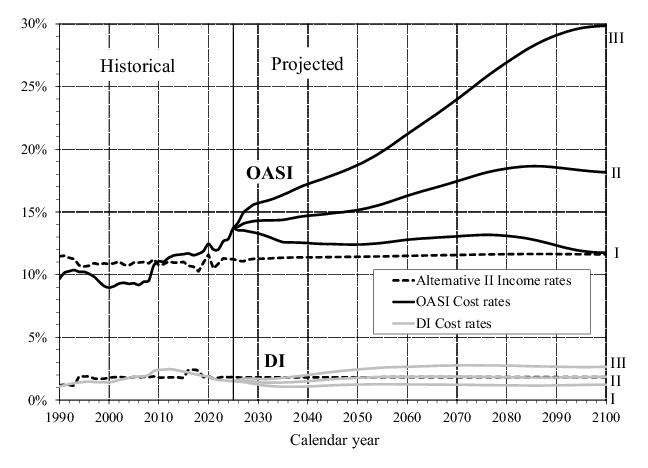
Under the intermediate assumptions, the OASI income rate decreases from 11.24 percent of payroll for 2025 to 11.11 percent of payroll for 2026 and to 11.06 percent of payroll for 2027. The projected income rates for 2026 and 2027 are relatively low because of negative adjustments expected in those years.4 After 2027, the OASI income rate generally gradually rises, reaching 11.62 percent of taxable payroll for 2100. Income from taxation of benefits causes this gradual increase in the OASI income rate for two main reasons: (1) total scheduled benefits are rising faster than payroll; and (2) the ratio of total income tax on benefits to total benefits increases over time for reasons discussed in detail on page 161.
The OASI cost has generally increased rapidly since 2008 and is projected to continue to do so through about 2085. In this period, the number of beneficiaries is increasing much faster than the number of covered workers, as subsequent lower-birth-rate generations replace earlier generations at working ages. The OASI cost rate reaches a maximum of 18.65 percent for 2086 and then declines to 18.17 percent for 2100.
Projections of income rates under the low-cost and high-cost sets of assumptions are similar to those projected for the intermediate assumptions, because income rates are largely a reflection of the payroll tax rates specified in the law, with the changes from taxation of benefits noted above. In contrast, OASI cost rates for the low-cost and high-cost assumptions are significantly different from those projected for the intermediate assumptions. For the low-cost assumptions, the OASI cost rate generally declines from 13.54 percent for 2026 to 12.40 percent for 2049, rises to 13.17 percent for 2076, and then declines to 11.76 percent for 2100, at which point the income rate reaches 11.25 percent. For the high-cost assumptions, the OASI cost rate rises throughout the projection period from 14.18 percent for 2026 to 29.85 percent for 2100, at which point the income rate reaches 12.28 percent.
The pattern of the projected OASI annual balance is important in the analysis of the actuarial status of the program. Under the intermediate assumptions, the annual balance is negative throughout the projection period. The annual deficit generally increases from 2.48 percent of taxable payroll for 2025 to 7.01 percent for 2086, and declines thereafter, reaching 6.55 percent of taxable payroll for 2100.
Under the low-cost assumptions, the OASI annual deficit decreases from 2.52 percent of payroll for 2026 to 1.13 percent of payroll for 2049. After 2049, the annual deficit rises to 1.84 percent for 2076, before decreasing and reaching an annual deficit of 0.51 percent in 2100. Under the high-cost assumptions, the OASI annual deficit rises throughout the projection period from 3.00 percent for 2026 to 17.57 percent for 2100.
Under the intermediate assumptions, the projected DI cost rate generally declines from 1.53 percent for 2026 to 1.38 percent for 2033. Then the DI cost rate increases gradually to 1.86 percent for 2057. Thereafter, the cost rate remains relatively stable, again reaching 1.86 percent for 2100. The DI income rate generally increases from 1.81 percent in 2026 to 1.83 percent in 2100. The annual balance decreases from 0.28 percent of payroll for 2026 to 0.24 percent for 2027, increases to 0.43 percent for 2033 and then decreases and becomes slightly negative (i.e., an annual deficit) in years 2054 through 2079. After 2079, the annual balance increases to 0.04 percent for 2087 and then declines and becomes negative again, reaching an annual deficit of 0.02 percent in 2100.
Under the low-cost assumptions, the projected DI cost rate declines from 1.47 percent of payroll for 2026 to 1.06 percent for 2037 and then increases to 1.26 percent for 2055. The cost rate then declines through 2086 and increases slowly thereafter, reaching 1.23 percent for 2100. The annual balance is positive throughout the long-range period, reaching 0.59 percent of payroll for 2100. Under the high-cost assumptions, the DI cost rate generally rises from 1.59 percent of payroll for 2026 to 2.78 percent for 2072 and fluctuates thereafter, reaching 2.65 percent for 2100. The DI annual balance declines from 0.22 percent of payroll for 2026 and becomes negative starting in 2037. The annual deficits increase to 0.93 percent for 2072, decrease to 0.78 percent for 2095 and then increase to 0.81 percent for 2100.
[As a percentage of taxable payrolla]
Income
rate b
Cost
ratec

a
Annual taxable payroll values are shown in table VI.G1.

b
Income rates include certain reimbursements from the General Fund of the Treasury, but exclude interest income.

c
Benefit payments scheduled to be paid on January 3 are actually paid on December 31 as required by the statutory provision for early delivery of benefit payments when the normal payment delivery date is a Saturday, Sunday, or legal public holiday. For comparability with the values for historical years and the projections in this report, all trust fund operations and reserves reflect the 12 months of benefits scheduled for payment each year.

d
Between -0.005 and 0.005 percent of taxable payroll.

e
The annual balance is projected to be positive throughout the entire 75-year projection period.

f
The annual balance is projected to be negative for a temporary period and then become positive before the end of the projection period.

Notes:
1. Revisions of taxable payroll may change some historical values.
2. Components may not sum to totals because of rounding.
Figure IV.B1 shows the patterns of the historical and projected OASI and DI annual cost rates. The patterns in projected OASI and DI cost rates are described earlier in this chapter. Historical annual OASI cost rates shifted upward starting in 2008 and have remained at relatively high levels since then, primarily due to the changing age distribution of the adult population with the retirement of the baby-boom generation and entry of lower birth-rate generations into working ages.
Historical annual DI cost rates rose substantially between 1990 and 2010 in large part due to: (1) aging of the working population as the baby-boom generation moved from ages 25-44 in 1990, where disabled-worker prevalence is low, to ages 45-64 in 2010, where disabled-worker prevalence is much higher; (2) a substantial increase in the percentage of women insured for DI benefits as a result of increased and more consistent rates of employment; and (3) increased disabled-worker incidence rates for women to a level similar to those for men by 2010. As of 2010, these three factors have largely stabilized. Other factors that are not yet fully understood, including the changing nature of work, have caused age-sex-adjusted disabled-worker incidence rates to generally decline from 2010 to 2022, and remain low through 2025. In turn, age-sex-adjusted disabled-worker prevalence rates and DI cost rates have declined over the last decade.
Figure IV.B1 shows only the income rates for alternative II because the variation in income rates by alternative is very small. Income rates generally increase slowly for each of the alternatives over the long-range period. Taxation of benefits, which is a small portion of income, is the main source of the increases in the income rate and the variation among the alternatives.
Table IV.B1 shows the annual balances for OASI, DI, and OASDI. The pattern of the annual balances is important to the analysis of the actuarial status of the Social Security program as a whole. As seen in figure  IV.B1, the magnitude of each of the positive annual balances is the distance between the appropriate cost-rate curve and the income-rate curve above it. The magnitude of each of the annual deficits is the distance between the appropriate cost-rate curve and the income-rate curve below it. Annual balances follow closely the pattern of annual cost rates after 1990 because the payroll tax rate for the OASDI program has not changed and will not under current law, with only small variations in the allocation between DI and OASI except for changes due to the 1994 and the 2016-18 payroll tax rate reallocations.
In the future, the costs of OASI, DI, and the combined OASDI programs as a percentage of taxable payroll are unlikely to fall outside the range encompassed by alternatives I and III, because alternatives I and III define a wide range of demographic, economic, and program-specific assumptions.
Table IV.B2 contains historical and projected annual income rates and their components by trust fund and alternative. The annual income rates consist of the scheduled payroll tax rates, the rates of income from taxation of scheduled benefits, and the rates of income from General Fund reimbursements. Projected income from taxation of benefits increases over time for reasons discussed on page 161.
Tax-ation
of
bene-
fitsa
General Fund reim-
bursementsb
Totalc

a
Revenue from taxation of benefits is the amount that would be assessed on scheduled benefits under current law.

b
Includes payroll tax revenue forgone under the provisions of Public Laws 111-147, 111-312, 112-78, and 112‑96, and other miscellaneous reimbursements. Also includes transfers of a portion of the proceeds from repayments of loans authorized under Public Law 116-136.

c
Values exclude interest income.

d
Between -0.005 and 0.005 percent of taxable payroll.

Note: Components may not sum to totals because of rounding.
Long-range OASDI cost and income are most often expressed as percentages of taxable payroll. However, cost and income can also be presented as shares of GDP, the value of goods and services produced during the year in the United States. While expressing fund operations as a percentage of taxable payroll is a very useful approach for assessing the financial status of the programs, expressing them as a percentage of GDP provides an additional perspective. Table IV.B3 shows non-interest income, total cost, and the resulting balance of the OASI Trust Fund, the DI Trust Fund, and the combined OASI and DI Trust Funds, expressed as percentages of GDP5 on the basis of each of the three alternative sets of assumptions.
The trends of the annual balance presented as a percentage of GDP are similar to the trends described earlier in this section when presented as a percentage of taxable payroll. The Trustees project the OASDI annual balance (non-interest income less cost) as a percentage of GDP to be negative throughout the projection period under the intermediate and high-cost assumptions. Under the low-cost assumptions, the OASDI annual deficit as a percentage of GDP generally decreases from 2026 through 2042, generally increases through 2075, and then decreases through 2095 before annual balances become positive for years 2096 and later. Under the intermediate assumptions, the OASDI annual deficits as a percentage of GDP generally increase from 2026 through 2085 and decrease thereafter. Under the high-cost assumptions, OASDI annual deficits increase relatively rapidly through 2097 and then slightly decrease through the end of the projection period.
Incomeb
Costc

a
Annual GDP values are shown in table VI.G1.

b
Income rates include certain reimbursements from the General Fund of the Treasury, but exclude interest income.

c
Benefit payments which were scheduled to be paid on January 3 for some past and future years were actually paid on December 31 as required by the statutory provision for early delivery of benefit payments when the normal payment delivery date is a Saturday, Sunday, or legal public holiday. For comparability with the values for historical years and the projections in this report, all trust fund operations and reserves reflect the 12 months of benefits scheduled for payment each year.

d
Between -0.005 and 0.005 percent of GDP.

Notes:
1. Revisions of GDP may change some historical values.
2. Components may not sum to totals because of rounding.
2. Comparison of Workers to Beneficiaries
Under the intermediate assumptions, the OASDI cost rate will rise rapidly until about 2085, primarily because the number of beneficiaries rises much more rapidly than the number of covered workers as workers of earlier generations continue to retire and are replaced at working ages by workers of lower birth-rate generations. The ratio of OASDI beneficiaries to workers is dominated by the OASI program because all workers eventually die or reach retired-worker benefit eligibility age, but only a small minority become eligible for benefits under the DI program.
The trends described below are primarily due to demographic changes and thus affect the DI program roughly 20 years earlier than the OASI and OASDI programs. The baby-boom generation had lower fertility rates than their parents, and lower rates are expected to persist for all future generations. Combining this factor with increasing longevity in the future, the ratio of OASDI beneficiaries to workers will continue to rise over about the next 60 years. Table IV.B4 provides a comparison of the numbers of covered workers and beneficiaries.
Covered
workers a
(in thousands)
Beneficiaries b (in thousands)
OASDIc
4184,666

a
Workers who are paid at some time during the year for employment on which OASDI taxes are due.

b
Beneficiaries with monthly benefits in current-payment status as of June 30.

c
This column is the sum of OASI and DI beneficiaries. A small number of beneficiaries receive benefits from both funds.

d
Estimated values for 2025 vary slightly by alternative and are shown for the intermediate assumptions.

Notes:
1. The number of beneficiaries does not include uninsured individuals who received benefits under section 228 of the Social Security Act. The General Fund of the Treasury reimbursed the trust funds for the costs of most of these individuals.
2. Historical covered worker and beneficiary data are subject to revision.
3. Components may not sum to totals because of rounding.
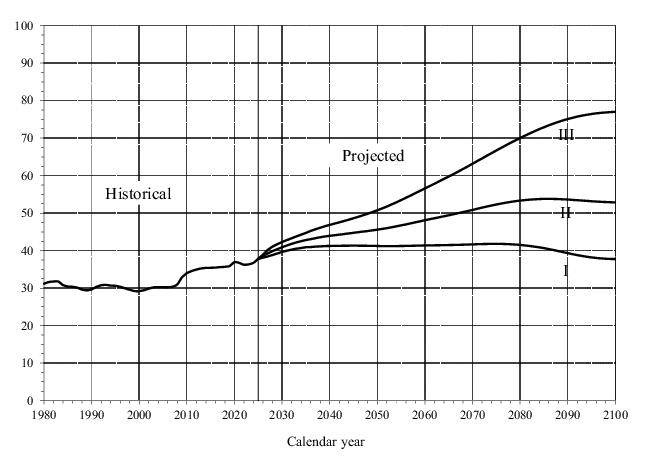
The effect of the demographic shift on the OASDI cost rates is clear when one considers the projected number of OASDI beneficiaries per 100 covered workers under the three alternatives. Compared to the 2025 level of 38 beneficiaries per 100 covered workers, this ratio is projected to rise to 54 by 2085 under the intermediate assumptions, because the growth in beneficiaries greatly exceeds the growth in workers. This projected ratio under the intermediate assumptions remains relatively stable thereafter, reaching 53 by 2100. Under the high-cost assumptions, this ratio rises to 77 by 2100. Under the low-cost assumptions, this ratio rises to 42 by 2070 and then generally declines, reaching 38 by 2100. Figure IV.B2 shows beneficiaries per 100 covered workers.
For each alternative, the curve in figure IV.B2 is strikingly similar to the corresponding cost-rate curve in figure IV.B1. This similarity emphasizes the extent to which the cost rate is determined by the age distribution of the population. The cost rate is essentially the product of the number of beneficiaries and their average benefit, divided by the product of the number of covered workers and their average taxable earnings. For this reason, the pattern of the annual cost rates is similar to that of the annual ratios of beneficiaries to workers.
Table IV.B4 also shows the number of covered workers per OASDI beneficiary, which was about 2.6 for 2025. Under the intermediate assumptions, this ratio declines generally throughout the long-range period, reaching 1.9 by 2075 and remaining relatively stable thereafter. Under the low-cost assumptions, this ratio declines to 2.4 for 2035, remains stable through 2084 before generally increasing to 2.6 for 2100. Under the high-cost assumptions, this ratio decreases to 1.3 for 2100.
3. Trust Fund Ratios and Test of Long-Range Close Actuarial Balance
Trust fund ratios are critical indicators of the adequacy of the financial resources of the Social Security program. The trust fund ratio for a year is the amount of reserves in a fund at the beginning of a year expressed as a percentage of the cost for the year. Under current law, the OASI and DI Trust Funds do not have the authority to borrow other than in the form of advance tax transfers. If reserves held in either trust fund become depleted during a year, and continuing revenue falls short of the cost of scheduled benefits, then full scheduled benefits would not be payable on a timely basis. For this reason, the trust fund ratio is a critical financial measure.
The trust fund ratio serves an additional important purpose in assessing the actuarial status of the program. If the projected trust fund ratio is positive throughout the period and is either level or increasing at the end of the period, then projected adequacy for the long-range period is likely to continue for subsequent reports. Under these conditions, the program has achieved sustainable solvency.
Table IV.B5 shows the projections of trust fund ratios by alternative, without regard to advance tax transfers that would be effected, for the separate and combined OASI and DI Trust Funds. The table also shows the years of trust fund reserve depletion and the percentage of scheduled benefits that would be payable thereafter, by alternative.
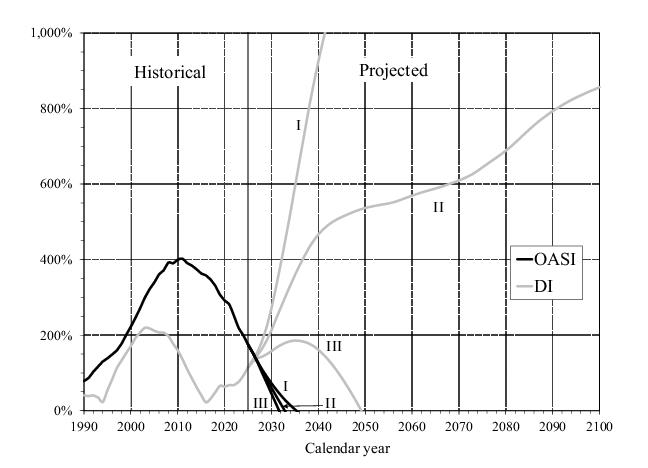
Under the intermediate assumptions, the OASI trust fund ratio is projected to decline from 153 percent at the beginning of 2026 until the trust fund reserves become depleted in 2032 (one year earlier than projected in last year’s report), at which time 78 percent of scheduled benefits would be payable.
The DI Trust Fund remains solvent throughout the long-range period under the intermediate assumptions, as in last year’s report. The DI trust fund ratio increases throughout the projection period from 132 percent at the beginning of 2026 to 862 percent for 2101. Because the DI trust fund ratio is positive throughout the 75-year projection period and increasing at the end of the period, the DI program achieves sustainable solvency under the intermediate assumptions.
Under the intermediate assumptions, the trust fund ratio for the combined OASI and DI Trust Funds declines from 151 percent at the beginning of 2026 until the combined fund reserves become depleted in 2034 (the same year as projected in last year’s report), at which time 83 percent of scheduled benefits would be payable.
Under the low-cost assumptions, the trust fund ratio for the DI program increases from 2026 throughout the projection period, from 134 percent at the beginning of 2026 to the extremely high level of 4,560 percent for 2101. For the OASI program, the trust fund ratio declines steadily, from 153 percent for 2026 until the reserves become depleted in 2035, at which time 89 percent of scheduled benefits would be payable. For the combined OASDI program, the trust fund ratio declines from 151 percent for 2026 until the combined fund reserves become depleted in 2048. Because the DI trust fund ratio is positive throughout the projection period and increasing at the end of the period, the DI program achieves sustainable solvency under the low-cost assumptions.
Under the high-cost assumptions, the OASI trust fund ratio declines from 153 percent for 2026 until reserves become depleted in 2031, at which time 70 percent of scheduled benefits would still be payable. The DI trust fund ratio increases from 130 percent for 2026 to 185 percent for 2035, and then declines until the reserves become depleted in 2049. At that time, 76 percent of scheduled benefits would still be payable. The combined OASI and DI trust fund ratio declines from 151 percent for 2026 until reserves become depleted in 2032, at which time 74 percent of scheduled benefits would still be payable.
Trust fund reserve depletion occurs within the 75-year projection period for the OASI Trust Fund under the low-cost, intermediate, and high-cost assumptions, and for the DI Trust Fund under the high-cost assumptions. It is therefore very likely that lawmakers will need to increase income, reduce program costs, or both, in order to maintain solvency for the OASI Trust Fund. The stochastic projections discussed in appendix E suggest that OASI and combined OASI and DI Trust Fund reserve depletion is highly probable by 2040.
In the 2025 report, the combined trust fund reserves were projected to become depleted in 2032, 2034, and 2051 under the high-cost, intermediate, and low-cost assumptions, respectively.
Table IV.B5.—Trust Fund Ratios, Calendar Years 2026-2100a
c100
c100

a
Benefit payments scheduled to be paid on January 3 are actually paid on December 31 as required by the statutory provision for early delivery of benefit payments when the normal payment delivery date is a Saturday, Sunday, or legal public holiday. For comparability with the values for historical years and the projections in this report, all trust fund ratios reflect the 12 months of benefits scheduled for payment each year.

b
Trust fund reserves would be depleted at the beginning of this year.

c
Trust fund reserves would not be depleted within the projection period.

Note: The definition of trust fund ratio appears in the Glossary.
Since 2013, when the Trustees last modified the test of long-range close actuarial balance, the standard for each trust fund requires meeting two conditions: (1) the test of short-range financial adequacy is satisfied; and (2) the trust fund ratios stay above zero throughout the 75-year projection period, allowing scheduled benefits to be paid in a timely manner throughout the period. Both the long-range test and the short-range test are applied based on the intermediate set of assumptions. As discussed in section IV.A, the DI Trust Fund satisfies the test of short-range financial adequacy because the trust fund ratio stays above 100 percent throughout the 10-year short-range projection period. The OASI and combined OASI and DI Trust Funds fail the test of short-range financial adequacy because the trust fund ratios drop below 100 percent by the end of the 10‑year period. Under the intermediate assumptions, the OASI Trust Fund reserves become depleted in 2032, DI Trust Fund reserves stay positive throughout the 75‑year period, and the combined OASI and DI Trust Fund reserves become depleted in 2034. Therefore, the OASI and combined OASI and DI Trust Funds fail the test of long-range close actuarial balance, and the DI program satisfies the test of long-range close actuarial balance.
Figure IV.B3 illustrates the trust fund ratios for the separate OASI and DI Trust Funds for each of the alternative sets of assumptions. DI Trust Fund status is more uncertain than OASI Trust Fund status because there is a high degree of uncertainty associated with future disabled-worker prevalence. A graph of the trust fund ratios for the combined trust funds appears in figure II.D6.
4. Summarized Income Rates, Summarized Cost Rates, and Actuarial Balances
Summarized values for the full 75-year period are useful in analyzing the program’s long-range actuarial status over the period as a whole, both under current law and under proposed modifications to the law. All annual amounts included in a summarized value are present-value discounted to the valuation date. It is important to note that the actuarial balance indicates the solvency status of the fund only for the very end of the period.
Table IV.B6 presents summarized income rates, summarized cost rates, and actuarial balances, expressed as percentages of taxable payroll, for 25-year, 50-year, and 75-year valuation periods. Summarized income rates are the sum of the present value of non-interest income for a period (which includes scheduled payroll taxes, the projected income from the taxation of scheduled benefits, and reimbursements from the General Fund of the Treasury) and the starting trust fund reserves, expressed as a percentage of the present value of taxable payroll over the period. Under current law, the total OASDI payroll tax rate will remain at 12.4 percent in the future. In contrast, income from taxation of benefits, expressed as a percentage of taxable payroll, is expected to increase in most years of the long-range period for the reasons discussed on page 161. Summarized cost rates are the sum of the present value of cost for a period (which includes scheduled benefits, administrative expenses, net interchange with the Railroad Retirement program, and payments for vocational rehabilitation services for disabled beneficiaries) and the present value of the cost of reaching a target trust fund of 100 percent of annual cost at the end of the period, expressed as a percentage of the present value of taxable payroll over the period.
The actuarial balance for a valuation period is equal to the difference between the summarized income rate and the summarized cost rate for the period. An actuarial balance of zero for any period indicates that cost for the period could be met for the period as a whole (but not necessarily at all points within the period), with a remaining trust fund reserve at the end of the period equal to 100 percent of the following year’s cost. A negative actuarial balance for a period indicates that the present value of income to the program plus the existing trust fund is less than the present value of the cost of the program plus the cost of reaching a target trust fund reserve of one year’s cost by the end of the period. Generally, a trust fund is deemed to be adequately financed for a period as a whole if the actuarial balance is zero or positive, meaning that the reserves at the end of the period are at least equal to annual cost. Note that solvency is possible at the end of the period with a small negative actuarial balance where reserves are still positive.6
Table IV.B6 contains summarized rates for the intermediate, low-cost, and high-cost assumptions. The low-cost and high-cost assumptions define a wide range of possibilities. Financial outcomes as good as the low-cost scenario or as bad as the high-cost scenario are unlikely to occur.
For the 25-year valuation period, the OASDI program has an actuarial balance of -0.59 percent of taxable payroll under the low-cost assumptions, ‑2.69 percent under the intermediate assumptions, and -5.20 percent under the high-cost assumptions. These balances indicate that the program is not adequately financed for the 25‑year valuation period under any of these three sets of assumptions.
For the 50‑year valuation period, the OASDI program has actuarial balances of -0.72 percent under the low-cost assumptions, ‑3.70 percent under the intermediate assumptions, and ‑7.51 percent under the high-cost assumptions. These actuarial balances mean that the OASDI program is not adequately financed for the 50‑year valuation period under any of these three sets of assumptions.
For the entire 75-year valuation period, the combined OASDI program has actuarial balances of -0.64 percent of taxable payroll under the low-cost assumptions, ‑4.42 percent under the intermediate assumptions, and ‑9.42 percent under the high-cost assumptions. These balances indicate that the combined OASDI program is not adequately financed for the 75-year valuation period under any of these three sets of assumptions.
Assuming the intermediate assumptions accurately capture future demographic, economic, and program-specific trends, solvency for the program over the next 75 years could be restored using a variety of illustrative approaches. For example, revenue could be increased in a manner equivalent to an immediate and permanent increase in the combined Social Security payroll tax rate from 12.40 percent to 16.65 percent (a relative increase of 34.3 percent),7 cost could be reduced in a manner equivalent to an immediate and permanent reduction in scheduled benefits of 25.2 percent, or some combination of approaches could be used.
However, eliminating the actuarial deficit for the next 75-year valuation period requires raising payroll taxes or lowering benefits by more than is required just to achieve solvency, because the actuarial deficit includes the cost of attaining a target trust fund equal to 100 percent of annual program cost by the end of the period. The actuarial deficit could be eliminated for the 75-year period by increasing revenue in a manner equivalent to an immediate and permanent increase in the combined payroll tax from 12.40 percent to 16.83 percent (a relative increase of 35.7 percent),8 reducing cost in a manner equivalent to an immediate reduction in scheduled benefits of 25.9 percent, or some combination of approaches could be used.
Under the intermediate assumptions, the OASDI program has large annual deficits toward the end of the long-range period that reach 6.57 percent of payroll for 2100 (see table IV.B1). These large deficits indicate that annual cost continues to exceed non-interest income after 2100, so continued adequate financing would require larger changes than those needed to maintain solvency for the 75-year period. Over the period extending through the infinite horizon, the actuarial deficit is 5.7 percent of payroll under the intermediate assumptions.
Beginning
reservesa

1
Benefit payments scheduled to be paid on January 3 are actually paid on December 31 as required by the statutory provision for early delivery of benefit payments when the normal payment delivery date is a Saturday, Sunday, or legal public holiday. For comparability with the values for historical years and the projections in this report, all trust fund operations and reserves reflect the 12 months of benefits scheduled for payment each year.

Note: Components may not sum to totals because of rounding.
Table IV.B7 presents summarized income rates, summarized cost rates, and actuarial balances, expressed as percentages of GDP, for 25-year, 50-year, and 75-year valuation periods. The table contains summarized rates for the OASI Trust Fund, the DI Trust Fund, and the combined OASI and DI Trust Funds for the intermediate, low-cost, and high-cost assumptions.
The summarized long-range (75-year) actuarial balance as a percentage of GDP for the OASDI program varies among the three alternatives by a relatively large amount, from an actuarial deficit of 0.24 percent under the low-cost assumptions to an actuarial deficit of 3.14 percent under the high-cost assumptions. The 25-year summarized actuarial balance varies by a smaller amount, from an actuarial deficit of 0.22 percent of GDP to an actuarial deficit of 1.79 percent. Summarized rates are calculated on a present-value basis. They include the trust fund reserve balances on January 1, 2026 and the cost of reaching a target trust fund level equal to 100 percent of the following year’s annual cost at the end of the period.
Beginning
reservesa

a
Benefit payments scheduled to be paid on January 3 are actually paid on December 31 as required by the statutory provision for early delivery of benefit payments when the normal payment delivery date is a Saturday, Sunday, or legal public holiday. For comparability with the values for historical years and the projections in this report, all trust fund operations and reserves reflect the 12 months of benefits scheduled for payment each year.

Note: Components may not sum to totals because of rounding.
5. Open-Group Unfunded Obligation
This report uses a 75-year open-group valuation to evaluate the long-range actuarial status of the OASDI program. The open-group valuation includes non-interest income and cost for past, current, and future participants through the year 2100. The open-group unfunded obligation measures the adequacy of financing over the period as a whole for a program financed on a pay-as-you-go basis. On this basis, payroll taxes and scheduled benefits for all participants are included through 2100.
The open-group unfunded obligation increased from $25.1 trillion shown in last year's report to $29.3 trillion in this report. If there had been no changes in starting values, assumptions, laws, or methods for this report, then the open-group unfunded obligation would have increased to $26.1 trillion solely due to the change in the valuation period. This expected increase in the unfunded obligation occurs because: (1) the unfunded obligation is now discounted to January 1, 2026, rather than to January 1, 2025, which tends to increase the unfunded obligation by the annual nominal interest rate; and (2) the unfunded obligation now includes an additional year (2100). Changes in the law, assumptions, methods, and starting values resulted in an additional $3.2 trillion increase in the unfunded obligation.
The 75-year unfunded obligation is equivalent to 4.24 percent of OASDI taxable payroll and 1.5 percent of GDP for 2026-2100.9 These percentages were 3.64 and 1.3, respectively, for last year’s report. The 75-year unfunded obligation as a percentage of taxable payroll is less than the actuarial deficit, because the unfunded obligation excludes the cost of having an ending target trust fund value.
The actuarial deficit was 3.82 percent of payroll in last year’s report, and was expected to increase to a deficit of 3.89 percent of payroll solely due to the change in the valuation period. Changes in the law, assumptions, methods, and starting values combined to account for an additional 0.53 percentage point increase (worsening) in the actuarial deficit to 4.42 percent of payroll. The actuarial deficit is 1.5 percent of GDP in this year’s report, 0.2 percentage points higher than in last year’s report.
As mentioned above, the open-group unfunded obligation expressed in dollars is higher than it would have been if only the valuation period had been changed. This net increase occurred for a variety of reasons described in the next section, in particular: (1) the reduction in the assumed ultimate fertility rate from 1.90 children per woman to 1.75 children per woman, (2) changes to assumptions for immigration levels and emigration rates for the temporary or unlawfully present immigrant population, and (3) the enactment of the One Big Beautiful Bill Act, which led to lower trust fund income from taxation of benefits.
Table IV.B8 presents the components and the calculation of the long-range (75-year) actuarial balance under the intermediate assumptions. The present value of future cost less future non-interest income over the long-range period, minus the amount of trust fund reserves at the beginning of the projection period, is $29.3 trillion for the OASDI program. This amount is the 75-year open-group unfunded obligation (see row H). The actuarial deficit (which is the negative of the actuarial balance) combines this unfunded obligation with the present value of the ending target trust fund and expresses the total as a percentage of the present value of the taxable payroll for the period. The present value of future non-interest income minus cost, plus starting trust fund reserves, minus the present value of the ending target trust fund, is ‑$30.5 trillion for the OASDI program.

a
Less than $0.5 billion.

b
The calculation of the actuarial balance includes the cost of accumulating a target trust fund reserve equal to 100 percent of annual cost at the end of the period.

Note: Components may not sum to totals because of rounding.
Consideration of summary measures alone (such as the actuarial balance and open-group unfunded obligation) for a 75-year period can lead to incorrect perceptions and to policy prescriptions that do not achieve sustainable solvency. These concerns can be addressed by considering the trend in trust fund ratios toward the end of the period. (See the discussion of sustainable solvency beginning on page 55.)
Another measure of trust fund finances, discussed in appendix F, is the infinite horizon unfunded obligation, which takes account of all annual balances, even those after 75 years. The extension of the time period past 75 years assumes that the current-law OASDI program and the demographic, economic, and program-specific trends used for the 75‑year projection continue indefinitely. This infinite horizon unfunded obligation is estimated to be 5.7 percent of taxable payroll or 1.8 percent of GDP. These percentages were 5.2 and 1.6, respectively, for last year’s report. Of course, the degree of uncertainty associated with estimates increases substantially for years further in the future.
6. Reasons for Change in Actuarial Balance From Last Year’s Report
Table IV.B9 shows the net effects of changes on the long-range actuarial balance for OASI, DI, and OASDI under the intermediate assumptions, by broad category, between last year’s report and this report.
Valuation period b
-.06
-.01
-.07
-.43
-.02
-.44
-.61

a
Between -0.005 and 0.005 percent of taxable payroll.

b
The change in the 75-year valuation period from last year’s report to this report means that the 75-year actuarial balance now includes the relatively large negative annual balance for 2100. This change in the valuation period results in a larger long-range actuarial deficit. The actuarial deficit includes the trust fund reserve at the beginning of the projection period.

Note: Components may not sum to totals because of rounding.
If the law, data, assumptions, and methods had all remained unchanged from last year’s Trustees Report, the long-range OASDI actuarial balance would have decreased (worsened) by 0.07 percent of taxable payroll solely due to the change in the valuation period. However, as described in more detail below, projections in this report also reflect new data and changes in law, assumptions, and methods. These changes, including the change in the valuation period, combine to decrease the long-range OASDI actuarial balance by 0.60 percentage points, from ‑3.82 percent of taxable payroll in last year’s report to -4.42 percent in this report.10
Legislation/Regulation
Changes in law, regulations, and policy since the last report decrease the long-range OASDI actuarial balance by 0.16 percent of taxable payroll. See section III.B for further details.
The One Big Beautiful Bill Act (OBBBA) was signed into law on July 4, 2025. This law makes permanent the lower ordinary income tax rates and adjusted tax brackets originally enacted under the 2017 Tax Cuts and Jobs Act and both increases and makes permanent the larger standard deduction of the 2017 Act. The OBBBA also adds a temporary additional standard deduction for taxpayers over age 65. Overall, the OBBBA effectively reduces taxable income for many Social Security beneficiaries. As a result, less income tax will be paid on Social Security benefits, and the OASI and DI Trust Funds will receive lower levels of revenue in the future from income taxation of Social Security benefits. The overall effect of this law change is a decrease in the OASDI actuarial balance of 0.16 percent of taxable payroll.
Valuation Period
As mentioned above, changing the 75-year valuation period from 2025 through 2099 for last year’s report to 2026 through 2100 for this report decreases the projected long-range OASDI actuarial balance by 0.07 percent of taxable payroll. This decrease occurs because (1) the annual balances after 2025 are now discounted to January 1, 2026, rather than to January 1, 2025, and (2) the relatively large negative annual balance for 2100 is now included in this year’s 75-year projection period. Note that the actuarial balance calculation includes trust fund reserves at the beginning of the projection period. These reserves reflect the program’s net financial flows for all past years, including 2025, up to the start of the valuation period.
Demographic Data and Assumptions
New demographic data and changes in demographic assumptions combine to decrease the long-range OASDI actuarial balance by 0.44 percent of taxable payroll.
Two ultimate demographic assumptions were changed for this year’s report.
First, the ultimate total fertility rate was lowered from 1.90 children per woman to 1.75 children per woman; the ultimate rate is reached in 2050 in both this year’s report and last year’s report. Continued low birth rates in the U.S. and around the world, in addition to societal changes related to family formation and the desire for children, provide convincing evidence that birth rates will not rise to historical averages. At the same time, there is evidence that the recent period of very low birth rates is partially the result of women waiting to have children until older ages. The Trustees weighed these factors and reduced the ultimate total fertility rate to a level below historical averages but above recent low levels. This change to the ultimate rate, including the resulting lower rates during the transition period from now until 2050, decreases the actuarial balance by 0.33 percent of taxable payroll.
Second, the ultimate level of temporary or unlawfully present immigrants entering the country was reduced to 1,200,000 per year for years 2035 and later, based on a review of the levels of such immigration since 1999. This value is 150,000 less than the ultimate value of 1,350,000 assumed for last year’s report. This change in the ultimate level, in combination with the gradually increasing transition path from current low levels to the ultimate level in 2035, decreases the actuarial balance by 0.12 percent of taxable payroll.
Updates to recent demographic data and near-term assumptions also result in significant changes in the actuarial balance.
First, final birth data for calendar year 2024 and preliminary data for 2025 indicate that total fertility rates were somewhat lower than the rates assumed in last year’s report for those years. Incorporating the updated data led to generally slightly lower birth rates during the transition period to the ultimate level, decreasing the actuarial balance by 0.02 percent of taxable payroll.
Second, there were several updates to the mortality data used for this report. The projections now include 2024 data in the regressions used to develop the starting death rates and the starting rates of mortality improvement. Data for years 2020 through 2023 continue to be excluded, in order to avoid biasing the projections inappropriately by including data from the years most affected by the COVID-19 pandemic. For the 2021 through 2025 reports, data only through 2019 was included in the regressions, with adjustment factors applied to death probabilities for the first few years of the projection to adjust for the effects of the pandemic. The updated approach for this year’s report allows the projections to better capture recent trends by age group and cause of death. In addition, this year’s report incorporates updated data on the U.S. resident population from the Census Bureau, mortality data for ages under 65 from the National Center for Health Statistics for years 2023-25, and mortality data for ages 65 and older from Medicare experience for years 2022-24. In combination, these mortality data updates lead to higher death rates for all future years than were projected in last year’s report, increasing the actuarial balance by about 0.09 percent of taxable payroll.
Third, the estimated levels of temporary or unlawfully present immigrant entrants have been decreased for calendar years 2022-25, compared to the levels in last year’s report. The lower levels in 2022-25 reflect updated data on border crossings from the Department of Homeland Security. These changes result in a decrease in the actuarial balance of 0.04 percent of taxable payroll.
Fourth, assumed emigration rates from the unlawfully present population are higher for years 2025-30 than those assumed in last year’s report, consistent with the recent adoption of more restrictive policies regarding the unlawfully present population and the expectation that these policies will continue into the near future. This change to assumed emigration rates decreases the actuarial balance by 0.05 percent of payroll.
Fifth, updates to data for lawful immigration, the historical population, marriage, and divorce combine to increase the actuarial balance by 0.03 percent of taxable payroll.
Economic Data and Assumptions
New economic data and changes in economic assumptions, in combination, increase the long-range OASDI actuarial balance by 0.10 percent of taxable payroll.
The ultimate economic assumptions are unchanged for this year’s report. However, updates to recent economic data and near-term assumptions result in significant changes in the actuarial balance.
In particular, this year’s report includes an improved outlook for labor productivity and average earnings growth over the next ten years. The average productivity growth rate from 2025 to 2035 is 1.62 percent, 0.05 percentage points above the rate assumed over that period in the last year’s report. The growth in average real earnings from 2025 to 2035 averages 1.72 percent, significantly higher than the 1.44 percent annual rate projected in the 2025 reports. These updates to economic data and near-term assumptions combine to increase the actuarial balance by 0.10 percent of taxable payroll.
Other small changes to historical data and near-term economic assumptions combine for a net negligible increase in the actuarial balance. These changes include updates to data for average weeks worked and educational attainment and small changes to the assumed real interest rates over the first 20 years of the projection period.
Disability Data and Assumptions
New disability data and changes in disability assumptions combine to increase the long-range OASDI actuarial balance by 0.02 percent of taxable payroll. The largest effect is due to the assumptions for disabled-worker incidence rates over the first ten years of the projection, which transition more gradually to the ultimate incidence rate of 4.6 per thousand than in last year’s report.
Methods and Programmatic Data
The projections in this report also reflect several methodological improvements and updates based on new program-specific data. These methodological changes, programmatic data updates, and interactions combine to decrease the long-range OASDI actuarial balance by 0.05 percent of taxable payroll. Descriptions of four significant methodological changes and programmatic data updates follow.
First, the approach used to model labor force participation of workers age 75 and older was improved. The parameters used in the modeling were updated to be consistent with administrative employment records for recent years (2011 through 2024), resulting in lower projected labor force participation and employment rates of the oldest workers. This method improvement decreases the actuarial balance by 0.08 percent of taxable payroll.
The second significant change is an improvement to the method for projecting the age distribution of those who became eligible to receive aged-spouse and widow(er) benefits following enactment of the Social Security Fairness Act. Prior to enactment of this law in January 2025, these individuals were not eligible to receive Social Security benefits because they received a substantial government pension. This method improvement decreases the actuarial balance by 0.02 percent of taxable payroll.
Third, recent data and estimates provided by the Office of Tax Analysis in the Department of the Treasury indicate lower levels of revenue from income taxation of OASDI benefits than projected in last year’s report, but not as low as indicated by the effects of the OBBBA alone. This offsetting increase in projected ratios of income tax on benefits to benefit amounts, by itself, increases the actuarial balance by 0.04 percent of taxable payroll.
The fourth significant change is related to the sample used for the long-range model for projecting average benefit levels of retired-worker and disabled-worker beneficiaries who become newly entitled for benefits. This model uses a large sample of 10 percent of all newly entitled retired-worker beneficiaries in a recent year. The sample used in last year’s report was for worker beneficiaries newly entitled in 2021, while this year’s report uses the results from worker beneficiaries newly entitled in 2022. This update results in an increase in the actuarial balance of 0.03 percent of taxable payroll.
In addition to these four methodological changes and programmatic data updates, changes in starting levels and projected levels of OASI and DI beneficiaries and benefit amounts over the first 10 years of the projection period, updating other programmatic data, other small methodological improvements, and interactions among the various method changes and updates to programmatic experience combine to decrease the long-range actuarial balance by about 0.02 percent of taxable payroll.
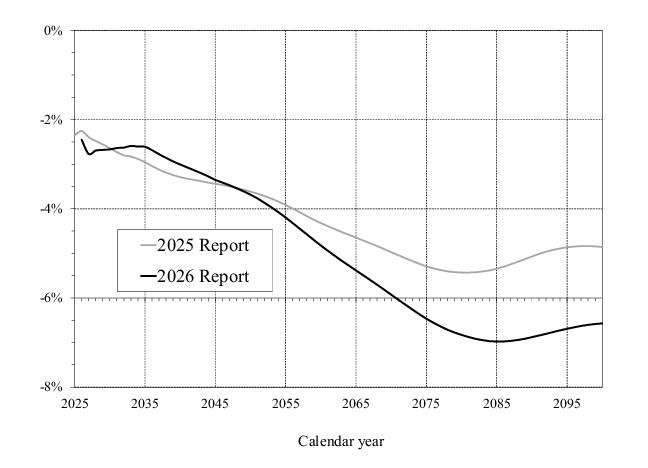
Figure IV.B4 compares the annual balances for this report and the prior year’s report for the combined OASDI program over the long-range (75‑year) projection period. The figure illustrates the annual effects of the changes described earlier in this section.
The projected annual balances in this year’s report are lower in years 2026‑30, higher in 2031-47, and lower in 2048-2100 than the annual balances in last year’s report. These patterns are due to the changes incorporated in this year’s report, described above. In particular, annual balances are lower in this year’s report for 2026 and 2027 due to anticipated negative adjustments to payroll tax contributions, and lower through 2030 due to the effects of the changes in near-term immigration assumptions and the near-term effects of the OBBBA. Annual balances trend higher over the next several years due to the improved outlook for labor productivity and average earnings growth in the first ten years of the projection. After that, the annual balances trend increasingly lower than in last year’s report, due primarily to the reduction in the ultimate total fertility rate; the changes in assumptions for temporary or unlawfully present immigration and emigration also contribute. For the 75‑year projection period 2026-2100, the annual balances average 0.72 percentage points lower in this year’s report. For 2100, the projected annual deficit is 6.57 percent of taxable payroll in this report, compared to 4.86 percent in last year's report.

1
See appendix F.

2
Adjustments include adding deemed wage credits based on military service for 1983-2001 and reflecting the lower effective tax rates (as compared to the combined employee-employer rate) that apply to multiple-employer excess wages. Lower rates also applied to net earnings from self-employment before 1984 and to income from tips before 1988.

3
Annual taxable payroll values are shown in table VI.G1.

4
Payroll taxes are initially credited to the trust funds on an estimated basis during a given year. Adjustments reflect differences due to the subsequent determination of taxes owed based on actual earnings for that year as reported to the Social Security Administration. A positive adjustment indicates that the initial taxes credited were underestimated; a negative adjustment indicates an overestimate.

5
Annual GDP values are shown in table VI.G1.

6
A program is solvent over any period for which the trust fund maintains a positive level of reserves. In contrast, the actuarial balance for a period includes the cost of having a target fund equal to 100 percent of the following year’s cost at the end of the period. Therefore, if a program ends the period with reserves that are positive but not sufficient to cover the following year’s costs, it will be solvent at the end of the period and yet still have a small negative actuarial balance for that period.

7
The 4.25 percentage point increase in the payroll tax rate required to achieve 75-year solvency differs somewhat from the 4.42 percent actuarial deficit. This is primarily because the rate increase required to achieve 75-year solvency reflects a zero trust fund reserve at the end of the period, whereas the 4.42 percent actuarial deficit incorporates an ending trust fund reserve equal to one year’s cost. While such an increase in the payroll tax rate would cause some behavioral changes in earnings and ensuing changes in benefit levels, such changes are not included in these calculations because they are assumed to have roughly offsetting effects on actuarial status over the 75-year long-range period as a whole.

8
The calculation of the payroll tax rate increase required to eliminate the actuarial deficit also does not include the effects of behavioral changes, because they are assumed to have roughly offsetting effects.

9
The present value of taxable payroll for 2026-2100 is $690.4 trillion. The present value of GDP for 2026-2100 is $1,978.4 trillion. In last year’s report, the present value of taxable payroll for 2025-99 was $689.6 trillion and the present value of GDP was $2,001.2 trillion.

10
Values in this section may not sum to totals because of rounding.


Table of Contents Previous Next Tables Figures Index
SSA Home | Privacy Policy | Website Policies & Other Important Information | Site Map | Actuarial Publications June 9, 2026