

History of SSA 1993-2000
he Social Security Administration (SSA) administers dynamic programs. Ideally, they change with the needs of those they are designed to serve. “Program management” is the process of overseeing these changes. Effective program management requires an agency to be in touch with its customers, the advocate community, the Congress, the media and other stakeholders. Besides understanding the current needs of its customers, an agency adept at program management engages in effective research and development and strategic planning to ensure that it both understands the future needs of its customers and is strategically positioned to address them. In 1993, at the beginning of the Clinton Administration, SSA was an agency under the guidance and leadership of HHS. As a component of HHS, SSA had little need for great expertise in the area of policy development or proactive program management, since these were functions performed for the most part for SSA by HHS. While SSA had a program policy staff, it was primarily engaged in formulating implementation plans rather than in defining and developing a public policy agenda. Similarly, SSA had only a small staff presence in Washington working with congressional staffs and with customer advocates. This began to change in 1995 after SSA became an independent agency and began to develop stronger legislative and policy expertise. Under the leadership of Commissioner Shirley Chater, SSA initiated a process change effort in the disability program by launching Disability Redesign. Simultaneously, SSA was challenged with the task of implementing several problematic aspects of Welfare Reform, affecting childhood disability and non-citizen recipients of the SSI program. Commissioner Kenneth Apfel built upon the work already underway to redesign the disability program. He focused on improving the management of the disability program by modernizing the disability decisionmaking process to improve the consistency of the decisions rendered at all levels of the process. In addition, he defined as his first priority as Commissioner the need to carefully review the way in which SSA had implemented the changes to the SSI childhood provisions of Welfare Reform. While the disability program is SSA’s largest and most complex, it is not the only program SSA administers and was not the only program management challenge SSA faced from 1993-2000. Besides the challenges of the disability program and Welfare Reform, SSA also faced challenges in other programs, as well as the challenge of preparing itself for the future.
The Challenge of the Disability Program
SSA administers two programs for the disabled. To qualify for either program, an individual must be totally disabled … that is strictly defined as having a physical or emotional disability that is so severe that it prevents the person from working for at least a year, or is expected to result in death. Social Security disability benefits (SSDI) are paid from worker contributions to the Social Security trust fund and requires both sufficient work to achieve insured status and recent work. The Supplemental Security Income (SSI) program is funded through general revenues rather than worker contributions, and it pays benefits to those who are disabled but do not meet the work requirements of SSDI and who are financially needy.
The Case for Process Change
Disability Redesign SSA and State Disability Determination Services (DDS) have continually worked to provide high-quality responsive service to the public. Despite these efforts, in the early 1990s, the disability insurance (DI) and Supplemental Security Income (SSI) claims workload became the Agency’s most challenging problem. SSA was faced with unprecedented workload increases in both the DI and SSI programs, which severely strained resources. Despite improvements in productivity by all components, SSA was having difficulty providing a satisfactory level of service to claimants for disability benefits. In an era of spending limitations and competing social-spending priorities, SSA recognized that placing more and more resources into the current process was not a viable alternative. Additionally, demographic changes in the general population and in the SSA claimant population presented challenges as well as opportunities for the Agency. More focus was needed in the area of disability. American society had changed dramatically since the DI program began in the 1950s. This was reflected in an increased demand for services, changes in the characteristics of claimants seeking benefits, and complexities in claims-related workloads and processes. Additionally, the enactment of the SSI program in the 1970s added individuals who had sketchy work histories, increased the number of individuals filing based on disabilities such as mental impairments, and provided for eligibility of disabled children. The requirements of the SSI program added complex and time consuming development of non-disability eligibility factors such as income, resources, and living arrangements. Despite the workload and demographic changes, however, the procedures for processing disability claims had not changed since the beginning of the DI program in the 1950s and many of the Agency’s current practices were based, in large part, on procedures begun 40 years ago. Disability process changes that had evolved over time tended to reflect small, incremental improvements designed to address various pieces of the overall process. It became increasingly clear that incremental improvements were no longer sufficient to achieve the level of service that could make a substantial difference to disability claimants. Thus, SSA needed a longer-term strategy for addressing service delivery problems in the disability claim process. The National Performance Review report, released in the fall of 1993, called upon agencies to establish customer service standards equal to the best in the business to guide their operations. Federal agencies were encouraged to identify “the customers who are, or should be serviced, by the agency,” and survey these customers “to determine the kind and quality of services they want and their level of satisfaction with existing services.” Because of the increasing need to focus on disability issues, SSA looked at their disability customers, including those filing for Social Security or Supplemental Security Income disability benefits and potential filers for these benefits. Focus groups conducted throughout the country, representing a demographically diverse cross-section of customers indicated that they
1993 Process
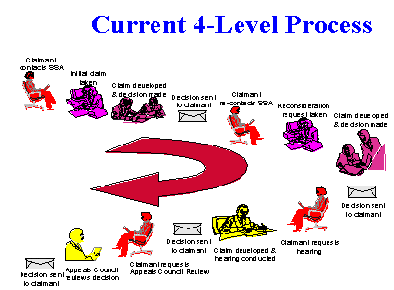
SSA’s current disability claims process consists of an initial determination and up to three levels of appeal if an individual is dissatisfied with the decision. Initial disability claims are generally taken in 1,300 Social Security offices located throughout the country. Local field office staff request and evaluate information about the non-medical aspects of each person’s claim, such as whether or not the individual has worked enough to be eligible for DI benefits or whether the individual meets the income and resource limits for SSI benefits. Field office staff also obtains information about claimants’ impairments, including medical sources. Disability claims are then forwarded to the Federally funded, but State-administered, Disability Determination Services (DDS) in the State where the person lives. State DDS staff obtain and review necessary medical and other evidence and an adjudicative team consisting of a disability specialist and a program physician make the disability determination based on Social Security regulations using a multi-step sequential evaluation process. An individual who is dissatisfied with the initial determination made on his or her claim may request a reconsideration of the determination that is conducted at the State DDS level. If the reconsideration is unsatisfactory to the individual, he or she may request a hearing before a Federal administrative law judge (ALJ), and, if still dissatisfied, the individual may request an Appeals Council review. Each level of review involves multi-step procedures for evidence collection, review, and decisionmaking. If the Appeals Council affirms the denial, the applicant can begin a civil action in a U.S. district court. Reengineering Concept Because of SSA’s continued desire to improve service delivery to its most vulnerable customers and the growing need to improve an overly complex process, the Agency explored reengineering as a method for addressing service delivery concerns. This concept was in line with Vice President Gore’s reinvention initiatives to create a government that works better and costs less. Under the leadership of Commissioner Chater, SSA developed a “redesign” plan which was released in September 1994 to improve the disability claims process, from initial contact through final administrative appeal, in order to improve service delivery to millions of individuals filing for, or appealing, disability claims every year. The disability process redesign plan was a high-level process description that provided a broad vision of how a new process would work, leaving operational, organizational, and other details for later development and implementation. The five primary objectives for the plan were:
Development and Release of the Plan SSA began its Agency-wide program of process reengineering in the summer of 1993. The Process Reengineering Program essentially asked the question, “If SSA had the opportunity to design its processes, what would they look like?” The program was the culmination of an investigation by SSA of the reengineering efforts conducted by private companies, public organizations, academic institutions, and consulting firms with “hands on” experience. The positive findings from that investigation, combined with concerns about the impact of current and projected workloads, led SSA to conclude that a disability claims process reengineering effort was critical to its objectives of providing world-class service to the public and restoring public confidence in its disability programs. Based on analysis of what has worked best in other organizations, SSA developed a customized reengineering methodology. This methodology used a team approach (composed of SSA and DDS employees as well as union representation) and combined a strong customer focus with classic management analysis techniques to intensely review a single business process. While the reengineering team was comprised of employees who were knowledgeable about the current disability process, the methodology focused heavily on obtaining the views of a broad segment of individuals; groups and organizations involved both internally and externally to the process. The parameters set for the project restricted the team from proposing any changes to the statutory definition of disability or the amount of benefits for which individuals are eligible. A team of 18 Federal and State employees came together in October 1993. After completing their initial tasks of analyzing the current process, obtaining process improvement recommendations from over 3,600 individuals and groups internal and external to the disability claim process, benchmarking with public and private sector organizations to identify “best practices,” and modeling theoretical processes via computer, the team presented an initial proposal on March 31, 1994. This proposal was published in the Federal Register on April 15, 1994. Within the 60-day comment period, the team received over 6,000 written responses. Group feedback discussions were held in over 80 sites across the country to facilitate dialogue with almost 2,000 employees. In addition, team members conducted briefings and spoke with more than 3,000 individuals about their reactions to the proposal. A public forum was also held in Washington, D.C. After considering all comments, the team reviewed the breadth of the initial process and on June 30, 1994, the team submitted their revised proposal to the Commissioner of Social Security. Subsequently, the Commissioner released SSA’s Plan for a New Disability Claim Process on September 7, 1994. Vice President Gore visited SSA and presented the team with Hammer Awards in recognition of their efforts at building a government that works better and costs less.
Key Features of the Proposed Redesign Plan
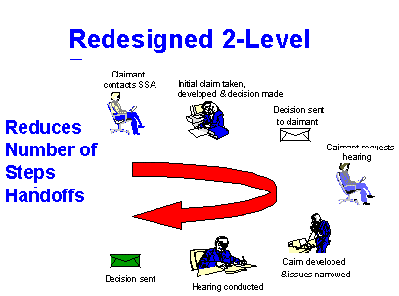
Process Streamlining: SSA’s current four-level administrative process is streamlined to two levels. Applicants who receive an initial claim denial (level one) have 60 days to request a hearing before an independent ALJ (level two). New position added to the initial level to act as the claimant’s single point of contact. A new position, the disability claim manager, was created as the key contact for claimants at the initial level, eliminating steps caused by numerous employees handling discrete parts of the claim. The claim manager would be trained to handle both disability and non-disability aspects of the claim, using other office expertise as needed. Claimants better understand the program and are more involved in the process. As part of the plan, claimants are provided a more intensive explanation of the disability program and process, have additional opportunities to interact with the decisionmaker, and can more fully participate in the process itself. Process Unification. Adjudicators at all levels of the process would use the same standards for decisionmaking to make correct decisions in an easier, faster, and more cost-efficient manner. Better use of the experience and expertise of staff. Changes in the adjudicative process would free time for the most highly specialized staff (physicians and ALJs) to work on those cases and tasks to make the best use of their talents—targeting expenditures for medical evidence to those areas most useful in determining disability. New position added to support the hearing process. The plan added a new position, the adjudication officer, to facilitate the hearing process. The adjudicative officer maintains authority to issue revised favorable decisions if warranted by the evidence in file.
Enablers to Support the Redesign Vision SSA’s reengineering project was dependent on a number of key factors that could provide the framework for the new process design. These included process unification and technological support. Process Unification. Under the Social Security Act, the Secretary is granted broad authority to promulgate regulations to govern the disability determination process. In addition to regulations, SSA publishes Social Security Rulings and Acquiescence Rulings. ALJs and the Appeals Council relied on the regulations and rulings in making disability decisions. However, guidance for decisionmakers at the initial and reconsideration level was provided in a series of administrative publications, including the Program Operations Manual System instructions and other administrative issuances which clarify or elaborate specific policy issues. The use of different source documents by adjudicators fostered the perception that different policy standards were being applied at different levels of decisionmaking in the disability claim process. To ensure that SSA provides consistent direction to all adjudicators regarding the standards for decisionmaking, the redesign plan pointed to the development of a single presentation of substantive policies used in the determination of eligibility for benefits by all adjudicators. Information Technology. Another key enabler of the redesign was information technology. The process plan looked for the development of seamless, electronic processing of disability claims through all levels. Technology enhancements would be made available to employees as well as to claimants and their representatives.
Testing Flexibility Pure reengineering concepts call for minimal testing and quick implementation. Although it was committed to moving forward quickly to begin implementing the new process, SSA embraced an equally strong commitment to rigorous testing and refinement of process changes before proceeding with full or permanent implementation. SSA recognized that full implementation of the new process vision was an iterative process that required development, testing, additional information gathering and possible modifications of process changes. In selecting sites for initial testing, SSA took advantage of the interest and capability of different offices, states, and regions to demonstrate the viability of improvements. And even with extensive testing, due to the nature of public policy formulation, SSA was flexible in developing, refining and implementing specific process elements. Additionally, if results of process testing necessitated modifications, SSA was prepared to make those modifications. SSA remains committed to change, not for its own sake, but because it is necessary to meet present and future challenges as the Agency strives to provide high-quality, responsive, world-class service to its customers. 1997 Redesign Focus Narrowed to Most Critical Areas
SSA generally agreed with the thrust of GAO’s recommendations and identified redesign areas in which to concentrate efforts to support critical, long-term efficiencies. As an outcome of SSA’s assessment, focus was narrowed to the most significant areas, including the testing of process changes, implementing process unification initiatives, and developing long-term support through other enablers. In the area of testing process changes, the most significant test of redesign initiatives was the Full Process Model (FPM) which served as an integrated model for several features. The Full Process Model The Full Process Model was closest to the original vision of the disability redesign. The test included a random selection of over 30,000 initial disability cases in eight DDSs. Case selection began in April 1997 and ended in January 1998. Participating states included Colorado, Georgia, New York, Pennsylvania, South Carolina, Tennessee, Utah, and Wisconsin. SSA evaluated whether, and to what degree, the FPM improved the disability determination process by assessing the impact of the FPM on allowance rates, appeal rates, accuracy administrative costs, processing time, program costs, and employee and customer satisfaction. General conclusions showed that the allowance rate at the initial level within the FPM was essentially the same as in two levels in the current process (initial level plus reconsideration). The claimant conference resulted in initial allowances that would have been made only after an appeal in the current process—or that would never have been allowed because not all claimants appeal, improving customer service. Accuracy on cases denied through the initial level was substantially better in the FPM than in the current process. Although the addition of the opportunity for claimants to talk with the disability decisionmaker added time to the process for some, those who were ultimately denied at the initial level and pursued an appeal, reached OHA over two months sooner. Savings from elimination of the reconsideration step could be invested at the initial level to improve quality and customer service. Although some claimants could be served more quickly with the adjudication officer in the process, the overall time at the hearing level was significantly higher. There was insufficient data on the elimination of the request for Appeals Council review portion of the model upon which to draw conclusions. Positive results from the Full Process Model test provided the impetus to move forward with the most positive factors of the process.
Redesign Decisions Incorporated into the Agency’s Broader Plan The 1994 redesign plan outlined a vision for an ideal process that was efficient, unified and highly automated. Rigorous testing was conducted throughout the country, realizing varying levels of success. Results did show the potential for improving customer service by focusing more attention at the initial level to improve quality, reduce hurdles and increase customer interaction—all concepts that epitomized the principles and goals of the National Partnership for Reinventing Government (NPR). A major strategy of the NPR is to achieve outcomes that balance business results, customer satisfaction and employee satisfaction. SSA remains committed to that strategy. In March 1999, Commissioner Apfel released a broader plan to improve management of the disability program, moving the agency from “proof of concept” testing to the next phase of development, incorporating decisions on redesign. In announcing his decision to employees in a “Commissioner’s Broadcast” on March 12, 1999, Commissioner Apfel said, “For many years, SSA has recognized the need to improve the administration of the disability programs. It is an enormous challenge to administer these large and complex programs efficiently, effectively and compassionately. We must be committed to making our programs both more responsive to our claimants and beneficiaries and more accountable to the American people. It is now time to move from ‘proof of concept’ testing to the next phase of development. Using our current testing authority, I want to combine the successful elements of our redesign pilots with enhanced DDS development and explanation of decisions in up to 10 state prototypes, as well as implement hearings improvements nationwide. This will allow us to put the complete process together and make necessary refinements prior to nationwide implementation.” [1] The Commissioner considered analysis from redesign test results along with additional factors including stakeholder comments, input from OMB, GAO, NPR and other Agency initiatives in making these decisions. The March plan, Social Security and Supplemental Security Income Disability Programs: Managing for Today/Planning for Tomorrow, broadened the Agency’s focus to reflect priority management objectives in the President’s FY 2000 Budget. The plan included 4 goals, consistent with the original redesign concepts: 1. Improve the disability adjudication process to ensure that decisions are made as accurately as possible, that those who should be paid are paid as early as possible, and that the adjudication process is consistent throughout; 2. Enhance beneficiaries’ opportunities to work by providing work incentives and facilitating appropriate support services; 3. Safeguard the integrity of disability programs by ensuring that beneficiaries on the rolls continue to be eligible for benefits and by undertaking initiatives that protect the program from fraud; and, 4. Improve the knowledge base for the next century by addressing the need for broadened understanding of the dynamics of disability, how decisions are made, and what economic and demographic trends affect the program.
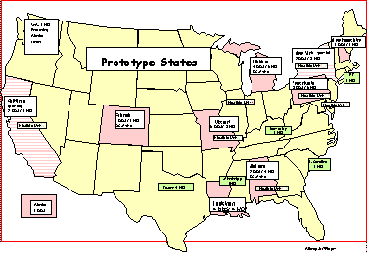
The Prototypes Using current testing authority, SSA moved to combine the successful elements of the redesign pilots with enhanced case development in 10 states. These prototypes put the complete process together and provided an opportunity to make necessary refinements prior to nationwide implementation. About 20% of SSA’s national disability claims workload was impacted. The prototypes were in state-wide operation in AL, NH, PA, LA, MO, MI, CO, AK, and in portions of NY and CA. The prototypes included the following five elements:
·
· Claimant conference. Providing an opportunity for the claimant to talk with the disability examiner before a less-than-fully-favorable decision is rendered at the initial level. This allowed the decisionmaker to review the findings with the claimant prior to a determination to ensure that all allegations have been identified and developed, and that the claimant understood the disability program and process. · Elimination of the reconsideration step. Streamlining the administrative review process by eliminating the reconsideration step. This provided the ability to focus more attention and resources at the first administrative level. · Improvements to the hearings process. A series of improvements are being implemented in hearing offices including changes in the management structure and a new team approach. Early data from the Prototypes had shown that the prototype process was a major cultural change for many DDS employees. The degree of change varied from state to state, but was significant for all states. Of particular note, the learning curve was longer in the prototypes as compared to the Full Process Model test, particularly as it related to enhanced rationales. Improvements made to the claimant conference process have paid off in terms of increasing the response rate for those who were offered the opportunity to talk with a decisionmaker prior to an initial-level determination. As of August 2000, the response rate had leveled to about 64%. By comparison, the response rate in the Full Process Model was 56%. This meant that claimants were more fully utilizing the opportunity to interact with their decisionmaker, helping to ensure that all allegations and sources of evidence had been explored. This interaction also provided the opportunity for disability examiners to explain the disability process and program requirements, as well as to respond to questions. Prototype cases, denied at the initial level and requesting appeal, had been filtering into hearing offices, where a series of improvements had been implemented to reduce processing time from request for hearing to final disposition. Cohort data on the prototypes were being tracked to assess the impact on customer service and program costs to determine if data trends were consistent with outcomes from SSA’s more formalized test, the Full Process Model. SSA planned a rollout of prototype process changes in FY 2002. Although redesign initiatives were not implemented as quickly or broadly as originally expected, they had been the impetus for significant movement toward major cultural shifts. Redesign initiatives increased the focus at the initial level and placed more emphasis on quality throughout the process. Tested changes had shown the potential to increase the volume of appropriate allowances at the initial level, increased claimant involvement in the process, and streamlined the appeals process to better serve disability applicants.
Testing of the Disability Claim Manager (DCM)
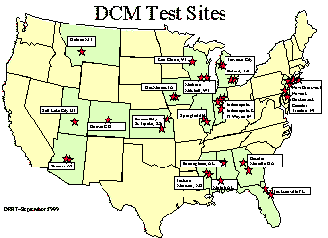
The DCM test, by design, was being conducted in two phases over a three-year period. Phase I began November 1997 and ended in June 1999. Phase II testing started November 1999 and ended in November 2000. SSA used an independent contractor to help assess the first phase of testing, which was conducted to determine the viability of the position and provided recommendations for the configuration of the second phase. The contractor’s final report concluded that the DCM is a “viable” approach to processing claims, in the limited sense that certain key outcomes were within the ballpark of outcomes under the current process.
Retest of the Elimination of Request for Review
As an adjunct to the FPM, a test of the elimination of the Appeals Council request for review (RRE) was conducted to determine if the claims process could be streamlined further by removing this adjudicative step in addition to the reconsideration step. This test was conducted under separate regulatory authority. The test for the FPM provided a substantial volume of data from which results could be analyzed to determine next steps in the redesign process; however, the sample size that was achieved for data relating to the elimination of the RRE was insufficient to support policy decisions. With the start-up of the prototype process in 10 states, SSA identified an opportunity to retest the RRE process. The retest of the RRE was conducted in conjunction with the prototypes in order to obtain the data necessary for assessing the effects of the elimination of the request for review. Data obtained during the test could also support supplementary efforts to examine the role of the Appeals Council and determined the most effective use of this valuable resource. The retest of the RRE was undertaken under the existing testing authority and a Federal Register notice announcing the test was published June 7, 2000. The primary objective of the project was to obtain and analyze valid and reliable data on the effects of the elimination or retention of the request for review step—including the impact on agency operation and processes, the federal court system and quality and timeliness of service to the public.
Prototype Process Combined With Improvements to the Hearing Process As part of SSA’s broader management plan, Commissioner Apfel decided not to pursue the adjudication officer position, but take what was learned from the pilot to incorporate into the Agency’s broader hearing process improvement plan. The Agency’s broader plan supported moving forward to improve the disability process from beginning to end on several fronts. Besides improving the process in both the DDS and OHA level, the plan supported training for claims representatives in field offices to improve the disability product beginning with application, continued to test the Disability Claim Manager process as an alternative approach to serving the needs of disability claimants and created Flexible Disability Units in processing centers to provide processing support as needed to both the DDS and OHA. The prototype changes, coupled with other initiatives, were part of SSA’s broad strategy to improve the effective and efficient administration of its disability programs that protect millions of Americans and their families.
The Hearing Process Improvement Plan
As part of its overall plan for managing the disability process, Commissioner Apfel directed in 1999 that the Agency develop a plan for improving the hearings process. In June 1999, SSA released the Hearings Process Improvement (HPI) initiative. Designed to enhance customer service by reducing processing time without expending additional resources, HPI has been fully implemented in 37 hearing offices and is expected to be in place in all 140 offices before the end of calendar year 2000. SSA began Phase 1 of HPI in January 2000, with full implementation in the Phase 1 hearing offices completed by the end of April. Challenges in several areas were met with innovative efforts, and lessons learned were applied to planning for Phases 2 and 3. · Communications: Early establishment of an Intranet website, frequent HPI newsletters, a PolicyNet collaboration site for managers, and a hotline were among the tools used to make information readily available to hearing offices. SSA held two conferences for Hearing Office Directors, and a summit for Hearing Office Chief Administrative Law Judges was scheduled for mid-October. · Partnership: SSA reached national agreements with union partners by October 1999, but delays in local agreements encouraged the combination of national and local issues in the agreements reached for Phases 2 and 3. · Training: SSA formed a national cadre of experienced trainers to deliver HPI orientation and needed skills training. Based on feedback received, the training timelines were refined for Phases 2 and 3. · Automation: Changes needed to provide immediate support for HPI had been made, and longer-term enhancements were in the planning stages. The elements of the early monitoring plan provided information and data that was being used to make improvements in the implementation efforts for Phases 2 and 3. Preliminary data collected since May 2000 was encouraging: HPI offices were showing higher disposition rates and lower processing times than in 1999. Early Phase 1 site visits provided valuable feedback, particularly on training and automation. SSA’s Office of Workforce Analysis (OWA) also conducted site visits, and their report of employee interviews gave a detailed look at staff concerns and suggestions, many of which were used to provide for a smoother transition in the next phases of implementation. Plus, the Regional Chief Administrative Law Judges closely monitored HPI start-up in the regions, and their reports in late August indicated that Phase 1 implementation was nearly complete in the critical elements of HPI. Phase 2 implementation brought HPI to 52 additional hearing offices in October 2000, and the remaining 49 offices rolled out by November 20, 2000. The implementation monitoring efforts will continue during Phases 2 and 3 rollout, and OWA has been asked to conduct a follow-up employee survey in late Spring 2001. Once all elements of HPI have been implemented in all hearing offices, SSA will take a thorough look at the process itself and determine whether refinements are needed.
The Appeals Council Improvement Plan
The Appeals Council’s process not only deals with dramatic increases in the volume of work in recent years; it also copes with workloads that are varied and inherently complex. Claimant requests for review of hearing decisions and dismissals represent the largest portion of the Appeals Council’s workloads.
However, the Appeals Council is responsible for other workloads including, but not limited to, quality assurance reviews and court case processing. Like HPI, the ACPI long-term strategy was to institute changes to streamline and simplify case movement, reduce case hand-offs, provide better oversight, and use systems improvement to more effectively capture and use data to improve service and management. A key process change within the overall strategy was Differential Case Management. Appeals Council staff individually examine all requests for review shortly after receipt to identify the appropriate case processing track and to process to completion cases identified for expedited action. This provides speedier service for different types of claims and ensures that the Appeals Council identifies and acts on cases that deserve immediate processing. The Appeals Council also places a heightened emphasis on processing aged requests for review and using legally sufficient streamlined formats for issuing decisions and remands. SSA anticipates that the ACPI initiatives, when fully implemented, will result in dramatic service improvements in request for review processing over the next five years. The ACPI initiatives will also ensure that the Appeals Council’s other workloads are managed timely and effectively. ACPI showed an impressive rollout performance, with a record 64,000 actions in the first six months of ACPI in FY 2000, and as of October 2000, was on target to meet the anticipated level of dispositions for the fiscal year. The Case for Disability Program Change
Ticket to Work/Work Incentives
The Ticket to Work and Work Incentive Improvement Act was the last piece of legislation President Clinton signed into law in the 20th Century. The signing of this law, on December 17, 1999, represented the culmination of 6 years of work by Social Security Administration, Clinton appointees and staff, scholarly think tanks, people with disabilities, disability organizations and the Congress. Articulating the Problems and the Solutions: Developing Consensus
WITHIN THE SOCIAL SECURITY ADMINISTRATION Commissioner Apfel and executives at SSA had long been listening to customers and other stakeholders to determine what improvements could be promoted in the disability programs to improve opportunities for those with significant disabilities. The goal for this dialogue from the beginning was to ensure maximum employment opportunities for people with disabilities while ensuring that the safety net represented by the disability programs and the medical benefits provided by them remained intact. SSA sponsored a series of roundtable discussions with people with disabilities throughout the country and gathered together a staff to assist the Commissioner in understanding their concerns and needs. SSA supported a conference sponsored by the World Institute on Disability in 1992 that gathered together consumers and experts from around the country to explore the SSI and SSDI programs and their relationship to the employment of people with disabilities. SSA also funded conferences at the National Press Club in 1996, 1997 and 1998, bringing together hundreds of stakeholders to examine the issues. Executives from SSA, in particular Susan Daniels, Ph.D., herself an appointee of President Clinton with a severe disability, met with scholars and experts who had dedicated their lives to studying Social Security. SSA pulled together internal working groups within the agency to examine the history and trends of the disability programs. Social Security actuaries, researchers, budget staff, operations staff and field staff examined the programs in light of their impact on return to work. These research and educational efforts determined that SSA’s disability programs had been growing steadily for over 10 years, and unless major policy changes were made, the growth was projected to continue. Young people with disabilities were coming on to the rolls in increasing numbers and were staying there for several decades. And the research showed that long term reliance on government income maintenance is undesirable because of the severe limits it places on the beneficiary’s financial and social independence. Receipt of monthly benefits generally promotes a lifestyle of dependence and marginalized poverty. Despite the existence of Social Security work incentives and rehabilitation reimbursement programs, few beneficiaries return to work, although many beneficiaries with disabilities say they want to work and can work, despite their impairments, if they receive the supports they need. It is primarily fear of losing health benefits that deters efforts by beneficiaries with disabilities from attempting to work. The conclusion reached is that creating dependence on benefits is not good public policy. It is inconsistent with the Americans with Disabilities Act and all progressive disability policy. With these findings in hand, SSA, under the leadership of Commissioner Chater and Dr. Daniels, developed an employment strategy in 1995. The strategy was anchored by four pillars: more options in securing return-to-work services; better access to health care; improving service delivery and work incentives; a special focus on youth. Other Studies and Reports
“DI and SSI programs present an all-or-nothing decision to those who apply. Applicants who meet the disability criteria receive cash benefits, and applicants found able-bodied receive no benefits. But this conflicts with prevailing views that disabled persons are an extraordinarily heterogeneous group. In addition, technological and medial advances have created more opportunities than ever for persons with disabilities to engage in meaningful and productive work. These new views, coupled with advances, suggest that the premise for DI and SSI may need to be modified. As a result, we may be underutilizing the productive capacity of many persons with disability.” The April 1996 GAO report called for the Commissioner of SSA to take immediate action to place greater priority on return to work and to develop legislation so the agency could emphasize return to work for beneficiaries. In response to a request from Congress, the National Academy of Social Insurance (NASI) convened a Disability Policy Panel of national experts to conduct a comprehensive review of Social Security’s disability programs and employment outcomes. In 1996, the Panel released a four volume report entitled Balancing Security and Opportunity – The Challenge of Disability Income Policy. This impressive work from a distinguished panel of experts noted in its report that its findings and recommendations derive from its fundamental belief that the primary goal of national disability policy should be the integration of people with disabilities into American society. The panel’s return to work proposal built on the principles of consumer choice and empowerment. It encouraged competition and innovation among service providers, rewarding service providers for their results rather than for the cost of their inputs, and encouraging providers to have a continuing interest in their clients’ long-term success in remaining employed. In addition, the Panel stressed the importance of health care coverage to Americans with disabilities. In July 1996, the National Council on Disability released a report entitled Achieving Independence: The Challenge for the 21st Century. The report noted that many features of the SSI and SSDI programs serve as obstacles to independence for people with disabilities. Lack of access to health insurance and lack of flexibility supporting maximal employment often promote lifetimes of dependence for people with disabilities. “The current set of policies and programs too often functions more as a spider web than a safety net, capturing people in poverty rather than supporting them to maximize their potential and their employment,” the report concluded.
Reaching Consensus
The Legislative Process
Formulating the Clinton Administration’s Bill
In February 1997, the President’s 1998 Budget was released. It included the ticket to work and the two health care provisions. The Medicaid provision enabled states to offer Medicaid to families with an income that was 250 percent over the poverty level. (This provision was eventually enacted as part of the Balanced Budget Amendment of 1997). The Medicare provision enabled a person leaving the roles to extend Medicare coverage for 2 years beyond the 4-year limit. In March 1997, the Social Security Administration sent the Clinton bill to the Congress. It addressed the ticket to work initiative. This bill was never introduced per se, as Members of Congress had already begun to address the issues with their own bills that contained very similar provisions. Action in the House and Senate
In March 1998, at the beginning of the 105th Session of Congress, Rep. Bunning introduced his bill again in the House. The bill was approved by the Subcommittee on Social Security and the full Committee on Ways and Means and passed by the House on June 4, 1998 with a vote of 410-1. The bill was referred to the Senate where it was never considered in the legislative process during the 105th Congress. However, the Senate was quite active behind the scenes in developing a companion bill. Senators Jeffords and Kennedy took the lead on the bill. During 1997, 1998 and 1999, their staffs met regularly with stakeholders, particularly consumers, to develop a bill that would have massive support. They circulated numerous drafts of bills broadly in the disability community for input and feedback. The Social Security Administration provided technical assistance for the drafting of the bill. In addition, the Administration included this bill in the President’s 2000 budget, thus indicating the President’s commitment to this bill. On January 28, 1999, Sen. Jeffords and Sen. Kennedy introduced the bill, S. 331 that would eventually become law. In February 1999, the Committee on Finance held hearings on the bill. In March 1999, the Committee reported out a substitute bill favorably. On June 16, 1999, Sen. Roth, Chairman of the Finance Committee, amended S. 331 with a substitute bill. On that same day, the Senate passed the bill with a vote of 99-0. The House was aware that the Administration and the Senate had made an agreement on a bill. In the 106th Congress, Rep. Rick Lazio took the lead on the bill in the House. On March 18, 1999 he introduced HR 1180, a bill similar to S. 331. This bill included Medicaid amendments so it was referred to the Commerce Committee in addition to the Ways and Means Committee. In the Commerce Committee, the bill was referred to the Subcommittee on Health and the Environment where hearings were held and the bill was marked up. The Subcommittee forwarded the bill to the full committee where the bill was reported out on July 1, 1999. On October 19, 1999, with the support of the Ways and Means chairman and the House leadership, the House passed, under suspension of the rules, HR 1180 and sent it to the Senate. On November 18, 1999, the House agreed to the conference report; on November 19, 1999, the Senate agreed to the conference report. On December 6, 1999, the HR 1180 was presented to the President for signature. Provisions in the Final Bill
·
The Ticket to Work and Self Sufficiency ·
Expanded Availability of Health Care Services 1. The new law extends Part A Medicare coverage for an additional 4½ years for working Social Security disability beneficiaries. This is in addition to the current law provision of free Part A Medicare coverage for 4 years after a Social Security beneficiary with a disability goes to work. 2. The new law allows workers with disabilities who are covered under Medicare to suspend Medicare supplemental policies while they are covered by group health insurance plans that are provided by their employers, and to regain coverage under their Medicare supplemental policies if they lose coverage under these group health plans. 3. The new law expands state options and funding for Medicaid. These options will permit states to liberalize the limits on resources and income for Medicaid eligibility for people with disabilities. They will also allow the states to permit an employed individual with a disability to buy into Medicaid, even though the individual is no longer eligible for Social Security or SSI benefits because his or her medical condition has improved. 4. The new law requires the Secretary of the Department of Health and Human Services (DHHS) to award grants to states to develop and operate programs which will support working individuals with disabilities and to let persons know about these new programs. These grants will begin in FY 2001, and $150 million is available to fund the grants over the first five years with additional funding for another six years. The Secretary of DHHS will also approve applications from states to conduct demonstration projects to provide Medicaid type coverage for working individuals with potentially severe disabilities. The demonstration projects will cover persons whose medical conditions are expected to meet the SSI definition of disability if the workers did not receive Medicaid services. The new law authorizes $250 million to fund these demonstration projects over a five-year period. · Work Incentive Enhancements The new law contains improvements to work incentives to help people with disabilities go to work and continue to work. These improvements include: 1. Expedited reinstatement of benefits – Effective January 1, 2001, a former Social Security or SSI disability beneficiary will be able to request reinstatement of his or her benefits if the benefits were terminated because the beneficiary went to work. To have the benefits reinstated, the former beneficiary will have to be unable to continue working because of his or her medical condition and will have to file a request for reinstatement within 60 months from the month in which the previous benefits were terminated. The beneficiary will be able to receive provisional payments for up to six months while SSA is making a decision on whether he or she is still disabled under the rules. These provisional payments will not have to be paid back if SSA decides that the beneficiary’s medical condition no longer meets the definition of disability. 2.
Changes to the Continuing Disability Review (CDR) process
– Once the Ticket program begins on January 1, 2001, SSA will not
conduct a CDR of an SSDI or SSI beneficiary’s medical condition
while the beneficiary is using a Ticket. In either case, the existing rules for suspending benefits because of earnings amounts will apply. Thus, for SSI, earned income rules for reducing benefits would apply, and for SSDI, rules for determining SGA would apply. ·
New Work Incentive Programs 1. Establishment of a work incentives specialist corps within SSA to provide accurate information regarding SSDI and SSI work incentives. SSA has established a new Employment Support representative (ESR) position that will be tested soon in a number of locations. The new position will continue to be expanded nationally after the current testing phase is complete. 2. Establishment of a community-based work incentive planning and assistance program. This will be accomplished through a program of grants, cooperative agreements, or contracts with private and/or public organizations in each state to provide benefits planning and assistance to beneficiaries to assist them to go to work. 3. Providing grants to the protection and advocacy systems in each of the states to provide information, advice, advocacy and other services to beneficiaries with disabilities. 4. Establishing a Work Incentives Advisory Panel within SSA to provide advice to the commissioner of SSA and Congress on work incentives, including the implementation of the Ticket program. The panel will consist of 12 members appointed by the President and Congress. At least half of the Panel members must be individuals with disabilities, or representatives of such individuals, with consideration given to current or former disability beneficiaries. This panel will convene in 2000 with a life span of eight years. ·
Demonstration Projects and Studies Signing the Bill into Law
On December 17, 1999, President Clinton held a signing ceremony for HR 1130 at the Franklin D. Roosevelt Memorial in front of a depiction of the former president. The setting was fitting, as it called forth the memory of one of the nation’s great Presidents, who led the country from his wheelchair. Hundreds of people were present for the signing, including many members of the disability community from across the country. In addition to President Clinton, remarks were made by Sen. Kennedy, Sen. Jeffords and Jim Sullivan, a person with a disability from New Hampshire who introduced the President. Justin Dart, Donna McNamee, Paul Marshall and Wesley Vinner joined the speakers on the stage. At the end of the program, SSA Commissioner Kenneth Apfel, HHS Secretary Donna Shalala, Labor Secretary Alexis Herman and Treasury Secretary Summers joined the President on the podium for the bill signing. On stage after the signing, Justin Dart presented President Clinton with a leather bound book with letters from people all across the country thanking the President and Congress for their leadership in making the Ticket to Work and Work Incentives Improvement Act law. President Clinton began his remarks by noting that “This landmark legislation will remove barriers that have placed many individuals with disabilities in the untenable position of choosing between health care coverage and work.” He concluded as follows: “Many individuals with disabilities want to work and become independent, and many can work if they receive the critical support they need. For too long, the fear of losing health and cash benefits and the inability to obtain rehabilitation and employment services has prevented such individuals’ work efforts. As a Nation, we are best served when all our citizens have the opportunity to contribute their talents, energy, and ideas to the workplace. I am pleased to sign into law today this important step to empower more Americans with disabilities to take their rightful place in our Nation’s workforce.” The Legacy of the Law
The enactment of TWWIIA also signifies a significant mission shift for SSA. Prior to TWWIIA, benefits were, for the most part, considered the endpoint of SSA’s activities. With TWIIA, good service is redefined as promoting employment as an end point, when it is appropriate for the beneficiary. SSA is now clearly in the family of federal agencies that share the mission of promoting employment of people with disabilities. This mission shift brings with it operational shifts which include improving the level of service related to employment and being a catalyst and funder for employment support services. Social Security’s commitment to this mission shift is visible in its organizational and staff restructuring. In January 1999, Commissioner Apfel created a new office with primary responsibility for implementing TWWIIA. The Office of Employment Support Programs is headed by a newly created Associate Commissioner position. Eighty staff have been assigned to this office which administers a $70 million TWIIA budget and a $10 million research budget. In addition, this office administers the $125 million dollar rehabilitation reimbursement program. The long-term legacy of TWIIA will
be determined over time. However, it is clear that the Clinton
Administration has left the Social Security Administration changed
in both culture and mission. The clear addition of employment
support as a goal of the agency represents a significant contribution
to public policy for people with disabilities.
Increase in the Substantial Gainful Activity Level
In 1999, SSA instituted a regulatory change to increase the SGA level for non-blind individuals from $500 to $700 per month. The Administration increased the SGA level as part of its efforts to encourage individuals with disabilities to attempt work and to provide an updated indicator of when earnings demonstrate the ability to engage in SGA. The SGA level had been increased only once since 1980, and that increase occurred in 1990. The increase to $700 reflects the amount that roughly corresponds to wage growth since the last increase in 1990. In 1999, Vice President Gore announced the SGA increase at a disability event in Albany, New York. In 2000, SSA published a rule that will automatically adjust the SGA level annually based on the national average wage index effective in January 2001. As part of the celebration of the 10th anniversary of the Americans with Disabilities Act, President Clinton announced the proposed rule change. Raising the SGA level to $700 provides a more realistic threshold to determine earnings capacity at the time of initial disability determination and provides a more realistic test of a beneficiary’s earnings capacity before losing SSDI benefits due to work activity. SSA expects that the higher SGA level will encourage more beneficiaries to attempt to work and ultimately become more independent.
Other
Regulatory Changes to Encourage
|
||||||||||||||||||||||||||||||||||||||||||||||||||||||||||||||||||||||||||||||||||||||||||||||||||||||||

 An
important initiative in SSA’s disability process redesign effort
had been the Disability Claim Manager (DCM). Under this model,
a single individual had responsibility for all phases of the initial
disability determination process, including development and decisions
on both medical and non-medical components of eligibility.
This represented a significant change from the current process,
where a federal claims representative was responsible for initial
contact with the czlaimant and collecting non-medical eligibility
information, and a State disability examiner and medical consultant
team determined whether the disability criteria meet SSA’s requirements.
The DCM was a single point of contact for claimants located at either
a field or DDS site, and had responsibility for processing the disability
claim, with substantial support form both clerical and medical staff.
The DCM as tested, had been focused on adult disability claims.
An
important initiative in SSA’s disability process redesign effort
had been the Disability Claim Manager (DCM). Under this model,
a single individual had responsibility for all phases of the initial
disability determination process, including development and decisions
on both medical and non-medical components of eligibility.
This represented a significant change from the current process,
where a federal claims representative was responsible for initial
contact with the czlaimant and collecting non-medical eligibility
information, and a State disability examiner and medical consultant
team determined whether the disability criteria meet SSA’s requirements.
The DCM was a single point of contact for claimants located at either
a field or DDS site, and had responsibility for processing the disability
claim, with substantial support form both clerical and medical staff.
The DCM as tested, had been focused on adult disability claims.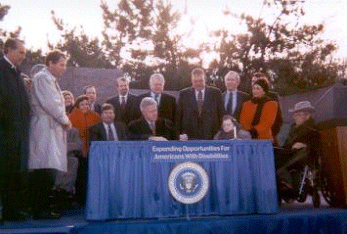 While the primary purpose of Social Security disability
insurance (SSDI) is to replace a portion of income lost to disability,
the program also includes provisions designed to encourage beneficiaries
to return to work. Similarly, the Supplemental Security Income
(SSI) disability program includes return-to-work provisions.
Research and experience have shown that even when individuals have
significant disabilities, with appropriate support and vocational
rehabilitation (VR), they may be able to work again. The primary
mechanism that is used by SSA to help people to return to work is
the referral of beneficiaries to State vocational rehabilitation
services. However, despite these longstanding provisions of
the law, historically only a very limited number of the approximately
10 million SSDI beneficiaries and SSI recipients leave the disability
rolls each year because of successful rehabilitation. The
passage on December 17, 1999 of The Ticket to Work and Work Incentive
Improvement Act (TWWIIA) represents, “…not just a new law, but
a new mission for SSA.”
While the primary purpose of Social Security disability
insurance (SSDI) is to replace a portion of income lost to disability,
the program also includes provisions designed to encourage beneficiaries
to return to work. Similarly, the Supplemental Security Income
(SSI) disability program includes return-to-work provisions.
Research and experience have shown that even when individuals have
significant disabilities, with appropriate support and vocational
rehabilitation (VR), they may be able to work again. The primary
mechanism that is used by SSA to help people to return to work is
the referral of beneficiaries to State vocational rehabilitation
services. However, despite these longstanding provisions of
the law, historically only a very limited number of the approximately
10 million SSDI beneficiaries and SSI recipients leave the disability
rolls each year because of successful rehabilitation. The
passage on December 17, 1999 of The Ticket to Work and Work Incentive
Improvement Act (TWWIIA) represents, “…not just a new law, but
a new mission for SSA.” |
CATEGORY |
TOTAL NUMBER OF INDIVIDUALS REACHED |
| Clients interviewed (intake screenings) |
123,209 |
| SSI applications |
55,704 |
| SSI awards |
21,967 |
Because of some technical and administrative problems on the part of several projects, SSA believes that the above totals under-report the actual number of clients contacted and provided assistance by the SSI Outreach Demonstration Program projects.
The SSI Outreach Demonstration Program found that many outside agencies and organizations are willing and capable of helping SSA reach and assist needy individuals in securing benefits. In addition, SSA found that some organizations were very committed to continuing at least some aspects of their outreach activities after SSA funding ended. While providing application forms, public informational materials and training by SSA staff are valuable assets; however, many organizations must have some outside funding available in order to provide outreach services to their clients.
Other Program Challenges
Changes in Coverage Thresholds For Domestic Employees: “The Nanny Tax”
Early in the Clinton Administration, a few high profile cases regarding
compliance with the “nanny tax” led Congress to simplify the requirements
for reporting wages paid to nannies, maids, and other domestic employees
for the purposes of paying the employer’s share of Social Security,
Medicare, and Federal unemployment taxes. The President signed
the Social Security Domestic Employment Reform Act (P.L. 103-387)
in October 1994. The goal of the new law was to reduce the
administrative burden on individuals who hire household workers,
to eliminate tax liability when employment is occasional or of short
duration, and to help insure that household workers receive the
Social Security coverage to which they are entitled.
When domestic workers were first covered by the Social Security Amendments of 1950, lawmakers wanted to help insure these workers for Social Security benefits while minimizing administrative burdens on individuals who hire occasional household help. The Social Security Amendments of 1950 provided coverage for domestic workers if they earned at least $50 in a quarter and were “regularly” employed, which was defined as working for an employer in at least 24 days in a quarter. At the time, the Committee on Finance noted that employees in domestic service, “whose need for the protection of social insurance is very great,” would generally be covered if they were “regular” workers, while casual or intermittent workers would be excluded. The $50 limit equaled the amount workers needed to earn a quarter of coverage at the time.
In 1954, the Congress removed the 24-day rule, leaving just the $50-per-quarter coverage threshold. The Social Security Amendments of 1977 increased the amount of earnings needed to achieve a quarter of coverage, but did not increase the $50-per-quarter coverage threshold for domestic workers. In 1994, a worker needed wages of $620 to earn one quarter of coverage. Between 1950 and 1994, the declining real value of the coverage threshold caused employers of occasional household help to incur Social Security tax liability.
In addition to the increasing number of domestic employees falling below the relatively low threshold, the administrative requirements associated with compliance were extensive, including both quarterly and annual reports that were separate from the employer’s income tax reports. Both of these factors contributed to taxpayer non-compliance. Prior to enactment of P.L. 103-387, estimates indicated that less than 25 percent of employers of domestic workers reported wages paid to these employees.
The Internal Revenue Service first recommended “nanny tax” reforms to simplify payment of employment taxes on domestic employees in 1991. Congress approved these recommendations on two separate occasions during the 102nd Congress. President Bush vetoed the omnibus tax bills in which they were included.
The law signed by President Clinton provided a balance between administrative simplicity and insuring domestic workers could become covered under Social Security. Mr. Robert J. Myers, former Chief Actuary of the Social Security Administration, provided testimony on the Senate version of the legislation (which had a coverage threshold equal to a quarter of coverage) and said it would “provide reasonable Social Security protection for this category of workers, while at the same time greatly reducing the administrative burden on the employer involved.” He also said, “coverage compliance would be greatly improved.”
P.L. 103-387 reduced both paperwork and the number of domestic employees for whom employers would need to pay payroll taxes. Instead of filing separate reports, employers would include information on payroll taxes paid for domestic employees in their own income tax returns. The new law also raised the coverage threshold from $50 per calendar quarter to $1,000 per calendar year. The coverage threshold, currently $1,200 per calendar year, is indexed in $100 increments based on wage growth.
The Social Security Administration (SSA) has made special efforts since the law’s enactment to inform the public about the need to pay FICA taxes for domestic employees. The Agency’s Office of Communication provided a fact sheet on domestic employees, news releases and a radio announcement for use by SSA field offices and local media, and articles and reminders in various publications.
Although the Agency has worked to encourage compliance with the “nanny tax,” the Agency has also expressed concern that the coverage threshold is now too high and domestic employees, especially those with multiple employers, may not be covered under Social Security. For example, a maid who cleans three different houses in 2000 and receives annual wages of $1,000 from each employer would receive no credit under Social Security. SSA has proposed setting the coverage threshold for domestic workers equal to the amount needed for a quarter of coverage. This would require some additional wage reporting by employers. However, the reporting simplifications enacted in 1994 should minimize the burden on employers. This change would allow more domestic workers to become insured for Social Security benefits.
Title VIII
 The “Foster Care Independence Act of 1999” (P.L.
106-169), was signed by President Clinton on December 14, 1999.
Section 251 of this law introduced a new cash benefit program, “Special
Benefits for Certain World War II (WWII) Veterans,” to be administered
under a new title VIII of the Social Security Act. This program
permits certain WWII veterans who are eligible for Supplemental
Security Income (SSI) in December 1999 and in the month they apply
under the new program to receive special veterans benefits abroad
(equal to 75 percent of the SSI federal benefit rate) should they
decide to relinquish their U.S. residence (and rights to SSI) by
living outside the United States.
The “Foster Care Independence Act of 1999” (P.L.
106-169), was signed by President Clinton on December 14, 1999.
Section 251 of this law introduced a new cash benefit program, “Special
Benefits for Certain World War II (WWII) Veterans,” to be administered
under a new title VIII of the Social Security Act. This program
permits certain WWII veterans who are eligible for Supplemental
Security Income (SSI) in December 1999 and in the month they apply
under the new program to receive special veterans benefits abroad
(equal to 75 percent of the SSI federal benefit rate) should they
decide to relinquish their U.S. residence (and rights to SSI) by
living outside the United States.
Qualifying For Special Veterans Benefits (SVB)
To qualify for SVB payments, veterans must have served in the active U.S. military, naval or air service during WWII. (This includes the service of Filipino veterans in the organized military forces of the Philippines while those forces were in the service of the U.S. Armed Forces or in organized guerrilla forces under the auspices of the U.S. military.) In addition, veterans must have been at least age 65 on December 14, 1999 (when P.L. 106-169 was enacted) and must have been eligible for SSI payments in both the month of enactment and the month they apply for SVB payments.
Despite meeting the military service age and SSI requirements, veterans may not qualify if their monthly income from other benefits (such as annuities, pensions, retirement or disability benefits) equals or exceeds 75 percent of the current SSI federal benefit rate. (For example, based on the January 2000 federal benefit rate of $512, the veteran’s total other monthly benefit income must be less than $384.)
As mentioned above, qualified veterans can receive an SVB payment for each month they reside outside the United States, equal to 75 percent of the current SSI federal benefit rate less the amount of their monthly benefit income. (For purposes of this benefit, “outside the United States” means outside the 50 States, the District of Columbia, and the Northern Mariana Islands.)
SVB Beneficiaries
While the SVB program extends broadly to U.S. veterans with active WWII service, those applying for and receiving SVB payments are, for the most part, Filipino veterans of WWII. Generally, their eligibility for SVB is based on service in the organized military forces of the Philippines while those forces were in the service of the U.S. armed forces or service in organized guerrilla forces in the Philippines under the auspices of the U.S. military. Unlike other U.S. veterans of WWII, veterans of those Filipino forces have never been granted the right to a U.S. veteran’s benefit on the basis of this type of service alone. In fact, legislators intentionally included SVB provisions in P.L. 106-169 in an effort to address this situation and other concerns raised by advocates for Filipino WWII veterans regarding compensation believed due them, but never received. As a result, the law enables elderly Filipino veterans to depart the United States and return to family and homeland without entirely sacrificing the monetary support they received in the form of SSI payments while living in the United States. Estimates of veterans that may benefit from the program in the long term have ranged from approximately 1,400 to 2,500.
As a counterbalance to the proposed benefit program, the Congressional Budget Office estimated that SVB provisions would also lead to a reduction of SSI outlays and spending in the Medicaid and food stamp programs by an overall $43 million over the 2000-2004 period. This effect arises from the established policy that SSI and other types of U.S. benefits are stopped once the veteran leaves the United States and begins to receive SVB payments. (Generally, veterans must leave the United States within four months of qualifying for SVB payments in order to receive payments.)
SVB Payment Initiation
P.L. 106-169 mandated that SVB payments be initiated for months after September 2000 or sooner, if administratively feasible. Realizing that potential beneficiaries under the new program were aged and eager to return to the Philippines as soon as possible, SSA accelerated the start of the SVB claims-taking process to April 3, 2000. Payment to the first SVB beneficiary, Mrs. Lolita Soberano, was made on May 1, 2000.
Mrs. Soberano, a former nurse and SSI recipient while residing in New Jersey, was age 73 at the time of her entitlement to SVB. She had served in the Philippine guerrilla forces during WWII. The SSA Division of the VARO staff in Manila handled Mrs. Soberano’s claim and conducted a “ceremonial” interview with her, at which time they photographed her. (Her photograph is attached.) During her interview, Mrs. Soberano expressed joy as an elderly individual at the opportunity afforded her under P.L. 106-169 to return to the Philippines and be reunited with her husband (who had been unable to accompany her to the United States) while maintaining a decent standard of living as a result of her SVB payments.
Between April and September 2000, SSA took over 2300 SVB claims from Filipino veterans and awarded payments in approximately 560 of those claims.
The Challenge Of The Future
Strategic Management
SSA has a long history of looking toward the future. Strategic planning at SSA has been the overarching tool that has allowed SSA, over the years, to address issues created by increasing workloads, changing customer expectations, limited resources and technological innovation. Strategic planning has helped marshal SSA’s forces to accomplish its mission and attain its vision. Strategic planning has undergone an evolution at SSA during the years of the Clinton Administration, and every plan produced improves upon the prior one in important ways.
The earliest document considered to be a strategic plan was the Master Plan for the Development of the Future SSA Process, published in 1975. The Master Plan was produced in response to the legislation enacting the SSI program. The assignment of program administration to SSA occasioned a mass hiring of employees into SSA, and it also highlighted the critical role that automated systems played—and would be required to play in the future—in SSA’s ability to accomplish its mission work. One independent analysis published in 1993 asserted that “virtually all the key systems and work process goals of the Master Plan have been achieved through the continuity of plans and design that followed [the Master Plan’s] demise.” [6]
Numerous planning documents that provided direction to staff and/or responded to external requirements were produced by SSA in the years to follow. The utility of many of these plans was limited due to their relatively narrow scope and the lack of integration among them. The first Agency Strategic Plan (ASP), SSA 2000, published in 1988, improved SSA’s overall planning posture by providing a single vision of the future, capsulated in the Agency’s first mission statement. SSA 2000 was ahead of its time in government in terms of taking a comprehensive, business-wide look at the future of the organization. The plan drove action: SSA’s national 800 number is a direct result of this plan.
Unfortunately, SSA 2000 also had some weaknesses. The delivery of anticipated enabling technology fell far behind a too-ambitious schedule. Some program changes required congressional action. And, while the plan drove action, the action it drove was isolated and project-specific. The ultimate vision of the plan was lost amidst the attention paid to a handful of special projects whose overall value to the Agency might not have been the highest of the lot. Further, the Agency’s limitations in facilitating implementation reduced the plan’s utility as a guide to the future.
In order to address the weaknesses in the planning process, SSA created a Unified Planning System (UPS) in 1992 to benefit the Agency in both internal management processes and in relationships with external stakeholders, including the public, advocacy groups, the Congress, and other “higher monitoring authorities.”
The UPS incorporates SSA’s strategic planning process, under which the Agency Strategic Plan (ASP) is developed and maintained, with the tactical-level action-oriented Planning and Budgeting System (PBS). It provides direction to all supplemental resource and subordinate component-level operational planning activities.
The two principle planning components of the UPS are the ASP and the PBS. The ASP presents the strategic direction that SSA has set for itself. The ASP articulates the mission of the Agency, surveys the operating environment, sets forth the Agency’s service delivery goals and objectives, provides appropriate strategic guidance, creates a vision of the future and identifies the critical areas that will receive initial priority attention. In short, the ASP points the way; it is the guiding light for all other planning activities in the Agency.
Within the PBS, the direction set forth in the ASP is translated into a wide variety of Agency-level, shorter-term, tactical-level plans. By providing the bridge between long-range planning at the strategic level and shorter term planning at the tactical level, the PBS provides the vehicle through which SSA’s programmatic and administrative budgets can be crafted to reflect the resources needed. The PBS, in short, helps to ensure that SSA will fully realize the vision set forth in the ASP and ultimately attain its service delivery goals and objectives.
The
Social Security Strategic Plan: A Framework
For The Future
|
Mission of the Agency "To administer national
Social Security legislation in an equitable, effective, efficient
and caring manner" |
SSA’s last ASP prior to the inauguration of President Clinton was The Social Security Strategic Plan: A Framework for the Future (1991). While the major operational elements of the new vision—which stretched out to 2005—remained the same as in the SSA 2000 plan, there were major differences. The plan addressed the Agency’s values in terms of its commitments to the public, to employees, and to effective management. Second, a slate of service-delivery objectives presented, for the first time in a public document, a coherent set of service standards. Third, the analysis of service-delivery performance led the Agency to identify five priority areas that were used as the foundation of all implementation planning for the next several years.
The Framework ASP received high marks from many stakeholders, and some criticism. The major complaint has been the Agency’s failure to determine, using explicit information-gathering processes, what the public wanted in terms of service in setting service-delivery objectives.
The bridge activity between the strategic plan and tactical planning was the development of transition guidance; that is, a document identifying all of the major activities that would have to be pursued between 1991 (the plan date) and the year 2005. In 1992, an intercomponent group developed an Agency Transition Guidance Document that served as the basis for 7-year tactical plans covering the five priorities in the strategic plan.
The development of an ongoing process for planning and decisionmaking made this plan, much like the SMP before it, a document that has supported an integrated consideration of the activities being pursued at SSA and helped to make better use of limited resources. Unlike the SMP, however, the Framework was focused on the business of the Agency. The choice of Agency priorities clearly resulted from an overall look at performance in all aspects of SSA’s mission work; and the plan clearly requires not just the application of technology to improve business processes, but also the creation of improvements to the processes themselves.
1993: The Watershed Year
Without doubt, 1993 marked the watershed in SSA’s strategic planning
efforts. First, the Government Performance and Results Act
(GPRA), signed into law by President Clinton on August 12, 1993,
mandated federal agencies to submit long-range (at least five years)
strategic plans focusing on results, quality and customer service—outcomes
rather than outputs, effectiveness rather than efficiency.
GPRA required a quantum leap forward in federal strategic planning
and performance measurement, even for SSA.
On September 11, 1993, President Clinton issued Executive Order 12862, (Setting Customer Performance Standards) directing public officials to “embark upon a revolution within the Federal Government … to provide service to the public that matches or exceeds the best service available in the private sector.” EO 12862 supported GPRA by requiring each federal agency to publish a customer service plan that included customer service standards.
Because GPRA required drastic changes in the way government conducted business, the Congress provided for pilot projects to allow agencies time to “practice” this new approach to measurement. SSA’s history in planning and performance measurement provided the wealth of experience and solid foundation that encouraged the Agency to volunteer for inclusion in the first GPRA piloting activities in 1994. The Office of Management and Budget selected SSA as one of the first agencies to pilot performance management projects. SSA and other designated agencies were tasked with undertaking the preparation of annual performance plans and program performance reports for one or more of the major functions and/or operations of the agency.
The appointment of Shirley S. Chater as Commissioner of Social Security in October 1993 provided the second major impetus to new and more complex strategic planning at SSA. Commissioner Chater’s strong support of the concept of strategic decisionmaking helped evolve the thinking of SSA’s strategic team about the value of planning. SSA’s promotion of the idea of strategic thinking is based largely on her insights that “strategic” does not only mean “long-range” and that good strategic direction can result from any Agency interaction, not just from formal executive activity focused on providing it.
1994: Piloting Performance Measurement
In January 1994, SSA revised its three Agency-level strategic goals
as follows:
- Rebuild the Public Confidence in Social Security – “Public belief in the fundamental philosophy that underlies the system, trust that Social Security will be there for them when they need it, and confidence in the Agency’s role in administering Social Security Insurance and Supplemental Security Income programs are critical to the continued well-being of the system. As a consequence, SSA will take the steps necessary to make its customers more aware of the individual and collective value of the programs administered by the Agency and demonstrate the fiscal soundness of the system now and into the foreseeable future.” [7]
- Provide World-Class Service – “SSA has a responsibility to provide its customers with service that is of the highest quality possible – not just “good” service, but “world class” service. Quite simply, this means that SSA will provide service equal or superior to that provided anywhere in the comparable public or private sector. Moreover, SSA intends to provide uniformly high quality service to its customers regardless of whether they choose to conduct their business with SSA in person, by the phone, through the mail or by any electronic means that is or may become available.”
- Create a Nurturing Environment for SSA Employees – “To provide the public with the service they need and expect requires knowledgeable, sensitive and dedicated employees. Therefore, SSA must establish and maintain an organizational environment that attracts employees possessing these attributes, encourages their retention and facilitates their personal and professional growth within the system. Such an environment provides not only the tools and physical resources necessary for effective and efficient job performance, but also the proper degree of trust and personal empowerment that leads to peak performance both individually and organizationally.”
SSA’s Fiscal Year 1994 Abbreviated Annual Performance Plan (APP) was forwarded to the Department of Health and Human Services for submission to the Office of Management and Budget on March 31, 1994. Performance targets were selected to cover the key disability workloads and production rates normally used by SSA in its annual budget requests, including DDS initial claims and total cases and the OHA hearings. These workloads were and remain the most visible indicators of SSA’s performance in applying its resources to the disability case and appeals processing backlogs then existing. The targets were expressed in terms of volumes of cases to be processed in FY 1994, including the increase in caseloads processed over FY 1993.
In preparation for the issuance of the FY 1995 plan, SSA conducted an extensive effort to meet the requirements of Executive Order (EO) 12862 (Setting Customer Performance Standards). On September 30, 1994, the Agency issued its Annual Performance Plan for FY 1995. This plan, like the abbreviated pilot project plan for FY 1994, focused on the disability program and the appeals process—still SSA’s major programmatic priorities as set forth in the 1991 ASP. Unlike the FY 1994 plan, however, the new plan provided a broader range of measures for disability and appeals-related performance outputs and outcomes. A total of 27 performance measures were adopted, of which only 13 were strictly related to the disability and hearings workloads.
Each of the performance measures in SSA’s FY 1995 Pilot Project Annual Performance Plan was supported by SSA’s basic administrative account, the “Limitation on Administrative Expenses” (LAE) account. Two key components of the FY 1995 LAE appropriation were the Disability Investment Funding and the Automation Investment Funding. The first was vital to the processing of the numbers of disability cases and hearings projected by the 1995 plan; the second was vital to all of SSA’s performance goals, since it provided funding for individual employee workstations. This second initiative, known as the IWS/LAN initiative, included hardware, software, capital resources and skills training.
Over the years, SSA had, in many respects, anticipated the requirements of GPRA in terms of strategic planning and management and in terms of performance management and reporting. The prevalence in the FY 1995 APP of Input and Output measures and the lack of already measured Outcomes demonstrated that SSA still had a distance to travel. The Agency understood what was needed and anticipated that, for FY 1997, a performance plan and budget submission could be developed that not only met GPRA requirements, OMB expectations and Congressional needs, but would also reflect the important new directions to be taken by an independent SSA.
1995: Planning in an Independent Agency
On August 15, 1994, President Clinton signed legislation passed
unanimously in both houses of Congress to make SSA an independent
agency. On March 31, 1995, the change took effect. Underscoring
the importance of strategic planning in an independent agency, Commissioner
Chater reorganized and consolidated various planning elements into
a single component responsible for strategic planning activities.
The Strategic Planning Staff in the Office of the Commissioner was
combined with the Office of Information Resource Management and
Disability Reengineering planning staff to form the new Office of
Strategic Management (OSM) within the Office of the Commissioner.
The responsibilities of OSM include agency strategic and business
planning and business process reengineering activities.
Up to this point, Agency plans had never been compiled into any document (other than the budget) that could be used to relate what SSA planned to spend with what SSA planned to accomplish in terms of service objectives or business process improvement.
SSA’s General Business Plan: Fiscal Years 1996-1999
Under the Commissioner’s guidance, SSA crafted the General Business Plan: Fiscal Years 1996-1999 (GBP), a document that presented the near-term vision of SSA’s future and produced the “story around the budget.”
In short, SSA’s first General Business Plan presented how the Agency would pursue its goals, improve its stewardship of the programs administered, and provide employees with the tools and training that would empower them to improve performance.
Rather than detail the many ways in which SSA successfully delivered its services, the GBP focused on those activities undertaken to improve service. The overall business approach to addressing service improvement incorporated three related approaches. When taken as a whole, the business approach was designed to allow SSA to keep up with workload growth, overcome resource constraints, and improve service in the following targeted areas: streamlining of the organization (i.e., reducing management and staff positions), reengineering of the disability process, and automation/continuous improvement.
In this first General Business Plan, published in February 1995, SSA declared that its goal for each of the core business processes and service delivery interfaces was “nothing short of world-class service.” [8] The FY 1996-99 GBP did not identify any of the areas as fully attaining world-class levels by FY 1999, since the paths from then current service levels to world-class levels were not yet fully detailed.
The GBP indicated that additional work was required in every aspect of SSA’s core business processes and service delivery interfaces in order to produce full world-class service. SSA projected that it would maintain or improve service in all aspects of its business through streamlining, reengineering and automation/continuous improvement.
The format of the General Business Plan, as expected, satisfied the information needs of the Congress and a number of other stakeholders. It also provided essential information to SSA employees by reminding them of the key change initiatives in which they and their colleagues were engaged and why they were important to success as an Agency. It helped SSA managers think strategically about the relationship between the decisions they were making day to day and the ultimate aims of the organization. And the very process of putting the document together served as an integrating mechanism to help SSA’s leaders understand how the activities of their respective components were working together to move SSA forward. In fact, the utility of the plan to SSA led the Agency to install it as a regular feature of the PBS. Because the components of the Business Plan in conjunction with the components of the ASP satisfied most of the requirements of the strategic plan and annual performance plan required by GPRA, SSA determined to continue publishing the BP annually.
SSA continued to participate as a “total agency pilot” under the performance measurement and reporting pilot project provisions of GPRA. On May 18, 1995, the Agency submitted to OMB its FY 1996 Annual Performance Plan. This pilot APP was based on the 1991 Agency Strategic Plan and was marked by a particular focus on disability/hearings workloads and 800 telephone number service—SSA’s major programmatic and service priorities as set forth in the General Business Plan. Recognition of the growing diversity of the American people and the need for employees who reflected our diverse populations manifested in the addition or revision of three performance measures related to these concerns.
A second reorganization move within the Office of the Commissioner was the creation of the Office of Customer Service Integration (OCSI) in 1995. A major criticism of the 1991 strategic plan, Framework for the Future, had been the failure to determine what service the public actually wanted. Employees of SSA, both those who deal directly with the public and the rest who support the direct service employees, have always exhibited a real desire to understand the needs of the customer and fill them. At the Agency level, SSA had held group discussions with beneficiaries and taxpayers; conducted phone surveys; mailed “comment cards” to thousands of customers; and contacted advocacy groups, medical associations and other interested organizations. This activity was supplemented by local efforts. However, there had been no single Agency focal point for this information, customer information activities had often been ad hoc, and no systematic use was made of the data for strategic purposes. To improve responsiveness to customer needs and expectations, in 1995, SSA established OCSI as the agency focal point. OCSI put into place a comprehensive program for obtaining direct customer input.
1996: Moving Toward GPRA Implementation
The submission of the pilot project performance plan for FY 1996 completed SSA’s formal participation in the GPRA pre-implementation pilot. In all, 71 pilot projects were undertaken throughout the federal government. For SSA, the shift in focus to outcomes rather than outputs (or inputs) was initially slow. The FY 1995 pilot APP had included just 12 performance measures out of 27 based on outcomes. One year later, the number had risen to just 15. However, SSA’s long history of strategic management and its traditional focus on measuring work, coupled with the correct decision to participate in the GPRA performance measurement pilot, paid dividends in 1996, one year ahead of full GPRA implementation.
With these transitional measurements in place, SSA began focusing its energies on developing a comprehensive set of Agency-level measures to reflect the basic mission of SSA and to guide planning and budgeting for FY 1998 and beyond.
SSA’s Business Plan: Fiscal Years 1997-2001
In April 1996, the Agency published its second business plan. Again, this document served as a comprehensive articulation of service goals, assessments of its performance in core business processes and service delivery interfaces, strategies for narrowing the gap between actual and desired performance, and descriptions of key initiatives designed to provide or progress toward World-Class Service. Again, the business plan acknowledged customer expectations, and the challenge of resources and workloads as primary factors in determining the Agency’s activities. The Business Plan (BP) served as a reference for organizations and authorities outside the Agency and as a blueprint for action within the Agency.
The BP took note of two important variables that would have a particular influence on the eventual outcome of the Plan. First, the protracted debate around the Federal budget taking place that fiscal year, and the fact that SSA had been operating under a continuing resolution deep into the year, made it difficult for the Agency to assume the level of resources needed to invest in the initiatives fundamental to carrying out the BP. SSA was particularly concerned about the Automation Investment Fund. (AIF), established to provide $1.05 billion for fiscal years 1994-1998 to support the national implementation of the IWS/LAN initiative. Receiving the requested funding on time was seen as critical to plans to implement IWS/LAN rollout on time and to avoid a sharp deterioration in service as available terminals wore out and customer demands increased. Without timely IWS/LAN rollout, SSA would be hamstrung in making and carrying out plans to process growing workloads, plans highly dependent on resource savings to be obtained from the economies and service improvement made possible by rapidly advancing information technology.
The second critical variable in planning for FY 1997 was the “unknown” of pending welfare reform legislation, which carried the potential to divert Agency focus from business plan initiatives and to further strain resources. SSA estimated that even the most conservative version of similar bills working their way through the House and Senate would require the application of resources equivalent to thousands of employee work years if and when passed into law. For planning purposes, SSA assumed that any major welfare reform legislation enacted would include the President’s proposed statutory language adjusting the discretionary spending caps to permit the allocation of additional resources to SSA.
The Mission of SSA, as articulated in the Business Plan for FY 1997-2001, remained unchanged from the 1991 Strategic Plan: “To administer national Social Security programs as prescribed by legislation in an equitable, effective, efficient and caring manner.” To achieve this mission, SSA continued to organize its major initiatives around three major goals and identified 22 specific initiatives to be the Agencies highest priorities. During this period of especially tightly constrained resources, due to the protracted budget debate, most discretionary SSA resources were to be applied to these initiatives because of their promise for the greatest payback—in terms of achievement of SSA goals—for the resources invested. Table 4 lists these initiatives and relates them to the Agency goals and service.
SSA’s decision in 1995 to reorient its commitment toward excellence in service as defined by the customer rather than as defined by the Agency, had a major impact on agency planning, as reflected in the new Business Plan. A number of general themes, which customers identified repeatedly as important, emerged from the extensive customer survey activities conducted by SSA.
As in the previous Business Plan, SSA listed “Key Enablers” as critical elements of SSA’s strategic planning. Three Key Enablers, the SSA/DDS Workforce, Technology, and the newest enabler, “A Changed Managerial Environment,” were identified as factors of such fundamental importance that SSA’s business approach cannot succeed without them.
Employees in both SSA and the DDSs were identified as the most valuable and enabling resource of the Agency. Recognizing this salient fact, SSA revised its employee focused Agency level goal from “Providing a Nurturing Environment for Employees” to the more comprehensive “To Create a Supportive Environment for Employees.” Increasingly, employees operated in an environment marked by swelling disability and legislatively-mandated workloads, by diminished resources, and by the growing need to deliver direct public service in fundamentally altered ways. More than ever, training and technology were critical to employee support.
- SSA continued to identify Technology as indispensable to the success of the SSA business approach. The Business Plan for FY 1996-2001 identified several major technology development themes on which SSA’s Information Technology (IT) resources would focus over the next five years.
- The streamlining of management, necessitated by ever-tighter Agency resources, created a very different environment for SSA’s managers, staff support, and direct service employees. SSA recognized that fundamental changes in SSA’s organizational and internal business processes were needed to free employees from hierarchical and paper-bound procedures and reduce the resources expended in overhead. These changes included reducing layers of management, eliminating handoffs, eliminating reports and supervisory reviews, improved policy analysis and development, a redesigned policy process, a restructuring of the Office of Hearings and Appeals, working in teams, reducing managerial work, redelegations of authority, moving work to employees, and streamlining of the procurement process.
SSA also projected that aspects of service would achieve world-class levels in the remaining five core business processes and in two other service delivery interfaces (face-to-face service in field offices and mail received by customers from SSA). In two service delivery interfaces (service provided by third parties and automated self-service), SSA’s service level expectations declined from the previous Business Plan. This reduction resulted from a better assessment of the state of technology and renewed concern over both the security/privacy/legal aspects of direct automated and third-party service and the projected timing of general public ability to take advantage of such service.
1997: “Keeping the Promise”
1997 was another watershed year for strategic management at SSA, as the Agency issued its first Agency Strategic Plan in six years, the first ASP developed and issued in response to the mandates of the Government Performance and Results Act. Titled "Keeping the Promise," this ASP was developed with broad input from internal and external stakeholders, and has served as the focal point for a major effort to communicate the relevance of the ASP, with its goals and objectives, to employees throughout the Agency.
Business Plan: Fiscal Years 1998-2002 [9]
As SSA worked toward completion of its first GPRA-mandated ASP, it issued the third and final pre-GPRA implementation Business Plan. The strategy drivers, business approach, and key enablers described in the prior two editions of the BP formed the foundation for the new document. In response to the mandates of GPRA, SSA had continued to work to create a framework of performance measures that placed a greater emphasis on performance outcomes rather than outputs and better defined service from the customers’ perspective.
SSA’s first GPRA-mandated Agency Strategic Plan represented the culmination of SSA’s long tradition of strategic planning, the experienced gained in GAO’s performance measurement pilot project, the expanded solicitation of customer input, and the lessons learned in the development of three Business Plans. But Keeping the Promise: Strategic Plan 1997-2002 [10] was more than a step forward. It represented an evolutionary leap in SSA’s strategic planning. Keeping the Promise was marked by a new Mission statement, a first-time statement of SSA’s values, improved and more encompassing Agency-level goals, and the results of SSA’s continuing effort to measure results that make a real difference to Agency customers. These features, and others, followed an intensive strategic discussion among SSA’s various internal and external stakeholders.
The GPRA legislation mandated that agencies submit their GPRA-compliant ASPs to Congress and to OMB no later than September 30, 1997. SSA began coordinating its strategic plan development efforts as early as July 1996.
| The
Mission of SSA To promote the economic security of the nation's people through compassionate and vigilant leadership in shaping and managing America's social security programs. -from "Keeping the Promise: Strategic Plan 1997-2002" (1997) |
A critical first step in the development of the new ASP was the formulation of the Agency’s first new mission statement since 1991. The new Mission was debated at length and underwent several versions before reaching its final wording. Ultimately, the new Mission reflected both SSA’s traditional role in American life and its expanded role as an independent Agency. The Agency had always taken pride in paying “the right check to the right person at the right time,” [11] and in treating each customer with care and compassion. The new Mission signaled that these ideas retained their importance.
Second, SSA’s stewardship of Trust Funds and general revenues had also been the focus of great Agency attention. The new Mission statement elevated this traditional stewardship role to one of “vigilant leadership in … managing” funds entrusted to the Agency. Third, as an independent Agency, SSA’s mission included for the first time, leadership in the shaping of Social Security programs through active policy development, research, and program evaluation.
Finally, where the prior Mission was directed towards an output (“[To] administer national Social Security programs as prescribed by legislation…”), the new Mission was clearly directed toward producing an outcome (“To promote the economic security of the nation’s people…”). This new Mission supported GPRA’s mandate for a government focused on producing outcomes. And in order to achieve an outcome-oriented Mission, the Agency goals, objectives and strategies of the new ASP, in turn, looked to achieving outcomes supporting the Mission.
In many instances, SSA set improvement objectives, intended to stretch the agency to higher levels of performance over the next 3-5 years. In other cases, objectives were set to maintain current levels of performance to ensure that performance did not slip unintentionally while other priorities were given focus. In some instances, targets could not be set until measurement systems were in place. However, the importance of such objectives was such that initiatives expected to have a positive impact on performance would be pursued.
The customer-orientation of the ASP was supportive of the President’s and Vice President’s National Performance Review initiatives to provide high quality service to the American people.
The new ASP received the widest communication of any SSA plan to date. Over 21,600 copies were printed and distributed to all SSA components, to Congressional committees, and to other interested stakeholders. The plan was immediately placed on both SSA’s Internet and Intranet home pages. A Commissioner’s Broadcast message to all employees, as well as an SSA NewsBYTE electronic newsletter item, an article in the OASIS, SSA’s monthly magazine, and in the Central Office Bulletin, were all released hard on the heals of ASP publication. An extensive round of ASP presentations and dialogues with employees began in the Chicago Regional Office in December 1997 and moved into high gear in the following year.
1998: Institutionalizing the ASP
Simple release of the ASP and notification of its existence to stakeholders did not guarantee the plan's viability. If the ASP was to successfully drive SSA forward toward outcomes demanded by GPRA and pledged in the plan, more was needed. Successful implementation would take Agency-wide institutionalization. Many of SSA's activities during 1998 were devoted to a broadening and deepening of the Agency's understanding of what the ASP meant for the future of SSA and an intensification of the dialogue for translating the strategic plan into strategic and tactical action.
SSA Planning Guide
In January 1998, in time for the FY 2000 planning and budgeting cycle, [12] SSA issued the first edition of the SSA Planning Guide. [13] This document served as an overview of the Agency planning framework and provided SSA executives and planning officials specific guidance for the development and management of Agency plans. A major feature of the Planning Guide was the discussion of some new aspects of the SSA planning process. These included the Program for Objective Achievement (POA), SSA’s plan for executive accountability through strategic objective sponsorship at the executive level, and a defined role for the component planning representative.
SSA Planning Guidance—Process Revised
SSA issued a revised Planning Guide [14] in November 1998 that reflected the Agency’s shift in focus from developing a baseline of POAs to plan management. The new Guide described SSA’s evolving approach to accountability, discussed the approved method for managing key initiatives, and organized the 60 Key Initiatives into three groups by priority.
The Planning Guide [15] described several mechanisms designed to collectively keep the Agency on track toward meeting its strategic goals and objectives: quarterly performance reviews, and additional performance reviews as needed, to focus on progress in accomplishing agency performance goals. In addition, 5-year systems plans were initiated, along with the executive and management information system (EMIS) and an integrated evaluation plan to ensure that each strategic goal, objective and Agency business process was appropriately evaluated to assess performance.
1999 Annual Performance Plan (APP)
GPRA requires that the Agency submit an Annual Performance Plan (APP) to OMB and Congress each year along with the budget submittal. The APP links the budget submittal with the ASP by identifying the Agency’s strategic goals (i.e., the incremental progress made each year in achieving the Agency’s strategic goals and objectives). The APP lists each performance indicator with its related performance targets for that budget year.
Initial Performance Plan – Fiscal Year 2000
In 1998, SSA drafted the first fully realized Annual Performance Plan, prepared in accordance with the mandates of GPRA. Where the ASP paints a broad picture of where SSA is headed over a five-year span, the APP provides the details of what the Agency will do over two years. The ASP outlines the strategic goals and objectives over the course of five years, while the APP, as a bridge between the ASP and the budget, describes the specific levels of performance and key activities the Agency is committed to achieve in that near-term two years.
SSA sent the Initial Performance Plan Fiscal Year 2000 [16] to the Office of Management and Budget in September 1998 for review and comment. OMB comments were returned before the end of the calendar year, for necessary Agency action to align the APP with the President’s budget. The final APP was released to Congress with the President’s FY 2000 budget request in February 1999. The APP is discussed at length in the narrative for 1999.
1999: Performance Management Evolves to a New Level/First
Steps to a New Vision
In 1999, SSA released the final version of its first Annual Performance Plan to Congress, and the initial version of its second, as required by GPRA. But even as SSA acquired experience in near-term strategic management, Commissioner Apfel made the decision to significantly extend the Agency’s planning horizon in response to exploding workload demands predicted for the coming decade.
Annual Performance Plan Fiscal Year 2000
The “final” Annual Performance Plan (APP) for FY 2000 was released to Congress in February 2000. Several features that distinguish the APP from the ASP, other than the shorter time frame (i.e., two years instead of the ASP’s five), are described below.
As the “bridge” between the ASP and the budget, the APP discusses the Agency “Budget Account Structure,” its relation to the President’s budget and Congressional appropriations, and its relation to operational planning. SSA’s program budget covers payments to individuals, and the greatest part of it is a “permanent expense,” not subject to the ordinary Congressional appropriation process. SSA’s administrative budget, on the other hand, covers the cost of accomplishing SSA’s mission. This administrative budget, called the “Limitation on Administrative Expenses (LAE),” is considered discretionary spending which must compete for scarce resources with the budgets of other Federal agencies within an overall spending cap.
SSA aligns the strategic goals in the ASP and the performance goals in the APP by its major functional responsibilities rather than by program or budget account. This is because SSA’s programs share many customers in common and rely on a common set of business processes and delivery systems that do not specialize by program.
The APP included a chart [17] that linked funding amounts within the administrative budget to four functional strategic goals.
|
FY 2000 ADMINISTRATIVE BUDGET BY STRATEGIC GOAL (DOLLARS IN MILLIONS) |
||||
|
Budget Accounts |
Responsive Programs |
World-Class Service |
Program Management |
Public Understanding |
|
$21 |
$5,098 |
$1,583 |
$104 |
|
|
$17 |
-- |
-- |
-- |
|
| OIG |
-- |
-- |
$66 |
-- |
| Total |
$38 |
$5,098 |
$1,649 |
$104 |
The heart and largest section of the FY 2000 APP addressed SSA’s performance goals and the means and strategies for achieving them. SSA’s annual Accountability Report reports on SSA’s key goals and performance measures, as well as the Agency’s progress in meeting its GPRA goals.
As GAO had designated the SSI program as one of the Federal Government’s “high risk” programs, the APP briefly highlighted objectives designed to strengthen the integrity of the SSI program.
SSA’s first GPRA-era Annual Performance Plan was rated a success, both by Congress and in an independent survey. The U.S. House Ways and Means Committee charged the General Accounting Office (GAO) with reviewing the performance plans of all federal agencies to determine compliance with the provisions of the Government Performance and Results Act. In a letter to Commissioner Apfel, Chairman E. Clay Shaw, Jr. and Ranking Member Robert T. Matsui (Ranking Member) of the Social Security Subcommittee, Ways and Means Committee, wrote:
“SSA’s fiscal year 2000 plan is much improved over last year’s plan. Your attention to strategies and resources for achieving intended performance, relating budgetary resources to performance goals, and recognizing crosscutting agencies and organizations, have culminated in a strong, stand alone presentation of the agency’s intended performance for the year. Because of these improvements, your fiscal year 2000 plan has received a score of 84.5, out of a possible 100…. Due to your progress, your performance plan now ranks among the highest scoring agencies.” [18]
Three months earlier, Syracuse University’s prestigious Maxwell School of Citizenship and Public Affairs released its assessment of 15 federal agencies, ranking them in five areas. The Social Security Administration received an overall grade of “A,” as well as a “B” in the area of “Managing for results,” which focused on strategic planning and self-evaluation, measurement of outputs and outcomes, and the use of performance measures. [19]
In October 1999,
SSA sent to OMB its initial FY 2001 Performance Plan and a revised
FY 2000 Performance Plan. [20] OMB Circular
A-11 also permits an agency to modify its FY 2000 performance goals
based on its review of collected and reported program performance
information for FY 1999. SSA revised its FY 2000 performance
targets after reviewing the FY 1999 data. SSA noted that further
modifications to performance commitments for FY 2000 in response
to Congressional action, unanticipated exigencies and review of
data may be reflected in the revised FY 2000 APP. The revised
performance indicators included those dealing with the posting of
Social Security covered wages, disability claims processing time,
hearings accuracy rates, customer access to the 800 Number, public
knowledge of Social Security programs, and SSI recipients participating
in “1619 (a) status.”
2000: A New Strategic Driver: SSA’s 2010 Vision
The development and publication of SSA's 2010 Vision in the final year of the Clinton Administration marked a new phase in the Agency's strategic planning. Though not itself a strategic plan, the 2010 Vision was a substantive document designed to drive Agency strategic and tactical planning activities at all levels in order to meet the unprecedented challenges that faced SSA in the coming decade. Correspondingly, all Agency plans would from this time forward be aligned with the principles and specific strategic initiatives found in the 2010 Vision. Even before its publication, SSA began taking the first steps necessary to achieve the 2010 Vision. The first Vision-era product was the draft Agency Strategic Plan for FY 2000-2005. The newest ASP was crafted to meet GPRA standards and to articulate, at the strategic level, the actions SSA would take over the next five years to achieve the Vision.
The
final version of the FY 2001 APP was submitted to Congress in February
2000. It contained substantially the same information as the
draft sent to OMB the previous October.
SSA’s 2010 Vision [21]
SSA issued its 2010 Vision on August 25, 2000, after thirteen months of research, analysis, discussion and intense effort, with wide participation by internal and external stakeholders of the Agency. The Vision’s ten-year horizon made it a different sort of planning document, detailed enough to shape planning decisions and drive specific initiatives, broad enough to allow for a future that would certainly evolve in ways unimaginable in 2000. To create the Vision, SSA initiated a development process that mixed the familiar with the unique.
Business Case for the 2010 Vision
SSA’s ability to continue providing quality service to its customers as the first decade of the new millennium progressed was at serious risk:
- By 2010, workloads would swell to unprecedented volumes (3 million new disability beneficiaries and auxiliaries, 6.5 million new retirement and survivor beneficiaries, 7 million new SSI recipients). The most significant contributing factor would be the aging of the baby-boom generation (those born between 1946 and 1964).
- Along with the workload increase, the incredible pace of technological change would have a profound impact on both customer expectations and SSA’s ability to meet those expectations.
- More than one-half of the current Federal workforce was expected to be gone by 2010, over 28,000 SSA employees would be eligible to retire, and another 10,000 were expected to leave the Agency for other reasons. This retirement wave would result in a significant loss of institutional knowledge. SSA’s DDS partners would also experience a retirement wave.
If SSA continued business as usual, the gap between workloads and the resources available to meet them, would rise by 2010 to 20,000 workyears, or 20% of what would be needed.
SSA’s traditional incremental productivity improvements would not be enough to manage the exploding workloads with constrained resources and record staff turnovers. The challenges required SSA instead to rethink the way it did business and to develop innovative ways of business. This rethinking began with the view taken by the Vision. As Commissioner Apfel stated in his Commissioner’s Broadcast of January 18, 2000, the Vision, “ is not just an extension of our Agency Strategic Plan, which starts from the vantage point of how we now provide service. The 2010 Vision will start from a different perspective—how we should provide service in 2010 and beyond.”
That “View from 2010,” as it came to be called, would be from the customers’ perspective and would serve as the basis for planning and action to achieve the Vision.
Shaping the 2010 Vision
While stakeholders were providing input to the “View from 2010,” SSA’s leadership continued its discussions of how the 2010 Vision should be developed and designed. Among the most difficult of the issues that required resolution was the question of what the Vision document should specifically say about the “resource gap,” and whether it should be expressed as a range or as a hard figure.
Agency experts in budgeting, human resources, systems and operations were tasked with arriving at an answer. Determining resources needed based on current work processes was one thing. Determining expected workyear savings based on future technological changes were more problematic. Any figures used could be open to question, and yet fuzziness on the issue would open the Vision to attacks on its credibility. In the end, Commissioner Apfel decided that a credible Vision document must contain as much detail as possible on workyear estimates and assumptions, expressed in anticipated ranges.
Additional Stakeholder Dialogues
On June 6, 2000, representatives from about 50 external stakeholder organizations, most of them advocacy groups with national constituencies, met in Washington to react to the major themes of the Vision as it was developing. They provided SSA with clear expressions of concern for improved service to disabled, non-English speaking and other hard-to-reach segments of the population.
On July 13, 2000, the Agency brought back together roughly 100 Agency leaders who had participated in the strategic discussions extending back to June 1999. Participants had the opportunity to share their reactions to the Vision and to discuss their ideas for implementation. The conference also provided the Commissioner and Executive Staff with an opportunity to hear the stakeholders’ reaction and ideas.
SSA’s 2010 Vision Released
The nationwide “rollout,” marked by training of all employees, began on September 7. The key elements of this unique planning document included:
- THE COMPELLING NEED FOR A VISION – Here the Agency spelled out the service delivery, workforce, and technology challenges of 2010 and made it clear that “without adequate human resource and technology investments, SSA will be unable to sustain current levels of service, let alone begin to address future workload increases.” [22]
- PRINCIPLES AND ENABLERS OF THE VISION [23] – The focus of the Vision is on customers. That focus is seen in the service principles that characterize and drive the Vision. Equally important are the service enablers. These key activities provide the efficiencies that enable SSA to meet the challenges ahead:
Service Principles
| Customer Choice | Customers have expanded options for service that are broad in terms of the time, place, mode of access, and language. |
| First Point of Contact | Customers complete their transactions at the first point of contact. |
| Privacy | Customers have the confidence that SSA collects personal information only as needed for the Government’s business and discloses personal information only as allowed by law. |
| One-Stop Government Service | SSA works with other government agencies to move toward providing a wide variety of government services in a single contact. |
| Proactive Service | SSA ensures contact with hard-to-reach segments of the population, provides an automated application process and is proactive in researching issues and trends that impact its programs. |
| Stewardship | SSA
safeguards trust fund contributions and tax dollars through
effective management and aggressive preventative, investigative,
and prosecutorial efforts. Service Enablers |
| Technology Enhancements | SSA maximizes use of technology to automate workload and administrative processes to enhance service and to support the fully electronic, paperless processing of its work. |
| Access to Electronic Records | Customers and employees have access to electronic records, with the necessary security, privacy, and authentication. |
| Operational Flexibility | SSA’s resources are integrated and restructured to provide maximum flexibility in meeting workload and service demands. |
| External Alliances | SSA develops strong alliances with government agencies, community-based organizations, tribal governments, and the private sector in areas that benefit SSA and its customers. |
| Public Communication | SSA’s communications activities include using innovative means to ensure that the public has up-to-date knowledge about SSA’s programs and services. |
|
Internal Working Relationships |
SSA has strong working relationships across component lines, with its unions and employee associations. |
| Employer of Choice | SSA develops, attracts, and retains a highly qualified and motivated workforce through enhanced benefits, improved facilities, flexible work arrangements, and increased career opportunities. |
| Leadership | SSA’s executives and managers provide proactive, entrepreneurial, and customer-centered leadership. |
- A VIEW FROM 2010 – In all
of SSA’s major planning documents, the “View from 2010” is unique.
This section, perhaps the heart of the 2010 Vision, illustrates
how the Agency will serve its customers, how it will perform its
work, and how it will support its employees at the end of a ten-year
horizon. It does not start from the Agency is now, but from
where it must be ten years from now. It describes an agency
of the future, one that fulfills the “Service Principles” and
“Service Enablers” previously described. It recognizes constraints
on Agency action, yet definitely calls for SSA to stretch.
- HOW SSA WILL MANAGE RESOURCES TO ACHIEVE THE VISION – This section was the result of the serious resource discussions at the Agency’s highest levels and the intensive analytical work at the staff level. The Vision acknowledges that:
Estimating resource needs is precarious when focusing on short-term changes. It is even more difficult when we attempt to make projections ten years out, given the host of variables and interdependencies that will surely occur. Therefore, the projections presented in this section are gross estimates based on relevant environmental assumptions and the Agency’s best judgments about workloads and resource needs. The assumptions used in these projections will continue to evolve as SSA’s planning and budgeting activities take place. We will regularly reevaluate, and adjust as necessary, these assumptions and projections as SSA moves toward 2010. [24]
Having stated this caveat, the Vision then offered gross estimates of the magnitude of process and technological change needed to reduce the projected resource shortfall (15,000 to 20,000 workyears). SSA stated that the resource gap could be narrowed and customer service improved only if (1) SSA received an annual funding increase of $300 to $400 million, (2) additional resources needed to support the workforce and technology were funded, and (3) the business changes described in the Vision achieved the projected levels of change.
Among the business changes required to realize the Vision included:
- Online service, providing customers the convenience of doing a full range of business at any time and from anywhere.
- Electronic access to records held by SSA and by other record holders
- Electronic notices
- Electronic verification of benefits and Social Security Numbers
- Electronic reporting of wages
- Improved toll free number service
- Improved quality of work
Next Steps
The Vision described in some detail nearly 40 strategic initiatives based on the Service Principles and Service Enablers and deemed necessary to achieve the Vision. Equally important was the Vision’s discussion of the “Next Steps,” the actions necessary to begin realizing the Vision. The Agency-wide “rollout” of the Vision on September 7, 2000 included the announcement of several concrete actions based on strategic initiatives found in the Vision, including the rapid delivery of 35,000 new, upgraded computer workstations, the establishment of a new, upgraded field office position, which would serve as the focal point for quality and technical mentoring, and the doubling of telecommunication line capacity, providing Internet access to all employees.
Implementation also required longer-term actions. As the Vision was being drafted, work had already begun on aligning the Agency’s strategic planning and budget processes with the Vision. A critical first step was the reshaping of the next Agency Strategic Plan. As described below, existing strategic objectives were redirected and new ones developed to mark five-year progress toward realizing the Vision. In addition, SSA began formulating options for the transition planning that must take place in the areas of Process Change, Human Resource, and Information Technology, in order to begin realizing the world that the 2010 Vision imagines.
The Vision is not static. While the Agency’s initial focus is on 2010, the Vision will be an evolving one that carries SSA beyond 2010. SSA will refresh the Vision at least a year before each new ASP to reinforce its role as the driving force for the ASP and subsequent decisions and plans. Though the 2010 Vision document is complete, it is important to understand that the process of visioning and strategic planning never ends. SSA will continue to look ahead, anticipate, and plan for changes in our world that will impact the service we deliver. [25]
“Mastering the Challenge:” Strategic Plan FY 2000-2005
Mastering the Challenge,” SSA’s second GPRA-era ASP, and the first to bear the marks of the 2010 Vision, was released to Congress and OMB at the end of September 2000. Built upon the foundation of the highly praised ASP released in FY 1997, it also reflected experience in GPRA-mandated outcome-based performance management acquired in the previous three years.
The new ASP briefly reiterated the compelling need for the 2010 Vision and explained it implications for the Agency’s strategic planning and its operations. The ASP noted that the key to attaining the Vision lies in rethinking the way SSA does business and developing innovative ways to accomplish it. The principle enablers of this strategy would be critical infrastructure investments in Information Technology and Human Resources. “[This] strategic plan depend[s] heavily on the premise that HR and IT will work together to deliver human services on the one hand, and design information systems around human talents on the other.” [26]
Another new feature of the ASP was Barometer Measures. While it could not set goals, SSA committed itself to defining certain quantitative indicators to assess the outcomes of its programs. These indicators (called “barometer measures”) are used to analyze program effects and to guide research and policy.
The first step in the Vision was the reshaping of the ASP through redirected and new strategic objectives. Work continued with a range of specific immediate actions, such as the creation of an upgraded field position. To begin realizing the Vision on a broad front, the Agency would need to undertake more detailed service delivery planning required to define the sequence, timing, cost and approach for each aspect of the Vision.
Strategic Planning 1993-2000: from GPRA to the 2010 Vision
During the Clinton Administration, SSA responded to the challenge of the Government Performance and Results Act of 1993, with its call for more responsive, customer-oriented government through quantified outcome-based performance measures. With its long tradition of strategic planning and its great experience in measuring work, SSA readily accepted the new law’s mandates. This tradition and experience constituted a good foundation, but moving from an output-measuring organization to an outcome-oriented Agency proved no easy task. Correct measurements had to be identified. SSA’s greater attention to customer thinking and expectations is a direct response to GPRA and has benefited its strategic planning. New systems to capture outcome-based performance measures were needed too. This was not always an easy accomplishment when management information to capture service delivery competed for scarce resources with direct service itself. In some cases, the process of identifying and capturing the right indicators still continues, yet advances have been made.
By 1997 and 1998, SSA was regularly receiving praise for the quality of its strategic and performance plans. All challenges had not been fully met, but the quality of planning from all components within the Agency enabled SSA to take the next step. Faced with unprecedented challenges of the next decade, SSA created a long-range vision of service in 2010. The 2010 Vision would drive Agency planning at all levels, and all Agency plans would align themselves with the Vision. Before the year 2000 was over, the 2000 ASP was reshaped, the 2002 Performance Plan was revised, and work began on Process Change planning and realigned IT and HR planning.
In an agency devoted to direct service, SSA’s planning efforts are a support function. But in an era of growing workloads, constrained resources, rapid technological change, and rising customer expectations, SSA’s strategic management has positioned the Agency to meet its responsibilities to the American people who depend upon it.
Research & Development: The Improved Policy Process
The general story of research and policy analysis at SSA during the Clinton Presidency is one of great expansion. In the early 1990s, it was widely recognized that SSA’s capacity to perform timely policy analysis had eroded. SSA’s problems in this area were highlighted in the 1994-1996 Social Security Advisory Council Report, a report by the General Accounting Office, and in the first report of the Social Security Advisory Board.
At the same time, SSA recognized these shortcomings and Commissioner Chater in the Spring of 1995, took several steps to improve its policy analysis capabilities. These steps included establishing lead policy development responsibilities under one Deputy Commissioner, creation of a new policy analysis office, and the addition of program evaluation capabilities to its long-established research and statistics office. Also, SSA conducted an internal review that resulted in recommendations designed to revitalize and strengthen the agency’s research and evaluation programs.
SSA’s efforts to strengthen its policy analysis capacity started to take concrete form when Commissioner Apfel, in one of his first acts as Commissioner, established the new Office of Policy (OP) early in 1998. This new organizational structure included the long-established Office of Research, Evaluation, and Statistics and two new offices: the Office of Retirement Policy (ORP) and the Office of Disability and Income Assistance Policy (ODIAP). The Office of Policy was able to work collaboratively to produce the timely analysis that was heretofore lacking. For example, OP analysis was influential in shaping the legislative and regulatory changes connected to partial repeal of the retirement earnings test, and increases in and indexation of the Substantial Gainful Activity amount.
Further evidence of SSA’s new commitment to improving its policy analysis capabilities included a greatly expanded research budget that has, among other things, led to the sponsorship of two outside University-based research consortiums focusing on retirement and disability issues. OP is also reaching out to the outside policy community by creating data linkages that make it easier for researchers to access SSA’s administrative data and at the same time protect the privacy of the records. Many of SSA’s publications and statistical tabulations are now accessible via the Internet. Internally, a growing number of resources were devoted to developing modeling capabilities so that distributional effects of proposed changes to the programs can be studied.
The theme, then, for the Office of Policy in SSA during the Clinton Presidency was clearly one of expansion and improvement. SSA accepted the criticisms that had been made of its policy analysis capabilities in the early years and moved aggressively to address every concern.
Early Clinton Years
In early 1993, SSA’s policy and research functions were largely housed in the Office of Policy and External Affairs (OPEA). Within OPEA, these functions were shared primarily between the Office of Legislation and Congressional Affairs (OLCA), the office responsible for legislative planning, and the Office of Research and Statistics (ORS), the office responsible for most of the Agency’s research.
At the start of the Clinton administration, SSA was a part of the Department of Health and Human Services (HHS). Therefore, the Office of the Secretary held general policy responsibility for health and income security programs including Social Security programs. Within SSA, policy analysis and the development of policy options at SSA had suffered some neglect in the previous decade.
As noted, SSA’s Office of Research and Statistics (ORS) had long been responsible for most of the Agency’s research program. It conducted research on the economic status of current and potential beneficiaries, on the operation of Social Security programs, and on interactions between Social Security programs and the rest of the economy. The office also developed a wealth of statistics about the Social Security system and had a long-standing program of publications. By the early 1990s, however, ORS had undergone roughly 2 decades of staff declines and, hence, an erosion in its capacity. [27] Still, an outside review team found that the office “consistently produces good quality research and sound statistics. It is the scope and the timeliness, not the quality of the research that is of concern” (Estes, 1997:10).
In April 1994, a small staff with responsibility for international studies of Social Security retirement and disability programs was returned to ORS from SSA’s Office of International Programs. One of the major products of that staff was the biennial publication Social Security Programs Around the World. (A small disability staff and parts of the SSI research staff had been returned to ORS from other parts of the Agency in 1992.)
Legislation passed on August 15, 1994 established the Social Security Administration as an independent agency in the Executive Branch effective March 31, 1995. Highlights of SSA’s research and policy programs in the Clinton years prior to SSA’s attainment of independent agency status are described below.
Policy Research
Monitoring the economic well-being of Social Security populations is a continuing SSA activity. Social Security benefits alone are rarely adequate for maintaining one’s preretirement standard of living, and many beneficiaries also rely on income from employer-provided pensions, from private savings, and from continued employment. Several major research initiatives and projects in the early Clinton years are summarized below.
Poverty
As part of its mission to monitor the economic status of the aged, SSA had developed poverty estimates for aged persons and for subgroups. Indeed, the basis of the poverty measure used since the Johnson Administration was developed in the 1960s. Early in the Clinton Administration, SSA considered how the public’s views of financial needs could be used to determine poverty thresholds and changes in such thresholds over time (Vaughan, 1993). The work was considered in deliberations of the National Academy Panel on Poverty and Family Assistance in its in-depth, independent review of poverty measurement (Citro and Michael, 1995: 134-40).
Developments in Pensions
SSA developed the first national statistics on pension coverage in the 1950s, and since 1972, periodically co-sponsored nationwide surveys on pension coverage.[28] In April 1993, shortly after President Clinton assumed office, another in that series of pension coverage surveys was conducted. In an interagency effort, SSA participated in developing early findings that were published by the Department of Labor in May of 1994. In the Fall of 1994, SSA released an analysis of coverage among the baby boomers, which generally suggested that their coverage rates were about the same as their parents rates at similar ages. However, the analysis also found a narrowing in the gender gap in coverage and an increasing shift from defined benefit plans to coverage solely by 401(k)-type plans (Woods, 1994).
Cohort-Specific Measures of Lifetime Net Social Security Transfers
Another major study in the early Clinton years developed estimates of lifetime net transfers under the Old-Age and Survivors Insurance program (Leimer, 1994). Estimates were developed to indicate the extent to which each cohort has (will) received its money’s worth from the program and to indicate the extent of redistribution across cohorts.
Short-Term Microsimulation Modeling
At the start of the Clinton administration, SSA’s microsimulation modeling capability was limited to the Simulated Tax and Transfer System (STATS) Model (Wixon, Bridges, Jr., and Pattison, 1987). The model was based on the Current Population Survey and used to estimate the short-term effects on population subgroups of changes in income taxes, payroll taxes, and some benefit changes. In the early 1990s, it was used in studies estimating the poverty effects of freezing Social Security COLAs, and the distributional effects of changes in the income taxation of benefits that occurred with the Omnibus Budget Reconciliation Act of 1993 (Pattison, 1994). It was also used to estimate the proportion of people who paid more in Social Security taxes than they did in income taxes. The STATS model was not used with the longer range solvency issues of the late 1990s.
Women, Work, and Social Security
SSA’s research program on women developed as a set of projects based on the observation that the pattern of women’s work behavior over the life cycle had been changing, and that these changes had important consequences for the economic well-being of women in their retirement years. The groundwork for these efforts was laid during the early Clinton years, and two survey papers were published on women, work, and Social Security. [29] Considerable progress was also made in developing the linked data files for the project that relied on the National Longitudinal Survey of Mature Women (NLSMW) as the main survey data source. The NLSMW provides socioeconomic data on a representative sample of 5,000 women who had been surveyed over a 25-year period. The survey database provides one of the richest available descriptions of life experiences like work and family history. With survey data linked to administrative data, the transitions of women from early middle age into their retirement years could be studied. For example, in a NLSMW-based study of the relationship between women’s economic status earlier in their lives and their poverty status in old age found that the large majority who were poor in 1991-1992 had been poor earlier in their adult lives (Choudhury and Leonesio, 1997).
While SSA was able to utilize these NLSMW data internally, it was not able to release the linked files for outside use. However, by the mid to late 1990s, SSA did provide financial support to insure continued interviews with the NLSMW sample. (The Bureau of Labor Statistics was the historical sponsor of the survey.) The support gave SSA the opportunity to participate in designing the survey as the sample population moved into their retirement years.
Disability Studies
From the late 1980s and continuing into the early 1990s, the Social Security disability program had seen dramatic program growth. The Board of Trustees for the Social Security Trust Funds in their 1992 Report to Congress discussed the impending financial crisis facing the disability program. The Board recommended study of whether the dramatic growth in program applications represented a temporary phenomenon or a longer-term trend.
One part of the agency effort to better understand program growth was an SSA-HHS joint contract with Lewin-VHI to study and quantify the reasons for disability program growth. While most of the Lewin-VHI research efforts were conducted during the years before SSA became an independent agency, final results were not presented publicly until after independence.
Only a small number of disabled worker beneficiaries make successful work attempts and leave the rolls. As part of the effort to better understand why some work attempts are successful in the long term and some are not, SSA began Project NetWork in 1991. It was a demonstration to test case management as a way to promote employment among Social Security Disability Insurance (DI) beneficiaries and SSI disability applicants and beneficiaries. Although the project was initiated prior to the Clinton Administration, evaluation of the intensive outreach, work-incentive waivers, and case management/referral services was undertaken during the Clinton years. [30] Key findings suggested a temporary, but not permanent, increase in earnings and “modest net benefits to persons with disabilities and net costs to taxpayers” (Kornfeld and Rupp, 2000). The project also resulted in a comprehensive administrative records database containing detailed information on 8,248 Project NetWork participants randomly assigned to receive case management services or to a control group, and 138,613 eligible nonparticipants living in the demonstration areas.
Data Linkages
SSA had a long history of working with administrative data linked to surveys sponsored by the Agency. Such linkages allow a greatly expanded set of policy research questions to be answered. But SSA also continued to work to expand access by outside researchers to these linked data sets while protecting data confidentiality and individual privacy.
Two major linked data releases occurred during the early years of the Clinton Presidency. The first involved linkage of SSA administrative data with survey data collected from persons who first took retirement or disability benefits in 1980-1981. Initial interviews were conducted about a year after they first took benefits and was called the New Beneficiary Survey. The New Beneficiary Followup (NBF) survey was conducted about a decade later with the same respondents to see how they were faring. A series of statistical notes from the NBF introducing the data and early findings began in the Social Security Bulletin in the Fall of 1993.
The NBF data were released for public use in 1994 as part of the New Beneficiary Data System (NBDS). [31] The files could be linked to others that had previously been made available for outside research; namely, administrative files containing Social Security and SSI benefit data, data on earnings histories and Medicare expenditures, and the earlier 1982 New Beneficiary Survey files (Public Use Files, 1994; Ycas, 1992). In FY 1995, NBDS data and supporting documents became the first SSA research file to be made available to the public on the Internet.
Survey data in the NBDS contains extensive information about the 1981-1982 new beneficiary population, first describing their situation roughly a year after benefit receipt, and then tracking their changing circumstances through the early 1990s. Information includes demographic characteristics; employment, marital, and child-bearing histories; household composition; health; income and assets; program knowledge; and information about the spouses of married respondents. In the follow-up, disabled workers were also asked about their efforts to return to work, experiences with rehabilitation services and knowledge of SSA work incentive provisions.
The second major data release involved the Health and Retirement Study (HRS), a then-new longitudinal survey primarily sponsored by the National Institute on Aging and conducted by the Institute for Social Research (ISR) at the University of Michigan (Juster and Suzman, 1995). Men and women approaching retirement age comprised the initial HRS study population. In the early 1990s, the HRS study director approached SSA with the request to link earnings data maintained by SSA with data from the new survey. After three-way discussions that included the Internal Revenue Service, an SSA-ISR agreement was signed in November 1993 that described the data that SSA would provide for the project and the conditions under which the ISR could release those data.
The project represented SSA’s first use of respondent permission forms to allow the release of identified data for research outside the agency (Olson, 1996). With the HRS, also came SSA’s first release of detailed earnings data, including earnings in jobs not covered by Social Security (Olson, 1999). As the decade passed, SSA developed agreements with ISR to provide data for consenting respondents in two additional longitudinal HRS surveys—the Assets and Health Dynamics of the Oldest Old that started in 1993 and the two New Cohorts surveys that started in 1998.
Linked Data For Internal Research
In the early years of the Clinton Presidency and continuing through most of the decade, the internal SSA research program benefited greatly from access to linked files, including the NBDS and, later, the HRS. Indeed, the SSA research program of the 1990s probably made more intensive use of linked data than it had been able to do in any previous decade. In addition to work with the NLSMW, NBDS, and HRS files described above, agreements with the Bureau of the Census allowed several panels of the Survey of Income and Program Participation (SIPP) and the Current Population Survey (CPS) to be linked to SSA administrative record data. SSA research staff, who had been designated as sworn agents of the Census Bureau, [32] had access to those data for internal research and policy analysis.
March 31, 1995 (Independent Agency) to Spring 1998 (the New OP)
With Agency independence on March 31, 1995, responsibility for policy evaluation and policy development for health and income security programs become that of SSA.
A new evaluation component, the Division of Policy Evaluation, was established and SSA’s long-standing Office of Research and Statistics became the Office of Research, Evaluation and Statistics (ORES). In June 1996, the SSI research staff which also held responsibility for the development of SSI extract files for research was returned to ORES.
Under Commissioner Shirley S. Chater, a small Policy Staff called the Office of Policy Analysis and Evaluation was established in early Spring 1995. A major study on disability program growth and followup conference on the issue, as well as a conference on demographic changes facing the SSI program, were among the major efforts sponsored or started by this staff. They also participated in a high-level intercomponent team to analyze issues related to long-term program solvency and to help ensure that the Commissioner was well versed on the implications of various proposals being put forth on this growing issue.
In May 1996, SSA sought to strengthen and reorganize its policy analysis functions in an Office of Policy and Planning (OPol). The new OPol staff again was small (about 10-15 analysts).
In 1996 and 1997, several outside reviews raised serious concerns about SSA’s research and policy capability in light of the Agency’s new independence and in light of the intensifying national debate on Social Security financing issues. Among the critical outside voices was that of the 1994-1996 Social Security Advisory Council. [33] Their final report, for example, included the recommendation that SSA “should enhance its research and analysis capabilities” because the current resources were not sufficient (Advisory Council, Volume I, 1997:22).
The Advisory Council’s Technical Panel on Assumptions and Methods similarly recommended “a substantial expansion of SSA’s research capabilities” because both ORES and the Office of the Actuary operated without adequate resources (1997:179). The Panel also noted that its concerns went beyond usual calls for additional research given by past panels. Rather, the Panel was concerned that policy makers’ ability to make informed choices for future reforms “is seriously compromised by the lack of research on issues that have an important bearing on those choices” (1997: 181).
In the Fall of 1996, Commissioner Chater asked Carroll L. Estes, Director of the Institute for Health and Aging at the University of California, San Francisco, to conduct a review of the mission, resources, and capabilities in ORES. The December 1997 report of the Estes team contained 47 recommendations for revitalizing and strengthening ORES and its research, statistical, and evaluation programs (Estes, 1997).
In a February 1997 report, the General Accounting Office (1997) reviewed SSA’s first 18 months as an independent agency and described the challenges facing SSA’s new commissioner. The report acknowledged that SSA, by creating OPol in May 1996, had taken steps toward taking a leadership role in critical policy and research issues. The report was positive about these steps “to reorganize and strengthen its policy analysis, research, and evaluation offices.” By November 1996, the report noted the new links that ORES had established with outside experts, and that it “had created an office to coordinate all policy planning activities.” (GAO, 1997:9) However, the report was critical about SSA’s continued shortcomings in terms of its active participation in debates on Social Security financing. (1997:7).
The need for a stronger policy role was also articulated in the first report of the recently created Social Security Advisory Board, [34] Developing Social Security Policy: How the Social Security Administration Can Provide Greater Policy Leadership, released in March 1997. In the report’s opening message, the Board called attention to the fact that policy development was the first issue that they addressed because of the primary importance they placed on it. One of the report’s key findings was that Agency leadership had given insufficient attention since the mid-1970s to policy issues, especially larger policy issues. The report noted that frequent organizational changes plagued the policy area and that policy responsibility within the Agency was fragmented and lacked continuity.
The Board’s key recommendations were that SSA provide greater policy leadership and strengthen policy research. In particular, they recommended that the Commissioner place a high priority on policy and research with the head of the policy development organization reporting directly to the Commissioner. In addition, the Board recommended that SSA should: (1) address the larger policy issues and undertake analyses of the effectiveness of its programs; (2) strengthen SSA’s policy, research, and evaluation capability through new staff and greater interaction and coordination with research and policy people outside SSA; (3) attend to the organizational structure, and (4) encourage additional research by developing surveys and administrative data for research, evaluation, and policy purposes both inside and outside the Agency.
New Commissioner
On September 29, 1997, Kenneth S. Apfel was sworn in as the first confirmed Commissioner of the independent SSA. In October, he released SSA’s new strategic plan. The agency had developed other strategic plans, but this was the first to give a prominent role to policy. In particular, the first strategic goal of the plan was “To promote valued, strong, and responsive Social Security programs and conduct effective policy development, research, and program evaluation.”
Disability Studies
The Lewin-VHI results of their studies on disability program growth and other papers were presented at a conference co-sponsored by SSA and the Office of the Assistant Secretary for Planning and Evaluation (ASPE), DHHS. Called “The Social Security Administration’s Disability Programs: Explanations of Recent Growth and Implications for Disability Policy,” it was held July 20-21, 1998 in Washington, D.C. [35]
Lewin-VHI’s study results also formed the basis for SSA’s report to Congress that had been mandated as part of the Social Security Domestic Employment Reform Act of 1994 (P.L. 103-387). Written in OPol, the report was officially titled Report to Congress on Rising Cost of Social Security Disability Insurance Benefits. Some of the principal findings of the report were: (1) the rate of growth in disability applications peaked in1991 and had leveled off since then; (2) DI program growth is a product of the complex interaction of economic, demographic, social, programmatic, and other factors; (3) longer-term growth is driven partly by an increase in the number of persons insured for benefits and partly by an increase in the disability incidence rate; (4) growth in the incidence rate is due in part to a long-term increase in rates of appeals and a continuing increase in award rates at the hearings level; (5) persons being awarded are younger than before, more likely to suffer from mental impairments, more likely to be female, and poorer than new beneficiaries used to be; (6) the program is sensitive to poor economic conditions and to changes in public awareness about the availability of benefits; and (7) the rate of growth in the program has varied in the past, and can be expected to vary in the future as a result of short-term influences.
The New Office of Policy (Spring 1998 to Present)
By early Spring 1998, Commissioner Apfel determined that to develop a stronger policy capability, a new organizational structure and additional resources were needed. In April 1998, he created a new Office of Policy (OP).
The new OP directs the formulation of overall policy for SSA and ensures the consistency of policy development and implementation activities across programs administered by SSA. The Deputy Commissioner for Policy is the principal advisor to the Commissioner of Social Security on major policy issues and is responsible for activities in the areas of overall policy development and analysis, policy research and evaluation, and statistical programs.
The new office includes the Office of Research, Evaluation and Statistics (ORES) and two new offices—the Office of Retirement Policy (ORP) and the Office of Disability and Income Assistance Policy (ODIAP).
Both new policy offices keep abreast of external factors affecting their programs, develop broad analyses of major social and economic trends and their impact on SSA programs, and help develop Agency policy regarding issues related to SSA programs. Coordination with other parts of SSA and with other agencies is part of that work.
In the new organization, ORES continued its responsibilities for research and evaluation studies on the effects of Social Security and income assistance programs—and proposed changes in those programs—on individuals, the economy, and program solvency.
OP was created at a time of great national discussion of Social Security policy issues. As a result, there was a major focus on research, modeling, and policy analysis aimed at addressing the current program and the effects of proposals to change the current program. In 1998, at the end of OP’s first year, a Policy and Research Agenda was developed to document for the larger Social Security policy community OP’s areas of focus and the work underway or planned in each of those areas. In developing the Agenda, OP reviewed several reports on SSA research and policy issues, including those from the Social Security Advisory Board, the General Accounting Office, and the Institute for Health and Aging’s research team at the University of California. [36] Potential topics and areas of coverage were also discussed with many researchers and policy experts inside and outside SSA.
Expanded Research and Policy Budget
To meet the research and policy evaluation needs of the new independent agency, OP added staff and greatly expanded its external program. The research budget, for example, increased from $10.9 million in total obligations for SSA-wide research in fiscal year (FY) 1993 to $27 million in estimated total obligations in FY 2000. In FY 2001, that extramural amount is expected to rise to $60 million. Through grants, contracts, cooperative agreements, and task orders, OP was able to extend its research and evaluation capabilities and obtain special skills that enhance its internal capabilities. By the end of the decade, working partnerships with outside experts were firmly in place.
In FY 1998, a Retirement Research Consortium (RRC) was established to bring together the academic and policy communities to increase objective, policy-relevant research and inform the public and policymakers about policy alternatives and their consequences. In October 1998, following an April 16, 1998 Federal Register announcement, two, university-based, multi-disciplinary centers were chosen for the RRC. One was centered at Boston College and the other at the University of Michigan Retirement Research Center. Both centers formed collaborative partnerships with other academic institutions and policy experts, and each center received $1.25 million in funding in its initial year. Funding was expected to allow up to $1 million annually for related projects in the 5-year program.
The mission of the Consortium is to plan and conduct a broad research program that will develop retirement policy information to assist policymakers, the public, and the media in understanding Social Security issues. As part of that effort, dissertation and postdoctoral fellowships, research assistantships, and courses on methodology and social insurance provides training and education in retirement policy area. Five small grants to junior scholars had been funded as of this writing. The RRC also disseminates information and research results to the public, policymakers, and the media through papers and conferences. Both centers established websites containing research papers, brief policy papers, and other information aimed to aid that effort.
In May 1999, the new RRC sponsored its first annual conference. Called “New Developments in Retirement Research,” conference papers and discussions covered a wide range of topics, including early retirement trends, the earnings test, investing the Trust Fund in equities, Social Security money’s worth, changing patterns of lifetime earnings, and Social Security policy issues related to disability and the coming retirement of the baby boomers. SSA’s major new microsimulation model, called “MINT” for Modeling Income in the Near Term, was introduced and some findings from the model were given. (See below for more on MINT and other microsimulation initiatives.) More than 250 people attended the conference that was held in Washington D.C.
A second RRC conference focused on “The Outlook for Retirement Income,” a topic at the heart of the SSA research program. Sessions in the May 2000 conference included those on joint retirement decisions in married couples, assessments of how women fared in retirement, responses to Social Security and pension retirement incentives, the progressivity of the Social Security system, retirement behavior and income of younger retirees, and the future of pension systems. The third annual RRC conference is planned for May 2001. [37]
A parallel Disability Research Institute (DRI) centered at the University of Illinois at Urbana-Champaign was started in May 2000. The general mission of the DRI is to plan and conduct a comprehensive research program in areas important to disability policy. The DRI will help the agency stay abreast of the ways in which changes in technology have altered the work place and the ways in which advancements in medicine, technology, rehabilitation and supportive services have enhanced the ability of impaired individuals to work. The Institute is also charged with disseminating information to the public and policymakers, encouraging young promising researchers to focus their efforts on disability issues through training and education programs, and keeping current practitioners abreast of the most current research available. The annual DRI budget consists of $1.25 million for the first year and an anticipated $1 million annually for the next 4 years.
Policy Development
One of the purposes in creating OP was to provide a focal point within the Agency for policy development. To accomplish that purpose, OP instituted a process that begins with the identification of policy problems and new policy ideas. From those, a list of possible policy development topics are presented to the Commissioner, and, based on his guidance, the list is revised and finalized. Each topic is then the subject of an analytical paper that provides the Commissioner with policy options as well as a recommendation. Knowledge gained from ORES research and evaluations is an important component of each paper. The papers are then presented to the Commissioner for decisions about possible inclusion in the budget and legislative program or for advancement through regulations.
OP/ORES’s Publishing and Statistical Program
ORES research findings and statistical data have long been disseminated through a series of publications. At the outset of the Clinton presidency, ORES publications were available as printed volumes. At the close of the Clinton presidency, all were available electronically as well. Starting in 1994, with selected tables and the report on Social Security Programs Throughout the World (see below), publications first became available to the public on the World Wide Web and Gopher Service. [38] During the 1990s, new titles were added to those already available on the Web (www.ssa.gov/policy). In addition, table updates were put online as soon as the new data were available and checked. ORES publications during the Clinton presidency are described below. [39]
The Social Security Bulletin is SSA’s “journal of record” and has been published since 1938. It includes articles written by SSA staff reflecting all aspects of SSA’s research and statistics program as well as the latest available data on OASDI and SSI benefits and beneficiaries. It also includes articles on policy issues relating to SSA’s programs. Starting with the first issue in 2000, the Bulletin announced a major change. [40] It was aimed at “enhance[ing] the Bulletin as one of the premier journals in its field, one in which the most significant and influential research on Social Security and SSI policy regularly appear.” The change involved the Bulletin’s editorial policy. For most of its 60 years, the Bulletin published only research done by SSA staff or funded by the SSA. Under the new policy, manuscripts would be accepted from anyone in the research community “interested in furthering the discussion on how we as a nation can provide the best system of economic security for the aged, the disabled, and survivors of deceased workers, and how we can protect our vulnerable poor.” Papers would be evaluated by some of the top experts in the field of interest. The initial Social Security Bulletin in 2000 marked the first appearance of the new section, called “Perspectives.” As noted in that issue, “Perspectives offers a forum for the analysis of diverse topics in social insurance and public policy, particularly research that improves the understanding of the Social Security Administration’s programs and related issues.”
The Annual Statistical Supplement to the Social Security Bulletin includes more than 250 statistical tables on beneficiaries, covered workers, and the trust funds. Data on related social insurance and welfare programs are also presented. Major narrative sections describe and chronicle the legislative history of the program.
Two publications describe the income of the aged. The first, Income of the Population 55 or Older, contains detailed information in more than 70 statistical tables. The tables focus on the major sources and amounts of income and include proportions below the poverty line. Several tables describe the economic situation of the aged with varying levels of Social Security benefits and total money income. Data are shown for persons aged 55 or older and by more detailed age, sex, marital status, race, and Hispanic origin groups. The second, Income of the Aged Chartbook, highlights selected data from the tabular report using easy to understand graphics. Both publications are updated biennially.
SSA administrative data are also published by geographic area. Titles in this series include OASDI Beneficiaries by State and County; SSI Recipients by State and County; Earnings and Employment Data for Workers Covered under Social Security, by State and County. One-page factsheets called State Statistics are also available for each state, the District of Columbia, Puerto Rico, and the Virgin Islands. An annual publication, State Assistance Programs for SSI Recipients, provides selected characteristics of the optional state supplementation of federal SSI payments.
Social Security Programs in the United States gives a descriptive picture of programs under the Social Security Act and was updated biennially in the Clinton years. Programs are grouped into four major areas: social insurance, health insurance and health services, assistance programs, and programs for specific groups (e.g., veterans, government employees, and railroad workers). The text includes a brief look at the history and current legislative provisions of each program.
A similar volume, Social Security Programs Throughout the World, gives a cross-national comparison of the Social Security systems in more than 150 countries. For each, five program areas are summarized: old age, disability, and survivors; sickness and maternity; work injury; unemployment; and family allowances. The report was published biennially.
The annual Fast Facts and Figures About Social Security chartbook presents answers to frequently asked questions. The booklet highlights the economic status of the older population and the role of Social Security and SSI in helping to reduce poverty. It also describes program characteristics.
Another long-standing ORES publication is the ORES Working Paper series. Preliminary research papers are circulated for review and comment in this series. Some two dozen were released during the Clinton Administration.
ORES Statistical Data
SSA administrative data are very valuable sources of information, useful for policy analysis, program evaluation, actuarial projections, estimates of legislative impact, economic research, and ongoing statistics. The following paragraphs very briefly summarize SSA’s major administrative data files and the Continuous Work History Sample file. For most of the master files, 1 percent and 10 percent sample extract files are developed monthly. A 100 percent extract file is generally drawn semiannually. Other, specialized sample extract files are developed as needed.
The Master Beneficiary Record (MBR) is the main file that SSA uses to administer the OASDI program. The MBR contains more than 160 million person records, one for every Social Security number under which a current or former benefit was paid. Since October 1977, a record for each person who applied for Social Security benefits have also been included in the MBR.
The Supplemental Security Records (SSR) is the main file that SSA uses to administer the SSI program. The SSR, which can have more than one record for each recipient, has information for more than 65 million persons. The file contains eligibility and payment information and some information about ineligible spouses or parents because their income and resources are considered in eligibility determinations.
The Master Earnings File (MEF) contains records for each of the more than 400 million Social Security number (SSN) holders (living or dead). It includes information on annual covered earnings since 1951, quarters of coverage, and additional related information. Since 1977, data for the MEF are primarily derived from Internal Revenue Service (IRS) Form W-2. As a result, information about earnings in jobs not covered by Social Security is also available.
The Number Identification (Numident) file contains about 620 million records of applications for original and replacement Social Security cards, including name, SSN, date and place of birth, and other information. That information is later augmented with information on date and place of death.
The “831” Disability File is a research file extracted from the National Disability Determination Services System maintained by SSA’s Office of Disability. It contains information on medical determinations made when a person applies for disability benefits either from the Social Security DI or SSI program.
The Continuous Work History Sample (CWHS) is probably the largest, continuously maintained longitudinal data file in the country. It is a 1 percent sample file that evolved from SSA’s original recordkeeping system, which collected quarterly wage and salary amounts for workers covered under the original Social Security Act. Today it is a system of files that is processed on an annual cycle and includes basic demographics, wages, and information from employer and benefit data bases. CWHS data are used in making revenue estimates, evaluating legislative proposals, and responding to informational inquiries.
In summary, SSA’s ability to perform useful research and policy analysis improved dramatically throughout the years of the Clinton Presidency. The big picture is one of a growing and continuing commitment to establishing a strong, stable, and useful policy component within SSA that would produce quality research and policy analysis, support the work of outside researchers, and actively participate and contribute to the policy debates on the futures of the OASDI and SSI programs.
FOOTNOTES
[2] Commissioner Kenneth Apfel on the signing of the Ticket to Work and Work Incentive Improvements Act.
[3] In February 1994, the GAO issued Social Security – Disability Rolls Keep Growing, While Explanations Remain Elusive; in April 1996, the GAO issued SSA Disability – Program Redesign Necessary to Encourage Return to Work; in September 1996, the GAO issued People with Disabilities – Federal Programs Could Work Together More Efficiently to Promote Employment.
[5] Section 431 of PRWORA established six categories of “qualified aliens:” (1) individuals who are lawfully admitted for permanent residence (LAPR), (2) conditional entrants, (3) certain individuals who were paroled into the U.S. for a period of at least one year, (4) refugees, (5) asylees, and (6) individuals whose deportation or removal has been withheld. Section 501 of the Illegal Immigration Reform and Immigrant Responsibility Act of 1996, enacted September 28, 1996, provided that certain noncitizens who have been battered or subjected to extreme cruelty or whose children or parents have been abused are considered to be “qualified aliens.” Finally, Section 5302 of the Balanced Budget Act of 1997, enacted August 5, 1997, expanded the categories of qualified aliens to include Cuban and Haitian entrants as defined under section 501(e) of the Refugee Education Assistance Act of 1980.
[6] Harris, Wester, and Finger, Innovations for Federal Service [Reference Point Foundation for the Office of Technology Assessment (Contract #13-4805.0)], February 1993, p.50.
[7] Text explaining the revised goals located in Social Security Administration Government Performance and Results Act Pilot Project Performance Plan for Fiscal Year 1995, page 3.
[9] Social Security Administration Business Plan Fiscal Years 1998-2002, SSA Pub. No. 01-008 (no date).
[10] Keeping the Promise: SSA Strategic Plan 1997-2002, Social Security Administration, Office of Strategic Management, SSA Pub. No. 01-001, September 1997.
[11] Though never official, this catch-phrase has, for many employees and many years, been viewed as SSA’s traditional mission The 1997 BP stated that, “Throughout its 60-year history, SSA has held to its basic mission to pay the right amount to the right person at the right time.”
[12] See Chart 8 for the “General Schedule for FY 2000 Planning and Budgeting Cycle,” the first under the new ASP.
[16] Initial Performance Plan Fiscal Year 2000, Social Security Administration, Office of Strategic Management. This was a draft, working document printed and released in August 1998 to the Office of Management for their use. The final APP was released in February 1999.
[17] The chart shown here is taken from Annual Performance Plan Fiscal Year 2000, Social Security Administration, Office of Strategic Management, SSA Pub. No. 22-001, February 1999. This “final” APP included dollar amounts which, in some cases, were lower than the initial APP submission to OMB in August 1998. The reductions reflected alignment with the President’s overall budget submission to Congress.
[18] E. Clay Shaw and Robert T. Matsui, Committee on Ways and Means, U.S. House of Representatives, Subcommittee on Social Security to Kenneth S. Apfel, Commissioner of Social Security, May 11, 1999.
[19] The Maxwell School’s Government Performance Project Federal Report appeared in the February issue of Government Executive and, on February 1, 1999, on www.govexec.com.
[20] Initial Performance Plan Fiscal Year 2001 and Revised Fiscal Year 2000 Performance Plan, Social Security Administration, Office of Strategic Management (no date or publication number).
[21] Social Security 2010 Vision, Social Security Administration, Office of the Commissioner, SSA Pub. No. 01-017, August 2000.
[28] These surveys were conducted as supplements to the Current Population Survey (CPS) conducted by the Census Bureau. Pension coverage supplements occurred in 1972, 1979, 1983, 1988, and 1993.
[29] SSA had commissioned Marianne Ferber, Professor of Economics and Women’s Studies, Emerita, University of Illinois at Urbana-Champaign, to write one paper which surveyed women’s employment and the Social Security system (Ferber, 1994). The other was a piece reviewing literature on the work and retirement decisions of older women (Weaver, 1994).
[30] Kornfeld and Rupp (2000) provide summary of Project NetWork results and give references to several earlier reports from the project.
[31] Prior to making the data public, SSA received IRS approval for the inclusion of earnings data from SSA administrative records in the release.
[32] The SIPP and CPS data were covered by Title 13 of the U.S. Code, and only Census employees or agents of the Census Bureau were allowed access to the data.
[33] Before the Independent Agency legislation (P.L. 103-296), the Social Security Act provided for a nonpartisan Advisory Council to be appointed every 4 years to examine issues affecting the OASI, DI, and Medicare programs. The 1994-1996 Advisory Council on Social Security was established on March 23, 1994, by the Secretary of Health and Human Services, Donna E. Shalala, under Section 706 of the Social Security Act. It was the last one authorized under that provision.
[34] The Independent Agency legislation had also created a new bipartisan Social Security Advisory Board. Among the Board’s responsibilities are those of making recommendations with respect to (1) policies that will ensure the financial solvency of the Social Security programs and (2) policies and regulations about Social Security and SSI programs.
[35] Rupp and Stapleton (1998) later published results of that work in their edited collection, Growth in Disability Benefits.
[36] The Social Security Advisory Board reports included Forum on a Long-Range Research and Program Evaluation Plan for the Social Security Administration: Proceedings and Additional Comments, June 24, 1997; Strengthening Social Security Research: The Responsibilities of the Social Security Administration, January 1998; and How SSA’s Disability Programs Can Be Improved, August 1998. We also consulted the General Accounting Office report, Social Security Administration—Significant Challenges Await New Commissioner (HEHS-97-53), February 1997, and the review of ORES written by Carroll Estes of the University of California, San Francisco, Institute for Health and Aging. (The 1997 review was called “Strengthening Policy Development Work Within the Social Security Administration: A Review of the Mission, Resources, and Capabilities in the Office of Research, Evaluation and Statistics.”)
[37] In addition, a specialized 2-day symposium on the “Impact of Privatization of Social Security on Retirement Income” was held in May 1999 in Ann Arbor, Michigan. Sponsored jointly by the Michigan Retirement Research center, the Business School, and the Mathematics Department of the University of Michigan and the Society of Actuaries, the conference was targeted at actuaries and other professionals knowledgeable on Social Security.